NGS-Based Proteomics Services Market
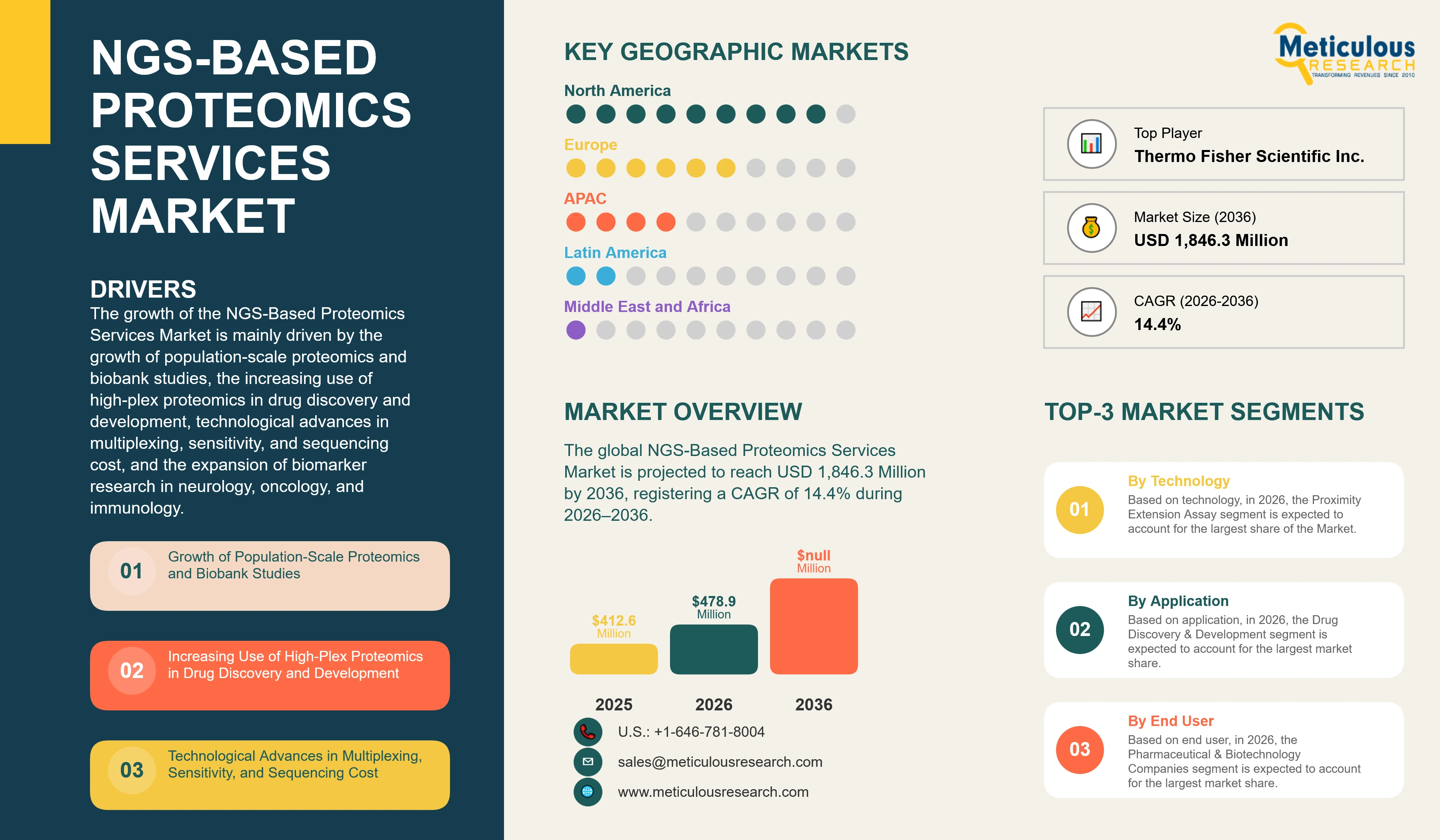
The global NGS-Based Proteomics Services Market was valued at USD 412.6 million in 2025. This market is expected to reach USD 1,846.3 million by 2036 from an estimated USD 478.9 million in 2026, registering a CAGR of 14.4% during the forecast period (2026-2036).
- Published
- Oct 2026
- Pages
- 347
- Format
- PDF + Excel
- Report ID
- MR-2338
- Base year
- 2025
- 2025 · BASELINE
- $412.6M
- 2036
- $1.85B
- CAGR 2026–2036
- 14.4%
2025 baseline · 2026–2036 forecast at 14.4% CAGR · hover a bar for the value
Key highlights
The global NGS-Based Proteomics Services Market is projected to reach USD 1, 846.3 million by 2036, driven by population-scale proteomics, pharmaceutical demand for target discovery and biomarker data, and multiomics integration.
North America is expected to account for the largest market share in 2026, while Asia-Pacific is projected to register the fastest growth during the forecast period. In January 2025, UK Biobank selected the Olink Explore platform of Thermo Fisher Scientific for the UK Biobank Pharma Proteomics Project, a collaboration with 14 biopharmaceutical companies that is measuring more than 5,400 proteins in up to 600,000 samples, with staggered data releases to approved researchers beginning in 2026 and the full dataset expected in 2027.
By technology, the Proximity Extension Assay segment is expected to account for the largest market share in 2026, whereas the NULISA segment is projected to witness the fastest growth through 2036. Alamar Biosciences, which completed its initial public offering in April 2026 with gross proceeds of USD 219.9 million, reported Q2 2026 revenue of USD 29.4 million, up 82% year over year, with services and other revenue up 49% to USD 6.2 million, and guided to FY2026 revenue of USD 116 million to USD 120 million.
Market consolidation is accelerating. In January 2026, Illumina completed the acquisition of SomaLogic from Standard BioTools for USD 350 million in cash at closing, plus up to USD 75 million in near-term milestones and performance-based royalties, combining the SomaScan aptamer-based assay with the Illumina NGS ecosystem, DRAGEN software, and Illumina Connected Multiomics.
By end user, Pharmaceutical & Biotechnology Companies are expected to account for the largest market share in 2026, while Biobanks & Population Health Programs are projected to grow the fastest, supported by large-scale proteomic profiling projects in the U.K. and other countries.
Report summary
| Particulars | Details |
|---|---|
| Forecast Period | 2026-2036 |
| Base Year | 2025 |
| Estimated Year | 2026 |
| CAGR (Value) | 14.4% |
| Format | PDF, Excel & Cloud Portal · 347 pages |
| Market Size (Value) in 2026 | USD 478.9 Million |
| Market Size (Value) in 2036 | USD 1,846.3 Million |
| Segments Covered | By Technology: Proximity Extension Assay (PEA), Aptamer-Based Assays, Nucleic Acid-Linked Immuno-Sandwich Assay (NULISA), Antibody-Oligonucleotide Conjugate-Based Single-Cell & Spatial Proteogenomics, Other Technologies. By Service Type: Sample Processing & Assay Services, Data Analysis & Bioinformatics Services, Study Design & Consulting Services. By Application: Drug Discovery & Development, Biomarker Discovery & Validation, Population Health & Biobank Studies, Disease Research (Neurology, Oncology, Inflammation & Immunology, Cardiometabolic Diseases, Other Diseases), Clinical Research. By End User: Pharmaceutical & Biotechnology Companies, Academic & Research Institutes, Biobanks & Population Health Programs, Contract Research Organizations, Hospitals & Clinical Research Centers. |
| Countries Covered | North America: U.S., Canada. Europe: U.K., Germany, France, Sweden, Switzerland, Netherlands, Rest of Europe. Asia-Pacific: China, Japan, South Korea, Singapore, Australia, India, Rest of Asia-Pacific. Latin America: Brazil, Mexico, Rest of Latin America. Middle East & Africa: Saudi Arabia, UAE, Qatar, Rest of Middle East & Africa. |
| Key Companies | Thermo Fisher Scientific Inc., Illumina, Inc., Alamar Biosciences, Inc., Novogene Co., Ltd., and Azenta, Inc. |
Report overview
Segments covered: technology, service type, application, end user.
The growth of this market is mainly driven by the ability of next-generation sequencing (NGS) readouts to measure thousands of proteins in large numbers of samples at low sample volumes, the rapid growth of population-scale proteomics studies and biobank programs, the increasing use of high-plex proteomics in drug discovery and clinical development, and the integration of proteomic and genomic data in multiomics research. In addition, the expansion of biomarker research in neurology, oncology, inflammation, and cardiometabolic disease, together with the consolidation of the market around large life science tools companies with global service networks, is further supporting the growth of this market.
The NGS-Based Proteomics Services Market, also referred to as the sequencing-based proteomics services market, NGS-readout proteomics services market, or high-plex affinity proteomics services market, comprises the contract assay, data generation, and bioinformatics services that use next-generation sequencing to read out protein measurements. In these technologies, affinity reagents such as antibody pairs, aptamers, or oligonucleotide-conjugated antibodies bind target proteins, and the binding events are converted into DNA barcodes that are quantified by sequencing. The market includes services based on proximity extension assays, aptamer-based assays with an NGS readout, nucleic acid-linked immuno-sandwich assays (NULISA), and antibody-oligonucleotide conjugate methods used for single-cell and spatial proteogenomics. Services include study design, sample processing and assay services, sequencing, quality control, and data analysis and bioinformatics, delivered by platform providers, genomics and contract research service providers, and academic core facilities. Purchases of instruments and kits for in-house use are excluded.
The market is experiencing strong growth as researchers seek to measure the proteome at a scale comparable to genomics. Proteins are the direct targets of most drugs and the most immediate indicators of disease activity, but traditional immunoassays measure only a few proteins at a time, and mass spectrometry can be difficult to scale to tens of thousands of plasma samples. NGS-based proteomics overcomes these limitations by combining highly multiplexed affinity reagents with the throughput and falling cost of sequencing, enabling thousands of proteins to be measured in microliters of plasma across very large sample cohorts. This capability is making high-plex proteomics a routine component of population health studies, drug development programs, and translational research.
Population-scale studies are an important source of demand. In January 2025, UK Biobank selected the Olink Explore platform of Thermo Fisher Scientific for the UK Biobank Pharma Proteomics Project, a collaboration with 14 biopharmaceutical companies that is measuring more than 5,400 proteins in up to 600,000 samples, with staggered data releases to approved researchers beginning in 2026 and the full dataset expected in 2027. A 2023 pilot on the same platform analyzed more than 54,000 UK Biobank samples, and its findings, published in Nature, have been cited more than 400 times, demonstrating the value of combining proteomic and genetic data to identify drug targets and disease mechanisms. Illumina Protein Prep, built on SOMAmer reagents with an NGS readout, measures up to 9,500 unique human protein targets in a single experiment, and has been used by Genomics England to profile more than 7,800 rare disease participants, while UK Biobank, GSK, Johnson & Johnson, Novartis, and Standard BioTools are analyzing about 50,000 additional samples. Projects of this scale generate large volumes of contract assay and data analysis work for service providers and create reference datasets that encourage further proteomic studies.
The competitive landscape has consolidated rapidly around large life science tools companies. Thermo Fisher Scientific acquired Olink in July 2024, adding proximity extension assay technology and the Olink analysis service to its portfolio. In January 2026, Illumina completed the acquisition of SomaLogic from Standard BioTools for USD 350 million in cash at closing, plus up to USD 75 million in near-term milestones and performance-based royalties, combining the SomaScan aptamer-based assay with the Illumina NGS ecosystem, DRAGEN software, and Illumina Connected Multiomics. Meanwhile, Alamar Biosciences is expanding quickly with its NULISA technology, which uses an NGS readout in its NULISAseq panels. Alamar Biosciences, which completed its initial public offering in April 2026 with gross proceeds of USD 219.9 million, reported Q2 2026 revenue of USD 29.4 million, up 82% year over year, with services and other revenue up 49% to USD 6.2 million, and guided to FY2026 revenue of USD 116 million to USD 120 million. In Q2 2026, Alamar launched the NULISAseq Immune 340 Panel and a multiplexed blood-based immunoassay for eMTBR-tau in its NULISAseq Neuro 220 Panel, and NULISA data were featured in more than 140 presentations at the Alzheimer Association International Conference (AAIC) 2026.
Genomics and contract research service providers are also expanding their NGS-based proteomics offerings. Novogene offers Olink Explore HT services across its global laboratories, and Azenta Life Sciences offers Olink and Alamar NULISA proteomics services through GENEWIZ. Academic core facilities, such as the National Genomics Infrastructure in Sweden, provide proteomics services with an NGS readout to research groups. These providers allow pharmaceutical companies, academic institutions, and biobanks to access high-plex proteomics without investing in specialized equipment and expertise.
Demand for these services spans a wide range of applications. Pharmaceutical and biotechnology companies use high-plex proteomics to identify and validate drug targets, understand mechanisms of action, and measure pharmacodynamic responses and safety signals in clinical trial samples. Biobanks and population health programs add proteomic data to genomic and health record data to study disease risk and progression, while academic researchers use these services to discover biomarkers in neurology, oncology, inflammation and immunology, and cardiometabolic disease. Because NGS-based proteomics requires only small volumes of plasma or serum, it is particularly well suited to stored biobank and clinical trial samples, allowing researchers to generate new data from existing sample collections.
At the same time, the market faces important structural changes. The introduction of kits designed for laboratories with existing sequencers, such as Olink Reveal and Illumina Protein Prep, allows some customers to bring proteomics in-house, while the integration of proteomic data with genomics through software such as DRAGEN and Illumina Connected Multiomics is expanding the role of data analysis services. As a result, service providers that can deliver large-scale studies, high data quality, and advanced bioinformatics are expected to capture the largest share of growth over the forecast period.
Report infographic
Market dynamics
15 factors across 5 forcesGrowth of Population-Scale Proteomics and Biobank Studies
The growth of population-scale proteomics and biobank studies is a major factor driving the NGS-Based Proteomics Services Market, as large cohorts combining proteomic, genetic, and health record data are becoming central to drug target discovery and disease research. In January 2025, UK Biobank selected the Olink Explore platform of Thermo Fisher Scientific for the UK Biobank Pharma Proteomics Project, a collaboration with 14 biopharmaceutical companies that is measuring more than 5,400 proteins in up to 600,000 samples, with staggered data releases to approved researchers beginning in 2026 and the full dataset expected in 2027. Genomics England has also profiled more than 7,800 rare disease participants with Illumina Protein Prep, and UK Biobank, GSK, Johnson & Johnson, Novartis, and Standard BioTools are analyzing about 50,000 additional samples on the same platform.
These projects require the processing of hundreds of thousands of samples under consistent conditions, which favors centralized, high-throughput service laboratories. As other biobanks and national health programs follow the UK Biobank model, demand for large-scale NGS-based proteomics services is expected to grow steadily over the forecast period.
Increasing Use of High-Plex Proteomics in Drug Discovery and Development
The increasing use of high-plex proteomics in drug discovery and development is significantly accelerating market growth, as pharmaceutical and biotechnology companies use proteomic data to identify targets, understand mechanisms of action, stratify patients, and measure pharmacodynamic responses in clinical trials. The participation of 14 biopharmaceutical companies in the UK Biobank Pharma Proteomics Project, and of GSK, Johnson & Johnson, and Novartis in proteomic studies with Illumina Protein Prep, reflects the strategic importance of proteomics to the industry.
Pharmaceutical companies typically outsource these studies to service providers to access high-plex platforms, validated workflows, and large sample capacity without capital investment. As drug developers apply proteomics across more programs and clinical trials, demand for sample processing and data analysis services is expected to increase.
Technological Advances in Multiplexing, Sensitivity, and Sequencing Cost
Technological advances in affinity reagents and sequencing are expanding the capabilities of NGS-based proteomics. The Olink Explore platform measures more than 5,400 proteins, Illumina Protein Prep measures up to 9,500 unique human protein targets in a single experiment, and the NULISA technology of Alamar Biosciences is designed to detect low-abundance proteins with high sensitivity, enabling blood-based measurement of biomarkers such as eMTBR-tau in neurodegenerative disease. At the same time, the declining cost and rising throughput of sequencing are reducing the cost per sample of proteomic studies, making large studies more affordable and supporting demand for services.
Expansion of Biomarker Research in Neurology, Oncology, and Immunology
The expansion of biomarker research in neurology, oncology, inflammation and immunology, and cardiometabolic disease is creating strong demand for NGS-based proteomics services. In neurology, Alamar Biosciences expanded its partnership with the AD Data Initiative and Gates Ventures to create a combined dataset of more than 140,000 samples, and NULISA data were featured in more than 140 presentations at AAIC 2026. In immunology, the launch of the NULISAseq Immune 340 Panel in Q2 2026 supports translational research and drug development. As researchers seek blood-based biomarkers for early diagnosis, disease monitoring, and treatment selection, demand for high-plex proteomics services is expected to grow across therapeutic areas.
Table of contents
12 chapters · 140 sections · 347 pages · click to expandSegmental analysis
| Segment | Largest share (2026) | Fastest growth (2026–2036) |
|---|---|---|
| By Technology | Proximity Extension Assay | NULISA |
| By Service Type | Sample Processing & Assay Services | Data Analysis & Bioinformatics Services |
| By Application | Drug Discovery & Development | Population Health & Biobank Studies |
| By End User | Pharmaceutical & Biotechnology Companies | Biobanks & Population Health Programs |
By Technology
- NGS-Based Proteomics Services Market Analysis by Technology
- The Proximity Extension Assay segment is expected to account for the largest share of the global NGS-Based Proteomics Services Market.
- The large share of this segment is mainly due to the wide adoption of the Olink platform among pharmaceutical companies, academic institutions, and service providers, its selection for the UK Biobank Pharma Proteomics Project covering more than 5,400 proteins in up to 600,000 samples, and its availability through service providers such as Novogene and Azenta Life Sciences.
- However, the NULISA segment is projected to register the highest CAGR during the forecast period.
- The rapid growth of this segment is attributed to the high sensitivity of NULISA for low-abundance proteins, its strong adoption in neurodegenerative disease research, and the rapid growth of Alamar Biosciences, which reported 82% revenue growth in Q2 2026.
- The Aptamer-Based Assays segment is expected to record strong growth, supported by the acquisition of SomaLogic by Illumina and the broader availability of Illumina Protein Prep, which measures up to 9,500 protein targets with an NGS readout.
By Service Type
- NGS-Based Proteomics Services Market Analysis by Service Type
- The Sample Processing & Assay Services segment is expected to account for the largest market share, as this service represents the core of every NGS-based proteomics study, covering sample preparation, affinity assay, library preparation, sequencing, and quality control.
- However, the Data Analysis & Bioinformatics Services segment is projected to register the highest CAGR during the forecast period, driven by the growing size and complexity of proteomic datasets, the integration of proteomic and genomic data, and the shift of some sample processing work to in-house laboratories using distributed kits.
By Application
- NGS-Based Proteomics Services Market Analysis by Application
- Disease research is further segmented into Neurology, Oncology, Inflammation & Immunology, Cardiometabolic Diseases, and Other Diseases.
- The Drug Discovery & Development segment is expected to account for the largest market share, due to the extensive use of high-plex proteomics by pharmaceutical companies for target identification, mechanism of action studies, and clinical trial biomarker analysis, as reflected in the participation of 14 biopharmaceutical companies in the UK Biobank Pharma Proteomics Project.
- However, the Population Health & Biobank Studies segment is projected to register the highest CAGR during the forecast period, owing to the scale of projects such as the UK Biobank study of up to 600,000 samples and the growing number of national biobanks adding proteomic data to genomic resources.
- Within disease research, the Neurology segment is expected to record the fastest growth, supported by the development of blood-based biomarkers for neurodegenerative disease, while the Oncology and Inflammation & Immunology segments are expected to account for significant shares.
By End User
- NGS-Based Proteomics Services Market Analysis by End User
- The Pharmaceutical & Biotechnology Companies segment is expected to account for the largest market share, as drug developers outsource large proteomic studies to access high-plex platforms, capacity, and expertise without capital investment.
- However, the Biobanks & Population Health Programs segment is projected to register the highest CAGR during the forecast period, driven by population-scale proteomic studies and the expansion of national genomic medicine programs.
Geographic analysis
North America
Largest shareIn 2026, North America is expected to account for the largest share of the global NGS-Based Proteomics Services Market. The large share of this region is mainly attributed to the concentration of pharmaceutical and biotechnology companies, high research and development spending, strong academic and translational research institutions, and the presence of leading providers, including Thermo Fisher Scientific, Illumina, and Alamar Biosciences. The U.S. accounted for USD 19.7 million of the USD 29.4 million revenue reported by Alamar Biosciences in Q2 2026, reflecting the importance of the U.S. market. In addition, large research programs in neurodegenerative disease, oncology, and immunology, supported by public and philanthropic funding, are driving demand for high-plex proteomics services across the region. Canada is also expected to contribute to regional growth, supported by academic research centers and biotechnology clusters.
Europe
Europe is expected to account for a significant share of the market, supported by population-scale proteomics projects, strong academic research, and the presence of major pharmaceutical companies. The U.K. is expected to account for the largest share within the region, as the UK Biobank Pharma Proteomics Project is measuring more than 5,400 proteins in up to 600,000 samples and Genomics England has profiled more than 7,800 rare disease participants with Illumina Protein Prep. Sweden, the original home of Olink, has a strong proteomics research base, with the National Genomics Infrastructure offering proteomics with an NGS readout to researchers. Germany, France, Switzerland, and the Netherlands are also expected to contribute significantly, supported by pharmaceutical research and development and academic research institutions.
Asia-Pacific
Fastest growthAsia-Pacific is projected to register the highest CAGR during the forecast period. The growth of this region is driven by expanding pharmaceutical research and development, national biobank and genomic medicine programs, and the presence of large genomics service providers. Novogene offers Olink Explore HT services across its laboratories, supporting multiomics research in the region. China is expected to account for the largest share within Asia-Pacific, supported by large research populations and investment in precision medicine, while Japan, South Korea, Singapore, and Australia are expected to see strong growth in proteomics research and drug discovery. India is also expected to emerge as a growing market, supported by expanding biotechnology research and contract research services.
Latin America
Latin America and the Middle East & Africa are expected to account for smaller shares of the market.
Middle East & Africa
In the Middle East, national genomic medicine programs in Saudi Arabia, the UAE, and Qatar are expected to create demand for proteomic profiling, while in Latin America, demand is supported by academic research and growing clinical research activity in Brazil and Mexico.
Competitive landscape
The global NGS-Based Proteomics Services Market is moderately consolidated, with a small number of platform providers that also operate their own service laboratories, alongside genomics and contract research service providers and academic core facilities that offer services using these platforms. Market participants compete primarily on the number of proteins measured, sensitivity, data quality and reproducibility, sample throughput, turnaround time, cost per sample, bioinformatics and multiomics capabilities, and global laboratory coverage.
Leading companies are investing in larger and more sensitive panels, high-throughput service laboratories, distributed kits, bioinformatics and multiomics software, and partnerships with biobanks and pharmaceutical companies. Recent examples include the acquisition of Olink by Thermo Fisher Scientific in July 2024, the selection of the Olink platform for the UK Biobank Pharma Proteomics Project in January 2025, the completion of the SomaLogic acquisition by Illumina in January 2026, the initial public offering of Alamar Biosciences in April 2026, and the launch of the NULISAseq Immune 340 Panel in Q2 2026.
The report provides a comprehensive competitive assessment of the leading companies operating in the global NGS-Based Proteomics Services Market. The key players profiled in the report include Thermo Fisher Scientific Inc. (U.S.), Illumina, Inc. (U.S.), Alamar Biosciences, Inc. (U.S.), Novogene Co., Ltd. (China), and Azenta, Inc. (U.S.).
- Thermo Fisher Scientific Inc.
- Illumina, Inc.
- Alamar Biosciences, Inc.
- Novogene Co., Ltd.
- Azenta, Inc
Expert perspectives
The NGS-Based Proteomics Services Market is entering a period in which scale, rather than technology access, is becoming the main source of competitive advantage. With the two leading high-plex affinity proteomics technologies now owned by Thermo Fisher Scientific and Illumina, a population-scale study of up to 600,000 samples underway in the U.K., and Alamar Biosciences growing revenue 82% in Q2 2026, NGS-based proteomics is moving from specialized research to a standard component of drug discovery and population health. The binding constraint is shifting from the availability of high-plex assays to the ability of providers to process very large studies with consistent quality and to turn proteomic data into biological and clinical insight.
Three structural changes are expected to shape competitive positions through 2036. First, population-scale and pharmaceutical studies are expected to concentrate demand among providers with high-throughput laboratories and global reach. Second, distributed kits such as Olink Reveal and Illumina Protein Prep are expected to shift routine sample processing toward in-house laboratories, increasing the importance of data analysis and multiomics services. Third, the growth of high-sensitivity technologies such as NULISA is expanding applications in neurology and low-abundance biomarkers.
For companies planning entry or expansion, the most defensible positions over the forecast period are likely to be found in integrated proteogenomic data analysis, clinical trial proteomics with validated quality systems, neurology and immunology biomarker services, and partnerships with biobanks in Asia-Pacific and the Middle East. For established providers, the principal risks are the shift toward in-house proteomics, competition from mass spectrometry, and limited comparability across platforms.
Overall, the market is expected to grow strongly, with proximity extension assays and pharmaceutical customers providing the core of demand and NULISA, population health programs, data analysis services, and Asia-Pacific providing the fastest growth.
Customer perspectives
Insights gathered during primary interviews with translational scientists, biobank managers, and proteomics core directors operating in this market highlight where procurement priorities are shifting. The following perspectives reflect recurring themes raised across these discussions.
“This reflects the role of outsourcing in pharmaceutical proteomics.”
“This indicates that scale and consistency are critical for biobank studies.”
“This points to the growing value of bioinformatics and multiomics services.”
Frequently asked questions
The global NGS-Based Proteomics Services Market is estimated at USD 478.9 million in 2026.
Cite this report
Meticulous Research. (2026). NGS-Based Proteomics Services Market (Report No. MR-2338). Meticulous Market Research Pvt. Ltd. https://www.meticulousresearch.com/product/ngs-based-proteomics-services-market-7021