Metabolomics Market (2026-2036)
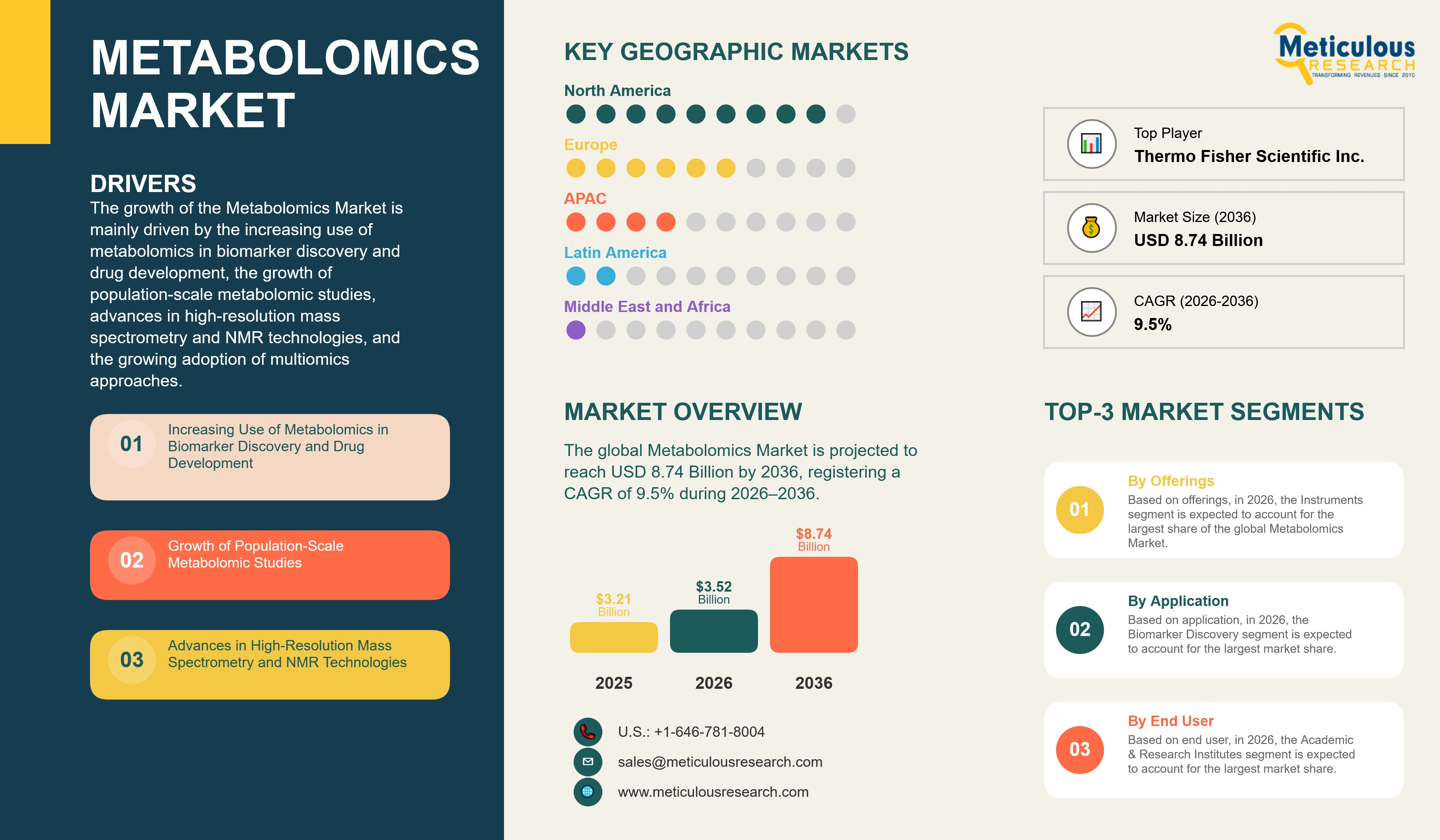
The global Metabolomics Market was valued at USD 3.21 billion in 2025. This market is expected to reach USD 8.74 billion by 2036 from an estimated USD 3.52 billion in 2026, registering a CAGR of 9.5% during the forecast period (2026-2036).
- Published
- Oct 2026
- Pages
- 289
- Format
- PDF + Excel
- Report ID
- MR-2339
- Base year
- 2025
- 2025 · BASELINE
- $3.21B
- 2036
- $8.74B
- CAGR 2026–2036
- 9.5%
2025 baseline · 2026–2036 forecast at 9.5% CAGR · hover a bar for the value
Key highlights
The global Metabolomics Market is projected to reach USD 8.74 billion by 2036, driven by biomarker discovery, drug development, population-scale studies, multiomics research, and clinical translation.
North America is expected to account for the largest market share in 2026, while Asia-Pacific is projected to register the fastest growth during the forecast period, supported by population health programs such as the PRECISE-SG100K study in Singapore and expanding research investment in China, Japan, and South Korea.
By offering, Instruments are expected to account for the largest market share in 2026, whereas Software & Bioinformatics are projected to witness the fastest growth through 2036. At the American Society for Mass Spectrometry (ASMS) conference in June 2026, Thermo Fisher Scientific introduced the Orbitrap Tribrid Apex and Orbitrap Excedion mass spectrometers, Waters launched the Xevo MRT P10 and Cyclic IMS P20 systems for large-scale multiomics and isomer separation, Bruker introduced the timsMRMS system combining trapped ion mobility with FT-ICR mass spectrometry, SCIEX expanded its ZenoTOF 8600 platform, and Shimadzu introduced the LCMS-8065XE triple quadrupole system with AI-enabled workflows.
Population-scale metabolomics is moving into clinical use. In November 2025, Nightingale Health completed the release of nuclear magnetic resonance (NMR)-based metabolic profiles for all 500,000 UK Biobank participants to researchers worldwide, creating one of the largest metabolomic datasets linked to genetic and health data. Nightingale Health has expanded its agreement with Terveystalo to bring its blood analysis to all Terveystalo customers in Finland, with more than 200,000 people having received results through occupational health checks, and in February 2026 received a clinical laboratory permit from the New York State Department of Health.
Leading instrument companies are expanding into metabolomics kits, software, and services. In June 2025, Bruker acquired biocrates life sciences, an Innsbruck-based provider of mass spectrometry-based quantitative metabolomics kits, assays, software, and services, whose kits cover more than 1,000 metabolites from over 40 metabolite classes, further expanding its multiomics strategy after the acquisitions of PreOmics and Biognosys.
Report summary
| Particulars | Details |
|---|---|
| Forecast Period | 2026-2036 |
| Base Year | 2025 |
| Estimated Year | 2026 |
| CAGR (Value) | 9.5% |
| Format | PDF, Excel & Cloud Portal · 289 pages |
| Market Size (Value) in 2026 | USD 3.52 Billion |
| Market Size (Value) in 2036 | USD 8.74 Billion |
| Segments Covered | By Offering: Instruments (Mass Spectrometry Systems [LC-MS, GC-MS, CE-MS, Mass Spectrometry Imaging], NMR Spectroscopy Systems, Chromatography Systems, Other Instruments), Consumables & Kits (Targeted Metabolomics Kits, Standards & Reagents, Columns & Other Consumables), Software & Bioinformatics, Services. By Approach: Untargeted Metabolomics, Targeted Metabolomics. By Application: Biomarker Discovery, Drug Discovery & Development, Clinical Diagnostics & Precision Medicine, Toxicology & Environmental Testing, Nutrition & Food Testing, Agriculture & Plant Research, Other Applications. By Indication: Oncology, Cardiovascular & Metabolic Disorders, Neurological Disorders, Inborn Errors of Metabolism, Other Indications. By End User: Academic & Research Institutes, Pharmaceutical & Biotechnology Companies, Contract Research Organizations & Service Providers, Hospitals & Diagnostic Laboratories, Food, Nutrition & Agriculture Companies. |
| Countries Covered | North America: U.S., Canada. Europe: Germany, U.K., France, Italy, Spain, Netherlands, Austria, Finland, Denmark, Rest of Europe. Asia-Pacific: China, Japan, South Korea, India, Australia, Singapore, Rest of Asia-Pacific. Latin America: Brazil, Mexico, Rest of Latin America. Middle East & Africa: Saudi Arabia, UAE, Qatar, Rest of Middle East & Africa. |
| Key Companies | Thermo Fisher Scientific Inc., Agilent Technologies, Inc., Waters Corporation, Bruker Corporation, Danaher Corporation (SCIEX), Shimadzu Corporation, JEOL Ltd., LECO Corporation, Metabolon, Inc., Nightingale Health Plc, and Human Metabolome Technologies, Inc. |
Report overview
Segments covered: offering, approach, application, indication, end user.
The growth of this market is mainly driven by the increasing use of metabolomics in biomarker discovery and drug development, the growth of population-scale metabolomic studies linked to genomic and health data, continuous advances in high-resolution mass spectrometry and NMR technologies, and the growing adoption of multiomics approaches in life science research. In addition, the translation of metabolomics into clinical diagnostics and preventive healthcare, the availability of standardized quantitative kits, and the use of artificial intelligence (AI) for metabolite identification and data interpretation are further supporting the growth of this market.
The Metabolomics Market, also referred to as the metabolite profiling market, metabolic phenotyping market, or metabolomics and lipidomics market, comprises the instruments, consumables and kits, software, and services used to identify and quantify small molecules, known as metabolites, in biological samples such as blood, urine, tissue, cells, and microbial and plant samples. The market includes analytical instruments such as liquid chromatography-mass spectrometry (LC-MS), gas chromatography-mass spectrometry (GC-MS), capillary electrophoresis-mass spectrometry (CE-MS), mass spectrometry imaging, and NMR spectroscopy systems; consumables such as targeted metabolomics kits, standards, reagents, and columns; software for data processing, metabolite identification, and pathway analysis; and contract metabolomics and lipidomics services. Because metabolites are the downstream products of gene expression, protein activity, diet, the microbiome, drugs, and the environment, metabolomics provides a direct functional readout of the biological state of an organism. The market ecosystem extends from instrument and reagent manufacturers to software developers, service providers, academic and government research institutions, pharmaceutical and biotechnology companies, clinical laboratories, and food, nutrition, and agriculture companies.
The market is experiencing steady growth as metabolomics becomes an essential tool in life science research, drug development, and precision medicine. Metabolic changes are closely associated with diseases such as cancer, cardiovascular and metabolic disorders, neurodegenerative diseases, and inborn errors of metabolism, and metabolite measurements are increasingly used to identify disease mechanisms, discover biomarkers, monitor drug response, and assess toxicity. At the same time, metabolomics is a core component of multiomics research, in which metabolite data are combined with genomic, transcriptomic, and proteomic data to understand how genetic variation and environmental exposures affect health.
Technological advances are expanding the capabilities of metabolomics. Modern high-resolution mass spectrometers offer higher sensitivity, faster acquisition, and better mass accuracy, while ion mobility separation helps distinguish isomeric metabolites and lipids that are difficult to resolve by mass alone. At the American Society for Mass Spectrometry (ASMS) conference in June 2026, Thermo Fisher Scientific introduced the Orbitrap Tribrid Apex and Orbitrap Excedion mass spectrometers, Waters launched the Xevo MRT P10 and Cyclic IMS P20 systems for large-scale multiomics and isomer separation, Bruker introduced the timsMRMS system combining trapped ion mobility with FT-ICR mass spectrometry, SCIEX expanded its ZenoTOF 8600 platform, and Shimadzu introduced the LCMS-8065XE triple quadrupole system with AI-enabled workflows. These advances are enabling the measurement of more metabolites in smaller samples and larger studies, supporting demand for new instruments and upgrades across research and clinical laboratories.
Population-scale studies are creating large metabolomic resources and demonstrating the value of metabolomics for disease risk prediction. In November 2025, Nightingale Health completed the release of nuclear magnetic resonance (NMR)-based metabolic profiles for all 500,000 UK Biobank participants to researchers worldwide, creating one of the largest metabolomic datasets linked to genetic and health data. Thermo Fisher Scientific is also supporting the PRECISE-SG100K population health study in Singapore through a strategic collaboration with Precision Health Research, Singapore. These programs combine metabolomic, proteomic, and genomic data with health records, creating opportunities to identify early markers of disease and new drug targets, and generating demand for high-throughput analysis platforms, standardized assays, and data analysis tools.
Clinical translation is an increasingly important growth area. Tandem mass spectrometry is already used routinely in newborn screening for inborn errors of metabolism, and metabolite-based tests are expanding into cardiovascular risk assessment, metabolic health, and preventive care. Nightingale Health has expanded its agreement with Terveystalo to bring its blood analysis to all Terveystalo customers in Finland, with more than 200,000 people having received results through occupational health checks, and in February 2026 received a clinical laboratory permit from the New York State Department of Health. In February 2026, Waters completed its combination with the Biosciences and Diagnostic Solutions businesses of BD, creating a company with about USD 6.5 billion in pro forma 2025 revenue and a dedicated Advanced Diagnostics division focused on regulated clinical workflows, including LC-MS-based multiplex testing. These developments reflect the growing use of mass spectrometry and NMR-based metabolic testing in regulated clinical environments.
The competitive landscape includes large analytical instrument manufacturers, specialized kit and software providers, and contract service providers. Thermo Fisher Scientific, Agilent Technologies, Waters, Bruker, SCIEX (a Danaher company), and Shimadzu lead the instrument segment, while Bruker, JEOL, and other providers offer NMR systems. Leading companies are expanding into consumables, software, and services to provide complete workflows. In June 2025, Bruker acquired biocrates life sciences, an Innsbruck-based provider of mass spectrometry-based quantitative metabolomics kits, assays, software, and services, whose kits cover more than 1,000 metabolites from over 40 metabolite classes, further expanding its multiomics strategy after the acquisitions of PreOmics and Biognosys. Specialized service providers such as Metabolon, which has completed more than 15,000 projects and supported more than 4,000 publications over more than 25 years, and Human Metabolome Technologies in Japan provide metabolomics services to research and pharmaceutical customers.
At the same time, the market faces challenges related to the chemical diversity of metabolites, the difficulty of identifying unknown compounds, and the lack of standardization across platforms and laboratories. The high cost of advanced instruments and the shortage of skilled personnel also limit adoption in some laboratories. As a result, standardized quantitative kits, AI-enabled software for metabolite identification, and complete workflow solutions are expected to play an increasingly important role in market growth over the forecast period.
Report infographic
Market dynamics
15 factors across 5 forcesIncreasing Use of Metabolomics in Biomarker Discovery and Drug Development
The increasing use of metabolomics in biomarker discovery and drug development is a major factor driving the Metabolomics Market, as metabolite profiles provide a direct readout of disease activity, drug response, and toxicity. Pharmaceutical and biotechnology companies use metabolomics to identify drug targets, understand mechanisms of action, monitor pharmacodynamic responses, assess drug safety, and stratify patients in clinical trials. Metabolon, one of the leading metabolomics service providers, has completed more than 15,000 projects and supported more than 4,000 publications, reflecting the wide use of metabolomics across disease biology, microbiome research, nutrition, and environmental health.
As drug developers increasingly rely on biomarkers to improve the success rates of clinical programs, demand for metabolomic analysis is growing across discovery, preclinical, and clinical stages. These trends are increasing demand for high-resolution mass spectrometry systems, standardized assays, and contract metabolomics services.
Growth of Population-Scale Metabolomic Studies
The growth of population-scale metabolomic studies is significantly accelerating market growth, as large cohorts combining metabolomic, genetic, and health record data are becoming key resources for disease risk prediction and drug discovery. In November 2025, Nightingale Health completed the release of nuclear magnetic resonance (NMR)-based metabolic profiles for all 500,000 UK Biobank participants to researchers worldwide, creating one of the largest metabolomic datasets linked to genetic and health data. In Singapore, Thermo Fisher Scientific is collaborating with Precision Health Research, Singapore, on the PRECISE-SG100K population health study, and Nightingale Health has secured research projects with cohort studies such as the Aalborg University cohort in Denmark and the Moli-sani study in Italy.
These projects require the analysis of very large numbers of samples with consistent quality, which drives demand for high-throughput platforms, standardized methods, and data analysis tools. As more national biobanks and population health programs add metabolomic data, demand for metabolomics instruments, consumables, and services is expected to grow steadily.
Advances in High-Resolution Mass Spectrometry and NMR Technologies
Continuous advances in mass spectrometry and NMR technologies are expanding the depth, speed, and reliability of metabolomic analysis. At the American Society for Mass Spectrometry (ASMS) conference in June 2026, Thermo Fisher Scientific introduced the Orbitrap Tribrid Apex and Orbitrap Excedion mass spectrometers, Waters launched the Xevo MRT P10 and Cyclic IMS P20 systems for large-scale multiomics and isomer separation, Bruker introduced the timsMRMS system combining trapped ion mobility with FT-ICR mass spectrometry, SCIEX expanded its ZenoTOF 8600 platform, and Shimadzu introduced the LCMS-8065XE triple quadrupole system with AI-enabled workflows. These systems offer higher sensitivity, faster scanning, sub-ppm mass accuracy, extended dynamic range, and improved separation of isomeric compounds, enabling more metabolites and lipids to be measured with greater confidence. As laboratories upgrade to these platforms to support larger and more complex studies, demand for metabolomics instruments is expected to remain strong.
Growing Adoption of Multiomics Approaches
The growing adoption of multiomics approaches is supporting the integration of metabolomics into broader life science research. Bruker has built a multiomics portfolio through the acquisitions of PreOmics, Biognosys, and biocrates, and its leadership has described multiomics as the cornerstone for the future of life sciences. Thermo Fisher Scientific positions its new Orbitrap platforms for multiomics, while Waters launched systems designed for large-scale multiomics studies at ASMS 2026. As researchers combine metabolomic data with genomic and proteomic data to understand disease biology, demand for metabolomics platforms, kits, and integrated software is expected to increase.
Table of contents
13 chapters · 163 sections · 289 pages · click to expandSegmental analysis
| Segment | Largest share (2026) | Fastest growth (2026–2036) |
|---|---|---|
| By Offering | Instruments | Software & Bioinformatics |
| By Approach | Untargeted Metabolomics | — |
| By Application | Biomarker Discovery | Clinical Diagnostics & Precision Medicine |
| By Indication | Oncology | Cardiovascular & Metabolic Disorders |
| By End User | Academic & Research Institutes | Hospitals & Diagnostic Laboratories |
By Offering
- Instruments are further segmented into Mass Spectrometry Systems, NMR Spectroscopy Systems, Chromatography Systems, and Other Instruments, with mass spectrometry systems further segmented into LC-MS, GC-MS, CE-MS, and Mass Spectrometry Imaging.
- Consumables & kits are further segmented into Targeted Metabolomics Kits, Standards & Reagents, and Columns & Other Consumables.
- The Instruments segment is expected to account for the largest share of the global Metabolomics Market.
- The large share of this segment is mainly due to the high value of mass spectrometry and NMR systems, the continuous introduction of new high-resolution platforms such as those launched at ASMS 2026, and the ongoing replacement and upgrade of instruments in research, pharmaceutical, and clinical laboratories.
- Within instruments, the Mass Spectrometry Systems segment, led by LC-MS, is expected to account for the largest share.
- However, the Software & Bioinformatics segment is projected to register the highest CAGR during the forecast period.
- The rapid growth of this segment is attributed to the increasing size and complexity of metabolomic datasets, the need for improved metabolite identification, and the growing use of AI-driven analytics and multiomics data integration.
- The Consumables & Kits segment is expected to record strong growth, supported by the recurring use of reagents and columns and the growing adoption of standardized quantitative kits, while the Services segment is expected to grow as pharmaceutical companies and research institutions outsource large studies to specialized providers.
By Approach
- The Untargeted Metabolomics segment is expected to account for the larger market share, due to its wide use in discovery research to profile as many metabolites as possible and identify new biomarkers and pathways.
- However, the Targeted Metabolomics segment is projected to register the higher CAGR during the forecast period, owing to the growing need for accurate quantification in large studies and clinical research, the availability of standardized kits covering more than 1,000 metabolites, and the translation of metabolite panels into clinical and preventive testing.
By Application
- Metabolomics Market Analysis by Application
- The Biomarker Discovery segment is expected to account for the largest market share, due to the extensive use of metabolomics in academic and pharmaceutical research to identify markers of disease, drug response, and toxicity.
- However, the Clinical Diagnostics & Precision Medicine segment is projected to register the highest CAGR during the forecast period, driven by the clinical use of metabolic testing in preventive healthcare, the receipt of a New York State clinical laboratory permit by Nightingale Health, and the expansion of LC-MS-based diagnostic workflows.
By Indication
- Metabolomics Market Analysis by Indication
- The Oncology segment is expected to account for the largest market share, due to the central role of altered metabolism in cancer and the extensive use of metabolomics in cancer research and drug development.
- However, the Cardiovascular & Metabolic Disorders segment is projected to register the highest CAGR during the forecast period, supported by the use of metabolic profiles for disease risk prediction in large population studies and preventive healthcare programs.
By End User
- The Academic & Research Institutes segment is expected to account for the largest market share, as universities, research institutes, and core facilities account for a large share of metabolomics instruments and studies.
- However, the Hospitals & Diagnostic Laboratories segment is projected to register the highest CAGR during the forecast period, driven by the clinical translation of metabolomics, the expansion of mass spectrometry-based diagnostic testing, and the use of metabolic testing in preventive healthcare.
Geographic analysis
North America
Largest shareIn 2026, North America is expected to account for the largest share of the global Metabolomics Market. The large share of this region is mainly attributed to strong research funding, a large number of academic research institutions and core facilities, the concentration of pharmaceutical and biotechnology companies, and the presence of leading instrument manufacturers and service providers, including Thermo Fisher Scientific, Agilent Technologies, Waters, Bruker, and Metabolon. The U.S. is also an important market for clinical mass spectrometry, including newborn screening and specialized testing, and the receipt of a New York State clinical laboratory permit by Nightingale Health in February 2026 reflects the growing interest in metabolic testing in U.S. healthcare. Canada is expected to contribute to regional growth, supported by academic research and metabolomics infrastructure.
Europe
Europe is expected to account for a significant share of the market, supported by strong academic research, population-scale studies, and the presence of leading companies and research centers. The U.K. is an important market due to UK Biobank, for which Nightingale Health released metabolic profiles of all 500,000 participants in November 2025. Germany, home to major Bruker operations, and Austria, where biocrates is based, are important centers for metabolomics technology, while Finland is emerging as a leader in clinical metabolic testing, with more than 200,000 people receiving Nightingale Health results through Terveystalo. France, Italy, Spain, the Netherlands, and Denmark are also expected to contribute, supported by cohort studies such as Moli-sani in Italy and the Aalborg University cohort in Denmark.
Asia-Pacific
Fastest growthAsia-Pacific is projected to register the highest CAGR during the forecast period. The growth of this region is driven by expanding research and development investment, large population health programs, and growing pharmaceutical and biotechnology industries. In Singapore, Thermo Fisher Scientific is collaborating with Precision Health Research, Singapore, on the PRECISE-SG100K population health study. Japan is an important market, with Shimadzu and JEOL among the leading instrument and NMR suppliers, and Human Metabolome Technologies providing metabolomics services, with a medium-term plan targeting sales of 2,000 million yen by the fiscal year ending June 2031. China is expected to account for the largest share within Asia-Pacific, supported by large research investments and a rapidly growing life science sector, while South Korea, India, and Australia are expected to see strong growth.
Latin America
Latin America and the Middle East & Africa are expected to account for smaller shares of the market. In Latin America, demand is supported by academic research and agricultural and food applications in Brazil and Mexico, while in the Middle East, national genomic and precision medicine programs in Saudi Arabia, the UAE, and Qatar are expected to create demand for metabolomic analysis.
Competitive landscape
The global Metabolomics Market is moderately consolidated, with a group of large analytical instrument manufacturers accounting for a significant share of the market, alongside NMR system providers, specialized kit and software developers, and contract metabolomics service providers. Market participants compete primarily on instrument performance, including sensitivity, resolution, speed, and robustness, as well as on workflow completeness, standardized kits and assays, software and AI-enabled data analysis, service capabilities, and global support networks.
Leading companies are investing in new high-resolution mass spectrometry platforms, ion mobility technology, standardized kits, AI-enabled software, and services, and are expanding through acquisitions and partnerships. Recent examples include the acquisition of biocrates by Bruker in June 2025, the completion of the Waters combination with the Biosciences and Diagnostic Solutions businesses of BD in February 2026, the new mass spectrometry platforms introduced at ASMS 2026, the collaboration of Thermo Fisher Scientific with Precision Health Research, Singapore, and the release of UK Biobank metabolomic data by Nightingale Health.
The report provides a comprehensive competitive assessment of the leading companies operating in the global Metabolomics Market. The key players profiled in the report include Thermo Fisher Scientific Inc. (U.S.), Agilent Technologies, Inc. (U.S.), Waters Corporation (U.S.), Bruker Corporation (U.S.), Danaher Corporation (SCIEX) (U.S.), Shimadzu Corporation (Japan), JEOL Ltd. (Japan), LECO Corporation (U.S.), Metabolon, Inc. (U.S.), Nightingale Health Plc (Finland), and Human Metabolome Technologies, Inc. (Japan).
- Thermo Fisher Scientific Inc.
- Agilent Technologies, Inc.
- Waters Corporation
- Bruker Corporation
- Danaher Corporation (SCIEX)
- Shimadzu Corporation
- JEOL Ltd.
- LECO Corporation
- Metabolon, Inc.
- Nightingale Health Plc
- Human Metabolome Technologies, Inc
Expert perspectives
The Metabolomics Market is entering a period in which data scale and standardization, rather than instrument performance alone, are becoming the main sources of value. With metabolic profiles available for all 500,000 UK Biobank participants, population studies underway in Singapore and Europe, and leading instrument companies expanding into kits, software, and diagnostics, metabolomics is moving from specialized discovery research toward routine use in large studies and clinical care. The binding constraint is shifting from the ability to detect metabolites to the ability to identify them confidently, compare results across studies, and translate metabolic signatures into actionable insights.
Three structural changes are expected to shape competitive positions through 2036. First, instrument companies are building complete workflows through acquisitions and integrated kits and software, favoring providers that can offer end-to-end solutions. Second, AI-enabled software and large reference datasets are expected to become key differentiators as untargeted studies generate increasingly complex data. Third, clinical and preventive applications are expanding the market beyond research, requiring regulated workflows and standardized assays.
For companies planning entry or expansion, the most defensible positions over the forecast period are likely to be found in standardized quantitative kits, AI-enabled metabolite identification and interpretation software, clinical metabolic testing, and high-throughput services for population studies and pharmaceutical research. For established providers, the principal risks are research funding constraints, the shortage of skilled personnel, and the slow pace of standardization and clinical validation.
Overall, the market is expected to grow steadily, with mass spectrometry instruments and academic and pharmaceutical research providing the core of demand and software, targeted assays, clinical diagnostics, and Asia-Pacific providing the fastest growth.
Customer perspectives
Insights gathered during primary interviews with metabolomics core directors, pharmaceutical biomarker scientists, and clinical laboratory managers operating in this market highlight where procurement priorities are shifting. The following perspectives reflect recurring themes raised across these discussions.
“This reflects the importance of identification and data analysis in instrument decisions.”
“This indicates the growing role of targeted assays and services in drug development.”
“This points to the importance of clinical-grade workflows for future market growth.”
Frequently asked questions
The global Metabolomics Market is estimated at USD 3.52 billion in 2026.
Cite this report
Meticulous Research. (2026). Metabolomics Market - Global Opportunity Analysis And Industry Forecast (2026-2036) (Report No. MR-2339). Meticulous Market Research Pvt. Ltd. https://www.meticulousresearch.com/product/metabolomics-market-7022