Muriate of Potash (MOP) Market (2026-2036)
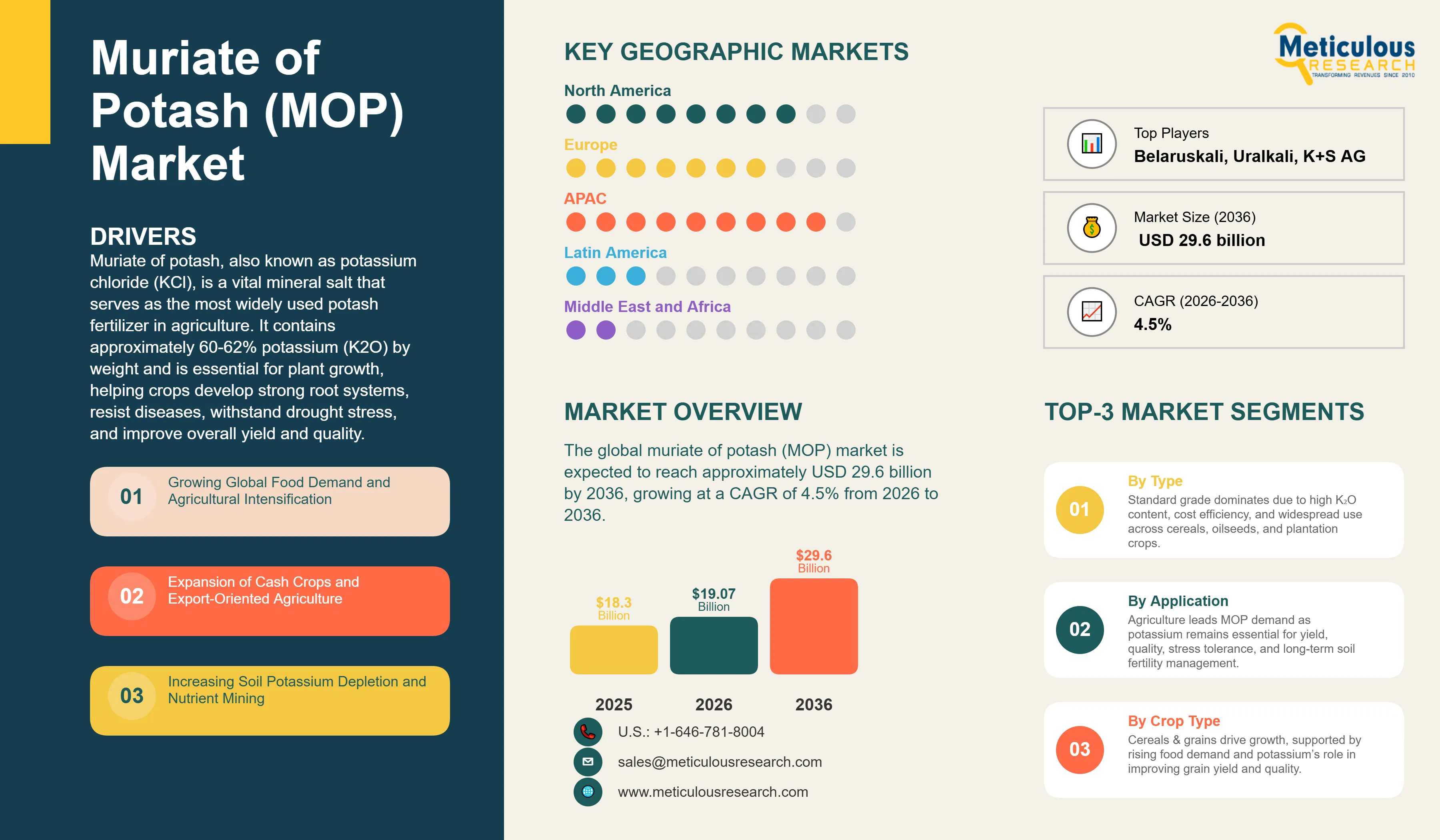
The global muriate of potash (MOP) market is expected to reach approximately USD 29.6 billion by 2036 from USD 19.07 billion in 2026, growing at a CAGR of 4.5% from 2026 to 2036.
- Published
- Jan 2026
- Pages
- 230
- Format
- PDF + Excel
- Report ID
- MR-1643
- Base year
- 2025
- 2026 · ESTIMATED
- $19.07B
- 2036
- $29.60B
- CAGR 2026–2036
- 4.5%
2025 baseline · 2026–2036 forecast at 4.5% CAGR · hover a bar for the value
Key highlights
In 2025, Asia-Pacific accounted for the largest share of the global muriate of potash market, driven by extensive agricultural activities, high crop production volumes, particularly in China and India, and increasing adoption of balanced fertilization practices to address potassium deficiencies in intensively farmed soils.
North America is projected to register a significant CAGR during the forecast period, fueled by advanced precision agriculture practices, increasing cultivation of potassium-responsive crops like corn and soybeans, and strong domestic production capabilities in Canada.
Based on grade, the standard grade segment held the largest share of the market in 2025, driven by its widespread application in agriculture for field crops, horticultural crops, and plantation crops due to its high potassium content and cost-effectiveness.
Based on application, the agriculture segment dominates the market in 2025, as potassium is one of the three essential macronutrients required for optimal crop growth and productivity.
Based on crop type, the cereals & grains segment is expected to witness the highest growth rate during the forecast period, driven by increasing global food demand, expanding cultivation of corn, wheat, and rice, and the critical role of potassium in enhancing grain quality and yield.
Based on application mode, the soil application segment accounted for the largest share of the market in 2025, as broadcast application and incorporation into soil remains the most common method for delivering potassium nutrients to crops in large-scale agricultural operations.
The fertigation segment is expected to grow at a significant CAGR during the forecast period, driven by increasing adoption of drip irrigation systems, precision agriculture practices, and the need for efficient nutrient delivery in water-scarce regions.
The U.S. muriate of potash market is projected to grow at a CAGR of around 3.8% during the forecast period 2026 to 2036, driven by expanding corn and soybean acreage and adoption of soil health management practices.
China is expected to lead the Asia-Pacific muriate of potash market, driven by massive agricultural production, growing food security concerns, and government initiatives to promote balanced fertilization and soil fertility management.
In 2025, Brazil accounted for a significant share of the Latin American muriate of potash market, driven by its extensive cultivation of soybeans, sugarcane, coffee, and other potassium-intensive crops.
Report summary
| Particulars | Details |
|---|---|
| Base Year | 2025 |
| Estimated Year | 2026 |
| Forecast Period | 2026–2036 |
| Market Size (2026) | USD 19.07 billion |
| Market Size (2036) | USD 29.60 billion |
| CAGR (2026–2036) | 4.5% |
| Format | PDF, Excel & Cloud Portal · 230 pages |
| Segments Covered | By Grade: In 2025, typically containing 60–62% K₂O, widespread availability, oilseeds, major cash crops, economies of scale, extensive distribution networks, support muscle function, maintain electrolyte balance · By Application: essential for plant growth, yield formation, including large‑scale production of cereals, oilseeds, cash crops, The industrial segment, while smaller in volume, chemical manufacturing, pharmaceutical production · By Crop Type: quality, stress tolerance. Major cereal crops such as corn, wheat, rice are moderately to highly responsive to potassium fertilization, MOP demand within this segment is expected to increase steadily., color, sugar content, firmness · By Application Mode |
| Key Companies | Nutrien Ltd., Belaruskali, Uralkali, Mosaic Company, K+S AG, ICL Group Ltd., Arab Potash Company, EuroChem Group AG, Intrepid Potash Inc., Laos Potash Industry Corporation, Qinghai Salt Lake Industry Co., Ltd., BHP Group Ltd. |
Report overview
Segments covered: grade, application, crop type, application mode.
Muriate of potash, also known as potassium chloride (KCl), is a vital mineral salt that serves as the most widely used potash fertilizer in agriculture. It contains approximately 60-62% potassium (K2O) by weight and is essential for plant growth, helping crops develop strong root systems, resist diseases, withstand drought stress, and improve overall yield and quality. MOP is produced through conventional underground mining or solution mining from natural potash deposits, primarily located in Canada, Russia, Belarus, and other regions with extensive evaporite formations.
Muriate of potash (MOP) is the primary product of the global potash fertilizer industry, accounting for approximately 90–95% of total potash consumption. As the most economical source of potassium for agriculture, MOP is essential to modern farming, correcting soil potassium deficiencies and supporting the nutritional needs of a wide range of crops. Potassium supplied through MOP is critical for enzyme activation, water regulation, photosynthesis, protein synthesis, and improved crop tolerance to disease and environmental stress.
The MOP market features a concentrated supply base, with Canada, Russia, and Belarus historically providing more than 65% of global production capacity. Recent geopolitical developments, export controls, and supply disruptions have increased price volatility and encouraged importing countries to diversify sourcing. In response, new production capacity is emerging in regions such as Laos, Ethiopia, and Brazil, where potash mining projects are being developed to meet rising demand.
Market dynamics are further shaped by intensified agricultural practices, declining soil potassium levels, and the adoption of precision agriculture and sustainable farming approaches. Demand is also supported by the expansion of high‑value crop cultivation and climate adaptation strategies, as potassium plays a key role in improving crop resilience to drought, heat, and other environmental stresses.
The global agricultural sector is increasingly adopting precision agriculture and site‑specific nutrient management, reshaping the application of muriate of potash. Technologies such as variable‑rate fertilization, soil testing, remote sensing, and data analytics allow farmers to align potassium application more closely with crop requirements and soil conditions, improving nutrient efficiency while lowering environmental impact and input costs.
Rising awareness of soil health and sustainable farming practices is also driving broader adoption of balanced fertilization strategies that incorporate potassium alongside nitrogen and phosphorus. As producers recognize that potassium deficiencies can constrain nutrient uptake and limit yields, maintaining optimal soil potassium levels through regular MOP application is gaining greater priority.
In addition, the expansion of high‑value crop cultivation, including fruits, vegetables, and specialty crops, is generating strong demand for quality‑driven MOP use. These crops respond particularly well to potassium nutrition, which enhances yield quality attributes such as size, color, sugar content, shelf life, and marketability. Growing consumer demand for premium produce and continued urbanization are supporting the expansion of horticultural production, further strengthening MOP consumption in this segment.
Report infographic
Market dynamics
3 factors across 2 forcesRising Global Food Demand and Agricultural Intensification
Global population growth is projected to reach approximately 9.7 billion by 2050. This growth is placing increasing pressure on agricultural systems to produce more food from a finite land base. With limited scope for expanding arable land, productivity gains through agricultural intensification have become essential. Potassium is a critical macronutrient for crop yield and quality, and intensive practices such as high‑yield crop varieties, continuous cropping, and increased harvest frequency are accelerating the depletion of soil potassium reserves. This nutrient removal necessitates consistent application of muriate of potash to maintain soil fertility and sustain long‑term productivity.
Conventional fertilization practices have historically emphasized nitrogen and phosphorus while underappreciating potassium requirements, resulting in widespread potassium deficiencies across cultivated soils. Agronomic studies indicate that inadequate potassium availability can reduce yields by 20–50% even when other nutrients are sufficient. As awareness of balanced fertilization grows and extension services increasingly promote integrated nutrient management, demand for MOP is rising, particularly in developing agricultural economies across Asia, Latin America, and Africa, where yield improvement is central to food security strategies.
Expansion of Cash Crops and Export‑Oriented Agriculture
Global agriculture is increasingly oriented toward high‑value cash crops and export‑driven production systems that offer superior economic returns and contribute materially to national export revenues. Crops such as soybeans, palm oil, sugarcane, coffee, cocoa, fruits, and vegetables are highly responsive to potassium nutrition and require substantial MOP inputs to optimize yields and achieve premium quality parameters. The expansion of these crops in key producing regions, including Brazil, Argentina, Southeast Asia, and West Africa, is a major driver of growth in MOP consumption.
Brazil provides a prominent example, where soybean production has expanded rapidly to position the country as the world’s leading producer, supported by intensive potassium fertilization across successive growing cycles. Similar dynamics are evident in the palm oil industries of Malaysia and Indonesia, coffee cultivation in Central and South America, and the rapid growth of horticultural production for domestic and export markets worldwide. As international agricultural trade continues to expand and developing economies prioritize export competitiveness, the cultivation of potassium‑intensive cash crops is expected to remain a structurally important driver of global MOP demand.
Table of contents
13 chapters · 145 sections · 230 pages · click to expandGeographic analysis
North America
North America represents a mature and significant market, supported by advanced agricultural systems, large‑scale commercial farming, and widespread adoption of precision agriculture technologies. The U.S. and Canada are both major producers and consumers of MOP, with primary applications in corn, soybean, and wheat cultivation across the Corn Belt, Great Plains, and Canadian Prairies. The region benefits from strong domestic production capacity, efficient logistics and distribution infrastructure, and high farmer awareness of long‑term soil fertility management.
Latin America
Latin America is experiencing robust growth in MOP demand, led by the rapid expansion of agricultural production in Brazil and the country’s emergence as a global agricultural powerhouse. Brazil is the world’s largest soybean producer and a major producer of sugarcane, coffee, citrus, and other potassium‑intensive crops, driving strong and sustained fertilizer demand. Limited domestic potash resources have made Brazil heavily reliant on MOP imports, positioning it as a strategic market for global suppliers. Other countries in the region, including Argentina and Chile, are also witnessing rising MOP consumption as agricultural intensification continues.
Competitive landscape
- Nutrien Ltd.
- Belaruskali
- Uralkali
- Mosaic Company
- K+S AG
- ICL Group Ltd.
- Arab Potash Company
- EuroChem Group AG
- Intrepid Potash Inc.
- Laos Potash Industry Corporation
- Qinghai Salt Lake Industry Co., Ltd.
- BHP Group Ltd.
Frequently asked questions
The muriate of potash market is expected to grow from USD 19.07 billion in 2026 to USD 29.6 billion by 2036.
Cite this report
Meticulous Research. (2026). Muriate of Potash (MOP) Market - Global Opportunity Analysis and Industry Forecast (2026-2036) (Report No. MR-1643). Meticulous Market Research Pvt. Ltd. https://www.meticulousresearch.com/product/muriate-of-potash-market-6326