
Mobility As a Service Market (2025-2035)
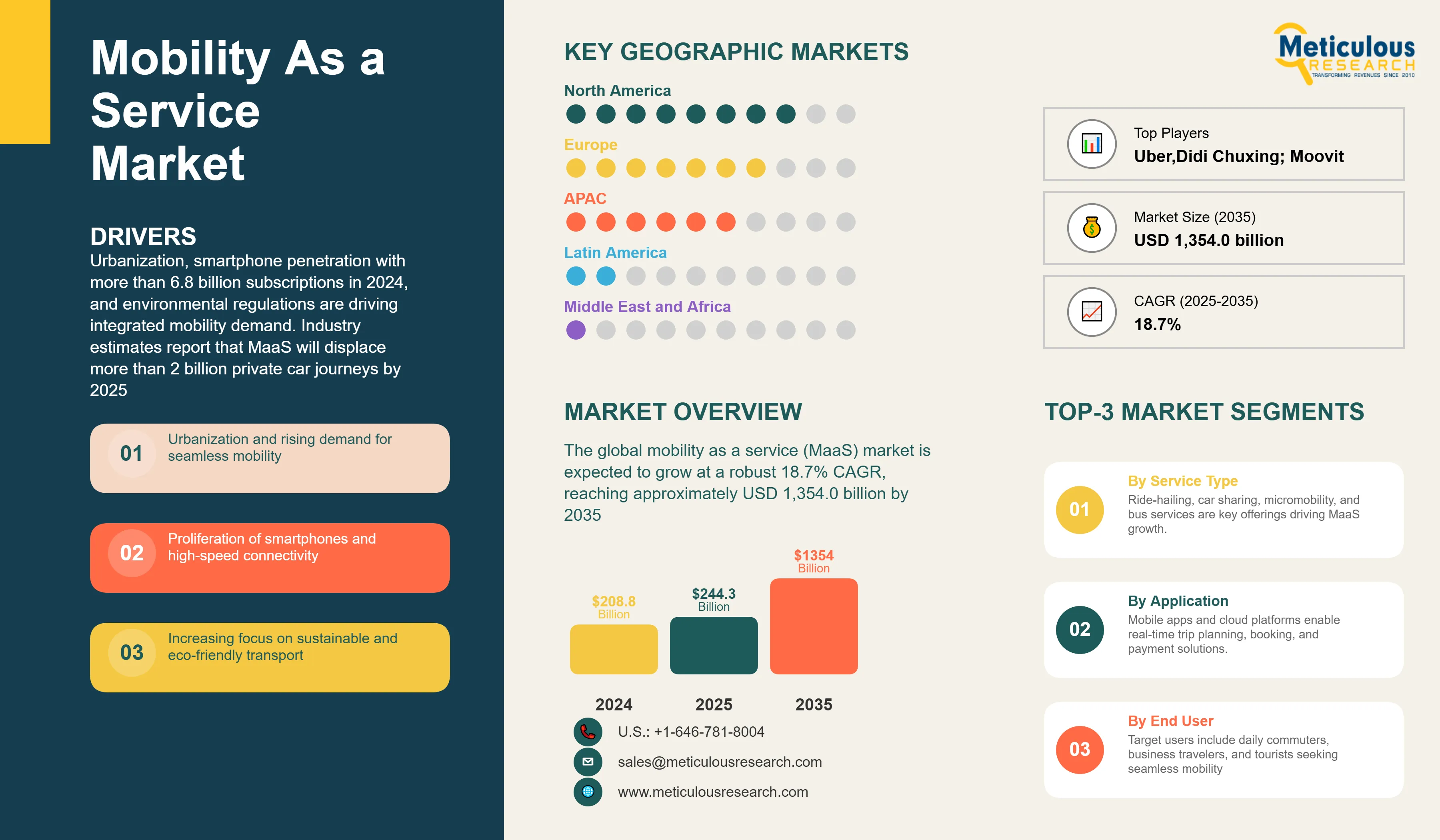
The global mobility as a service (MaaS) market was valued at USD 208.8 billion in 2024. This market is expected to grow at a robust 18.7% CAGR, reaching approximately USD 1,354.0 billion by 2035 from USD 244.3 billion in 2025.
- Published
- Aug 2025
- Pages
- 250
- Format
- PDF + Excel
- Report ID
- MR-1547
- Base year
- 2024
- 2024 · BASELINE
- $208.8B
- 2035
- $1.35T
- CAGR 2025–2035
- 18.7%
2024 baseline · 2025–2035 forecast at 18.7% CAGR · hover a bar for the value
Key highlights
The global mobility as a service (MaaS) market was valued at USD 208.8 billion in 2024.
This market is expected to grow at a robust 18.7% CAGR, reaching approximately USD 1,354.0 billion by 2035 from USD 244.3 billion in 2025.
Journey Planning & Management Solutions is estimated to dominate the mobility as a service (MaaS) market in 2025 with a share of 30%, primarily because they serve as the foundational layer that integrates various transportation modes into a seamless user experience.
North America dominates the global MaaS market, accounting for more than 30% market share in 2025. This market dominance is driven by high urbanization rates and significant infrastructure spending.
Asia-pacific region is expected to experience significant and rapid growth, expanding at 28% CAGR. This growth is driven by China’s super-apps WeChat and Alipay that integrate multiple MaaS options including metro, bus, bike-share, and ride-hail payments, achieving approximately 500 million combined users in 2024.
Germany is expected to lead the European MaaS market. Key drivers include Germany’s comprehensive transit infrastructure, a strong push for digitalization, and progressive urban mobility policies.
Report summary
| Particulars | Details |
|---|---|
| Market size (2025) | USD 244.3 billion |
| Revenue forecast in 2035 | USD 1,354.0 billion |
| CAGR (2025-2035) | 18.7% |
| Format | PDF, Excel & Cloud Portal · 250 pages |
| Base Year | 2024 |
| Forecast period | 2025 – 2035 |
| Report coverage | Market size and forecast, competitive landscape and benchmarking, country/regional level analysis, key trends, growth drivers and restraints |
| Segments covered | Service (Ride-hailing, Car Sharing, Bus Sharing), Solution, Service, Transportation Type (Public Transportation, Private Transportation), Propulsion Type, Operating System, Application, End-User Industry, Geography |
| Regional scope | North America, Europe, Asia-Pacific, Latin America, and Middle East & Africa |
| Key companies profiled | Uber; Lyft; Didi Chuxing; Moovit (Intel); Whim (MaaS Global); Grab; BlaBlaCar; Bird; Lime; Ola Cabs; Via Transportation; Gett; Zipcar; Bolt; Curb Mobility; Free2Move; GoEuro (Omio); Citymapper; EasyMile; Transdev. |
| Customization | Comprehensive report customization with purchase. Addition or modification to country, regional & segment scope available |
| Pricing Details | Access customized purchase options to meet your specific research requirements. Explore flexible pricing models |
Report overview
Segments covered: service, solution, transportation type, propulsion type, operating system, application, end-user industry.
Urbanization, smartphone penetration with more than 6.8 billion subscriptions in 2024, and environmental regulations are driving integrated mobility demand. Industry estimates report that MaaS will displace more than 2 billion private car journeys by 2025, reducing around 14 million MT of CO₂, on yearly basis. BCG estimates MaaS can reduce urban congestion by up to 20% via optimized multimodal routing. Public–private partnerships, such as the MaaS Alliance, MMfE strategic tie-up in February 2024, are optimizing open data protocols for service interoperability. Additionally, the vehicle subscription model drives the use of mobility solutions by offering dynamic and extensive transportation services.
Report infographic
Key Factors Impacting Global Mobility as a Service Market (2025–2035)
Base CAGR: 18.7%
|
Category |
Key Factor |
Short-Term Impact (2025–2028) |
Long-Term Impact (2029–2035) |
Estimated CAGR Impact |
|
Drivers |
1. Urbanization and seamless mobility |
Increased urban ride usage |
Mature integrated mobility |
▲ +6.0% |
|
2. Sustainability and eco-friendly transport |
Lower emissions per trip |
Widespread green mobility |
▲ +5.0% |
|
|
3. Smartphones and connectivity |
Higher app-based bookings |
Ubiquitous real-time services |
▲ +4.5% |
|
|
Restraints |
1. Data privacy and cybersecurity concerns |
User data sharing hesitation |
Stricter security protocols |
▼ −2.5% |
|
2. Regulatory and compliance barriers |
Delayed service rollouts |
Harmonized regulations |
▼ −2.0% |
|
|
Opportunities |
1. Integration of autonomous and electric mobility solutions |
Pilot AV/e-EV deployments |
Autonomous fleets mainstream |
▲ +5.5% |
|
2. Growing adoption of on-demand mobility across new geographies |
Expanded geographic coverage |
Global MaaS normalization |
▲ +4.8% |
|
|
Trends |
1. Rise of subscription-based and bundled mobility packages |
Initial bundle pilots |
Standardized subscription plans |
▲ +3.7% |
|
Challenges |
1. Infrastructure limitations for multi-modal integration |
Limited network connectivity |
Enhanced multimodal networks |
▼ −1.8% |
Market dynamics
5 factors across 2 forcesUrbanization and seamless mobility
Rapid urban population growth is shifting consumer preferences away from private car ownership toward integrated, shared, and multimodal transport solutions. Dense cities face mounting congestion and parking pressures, prompting commuters to seek unified mobility platforms. In many Asian megacities, government measures such as car registration limits, further channel commuters into exploring MaaS options. In China’s large cities, for instance, unified travel apps (like WeChat mini-programs) integrate metro, bus, bike-share and ride-hailing in one interface, exemplifying how urbanization boosts demand for seamless MaaS solutions.
Sustainability and eco-friendly transport
Growing environmental awareness and climate policies are steering MaaS toward greener mobility. Governments globally are setting strict emission targets, incentivizing electric vehicles (EVs) and shared mobility. This is reflected in MaaS offerings that bundle EV ride-hailing, e-bikes, and other low-emission modes. For instance, one analysis notes that stringent zero-emission mandates in Asia-Pacific are catalyzing the development of electric vehicle-focused MaaS offerings. Similarly, in Europe, Germany’s climate-neutral transport policies include major funding for EV charging and modernized transit, aligning with MaaS expansion. As a result, MaaS platforms increasingly feature electric or hybrid fleets, and cities are designing infrastructure to support integrated green mobility.
Smartphones and connectivity
Near-ubiquitous smartphone ownership and high-speed mobile networks are fundamental enablers of MaaS. Mobile apps let users plan, book and pay for multimodal trips in real time. Additionally, the rollout of 5G/IoT connectivity is also critical, as upgraded networks allow real-time fleet tracking and dynamic routing. Thus, the expanding 5G infrastructure and smart-city projects are expected to enhance MaaS platform performance and coverage.
Table of contents
16 chapters · 163 sections · 250 pages · click to expandSegmental analysis
| Segment | Largest share (2025) | Fastest growth (2025–2035) |
|---|---|---|
| By Service | Journey Planning & Management Solutions | — |
By Service
- Journey Planning & Management Solutions is estimated to dominate the mobility as a service (MaaS) market in 2025 with a share of 30%, primarily because they serve as the foundational layer that integrates various transportation modes into a seamless user experience.
- Unlike standalone services such as ride-hailing or car-sharing, these solutions aggregate multiple options—public transit, micro-mobility, taxis, and more—into a single platform, allowing users to compare routes, costs, and travel times in real time.
- This convenience is a major driver of adoption, as consumers increasingly prefer apps that eliminate the hassle of switching between multiple services or payment methods.
- Cities and governments also favor these solutions because they promote the use of public transit while reducing congestion and emissions, aligning with broader urban sustainability goals.
- Ride-Hailing Dominate Services; Micro-Mobility Shows Strongest Growth
- The ride-hailing services segment is estimated to command the largest share of 35% of the global MaaS market.
- Ride-hailing services are instrumental in meeting the increasing demand for transportation services by offering users a last-mile connectivity option.
- Users have the autonomy to select their preferred vehicle, route, and travel time with ride-hailing services.
- Mobility as a service platform provides users with a comprehensive selection of transportation options by incorporating ride-hailing services, enabling them to select the most appropriate mode for their requirements, all within a single application.
Geographic analysis
North America
Largest shareNorth America dominates the global MaaS market, accounting for more than 30% market share in 2025. This market dominance is driven by high urbanization rates and significant infrastructure spending. The U.S. in particular holds a dominant position, with major metropolitan areas and federal initiatives accelerating growth. Shared mobility is favoured by high vehicle ownership costs and urban densification. Public–private smart-city projects and EV incentives further bolster the transition. For instance, governments fund electric fleet programs and 5G connectivity to improve transit. Moreover, additional programs such as the USDOT’s Mobility on Demand sandbox grants and expansion of 5G rural broadband (e.g. a USD 9.2 billion 5G Fund in 2023) are improving connectivity and first/last-mile transit links. As a result, North American MaaS growth is robust but uneven, with tech hubs piloting advanced services and broader regions scaling more gradually. Super-App Integrations and Smart-City Programs Propel APAC’s Rapid MaaS Expansion
Asia-Pacific
Fastest growthAsia-pacific region is expected to experience significant and rapid growth, expanding at 28% CAGR. This growth is driven by China’s super-apps WeChat and Alipay that integrate multiple MaaS options including metro, bus, bike-share, and ride-hail payments, achieving approximately 500 million combined users in 2024. Morever, government smart-city initiatives in Singapore such as the Smart Nation 2030 and India’s National Urban Digital Mission empowers MaaS solutions. Southeast Asia also sees rapid e-scooter and e-bike integrations, reducing first-mile emissions by 28% in Bangkok’s pilot zones. Also, denser population in the cities drives the use of MaaS platform, assisting people navigate densely populated areas seamlessly. In 2025, the mobility as a service market in the United States is expected to maintain a dominant position. The market is being stimulated by the widespread implementation of real-time multimodal trip planning, the expansion of EV-based micro-transit fleets, and the increased federal support for first/last-mile transit programs. Additionally, there is a stronger collaboration between public agencies and private mobility providers. The user experience and network efficiency have been improved by the integration of scheduling, booking, and payments across buses, subways, bike-sharing, ride-hailing, and micro transit services by centralized platforms. Thus, expansion of EV-based vehicle fleets and public transportation integration is propelling the business growth in the U.S. The Chinese mobility as a service market is expected to witness the fastest growth globally during the forecast period, fuelled by the widespread adoption of smartphones and super-apps, the robust integration of digital payments, national smart transportation initiatives, and the growing demand from tier-2 and tier-3 urban centres. Platforms such as WeChat and Amap facilitate the seamless planning, booking, and payment of multimodal trips for metro, bus, bike-sharing, and ride-hailing services by means of a unified interface. For instance, cities such as Guangzhou, Xiamen, and Zhengzhou have implemented MaaS systems through WeChat mini-programs that is used by over 200 million active users, provides real-time transit data, fare integration, and one-click ticketing. This trend emphasizes China's strategic initiative to establish centralized, app-based transport ecosystems that enhance public mobility and alleviate urban congestion. Federal Grants and Tech-First Cities Cement U.S. MaaS Market Pre-eminence Government Policy & Super-App Ecosystem Accelerate China’s MaaS Dominance Harmonized Regulations and Climate Targets Propel Germany’s MaaS Growth
Europe
Germany is expected to lead the European MaaS market. Key drivers include Germany’s comprehensive transit infrastructure, a strong push for digitalization, and progressive urban mobility policies. High smartphone usage means consumers are receptive to app-based transport. Also, major German cities such as Berlin, Hamburg, Munich are increasingly multimodal, combining buses, trains, e-scooters, bike-sharing and car-sharing under unified payment platforms. The German government’s climate goals also align with MaaS growth, with federal and state policies allocate significant funding for EV infrastructure and modernizing public transit, directly supporting MaaS deployment. Thus, Germany’s strong mobility networks and supportive policy frameworks positions it at the forefront of MaaS innovation.
Competitive landscape
The competitive landscape of the global mobility as a service (MaaS) market is undergoing a dynamic and rapid evolution due to the presence of both established players and emerging startups. Integrated platform solutions that incorporate multiple modes of transportation, such as ride-hailing, public transit, bike-sharing, and micro-mobility, are being provided by key players. Furthermore, by optimizing routes and providing real-time updates, the user experience can be improved by utilizing advanced technologies such as artificial intelligence (AI), the Internet of Things (IoT), and big data analytics.
- February 2024
The MaaS Alliance and Micro-Mobility for Europe (MMfE) are pleased to announce the formation of a strategic partnership aimed at accelerating the development and implementation of sustainable mobility solutions in cities in Europe and beyond. This public–private collaboration established common data and API standards, enabling six European cities to interoperate on multimodal tickets, boosting cross-operator journeys.
- August 2024
Connexxion merged its services with Whim, a mobility-as-a-service (MaaS) platform. This merger enables users to access Connexxion's bus and train services using Whim platform, facilitating payment, booking and real-time insights. This collaboration aims to facilitate public transport for commuters and empower the use of public transportation by providing convenient and enhanced travel experience.
- Uber
- Lyft
- Didi Chuxing
- Moovit · Intel
- Whim (MaaS Global)
- Grab
- BlaBlaCar
- Bird
- Lime
- Ola Cabs
- Via Transportation
- Gett
- Zipcar
- Bolt
- Curb Mobility
- Free2Move
- GoEuro · Omio
- Citymapper
- EasyMile
- Transdev
Frequently asked questions
The mobility as a service market size is estimated to be USD 244.3 billion in 2025 and grow at a CAGR of 18.7% to reach USD 1,354 billion by 2035.
Cite this report
Meticulous Research. (2025). Mobility As a Service Market - Global Opportunity Analysis and Industry Forecast (2025–2035) (Report No. MR-1547). Meticulous Market Research Pvt. Ltd. https://www.meticulousresearch.com/product/mobility-as-a-service-market-6230