Manganese Sulphate Market (2026-2036)
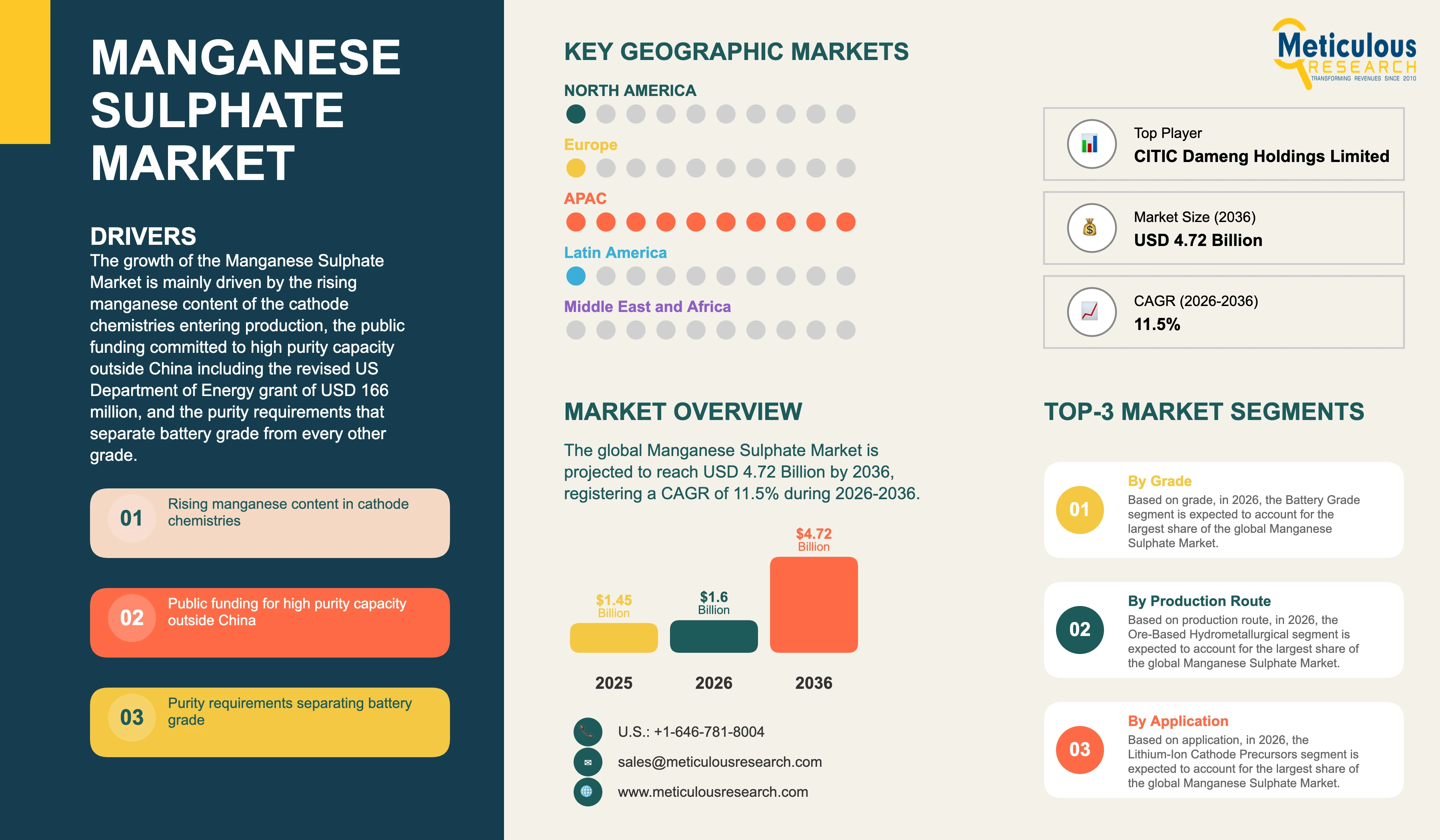
The global manganese sulphate market was valued at USD 1.45 billion in 2025. This market is expected to reach USD 4.72 billion by 2036 from an estimated USD 1.60 billion in 2026, registering a CAGR of 11.5% during the forecast period (2026-2036).
- Published
- Nov 2026
- Pages
- 255
- Format
- PDF + Excel
- Report ID
- MRCHM - 1042676
- Base year
- 2025
- 2025 · BASELINE
- $1.45B
- 2036
- $4.72B
- CAGR 2026–2036
- 11.5%
2025 baseline · 2026–2036 forecast at 11.5% CAGR · hover a bar for the value
Key highlights
The global manganese sulphate market is estimated at USD 1.60 billion in 2026 and is projected to reach USD 4.72 billion by 2036.
Market volume is estimated at 1, 520.00 kilotons in 2026 and is projected to reach 3,871.39 kilotons by 2036 at a CAGR of 9.8%, measured on a monohydrate-equivalent basis.
The average selling price is estimated at USD 1.05 per kg in 2026 and is projected to reach USD 1.22 per kg by 2036 on mix shift toward battery grade.
Battery grade is expected to account for the largest grade share in 2026 and is also projected to register the highest CAGR of 13.6%.
Ore-based hydrometallurgical production is expected to hold the largest production route share in 2026, while recycled and secondary feed is projected to grow fastest at a CAGR of 16.4%.
Lithium-ion cathode precursors are expected to be the largest application in 2026, while sodium-ion cathode materials are projected to register the highest CAGR of 28.0%.
Asia-Pacific is expected to hold the largest regional share in 2026, while North America is projected to register the highest CAGR of 21.6%.
Element 25 Limited reported in its quarterly announcement of 28 July 2026 that it had agreed terms with the US Department of Energy on a revised grant agreement for USD 166 million.
The grant is made under the Battery Materials Processing Grant Program and the terms were referenced to an announcement of 7 July 2026.
The company states that the Louisiana high purity manganese sulphate monohydrate project has support from General Motors LLC and Stellantis N.V.
The Project Execution Plan for the Louisiana project is under review, and the company states it will update the market when that review is complete.
The announcement gives no capacity, no capital cost and no build or commissioning dates for the Louisiana facility.
The product is described only as battery grade high purity manganese sulphate monohydrate, with no purity figure stated.
The Butcherbird project in Western Australia targets manganese concentrate production of 1.1 million tonnes per annum, with commissioning scheduled for the first quarter of 2027.
The Butcherbird Ore Reserve is stated at 101.4 million tonnes at 10.4% manganese, supporting a life of mine of more than 18 years at the planned rate.
The logwasher for Butcherbird, manufactured by KISA in Germany, arrived at Fremantle Port in June 2026.
This market sits upstream of the cathode active material precursors market and is not additive to it or to any cathode active material market.
Report summary
| Particulars | Details |
|---|---|
| Base Year | 2025 |
| Forecast Period | 2026-2036 |
| Market Size in 2025 | USD 1.45 billion |
| Market Size in 2026 | USD 1.60 billion |
| Market Size by 2036 | USD 4.72 billion |
| Value CAGR (2026-2036) | 11.5% |
| Format | PDF, Excel & Cloud Portal · 255 pages |
| Volume in 2026 | 1,520.00 kilotons |
| Volume by 2036 | 3,871.39 kilotons |
| Volume CAGR (2026-2036) | 9.8% |
| Volume Basis | Manganese sulphate supplied on a monohydrate-equivalent basis |
| Average Selling Price in 2026 | USD 1.05 per kg |
| Average Selling Price by 2036 | USD 1.22 per kg |
| Price Direction | Average selling price rises across the forecast period on mix shift toward battery grade, which commands a substantial premium over agricultural and technical grades of the same chemical, rather than on input cost inflation |
| Measurement Basis | Manganese sulphate in battery grade high purity monohydrate, technical and industrial, and feed and fertiliser grades, measured on a monohydrate-equivalent basis, and excluding manganese ore and concentrate, electrolytic manganese metal and flake, ferromanganese and silicomanganese alloys, electrolytic manganese dioxide, manganese carbonate, oxide and chloride, and the cathode precursors and cathode active materials into which the sulphate is converted |
| Relationship to Adjacent Markets | This market sits upstream of the cathode active material precursors market and is not additive to it or to any cathode active material market, because the sulphate is consumed as a feed into precursor co-precipitation and its value is carried forward into the precursor sold |
| Largest Grade | Battery grade |
| Fastest-Growing Grade | Battery grade (CAGR 13.6%) |
| Largest Production Route | Ore-based hydrometallurgical |
| Fastest-Growing Production Route | Recycled and secondary feed (CAGR 16.4%) |
| Largest Application | Lithium-ion cathode precursors |
| Fastest-Growing Application | Sodium-ion cathode materials (CAGR 28.0%) |
| Largest Region | Asia-Pacific |
| Fastest-Growing Region | North America (CAGR 21.6%) |
| Segments Covered | Grade, Production Route, Application, and Geography |
| Geographies Covered | Asia-Pacific, North America, Europe, Latin America, and Middle East & Africa |
| Companies Profiled | 10 companies, including CITIC Dameng Holdings Limited, Eramet SA, Manganese Metal Company (Pty) Ltd, ISKY Chemicals Co., Ltd., Nippon Denko Co., Ltd., and Element 25 Limited |
Report overview
Segments covered: grade, production route, application.
In volume terms, this market is estimated at 1,520.00 kilotons in 2026 and is projected to reach 3,871.39 kilotons by 2036, registering a CAGR of 9.8% during the same period, measured as manganese sulphate supplied on a monohydrate-equivalent basis. The average selling price is estimated at USD 1.05 per kg in 2026 and is projected to rise to USD 1.22 per kg by 2036 as battery grade material, which commands a substantial premium over agricultural and technical grades, takes a larger share of the tonnage supplied.
The growth of this market is mainly driven by the manganese content of the cathode chemistries now entering production, the government funding being committed to high purity capacity outside China including the revised US Department of Energy grant of USD 166 million whose terms Element 25 agreed in July 2026, the purity requirements that separate battery grade from every other grade of the same chemical, and the sodium-ion cathode materials that use manganese without any nickel or cobalt. However, factors such as the concentration of high purity refining capacity in a single country, the repeated deferral of announced capacity outside it, the impurity tolerances that disqualify most existing manganese sulphate production from battery use, and the ore quality that determines whether a deposit can reach battery grade at all are expected to restrain the growth of this market to some extent.
Battery grade material accounts for the largest share of this market and is also expected to grow fastest, at a CAGR of 13.6%, because the manganese content of the cathode chemistries entering production is rising while the purity specification those chemistries impose can be met by only a small part of installed manganese sulphate capacity, so demand growth and qualified supply growth are concentrated in the same grade.
Manganese sulphate is the soluble manganese salt through which manganese enters a cathode precursor reactor, a fertiliser blend or an animal feed premix, and the same chemical formula covers grades whose impurity tolerances differ by orders of magnitude. Market sizing in this report is on both a value basis in USD and a volume basis in kilotons measured as manganese sulphate supplied on a monohydrate-equivalent basis, with average selling price derived from the two. The measurement basis covers battery grade high purity manganese sulphate monohydrate, technical and industrial grades, and feed and fertiliser grades, and it excludes manganese ore and concentrate, electrolytic manganese metal and manganese flake, ferromanganese and silicomanganese alloys, electrolytic manganese dioxide, manganese carbonate, oxide and chloride, and the cathode precursors and cathode active materials into which the sulphate is subsequently converted.
Stating the basis as monohydrate-equivalent matters because manganese sulphate is traded as the monohydrate, as the anhydrous salt and as a solution, and the manganese content of a tonne differs materially between them. A tonne of anhydrous material carries roughly a third more manganese than a tonne of monohydrate, so a tonnage figure that mixes the forms describes neither the manganese supplied nor the material shipped. Battery grade trade is predominantly in the monohydrate, which makes it the sensible common denominator.
Element 25 Limited reported in its quarterly announcement of 28 July 2026 that it had agreed terms with the US Department of Energy on a revised grant agreement for USD 166 million under the Battery Materials Processing Grant Program, with the terms referenced to an announcement of 7 July 2026, and that the Louisiana high purity manganese sulphate monohydrate project has support from General Motors LLC and Stellantis N.V. The announcement states that the Project Execution Plan is under review and that the company will update the market when the review is complete. It gives no capacity, no capital cost and no build or commissioning dates for the facility, and no purity figure for the product.
The combination of a settled grant and an unsettled execution plan describes the position of Western high purity manganese capacity generally. Public funding has been committed and automotive support secured, while the schedule against which material would actually arrive is being reworked, which means the announced capacity cannot be treated as supply within a particular year. The same announcement reports the Butcherbird project in Western Australia targeting 1.1 million tonnes per annum of manganese concentrate with commissioning scheduled for the first quarter of 2027, against an Ore Reserve of 101.4 million tonnes at 10.4% manganese and a life of mine of more than 18 years.
Purity rather than chemistry separates battery grade from the rest of this market, and the separation is severe. A cathode precursor reactor co-precipitates manganese with nickel and cobalt into a particle whose structure determines cell performance, and metallic impurities carried in at parts per million concentrations nucleate defects, cause internal short circuits or consume lithium irreversibly. Sodium, calcium, iron, copper, zinc, chloride and sulphate residues are each specified separately. Agricultural and technical grades are made to no such limits, so most of the installed manganese sulphate capacity in the world cannot supply a precursor plant at any price.
Ore quality determines which deposits can reach that specification economically. Manganese ores carry iron, aluminium, silica, phosphorus and heavy metals in proportions set by their geology, and the purification burden falls on the refinery rather than the mine, so a lower-grade or dirtier ore consumes more reagent, generates more waste and produces a product that may still fail specification. This is why high purity projects are developed around particular deposits or around tailings of known composition rather than against market ore. The economics of battery grade manganese are consequently set at the orebody rather than in the refinery.
Geographic concentration in this market is more pronounced than in almost any other battery input. Refining capacity able to meet battery specification is overwhelmingly located in China, built alongside the precursor and cathode capacity it serves, and the qualification cycle that ties a precursor producer to a specific sulphate supplier reinforces that position because requalifying a new source means revalidating particle morphology and cell performance. Capacity announced elsewhere has repeatedly been deferred or rescoped. Asia-Pacific therefore holds the largest regional share throughout the forecast period even as North America grows fastest at 21.6%.
Cathode chemistry is what moves manganese demand per cell, and the direction is favourable. Nickel manganese cobalt chemistries use manganese as a structural stabiliser, lithium manganese iron phosphate and manganese-rich layered oxides raise the manganese fraction substantially while reducing nickel and cobalt, and manganese costs a fraction of either. Sodium-ion layered oxide cathodes use manganese with no nickel or cobalt at all. Sodium-ion cathode materials consequently register the highest application CAGR at 28.0% from a small base.
Recycled feed is the route that grows fastest, at 16.4%, for reasons of chemistry rather than policy. Black mass from spent lithium-ion cells is leached into a solution containing nickel, cobalt, manganese and lithium, and the manganese is recovered as sulphate from the same circuit that recovers the other metals, which means the purification work is already being done and the manganese arrives at precursor specification without a dedicated refinery. The constraint is the quantity of cells reaching end of life rather than the process. Secondary supply therefore scales with the installed vehicle fleet rather than with mining.
This market sits upstream of the cathode active material precursors market and is not additive to it, because the sulphate is consumed as a feed into precursor co-precipitation and its value is carried forward into the precursor sold. The same applies to the cathode active material and manganese-rich cathode markets further downstream. Reading the manganese sulphate tonnage and the precursor tonnage as separate markets would count the same manganese twice. Agricultural, feed and industrial grades have no such relationship and stand alone.
Asia-Pacific is expected to account for the largest share in 2026, on the concentration of battery grade refining capacity in China and the cell manufacturing base across the region. South Korea is projected to grow at 14.4%, Japan at 13.0% and China at 9.8%.
North America is projected to register the highest CAGR of 21.6% during the forecast period, with the United States at 22.4% and Canada at 19.6%.
Europe is projected to grow at a CAGR of 14.0%, with Germany at 14.8%, on cathode and cell capacity under construction and on high purity projects developed around historic residues of known composition rather than around new mining.
The Middle East & Africa is projected to grow at a CAGR of 10.0%, with South Africa at 11.2% on manganese resources and refining development. Latin America is projected to grow at a CAGR of 8.6%, driven by agricultural micronutrient demand rather than battery capacity.
CITIC Dameng Holdings Limited, Eramet SA, Manganese Metal Company (Pty) Ltd, ISKY Chemicals Co., Ltd. and Nippon Denko Co., Ltd. together accounted for an estimated 32.4% of this market in 2026. The 10 companies profiled in this report together accounted for an estimated 48.6%, with the balance held by a large number of regional producers of technical, feed and fertiliser grades.
Report infographic
Market dynamics
15 factors across 5 forcesRising Manganese Content in the Cathode Chemistries Entering Production
Nickel manganese cobalt chemistries use manganese as a structural stabiliser, while lithium manganese iron phosphate and manganese-rich layered oxides raise the manganese fraction substantially and reduce nickel and cobalt, which are the two most expensive cathode metals. Sodium-ion layered oxide cathodes use manganese with no nickel or cobalt at all. Manganese demand per cell therefore rises for reasons of cost rather than performance alone, and it rises faster than cell production does. Sodium-ion cathode materials register the highest application CAGR at 28.0%.
The effect compounds with cell volume rather than merely following it. A fleet of cells whose average manganese content is increasing consumes more sulphate per gigawatt hour each year, so manganese sulphate demand grows ahead of installed cell capacity even on unchanged vehicle forecasts. That is the opposite of the position for cobalt, where content per cell has been falling. A cell forecast alone therefore understates manganese sulphate demand unless the chemistry mix underlying it is stated, and the mix is moving toward manganese on cost grounds.
Public Funding Committed to High Purity Capacity Outside China
Element 25 Limited reported in its quarterly announcement of 28 July 2026 that it had agreed terms with the US Department of Energy on a revised grant agreement for USD 166 million under the Battery Materials Processing Grant Program, with support for the Louisiana project stated from General Motors LLC and Stellantis N.V. Grants of that size change the economics of a refinery whose product competes against established low-cost capacity. The commitment of public money alongside automotive support is what makes such projects financeable at all. The driver acts on where capacity is built rather than on how much manganese is consumed.
Public money is also what closes the gap between an announced project and a financeable one. A refinery whose product competes against established low-cost capacity cannot usually be built on merchant returns, so grants and customer offtake together rather than either alone are what move such projects forward.
Purity Requirements That Separate Battery Grade From Every Other Grade
A cathode precursor reactor co-precipitates manganese into a particle whose structure determines cell performance, and metallic impurities carried in at parts per million concentrations nucleate defects, cause internal short circuits or consume lithium irreversibly, with sodium, calcium, iron, copper, zinc and chloride each specified separately. Agricultural and technical grades are made to no such limits, so most installed manganese sulphate capacity cannot supply a precursor plant at any price. Demand growth is therefore concentrated in a grade with its own supply base. Battery grade is both the largest grade and the fastest growing at 13.6%.
The separation also means the two parts of this market do not compete for the same material. Growth in battery demand does not tighten supply of agricultural or technical grade, and a surplus of agricultural grade does nothing to relieve a shortage of battery grade, so the headline tonnage balance for manganese sulphate carries little information about either.
Recycled Feed Reaching Battery Specification Without a Dedicated Refinery
Black mass from spent lithium-ion cells is leached into a solution containing nickel, cobalt, manganese and lithium, and manganese is recovered as sulphate from the same circuit that recovers the other metals, so the purification work is already being performed and the product arrives at precursor specification without a refinery built for the purpose. The marginal cost of the manganese in that circuit is low because the other metals justify the plant. Secondary supply scales with the installed vehicle fleet rather than with mining investment. Recycled and secondary feed registers the highest production route CAGR at 16.4%.
Table of contents
11 chapters · 131 sections · 255 pages · click to expandSegmental analysis
| Segment | Largest share (2026) | Fastest growth (2026–2036) |
|---|---|---|
| By Grade | Battery grade | Battery grade |
| By Production Route | Ore-based hydrometallurgical | Recycled and secondary feed |
| By Application | Lithium-ion cathode precursors | Sodium-ion cathode materials |
| Other segments | Ore-based hydrometallurgical production | Recycled and secondary feed |
By Grade
- The battery grade segment is expected to account for the largest share of the global manganese sulphate market and is also projected to register the highest CAGR of 13.6% during the forecast period.
- The position of this segment is mainly due to the rising manganese content of the cathode chemistries entering production, the premium that battery specification commands over every other grade of the same chemical, and the impurity limits at parts per million concentrations that only a small part of installed manganese sulphate capacity can meet, which concentrates both demand growth and qualified supply in the same grade.
- Technical and industrial grade holds the second position, supplying electrolytic manganese dioxide production, catalyst manufacture, pigments, water treatment and electroplating, where manganese content and consistency matter but parts per million metallic limits do not apply.
- Feed and fertiliser grade supplies manganese as a micronutrient in soil amendments, foliar sprays and animal feed premixes, with demand following agricultural acreage and livestock numbers rather than battery production.
- Both grades grow at single-digit rates set by their own end markets, which is why the mix shift toward battery grade raises the average selling price across the period.
- Grade also determines who a producer can sell to and how quickly that can change.
- Battery grade supply is tied to specific precursor customers through qualification, so a producer cannot redirect tonnage to another buyer without revalidation, while technical, feed and fertiliser grades trade against published specifications and move freely between buyers.
- A producer serving both therefore runs two different businesses from one plant, with the premium grade carrying the margin and the commodity grades carrying the volume flexibility.
- Battery grade is expected to account for the largest share in 2026, on the rising manganese content of cathode chemistries and the premium that battery specification commands over every other grade.
- Battery grade is also projected to register the highest CAGR of 13.6% during the forecast period, because impurity limits at parts per million concentrations confine both demand growth and qualified supply to the same grade.
By Production Route
- Manganese Sulphate Analysis by Production Route
- The ore-based hydrometallurgical segment is expected to account for the largest share of the global manganese sulphate market.
- The large share of this segment is mainly due to the direct leaching of manganese ore or concentrate in sulphuric acid being the established route at scale, the integration of that route with existing manganese mining and processing assets, and the capacity built in China alongside precursor and cathode production.
- However, the recycled and secondary feed segment is projected to register the highest CAGR of 16.4% during the forecast period.
- The rapid growth of this segment is attributed to manganese being recovered as sulphate from the same black mass leaching circuit that recovers nickel, cobalt and lithium, so the purification work is already performed and the product reaches precursor specification without a dedicated refinery, with the quantity available scaling as the installed vehicle fleet reaches end of life.
- Manganese metal and intermediate dissolution holds an intermediate position, dissolving electrolytic manganese metal or a purified intermediate in sulphuric acid to produce a high purity solution without carrying out ore purification at the sulphate plant.
- The route reaches battery specification reliably because the impurity removal has already happened upstream, at the cost of the energy consumed in producing the metal, which makes it sensitive to electricity prices.
- Route selection is therefore a choice about where purification cost is incurred rather than about product quality.
- Route also determines where a producer sits in the cost curve through the cycle.
- An ore-based operation carries mining and purification cost and is exposed to ore grade, a dissolution operation carries the electricity embedded in manganese metal, and a recycling operation carries almost no dedicated cost because other metals fund the circuit.
- Movements in ore prices, power tariffs and recycled feed availability therefore change the relative position of the three routes rather than raising the cost of all of them together.
By Application
- Manganese Sulphate Analysis by Application
- The lithium-ion cathode precursors segment is expected to account for the largest share of the global manganese sulphate market.
- The large share of this segment is mainly due to the manganese content of nickel manganese cobalt, lithium manganese iron phosphate and manganese-rich layered oxide chemistries, the scale of cathode precursor capacity already in operation, and the absence of any substitute for manganese in those structures.
- However, the sodium-ion cathode materials segment is projected to register the highest CAGR of 28.0% during the forecast period.
- The rapid growth of this segment is attributed to sodium-ion layered oxide cathodes using manganese as a principal transition metal with no nickel or cobalt at all, which makes each gigawatt hour of sodium-ion capacity consume considerably more manganese than equivalent nickel-rich lithium-ion capacity, together with commercialisation for stationary storage and entry-level vehicles.
- Agriculture and animal nutrition holds a substantial share, supplying manganese as a micronutrient in soil amendments, foliar applications and feed premixes, with demand following acreage, soil deficiency and livestock numbers and therefore growing steadily rather than cyclically.
- Industrial chemicals and water treatment covers electrolytic manganese dioxide feed, catalysts, pigments, electroplating and potassium permanganate production.
- These applications take technical and feed grades, so growth in battery demand does not compete with them for the same qualified material.
- Application mix also determines how sensitive the market is to vehicle demand.
- Agriculture, animal nutrition, industrial chemicals and water treatment together account for a substantial minority of the tonnage and grow with acreage, livestock numbers and industrial output rather than with cell production, which gives the market a base that does not move with the automotive cycle.
- Battery applications supply the growth and the price mix, while the non-battery applications supply the stability, and the two draw on different grades and largely different producers.
Other segments
- Ore-based hydrometallurgical production is expected to hold the largest share in 2026, on direct leaching of manganese ore in sulphuric acid being the established route at scale.
- Recycled and secondary feed is projected to register the highest CAGR of 16.4% during the forecast period.
- Lithium-ion cathode precursors are expected to account for the largest share in 2026, on the manganese content of nickel manganese cobalt, lithium manganese iron phosphate and manganese-rich layered oxide chemistries.
- Sodium-ion cathode materials are projected to register the highest CAGR of 28.0% during the forecast period from a small base.
Geographic analysis
Asia-Pacific
Largest shareIn 2026, Asia-Pacific is expected to account for the largest share of the global manganese sulphate market. The large share of this region is mainly due to the concentration of battery grade refining capacity in China built alongside the precursor and cathode capacity it serves, the qualification cycles that tie precursor producers to established suppliers, the cell manufacturing base in China, Japan and South Korea, and the agricultural micronutrient demand across the region. China is projected to register a CAGR of 9.8%, South Korea a CAGR of 14.4% and Japan a CAGR of 13.0% during the forecast period. Australia is projected to grow at 18.0% on mining and refining projects serving export markets. Regional share in this market describes where manganese is refined to specification rather than where it is mined or where cells are made, and the three do not coincide. Ore comes principally from South Africa, Gabon and Australia, battery grade refining is concentrated in China, and cell capacity is being built across North America and Europe, so the material crosses several borders between orebody and cathode. The refining stage is the one that determines whether a cathode chain can be supplied domestically, which is why public funding is directed at it rather than at mining. The policy consequence is that funding for mining and funding for refining do very different things in this market. Additional ore from South Africa, Gabon or Australia does not shorten a cathode chain that still has to send the material to China for purification, while a refinery without access to suitable ore cannot be built at all.
North America
Fastest growthHowever, North America is projected to register the highest CAGR of 21.6% during the forecast period. The rapid growth of this region is attributed to the cell and cathode capacity under construction, the critical mineral sourcing requirements attached to vehicle incentives, and the public funding committed to high purity refining including the revised US Department of Energy grant of USD 166 million whose terms Element 25 Limited agreed in July 2026 under the Battery Materials Processing Grant Program. The United States is projected to register a CAGR of 22.4% and Canada a CAGR of 19.6%.
Europe
Europe is projected to grow at 14.0%, with Germany at 14.8%, on cathode and cell capacity under construction and on projects developed around historic residues of known composition.
Middle East & Africa
The Middle East & Africa is projected to grow at 10.0%, with South Africa at 11.2% on manganese resources and refining development.
Latin America
Latin America is projected to grow at 8.6% on agricultural micronutrient demand rather than battery capacity.
Competitive landscape
The global manganese sulphate market is characterised by the presence of integrated Chinese manganese chemical producers supplying the precursor and cathode capacity alongside which they are built, established manganese miners and refiners extending into battery grade, specialty chemical companies supplying technical and feed grades, and development-stage companies building high purity capacity outside China with public and automotive support. Competition in battery grade is contested on qualification against a customer-specific analytical specification rather than on price, while technical and feed grades compete on cost. CITIC Dameng Holdings Limited, Eramet SA, Manganese Metal Company (Pty) Ltd, ISKY Chemicals Co., Ltd. and Nippon Denko Co., Ltd. together accounted for an estimated 32.4% of this market in 2026, while the companies profiled in this report together accounted for an estimated 48.6%. These shares describe identified suppliers across all grades, and the balance is held by a large number of regional producers supplying technical, feed and fertiliser grades.
Element 25 Limited reported in its quarterly announcement of 28 July 2026 that it had agreed terms with the US Department of Energy on a revised grant agreement for USD 166 million under the Battery Materials Processing Grant Program, with the Louisiana project supported by General Motors LLC and Stellantis N.V. and its Project Execution Plan under review, while the Butcherbird project in Western Australia targets 1.1 million tonnes per annum of manganese concentrate with commissioning scheduled for the first quarter of 2027 against an Ore Reserve of 101.4 million tonnes at 10.4% manganese. Qualification of non-Chinese supply with precursor producers, development of residue and tailings-based projects, and recovery of battery grade manganese from recycling circuits accounted for most competitive activity through 2026.
Access to a suitable orebody or residue rather than refining skill separates the competitors, because the purification burden falls on the refinery and is set by the feed it receives. CITIC Dameng Holdings Limited and ISKY Chemicals Co., Ltd. compete from integrated Chinese positions, Eramet SA and Manganese Metal Company (Pty) Ltd from established manganese resources and refining operations, Nippon Denko Co., Ltd. and Vibrantz Technologies Inc. from manganese chemical portfolios, and Element 25 Limited, Euro Manganese Inc., Giyani Metals Corp. and Firebird Metals Limited from specific deposits and residues under development. Some of the key players operating in the manganese sulphate market are CITIC Dameng Holdings Limited (China), Eramet SA (France), Manganese Metal Company (Pty) Ltd (South Africa), ISKY Chemicals Co., Ltd. (China), Nippon Denko Co., Ltd. (Japan), Vibrantz Technologies Inc. (U.S.), Element 25 Limited (Australia), Euro Manganese Inc. (Canada), Giyani Metals Corp. (Canada), and Firebird Metals Limited (Australia), among others.
- —
Element 25 Limited reported in its quarterly announcement of 28 July 2026 that it had agreed terms with the US Department of Energy on a revised grant agreement for USD 166 million under the Battery Materials Processing Grant Program, with the terms referenced to an announcement of 7 July 2026, and that the Louisiana high purity manganese sulphate monohydrate project has support from General Motors LLC and Stellantis N.V. The announcement states that the Project Execution Plan is under review and that the company will update the market when the review is complete, and it gives no capacity, no capital cost, no build or commissioning dates and no purity figure. The same announcement reports that the Butcherbird project in Western Australia targets manganese concentrate production of 1.1 million tonnes per annum with commissioning scheduled for the first quarter of 2027, against an Ore Reserve of 101.4 million tonnes at 10.4% manganese supporting a life of mine of more than 18 years, and that the logwasher manufactured by KISA in Germany arrived at Fremantle Port in June 2026.
- CITIC Dameng Holdings Limited
- Eramet SA
- Manganese Metal Company (Pty) Ltd
- ISKY Chemicals Co., Ltd.
- Nippon Denko Co., Ltd.
- Element 25 Limited
Expert perspectives
Value grows at 11.5% against 9.8% in volume over the forecast period, and the average selling price rises from USD 1.05 per kg in 2026 to USD 1.22 per kg by 2036. The increase is mix rather than inflation: battery grade commands a substantial premium over agricultural and technical grades of the same chemical and takes a larger share of the tonnage, so a tonnage reading understates the market and a value reading overstates the manganese supplied.
Battery grade is both the largest and the fastest-growing grade, which is unusual and worth understanding. Impurity limits at parts per million concentrations disqualify most installed manganese sulphate capacity from precursor use at any price, so demand growth and qualified supply growth are confined to the same grade rather than competing across the market. A tonnage figure for global manganese sulphate capacity therefore says very little about what a precursor plant can actually buy.
The Element 25 announcement of 28 July 2026 is the clearest statement of where Western capacity stands. A USD 166 million Department of Energy grant agreed under the Battery Materials Processing Grant Program with support from General Motors LLC and Stellantis N.V., and a Project Execution Plan under review with no capacity, capital cost or commissioning date given. Funding is settled and schedule is not, so announced tonnage should not be treated as supply in any particular year.
That leaves the concentration unresolved through the period. Refining capacity able to meet battery specification is overwhelmingly in China, and the qualification cycle that ties a precursor producer to a supplier makes substitution slow even once alternative capacity exists, because displacing a qualified source means revalidating particle morphology and cell performance on a producing line. Asia-Pacific holds the largest share throughout while North America grows fastest at 21.6%.
Where a project can be built is decided at the orebody rather than by policy. Ore carries iron, aluminium, silica, phosphorus and heavy metals in proportions set by geology, the purification burden falls on the refinery, and a dirtier feed consumes more reagent and generates more residue to permit and dispose of. Capacity therefore clusters around particular deposits and residues, which is why funding alone has not relocated this stage.
Recycling is the supply route most likely to be underestimated. Manganese comes out of the same black mass circuit that recovers nickel, cobalt and lithium, so its incremental recovery cost is small and it arrives at precursor specification without a refinery built for it, growing at 16.4% as the installed fleet reaches end of life. On the demand side, sodium-ion cathodes use manganese with no nickel or cobalt at all and grow at 28.0% from a small base.
Customer perspectives
Battery grade covers a range of impurity limits that differ between precursor chemistries, so contracts are written against customer-specific analytical specifications and reported capacity says little about available qualified supply.
Because the purification burden falls on the refinery and is set by the feed it receives, project viability is determined by ore or residue composition rather than by funding or offtake support, which limits where capacity can be located.
In multi-metal recycling circuits the nickel and cobalt recovery justifies the capital, leaving manganese as a co-product with a low incremental recovery cost that reaches precursor specification from a circuit that was built and permitted for purity in the first place, already built for purity.
A recycler is therefore a supply source whose volume is set by the vehicle fleet reaching end of life rather than by a capacity decision, and whose manganese competes on specification without needing a refinery built for it.
“Battery grade is not one specification, it is ours. We hold separate qualifications for each chemistry we run, and a supplier who meets one of them has not met the others. That is why a capacity announcement tells me nothing about whether I can buy from them.”
“We can finance a refinery and we can sign an offtake, but we cannot move a deposit. The projects that work are the ones where the ore or the residue is already the right composition, and that is a shorter list than the list of announcements.”
“Nickel and cobalt pay for the plant, so the manganese is close to free once the circuit is running. The only question is whether we take it to battery specification or sell it down the chain, and that decision is getting easier every year.”
Frequently asked questions
This market was valued at USD 1.34 billion in 2024 and USD 1.45 billion in 2025, and is estimated at USD 1.60 billion in 2026. In volume terms it is estimated at 1,520.00 kilotons in 2026 on a monohydrate-equivalent basis.
Cite this report
Meticulous Research. (2026). Manganese Sulphate Market - Global Opportunity Analysis and Industry Forecast (2026-2036) (Report No. MRCHM - 1042676). Meticulous Market Research Pvt. Ltd. https://www.meticulousresearch.com/product/manganese-sulphate-market-7359