Low Temperature Cure Powder Coatings Market (2026-2036)
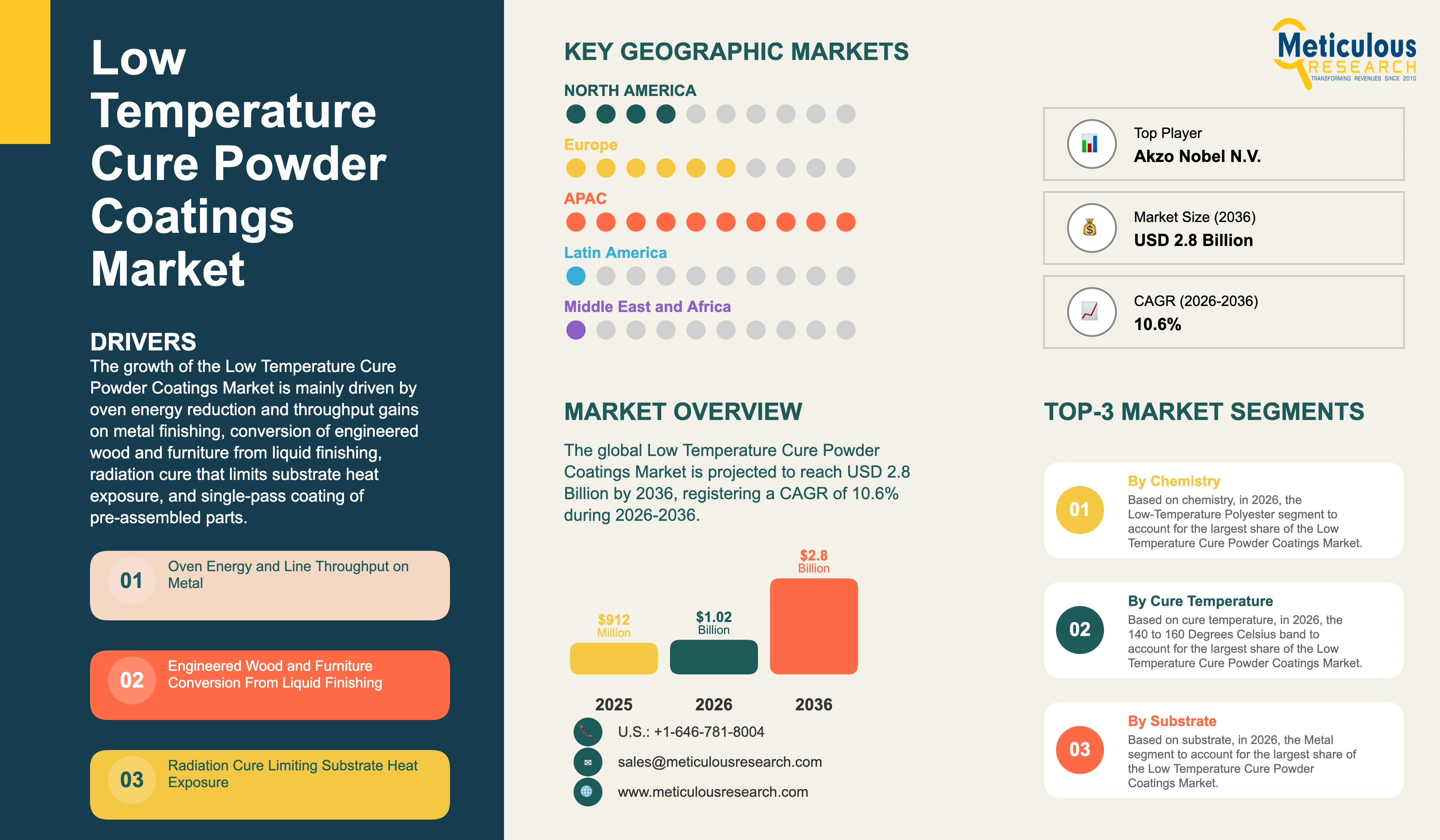
The global Low Temperature Cure Powder Coatings Market was valued at USD 912.0 million in 2025. This market is expected to reach USD 2.80 billion by 2036 from an estimated USD 1.02 billion in 2026, registering a CAGR of 10.6% during the forecast period (2026-2036).
- Published
- Nov 2026
- Pages
- 272
- Format
- PDF + Excel
- Report ID
- MRCHM - 1042784
- Base year
- 2025
- 2025 · BASELINE
- $912.0M
- 2036
- $2.80B
- CAGR 2026–2036
- 10.6%
2025 baseline · 2026–2036 forecast at 10.6% CAGR · hover a bar for the value
Key highlights
The global Low Temperature Cure Powder Coatings Market is projected to reach USD 2.80 billion by 2036, driven by oven energy and throughput gains on metal, engineered wood conversion from liquid finishing, radiation cure adoption, and pre-assembled part coating.
Asia-Pacific is expected to account for the largest market share in 2026 and is also projected to register the fastest growth during the forecast period, supported by the concentration of architectural, furniture and appliance manufacturing capacity in the region together with the fastest addition of new powder finishing lines.
By chemistry, Low-Temperature Polyester systems are expected to account for the largest market share, whereas Ultraviolet-Curable Powder are projected to witness the fastest growth through 2036.
By cure temperature, the 140 to 160 Degrees Celsius band are expected to account for the largest market share, whereas the Below 120 Degrees Celsius Including Radiation Cure band are projected to witness the fastest growth through 2036.
By substrate, Metal substrates are expected to account for the largest market share, whereas Medium Density Fiberboard and Engineered Wood are projected to witness the fastest growth through 2036.
Low-temperature epoxy systems cure at 125 degrees Celsius in 5 to 10 minutes under infrared but are suited to interior service only, while hybrid systems cure at approximately 140 degrees Celsius and triglycidyl isocyanurate polyesters cure at 135 degrees Celsius with good to excellent exterior durability.
Hydroxyalkylamide-cured polyesters require approximately 160 degrees Celsius and are therefore not suited to most heat-sensitive substrates, which is the principal reason chemistry rather than oven control determines the accessible substrate range.
Unsaturated polyester and divinyl ether systems cure at 130 degrees Celsius in 5 minutes on medium density fiberboard, while polyurethane systems require approximately 145 degrees Celsius for 25 minutes.
Ultraviolet-curable powders melt in 60 to 120 seconds under infrared and cure in under 5 seconds, holding total substrate heat exposure below 5 minutes, which is the mechanism that makes wood and plastic coating practical.
One engineered wood system cures at 120 degrees Celsius where conventional powders above 150 degrees Celsius cracked the board, is reported up to 10 times faster than waterborne finishing with up to 45% cost reduction, and allows overspray to be approximately 100% recyclable.
A low-temperature architectural powder launched in November 2023 cures at 150 degrees Celsius with a reported 20% energy saving and up to 25% faster throughput, is certified under the applicable architectural coating scheme and carries an environmental product declaration.
Triglycidyl isocyanurate carries a harmonized classification as a category 1B mutagen and is identified as a substance of very high concern, which constrains the use of the chemistry that currently offers the best combination of 135 degree cure and exterior durability.
Report summary
| Particulars | Details |
|---|---|
| Forecast Period | 2026-2036 |
| Base Year | 2025 |
| Estimated Year | 2026 |
| CAGR (Value) | 10.6% |
| Format | PDF, Excel & Cloud Portal · 272 pages |
| CAGR (Volume) | 8.6% |
| Market Size (Value) in 2026 | USD 1.02 billion |
| Market Size (Value) in 2036 | USD 2.80 billion |
| Market Size (Volume) in 2026 | 188.00 kilotons of powder as supplied |
| Market Size (Volume) in 2036 | 430.00 kilotons |
| Average Selling Price, 2026 | USD 5,415 per ton |
| Average Selling Price, 2036 | USD 6,510 per ton |
| Segments Covered | By Chemistry: Low-Temperature Polyester, Epoxy and Epoxy-Polyester Hybrid, Ultraviolet-Curable Powder, Polyester-Urethane, Low-Temperature Acrylic, Other Chemistries. By Cure Temperature: 140 to 160 Degrees Celsius, 120 to 140 Degrees Celsius, Below 120 Degrees Celsius Including Radiation Cure. By Substrate: Metal, Medium Density Fiberboard and Engineered Wood, Plastics and Composites, Pre-Assembled and Mixed-Material Parts, Other Substrates. By End Use: Architectural and Building Products, Furniture and Interior Fittings, Automotive and Transport, Appliances and Electronics, General Industrial and Machinery, Other End Uses. |
| Countries Covered | China; India; Japan; South Korea; Germany; Italy; Turkey; U.K.; U.S.; Canada; Mexico; Brazil |
| Key Companies | Akzo Nobel N.V., PPG Industries, Inc., Axalta Coating Systems Ltd., The Sherwin-Williams Company, TIGER Coatings GmbH & Co. KG, Jotun A/S, and Kansai Paint Co., Ltd. |
Report overview
Segments covered: chemistry, cure temperature, substrate, end use.
In volume terms, the market is estimated at 188.00 kilotons of powder as supplied in 2026 and is expected to reach 430.00 kilotons by 2036, registering a CAGR of 8.6% during the forecast period. The average selling price is estimated at USD 5,415 per ton in 2026 and USD 6,510 per ton in 2036.
The growth of this market is mainly driven by oven energy reduction and higher line throughput on metal finishing, conversion of engineered wood and furniture from liquid finishing to powder, growing adoption of radiation cure that limits substrate heat exposure, and increasing coating of pre-assembled and mixed-material parts. However, factors such as exterior durability limitations on the lowest-temperature chemistries, the classification of a widely used curing agent as a substance of very high concern, storage and handling requirements below 25 degrees Celsius with 24 to 48 hour acclimatization, and the capital cost of adding infrared or ultraviolet curing capability to an existing line are expected to restrain the growth of this market to some extent.
Among end uses, Architectural and Building Products are expected to account for the largest market share in 2026, while Furniture and Interior Fittings are projected to register the highest CAGR during the forecast period. Geographically, Asia-Pacific is expected to account for the largest share of this market in 2026 and is also expected to register the highest CAGR during the forecast period.
The Low Temperature Cure Powder Coatings Market comprises thermosetting powder coatings formulated to crosslink at substantially lower temperatures than conventional powder systems, together with radiation-curable powders that separate melting from crosslinking. The market includes low-temperature polyester, epoxy and epoxy-polyester hybrid, ultraviolet-curable, polyester-urethane, low-temperature acrylic and other chemistries, applied to metal, medium density fiberboard and engineered wood, plastics and composites, pre-assembled and mixed-material parts, and other substrates. The market ecosystem extends from resin and curing agent producers through powder formulators and equipment suppliers to custom coaters, original equipment manufacturers and the furniture, architectural, appliance and transport customers that specify the finish.
Two distinct demand cases sit inside this market and they are driven by different economics. On metal, the argument is oven energy and line throughput, since the cure oven is typically the largest energy consumer in a powder finishing line and a lower bake temperature with a shorter dwell both reduces gas consumption and increases parts per hour on existing equipment. One low-temperature architectural powder launched in November 2023 cures at 150 degrees Celsius with a reported 20% energy saving and up to 25% faster throughput while remaining certified under the applicable architectural coating scheme.
On heat-sensitive substrates the argument is access rather than efficiency, because the substrate cannot survive a conventional bake at all. Unsaturated polyester and divinyl ether systems cure at 130 degrees Celsius in 5 minutes on medium density fiberboard and polyurethane systems require approximately 145 degrees Celsius for 25 minutes, while one engineered wood system cures at 120 degrees Celsius where conventional powders above 150 degrees Celsius cracked the board. These systems open a substrate class that powder coating could not previously address.
Chemistry rather than oven control determines the accessible temperature. Low-temperature epoxy systems cure at 125 degrees Celsius in 5 to 10 minutes under infrared but are suited to interior service only, hybrid systems cure at approximately 140 degrees Celsius, triglycidyl isocyanurate polyesters cure at 135 degrees Celsius with good to excellent exterior durability, and hydroxyalkylamide-cured polyesters require approximately 160 degrees Celsius and are therefore not suited to most heat-sensitive substrates. The specifier is consequently trading cure temperature against exterior performance within a narrow set of established chemistries.
Radiation cure removes that trade-off by separating the two process steps. Ultraviolet-curable powders melt in 60 to 120 seconds under infrared and crosslink in under 5 seconds, which holds total substrate heat exposure below 5 minutes and allows coating of wood, plastics and assemblies containing heat-sensitive components. Ultraviolet-Curable Powder is projected to register the fastest chemistry growth in this market at 16.4%, and the Below 120 Degrees Celsius Including Radiation Cure segment is the fastest-growing cure temperature band at 14.2%.
Handling requirements are tighter than for conventional powder and are part of the specification. Low-temperature systems must be stored below 25 degrees Celsius and acclimatized for 24 to 48 hours before use, because the same reactivity that lowers the cure temperature also shortens shelf stability and raises the risk of premature crosslinking during storage and transport. This adds warehousing and logistics cost that a custom coater must absorb and is a practical barrier to adoption in hot climates.
Regulatory status constrains the best-performing low-temperature chemistry. Triglycidyl isocyanurate, which cures polyester systems at 135 degrees Celsius with good to excellent exterior durability, carries a harmonized classification as a category 1B mutagen and is identified as a substance of very high concern, which restricts its use and drives development toward alternative curing systems. Bio-based low-temperature polyester amide systems curing at 135 degrees Celsius with 84% bio-based content and 4,000 hours of accelerated weathering performance have been demonstrated at pilot scale as part of that substitution effort.
Asia-Pacific is expected to account for the largest share of this market in 2026 at 45.0%, supported by the concentration of furniture, appliance, electronics and architectural extrusion manufacturing in the region and by the fastest addition of new powder finishing capacity.
Europe accounts for 27.0% of this market in 2026 and is projected to grow at 9.4%. Higher gas costs across European finishing operations raise the per-part value of the reported 20% oven energy reduction and support a price premium for low-temperature products. Architectural demand is concentrated in Germany, Italy and Turkey, where scheme certification is a precondition for specification and environmental product declarations are routinely requested. Substitution work away from triglycidyl isocyanurate is most advanced in the region.
The Middle East & Africa region holds 3.5% of this market in 2026 with projected growth of 12.4%, concentrated in architectural extrusion coating in the Gulf states, where high ambient temperatures make conditioned local stockholding a condition of supply. Latin America holds 4.5% with projected growth of 9.6%, with Brazil and Mexico accounting for most regional volume across appliance, automotive component, building product and furniture applications.
Some of the key players operating in the low temperature cure powder coatings market are Akzo Nobel N.V., PPG Industries, Inc., Axalta Coating Systems Ltd., The Sherwin-Williams Company, TIGER Coatings GmbH & Co. KG, Jotun A/S, and Kansai Paint Co., Ltd., among others.
Key strategies include launching certified low-temperature architectural grades with documented energy savings and environmental product declarations, developing curing systems that remove the classified crosslinker while holding the 135 degree Celsius cure, extending ultraviolet powder portfolios onto wood and plastic substrates, commissioning infrared and ultraviolet curing capability alongside customers, and building conditioned distribution for grades requiring storage below 25 degrees Celsius.
Report infographic
Market dynamics
20 factors across 4 forcesOven Energy and Line Throughput on Metal
The cure oven is typically the largest single energy consumer in a powder coating line, and the temperature and dwell time it must hold are set by the chemistry rather than by the coater. Reducing the bake from a conventional schedule to a 150 degree Celsius cure has been reported to deliver a 20% energy saving on an architectural powder launched in November 2023, with up to 25% faster throughput because the shorter dwell allows more parts to pass through the same oven in a shift. Both effects accrue on installed equipment without a capital project. The commercial consequence is that a coater can absorb a higher powder price and still improve cost per part, because the saving sits in gas consumption and in fixed-cost absorption across a larger output. Where energy prices are high, as across much of Europe, that arithmetic favors the lower-temperature product even at a premium, which is why Low-Temperature Polyester holds the largest chemistry share in this market at 34.0% in 2026.
Engineered Wood and Furniture Conversion From Liquid Finishing
Medium density fiberboard and engineered wood panels cannot survive a conventional powder bake, and conventional powders above 150 degrees Celsius have been shown to crack the board. Systems that cure at 120 degrees Celsius remove that barrier, and one such engineered wood system is reported to run up to 10 times faster than waterborne finishing with up to 45% cost reduction, while allowing overspray to be approximately 100% recyclable rather than disposed of as liquid waste. Unsaturated polyester and divinyl ether systems cure at 130 degrees Celsius in 5 minutes on the same substrate. Furniture and panel producers running wet lines carry solvent handling, flash-off space, long cure ovens and material loss to overspray. Powder removes the solvent inventory and the associated emissions control, and the near-complete recyclability of overspray changes the material yield calculation on a high-volume panel line. Medium Density Fiberboard and Engineered Wood is projected to be the fastest-growing substrate in this market at 13.2%.
Radiation Cure Limiting Substrate Heat Exposure
Ultraviolet-curable powders separate the two functions that a thermal powder performs at once. The powder melts and flows under infrared in 60 to 120 seconds, then crosslinks under ultraviolet light in under 5 seconds, which holds total substrate heat exposure below 5 minutes. Because crosslinking no longer depends on holding the part at temperature, the ceiling on what can be coated is set by the melt step alone, and that step can be tuned by infrared intensity and belt speed rather than by chemistry. This opens plastics, composites and assemblies containing heat-sensitive components to powder finishing for the first time, and it compresses line length because a 5 second cure replaces a multi-minute oven pass. Ultraviolet-Curable Powder is projected to register the fastest chemistry growth in this market at 16.4%, and the Below 120 Degrees Celsius Including Radiation Cure cure temperature band is projected to grow at 14.2%.
Coating of Pre-Assembled and Mixed-Material Parts
Components that combine metal with plastic clips, elastomeric seals, bearings, magnets or electronics have conventionally been coated before assembly, which adds a handling step, risks damage to the finish during assembly and leaves fasteners and joints uncoated. A cure schedule below 120 degrees Celsius, and particularly a radiation cure that limits heat exposure to minutes, allows the finished assembly to be coated in one pass. The saving is in process steps rather than in material, and it is largest on appliance, electronics and automotive interior parts where sub-assemblies are numerous and the finish is cosmetic. Pre-Assembled and Mixed-Material Parts is accordingly one of the faster-growing substrate categories, and the specification driver is the temperature tolerance of the least heat-tolerant component in the assembly rather than the base metal.
Energy Cost and Emissions Reporting on Existing Finishing Lines
Finishing operations report scope 1 emissions from oven gas consumption, and the cure oven dominates that figure in a powder line. A lower-temperature chemistry reduces reported emissions without changing the process layout, which makes it one of the few abatement options available to a coater that does not involve replacing capital equipment. The architectural powder launched in November 2023 carries an environmental product declaration alongside its 20% reported energy saving, which allows the reduction to be carried into a customer disclosure. Specifiers in construction and appliance supply chains increasingly request product-level environmental data as part of tendering, and a declaration covering the coating is becoming part of the submission package. That makes the energy saving commercially visible rather than an internal cost item, and it supports the price position of the low-temperature product.
Table of contents
12 chapters · 135 sections · 272 pages · click to expandSegmental analysis
| Segment | Largest share (2026) | Fastest growth (2026–2036) |
|---|---|---|
| By Chemistry | Low-Temperature Polyester systems | Ultraviolet-Curable Powder |
| By Cure Temperature | 140 to 160 Degrees Celsius band | Below 120 Degrees Celsius Including Radiation Cure band |
| By Substrate | Metal substrates | Medium Density Fiberboard and Engineered Wood |
| By End use | Architectural and Building Products | Furniture and Interior Fittings |
| Other segments | 140 to 160 Degrees Celsius band | Below 120 Degrees Celsius Including Radiation Cure band |
By Chemistry
- Low-Temperature Polyester systems are expected to account for the largest share of the global Low Temperature Cure Powder Coatings Market.
- The large share of this segment is mainly due to the combination of a 135 degree Celsius cure with good to excellent exterior durability, which is the only point in the chemistry set that serves architectural and transport specifications at a reduced bake, together with the established position of polyester systems in the conventional powder base from which low-temperature grades are substituted.
- However, Ultraviolet-Curable Powder are projected to register the highest CAGR during the forecast period.
- The rapid growth of this segment is attributed to the melt-then-cure sequence that holds total substrate heat exposure below 5 minutes, with a 60 to 120 second infrared melt and crosslinking in under 5 seconds, which brings engineered wood, plastics and pre-assembled parts within reach of powder finishing and compresses line length.
- Low-Temperature Polyester systems are expected to account for the largest market share in 2026.
- Ultraviolet-Curable Powder are projected to register the highest CAGR during the forecast period, owing to the melt-then-cure sequence that holds total substrate heat exposure below 5 minutes, with a 60 to 120 second infrared melt and crosslinking in under 5 seconds, which brings engineered wood, plastics and pre-assembled parts within reach of powder finishing and compresses line length.
- Medium Density Fiberboard and Engineered Wood are projected to register the highest CAGR during the forecast period, owing to the conversion of panel and furniture production from liquid finishing, where a system curing at 120 degrees Celsius is reported to run up to 10 times faster than waterborne with up to 45% cost reduction and approximately 100% recyclable overspray.
- Furniture and Interior Fittings are projected to register the highest CAGR during the forecast period, owing to the substrate shift in panel and furniture manufacture, where engineered wood and assembled units could not previously be powder coated and where the economics of displacing liquid finishing are strongest.
By Cure Temperature
- The 140 to 160 Degrees Celsius band are expected to account for the largest market share.
- The large share of this segment is mainly due to the concentration of demand in metal finishing, where the saving is in oven energy and throughput rather than in substrate access, and where a moderate reduction from a conventional schedule already delivers a reported 20% energy saving and up to 25% faster throughput.
- However, the Below 120 Degrees Celsius Including Radiation Cure band are projected to register the highest CAGR during the forecast period.
- The rapid growth of this segment is attributed to the substrate-access argument, since engineered wood cracks under conventional powders above 150 degrees Celsius while systems curing at 120 to 130 degrees Celsius coat it successfully, and radiation cure removes the thermal budget as the limiting variable altogether.
By Substrate
- Metal substrates are expected to account for the largest market share.
- The large share of this segment is mainly due to the installed base of metal powder finishing lines into which low-temperature grades substitute directly, with the energy and throughput gain available on existing equipment and without any change to pretreatment or application.
- However, Medium Density Fiberboard and Engineered Wood are projected to register the highest CAGR during the forecast period.
- The rapid growth of this segment is attributed to the conversion of panel and furniture production from liquid finishing, where a system curing at 120 degrees Celsius is reported to run up to 10 times faster than waterborne with up to 45% cost reduction and approximately 100% recyclable overspray.
By End use
- Architectural and Building Products are expected to account for the largest market share.
- The large share of this segment is mainly due to the volume of extrusion and sheet finishing in construction, the requirement for certified exterior durability that the 135 degree Celsius polyester chemistry satisfies, and the role of environmental product declarations in construction tendering.
- However, Furniture and Interior Fittings are projected to register the highest CAGR during the forecast period.
- The rapid growth of this segment is attributed to the substrate shift in panel and furniture manufacture, where engineered wood and assembled units could not previously be powder coated and where the economics of displacing liquid finishing are strongest.
Other segments
- The 140 to 160 Degrees Celsius band are expected to account for the largest market share in 2026.
- The Below 120 Degrees Celsius Including Radiation Cure band are projected to register the highest CAGR during the forecast period, owing to the substrate-access argument, since engineered wood cracks under conventional powders above 150 degrees Celsius while systems curing at 120 to 130 degrees Celsius coat it successfully, and radiation cure removes the thermal budget as the limiting variable altogether.
- Metal substrates are expected to account for the largest market share in 2026.
- Architectural and Building Products are expected to account for the largest market share in 2026.
Geographic analysis
Asia-Pacific
Largest shareAsia-Pacific holds the largest share of this market in 2026 at 45.0% and is projected to grow at 12.0% through 2036. The region carries the bulk of global furniture, appliance, electronics and architectural extrusion manufacturing, and new powder finishing capacity is being installed there at a faster rate than elsewhere, which allows infrared and ultraviolet curing to be specified at the design stage rather than retrofitted. India is projected to be the fastest-growing country in this market at 14.6%, reflecting both construction demand for coated extrusion and the expansion of domestic furniture and appliance production. China remains the largest national market, with the deepest base of custom coaters and the broadest substrate mix. Japan is projected to be the slowest growing country at 7.4%, where the finishing base is mature and already efficient. The requirement to store these grades below 25 degrees Celsius and acclimatize for 24 to 48 hours is a practical constraint across the tropical parts of the region.
Europe
Europe accounts for 27.0% of this market in 2026 with projected growth of 9.4%. Gas costs across European finishing operations are higher than in most other regions, which raises the per-part value of the reported 20% oven energy reduction and supports a price premium for low-temperature products. Architectural demand is concentrated in Germany, Italy and Turkey, where extrusion coating volumes are large and scheme certification is a precondition for specification. The classification of triglycidyl isocyanurate as a category 1B mutagen and its identification as a substance of very high concern bear most directly on European formulators and users, and substitution work toward hydroxyalkylamide and bio-based polyester amide systems is most advanced in the region. Environmental product declarations attached to architectural powders are routinely requested in European construction tendering. Energy costs are lower than in Europe, which weakens the pure efficiency argument and shifts the regional case toward substrate access and throughput on constrained lines.
North America
North America represents 20.0% of this market in 2026 with projected growth of 9.0%. The United States holds the majority of regional volume, with demand split between architectural extrusion, appliance manufacture and a large general industrial custom coating base. Engineered wood conversion is advancing in office and retail furniture production, where the economics of displacing liquid finishing on panel lines are clearest. Canadian demand is concentrated in building products and transport components.
Latin America
Latin America accounts for 4.5% of this market in 2026 and is projected to grow at 9.6%. Brazil and Mexico hold most of the regional volume, with Mexican demand supported by appliance and automotive component manufacture serving North American assembly and Brazilian demand concentrated in building products and furniture. Conditioned storage is a constraint in both markets given ambient temperatures and the storage requirement below 25 degrees Celsius, and distribution arrangements for reactive grades are a determinant of which suppliers can serve the region reliably.
Middle East & Africa
Fastest growthThe Middle East & Africa region holds 3.5% of this market in 2026 and is projected to be the fastest-growing region at 12.4% from a small base. Architectural extrusion coating in the Gulf states is the principal application, driven by construction activity and by the specification of certified exterior finishes on facade systems. High ambient temperatures make the storage requirement below 25 degrees Celsius and the 24 to 48 hour acclimatization period operationally significant, and local stockholding with temperature control is a condition of supply rather than a service differentiator. The Middle East & Africa region is projected to register the highest CAGR at 12.4% from a small base, driven by architectural extrusion coating in the Gulf states, while India is projected to be the fastest-growing country at 14.6%.
Competitive landscape
The global Low Temperature Cure Powder Coatings Market is moderately consolidated, with competition among global coatings groups with powder divisions, specialist powder coating formulators and regional powder producers. Market participants compete primarily on cure temperature achieved at a given durability level, scheme certification and environmental product declaration coverage, technical support for infrared and ultraviolet line commissioning, and conditioned supply of reactive grades.
launching certified low-temperature architectural grades with documented energy savings, developing curing systems that remove the classified crosslinker while holding the 135 degree Celsius cure, extending ultraviolet powder portfolios onto wood and plastic substrates, and building conditioned distribution for grades that require storage below 25 degrees Celsius
The report provides a comprehensive competitive assessment of the leading companies operating in the global Low Temperature Cure Powder Coatings Market. The key players profiled in the report include Akzo Nobel N.V. (Netherlands), PPG Industries, Inc. (U.S.), Axalta Coating Systems Ltd. (U.S.), The Sherwin-Williams Company (U.S.), TIGER Coatings GmbH & Co. KG (Austria), Jotun A/S (Norway), and Kansai Paint Co., Ltd. (Japan).
- Akzo Nobel N.V.
- PPG Industries, Inc.
- Axalta Coating Systems Ltd.
- Sherwin-Williams Company
- TIGER Coatings GmbH & Co. KG
- Jotun A/S
- Kansai Paint Co., Ltd
Expert perspectives
The two demand cases inside this market should be priced and supported differently. On metal, the customer is buying oven energy and throughput on equipment already installed, which is a quantifiable saving against a known gas price and a known line rate, and the sale is made on a cost per part calculation. On heat-sensitive substrates the customer is buying access to a process that was previously unavailable, and the comparison is against liquid finishing rather than against conventional powder. Suppliers that run one commercial approach across both cases leave value on the table in the second.
Regulatory exposure, not performance, is the binding constraint on the leading chemistry. Triglycidyl isocyanurate cured polyesters deliver the 135 degree Celsius cure with good to excellent exterior durability that defines the current benchmark, and that crosslinker carries a harmonized category 1B mutagen classification and substance of very high concern identification. The obvious non-classified alternative, hydroxyalkylamide curing, requires approximately 160 degrees Celsius and therefore moves in the wrong direction. The pilot-scale bio-based polyester amide system at 135 degrees Celsius, 84% bio-based content and 4,000 hours of accelerated weathering is the first route that holds both requirements, and whoever commercializes that combination sets the reference specification for the architectural segment.
Defensible positions in this market sit where the handling burden and the equipment requirement are highest rather than where the volume is largest. Grades requiring storage below 25 degrees Celsius and 24 to 48 hour acclimatization cannot be served through ordinary distribution, and ultraviolet powder requires the customer to hold infrared and ultraviolet capability that most finishing lines lack. Suppliers that carry conditioned stock, commission the curing equipment alongside the customer and certify the resulting finish are selling a capability rather than a powder, and that position holds against price competition in a way that a metal substitution grade does not.
Customer perspectives
“The request we get is always the same shape: hold the durability, drop the bake. We can get to 125 degrees with epoxy but only for interior work, and the polyester that does 135 with real exterior performance uses a crosslinker our customers are now writing out of their specifications. Moving to hydroxyalkylamide puts us back up at 160, which defeats the purpose. That is the problem we are actually solving.”
“We put an infrared section in ahead of the convection oven rather than replacing the oven, and that let us take low-temperature work without a capital case. The part nobody mentions is storage. These powders have to sit under 25 degrees and acclimatize for a day or two before we run them, so we built a conditioned room. Without it we were scrapping material in summer.”
“Conventional powder cracked the board every time, so for years this was a wet-line process for us. At 120 degrees it works, and the throughput difference against waterborne is not marginal, it is an order of magnitude on our line. Recovering the overspray changed the material yield as much as the speed did. The constraint now is cure consistency across panel thickness.”
Frequently asked questions
The global Low Temperature Cure Powder Coatings Market is estimated at USD 1.02 billion in 2026.
The market is projected to reach USD 2.80 billion by 2036.
The market is expected to grow at a CAGR of 10.6% during 2026-2036.
Growth is driven by oven energy reduction and higher line throughput on metal finishing, conversion of engineered wood and furniture from liquid finishing, adoption of radiation cure that holds total substrate heat exposure below 5 minutes, and coating of pre-assembled and mixed-material parts in a single pass.
Low-temperature epoxy cures at 125 degrees Celsius in 5 to 10 minutes under infrared but is for interior service only, hybrids at approximately 140 degrees Celsius, and triglycidyl isocyanurate polyesters at 135 degrees Celsius with good to excellent exterior durability. Hydroxyalkylamide-cured polyesters require approximately 160 degrees Celsius.
Ultraviolet-curable powders separate melting from crosslinking: they melt under infrared in 60 to 120 seconds, then crosslink under ultraviolet light in under 5 seconds, holding total substrate heat exposure below 5 minutes. This makes wood, plastics and heat-sensitive assemblies accessible.
These systems must be stored below 25 degrees Celsius and acclimatized for 24 to 48 hours before use, because the reactivity that lowers cure temperature also shortens shelf stability. The requirement adds conditioned warehousing and is a practical barrier to adoption in hot climates.
Principal challenges are the interior-only service of the lowest-temperature chemistries, the category 1B mutagen classification and substance of very high concern status of triglycidyl isocyanurate, storage and acclimatization requirements, the capital cost of infrared or ultraviolet curing capability, and the approximately 160 degrees Celsius cure of hydroxyalkylamide alternatives.
Emerging technologies include pilot-scale bio-based polyester amide systems curing at 135 degrees Celsius with 84% bio-based content, ultraviolet powders that melt in 60 to 120 seconds and cure in under 5 seconds, unsaturated polyester and divinyl ether systems curing at 130 degrees Celsius on medium density fiberboard, and infrared boost retrofits.
Triglycidyl isocyanurate carries a harmonized category 1B mutagen classification and is a substance of very high concern, driving substitution. Architectural products also need certification under the applicable coating scheme, and environmental product declarations are increasingly requested in tendering.
Low-Temperature Polyester systems are expected to account for the largest market share in 2026.
Ultraviolet-Curable Powder is projected to register the highest CAGR during the forecast period, owing to the melt-then-cure sequence that holds total substrate heat exposure below 5 minutes and brings engineered wood, plastics and pre-assembled parts within reach of powder finishing.
The 140 to 160 Degrees Celsius band is expected to account for the largest market share in 2026.
The Below 120 Degrees Celsius Including Radiation Cure band is projected to register the highest CAGR, owing to the substrate-access argument, as engineered wood cracks under conventional powders above 150 degrees Celsius while radiation cure removes the thermal budget as the limiting variable.
Metal substrates are expected to account for the largest market share in 2026.
Medium Density Fiberboard and Engineered Wood are projected to register the highest CAGR, owing to the conversion of panel and furniture production from liquid finishing, where a 120 degrees Celsius system is reported to run up to 10 times faster than waterborne with up to 45% cost reduction.
Architectural and Building Products are expected to account for the largest market share in 2026.
Furniture and Interior Fittings are projected to register the highest CAGR, owing to the substrate shift in panel and furniture manufacture, where engineered wood and assembled units could not previously be powder coated.
Asia-Pacific is expected to account for the largest share in 2026 at 45.0%, supported by the concentration of furniture, appliance, electronics and architectural extrusion manufacturing and the fastest addition of new powder finishing capacity.
The Middle East & Africa region is projected to register the highest CAGR at 12.4% from a small base, driven by architectural extrusion coating in the Gulf states, while India is projected to be the fastest-growing country at 14.6%.
Europe accounts for 27.0% of this market in 2026 and is projected to grow at 9.4%. Higher gas costs raise the per-part value of the reported 20% oven energy reduction, and substitution work away from triglycidyl isocyanurate is most advanced in the region.
The Middle East & Africa holds 3.5% with projected growth of 12.4%, concentrated in Gulf architectural extrusion coating where conditioned local stockholding is a condition of supply. Latin America holds 4.5% with projected growth of 9.6%, led by Brazil and Mexico.
Key players include Akzo Nobel N.V., PPG Industries, Inc., Axalta Coating Systems Ltd., The Sherwin-Williams Company, TIGER Coatings GmbH & Co. KG, Jotun A/S, and Kansai Paint Co., Ltd., among others.
Key strategies include launching certified low-temperature architectural grades with documented energy savings, developing curing systems that remove the classified crosslinker while holding the 135 degree Celsius cure, extending ultraviolet powder portfolios onto wood and plastic, commissioning curing capability alongside customers, and building conditioned distribution.
Cite this report
Meticulous Research. (2026). Low Temperature Cure Powder Coatings Market - Global Opportunity Analysis and Industry Forecast (2026-2036) (Report No. MRCHM - 1042784). Meticulous Market Research Pvt. Ltd. https://www.meticulousresearch.com/product/low-temperature-cure-powder-coatings-market-7467