Structural Adhesives for Vehicles Market (2026-2036)
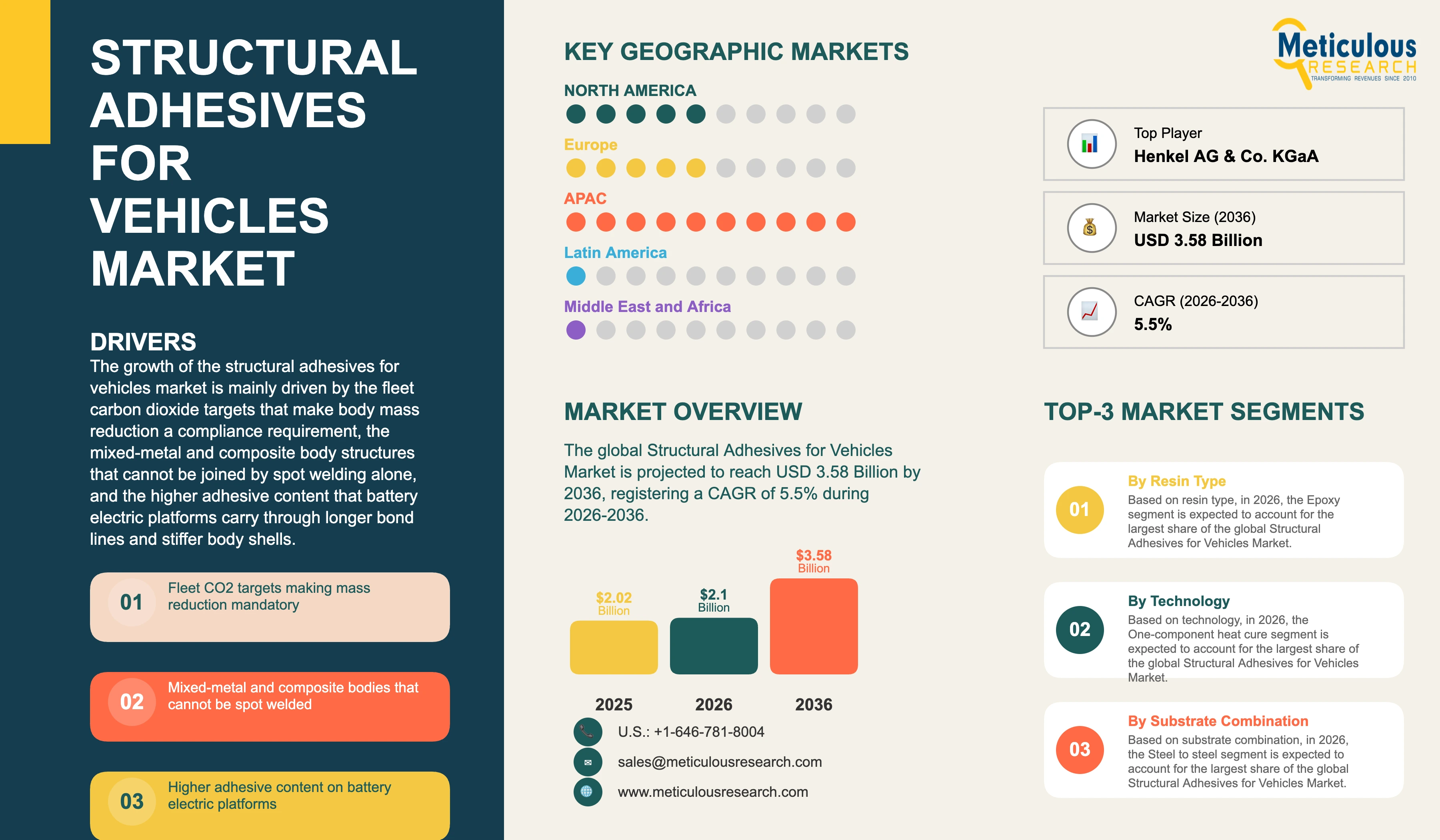
The global structural adhesives for vehicles market was valued at USD 2.02 billion in 2025. This market is expected to reach USD 3.58 billion by 2036 from an estimated USD 2.10 billion in 2026, registering a CAGR of 5.5% during the forecast period (2026-2036).
- Published
- Nov 2026
- Pages
- 244
- Format
- PDF + Excel
- Report ID
- MRCHM - 1042655
- Base year
- 2025
- 2025 · BASELINE
- $2.02B
- 2036
- $3.58B
- CAGR 2026–2036
- 5.5%
2025 baseline · 2026–2036 forecast at 5.5% CAGR · hover a bar for the value
Key highlights
The global structural adhesives for vehicles market is estimated at USD 2.10 billion in 2026 and is projected to reach USD 3.58 billion by 2036.
Market volume is estimated at 318.00 kilotons in 2026 and is projected to reach 591.20 kilotons by 2036 at a CAGR of 6.4%.
The average selling price is estimated at USD 6.60 per kg in 2026 and is projected to reach USD 6.05 per kg by 2036.
Epoxy is expected to account for the largest resin type share in 2026, while acrylic and methacrylate are projected to register the highest CAGR of 7.6%.
One-component heat cure is expected to hold the largest technology share in 2026, while two-component ambient cure is projected to grow fastest at a CAGR of 7.2%.
Steel to steel is expected to be the largest substrate combination in 2026, while mixed metal joints are projected to register the highest CAGR of 8.4%.
Internal combustion platforms are expected to account for the largest propulsion share in 2026, while battery electric platforms are projected to grow fastest at a CAGR of 9.6%.
Body-in-white is expected to be the largest application in 2026, while chassis and subframe bonding is projected to register the highest CAGR of 6.2%.
Asia-Pacific is expected to hold the largest regional share in 2026, while Europe is projected to register the highest CAGR of 6.4%.
Regulation (EU) 2026/1738, the End-of-Life Vehicles Regulation, entered into force on 13 August 2026 and applies from 1 September 2028, with the End-of-Life Vehicles Directive 2000/53/EC and the 3R Type Approval Directive applying until then.
That regulation sets a mandatory recycled plastic content target of 15% from 2032, rising to 25% from 2036.
It also introduces standardised requirements to facilitate dismantling, repair, reuse, recyclability and recoverability of vehicle parts and materials.
Treatment requirements under that regulation begin to apply from September 2029, and its scope extends to motorcycles, lorries, buses and trailers from September 2031.
Recycled content requirements for steel and aluminium are expected to apply from September 2033 as set by the Commission.
Regulation (EU) 2019/631, as amended by Regulation (EU) 2023/851, sets a fleet average target of 93.6 g CO2 per km for cars and 153.9 g CO2 per km for vans over 2025 to 2029, tightening to 49.5 g and 90.6 g per km over 2030 to 2034.
Those targets represent a 15% reduction against the 2021 baseline over 2025 to 2029, with a 100% reduction, meaning 0 g CO2 per km, in force for 2035.
Regulation (EU) 2025/1214, adopted on 17 June 2025, allows manufacturers to meet the targets on a registration-weighted average across 2025, 2026 and 2027 rather than annually.
Zero and low emission vehicle crediting applies over 2025 to 2029 against benchmarks of 25% for cars and 17% for vans, with target relief capped at 5%.
The December 2025 Automotive Package proposes a further revision, including a 90% tailpipe reduction for 2035 with the remaining 10% offset through low-carbon European steel, e-fuels or biofuels, a cut in the 2030 van target from 50% to 40%, and banking and borrowing across 2030 to 2032. Those proposals are not yet law.
Report summary
| Particulars | Details |
|---|---|
| Base Year | 2025 |
| Forecast Period | 2026-2036 |
| Market Size in 2025 | USD 2.02 billion |
| Market Size in 2026 | USD 2.10 billion |
| Market Size by 2036 | USD 3.58 billion |
| Value CAGR (2026-2036) | 5.5% |
| Format | PDF, Excel & Cloud Portal · 244 pages |
| Volume in 2026 | 318.00 kilotons |
| Volume by 2036 | 591.20 kilotons |
| Volume CAGR (2026-2036) | 6.4% |
| Average Selling Price in 2026 | USD 6.60 per kg |
| Average Selling Price by 2036 | USD 6.05 per kg |
| Measurement Basis | Load-bearing adhesive consumed in original equipment vehicle assembly across body-in-white, closures and panels, chassis and subframe and interior structural joints, excluding battery pack bonding and thermal interface materials, direct glazing and windscreen urethanes, noise, vibration and harshness and anti-flutter adhesives, hem flange and seam sealers, underbody coatings and aftermarket repair adhesives |
| Largest Resin Type Segment | Epoxy |
| Fastest-Growing Resin Type Segment | Acrylic and methacrylate (CAGR 7.6%) |
| Largest Technology Segment | One-component heat cure |
| Fastest-Growing Technology Segment | Two-component ambient cure (CAGR 7.2%) |
| Largest Substrate Combination | Steel to steel |
| Fastest-Growing Substrate Combination | Mixed metal (CAGR 8.4%) |
| Largest Propulsion Segment | Internal combustion |
| Fastest-Growing Propulsion Segment | Battery electric (CAGR 9.6%) |
| Largest Application Segment | Body-in-white |
| Fastest-Growing Application Segment | Chassis and subframe (CAGR 6.2%) |
| Largest Region | Asia-Pacific |
| Fastest-Growing Region | Europe (CAGR 6.4%) |
| Segments Covered | Resin Type, Technology, Substrate Combination, Propulsion, Application, and Geography |
| Geographies Covered | Asia-Pacific, Europe, North America, Middle East & Africa, and Latin America |
| Companies Profiled | 13 companies, including Henkel AG & Co. KGaA, Sika AG, Dow Inc., 3M Company, H.B. Fuller Company, and Arkema S.A. |
Report overview
Segments covered: resin type, technology, substrate combination, propulsion, application.
The growth of this market is mainly driven by the fleet carbon dioxide targets that make body mass reduction a compliance requirement rather than a design preference, the mixed-metal and composite body structures that cannot be joined by spot welding alone, the adhesive content increase that battery electric platforms carry through longer bond lines and stiffer body shells, and the crash performance that a bonded and welded joint delivers over a welded joint alone. However, factors such as the dismantling and recycled content requirements of the new End-of-Life Vehicles Regulation, which work against permanent bonded joints, and the oven cure and process investment that one-component heat cure adhesives require on an assembly line, are expected to restrain the growth of this market to some extent.
Structural adhesives for vehicles are load-bearing adhesives applied during vehicle manufacture to join body, closure and chassis components, transferring load across the joint rather than sealing or damping it. Market sizing in this report is on both a value basis in USD and a volume basis in kilotons, with average selling price derived from the two. The measurement basis is load-bearing adhesive consumed in original equipment vehicle assembly across body-in-white, closures and panels, chassis and subframe and interior structural joints, and it excludes battery pack bonding and thermal interface materials, direct glazing and windscreen urethanes, noise, vibration and harshness and anti-flutter adhesives, hem flange and seam sealers, underbody coatings and aftermarket repair adhesives.
A bonded joint distributes load along the whole flange rather than concentrating it at discrete points, which is the reason it is used alongside spot welding rather than instead of it. Weld bonding places adhesive in the flange and welds through it, so the joint carries the fatigue and torsional performance of a continuous bond with the immediate fixturing of a weld, and body stiffness rises without additional gauge. That combination is what lets a body engineer remove mass from a structure while holding crash and durability performance, and it is why adhesive content is specified at the body engineering stage rather than procured as a consumable.
Regulation (EU) 2019/631 as amended by Regulation (EU) 2023/851 and by Regulation (EU) 2025/1214, adopted on 17 June 2025 is the instrument that makes that mass reduction a compliance matter. The fleet average target stands at 93.6 g CO2 per km for cars and 153.9 g per km for vans over 2025 to 2029, a 15% reduction against the 2021 baseline, tightening to 49.5 g and 90.6 g per km over 2030 to 2034, with a 100% reduction in force for 2035. Zero and low emission vehicle crediting applies over 2025 to 2029 against benchmarks of 25% for cars and 17% for vans with relief capped at 5%. Every kilogram removed from a body structure reduces the energy the vehicle needs over its life, which is why lightweighting proceeds regardless of the propulsion mix a manufacturer sells.
Compliance timing has been loosened without the targets being relaxed. Regulation (EU) 2025/1214, adopted on 17 June 2025, allows manufacturers to meet the targets on a registration-weighted average across 2025, 2026 and 2027 rather than annually, which the Commission describes as temporary. The December 2025 Automotive Package proposes a further revision, including a 90% tailpipe reduction for 2035 with the remaining 10% offset through low-carbon European steel, e-fuels or biofuels, a cut in the 2030 van target from 50% to 40%, and banking and borrowing across 2030 to 2032, none of which is yet law. Body programmes already in development were engineered against the existing targets, so the material specifications they carry do not change with a compliance flexibility.
Multi-material construction is what creates the joint the adhesive is needed for. Aluminium cannot be spot welded to steel without an intermediate element because the two form brittle intermetallic phases, carbon fibre reinforced plastic cannot be welded at all, and galvanic corrosion at a steel to aluminium interface has to be interrupted by an insulating layer. A structural adhesive joins the dissimilar pair, carries the load and electrically isolates the two metals in one operation, which no mechanical fastener achieves alone. Mixed-metal body structures therefore consume adhesive as a structural necessity rather than as a stiffness improvement.
Battery electric platforms raise adhesive content for reasons that are independent of the battery itself. A heavier vehicle on the same footprint requires a stiffer body shell to hold ride and handling targets, the absence of engine and transmission mass shifts the load paths through the body sides and floor, and the body structure has to protect a large enclosure against intrusion. Longer bond lines and higher strength grades follow from those requirements, and the body is frequently a mixed-metal design because mass has to be recovered elsewhere to offset the pack. Adhesive consumption per vehicle on such platforms sits well above a comparable internal combustion body.
Regulation (EU) 2026/1738, the End-of-Life Vehicles Regulation, which entered into force on 13 August 2026 and applies from 1 September 2028 now works against the same joints. It sets a mandatory recycled plastic content target of 15% from 2032 rising to 25% from 2036, introduces standardised requirements to facilitate dismantling, repair, reuse, recyclability and recoverability of parts and materials, begins applying treatment requirements from September 2029 and extends its scope to motorcycles, lorries, buses and trailers from September 2031, with recycled content requirements for steel and aluminium expected from September 2033. A bonded joint is permanent by design, so a structure optimised for dismantling and a structure optimised for mass are pulling against each other within the same vehicle programme.
The two instruments together define the engineering problem this market now sells into. Mass reduction and mixed-material joining raise adhesive content, while dismantlability and material separation at end of life argue for joints that can be released, and both apply to vehicles entering development now for production in the 2030s. Debondable chemistries, adhesive-free material separation routes and bonded joints designed around a release mechanism are consequently moving from research into platform specification. Which of the two requirements governs a given joint is being decided case by case rather than by a general rule.
Steel to steel is expected to account for the largest share in 2026, reflecting the predominance of steel body structures in global vehicle production.
Mixed metal joints are projected to register the highest CAGR of 8.4% during the forecast period.
Asia-Pacific is expected to account for the largest share in 2026, supported by the proportion of global vehicle production built in China, Japan, South Korea and India. China is projected to grow at 5.8% and India at 8.6%.
Europe is projected to register the highest CAGR of 6.4% during the forecast period, with Germany at 6.2% and France at 6.0%.
Europe is projected to grow at a CAGR of 6.4% and is the fastest-growing region, supported by the carbon dioxide targets tightening to 49.5 g per km for cars over 2030 to 2034 and to a 100% reduction for 2035, and by the mixed-metal and aluminium-intensive body structures European manufacturers use to meet them. Germany is projected at 6.2% and France at 6.0%.
The Middle East & Africa is projected to grow at a CAGR of 5.0% as assembly capacity is added. Latin America is projected to grow at a CAGR of 4.4%, with Mexico the principal market as vehicle and tier one assembly serving the North American market expands.
Henkel AG & Co. KGaA, Sika AG, Dow Inc., 3M Company and H.B. Fuller Company together accounted for an estimated 58.4% of this market in 2026. The 13 companies profiled in this report together accounted for an estimated 84.0%.
Report infographic
Market dynamics
15 factors across 5 forcesFleet Carbon Dioxide Targets Making Body Mass Reduction a Compliance Requirement
Regulation (EU) 2019/631 as amended by Regulation (EU) 2023/851 and by Regulation (EU) 2025/1214, adopted on 17 June 2025 sets a fleet average of 93.6 g CO2 per km for cars and 153.9 g per km for vans over 2025 to 2029, a 15% reduction against the 2021 baseline, tightening to 49.5 g and 90.6 g per km over 2030 to 2034 and to a 100% reduction for 2035. A bonded and welded body achieves a given stiffness and crash performance at lower gauge than a welded body alone, so adhesive substitutes directly for steel mass. Zero and low emission vehicle crediting over 2025 to 2029 against benchmarks of 25% for cars and 17% for vans with relief capped at 5% reduces the pressure on the fleet average without altering the physics of a heavier vehicle. Mass reduction therefore proceeds across every propulsion type a manufacturer builds, and adhesive content is specified at body engineering rather than negotiated at purchasing.
Mixed-Metal and Composite Body Structures That Cannot Be Spot Welded
Aluminium cannot be resistance spot welded to steel without an intermediate element because the pair forms brittle intermetallic phases, carbon fibre reinforced plastic cannot be welded at all, and a steel to aluminium interface sets up galvanic corrosion unless the two are electrically separated. A structural adhesive carries the load across the dissimilar joint and insulates the metals in the same operation, which neither a weld nor a mechanical fastener delivers alone. Mixed-metal designs are selected to recover mass where a full aluminium body is not economic, which is the volume case rather than the premium one. Adhesive is consequently a structural necessity in those bodies rather than a stiffness enhancement, and the bond line length per vehicle rises with the proportion of the structure that is mixed.
Adhesive Content Increase on Battery Electric Platforms
A battery electric vehicle carries more mass on the same footprint than the internal combustion vehicle it replaces, so the body shell has to be stiffer to hold ride, handling and noise targets, and the load paths shift through the body sides and floor in the absence of engine and transmission mass. The structure also has to resist intrusion into a large enclosure, which raises the strength requirement on the joints around the floor and sills. Mass has to be recovered elsewhere to offset the pack, which pushes those platforms toward mixed-metal construction and therefore toward adhesive bonding. Adhesive consumption per vehicle on a battery electric platform sits well above a comparable internal combustion body, which is why the propulsion mix shift raises market volume independently of total vehicle production.
Crash Performance Delivered by a Bonded and Welded Joint
A spot weld concentrates load at discrete points while a continuous bond distributes it along the flange, so a weld bonded joint carries higher fatigue strength, higher torsional stiffness and better energy absorption than the same flange welded alone. Crash-durable toughened epoxy is formulated to retain impact peel strength at low temperature and after ageing, which is what allows the joint to be relied on in a crash load path rather than only in a stiffness role. Body engineers consequently place adhesive along load paths that have to deform in a controlled way rather than fracture. The performance is specified in the body structure design, which makes the adhesive difficult to remove from a platform once the structure has been validated against it. Energy absorption also has to hold after the body has aged and corroded, so the grade is selected against end-of-life crash performance rather than against a figure measured on a fresh joint.
Table of contents
13 chapters · 149 sections · 244 pages · click to expandSegmental analysis
| Segment | Largest share (2026) | Fastest growth (2026–2036) |
|---|---|---|
| By Resin Type | Epoxy | Acrylic and methacrylate |
| By Technology | One-component heat cure | Two-component ambient cure |
| By Substrate Combination | Steel to steel | Mixed metal |
| By Propulsion | Internal combustion | Battery electric |
| By Application | Body-in-white | Chassis and subframe |
| Other segments | One-component heat cure | Two-component ambient cure |
By Resin Type
- Structural Adhesives for Vehicles Analysis by Resin Type
- The epoxy segment is expected to account for the largest share of the global structural adhesives for vehicles market.
- The large share of this segment is mainly due to the crash-durable toughened grades that deliver the lap shear strength and the impact peel performance retained at low temperature and after ageing that body-in-white load paths require, the cure in the existing paint oven that avoids a separate process step, and the oil tolerance needed to bond steel carrying mill and forming residue without degreasing.
- However, the acrylic and methacrylate segment is projected to register the highest CAGR of 7.6% during the forecast period.
- The rapid growth of this segment is attributed to the ambient cure that allows bonding after the paint shop and on subassemblies that cannot pass through an oven, the adhesion to composites, plastics and coated metals where an epoxy cure cycle cannot be applied, and the tier one chassis and subframe assembly that is carried out away from the vehicle body shop.
- Polyurethane holds positions where elongation and impact resistance matter more than ultimate strength, particularly on composite and plastic closures and where a joint has to accommodate differential thermal expansion between dissimilar materials.
- The remaining resin types occupy narrow positions defined by a single substrate or temperature requirement.
- Resin selection in practice follows where in the plant the joint is made and what the substrates can tolerate rather than the strength available, since every grade in this market is formulated to carry structural load.
- Epoxy is expected to account for the largest share in 2026, supported by crash-durable toughened grades that cure in the existing paint oven.
- Acrylic and methacrylate are projected to register the highest CAGR of 7.6% during the forecast period.
By Technology
- Structural Adhesives for Vehicles Analysis by Technology
- The one-component heat cure segment is expected to account for the largest share of the global structural adhesives for vehicles market.
- The large share of this segment is mainly due to the application in the body shop followed by cure in the paint oven, which adds no process step to an existing line, the single-part supply that avoids mixing and metering equipment at the robot, and the body-in-white joints that account for most bond line length in a vehicle and are all made before the paint shop.
- However, the two-component ambient cure segment is projected to register the highest CAGR of 7.2% during the forecast period.
- The rapid growth of this segment is attributed to the joints made after the paint shop and on subassemblies supplied to the line, the heat-sensitive composite and plastic components that cannot pass through an oven, and the absence of the oven profile and capital investment that one-component heat cure requires, which widens the set of plants and tier one suppliers able to adopt structural bonding.
By Substrate Combination
- Structural Adhesives for Vehicles Analysis by Substrate Combination
- The steel to steel segment is expected to account for the largest share of the global structural adhesives for vehicles market.
- The large share of this segment is mainly due to the predominance of steel body structures in global vehicle production, the weld bonding of steel flanges that raises body stiffness without additional gauge, and the established oil-tolerant epoxy grades and application equipment built around that combination.
- However, the mixed metal segment is projected to register the highest CAGR of 8.4% during the forecast period.
- The rapid growth of this segment is attributed to the brittle intermetallic phases that prevent resistance spot welding of aluminium to steel, the galvanic corrosion at that interface which requires the two metals to be electrically separated, and the selection of mixed-metal construction to recover mass where a full aluminium body is not economic, which makes the adhesive a structural necessity rather than a stiffness improvement.
By Propulsion
- Structural Adhesives for Vehicles Analysis by Propulsion
- The internal combustion segment is expected to account for the largest share of the global structural adhesives for vehicles market.
- The large share of this segment is mainly due to the proportion of global vehicle production still built on internal combustion platforms, the installed body shops and validated body structures those platforms run on, and the lightweighting that fleet carbon dioxide targets require across every propulsion type a manufacturer sells rather than only on electric models.
- However, the battery electric segment is projected to register the highest CAGR of 9.6% during the forecast period.
- The rapid growth of this segment is attributed to the stiffer body shell a heavier vehicle on the same footprint requires to hold ride and handling targets, the load paths that shift through the body sides and floor without engine and transmission mass, the intrusion resistance needed around a large enclosure, and the mixed-metal construction those platforms adopt to recover mass, all of which raise adhesive consumption per vehicle well above a comparable internal combustion body.
By Application
- Structural Adhesives for Vehicles Analysis by Application
- The body-in-white segment is expected to account for the largest share of the global structural adhesives for vehicles market.
- The large share of this segment is mainly due to the flange length in a body shell against any other assembly in the vehicle, the weld bonding of those flanges that carries most of the stiffness and fatigue benefit, and the position of the body shop ahead of the paint oven, which allows the one-component heat cure grades that dominate the market to be used.
- However, the chassis and subframe segment is projected to register the highest CAGR of 6.2% during the forecast period.
- The rapid growth of this segment is attributed to the bonded subframes, cross members and suspension mounts assembled by tier one suppliers outside the vehicle body shop, the combination of steel, aluminium and composite in single assemblies carrying fatigue loads over the vehicle life, and the shipping of those assemblies between regions, which requires the bonded joint to survive transport and storage before installation.
Other segments
- One-component heat cure is expected to hold the largest share in 2026, as body-in-white joints are all made before the paint shop.
- Two-component ambient cure is projected to register the highest CAGR of 7.2% during the forecast period.
- Internal combustion platforms are expected to hold the largest share in 2026.
- Battery electric platforms are projected to register the highest CAGR of 9.6% during the forecast period.
- Body-in-white is expected to account for the largest share in 2026, reflecting the flange length in a body shell against any other assembly in the vehicle.
- Chassis and subframe bonding is projected to register the highest CAGR of 6.2% during the forecast period.
Geographic analysis
Asia-Pacific
Largest shareIn 2026, Asia-Pacific is expected to account for the largest share of the global structural adhesives for vehicles market. The large share of this region is mainly due to the proportion of global vehicle production built in China, Japan, South Korea and India, the battery electric platform output concentrated in China where body structures are engineered for the mass and stiffness requirements those vehicles carry, and the local adhesive compounding capacity established close to the assembly base. China is projected to register a CAGR of 5.8% and India a CAGR of 8.6% during the forecast period.
Europe
Fastest growthHowever, Europe is projected to register the highest CAGR of 6.4% during the forecast period. The rapid growth of this region is attributed to the fleet carbon dioxide targets under Regulation (EU) 2019/631 tightening to 49.5 g per km for cars over 2030 to 2034 and to a 100% reduction for 2035, the mixed-metal and aluminium-intensive body structures European manufacturers use to meet them, and the premium and battery electric platforms that carry the highest adhesive content per vehicle. Germany is projected to register a CAGR of 6.2% and France a CAGR of 6.0%. Platforms engineered in Europe are frequently built in several regions, which carries those material specifications into plants whose local regulation does not require them. Adhesive supply is nonetheless regional, since a one-component epoxy has limited shelf life and is shipped in bulk to the body shop rather than held centrally, so supply follows assembly even where the specification does not originate locally.
North America
North America holds the third-largest share, supported by light truck and sport utility production where body mass is high and aluminium closures are established, and the region is projected to grow at 4.6%, with the United States at 4.6%.
Middle East & Africa
The Middle East & Africa is projected to grow at 5.0% as assembly capacity is added, and Latin America at 4.4%, with Mexico the principal market as vehicle and tier one assembly serving the North American market expands and Brazil holding the domestic volume. Regulation rather than production volume explains why the fastest growth is not where the most vehicles are built. Regulation (EU) 2026/1738 and the carbon dioxide targets both apply to vehicles placed on the European market, so European body programmes carry both the lightweighting requirement that raises adhesive content and the dismantlability requirement that constrains where it can be placed, and they are resolving the two first.
Competitive landscape
The global structural adhesives for vehicles market is characterised by the presence of diversified adhesives and sealants companies with automotive engineering organisations, specialty chemical groups supplying both formulated adhesives and the toughening and epoxy intermediates behind them, and regional Chinese formulators serving domestic vehicle assembly. Competition is contested at platform definition rather than at purchasing, since a body structure is validated through crash, fatigue and corrosion testing against a specific adhesive and the specification then holds for the life of the platform. Henkel AG & Co. KGaA, Sika AG, Dow Inc., 3M Company and H.B. Fuller Company together accounted for an estimated 58.4% of this market in 2026, while the companies profiled in this report together accounted for an estimated 84.0%.
Regulation (EU) 2026/1738 entered into force on 13 August 2026 and applies from 1 September 2028, with recycled plastic content targets of 15% from 2032 and 25% from 2036 and standardised requirements to facilitate dismantling, repair, reuse, recyclability and recoverability. Regulation (EU) 2025/1214, adopted on 17 June 2025, allows carbon dioxide compliance on a registration-weighted average across 2025 to 2027, and the December 2025 Automotive Package proposes a 90% tailpipe reduction for 2035 with a 10% offset, a cut in the 2030 van target from 50% to 40% and banking and borrowing across 2030 to 2032, none of it yet law. Debondable systems, documented recycled and bio-based content, and ambient cure grades for post-paint and tier one assembly accounted for most competitive activity through 2026.
The suppliers able to compete here maintain application engineering inside customer body engineering groups, because the adhesive is selected during body structure design years before the first litre ships. Illinois Tool Works Inc. and Parker-Hannifin Corporation hold positions in two-component ambient cure methacrylate and acrylic bonding for composite and post-paint assembly, while Hubei Huitian New Materials Co., Ltd. serves Chinese vehicle production. Some of the key players operating in the structural adhesives for vehicles market are Henkel AG & Co. KGaA (Germany), Sika AG (Switzerland), Dow Inc. (U.S.), 3M Company (U.S.), H.B. Fuller Company (U.S.), Arkema S.A. (France), Parker-Hannifin Corporation (U.S.), Illinois Tool Works Inc. (U.S.), Huntsman Corporation (U.S.), PPG Industries, Inc. (U.S.), BASF SE (Germany), ThreeBond Holdings Co., Ltd. (Japan), and Hubei Huitian New Materials Co., Ltd. (China), among others.
- —
Regulation (EU) 2026/1738, the End-of-Life Vehicles Regulation, entered into force on 13 August 2026 and applies from 1 September 2028, with treatment requirements from September 2029, scope extension to motorcycles, lorries, buses and trailers from September 2031, and recycled plastic content targets of 15% from 2032 and 25% from 2036. Regulation (EU) 2025/1214, adopted on 17 June 2025, introduced registration-weighted averaging across 2025 to 2027 for carbon dioxide compliance. The December 2025 Automotive Package proposes a further revision that is not yet law.
- Henkel AG & Co. KGaA
- Sika AG
- Dow Inc.
- 3M Company
- H.B. Fuller Company
- Arkema S.A
Expert perspectives
Volume grows at 6.4% against 5.5% in value over the forecast period, and the average selling price falls from USD 6.60 per kg in 2026 to USD 6.05 per kg by 2036 as crash-durable epoxy moves from premium platforms onto volume models and regional compounding capacity expands in Asia-Pacific. The decline reflects a grade that was a specialty becoming a standard body shop material, not pressure on the formulation premium, which holds where the joint sits in a crash load path.
Two European instruments now pull the same body structure in opposite directions. The carbon dioxide targets under Regulation (EU) 2019/631 tighten to 49.5 g per km for cars over 2030 to 2034 and to a 100% reduction for 2035, which raises adhesive content through mass reduction and mixed-material joining, while Regulation (EU) 2026/1738 introduces standardised dismantling requirements and recycled content targets of 15% from 2032 and 25% from 2036, which argue for joints that can be released. Both reach vehicles entering development now.
The compliance flexibility adopted in 2025 changes the timing and not the engineering. Regulation (EU) 2025/1214 of 17 June 2025 allows a registration-weighted average across 2025 to 2027, and the December 2025 Automotive Package proposes a 90% tailpipe reduction for 2035 with a 10% offset and a cut in the 2030 van target from 50% to 40%, neither of which is law. Body programmes already in development were engineered against the existing targets, so the material specifications they carry do not move with a reporting flexibility.
Where the adhesive is strictly necessary rather than merely beneficial is the mixed-metal joint. Aluminium cannot be resistance spot welded to steel because the pair forms brittle intermetallic phases, the interface corrodes galvanically unless the metals are separated, and composite cannot be welded at all. That is why mixed metal grows fastest among the substrate combinations at 8.4% while steel to steel remains the largest, and why the fastest-growing substrate and the fastest-growing propulsion type are the same engineering decision seen from two directions.
Platform validation rather than formulation is the barrier to entry. A body structure is signed off through crash, fatigue, corrosion and ageing testing against one specific adhesive, and changing it means repeating that evidence, so a specification holds for the life of a platform and frequently its successor. A challenger reaches only programmes entering development, which arrive on a multi-year cycle, and that is why an estimated 58.4% of this market sits with five suppliers.
The unresolved commercial question is debonding. No manufacturer currently has a validated structural adhesive that carries load for fifteen years and releases on demand, and the dismantling provisions apply from 1 September 2028 with treatment requirements from September 2029. Whoever qualifies such a system first does not win on performance against incumbents but on a requirement the incumbent grades cannot meet at all, which is the only route past the platform validation barrier available in this market.
Customer perspectives
“We put adhesive in the flange because it lets us take gauge out and still pass the crash case. That decision is made in body engineering, not in purchasing, and once the structure is validated against a particular adhesive we are not changing it. The new question we cannot answer yet is how we take the body apart again at the end of its life.”
“We build subframes that mix steel, aluminium and sometimes composite, and they ship across an ocean before anyone installs them. We cannot run them through a paint oven, so a two-part adhesive that cures at ambient is the only practical route. It also has to survive months of storage before the joint is ever loaded.”
“Recycled content is calculated on the whole vehicle, so every polymer we use is now a line in that calculation, adhesive included. At the same time we are being asked to make the car easier to take apart. If a supplier can show us documented recycled carbon in the formulation and a way to release the joint, that is two problems answered at once.”
Frequently asked questions
This market was valued at USD 1.97 billion in 2024 and USD 2.02 billion in 2025, and is estimated at USD 2.10 billion in 2026. In volume terms it is estimated at 318.00 kilotons in 2026.
This market is projected to reach USD 3.58 billion by 2036 in value and 591.20 kilotons in volume.
This market is projected to register a value CAGR of 5.5% and a volume CAGR of 6.4% during the forecast period 2026-2036. The average selling price is projected to move from USD 6.60 per kg in 2026 to USD 6.05 per kg by 2036.
Growth is driven by the fleet carbon dioxide targets under Regulation (EU) 2019/631, the mixed-metal and composite body structures that cannot be spot welded, the higher adhesive content battery electric platforms carry, and the crash and fatigue performance a weld bonded joint delivers over a welded joint alone.
Regulation (EU) 2026/1738 introduces dismantling requirements and recycled plastic content targets of 15% from 2032 and 25% from 2036, which work against permanent bonded joints. One-component heat cure adhesives depend on the line's oven profile and equipment, platform validation locks in specifications, and oil tolerance must be formulated for varying lubricants.
Debondable and separable adhesive systems answer the dismantling provisions applying from 1 September 2028. Two-component ambient cure grades, documented recycled and bio-based content, and chassis, subframe and multi-material joining at tier one suppliers are further opportunities.
Epoxy is expected to account for the largest share in 2026, supported by crash-durable toughened grades that cure in the existing paint oven.
Acrylic and methacrylate are projected to register the highest CAGR of 7.6% during the forecast period.
One-component heat cure is expected to hold the largest share in 2026, as body-in-white joints are all made before the paint shop.
Two-component ambient cure is projected to register the highest CAGR of 7.2% during the forecast period.
Steel to steel is expected to account for the largest share in 2026, reflecting the predominance of steel body structures in global vehicle production.
Mixed metal joints are projected to register the highest CAGR of 8.4% during the forecast period.
Internal combustion platforms are expected to hold the largest share in 2026.
Battery electric platforms are projected to register the highest CAGR of 9.6% during the forecast period.
Body-in-white is expected to account for the largest share in 2026, reflecting the flange length in a body shell against any other assembly in the vehicle.
Chassis and subframe bonding is projected to register the highest CAGR of 6.2% during the forecast period.
Asia-Pacific is expected to account for the largest share in 2026, supported by the proportion of global vehicle production built in China, Japan, South Korea and India. China is projected to grow at 5.8% and India at 8.6%.
Europe is projected to register the highest CAGR of 6.4% during the forecast period, with Germany at 6.2% and France at 6.0%.
Europe is projected to grow at a CAGR of 6.4% and is the fastest-growing region, supported by the carbon dioxide targets tightening to 49.5 g per km for cars over 2030 to 2034 and to a 100% reduction for 2035, and by mixed-metal and aluminium-intensive body structures. Germany is projected at 6.2% and France at 6.0%.
The Middle East & Africa is projected to grow at a CAGR of 5.0% as assembly capacity is added. Latin America is projected to grow at a CAGR of 4.4%, with Mexico the principal market as vehicle and tier one assembly serving the North American market expands.
Henkel AG & Co. KGaA, Sika AG, Dow Inc., 3M Company and H.B. Fuller Company together accounted for an estimated 58.4% of this market in 2026. The 13 companies profiled in this report together accounted for an estimated 84.0%.
Regulation (EU) 2026/1738, the End-of-Life Vehicles Regulation, entered into force on 13 August 2026 and applies from 1 September 2028, with recycled plastic content targets of 15% from 2032 and 25% from 2036. Regulation (EU) 2025/1214, adopted on 17 June 2025, introduced registration-weighted averaging across 2025 to 2027, and the December 2025 Automotive Package proposes a further revision that is not yet law.
Cite this report
Meticulous Research. (2026). Structural Adhesives for Vehicles Market - Global Opportunity Analysis and Industry Forecast (2026-2036) (Report No. MRCHM - 1042655). Meticulous Market Research Pvt. Ltd. https://www.meticulousresearch.com/product/structural-adhesives-for-vehicles-market-7338