Lead Service Line Replacement Market (2026-2036)
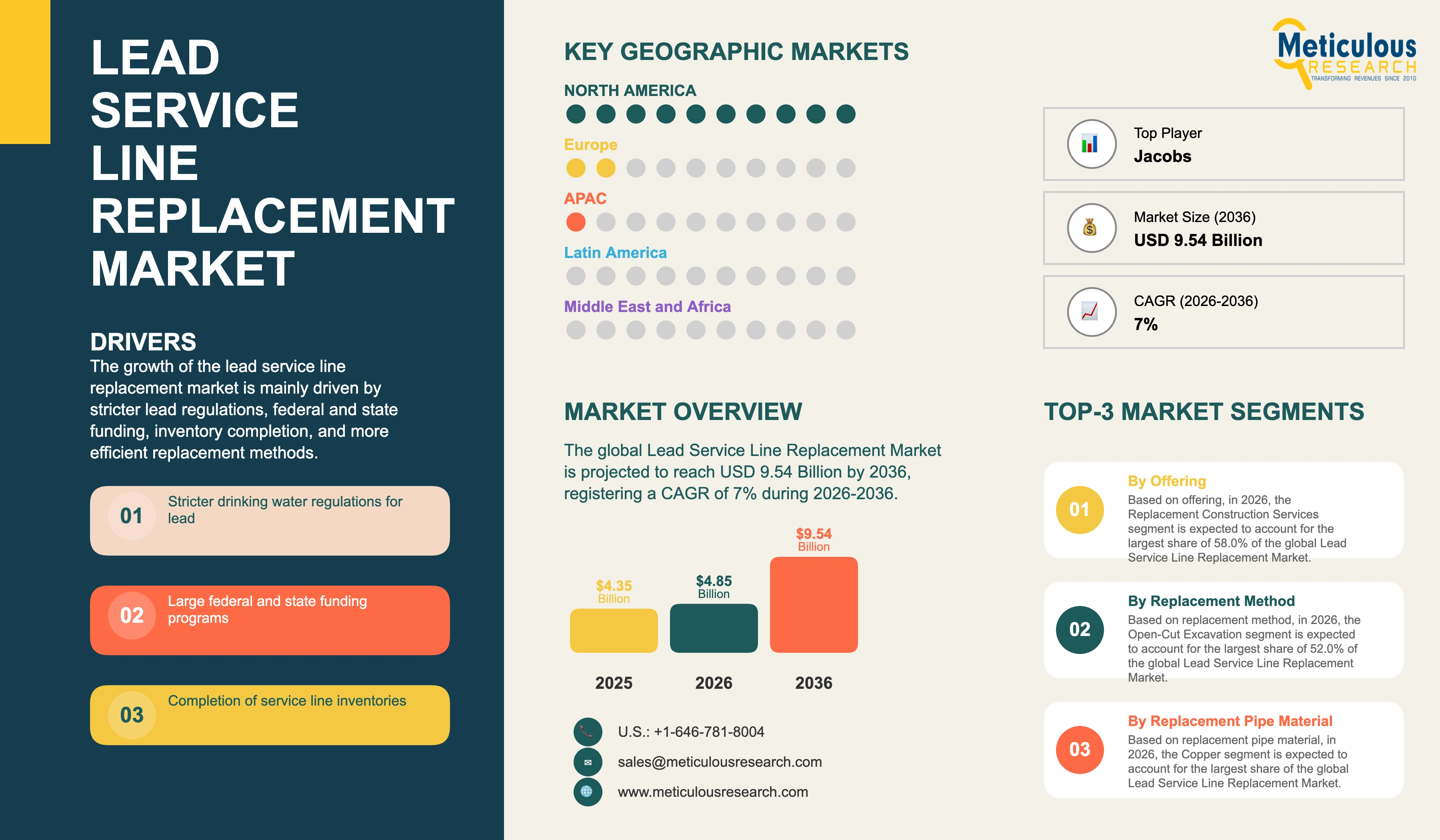
The global lead service line replacement market was valued at USD 4.35 billion in 2025. This market is expected to reach USD 9.54 billion by 2036 from an estimated USD 4.85 billion in 2026, registering a CAGR of 7.0% during the forecast period (2026-2036).
- Published
- Nov 2026
- Pages
- 233
- Format
- PDF + Excel
- Report ID
- MROTH - 1042571
- Base year
- 2025
- 2025 · BASELINE
- $4.35B
- 2036
- $9.54B
- CAGR 2026–2036
- 7.0%
2025 baseline · 2026–2036 forecast at 7.0% CAGR · hover a bar for the value
Key highlights
The U.S. Environmental Protection Agency finalized the Lead and Copper Rule Improvements (LCRI) in October 2024. The rule requires most water systems to replace all lead and galvanized requiring replacement service lines within 10 years, which raises the pace of replacement from about 3% per year to about 10% per year beginning in 2027, according to Bloomberg Government, and the compliance date for the rule is November 1, 2027.
The LCRI also lowers the lead action level from 15 micrograms per liter to 10 micrograms per liter, adds connectors to the baseline service line inventory, and requires water systems to validate their non-lead service lines within seven years, according to a fact sheet published by Jacobs in August 2025.
In November 2025, the EPA announced USD 3 billion in new Drinking Water State Revolving Fund (DWSRF) assistance for lead service line replacement and the redistribution of another USD 1.1 billion in unused funds, and it reported that updated state inventories show about 4 million lead service lines nationwide, which is less than half of earlier estimates, according to ENR.
On May 20, 2026, the EPA announced about USD 2.9 billion in fiscal year 2026 funding for lead service line replacement, which the National Association of Counties notes is the final year of the supplemental USD 3 billion annual funding provided under the Infrastructure Investment and Jobs Act. WaterWorld reported that the total fiscal year 2026 appropriation for the program is USD 2.875 billion.
In Europe, the recast Drinking Water Directive halves the permitted level of lead in drinking water from 10 micrograms per liter to 5 micrograms per liter by January 2036, and Pipelife reports that Germany plans to apply the lower limit from January 2028. Ireland's Environmental Protection Agency has warned that Uisce Éireann's rate of lead connection replacement is still too slow to meet the new limit.
By offering, replacement construction services account for the largest share of 58.0% in 2026, while inventory, identification, and inspection services register the highest CAGR.
By replacement method, open-cut excavation accounts for the largest share of 52.0% in 2026, while trenchless replacement registers the highest CAGR.
By replacement pipe material, copper accounts for the largest share in 2026, while plastic (HDPE and PEX) registers the highest CAGR.
By end user, public water systems and utilities account for the largest share in 2026, while schools, childcare facilities, and commercial buildings register the highest CAGR.
By geography, North America accounts for the largest share of 74.0% in 2026, while Europe registers the highest CAGR of 10.3%.
Report summary
| Particulars | Details |
|---|---|
| Forecast Period | 2026-2036 |
| Base Year | 2025 |
| Estimated Year | 2026 |
| CAGR (Value) | 7.0% |
| Format | PDF, Excel & Cloud Portal · 233 pages |
| Market Size (Value) in 2025 | USD 4.35 billion |
| Market Size (Value) in 2026 | USD 4.85 billion |
| Market Size (Value) in 2036 | USD 9.54 billion |
| Segments Covered | Offering, Replacement Method, Replacement Pipe Material, End User, Geography |
| Countries Covered | U.S., Canada, U.K., Ireland, Germany, France, Belgium, Netherlands, Italy, Spain, Denmark, Sweden, Rest of Europe, Japan, Australia, South Korea, New Zealand, China, India, Rest of Asia-Pacific, Brazil, Mexico, Chile, Argentina, Rest of Latin America, South Africa, Israel, Saudi Arabia, Rest of Middle East & Africa |
| Key Companies | 16 companies and other companies |
| Largest Segment by Offering (2026) | Replacement Construction Services (58.0%) |
| Largest Segment by Replacement Method (2026) | Open-Cut Excavation (52.0%) |
| Largest Region (2026) | North America (74.0%) |
| Fastest-Growing Region | Europe (CAGR 10.3%) |
Report overview
Segments covered: offering, replacement method, pipe material, end user.
The growth of this market is mainly driven by stricter drinking water regulations for lead in the U.S. and Europe, the U.S. Environmental Protection Agency's requirement that most water systems replace all lead service lines within 10 years, large federal and state funding programs for lead pipe replacement, the completion of service line inventories that are identifying the location of lead pipes, growing public awareness of the health effects of lead exposure, especially for children, and the adoption of trenchless replacement methods and digital tools that reduce replacement costs and disruption. However, factors such as the high cost of full replacement, difficulties in obtaining access to private property, shortages of skilled labor, and uncertainty about future federal funding are expected to restrain the growth of this market to some extent.
A lead service line is the pipe that connects a water main under the street to a building's internal plumbing and is made wholly or partly of lead. Lead service lines were widely installed in the U.S., Canada, the U.K., Ireland, much of continental Europe, Japan, and other countries during the late 19th and early 20th centuries, and some cities continued to install or allow them until the 1980s. When water passes through these pipes, lead can dissolve into it, particularly when water chemistry changes or pipes are disturbed. Because no safe level of lead exposure has been identified, especially for children and pregnant women, regulators increasingly regard the complete removal of lead service lines as the most reliable way to reduce exposure to lead in drinking water.
This report covers products and services used to locate, plan, and replace lead service lines and galvanized service lines that have been downstream of lead pipes. It includes inventory development, material identification, inspection, and predictive modeling services; engineering, design, program management, and software; construction services for the physical replacement of service lines using open-cut, trenchless, and lining methods; and replacement pipes, fittings, curb stops, and related materials. The market is measured on a revenue basis and includes spending by public water systems and utilities, residential property owners, and owners of schools, childcare facilities, and commercial buildings. Replacement of water mains, internal household plumbing, and lead-free fixtures is analyzed in separate reports.
The U.S. is by far the largest market for lead service line replacement, and its regulations and funding programs shape the global market. In October 2024, the EPA finalized the Lead and Copper Rule Improvements, which replaced the earlier Lead and Copper Rule Revisions and require most water systems to replace all lead and galvanized requiring replacement service lines within 10 years of the compliance date of November 1, 2027. According to Bloomberg Government, the rule increases the pace of replacement from about 3% per year to about 10% per year and gives water systems until about 2037 to complete their programs. Systems that would need to replace more than 39 service lines per 1,000 connections each year may qualify for an extension.
The size of the replacement task has become clearer as water systems have completed their initial service line inventories, which were due in October 2024. In November 2025, the EPA reported that updated inventory data show about 4 million active lead service lines, compared with an earlier estimate of about 9.2 million used in the rule's economic analysis. Many systems still report large numbers of service lines of unknown material, however, and the EPA's April 2026 draft guidance on service line inventories explicitly encourages the use of artificial intelligence and predictive modeling to classify these unknown lines, according to ALL4. As unknown lines are investigated, some will be found to contain lead and will be added to replacement programs.
Funding is a central factor in the market because full replacement of a lead service line typically costs several thousand dollars or more per home, depending on the length of the line, the replacement method, and local labor costs. The Infrastructure Investment and Jobs Act, also known as the Bipartisan Infrastructure Law, provided USD 15 billion for lead service line replacement through the DWSRF in five annual installments of USD 3 billion from fiscal year 2022 to fiscal year 2026. In November 2025, the EPA announced USD 3 billion in new DWSRF funding and redistributed USD 1.1 billion in unused funds, and in May 2026, it announced about USD 2.9 billion in fiscal year 2026 allotments, the final year of this supplemental funding. States, cities, and water utilities also fund replacement through general DWSRF loans, state grant programs, water rates, bonds, and contributions from property owners.
Outside North America, the main driver of the market is the European Union's recast Drinking Water Directive, which requires member states to lower the maximum lead concentration at the tap from 10 micrograms per liter to 5 micrograms per liter by January 2036. Ireland's Environmental Protection Agency has stated that the new limit will most likely not be achievable without the replacement of all lead connections in Ireland, and some countries, such as Germany, plan to apply the lower limit earlier. The U.K., Belgium, France, and other European countries with older housing stock also have significant numbers of lead connections, and Japan, Australia, and some other countries continue to replace remaining lead service pipes as part of water network renewal programs.
Replacement construction services account for the largest share of the market by offering, since the physical excavation, installation, and restoration work represents most of the cost of each replacement. Inventory, identification, and inspection services are the fastest-growing offering, supported by the need to resolve large numbers of unknown service lines and to validate non-lead lines. Open-cut excavation remains the most common replacement method, while trenchless methods such as pipe pulling, pipe bursting, and directional drilling are growing fastest because they reduce excavation, restoration costs, and disruption to residents.
North America accounts for the largest share of the market, driven by the U.S., while Europe is the fastest-growing region, supported by the tightening of lead limits under the Drinking Water Directive. Over the forecast period, the market is expected to grow steadily as U.S. water systems move from inventory development to large-scale replacement under the LCRI and as European countries accelerate lead connection replacement ahead of 2036. At the same time, the market's growth will depend on the availability of funding, the ability of water systems to obtain access to private property, and the capacity of contractors and supply chains to deliver replacement work at scale.
We have tens of thousands of lead lines and a 10-year deadline, so our biggest challenges are funding, getting homeowner consent, and finding enough contractors. We now award multi-year contracts and use trenchless methods wherever possible.
This comment explains why North America accounts for 74.0% of the market, why replacement construction services account for 58.0% of the market, and why trenchless replacement is the fastest-growing method. It also shows the importance of access and contractor capacity as constraints on the pace of replacement.
Program Manager - engineering consultancy, U.S.
Many of our clients still have a large share of unknown service lines, so we combine records review, field inspections, and predictive models to find the lead lines before construction starts.
This comment explains why inventory, identification, and inspection services are the fastest-growing offering and why digital tools are becoming a standard part of replacement programs.
The new lead limit in the Drinking Water Directive means we can no longer rely only on water treatment, so we are planning to remove lead connections across our network before 2036.
This comment explains why Europe is the fastest-growing region and why regulatory deadlines are the main driver of replacement programs outside North America.
North America is expected to account for the largest share of 74.0% of the market in 2026, mainly due to about 4 million remaining lead service lines in the U.S., the LCRI's replacement mandate, federal DWSRF funding, and state replacement laws.
Europe is projected to register the highest CAGR of 10.3% during the forecast period, driven by the recast Drinking Water Directive's 5 micrograms per liter lead limit by January 2036, national lead reduction strategies, and the large number of lead connections in older housing.
The report profiles 16 companies, including Jacobs, Stantec, AECOM, Black & Veatch, Arcadis, CDM Smith, Michels, Garney, Mueller Industries, Mueller Water Products, Ford Meter Box, A.Y. McDonald, Georg Fischer (Uponor), TT Technologies, 120Water, and BlueConduit.
The LCRI requires most U.S. water systems to replace all lead and galvanized requiring replacement service lines within 10 years from the compliance date of November 1, 2027, lowers the lead action level to 10 micrograms per liter, and requires inventory updates, validation of non-lead lines, and annual customer notifications.
Report infographic
Market dynamics
18 factors across 5 forcesStricter drinking water regulations for lead
Stricter regulations are the most important driver of the lead service line replacement market across North America and Europe. In the U.S., the Lead and Copper Rule Improvements require most community water systems with lead or galvanized requiring replacement service lines to replace all of these lines within 10 years, starting from the compliance date of November 1, 2027. The rule also requires water systems to prepare and submit service line replacement plans, to provide annual notifications to customers served by lead, galvanized requiring replacement, or unknown service lines, and to validate the material of non-lead lines within seven years. In addition, it lowers the lead action level from 15 micrograms per liter to 10 micrograms per liter, which will increase the number of systems that must take additional actions, such as public education and optimized corrosion control.
Unlike earlier rules, which required replacement only when a water system exceeded the lead action level, the LCRI makes replacement mandatory regardless of water sampling results. This creates a large and predictable pipeline of replacement work over the next decade and encourages water systems to plan multi-year replacement programs and procure contractors and materials in advance.
States are also adopting the federal requirements into their own drinking water rules. The Washington State Department of Health, for example, adopted changes to its drinking water rules in July 2026 to incorporate the federal requirements, and several states, including Illinois, Michigan, and New Jersey, had already adopted their own laws requiring the replacement of all lead service lines before the federal rule was finalized.
In Europe, the recast Drinking Water Directive lowers the parametric value for lead from 10 micrograms per liter to 5 micrograms per liter by January 2036, and the directive also requires member states to take measures to reduce the presence of lead in domestic distribution systems. Since lead connections are the main source of lead in tap water in many European cities, meeting the new limit will require large-scale replacement programs in countries with older water networks and housing stock.
Large federal and state funding programs
Funding programs have made large-scale lead service line replacement financially feasible for many water systems, particularly smaller and disadvantaged communities. The Infrastructure Investment and Jobs Act provided USD 15 billion for lead service line replacement through the DWSRF over five years, and a large share of this funding must be provided to disadvantaged communities as grants or forgivable loans. In November 2025, the EPA announced USD 3 billion in new funding and the redistribution of USD 1.1 billion in previously awarded but unused funds to states with greater replacement needs, and in May 2026, it announced about USD 2.9 billion in fiscal year 2026 allotments. The EPA has also issued a memorandum giving states additional flexibility in how they use these funds, including for the replacement of integrated components connected to lead service lines.
State governments and cities are adding their own funding through state revolving fund loans, state grant programs, and municipal bonds. Many cities have also created programs that cover all or most of the cost of replacing the private side of a service line, which reduces cost barriers for homeowners and makes full replacement more achievable.
Because federal funding is distributed on the basis of the location of lead service lines, the EPA's updated inventory data are shifting more funding toward states with the largest remaining replacement needs, such as Illinois and other Great Lakes states, which supports faster replacement in these areas.
Completion of service line inventories
The completion of service line inventories is turning the general problem of lead pipes into a specific list of addresses that require replacement. Under the federal rules, all community and non-transient non-community water systems were required to submit an initial inventory of service line materials by October 16, 2024, and the LCRI requires water systems to update their inventories, include connectors, and resolve unknown lines over time. In November 2025, the EPA launched a lead service line inventory dashboard based on data submitted by states, which identified about 4 million active lead service lines.
As water systems complete and refine their inventories, they can prioritize replacements, estimate costs, apply for funding, and procure contractors. Inventories also identify large numbers of unknown service lines that require investigation through records review, visual inspection, excavation, or predictive modeling, which creates demand for identification services and software.
Growing awareness of the health effects of lead exposure
Public awareness of the health risks of lead in drinking water has increased significantly since the Flint, Michigan, water crisis that began in 2014 and later lead contamination events in other cities, such as Newark, New Jersey, and Benton Harbor, Michigan. Exposure to lead can harm brain development in children and is associated with cardiovascular and kidney effects in adults, and the World Health Organization advises that there is no known safe level of lead exposure. This awareness has created strong political and community support for replacement programs and has encouraged elected officials to commit to removing all lead service lines in their communities.
Health economic analyses published by federal agencies and researchers also provide strong support for replacement programs. The EPA estimates that the health-related benefits of lead service line replacement are many times larger than the costs, which strengthens the case for public investment.
Customer notification requirements under the LCRI will further increase awareness, since water systems must notify every customer served by a lead, galvanized requiring replacement, or unknown service line each year, which encourages homeowners to participate in replacement programs.
Adoption of trenchless methods and digital tools
Trenchless replacement methods, such as pipe pulling, pipe bursting, and horizontal directional drilling, allow contractors to replace service lines with small access pits instead of digging trenches across yards, driveways, and sidewalks. These methods reduce restoration costs, shorten the time required for each replacement, and reduce disruption to residents, which makes it easier for water systems to achieve high replacement rates. Cities such as Milwaukee have reduced their costs per replacement by using efficient methods and coordinated contracting.
Digital tools, including predictive models, geographic information systems, mobile inspection applications, and customer engagement platforms, help water systems manage inventories, prioritize replacements, obtain homeowner consent, and report progress to regulators, which improves the efficiency of replacement programs. The EPA's April 2026 draft guidance encourages the use of AI and predictive modeling to classify unknown service lines, which supports wider adoption of these tools.
Table of contents
12 chapters · 154 sections · 233 pages · click to expandSegmental analysis
| Segment | Largest share (2026) | Fastest growth (2026–2036) |
|---|---|---|
| By Offering | Replacement construction services | Inspection services |
| By Replacement Method | Open-cut excavation | Trenchless replacement |
| By Replacement Pipe Material | Copper | Rapid growth of this |
| By End User | Public water systems and utilities | Commercial buildings |
| Other segments | Copper | Plastic (HDPE and PEX) |
By Offering
- Lead Service Line Replacement Market Analysis by Offering
- The replacement construction services segment is expected to account for the largest share of 58.0% of the global lead service line replacement market.
- The large share of this segment is mainly due to the high labor and equipment content of each replacement, which includes excavation or trenchless installation, the connection of new service lines to water mains and building plumbing, the replacement of curb stops and meters, traffic control, and the restoration of sidewalks, roads, driveways, and landscaping.
- Construction work typically accounts for most of the total cost of replacing a lead service line, and the large number of replacements required under the LCRI in the U.S. creates a substantial pipeline of construction work.
- Construction services are provided by large infrastructure contractors, regional underground utility contractors, and plumbing firms, and many water systems use their own crews for part of their replacement work.
- Multi-year contracts that cover thousands of addresses are becoming more common as water systems scale up their programs.
- However, the inventory, identification, and inspection services segment is projected to register the highest CAGR during the forecast period.
- The rapid growth of this segment is driven by the large number of service lines with unknown material in U.S. inventories, the LCRI's requirements to identify unknown lines and validate non-lead lines within seven years, the EPA's encouragement of predictive modeling and AI for classification, and the need for European water utilities to locate lead connections ahead of the 2036 deadline.
- Water systems are using records research, curb box inspections, potholing, camera inspections, and predictive models to determine service line materials.
- Pipes, fittings, and materials form the second-largest segment, supported by demand for copper tubing, plastic service pipes, brass fittings, curb stops, and meter setters.
- The engineering, program management, and software segment accounts for the remaining share and is growing steadily as water systems outsource program management and adopt digital tracking tools.
- The materials segment is closely tied to the volume of replacements, and suppliers of copper tubing, plastic pipes, and service brass are expanding their capacity and distribution to meet expected demand.
- Requirements for products in contact with drinking water to meet lead-free standards also shape the choice of fittings and materials.
By Replacement Method
- Lead Service Line Replacement Market Analysis by Replacement Method
- The open-cut excavation segment is expected to account for the largest share of 52.0% of the global lead service line replacement market.
- The large share of this segment is mainly due to the long-established use of open-cut methods by water utilities and contractors, their suitability for a wide range of soil and site conditions, the need to excavate at the water main and building connections in many replacements, and the ability to replace curb stops, meters, and other components at the same time.
- Open-cut excavation is also commonly used when lead service line replacement is coordinated with water main replacement or road reconstruction projects.
- However, the trenchless replacement segment is projected to register the highest CAGR during the forecast period.
- The rapid growth of this segment is driven by the need to complete large numbers of replacements quickly and at lower cost, the reduced need for surface restoration, lower disruption to residents and traffic, and improvements in pipe pulling, pipe bursting, and directional drilling equipment designed for service lines.
- Trenchless methods typically require only small access pits at the main and at the building, which can significantly reduce restoration costs in urban areas with paved surfaces and mature landscaping.
- The pipe lining and coating segment accounts for the remaining share of the market.
- Lining and coating methods, which apply an internal barrier to existing lead pipes, are used in some countries and situations where full replacement is difficult, but they are not considered equivalent to replacement under the LCRI, which limits their use in the U.S. These methods are more commonly used in parts of Europe and for pipes inside buildings where replacement would be highly disruptive.
- The choice of method depends on site conditions, soil type, the length and depth of the service line, the presence of other utilities, and local regulations, and many replacement programs use a combination of methods.
- Contractors that are skilled in several methods can adapt to different conditions and achieve higher productivity.
By Replacement Pipe Material
- Lead Service Line Replacement Market Analysis by Replacement Pipe Material
- The copper segment is expected to account for the largest share of the global lead service line replacement market.
- The large share of this segment is mainly due to the long history of copper as the standard material for water service lines in the U.S. and many other countries, its durability, its resistance to many forms of corrosion, its compatibility with existing fittings and meter setters, and its acceptance by water utilities, plumbing codes, and building owners.
- Copper's ability to be pulled through the path of an existing lead line using trenchless methods also supports its use.
- However, the plastic segment, which includes high-density polyethylene and cross-linked polyethylene, is projected to register the highest CAGR during the forecast period.
- The rapid growth of this segment is driven by the lower material cost of plastic pipes compared with copper, their flexibility, which makes them suitable for trenchless installation, their resistance to corrosion, and their growing acceptance by water utilities in North America and Europe.
- Rising copper prices also encourage some water systems to specify plastic service lines.
- Other materials, such as ductile iron and stainless steel, account for the remaining share of the market and are used mainly for larger service connections.
By End User
- Lead Service Line Replacement Market Analysis by End User
- The public water systems and utilities segment is expected to account for the largest share of the global lead service line replacement market.
- The large share of this segment is mainly due to the legal obligation of water systems under the LCRI to replace lead service lines, the role of water utilities in managing replacement programs, applying for federal and state funding, and contracting with engineers and contractors, and the growing number of utilities that pay for both public and private portions of service lines.
- In Europe, public water utilities such as Uisce Éireann in Ireland and water companies in the U.K. are also responsible for replacing lead pipes on the public side of connections.
- However, the schools, childcare facilities, and commercial buildings segment is projected to register the highest CAGR during the forecast period.
- The growth of this segment is driven by increased testing of drinking water in schools and childcare facilities under the LCRI and state programs, the vulnerability of children to lead exposure, and the need for building owners to replace lead service lines and internal plumbing to meet the lower lead limits in Europe.
- Residential property owners form the second-largest segment, since homeowners and landlords pay for part or all of private-side replacement in some programs, particularly where public funding does not cover these costs.
Other segments
- The copper segment is expected to account for the largest share of the lead service line replacement market, while the plastic (HDPE and PEX) segment is projected to register the highest CAGR during the forecast period.
- The public water systems and utilities segment is expected to account for the largest share of the lead service line replacement market, while the schools, childcare facilities, and commercial buildings segment is projected to register the highest CAGR during the forecast period.
Geographic analysis
North America
Largest shareIn 2026, North America is expected to account for the largest share of 74.0% of the global lead service line replacement market. The large share of this region is mainly due to the large number of remaining lead service lines in the U.S., estimated at about 4 million based on updated state inventories, the LCRI's requirement for most water systems to replace all lead and galvanized requiring replacement service lines within 10 years, substantial federal funding through the DWSRF, and state replacement mandates in Illinois, Michigan, New Jersey, and other states. Cities such as Chicago, Milwaukee, Detroit, Cleveland, Newark, Pittsburgh, and Denver have large replacement programs, and the Great Lakes states account for a significant share of the remaining lead lines. Canada also has significant replacement programs in cities such as Montreal, Toronto, and Ottawa.
Europe
Fastest growthEurope is projected to register the highest CAGR of 10.3% during the forecast period. The rapid growth of this region is mainly driven by the recast Drinking Water Directive, which halves the lead limit to 5 micrograms per liter by January 2036, national strategies to reduce lead exposure, and the large number of lead connections in older housing in Ireland, the U.K., Belgium, France, Germany, and other countries. Germany plans to apply the lower limit from January 2028, according to Pipelife, and Ireland's Environmental Protection Agency has called for much greater effort from government departments and Uisce Éireann to remove lead from the supply network and public buildings. The U.K. is also an important market, since water companies continue to replace lead communication pipes and encourage customers to replace lead supply pipes on their property.
Asia-Pacific
Asia-Pacific accounts for a smaller share of the market, mainly driven by Japan, where water utilities in cities such as Osaka and Tokyo have run long-term programs to replace remaining lead service pipes, as well as Australia, New Zealand, and South Korea, where lead pipes are less common but older networks are being renewed.
Latin America
Latin America and the Middle East & Africa account for the smallest shares of the market, with activity concentrated in older urban water networks in Brazil, Mexico, Chile, Argentina, South Africa, and Israel, where water utilities replace lead and other legacy pipes as part of broader network renewal programs. Regional differences in regulations, funding, housing age, and the ownership of service lines shape how replacement programs are designed and delivered. Countries with clear deadlines and dedicated funding are expected to see the fastest progress over the forecast period.
Competitive landscape
The global lead service line replacement market is highly fragmented, with the top five players estimated to account for less than 20% of the market in 2025. The market includes engineering and program management firms, large infrastructure and underground utility contractors, regional and local plumbing contractors, pipe, fitting, and valve manufacturers, trenchless equipment suppliers, and specialist inventory and data analytics providers. Water utilities themselves also perform a significant share of replacement work using their own crews.
Engineering and consulting firms such as Jacobs, Stantec, AECOM, Black & Veatch, Arcadis, and CDM Smith help water systems develop inventories, prepare replacement plans, apply for funding, design replacement programs, and manage construction. Construction firms such as Michels and Garney deliver large replacement contracts, often in partnership with engineering firms under integrated delivery models. Manufacturers such as Mueller Industries supply copper tubing, Mueller Water Products, The Ford Meter Box Company, and A.Y. McDonald supply service brass, curb stops, and meter setters, and Georg Fischer, through Uponor, supplies plastic piping systems. TT Technologies supplies trenchless replacement equipment, and 120Water and BlueConduit offer inventory management, predictive modeling, and compliance software.
Companies in this market compete on cost per replacement, productivity, experience with large programs, local presence, customer engagement capabilities, compliance expertise, and the ability to help water systems obtain funding. Key strategies include multi-year program contracts, integrated design and construction delivery, investment in trenchless equipment and digital tools, partnerships between engineering firms and contractors, and expansion of manufacturing and distribution capacity for service line materials.
Because replacement work is local, regional contractors and plumbing firms hold strong positions in many cities, while national firms compete for the largest programs. Software and analytics companies are building partnerships with engineering firms and utilities to integrate predictive modeling into program delivery. We expect competition to intensify as more water systems award large replacement contracts ahead of the LCRI compliance date and as European programs expand. Mergers and acquisitions among engineering firms, contractors, and software providers are also likely, as companies seek to offer complete replacement programs, add local construction capacity, and strengthen their data analytics capabilities in a market that will remain active for at least the next decade.
Some of the key players operating in the lead service line replacement market are Jacobs Solutions Inc., Stantec Inc., AECOM, Black & Veatch Holding Company, Arcadis NV, CDM Smith Inc., Michels Corporation, Garney Holding Company, Mueller Industries, Inc., Mueller Water Products, Inc., The Ford Meter Box Company, Inc., A.Y. McDonald Mfg. Co., Georg Fischer AG (Uponor), TT Technologies, Inc., 120Water, and BlueConduit, among others.
- —
The EPA announced about USD 2.9 billion in fiscal year 2026 lead service line replacement funding in May 2026, issued draft guidance encouraging AI-based classification of unknown lines in April 2026, and announced USD 3 billion in new funding and USD 1.1 billion in redistributed funds in November 2025, when it also reported about 4 million lead service lines nationwide.
- Jacobs Solutions Inc.
- Stantec Inc.
- AECOM
- Black & Veatch Holding Company
- Arcadis NV
- CDM Smith Inc.
- Michels Corporation
- Garney Holding Company
- Mueller Industries, Inc.
- Mueller Water Products, Inc.
- Ford Meter Box Company, Inc.
- A.Y. McDonald Mfg. Co.
- Georg Fischer AG · Uponor
- TT Technologies, Inc.
- 120Water
- BlueConduit
Expert perspectives
Lead service line replacement has become one of the most important public health infrastructure programs in the U.S. and an emerging priority in Europe. The combination of mandatory replacement under the LCRI, completed service line inventories, and dedicated federal funding has turned a long-standing problem into a defined replacement program with clear deadlines.
Over the forecast period, the market is expected to grow at a CAGR of 7.0%, from USD 4.85 billion in 2026 to USD 9.54 billion in 2036. Growth will be supported by stricter regulations, funding programs, inventory completion, public health awareness, and more efficient replacement methods and tools.
Among the market segments, replacement construction services are the largest offering, while inventory, identification, and inspection services grow fastest. Open-cut excavation is the largest replacement method, while trenchless replacement grows fastest. Copper is the largest replacement pipe material, while plastic pipes grow fastest, and public water systems and utilities are the largest end user. North America is the largest region, and Europe is the fastest-growing region at a CAGR of 10.3%.
In our view, the most important factor for the market over the forecast period will be the ability of U.S. water systems to scale up replacement from a few percent of lead lines per year to about 10% per year after November 2027. This will require stable funding, efficient contracting, skilled labor, and effective homeowner engagement. Water systems that have already completed accurate inventories, secured funding, and procured multi-year contracts are best positioned to meet their deadlines, while smaller systems may need more support from states and program managers.
The end of supplemental federal funding after fiscal year 2026 is a key uncertainty, and we expect a growing share of replacement costs to be funded through water rates, bonds, and state programs. This may slow progress in some communities, but the legal requirement to replace lead lines and strong public support for lead removal are likely to sustain replacement activity. We also expect the identification of unknown lines, supported by predictive modeling and AI, to remain an important source of demand throughout the forecast period, since each confirmed lead line adds to the replacement workload.
In Europe, we expect replacement activity to accelerate as the 2036 deadline approaches and as countries such as Germany apply the lower lead limit earlier. Ireland, the U.K., Belgium, and France are likely to be among the most active markets, and European water utilities will increasingly adopt identification and trenchless methods developed in North America. Overall, we believe the lead service line replacement market will grow steadily over the forecast period, with demand shifting from inventory development to large-scale construction in the U.S. and gradually expanding across Europe.
Customer perspectives
Buyers of lead service line replacement products and services include public water systems and utilities, municipalities, state agencies, residential property owners, and owners of schools, childcare facilities, and commercial buildings. Their purchase decisions depend mainly on regulatory compliance, cost per replacement and the availability of funding, contractor capacity and reliability, speed and productivity, the ability to obtain homeowner consent, the quality of restoration, and the ability to report progress to regulators.
Frequently asked questions
The global lead service line replacement market was valued at USD 4.35 billion in 2025, up from USD 3.95 billion in 2024, and is estimated at USD 4.85 billion in 2026. The market includes replacement construction services, inventory, identification, and inspection services, pipes, fittings, and materials, and engineering, program management, and software used in lead service line replacement programs.
Cite this report
Meticulous Research. (2026). Lead Service Line Replacement Market - Global Opportunity Analysis and Industry Forecast (2026-2036) (Report No. MROTH - 1042571). Meticulous Market Research Pvt. Ltd. https://www.meticulousresearch.com/product/lead-service-line-replacement-market-7254