Luxury Resale Market (2026-2036)
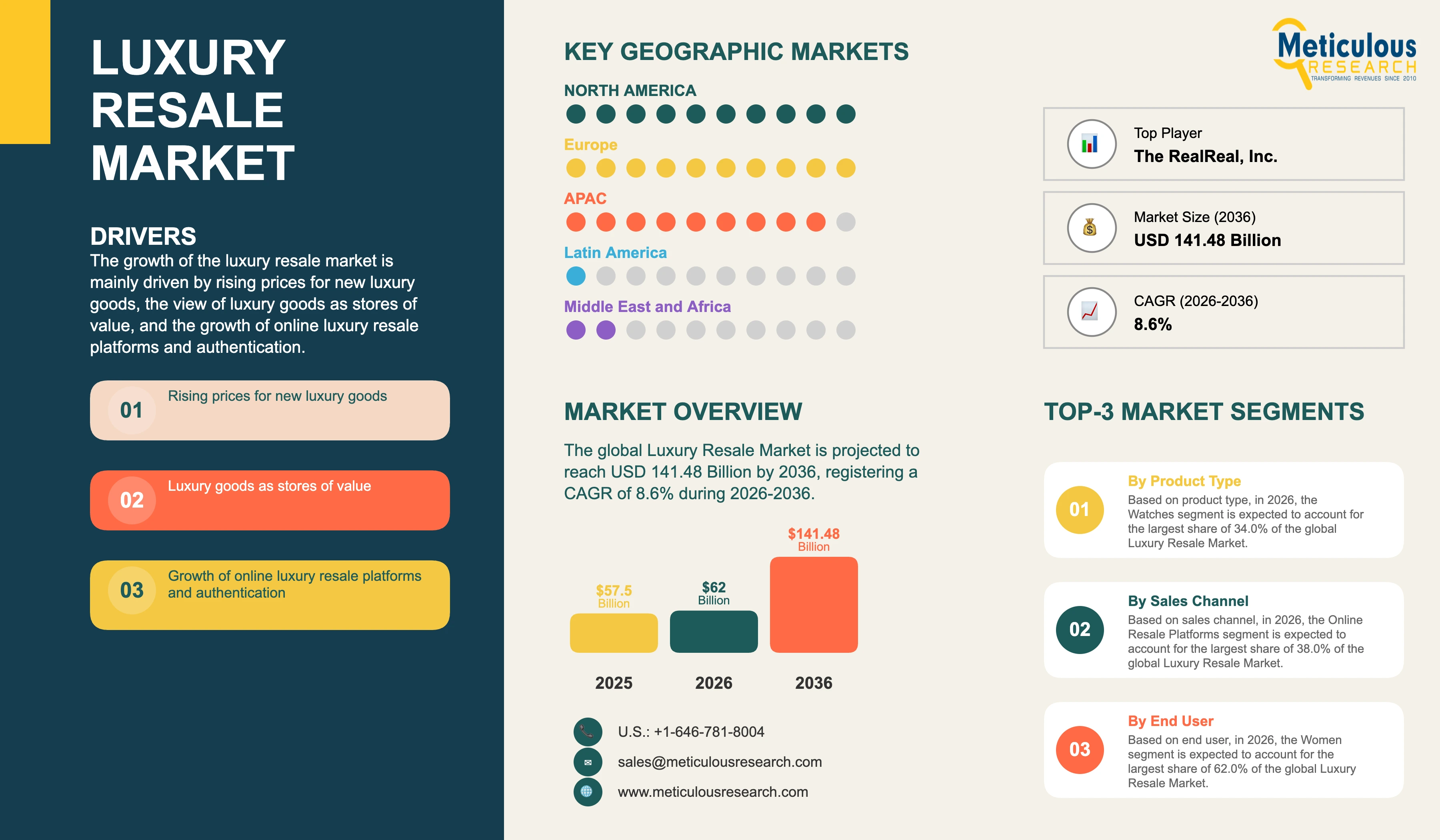
The global luxury resale market was valued at USD 57.50 billion in 2025. This market is expected to reach USD 141.48 billion by 2036 from an estimated USD 62.00 billion in 2026, registering a CAGR of 8.6% during the forecast period (2026-2036).
- Published
- Nov 2026
- Pages
- 299
- Format
- PDF + Excel
- Report ID
- MROTH - 1042482
- Base year
- 2025
- 2025 · BASELINE
- $57.50B
- 2036
- $141.5B
- CAGR 2026–2036
- 8.6%
2025 baseline · 2026–2036 forecast at 8.6% CAGR · hover a bar for the value
Key highlights
The RealReal, the largest online marketplace for authenticated luxury resale in the U.S., reported gross merchandise value of about USD 2.13 billion in 2025, up 16%, and revenue of about USD 693 million, up 15%, and it guided for 2026 gross merchandise value of USD 2.39 billion to USD 2.45 billion.
The RealReal's chief executive noted that 47% of consumers now consider resale value when making primary luxury purchases, showing how resale is changing the way consumers buy new luxury goods.
Rolex operates a Certified Pre-Owned program through its authorized retailers and has owned the retailer Bucherer since 2023, while Richemont owns the pre-owned watch specialist Watchfinder and Co., showing the growing involvement of luxury groups in the secondary market.
The RealReal reported that its average order value rose to about USD 641 in the fourth quarter of 2025, up 11%, and that active buyers grew to more than 1 million, reflecting its shift toward higher-value categories such as watches, fine jewelry, and top-tier handbags.
Japan has one of the largest and most established markets for pre-owned luxury goods in the world, with listed resale companies such as Komehyo and Valuence operating stores, buying offices, and auctions for watches, handbags, and jewelry, and serving domestic buyers, tourists, and overseas dealers.
Online luxury resale platforms, such as The RealReal, Vestiaire Collective, Fashionphile, Rebag, and Chrono24, are investing in AI-based authentication, pricing, and listing tools to increase supply and improve trust.
Secondhand luxury has benefited from weaker demand for new luxury goods in 2024 and 2025 after strong price increases by luxury brands, as some consumers turned to pre-owned items as a lower-cost way to buy luxury.
The EU's Ecodesign for Sustainable Products Regulation, which bans the destruction of unsold apparel and footwear by large companies from July 2026, and digital product passports planned for textiles and other products are expected to support traceability and resale of luxury goods.
By product type, watches account for the largest share of 34.0% in 2026, while jewelry registers the highest CAGR.
By sales channel, online resale platforms account for the largest share in 2026, while brand certified pre-owned programs register the highest CAGR.
By end user, women account for the largest share of 62.0% in 2026, while men register the higher CAGR.
By geography, North America accounts for the largest share of 32.0% in 2026, while Asia-Pacific registers the highest CAGR of 9.9%.
Report summary
| Particulars | Details |
|---|---|
| Base Year | 2025 |
| Estimated Year | 2026 |
| Forecast Period | 2026-2036 |
| Market Size in 2025 | USD 57.50 billion |
| Market Size in 2026 | USD 62.00 billion |
| Market Size by 2036 | USD 141.48 billion |
| CAGR (2026-2036) | 8.6% |
| Format | PDF, Excel & Cloud Portal · 299 pages |
| Largest Segment by Product Type (2026) | Watches (34.0%) |
| Largest Segment by End User (2026) | Women (62.0%) |
| Largest Region (2026) | North America (32.0%) |
| Fastest-Growing Region | Asia-Pacific (CAGR 9.9%) |
| Segments Covered | Product Type, Sales Channel, End User, and Geography |
| Geographic Scope | North America, Europe, Asia-Pacific, Middle East and Africa, and Latin America |
| Key Companies Profiled | The RealReal, Vestiaire Collective, Fashionphile, Rebag, Chrono24, Watchfinder and Co., The 1916 Company, Bucherer, Komehyo, Valuence Holdings, Sotheby's, Christie's, What Goes Around Comes Around, and Collector Square |
Report overview
Segments covered: product type, sales channel, end user.
The growth of this market is mainly driven by rising prices for new luxury goods, which make pre-owned items an attractive way to access luxury brands, the growing view of luxury watches, handbags, and jewelry as assets that hold or increase their value, younger consumers' interest in sustainable and circular luxury, improved trust through professional authentication, the growth of online luxury resale platforms, and the entry of luxury brands and authorized retailers into certified pre-owned programs. However, factors such as counterfeits and the cost of authentication, limited supply of the most sought-after items, price volatility in pre-owned watch and handbag markets, and the reluctance of some luxury brands to support resale are expected to restrain the growth of this market to some extent.
Luxury resale, also commonly called pre-owned, vintage, or secondhand luxury, refers to the sale of pre-owned luxury goods, such as watches, handbags, jewelry, apparel, footwear, and accessories from high-end brands, to new owners. Items are sold through online resale platforms, independent dealers and boutiques, certified pre-owned programs run by brands and authorized retailers, and auction houses. Because luxury goods are expensive, durable, and often hold their value well, the secondary market plays an important role in the luxury industry, allowing owners to sell items they no longer use and buyers to purchase luxury goods at lower prices or to find discontinued and rare pieces.
This market covers the global sales value of pre-owned luxury watches, handbags, jewelry, apparel and footwear, and small leather goods and accessories sold through resale channels, measured in value. It includes sales through independent dealers and boutiques, online resale platforms, brand certified pre-owned programs, and auction houses. It is segmented by product type, sales channel, end user, and geography. Pre-owned luxury cars, art, collectibles, fine wine, and real estate, as well as luxury rental services, are not included.
The luxury resale market has grown rapidly over the past decade, as consumers have become more comfortable buying pre-owned luxury goods, particularly online. Professional authentication services, buyer guarantees, and high-quality presentation have increased trust, while social media and price transparency have made it easier to compare prices and track the value of luxury items. The view of certain luxury goods, such as Rolex, Patek Philippe, and Audemars Piguet watches and Hermès and Chanel handbags, as investments that hold or increase their value has also attracted new buyers and sellers.
Different product categories have distinct dynamics, as the pre-owned watch market is large and well established, with a long history of dealers, auction houses, and enthusiast communities, and prices for the most sought-after models are closely tracked. Handbags from top brands are among the most traded luxury items, with some models selling above their original retail prices because of limited availability. Jewelry resale is growing, supported by demand for signed pieces from brands such as Cartier, Van Cleef and Arpels, and Tiffany, while apparel and footwear resale is driven by designer fashion and luxury sneakers.
Pricing in the luxury resale market depends on brand, model, condition, rarity, and market demand. Items from the most desirable brands and models can sell close to or above their original retail prices, while items from less sought-after brands often sell at large discounts. Condition grading, original packaging, receipts, and service records all affect value, particularly for watches and handbags, and price data published by platforms and dealers has made the market more transparent for both buyers and sellers.
The relationship between luxury brands and the resale market has changed significantly. Many brands were once wary of resale, seeing it as a threat to their control over pricing and brand image, but an increasing number now see it as an opportunity to engage customers, show the durability and value of their products, and meet sustainability goals. Rolex's Certified Pre-Owned program, Richemont's ownership of Watchfinder and Co., and partnerships between luxury brands and resale platforms are examples of this shift.
Economic conditions also shape the market, because strong price increases for new luxury goods in recent years have widened the gap between new and pre-owned prices, which has made resale more attractive, particularly when demand for new luxury goods weakened in 2024 and 2025. At the same time, prices for some pre-owned watches and handbags fell from their 2022 peaks, which reduced speculative demand but made pre-owned luxury more accessible to buyers seeking value.
Over the forecast period, the luxury resale market is expected to grow strongly in all major regions and to become more closely linked with the primary luxury market, supported by consumer acceptance, online platforms, brand involvement, authentication technology, and growing demand in Asia-Pacific and the Middle East.
Artificial intelligence offers opportunities to reduce the cost of authentication, improve pricing accuracy, and personalize the buying experience. AI tools can analyze images to detect counterfeits, estimate the value of items based on brand, model, condition, and market data, and recommend items to buyers based on their preferences. Resale platforms are investing in these tools to increase efficiency and scale.
AI can also help sellers by providing instant valuations and offers, which encourages more owners to sell their luxury items and increases supply for platforms.
AI-based tools can also help platforms detect fraudulent listings, monitor pricing trends, and manage inventory more effectively, which improves margins. However, AI authentication must be combined with human expertise for high-value items, as mistakes can be very costly.
Report infographic
Market dynamics
15 factors across 5 forcesRising prices for new luxury goods
Luxury brands have raised prices for many products significantly over the past several years, particularly for iconic handbags, watches, and jewelry, which has made new luxury goods less affordable for many consumers. Pre-owned items offer access to the same brands and products at lower prices, and for some limited items that are difficult to buy new, the secondary market is the only way to obtain them without waiting. As a result, resale has become an important entry point for aspirational luxury buyers.
Higher prices for new goods also increase the resale value of items already in circulation, which encourages owners to sell items they no longer use and adds to supply on resale platforms. According to The RealReal, 47% of consumers now consider resale value when making primary luxury purchases, which shows how the secondary market influences buying decisions in the primary market.
Resale also allows buyers to purchase discontinued models, older designs, and vintage pieces that are no longer available from brands, which attracts collectors and consumers looking for unique items. For many buyers, the combination of lower prices, wider choice, and immediate availability makes the resale market more attractive than buying new.
Luxury goods as stores of value
Certain luxury goods, particularly watches from brands such as Rolex, Patek Philippe, and Audemars Piguet, handbags from Hermès and Chanel, and signed jewelry, are increasingly seen as assets that hold or increase their value over time. Buyers consider not only the enjoyment of using these items but also their potential resale value, and some collectors treat them as alternative investments. Price tracking tools and indices published by resale platforms have made the value of these items more transparent.
This store-of-value perception supports demand for high-end pre-owned watches, handbags, and jewelry and encourages owners to sell through resale channels when prices are strong. Watches account for the largest share of the market by product type, supported by the deep and liquid market for pre-owned luxury watches.
Some resale platforms and dealers now offer buyback guarantees, trade-in credit, and financing for luxury purchases, which makes buying luxury goods with a view to future resale more practical. Collectors also use the resale market to upgrade their collections by trading in items for new purchases, which increases the frequency of transactions.
Sustainability and circular luxury
Younger luxury consumers, particularly millennials and Gen Z, place greater importance on sustainability and are more willing to buy pre-owned goods. Buying pre-owned luxury extends the life of high-quality products and reduces the need for new production, which aligns with their values. Luxury brands and groups are also including circularity in their sustainability strategies, through repair services, resale partnerships, and certified pre-owned programs.
Regulations in Europe, such as the ban on destroying unsold apparel and footwear and plans for digital product passports, are expected to further support circular luxury by increasing transparency about products' origin and history, which can help resale platforms verify items and provide information to buyers.
Luxury groups have also set targets to reduce their environmental impact, and resale and repair services are among the ways they can show progress. Some luxury fashion houses have launched or partnered on resale and refurbishment services to keep their products in use longer and to offer customers an option to sell items they no longer wear.
Growth of online luxury resale platforms and authentication
Online luxury resale platforms, such as The RealReal, Vestiaire Collective, Fashionphile, Rebag, Chrono24, and Watchfinder, have made it easy to buy and sell pre-owned luxury goods with confidence. These platforms offer authentication by trained experts and technology, condition grading, buyer guarantees, and convenient services for sellers, such as home pickups and instant offers. The RealReal reported gross merchandise value of about USD 2.13 billion in 2025, showing the scale that online luxury resale has reached.
Online platforms also reach buyers globally, which increases demand for items and improves prices for sellers. Investment in AI-based authentication, pricing, and personalization is improving efficiency and conversion. Online resale platforms account for the largest share of the market by sales channel.
Seller services are a key part of the online model, and platforms offer concierge pickups, consignment offices, drop-off locations, and instant buyout offers, which make it easy for owners to sell high-value items, and they use data on demand and prices to set competitive prices and sell items quickly. These services are particularly important for securing supply of watches, jewelry, and top-tier handbags.
Table of contents
11 chapters · 116 sections · 299 pages · click to expandSegmental analysis
| Segment | Largest share (2026) | Fastest growth (2026–2036) |
|---|---|---|
| By Product Type | Watches | Jewelry |
| By Sales Channel | Online resale platforms | Brand certified pre-owned programs |
| By End User | Women | Rapid growth of this |
By Product Type
- Luxury Resale Market Analysis by Product Type
- The watches segment is expected to account for the largest share of 34.0% of the market.
- The large share of this segment is mainly due to the high value of pre-owned luxury watches, the large and well-established secondary market for watches from brands such as Rolex, Patek Philippe, Audemars Piguet, Omega, and Cartier, and the strong demand from collectors and buyers who see watches as stores of value.
- The pre-owned watch market is served by a wide range of channels, including specialist dealers, online marketplaces such as Chrono24, pre-owned specialists such as Watchfinder and Co. and The 1916 Company, certified pre-owned programs from Rolex and other brands, and auction houses such as Christie's, Sotheby's, and Phillips.
- Limited production of the most sought-after models means that many buyers turn to the pre-owned market, and some models trade above their retail prices.
- Prices for pre-owned watches have stabilized after the sharp rise and fall in 2021 to 2023, which has encouraged more buyers who were previously priced out of the market.
- Watches are expected to remain the largest product type over the forecast period, supported by strong collector demand, the growth of certified pre-owned programs, and active trading through online marketplaces, specialist dealers, and leading auction houses.
- However, the jewelry segment is projected to register the highest CAGR during the forecast period.
- The rapid growth of this segment is driven by demand for signed pieces from top jewelry houses, rising prices for new jewelry, gold, and other precious metals, and better authentication and gemological certification.
- Handbags hold a significant share, followed by apparel and footwear and small leather goods and accessories.
- Within watches, Rolex accounts for the largest share of pre-owned transactions by value worldwide by a wide margin, followed by Patek Philippe, Audemars Piguet, Omega, Cartier, and other Swiss brands, and independent and vintage watches are a growing niche among collectors.
- Servicing, original boxes and papers, and condition have a large effect on value, which is why certified pre-owned programs and specialist dealers that service and guarantee watches can command higher prices.
- Handbags are one of the most actively traded and widely followed categories in luxury resale, led by Hermès, Chanel, Louis Vuitton, Dior, and Gucci.
- Iconic models, such as the Hermès Birkin and Kelly and the Chanel Classic Flap, hold their value exceptionally well, and some trade above retail prices because of limited availability.
- Online platforms, such as The RealReal, Vestiaire Collective, Fashionphile, and Rebag, and Japanese resale chains are major channels for pre-owned handbags.
- Apparel and footwear include designer clothing, shoes, and luxury sneakers, which are sold mainly through online platforms and vintage boutiques and are strongly influenced by fashion trends, while small leather goods and accessories, such as wallets, belts, scarves, and sunglasses, are lower in value but sold in large numbers.
By Sales Channel
- Luxury Resale Market Analysis by Sales Channel
- The online resale platforms segment is expected to account for the largest share of the market.
- The large share of this segment is mainly due to the convenience, wide selection, global reach, and authentication services offered by online platforms, such as The RealReal, Vestiaire Collective, Fashionphile, Rebag, and Chrono24.
- However, the brand certified pre-owned programs segment is projected to register the highest CAGR during the forecast period.
- The rapid growth of this segment is driven by the entry of luxury brands and authorized retailers into the secondary market.
- Independent dealers and boutiques hold a significant share, while auction houses make up the rest of the market.
- Online platforms are investing in physical stores, consignment offices, and authentication centers to support their online sales, combining the convenience of online shopping with the trust of in-person service.
- Platforms also provide data on prices and demand that help sellers decide when, where, and at what price to sell, and many offer buyback and trade-in programs that create repeat business.
- Online resale platforms offer the widest selection and global reach, and they have become the main channel for pre-owned handbags, apparel, and accessories, while online marketplaces such as Chrono24 are important for watches.
- Independent dealers and boutiques, which include pre-owned watch dealers, jewelry dealers, and vintage boutiques, remain important, particularly for high-value watches and jewelry, where buyers often prefer to see items in person and value long-standing relationships with dealers.
- Auction houses, such as Christie's, Sotheby's, and Phillips, focus on rare and high-value watches, handbags, and jewelry, and their results often set reference prices for the market and attract wealthy collectors from around the world.
- Brand certified pre-owned programs, offered through brands and authorized retailers, are growing rapidly, led by watches.
By End User
- Luxury Resale Market Analysis by End User
- The women segment is expected to account for the largest share of 62.0% of the market.
- The large share of this segment is mainly due to women's strong demand for pre-owned luxury handbags, jewelry, apparel, footwear, and accessories, and their active participation as both buyers and sellers on resale platforms.
- Women are the main buyers and sellers of pre-owned handbags and designer fashion, and they are a growing share of buyers of pre-owned watches and jewelry, including vintage pieces and smaller-sized watches that have become popular in recent years.
- Platforms such as The RealReal, Vestiaire Collective, Fashionphile, and Rebag serve a largely female customer base.
- Women are expected to remain the largest end user over the forecast period.
- Men's participation in luxury resale is concentrated in watches, sneakers, and menswear, and men are among the most active buyers of pre-owned watches through dealers, online marketplaces, and auctions.
- The growing interest of younger men in watches and luxury streetwear, supported by social media and collector communities, is expected to drive strong growth in this segment.
- However, the men segment is projected to register the higher CAGR during the forecast period.
- The rapid growth of this segment is driven by demand for pre-owned watches, menswear, and sneakers, and by the growing interest of younger men in collecting.
- Women also play an important role as sellers, consigning handbags, jewelry, and designer clothing through online platforms and boutiques, and many use the proceeds to buy new or pre-owned luxury items, which increases the circulation of luxury goods and the supply available to other buyers.
Geographic analysis
Asia-Pacific
Fastest growthAsia-Pacific has a large and growing luxury resale market, led by Japan, which has a long-established culture of buying high-quality secondhand luxury goods through stores such as Komehyo and Brand Off, as well as Hong Kong, China, South Korea, and Singapore. Rising wealth and growing acceptance of pre-owned luxury among younger consumers in China and Southeast Asia are expected to drive strong growth. Asia-Pacific is the fastest-growing region in this market, at a CAGR of 9.9%. In China, younger luxury consumers are becoming more open to buying pre-owned items, supported by online platforms and live-streaming sales, while Hong Kong remains a regional hub for pre-owned watches and handbags. South Korea and Singapore also have active resale markets supported by high luxury spending. Asia-Pacific is projected to register the highest CAGR of 9.9% during the forecast period. Growth is driven by Japan's mature resale market, rising acceptance of pre-owned luxury in China, and strong demand in Hong Kong, South Korea, and Singapore. In Asia-Pacific, Japan has a mature market led by companies such as Komehyo, Valuence, and Brand Off, which buy and sell large volumes of pre-owned luxury goods and export items to other Asian markets. Hong Kong is a regional hub for watches and handbags, and China's pre-owned luxury market is growing as attitudes change among younger consumers. Asia-Pacific and Middle East demand Geographic Analysis
Middle East & Africa
The Middle East, particularly the UAE and Saudi Arabia, is also a growing market for pre-owned luxury watches, handbags, and jewelry, supported by high incomes, tourism, and the presence of international dealers and platforms in Dubai. In the Middle East, Dubai has become a major center for pre-owned luxury watches and handbags, serving buyers from the region and international visitors, with dealers and platforms opening stores in Dubai to reach these buyers.
North America
Largest shareIn 2026, North America is expected to account for the largest share of 32.0% of the global luxury resale market. The large share of this region is mainly due to the large number of luxury consumers in the U.S., the strong presence of online luxury resale platforms, such as The RealReal, Fashionphile, and Rebag, and the active pre-owned watch market served by dealers, online platforms, and auction houses. The U.S. is the largest single market for luxury resale, supported by high consumer spending on luxury goods, widespread acceptance of pre-owned luxury, and platforms that offer consignment, buyback, and authentication services. The RealReal, which reported USD 2.13 billion of gross merchandise value in 2025, is the largest online marketplace for authenticated luxury resale in the U.S., while The 1916 Company and other dealers lead in pre-owned watches. North America is expected to remain one of the largest regions throughout the forecast period.
Europe
Europe holds a significant share, supported by Vestiaire Collective, Watchfinder and Co., Collector Square, and strong luxury cultures in France, Italy, and the U.K., while the Middle East is growing quickly. In Europe, France, the U.K., Italy, Germany, and Switzerland are the largest markets. Vestiaire Collective, based in France, is one of the leading online luxury resale platforms in the region, Watchfinder and Co. is a leading pre-owned watch specialist in the U.K., Collector Square serves the French market, and Switzerland is a hub for pre-owned watches and auctions. European buyers have long been comfortable with vintage and pre-owned luxury, and sustainability awareness is high.
Competitive landscape
The luxury resale market is fragmented, with online resale platforms, independent dealers and boutiques, pre-owned specialists owned by luxury groups and retailers, brand certified pre-owned programs, Japanese resale chains, and auction houses. Leading companies include The RealReal, Vestiaire Collective, Fashionphile, Rebag, Chrono24, Watchfinder and Co. (Richemont), The 1916 Company, Bucherer, Komehyo, Valuence Holdings, Sotheby's, Christie's, What Goes Around Comes Around, and Collector Square.
Luxury resale companies compete mainly on authentication and buyer trust, access to scarce, high-value supply, the quality and range of inventory, pricing, services for sellers, customer experience, global reach, and relationships with brands. Platforms with strong authentication and access to supply have an advantage, while brand-affiliated programs benefit from brand trust.
Online platforms, such as The RealReal, Vestiaire Collective, Fashionphile, Rebag, and Chrono24, lead in online luxury resale across handbags, apparel, accessories, jewelry, and watches. Pre-owned watch specialists, such as Watchfinder and Co., owned by Richemont, The 1916 Company, and Bucherer, owned by Rolex, lead in certified and specialist watch resale. Japanese companies, such as Komehyo and Valuence, operate large store and auction networks, auction houses such as Sotheby's and Christie's lead in rare and high-value pieces, and vintage specialists such as What Goes Around Comes Around and Collector Square serve collectors.
The top five players are estimated to account for 14.0% of the luxury resale market in 2025, reflecting the large number of independent dealers, boutiques, and regional resellers.
Players use several strategies to grow in this market, including expanding into high-value categories such as watches and fine jewelry, investing in AI authentication and pricing, opening physical stores, partnering with brands, and expanding internationally. The RealReal's focus on high-value categories and Rolex's Certified Pre-Owned program are examples.
Competition is expected to center on trust, supply, technology, and brand partnerships. Platforms and dealers with strong authentication, efficient operations, and brand relationships are expected to gain share.
Consolidation is also shaping the market, as luxury groups, retailers, and investors acquire pre-owned specialists and platforms to strengthen their positions in watches, jewelry, and handbags, and as smaller resellers struggle with authentication, compliance, and inventory costs, particularly when prices for pre-owned watches and handbags fall.
Some of the key players operating in the luxury resale market are The RealReal, Inc., Vestiaire Collective, Fashionphile, Rebag, Chrono24 GmbH, Watchfinder and Co. (Richemont), The 1916 Company, Bucherer AG, Komehyo Holdings Co., Ltd., Valuence Holdings Inc., Sotheby's, Christie's, What Goes Around Comes Around, and Collector Square.
- —
The RealReal passed USD 2 billion of gross merchandise value in 2025, luxury groups expanded certified pre-owned programs, and resale platforms invested in AI authentication and high-value categories.
- RealReal
- Vestiaire Collective
- Fashionphile
- Rebag
- Chrono24
- Watchfinder and Co.
- 1916 Company
- Bucherer
- Komehyo
- Valuence Holdings
- Sotheby's
- Christie's
- What Goes Around Comes Around
- Collector Square
Expert perspectives
Luxury resale has become an established part of the luxury industry, supported by consumer acceptance, trusted platforms, and growing involvement from luxury brands. Resale offers consumers access to luxury goods at lower prices, provides liquidity for owners, and supports the circular economy.
Over the forecast period, the market is expected to grow at about 8.6% per year, supported by rising prices for new luxury goods, online platforms, brand certified pre-owned programs, authentication technology, and demand in Asia-Pacific and the Middle East.
Watches remain the largest product type, while jewelry grows fastest, and online resale platforms are the largest sales channel, while brand certified pre-owned programs grow fastest. Women are the largest end user, while men grow faster.
North America remains the largest region, while Asia-Pacific is the fastest-growing region at a CAGR of 9.9%. The main swing factors are luxury demand, pre-owned price trends, counterfeits, and brands' approach to resale.
For resale platforms, the key priorities are securing supply, improving authentication, focusing on high-value categories, and building brand partnerships. For brands, resale offers a way to engage customers and support sustainability while protecting brand value.
The most important structural change in the market is the growing involvement of luxury brands and their owners in the secondary market. Certified pre-owned programs, ownership of resale specialists, and partnerships with platforms are bringing more trust and structure to the market, but they could also change the competitive balance between independent platforms and brand-affiliated channels. Independent online platforms that offer a broad selection, strong authentication, and good seller services are expected to remain important, particularly for multi-brand shoppers and for categories where brands do not offer resale.
Risks to the outlook include a downturn in luxury demand, falling prices for pre-owned watches and handbags, increases in counterfeit activity, and restrictions by brands, while opportunities include jewelry, Asia-Pacific and Middle East growth, AI-driven efficiency, and deeper partnerships between brands and resale platforms.
Overall, luxury resale is expected to become an increasingly important part of the luxury market over the forecast period, with closer integration between the primary and secondary markets.
The growing importance of jewelry and watches, which hold their value well and have high transaction values, is expected to shift the mix of the market toward hard luxury over the forecast period. Platforms that build expertise in these categories, including gemology, watch servicing, and certification, are expected to capture a larger share of growth, while those focused mainly on lower-priced apparel and accessories may face pressure on margins.
Customer perspectives
Collector and pre-owned watch buyer - U.S.
Many of the sports watches I want are impossible to buy new without years of waiting at an authorized dealer. Buying certified pre-owned gives me the watch now, fully serviced, with confidence that it is authentic.
This experience, which is shared by many collectors, explains why watches account for 34.0% of the market and why certified pre-owned programs are the fastest-growing sales channel.
Active participation by women as both buyers and sellers of handbags, jewelry, and designer fashion explains why women account for 62.0% of the market.
This supports Asia-Pacific's position as the fastest-growing region.
This strong and growing demand for retailer and brand programs among younger clients explains why certified pre-owned is the fastest-growing sales channel in this market.
“I buy and sell designer handbags on resale platforms several times a year. I always consider resale value before buying new, and professional authentication gives me the confidence to buy pre-owned pieces worth thousands of dollars.”
“Demand from younger Japanese customers and from tourists is strong, and jewelry and watches are growing fastest in our stores. We also sell more items overseas through online channels and auctions.”
“Our certified pre-owned watches come with our warranty and full servicing, and many buyers later return to buy new pieces from us. The program has brought in a younger group of clients who may not have visited our boutiques before.”
Frequently asked questions
The market was valued at USD 57.50 billion in 2025 and USD 53.00 billion in 2024, and is estimated at USD 62.00 billion in 2026, measured as the sales value of pre-owned luxury goods.
Cite this report
Meticulous Research. (2026). Luxury Resale Market - Global Opportunity Analysis and Industry Forecast (2026-2036) (Report No. MROTH - 1042482). Meticulous Market Research Pvt. Ltd. https://www.meticulousresearch.com/product/luxury-resale-market-7165