Apparel Resale Market (2026-2036)
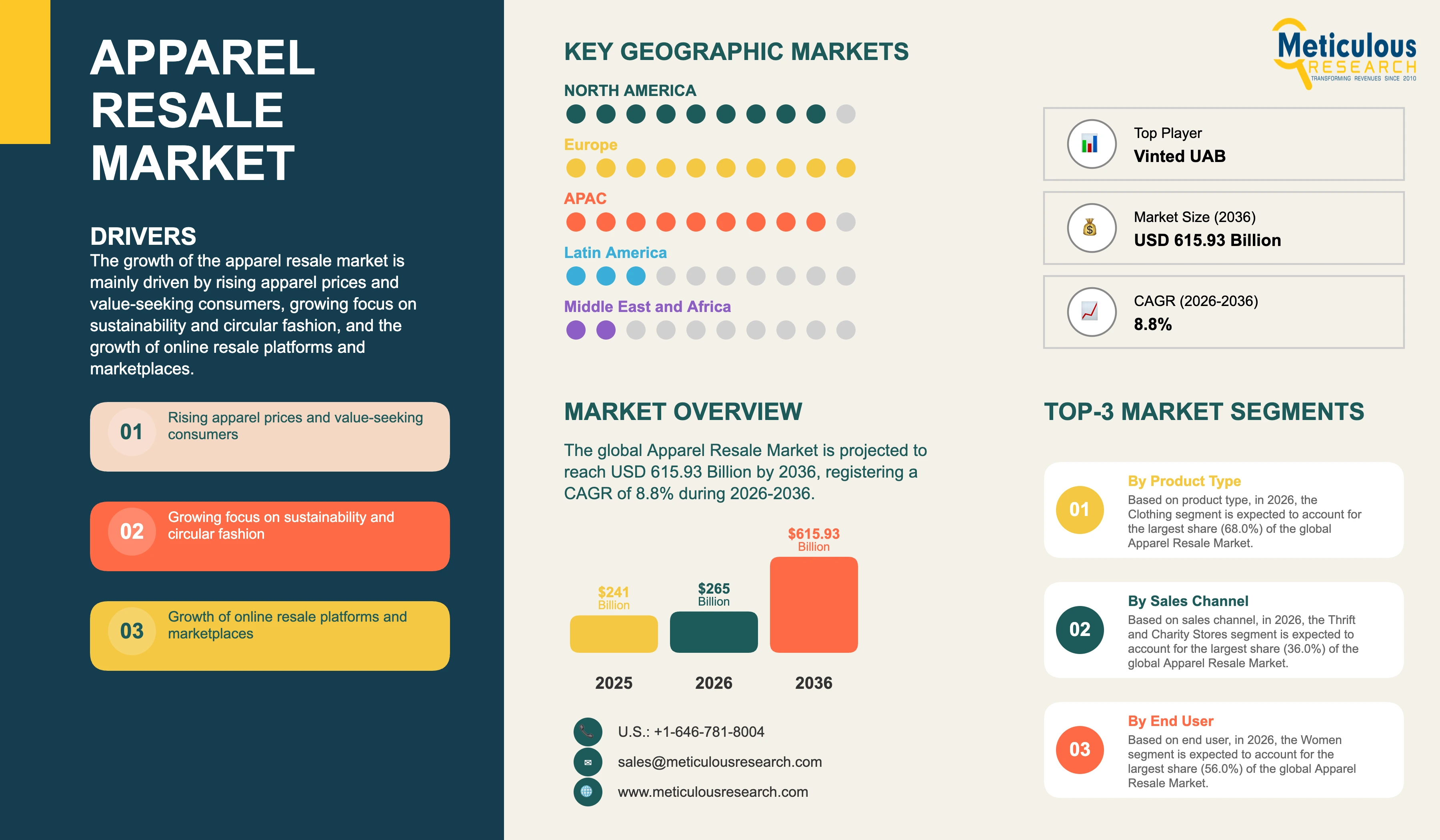
The global apparel resale market was valued at USD 241.00 billion in 2025. This market is expected to reach USD 615.93 billion by 2036 from an estimated USD 265.00 billion in 2026, registering a CAGR of 8.8% during the forecast period (2026-2036).
- Published
- Nov 2026
- Pages
- 284
- Format
- PDF + Excel
- Report ID
- MROTH - 1042501
- Base year
- 2025
- 2025 · BASELINE
- $241.0B
- 2036
- $615.9B
- CAGR 2026–2036
- 8.8%
2025 baseline · 2026–2036 forecast at 8.8% CAGR · hover a bar for the value
Key highlights
The global secondhand apparel market grew about 13% in 2025 to about USD 257 billion, representing roughly 10% of global apparel spending, according to ThredUp's 2026 Resale Report, which also expects the market to grow about twice as fast as the overall apparel market through 2030.
The U.S. secondhand apparel market, including online and in-store resale and the thrift and donation sector, grew 19% in 2025, its strongest growth since 2021, and U.S. online resale is expected to reach about USD 31 billion in 2026 from about USD 26 billion in 2025, according to ThredUp.
About 59% of consumers surveyed globally shopped for secondhand apparel in 2025, up seven points from three years earlier, and 72% said rising prices were directly affecting their apparel spending, according to ThredUp's 2026 Resale Report.
Vinted, Europe's largest online secondhand fashion marketplace, reported 2025 gross merchandise value of EUR 10.8 billion, up 47%, and revenue of EUR 1.1 billion, up 35%, and it entered the U.S. market in January 2026.
ThredUp expects the U.S. secondhand apparel market to reach about USD 78.8 billion by 2030 and the global market to reach about USD 393 billion by 2030, growing at roughly 9% per year, with online resale growing faster than the market as a whole.
eBay completed its acquisition of the resale marketplace Depop from Etsy on July 30, 2026, for about USD 1.4 billion after adjustments; Depop has about seven million active buyers, nearly 90% of them under 34, and more than three million active sellers.
The EU's Ecodesign for Sustainable Products Regulation bans large companies from destroying unsold apparel and footwear from July 2026, and the revised EU Waste Framework Directive requires member states to set up extended producer responsibility schemes for textiles, which are expected to support resale and reuse.
By product type, clothing accounts for the largest share of 68.0% in 2026, while footwear registers the highest CAGR.
By sales channel, thrift and charity stores account for the largest share in 2026, while brand-owned resale programs register the highest CAGR.
By price segment, the mass market accounts for the largest share in 2026, while the luxury segment registers the highest CAGR.
By end user, women account for the largest share of 56.0% in 2026, while children register the highest CAGR.
By geography, Europe accounts for the largest share of 31.0% in 2026, while Asia-Pacific registers the highest CAGR of 10.2%.
Report summary
| Particulars | Details |
|---|---|
| Base Year | 2025 |
| Estimated Year | 2026 |
| Forecast Period | 2026-2036 |
| Market Size in 2025 | USD 241.00 billion |
| Market Size in 2026 | USD 265.00 billion |
| Market Size by 2036 | USD 615.93 billion |
| CAGR (2026-2036) | 8.8% |
| Format | PDF, Excel & Cloud Portal · 284 pages |
| Largest Segment by Product Type (2026) | Clothing (68.0%) |
| Largest Segment by End User (2026) | Women (56.0%) |
| Largest Region (2026) | Europe (31.0%) |
| Fastest-Growing Region | Asia-Pacific (CAGR 10.2%) |
| Segments Covered | Product Type, Sales Channel, Price Segment, End User, and Geography |
| Geographic Scope | Europe, Asia-Pacific, North America, Latin America, and Middle East and Africa |
| Key Companies Profiled | Vinted, eBay (Depop), ThredUp, Poshmark, Mercari, Savers Value Village, Winmark (Plato's Closet), Zalando, Vestiaire Collective, Alibaba (Xianyu), Geo Holdings (2nd Street), Goodwill, Trove, and Archive |
Report overview
Segments covered: product type, sales channel, price segment, end user.
The growth of this market is mainly driven by rising apparel prices and cost-of-living pressures that push consumers toward lower-cost secondhand clothing, growing consumer interest in sustainable and circular fashion, the rapid growth of online resale platforms and peer-to-peer marketplaces, such as Vinted, eBay, Depop, ThredUp, Poshmark, and Mercari, the launch of brand-owned resale and take-back programs, and new regulations in Europe that restrict the destruction of unsold clothing and require producers to manage textile waste. However, factors such as the high cost of processing, grading, and photographing single-item inventory, inconsistent quality and sizing, the low value of many secondhand items, competition from ultra-low-cost fast fashion, and concerns about counterfeits are expected to restrain the growth of this market to some extent.
Apparel resale refers to the sale of pre-owned clothing, footwear, bags, and accessories to new owners. It includes secondhand items sold through thrift and charity stores, resale and consignment stores, online resale platforms and peer-to-peer marketplaces, and resale programs run by apparel brands and retailers. The market spans all price levels, from low-cost secondhand basics to premium brands and luxury fashion, and it serves consumers who are looking for lower prices, unique or vintage items, and more sustainable ways to buy clothing.
This market covers the global sales value of secondhand clothing, footwear, bags, and accessories sold through resale channels, measured in value. It includes sales through thrift and charity stores, online resale platforms and marketplaces, resale and consignment stores, and brand-owned resale programs, across mass market, premium, and luxury price segments. It is segmented by product type, sales channel, price segment, end user, and geography. Secondhand watches, fine jewelry, and other luxury hard goods, rental clothing, and exports of used clothing sold in bulk by weight are not included.
The market has grown rapidly over the past decade, as resale has moved from a niche activity to a mainstream way of buying clothing, particularly among younger consumers. Online resale platforms have made it easy for consumers to sell items from their wardrobes and to search for specific brands, sizes, and styles, while social media has made secondhand and vintage fashion more fashionable. According to ThredUp's 2026 Resale Report, about 59% of consumers globally shopped for secondhand apparel in 2025, and Gen Z and millennial shoppers are among the most active buyers and sellers.
Business models in the market vary widely, as peer-to-peer marketplaces, such as Vinted, eBay, Depop, Poshmark, and Mercari, allow consumers to list and sell items directly to other consumers and earn revenue from buyer fees, seller fees, shipping, and advertising. Managed marketplaces, such as ThredUp, collect items from sellers, process and list them, and sell them to buyers, while thrift stores, such as Savers Value Village and Goodwill, sell donated clothing in physical stores. Resale and consignment stores, such as Plato's Closet and 2nd Street, buy or consign items from consumers and resell them, and brand-owned resale programs allow customers to trade in used items and buy secondhand products directly from the brand.
Resale is increasingly connected to the broader apparel industry, as many brands and retailers have launched resale programs, often powered by technology and logistics providers such as Trove and Archive, to keep their products in circulation, attract new customers, and meet sustainability goals. Fashion retailers, such as Zalando, offer pre-owned categories on their platforms, and some department stores and specialty retailers have added secondhand sections in their stores. These developments are making resale a normal part of the fashion shopping experience.
The economics of resale differ by channel, as thrift stores receive most of their inventory as donations, which keeps acquisition costs low but means they must process large volumes of mixed-quality items, with unsold clothing often sold in bulk to textile exporters and recyclers. Peer-to-peer platforms hold no inventory and earn fees on each transaction, which allows them to scale quickly with low costs. Managed marketplaces and brand resale programs handle inventory themselves, which gives them more control over quality and presentation but requires significant investment in processing centers and logistics.
Sustainability and regulation are important forces in the market, because the fashion industry produces large amounts of waste, and most discarded clothing ends up in landfills or is incinerated. Governments, particularly in Europe, are introducing rules to reduce textile waste, such as extended producer responsibility for textiles and bans on destroying unsold goods, which encourage reuse and resale. At the same time, rising prices for new clothing and tight household budgets are making secondhand clothing more attractive for cost reasons.
Over the forecast period, the apparel resale market is expected to grow strongly, supported by changing consumer attitudes, online platforms, brand resale, regulation, and technology such as AI-based listing, pricing, and search, which make buying and selling secondhand clothing easier.
Footwear, particularly sneakers, is one of the fastest-growing categories in resale, supported by strong demand for limited-edition and premium sneakers and growing acceptance of secondhand footwear. Authentication services and specialized marketplaces have increased buyer trust in footwear resale. Footwear is the fastest-growing product type in this market.
Children's clothing is another strong opportunity, because children outgrow clothes quickly, and parents are increasingly buying and selling secondhand children's clothing to save money and reduce waste. Children form the fastest-growing end user in this market.
New regulations in Europe and other regions are expected to support resale. The EU's ban on destroying unsold apparel and footwear, which applies to large companies from July 2026, and the requirement for extended producer responsibility schemes for textiles under the revised Waste Framework Directive, will require brands to fund the collection, sorting, reuse, and recycling of textiles. These rules are expected to increase the volume of clothing available for resale and encourage brands to invest in resale and reuse.
Similar policies are being considered in other countries and U.S. states, such as California's textile extended producer responsibility law, which could create new opportunities for resale and sorting businesses.
France has already introduced rules that ban the destruction of unsold non-food products and has run an extended producer responsibility scheme for textiles for many years, which provides an example for other countries. As these rules expand, brands will have stronger incentives to design more durable products, collect used items, and support resale.
Japanese consumers have always valued high-quality secondhand items, and apps have made selling as easy as taking a photo. We are now seeing strong growth from younger users and cross-border buyers.
Report infographic
Market dynamics
14 factors across 5 forcesRising apparel prices and value-seeking consumers
Rising prices for new clothing, combined with inflation and cost-of-living pressures on household budgets, are pushing many consumers to look for lower-cost alternatives. Secondhand clothing allows consumers to buy branded and higher-quality items at a fraction of their original price, and selling unwanted items provides extra income that can be used for new purchases. According to ThredUp's 2026 Resale Report, 72% of consumers surveyed globally said rising prices were directly affecting their apparel spending, and 27% said they would increase secondhand purchases to offset further price increases.
Tariffs on imported apparel in the U.S. have also increased prices for new clothing, which has encouraged some consumers to shift spending toward secondhand items. Value-seeking behavior is particularly strong among younger consumers, families with children, and lower- and middle-income households, which supports demand across thrift stores, online marketplaces, and resale stores. The mass market accounts for the largest share of the market by price segment.
Selling secondhand clothing has also become a source of income for many consumers. Peer-to-peer platforms make it easy to sell unwanted items, and some consumers buy items with their resale value in mind, which increases the willingness to buy higher-quality and branded items that hold their value. This cycle of buying, selling, and relisting increases the number of items in circulation and supports market growth.
Growing consumer focus on sustainability and circular fashion
Consumers are increasingly aware of the environmental impact of the fashion industry, including the large amounts of water, energy, chemicals, and land used to produce clothing and the waste created by fast fashion. Buying secondhand extends the life of clothing and reduces the need for new production, which makes it one of the most effective ways for consumers to reduce the environmental impact of their wardrobes. Younger consumers, in particular, see secondhand shopping as a way to express their values and their personal style.
This focus on sustainability is also influencing brands, retailers, and investors, who see resale as part of the transition to a circular fashion industry. Many brands include resale in their sustainability strategies and report on the number of items they keep in circulation through resale and take-back programs.
Public awareness of textile waste has also increased through media coverage of large volumes of used clothing exported to countries in Africa, Asia, and Latin America, where much of it ends up in landfills or is burned. This has encouraged consumers and policymakers to support local reuse and resale over the export of used clothing in bulk.
Growth of online resale platforms and marketplaces
Online resale platforms have transformed the market by making it easy for consumers to buy and sell secondhand clothing from their phones. Peer-to-peer marketplaces allow anyone to list items in minutes, and features such as integrated shipping, buyer protection, payment wallets, and recommendation algorithms have made buying secondhand online safer and more convenient. Vinted, for example, reported 2025 gross merchandise value of EUR 10.8 billion, up 47%, and it has built its own shipping network and payment services in Europe.
Competition and investment in online resale are increasing, as shown by eBay's acquisition of Depop and Vinted's entry into the U.S. According to ThredUp, U.S. online resale is expected to grow from about USD 26 billion in 2025 to about USD 31 billion in 2026. Online resale platforms and marketplaces are among the fastest-growing sales channels in this market.
Social features, such as following sellers, sharing listings, and live selling, have also made online resale more engaging, particularly for younger users, and some platforms have become important fashion discovery channels in their own right.
Brand-owned resale and take-back programs
Many apparel and footwear brands have launched their own resale programs, which allow customers to trade in used items for store credit and buy secondhand products directly from the brand. These programs help brands keep their products in circulation, capture value from secondary markets, attract new and younger customers, and meet sustainability targets. Brands such as Patagonia, Levi's, Lululemon, The North Face, Arc'teryx, and COS have operated resale programs, often with technology and logistics partners.
Brand resale is still a small part of the market, but it is growing rapidly as more brands adopt it and as regulations encourage brands to take responsibility for their products after sale. Brand-owned resale programs form the fastest-growing sales channel in this market.
Retailers are also adding resale through trade-in programs in stores, partnerships with resale platforms, and pre-owned sections on their websites, such as the partnership between Marks and Spencer and eBay in the U.K. Brand resale gives brands control over how their products are presented and priced in secondary markets and provides data on product durability and customer behavior.
Table of contents
12 chapters · 127 sections · 284 pages · click to expandGeographic analysis
Asia-Pacific
Fastest growthResale is growing rapidly in Asia-Pacific, supported by large and active secondhand markets in Japan, where stores such as 2nd Street and platforms such as Mercari are popular, and China, where platforms such as Xianyu have large user bases, as well as rising interest in secondhand fashion in South Korea, Australia, India, and Southeast Asia. Asia-Pacific is the fastest-growing region in this market, at a CAGR of 10.2%. In India, rising smartphone use, a young population, and growing interest in sustainable fashion are supporting the emergence of online resale platforms, while in Southeast Asia, marketplaces and social commerce channels are increasingly used for secondhand fashion. In Japan, the long-established culture of buying and selling high-quality secondhand items through stores and apps provides a strong base for further growth. Asia-Pacific is projected to register the highest CAGR of 10.2% during the forecast period. Growth is driven by mature resale markets in Japan, large platforms in China, rising interest in secondhand fashion in South Korea, Australia, and India, and growing middle-class populations. In Asia-Pacific, Japan has one of the most developed resale markets in the world, with large store chains such as 2nd Street and Bookoff and platforms such as Mercari, while China's Xianyu platform has a very large user base. South Korea, Australia, and India are growing markets, supported by younger consumers, social media, and new online platforms that focus on secondhand fashion. Asia-Pacific and emerging markets Geographic Analysis
Latin America
Latin America and the Middle East also offer opportunities, as online marketplaces and resale apps expand and younger consumers adopt secondhand shopping. Platforms that adapt to local preferences, payment methods, and logistics can capture this growth. Latin America and the Middle East and Africa are smaller markets, but online platforms and social commerce are growing in Brazil, Mexico, the UAE, and South Africa.
Europe
Largest shareIn 2026, Europe is expected to account for the largest share of 31.0% of the global apparel resale market. The large share of this region is mainly due to the strong culture of secondhand shopping in many European countries, the rapid growth of online platforms such as Vinted, which reported EUR 10.8 billion of gross merchandise value in 2025, the large network of charity shops in the U.K. and other countries, and strong sustainability awareness among consumers. The U.K., France, Germany, Italy, and Spain are among the largest markets in Europe. Vinted is the leading online platform across much of the region, while eBay, Depop, Vestiaire Collective, Zalando, and many local platforms also compete, and charity shops operated by Oxfam, the British Red Cross, and others remain important. The EU's ban on destroying unsold apparel and footwear and textile extended producer responsibility schemes are expected to support further growth. Europe is expected to remain one of the largest regions throughout the forecast period.
North America
North America holds a significant share, led by the U.S., where thrift stores, ThredUp, Poshmark, eBay, Depop, and Mercari are major channels. In North America, the U.S. secondhand apparel market grew 19% in 2025, according to ThredUp, supported by value-seeking consumers, tariffs that raised prices for new clothing, and the growth of online resale. Thrift store chains, such as Goodwill, The Salvation Army, and Savers Value Village, remain important, while online platforms are competing intensely, with Vinted entering the U.S. in 2026 and eBay acquiring Depop. Canada has a similar mix of thrift stores and online platforms.
Competitive landscape
The apparel resale market is highly fragmented, with online peer-to-peer marketplaces, managed marketplaces, thrift store chains, charities, resale and consignment store franchises, online fashion retailers, brand resale programs, and resale technology providers. Leading companies include Vinted, eBay (including Depop), ThredUp, Poshmark, Mercari, Savers Value Village, Winmark (Plato's Closet), Zalando, Vestiaire Collective, Alibaba (Xianyu), Geo Holdings (2nd Street), Goodwill Industries International, Trove, and Archive.
Companies compete on the size and quality of their inventory, number of active buyers and sellers, fees, ease of listing and buying, shipping and payment services, authentication and trust, and brand partnerships. Online platforms benefit from network effects, as more sellers attract more buyers and vice versa, while thrift stores compete on low prices and large volumes of donated goods.
Peer-to-peer marketplaces, such as Vinted, eBay, Depop, Poshmark, and Mercari, lead online resale, with Vinted dominant in Europe and eBay, Depop, Poshmark, and Mercari strong in the U.S. ThredUp is the largest managed marketplace for apparel in the U.S. and also provides resale services to brands. Savers Value Village and Goodwill lead the thrift store channel in North America, Winmark operates the Plato's Closet franchise of resale stores, and Geo Holdings operates 2nd Street stores in Japan and other countries. Zalando offers pre-owned fashion on its platform in Europe, Vestiaire Collective focuses on premium and luxury resale, Xianyu is the largest resale platform in China, and Trove and Archive provide resale technology and services to brands.
The top five players are estimated to account for 17.0% of the apparel resale market in 2025, reflecting the large number of independent thrift stores, charity shops, small resale stores, and individual sellers.
Players use several strategies to grow in this market, including expanding into new countries, acquiring platforms, launching fee-free selling, investing in shipping and payment networks, adding AI tools, and partnering with brands on resale programs. eBay's acquisition of Depop and Vinted's U.S. expansion are recent examples.
Competition is expected to center on scale, convenience, trust, and cost, and platforms with strong network effects and efficient operations are expected to gain share, and consolidation is expected to continue.
Some of the key players operating in the apparel resale market are Vinted UAB, eBay Inc. (Depop), ThredUp Inc., Poshmark, Inc. (NAVER), Mercari, Inc., Savers Value Village, Inc., Winmark Corporation (Plato's Closet), Zalando SE, Vestiaire Collective, Alibaba Group (Xianyu), Geo Holdings Corporation (2nd Street), Goodwill Industries International, Inc., Trove, and Archive Resale.
- —
eBay completed its acquisition of Depop in July 2026, Vinted entered the U.S. in January 2026 after reporting EUR 10.8 billion of 2025 gross merchandise value, and the EU's ban on destroying unsold apparel and footwear took effect in July 2026.
- Vinted
- eBay · Depop
- ThredUp
- Poshmark
- Mercari
- Savers Value Village
- Winmark (Plato's Closet)
- Zalando
- Vestiaire Collective
- Alibaba · Xianyu
- Geo Holdings (2nd Street)
- Goodwill
- Trove
- Archive
Expert perspectives
Apparel resale has become a mainstream part of the fashion industry, supported by consumers' focus on value and sustainability, the convenience of online platforms, and the growing involvement of brands and retailers. Resale is growing much faster than the overall apparel market and is taking share from new clothing.
Over the forecast period, the market is expected to grow at about 8.8% per year, supported by online platforms, brand resale, regulation, and AI. Online channels and brand resale are expected to grow faster than physical thrift and resale stores.
Clothing remains the largest product type, while footwear grows fastest, and thrift and charity stores remain the largest sales channel, while brand-owned resale grows fastest. The mass market is the largest price segment, while luxury grows fastest. Women are the largest end user, while children grow fastest.
Europe remains the largest region, while Asia-Pacific is the fastest-growing region at a CAGR of 10.2%. The main swing factors are consumer spending, competition from ultra-low-cost fast fashion, platform economics, and regulation.
For platforms, the key priorities are reaching scale, improving operational efficiency, building trust, and using AI to make buying and selling easier. For brands, resale is becoming part of their business model and sustainability strategy, and brands that make durable products that hold their value are expected to benefit most from resale.
The most important development for the market over the next few years is the competition between large online platforms in the U.S. and Europe, which will determine the market structure for online resale. Vinted's expansion into the U.S., eBay's acquisition of Depop, and the continued growth of ThredUp, Poshmark, and Mercari show that the U.S. online resale market is far from saturated, and the companies that build the strongest networks of buyers and sellers are expected to gain lasting advantages.
Regulation is the second key factor, particularly in Europe, where extended producer responsibility for textiles and the ban on destroying unsold goods will push brands to support reuse and resale. Risks to the outlook include weak consumer spending, the continued growth of ultra-low-cost fast fashion, and the difficulty of making resale profitable at scale, while upside could come from faster adoption of AI tools and brand resale, as well as from regulations that increase the supply of good-quality secondhand clothing in Europe and other regions.
Overall, resale is expected to account for a growing share of apparel spending over the forecast period and to become a normal way for consumers to buy and sell clothing.
Customer perspectives
University student and frequent resale shopper - U.K.
I buy most of my clothes secondhand on apps because I can get better brands for less money than buying new, and I sell what I don't wear anymore to pay for my next purchases. It feels better for the planet too.
Head of Circularity - outdoor apparel brand, U.S.
Our resale program brings in new, younger customers and keeps our products in use longer, which fits our brand. Regulation and our own targets mean resale will become a bigger part of our business over the next few years.
“My children outgrow their clothes every few months, so I buy and sell secondhand through apps and local stores. It saves us money and the clothes are often like new.”
Frequently asked questions
The market was valued at USD 241.00 billion in 2025 and USD 216.00 billion in 2024, and is estimated at USD 265.00 billion in 2026, measured as the sales value of secondhand clothing, footwear, bags, and accessories.
Cite this report
Meticulous Research. (2026). Apparel Resale Market - Global Opportunity Analysis and Industry Forecast (2026-2036) (Report No. MROTH - 1042501). Meticulous Market Research Pvt. Ltd. https://www.meticulousresearch.com/product/apparel-resale-market-7184