Paper Straws Market (2026-2036)
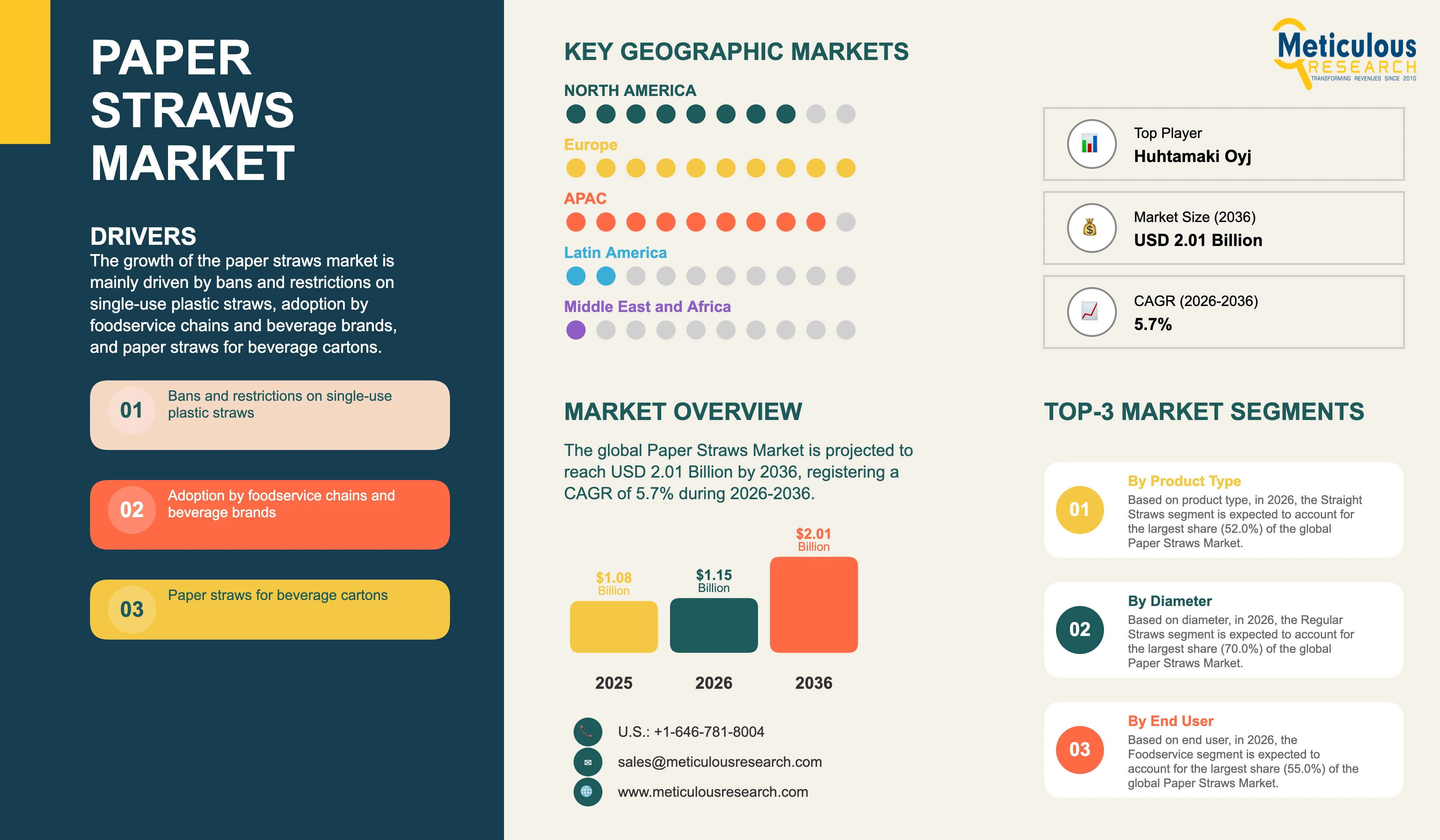
The global paper straws market was valued at USD 1.08 billion in 2025. This market is expected to reach USD 2.01 billion by 2036 from an estimated USD 1.15 billion in 2026, registering a CAGR of 5.7% during the forecast period (2026-2036). In terms of volume, this market is expected to reach 143.3 billion units by 2036 from an estimated 80.0 billion units in 2026, registering a CAGR of 6.0% during the forecast period.
- Published
- Nov 2026
- Pages
- 285
- Format
- PDF + Excel
- Report ID
- MROTH - 1042477
- Base year
- 2025
- 2025 · BASELINE
- $1.08B
- 2036
- $2.01B
- CAGR 2026–2036
- 5.7%
2025 baseline · 2026–2036 forecast at 5.7% CAGR · hover a bar for the value
Key highlights
The EU Single-Use Plastics Directive banned single-use plastic straws from July 2021, making Europe one of the largest markets for paper straws, while India banned single-use plastic items, including plastic straws, from July 2022, which led beverage companies to switch to paper straws for juice and dairy cartons.
China's National Development and Reform Commission banned non-degradable plastic straws in the catering industry from the end of 2020, which increased demand for paper and other alternative straws in the world's largest foodservice market.
In the U.S., President Trump signed Executive Order 14208 on February 10, 2025, ending federal procurement of paper straws and calling for a national strategy to end their use, although state and local restrictions on plastic straws in places such as California, Washington, New Jersey, and several cities remain in place.
A study by researchers at the University of Antwerp, published in 2023, detected PFAS chemicals in most of the paper straw brands tested in Belgium, which has increased pressure on producers to use PFAS-free coatings and adhesives, and the EU Packaging and Packaging Waste Regulation restricts PFAS in food-contact packaging from August 2026.
Beverage carton producers, such as Tetra Pak and SIG, have introduced paper straws for portion-pack cartons, which has created a large and growing market for U-shaped and telescopic paper straws in juice, dairy, and plant-based drinks.
Canada, Australia, New Zealand, and many countries in Africa, Latin America, and Southeast Asia have also introduced bans or restrictions on single-use plastic items, including straws, which has spread demand for paper straws well beyond Europe and North America.
Many coffee chains have adopted strawless lids for cold drinks and provide straws only on request, which reduces total straw use but means that most straws still provided in these outlets are made from paper or other non-plastic materials.
Paper straw producers have invested in new production lines in Europe, India, China, and Southeast Asia to meet demand from bans and from beverage and foodservice customers, which has increased capacity and reduced prices.
By product type, straight straws account for the largest share of 52.0% in 2026, while specialty straws register the highest CAGR.
By diameter, regular straws account for the largest share in 2026, while jumbo and wide straws register the higher CAGR.
By end user, foodservice accounts for the largest share of 55.0% in 2026, while beverage packaging registers the highest CAGR.
By geography, Europe accounts for the largest share of 34.0% in 2026, while Asia-Pacific registers the highest CAGR of 7.8%.
Report summary
| Particulars | Details |
|---|---|
| Base Year | 2025 |
| Estimated Year | 2026 |
| Forecast Period | 2026-2036 |
| Market Size in 2025 | USD 1.08 billion |
| Market Size in 2026 | USD 1.15 billion |
| Market Size by 2036 | USD 2.01 billion |
| CAGR (2026-2036), Value | 5.7% |
| Format | PDF, Excel & Cloud Portal · 285 pages |
| Market Volume (2026 to 2036) | 80.0 billion units to 143.3 billion units (CAGR 6.0%) |
| Largest Segment by Product Type (2026) | Straight Straws (52.0%) |
| Largest Segment by End User (2026) | Foodservice (55.0%) |
| Largest Region (2026) | Europe (34.0%) |
| Fastest-Growing Region | Asia-Pacific (CAGR 7.8%) |
| Segments Covered | Product Type, Diameter, End User, and Geography |
| Geographic Scope | Europe, Asia-Pacific, North America, Latin America, and Middle East and Africa |
| Key Companies Profiled | Huhtamaki, Tetra Pak, SIG Group, Hoffmaster Group (Aardvark Straws), Novolex (Eco-Products), Karat Packaging, Fuling Global, Transcend Packaging, BioPak, Biopac, Canada Brown Eco Products, Vegware, Stora Enso, and UFlex |
Report overview
Segments covered: product type, diameter, end user.
The growth of this market is mainly driven by bans and restrictions on single-use plastic straws in the European Union, India, China, and many other countries, the adoption of paper straws by quick-service restaurants, coffee chains, and beverage brands, the shift by beverage carton producers to paper straws for juice and dairy portion packs, growing consumer preference for plastic-free and recyclable products, and improvements in paper straw durability and food-safe, PFAS-free coatings. However, factors such as the higher cost of paper straws compared with plastic straws, consumer complaints about paper straws becoming soggy, concerns about PFAS and other chemicals in some paper straws, competition from alternative materials, such as plant-based plastics, bamboo, and strawless lids, and the reversal of anti-plastic straw policies in the U.S. federal government are expected to restrain the growth of this market to some extent. Value is expected to grow slightly more slowly than volume because average prices are expected to decline as production scales up, particularly in Asia.
Paper straws are drinking straws made from paper, usually several layers of food-grade paper wound in a spiral and bonded with food-safe adhesive, and sometimes coated to improve water resistance. They are used as an alternative to single-use plastic straws in restaurants, cafes, bars, quick-service restaurants, hotels, and events, and they are attached to beverage cartons, such as juice boxes and dairy portion packs. Paper straws are biodegradable, made from renewable fiber, and can be recycled or composted in some systems, which makes them a common replacement for plastic straws where plastic straws are banned or discouraged.
This market covers the global sales of paper straws, measured in value and volume. It includes straight straws, U-shaped and telescopic straws for beverage cartons, flexible straws, and specialty straws, such as cocktail and bubble tea straws, in regular and jumbo diameters, used in foodservice, beverage packaging, retail and household, and hospitality and events. It is segmented by product type, diameter, end user, and geography. Straws made from other materials, such as bamboo, wheat stems, plant-based plastics, metal, glass, and silicone, are not included.
Paper straws were widely used in the late nineteenth and early twentieth centuries before plastic straws became common, and they returned to widespread use in the late 2010s as governments, companies, and consumers sought to reduce plastic waste, particularly plastic pollution in oceans. Restrictions on single-use plastic straws in the European Union, India, China, Canada, Australia, and many U.S. states and cities, together with voluntary commitments by companies such as McDonald's in the U.K. and Starbucks, led to rapid growth in demand for paper straws.
Paper straws have faced criticism from consumers for becoming soft or soggy during use and for affecting the taste of drinks, and producers have responded by improving paper quality, adhesives, and the number of paper layers, and by developing new designs that last longer in drinks. Producers have also responded to concerns about PFAS, a group of chemicals used in some water-resistant coatings, by switching to PFAS-free coatings and adhesives and seeking food-contact certifications.
The market includes a range of producers, from large packaging companies, such as Huhtamaki, Tetra Pak, SIG, and Novolex, to specialist paper straw producers in Europe, North America, India, and China, many of which supply foodservice distributors, restaurant chains, and beverage brands. Paper suppliers, such as Stora Enso, provide specialized straw papers designed for strength and water resistance. Production is increasingly concentrated in Asia, where costs are lower, although producers in Europe and North America serve customers that prefer local supply.
Paper straw production uses specialized straw paper, often made from virgin fiber for strength and food safety, which is slit into narrow strips, coated with food-grade adhesive, and wound around a mandrel in several layers before being cut to length, dried, and packed. Production lines can be highly automated, and capacity has expanded rapidly in China and India. The number of paper layers, the type of paper and adhesive, and the curing process determine how long a straw lasts in a drink, and producers have increased the number of layers and improved adhesives to address consumer complaints about durability.
Prices for paper straws have declined as production has scaled up and competition has increased, particularly from Chinese and Indian producers, but paper straws remain more expensive than plastic straws. Prices vary by size, number of layers, printing, wrapping, and certification, with branded, individually wrapped, and jumbo straws commanding higher prices. As a result, market value is expected to grow slightly more slowly than volume.
Over the forecast period, the paper straws market is expected to grow steadily in volume and value, supported by plastic restrictions in Asia-Pacific, Latin America, and Africa, growth in beverage carton straws, improvements in product quality, and demand for specialty straws, while competition from alternative materials and strawless designs and policy changes in the U.S. may limit growth in some markets.
When plastic straws were banned, we had to find paper straws for billions of cartons almost overnight, and supply was very tight at first. Supply and quality have improved a lot since then as local production has grown.
This explains why beverage packaging is the fastest-growing end user and Asia-Pacific the fastest-growing region.
Wide paper straws were difficult at first because they softened before customers finished their drinks, but newer versions with more layers and sharper tips work well with tapioca pearls and sealed cups.
Growing bubble tea demand across Asia and other regions supports the strong growth of jumbo and specialty straws in this market.
Our hotels removed plastic straws across all outlets, and we now use paper straws on request. Guests accept them, especially the newer, stronger versions.
This reflects growing adoption in hospitality and in the Middle East.
Paper straws for home use sell steadily, especially printed and colored straws for parties and children. Customers want plastic-free options that look good and last through a drink.
Retail demand supports the retail and household segment.
Report infographic
Market dynamics
17 factors across 5 forcesBans and restrictions on single-use plastic straws
Government bans and restrictions on single-use plastic straws are the main driver of demand for paper straws. The EU Single-Use Plastics Directive banned plastic straws from July 2021, and similar bans have been introduced in the U.K., India, China, Canada, Australia, New Zealand, and many countries in Africa, Latin America, and Asia. In the U.S., states such as California, Washington, Oregon, New Jersey, and Vermont and many cities have restricted plastic straws, for example by requiring that straws be provided only on request or banning plastic straws altogether.
These rules require restaurants, cafes, beverage producers, and retailers to switch to alternatives, and paper straws have become the most common replacement because they are low in cost compared with other alternatives, widely available, and accepted by consumers and regulators. Europe accounts for the largest share of the market by region, reflecting the early introduction of the EU ban.
Regulations often apply to all single-use plastic items in foodservice, such as cutlery, stirrers, and cups, as well as straws, which means that paper straws are part of a broader shift to fiber-based foodservice packaging. In the EU, the Single-Use Plastics Directive also requires member states to reduce the consumption of single-use plastic cups and food containers, which has encouraged foodservice operators to adopt paper and other fiber-based products across their packaging ranges.
Adoption by foodservice chains and beverage brands
Large quick-service restaurant chains, coffee chains, and beverage brands have adopted paper straws to meet regulations and their own sustainability goals and to respond to consumer concerns about plastic waste. McDonald's switched to paper straws in the U.K. and Ireland in 2019, and many other chains in Europe, Asia, and other regions use paper straws as standard. The scale of these chains makes them major buyers of paper straws, often through long-term supply contracts with packaging companies.
Foodservice operators also use paper straws as part of broader efforts to reduce plastic packaging and to communicate their environmental commitments to customers. Foodservice accounts for the largest share of the market by end user.
Chains typically specify paper straws by size, color, number of layers, wrapping, and food-contact certifications, and many require suppliers to meet strict quality and safety standards, including PFAS-free coatings. The concentration of demand among large chains gives them strong bargaining power, which puts pressure on prices but also supports large, stable orders for qualified suppliers.
Paper straws for beverage cartons
Beverage cartons for juice, milk, plant-based drinks, and other beverages are often sold with an attached straw, and the shift from plastic to paper straws for these cartons has created a large new market. Tetra Pak and SIG have developed paper straws that can be attached to cartons and pierce the carton opening, including U-shaped and telescopic designs, and beverage brands in Europe, India, and other markets have adopted them to comply with plastic bans.
In India, the ban on plastic straws from July 2022 forced beverage companies to switch to paper straws for juice and dairy cartons, which created a sudden surge in demand and led to investment in domestic paper straw production. Beverage packaging is the fastest-growing end user in this market.
Carton straws require special designs, such as U-shaped straws that are folded and attached to the side of the carton and telescopic straws that extend when used, as well as strong tips that can pierce the carton opening. These designs are more complex to produce than standard straight straws and are made by specialist producers and carton companies, which has made this a higher-value segment of the market.
Consumer preference for plastic-free products
Many consumers, particularly younger consumers, prefer products and packaging that are plastic-free and recyclable, and they view paper straws as a more sustainable option. Media coverage of plastic pollution, particularly in oceans, has made plastic straws a symbol of single-use plastic waste, and many consumers choose businesses that avoid plastic.
Retailers also sell paper straws for home use, including printed and colored straws for parties and events, which supports demand in the retail and household segment.
Corporate sustainability goals also support demand, as many food and beverage companies have committed to eliminating unnecessary single-use plastics from their operations and packaging, and paper straws are one of the most visible ways to show progress to customers.
Table of contents
11 chapters · 118 sections · 285 pages · click to expandGeographic analysis
Europe
Largest shareIn 2026, Europe is expected to account for the largest share of 34.0% of the global paper straws market. The large share of this region is mainly due to the EU Single-Use Plastics Directive, which banned plastic straws from July 2021, the U.K. ban on plastic straws, the widespread use of paper straws in foodservice, and the adoption of paper straws on beverage cartons. Germany, the U.K., France, Italy, and Spain are among the largest markets in Europe, together accounting for most of the region's demand, with large foodservice sectors and beverage carton markets. European producers, such as Transcend Packaging, Biopac, and Huhtamaki, supply foodservice chains, and Tetra Pak and SIG supply carton straws to beverage brands. The EU's restrictions on PFAS in food-contact packaging are expected to shape product requirements. Europe is expected to remain one of the largest regions, although growth is expected to be slower than in emerging markets because the switch from plastic has largely been completed and many chains are reducing total straw use through strawless lids.
Asia-Pacific
Fastest growthAsia-Pacific is projected to register the highest CAGR of 7.8% during the forecast period. Growth is driven by plastic straw bans in India and China, growing foodservice and bubble tea markets, and new restrictions in Southeast Asia. In Asia-Pacific, India and China are the largest and fastest-growing national markets in the region, supported by plastic bans and large beverage and foodservice markets, while Japan, Australia, and Southeast Asia are growing markets.
North America
North America holds a significant share, supported by state and city restrictions, while Latin America and the Middle East and Africa are growing with new plastic bans, tourism, and the expansion of international foodservice chains. In North America, California, Washington, Oregon, New Jersey, and many cities have restricted plastic straws, and many foodservice chains use paper straws as standard, although the federal government ended its own procurement of paper straws in 2025. Canada has restricted single-use plastics, including straws, under federal regulations, and Mexico City and several Latin American cities have banned plastic straws.
Latin America
In Latin America, countries such as Chile, Colombia, Mexico, and Brazil have introduced restrictions on plastic straws at national or city level, and in the Middle East and Africa, countries such as the UAE, Saudi Arabia, Kenya, and South Africa have restricted single-use plastics, often starting with major cities and tourist areas.
Competitive landscape
The paper straws market is fragmented, with large packaging companies, beverage carton producers, foodservice packaging suppliers, specialist paper straw producers, and many small producers in China and India. Leading companies include Huhtamaki, Tetra Pak, SIG Group, Hoffmaster Group (Aardvark Straws), Novolex (Eco-Products), Karat Packaging, Fuling Global, Transcend Packaging, BioPak, Biopac, Canada Brown Eco Products, Vegware, Stora Enso, and UFlex.
Paper straw companies typically compete mainly on price, quality and durability, food safety and PFAS-free certification, customization and printing, production capacity, and relationships with foodservice chains and beverage brands.
Large packaging companies, such as Huhtamaki, Novolex, Karat Packaging, and Hoffmaster Group, supply paper straws alongside cups, lids, napkins, and other foodservice packaging, which allows them to serve large chains and distributors with a full range of products under one supply contract and delivery schedule. Tetra Pak and SIG supply paper straws for beverage cartons, while specialist producers, such as Transcend Packaging, Biopac, BioPak, Canada Brown Eco Products, and Vegware, focus on sustainable foodservice products. Fuling Global is a large producer of straws and foodservice disposables in China that exports to the U.S. and other markets, UFlex produces paper straws in India, and Stora Enso supplies specialized paper for straw production.
Consolidation is expected, as larger packaging companies acquire specialist producers to expand capacity and product ranges, and as smaller producers that cannot meet quality and certification requirements or compete on price exit the market.
The top five players are estimated to account for 26.0% of the paper straws market in 2025, reflecting the large number of small and regional producers, particularly in China and India, that supply local distributors and foodservice operators.
Players use several strategies to grow in this market, including expanding production capacity in Asia and Europe, developing durable and PFAS-free products, offering custom printing, partnering with beverage carton producers, and serving large foodservice chains under long-term contracts.
Competition is expected to center on cost, quality, and certification, and producers with large-scale, low-cost production and strong quality credentials are expected to gain share, while specialist producers can compete in premium, custom, and carton segments.
Some of the key players operating in the paper straws market are Huhtamaki Oyj, Tetra Pak International S.A., SIG Group AG, Hoffmaster Group, Inc. (Aardvark Straws), Novolex Holdings, LLC (Eco-Products), Karat Packaging Inc., Fuling Global Inc., Transcend Packaging Ltd., BioPak, Biopac (UK) Ltd., Canada Brown Eco Products Ltd., Vegware Ltd., Stora Enso Oyj, and UFlex Limited.
- —
The U.S. ended federal procurement of paper straws in February 2025, the EU restricted PFAS in food-contact packaging from August 2026, and producers expanded PFAS-free and durable paper straw ranges.
- Huhtamaki
- Tetra Pak
- SIG Group
- Hoffmaster Group · Aardvark Straws
- Novolex (Eco-Products)
- Karat Packaging
- Fuling Global
- Transcend Packaging
- BioPak
- Biopac
- Canada Brown Eco Products
- Vegware
- Stora Enso
- UFlex
Expert perspectives
The paper straws market has grown rapidly in response to plastic bans and is now entering a more mature phase in Europe, while growth is shifting to Asia-Pacific, Latin America, and Africa. Product quality and safety have become key issues, as consumers and regulators focus on durability and PFAS.
Over the forecast period, global volume is expected to grow at about 6.0% per year and value at about 5.7% per year across all regions, as prices decline with scale and competition. Growth will depend on the spread of plastic bans, beverage carton demand, and the competitiveness of paper straws against other alternatives.
Straight straws remain the largest product type, while specialty straws grow fastest. Foodservice is the largest end user, while beverage packaging grows fastest.
Europe remains the largest region, while Asia-Pacific is the fastest-growing region at a CAGR of 7.8%. The main swing factors are plastic regulations, U.S. policy, PFAS rules, and competition from alternatives.
For producers, the key priorities are improving durability, ensuring PFAS-free and food-safe products, reducing costs, and building capacity in growth markets such as India, China, and Southeast Asia.
The most important factors for the market over the next few years are the spread of plastic bans to new countries, the growth of carton-attached paper straws, and the response of producers to quality and safety concerns. If producers can make paper straws that perform well and are certified safe, they are likely to maintain their position as the main alternative to plastic straws. If not, other alternatives, such as plant-based plastics and strawless designs, may take share.
The U.S. policy change in 2025 shows that political support for paper straws can change, although regulations in Europe, India, China, and many other countries remain in place and are expanding. Price pressure from overcapacity in Asia is expected to continue, favoring large, low-cost producers, while producers in Europe and North America focus on quality, certification, customization, and local supply. Regulation on PFAS and food-contact materials will be an important factor in shaping the competitive landscape, as it raises the bar for product safety.
Beverage cartons are expected to be one of the most important growth areas, as more countries ban plastic straws on cartons and carton producers expand paper straw supply. Producers that can supply carton producers with high-quality U-shaped and telescopic straws at scale are expected to benefit.
Overall, paper straws are expected to remain the leading alternative to plastic straws in markets with plastic bans over the forecast period.
Customer perspectives
Procurement Manager - quick-service restaurant chain, U.K.
We switched to paper straws years ago because of the ban, and the latest straws last much longer, and we now require PFAS-free certification from all suppliers.
Foodservice demand explains why foodservice accounts for 55.0% of the market and Europe accounts for 34.0%.
Frequently asked questions
The market was valued at USD 1.08 billion in 2025 and USD 1.02 billion in 2024, and is estimated at USD 1.15 billion and 80.0 billion units in 2026.
Cite this report
Meticulous Research. (2026). Paper Straws Market - Global Opportunity Analysis and Industry Forecast (2026-2036) (Report No. MROTH - 1042477). Meticulous Market Research Pvt. Ltd. https://www.meticulousresearch.com/product/paper-straws-market-7160