Voluntary Carbon Market (2026-2036)
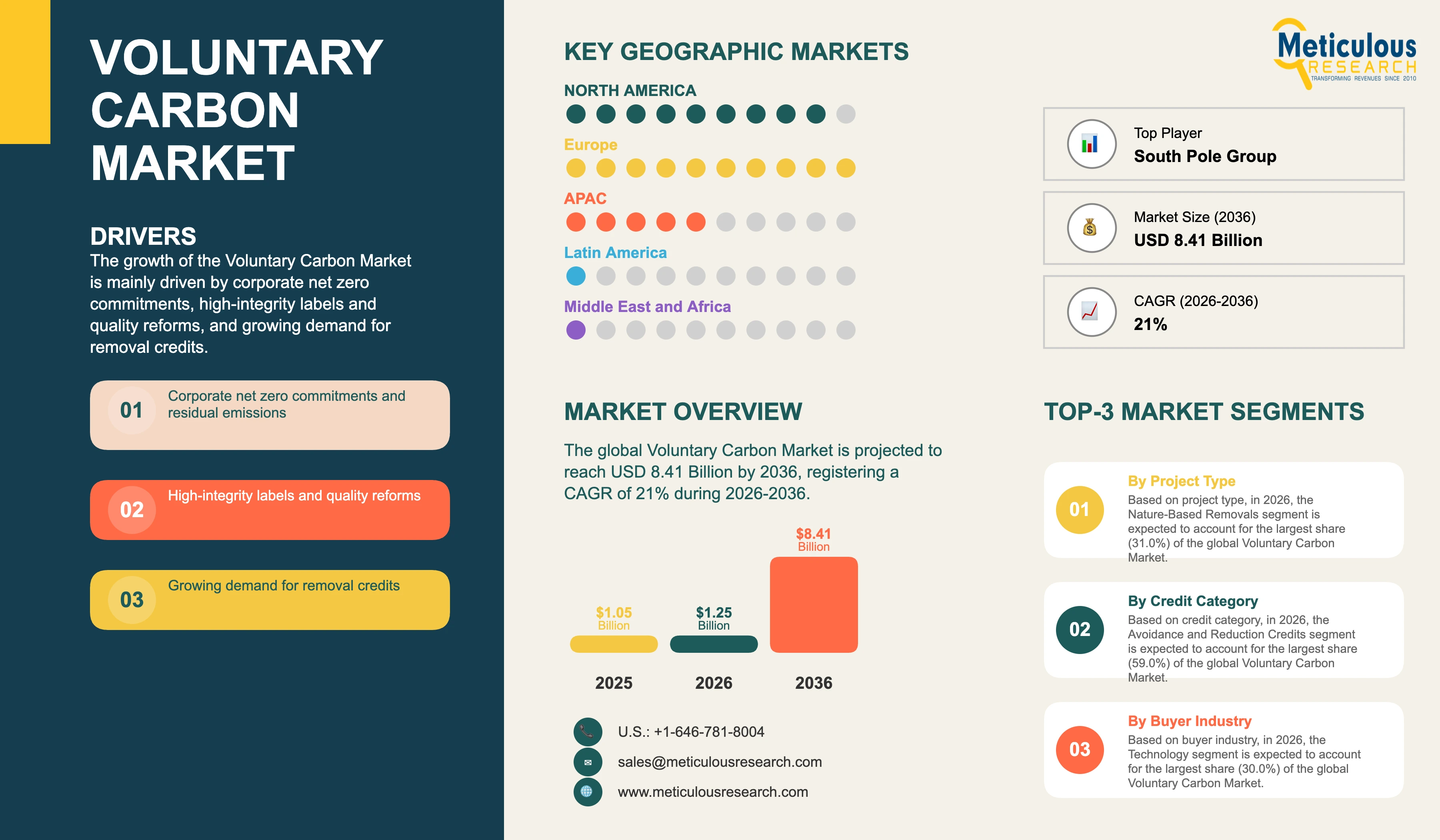
The global voluntary carbon market was valued at USD 1.05 billion in 2025. This market is expected to reach USD 8.41 billion by 2036 from an estimated USD 1.25 billion in 2026, registering a CAGR of 21.0% during the forecast period (2026-2036).
- Published
- Nov 2026
- Pages
- 256
- Format
- PDF + Excel
- Report ID
- MROTH - 1042526
- Base year
- 2025
- 2023 · HISTORICAL
- $723.0M
- 2036
- $8.41B
- CAGR 2026–2036
- 21.0%
2023–2025 baseline · 2026–2036 forecast at 21.0% CAGR · hover a bar for the value
Key highlights
Ecosystem Marketplace's State of the Voluntary Carbon Market 2025 report found that the value of voluntary carbon credit transactions fell by about 29% to USD 535 million in 2024, from USD 723 million in 2023, while traded volumes fell by about 25%, as buyers shifted toward fewer but higher-quality credits and average prices for nature-based removals rose.
Climate Focus estimated in its 2025 Voluntary Carbon Market Review that credit issuances fell by about 9% to around 263 million credits in 2025, while retirements were broadly stable at about 173 million credits, compared with about 176 million in 2024, showing that underlying corporate demand has held up despite market turbulence.
The Integrity Council for the Voluntary Carbon Market has approved several methodologies under its Core Carbon Principles, including jurisdictional REDD+, improved forest management, landfill gas, and some afforestation and reforestation methodologies, and credits carrying CCP labels have traded at a premium to unlabeled credits.
Microsoft, Google, Meta, Amazon, and other technology companies have become leading buyers of nature-based and technology-based removal credits through long-term agreements, and Microsoft signed several of the largest nature-based removal agreements on record in 2025 and early 2026.
The first phase of the International Civil Aviation Organization's CORSIA scheme, covering 2024 to 2026, requires airlines to offset emissions growth with eligible credits, and the limited supply of eligible credits with host country authorizations under Article 6 has created a price premium for these units.
Japan's GX emissions trading system became mandatory for large emitters from April 2026 and allows companies to use certain domestic and international credits toward part of their obligations, while Singapore allows companies to use eligible international credits to offset up to 5% of their taxable emissions under its carbon tax, creating new compliance-linked demand in Asia-Pacific. South Korea and Australia also allow certain offset credits within their domestic schemes, and several Asian exchanges have launched new credit trading products.
By project type, nature-based removals account for the largest share of 31.0% in 2026, while technology-based removals register the highest CAGR.
By credit category, avoidance and reduction credits account for the larger share in 2026, while removal credits register the higher CAGR.
By buyer industry, technology companies account for the largest share of 30.0% in 2026, while the aviation segment registers the highest CAGR.
By geography, Europe accounts for the largest share of 38.0% in 2026, while Asia-Pacific registers the highest CAGR of 26.9%.
Report summary
| Particulars | Details |
|---|---|
| Base Year | 2025 |
| Estimated Year | 2026 |
| Forecast Period | 2026-2036 |
| Market Size in 2025 | USD 1.05 billion |
| Market Size in 2026 | USD 1.25 billion |
| Market Size by 2036 | USD 8.41 billion |
| CAGR (2026-2036) | 21.0% |
| Format | PDF, Excel & Cloud Portal · 256 pages |
| Largest Segment by Project Type (2026) | Nature-Based Removals (31.0%) |
| Largest Segment by Buyer Industry (2026) | Technology (30.0%) |
| Largest Region (2026) | Europe (38.0%) |
| Fastest-Growing Region | Asia-Pacific (CAGR 26.9%) |
| Segments Covered | Project Type, Credit Category, Buyer Industry, and Geography |
| Geographic Scope | Europe, North America, Asia-Pacific, Latin America, and Middle East and Africa |
| Key Companies Profiled | South Pole, Climate Impact Partners, Xpansiv, AirCarbon Exchange, Verra, Gold Standard, ACT Group, Finite Carbon (BP), Shell, Respira International, Everland, Carbon Direct, Rubicon Carbon, Patch, and Isometric |
Report overview
Segments covered: project type, credit category, buyer industry.
The growth of this market is mainly driven by corporate net zero and climate neutrality commitments that require companies to address residual emissions, the rise of high-integrity credit labels such as the Core Carbon Principles of the Integrity Council for the Voluntary Carbon Market, growing demand for carbon removal credits, the use of credits in the aviation sector's CORSIA scheme, the operationalization of international crediting under Article 6 of the Paris Agreement, and new rules in countries such as Japan and Singapore that allow companies to use high-quality credits toward compliance obligations. However, factors such as concerns about the integrity of some credit types, the decline in prices and volumes after criticism of forestry and cookstove credits, uncertainty about how credits can be used under corporate climate standards, and fragmented market infrastructure are expected to restrain the growth of this market to some extent.
The voluntary carbon market is the market in which companies, organizations, governments, and individuals buy carbon credits voluntarily, rather than to meet a legal compliance obligation under an emissions trading system or carbon tax. Each carbon credit represents one tonne of carbon dioxide or equivalent greenhouse gas that has been avoided, reduced, or removed from the atmosphere by a certified project. Credits are issued by independent standards and registries, such as Verra, Gold Standard, the American Carbon Registry, Climate Action Reserve, Isometric, and Puro.earth, after the project's results have been verified by an accredited third party. When a buyer uses a credit to support a climate claim, the credit is retired in the registry so that it cannot be used again.
This market covers the global value of voluntary carbon credits sold to end buyers, including credits sold through primary sales by project developers, long-term offtake agreements, brokers and retailers, and exchanges, measured at the value of credits delivered or retired. It is segmented by project type, credit category, buyer industry, and geography, with geography based on the location of buyers. Credits used in national compliance schemes, such as the EU emissions trading system, and secondary trading between intermediaries that does not result in sales to end buyers are not included.
Carbon credits are generated by a wide range of projects that differ in method, cost, location, and the type of climate benefit they deliver. Avoidance and reduction projects prevent emissions that would otherwise occur, such as protecting forests from deforestation through REDD+ projects, distributing clean cookstoves to households, capturing methane from landfills and coal mines, and building renewable energy plants in developing countries. Removal projects take carbon dioxide out of the atmosphere, through nature-based methods such as afforestation, reforestation, and soil carbon, or through technology-based methods such as biochar, bioenergy with carbon capture and storage, enhanced weathering, and direct air capture.
The voluntary carbon market grew rapidly in 2021 and 2022, when many companies announced net zero targets and credit prices rose. In 2023 and 2024, the market went through a difficult period, as investigations by journalists and researchers raised concerns that some REDD+ forestry and cookstove credits had overstated their climate impact. According to Ecosystem Marketplace, transaction value fell to USD 535 million in 2024, and many buyers paused purchases or shifted toward higher-quality credits. However, Climate Focus found that retirements remained broadly stable in 2025, at about 173 million credits, which shows that a core group of buyers has continued to use credits as part of their climate strategies.
The market is now going through a period of reform focused on quality and integrity. The Integrity Council for the Voluntary Carbon Market has set the Core Carbon Principles, a global benchmark for high-integrity credits, and is assessing methodologies against them. The Voluntary Carbon Markets Integrity Initiative has published a Claims Code of Practice that guides how companies can credibly use credits in their climate claims. Rating agencies such as BeZero, Sylvera, and Calyx Global assess the quality of individual projects, and standards bodies have updated older methodologies, including Verra's new consolidated REDD+ methodology. These reforms are expected to rebuild buyer confidence and support higher prices for high-quality credits.
Policy developments are also reshaping the market and creating new sources of demand beyond voluntary corporate buyers. The Paris Agreement Crediting Mechanism under Article 6.4 has adopted its first standards and is expected to begin issuing credits, and countries are authorizing credits for international transfer under Article 6.2. Airlines must buy eligible credits under the first phase of CORSIA, which runs from 2024 to 2026. Japan's GX emissions trading system and Singapore's carbon tax allow companies to use certain international credits to meet part of their obligations, and Brazil, Colombia, South Africa, and other countries allow credits to be used under their carbon pricing systems. These developments blur the line between voluntary and compliance markets and are expected to bring new demand.
The market includes many types of participants across the value chain, from project origination to final retirement. Project developers and investors such as South Pole, Finite Carbon, Everland, and Respira International develop and finance projects, while retailers and solution providers such as Climate Impact Partners, Carbon Direct, Rubicon Carbon, and Patch help companies build credit portfolios. Exchanges and trading platforms such as Xpansiv and AirCarbon Exchange provide market infrastructure, trading firms such as ACT Group and energy companies such as Shell trade credits, and registries such as Verra and Gold Standard issue and track credits.
Over the forecast period, the voluntary carbon market is expected to recover and grow steadily, driven by demand for high-integrity credits, rapid growth in removal credits, CORSIA and Article 6 demand, and wider use of credits in compliance schemes. Europe is expected to remain the largest buyer region, while Asia-Pacific is expected to grow fastest at a CAGR of 26.9%.
After the criticism of some forestry credits, we reduced our purchases and changed our claims. Now we buy only highly rated or CCP-labeled credits, and we describe them as a contribution to climate action rather than as offsetting.
This explains why buyers across Europe are shifting toward high-quality credits and why Europe remains the largest buyer region despite tighter rules on claims.
CORSIA-eligible credits are scarce and expensive, so we are signing forward agreements to secure supply for the coming years.
This explains why aviation is the fastest-growing buyer industry, why authorized credits command a premium, and why Asia-Pacific is the fastest-growing region.
Report infographic
Market dynamics
16 factors across 5 forcesCorporate net zero commitments and residual emissions
Thousands of companies have committed to net zero or carbon neutrality targets, and many use carbon credits to address emissions they cannot yet eliminate. Standards such as the Science Based Targets initiative's Corporate Net-Zero Standard require companies to reduce emissions deeply and neutralize residual emissions with carbon removals by their net zero date, and the draft revision of the standard published in 2025 recognizes a greater role for credits in addressing ongoing emissions. The Voluntary Carbon Markets Integrity Initiative's Claims Code of Practice also provides a framework for companies that want to go beyond their value chain targets by buying high-quality credits.
Large corporate buyers, especially in the technology, consumer goods, financial services, and energy sectors, continue to retire significant volumes of credits each year. Technology companies have become the largest buyers by value, mainly because they buy higher-priced removal credits through long-term agreements. As more companies approach their interim targets in 2030, and as residual emissions become clearer, demand for credits is expected to increase. Technology companies account for the largest share of the market by buyer industry. Many companies are also adopting internal carbon prices and contribution claims, which create a steady annual budget for credit purchases that is less exposed to short-term changes in sentiment.
High-integrity labels and quality reforms
The Integrity Council for the Voluntary Carbon Market's Core Carbon Principles have created a global benchmark for high-quality credits, and methodologies such as jurisdictional REDD+, improved forest management, landfill gas, and certain afforestation and reforestation approaches have been approved. Credits that carry CCP labels have traded at a premium, and many buyers now specify CCP-approved or highly rated credits in their procurement. Standards bodies have also updated their methodologies to address past problems with baselines, leakage, and permanence.
Rating agencies such as BeZero, Sylvera, and Calyx Global, and improved monitoring tools based on satellite data, are giving buyers more information about project quality. These reforms are rebuilding confidence after the criticism of 2023 and 2024 and are expected to support higher average prices and greater participation by cautious buyers over the forecast period. Corporate buyers, especially large listed companies that face scrutiny from investors and regulators, increasingly require at least one independent rating and, where available, a CCP label before they approve purchases, which rewards developers that invest in quality.
Growing demand for removal credits
Demand for carbon removal credits is growing rapidly, as buyers seek credits that physically remove carbon dioxide from the atmosphere and that align with net zero standards. Microsoft, Google, Meta, Amazon, Salesforce, and other technology companies have signed long-term agreements for afforestation and reforestation, biochar, enhanced weathering, and other removal credits, and coalitions such as Frontier and the Symbiosis Coalition have pooled demand from many companies.
Removal credits typically command much higher prices than avoidance credits, so their growing share of purchases increases the value of the market even when volumes are stable. Removal credits form the faster-growing credit category in this market, and technology-based removals are the fastest-growing project type. As more removal projects begin delivering credits that were contracted in 2024 and 2025, the value of removal credits retired each year is expected to rise sharply. Smaller buyers are also entering the removal market through retailers and platforms such as Patch and Carbon Direct, which bundle credits from several projects into ready-made portfolios.
CORSIA, Article 6, and compliance links
The first phase of CORSIA, covering 2024 to 2026, requires airlines to offset growth in international aviation emissions above a baseline using eligible credits, and later phases from 2027 will apply to most international flights. Eligible credits must come from approved programs and carry host country authorizations and corresponding adjustments under Article 6, which has created a separate, higher-priced segment of the market.
Article 6.2 bilateral agreements and the Paris Agreement Crediting Mechanism under Article 6.4 are creating new channels for high-quality credits, while Japan, Singapore, South Korea, Colombia, South Africa, and other countries allow credits to be used under domestic carbon pricing systems. Aviation is the fastest-growing buyer industry in this market, with demand for CORSIA-eligible credits expected to rise sharply in the second phase, and Asia-Pacific is the fastest-growing region, helped by Japan's GX emissions trading system and Singapore's carbon tax.
Table of contents
11 chapters · 111 sections · 256 pages · click to expandSegmental analysis
| Segment | Largest share (2026) | Fastest growth (2026–2036) |
|---|---|---|
| By Project Type | Nature-based removals | Technology-based removals |
| By Credit Category | — | — |
| By Buyer Industry | Technology | Aviation |
By Project Type
- Voluntary Carbon Market Analysis by Project Type
- The nature-based removals segment is expected to account for the largest share of 31.0% of the market.
- The large share of this segment is mainly due to strong demand from technology companies and other buyers for afforestation, reforestation, and improved forest management credits, the higher prices these credits command compared with avoidance credits, the large multi-million-tonne agreements signed by Microsoft and others, and the strong co-benefits that these projects provide for biodiversity, water, and local communities.
- Nature-based removal projects plant trees on degraded or deforested land, restore native forests, improve forest management, and increase carbon in soils and wetlands.
- Large developers in Brazil, the U.S., Africa, and Asia, such as Mombak, re.green, Chestnut Carbon, and many smaller community-based developers, have attracted long-term agreements from technology companies and buyer coalitions such as the Symbiosis Coalition, which focuses on high-quality nature restoration.
- Methodologies for afforestation, reforestation, and revegetation have been assessed under the Core Carbon Principles, and developers are increasingly using native species, remote sensing, and buffer pools to address permanence and measurement concerns.
- Nature-based removals are expected to remain the largest project type over the forecast period, as buyers seek removal credits at lower cost than technology-based methods.
- Improved forest management projects in the U.S. and Canada, developed by companies such as Finite Carbon, also contribute to this segment and supply credits to both voluntary buyers and the California compliance market.
- Blue carbon projects that restore mangroves and seagrasses are a smaller but fast-growing part of the segment, attracting buyers because of their strong coastal protection and biodiversity benefits.
- Soil carbon and agricultural projects are also growing, supported by large agreements such as Microsoft's purchase of soil carbon credits from Indigo Ag in January 2026.
- Nature-based avoidance credits, mainly from REDD+ forest protection projects, remain a major segment by value, although their share has fallen after integrity concerns about older project-level credits.
- Jurisdictional REDD+ programs and updated methodologies are expected to support the recovery of this segment.
- Household devices and community projects, such as clean cookstoves and water purifiers, provide strong social benefits but have faced scrutiny over usage and baseline assumptions, and new methodologies with stricter monitoring have been introduced.
- However, the technology-based removals segment is projected to register the highest CAGR during the forecast period.
- The rapid growth of this segment is mainly driven by long-term purchases of biochar, enhanced weathering, BECCS, and direct air capture credits by technology companies and buyer coalitions, the delivery of contracted volumes as new plants begin operation, and buyer preferences for durable storage.
- Waste and methane abatement projects, such as landfill gas capture, are expected to grow steadily because of their measurable impact and CCP approvals, while renewable energy credits are expected to decline in relevance as many standards no longer accept new projects in most countries.
- Industrial and other projects, including the destruction of industrial gases and carbon capture at industrial sites, make up the rest of the market.
- These projects generally trade at lower prices but provide measurable and verifiable emission reductions.
By Credit Category
- Voluntary Carbon Market Analysis by Credit Category
- The avoidance and reduction segment is expected to account for the larger share of the market.
- The large share of this segment is mainly due to the large volume of credits issued by forest protection, cookstove, methane, and renewable energy projects, which still make up most credits retired each year.
- However, the removal credits segment is projected to register the higher CAGR during the forecast period.
- This segment's growth is mainly driven by corporate net zero standards that require removals for neutralization, the higher prices of removal credits, large long-term agreements by technology companies, and the delivery of technology-based removals as projects scale.
- Many buyers now combine avoidance credits for near-term climate contributions with removal credits that address long-term residual emissions.
- Removal credits already account for a much larger share of market value than of credit volume, because they sell at significantly higher prices than most avoidance credits, and this difference is expected to persist over the forecast period.
By Buyer Industry
- Voluntary Carbon Market Analysis by Buyer Industry
- The technology segment is expected to account for the largest share of 30.0% of the market.
- The large share of this segment is mainly due to large long-term purchases of removal credits by Microsoft, Google, Meta, Amazon, Salesforce, and other technology companies, which have ambitious climate goals, strong financial resources, and rising emissions from data centers and artificial intelligence workloads.
- Technology companies typically buy high-priced removal credits, so their share of the market by value is larger than their share by volume.
- Many also participate in buyer coalitions, such as Frontier and the Symbiosis Coalition, that support new project types and set quality standards.
- Their demand has helped sustain the market during the downturn in avoidance credit prices, and technology is expected to remain the largest buyer industry over the forecast period.
- However, the aviation segment is projected to register the highest CAGR during the forecast period.
- This segment's growth is mainly driven by CORSIA requirements, which oblige airlines to buy eligible credits for growth in international aviation emissions, the expansion of CORSIA to more flights in its second phase from 2027, and voluntary programs that allow passengers and corporate travel customers to support carbon credits.
- Energy and oil and gas companies, consumer goods and retail companies, financial services firms, and other industries make up the rest of the market, with energy companies acting both as buyers and as traders and developers of credits.
- Consumer goods and retail companies often buy credits linked to their supply chains, such as agriculture and forestry projects in sourcing regions, and financial services firms are increasingly buying credits and financing projects at the same time.
Geographic analysis
Europe
Largest shareIn 2026, Europe is expected to account for the largest share of 38.0% of the global voluntary carbon market. The large share of this region is mainly due to the large number of European companies with net zero and carbon neutrality commitments, strong corporate sustainability reporting requirements, the presence of major airlines, energy companies, consumer goods companies, and financial institutions that buy credits, and the location of leading project developers, retailers, and trading firms such as South Pole, Climate Impact Partners, ACT Group, and Shell. European buyers have long been among the most active in the voluntary carbon market, and many have shifted their portfolios toward high-quality removal credits and CCP-labeled credits in response to integrity concerns and new EU rules on environmental claims. Countries such as Switzerland, Sweden, and Norway are also buying Article 6 credits to meet national targets, which adds government demand. Europe is expected to remain the largest buyer region throughout the forecast period, although its share is expected to decline gradually as demand grows faster in other regions.
North America
North America is the second-largest buyer region, driven by very large removal credit purchases by U.S. technology companies and by buyers in the energy, financial services, and consumer goods sectors.
Asia-Pacific
Fastest growthAsia-Pacific is projected to register the highest CAGR of 26.9% during the forecast period. The rapid growth of this region is mainly driven by Japan's GX emissions trading system, which allows companies to use certain credits, Singapore's carbon tax, which allows companies to use eligible international credits for part of their liability, growing corporate net zero commitments in Japan, South Korea, Australia, and India, and the expansion of regional exchanges and trading hubs such as AirCarbon Exchange in Singapore.
Latin America
Latin America and the Middle East and Africa are mainly supply regions for carbon credits, but buyer demand is growing in Brazil, Colombia, Chile, and the Gulf countries, supported by domestic carbon pricing systems and national climate commitments. Gulf countries such as Saudi Arabia and the UAE have launched regional carbon trading platforms, which are expected to increase local demand over the forecast period. Brazil's new regulated carbon market law is also expected to create domestic demand for credits from Brazilian projects.
Competitive landscape
The voluntary carbon market is fragmented, with many project developers, investors, retailers, exchanges, trading firms, and registries. Leading companies include project developers and investors such as South Pole, Finite Carbon, Everland, and Respira International; retailers and solution providers such as Climate Impact Partners, Carbon Direct, Rubicon Carbon, and Patch; exchanges and trading platforms such as Xpansiv and AirCarbon Exchange; trading firms and energy companies such as ACT Group and Shell; and standards and registries such as Verra, Gold Standard, and Isometric.
Companies compete on credit quality, project pipeline, price, portfolio breadth, buyer relationships, and the ability to provide due diligence, ratings, and claims guidance. Buyers increasingly look for partners that can deliver CCP-labeled or highly rated credits, provide transparent information on project performance, and help them manage reputational risk. Developers with large pipelines of high-quality removal projects and trusted relationships with major buyers hold a strong position.
The top five players are estimated to account for 25.0% of the voluntary carbon market in 2025. This low concentration reflects the large number of project developers and intermediaries and the mainly over-the-counter nature of transactions.
Players use several strategies to grow in this market, including long-term offtake and streaming agreements with project developers, investment in new removal projects, partnerships with technology and rating companies, expansion into Article 6 and CORSIA-eligible credits, development of exchange-traded and standardized products, and acquisitions. For example, Rubicon Carbon and other well-funded companies have built portfolios of high-quality credits, and energy companies have expanded their nature-based project businesses, as BP has done through Finite Carbon.
Competition is expected to center on quality, transparency, and access to removal and authorized credits, and the market is expected to consolidate gradually as larger players acquire smaller developers and intermediaries with strong pipelines. Registries and standards bodies, including Verra, Gold Standard, and newer registries such as Isometric, are also competing to approve their methodologies under the Core Carbon Principles and to become approved programs under CORSIA and Article 6, which will influence which credits buyers prefer. Technology providers and rating agencies that offer digital monitoring, ratings, and portfolio management tools are becoming important partners for both developers and buyers.
Some of the key players operating in the voluntary carbon market are South Pole Group, Climate Impact Partners, Xpansiv Ltd., AirCarbon Exchange, Verra, The Gold Standard Foundation, ACT Group, Finite Carbon (BP p.l.c.), Shell plc, Respira International, Everland, Carbon Direct Inc., Rubicon Carbon, Patch Technologies, Inc., and Isometric.
- —
The ICVCM approved several methodologies under the Core Carbon Principles, Climate Focus reported stable retirements of about 173 million credits in 2025, Article 6.4 standards were adopted, and Microsoft signed several of the largest nature-based removal agreements on record. Japan's GX emissions trading system also became mandatory for large emitters in April 2026, allowing the use of certain credits.
- South Pole
- Climate Impact Partners
- Xpansiv
- AirCarbon Exchange
- Verra
- Gold Standard
- ACT Group
- Finite Carbon (BP)
- Shell
- Respira International
- Everland
- Carbon Direct
- Rubicon Carbon
- Patch
- Isometric
Expert perspectives
The voluntary carbon market has been through a difficult period, with integrity concerns, falling prices, and lower transaction values in 2023 and 2024. However, the market has not collapsed, since retirements have remained broadly stable, and it is now being rebuilt around higher quality standards, stronger governance, and closer links with compliance markets. We believe the market has passed its low point and is entering a period of steady, quality-driven recovery.
Over the forecast period, the market is expected to grow at a CAGR of 21.0%, driven mainly by rising average prices as buyers shift toward high-quality and removal credits, rather than by large increases in credit volumes. CORSIA, Article 6, and national compliance schemes in Asia-Pacific and Latin America are expected to add a growing layer of demand that is less exposed to changes in corporate sentiment.
Nature-based removals are the largest project type, supported by strong demand from technology companies, while technology-based removals grow fastest as new projects deliver. Technology companies remain the largest buyers, while aviation is the fastest-growing buyer industry because of CORSIA.
Europe remains the largest buyer region, while Asia-Pacific is the fastest-growing region at a CAGR of 26.9%, helped by Japan and Singapore's policies that allow credits in compliance schemes.
For project developers, the key priorities are to meet the Core Carbon Principles, improve measurement and transparency, secure host country authorizations where relevant, and build long-term relationships with buyers. For intermediaries and exchanges, the priorities are to provide trusted ratings, standardized products, and better price transparency. For buyers, the key is to build portfolios that balance cost, quality, and climate impact, and to align their claims with emerging standards. Companies that combine high integrity with reliable delivery are expected to gain the most as the market recovers.
The main risks to this outlook are further integrity scandals, slow progress on corporate climate standards, and political changes that weaken climate commitments. Strong progress on CCP labeling, CORSIA demand, and Article 6 transactions would support growth at the upper end of expectations. In our view, the market will increasingly split into two tiers: a premium tier of high-integrity, removal, and authorized credits with rising prices and strong demand, and a lower tier of older avoidance credits with weak prices. Value growth will come mainly from the premium tier, and companies positioned in it are expected to outperform the overall market. We also expect more transparency in pricing and contracts over the forecast period, as exchanges, standardized products, and public disclosure of corporate retirements become more common.
Customer perspectives
Buyers of voluntary carbon credits usually purchase through retailers, brokers, exchanges, or direct agreements with project developers, and they assess credits on quality ratings, CCP labels, co-benefits, price, delivery risk, and alignment with their climate claims. Their comments show why technology companies and removal credits now drive much of the market's value.
Head of Carbon Markets - technology company, U.S.
Our portfolio is now built mainly around removal credits with strong verification and long-term contracts, and we are willing to pay much more for credits that are measurable and durable, and we use independent ratings and site visits before we sign. Our purchases have to stand up to scrutiny from investors and the public.
This explains why technology companies account for 30.0% of the market by buyer industry and why nature-based removals hold the largest share by project type.
Frequently asked questions
The market was valued at USD 1.05 billion in 2025 and USD 0.87 billion in 2024, and is estimated at USD 1.25 billion in 2026. These values cover credits sold to end buyers through primary sales, offtake agreements, retailers, and exchanges.
Cite this report
Meticulous Research. (2026). Voluntary Carbon Market - Global Opportunity Analysis and Industry Forecast (2026-2036) (Report No. MROTH - 1042526). Meticulous Market Research Pvt. Ltd. https://www.meticulousresearch.com/product/voluntary-carbon-market-7209