Home Dialysis Market (2026-2036)
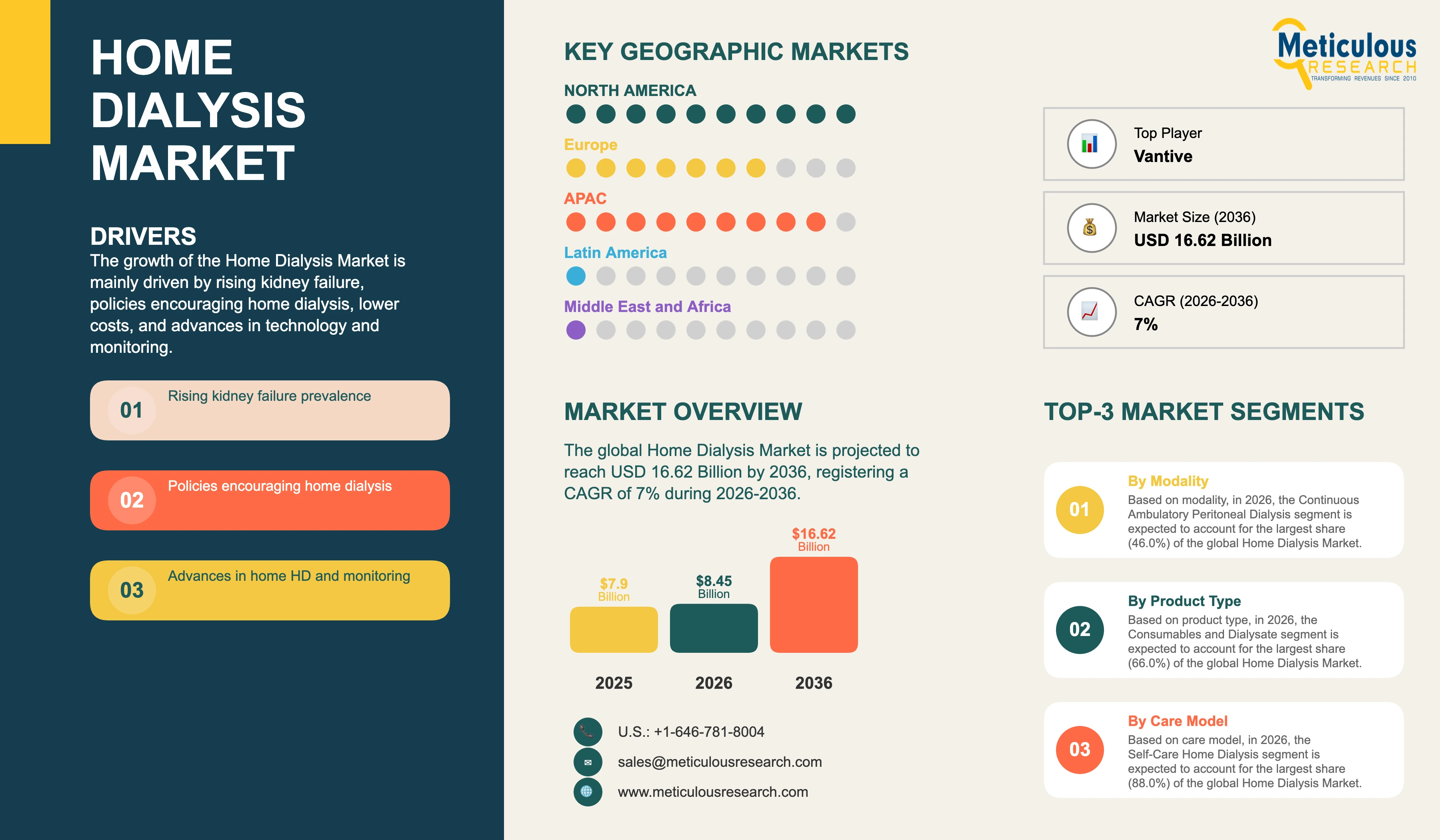
The global home dialysis market was valued at USD 7.90 billion in 2025. This market is expected to reach USD 16.62 billion by 2036 from an estimated USD 8.45 billion in 2026, registering a CAGR of 7.0% during the forecast period (2026-2036).
- Published
- Nov 2026
- Pages
- 267
- Format
- PDF + Excel
- Report ID
- MRHC - 1042628
- Base year
- 2025
- 2025 · BASELINE
- $7.90B
- 2036
- $16.62B
- CAGR 2026–2036
- 7.0%
2025 baseline · 2026–2036 forecast at 7.0% CAGR · hover a bar for the value
Key highlights
Approximately 4 million people worldwide receive dialysis treatment for chronic kidney disease, and access to this life-sustaining treatment varies across regions, according to Vantive, the kidney care company formerly operated as Baxter's Kidney Care segment.
A study published in April 2026 of 795, 232 people with kidney failure found that the rate of home dialysis increased from 12.8% to 16.7% of patient-months in regions assigned to the U.S. Centers for Medicare & Medicaid Services' End-Stage Renal Disease Treatment Choices model and from 13.7% to 17.3% in control regions between 2017 and September 2024, concluding that the model was not associated with meaningful increases in home dialysis beyond the broader upward trend, according to the published abstract.
Vantive launched as a standalone vital organ therapy company in February 2025 after its acquisition by funds managed by Carlyle from Baxter, with more than 23,000 employees, and said that the use of its remote patient monitoring technology has been associated with lower all-cause mortality, fewer hospitalizations, reduced treatment drop-out, and greater adherence for home dialysis, according to the company. The business had 2023 revenues of USD 4.5 billion, according to Pharmaceutical Technology.
The ETC model, which applies to a randomly selected group of U.S. regions covering about 30% of dialysis facilities, provides payment adjustments to dialysis facilities and managing clinicians based on their home dialysis and transplant rates and is scheduled to run through 2027, according to Healio, as part of the Advancing American Kidney Health initiative's goal of having most new kidney failure patients receive home dialysis or a transplant.
In August 2026, 70 nephrology fellows were selected for the American Society of Nephrology's 2026-2027 Home Dialysis Scholarship Program, reflecting continued efforts to train nephrologists in home dialysis, according to Home Dialysis Central.
Peritoneal dialysis, which uses the lining of the abdomen as a natural filter, accounts for the large majority of home dialysis patients worldwide, and several Asian countries and regions, including Hong Kong and Thailand, have adopted PD-first policies that make peritoneal dialysis the default modality for new dialysis patients, which has resulted in some of the highest peritoneal dialysis rates in the world.
By modality, continuous ambulatory peritoneal dialysis account for the largest share in 2026, while home hemodialysis register the highest CAGR.
By product type, consumables and dialysate accounts for the largest share of 66.0% in 2026, while services and remote monitoring registers the highest CAGR.
By care model, self-care home dialysis account for the larger share in 2026, while assisted home dialysis register the higher CAGR.
By end user, dialysis clinics and service providers account for the largest share of 64.0% in 2026, while home care agencies and other end users register the highest CAGR.
By geography, North America accounts for the largest share of 36.0% in 2026, while Asia-Pacific registers the highest CAGR of 8.4%.
Report summary
| Particulars | Details |
|---|---|
| Base Year | 2025 |
| Estimated Year | 2026 |
| Forecast Period | 2026-2036 |
| Market Size in 2025 | USD 7.90 billion |
| Market Size in 2026 | USD 8.45 billion |
| Market Size by 2036 | USD 16.62 billion |
| CAGR (2026-2036) | 7.0% |
| Format | PDF, Excel & Cloud Portal · 267 pages |
| Largest Segment by Product Type (2026) | Consumables and Dialysate (66.0%) |
| Largest Segment by End User (2026) | Dialysis Clinics and Service Providers (64.0%) |
| Largest Region (2026) | North America (36.0%) |
| Fastest-Growing Region | Asia-Pacific (CAGR 8.4%) |
| Companies Profiled | 13 companies and other companies |
| Segments Covered | Modality, Product Type, Care Model, End User, Geography |
| Countries Covered | U.S., Canada, Rest of North America, Germany, U.K., France, Italy, Spain, Netherlands, Switzerland, Belgium, Sweden, Denmark, Norway, Finland, Austria, Poland, Ireland, Rest of Europe, China, Japan, India, South Korea, Australia, Thailand, Hong Kong, Indonesia, Singapore, Malaysia, Vietnam, Philippines, Taiwan, New Zealand, Rest of Asia-Pacific, Mexico, Brazil, Argentina, Colombia, Guatemala, Chile, Peru, Rest of Latin America, Saudi Arabia, U.A.E., South Africa, Egypt, Israel, Turkey, Rest of Middle East & Africa |
Report overview
Segments covered: modality, product type, care model.
The growth of this market is mainly driven by the rising prevalence of chronic kidney disease and kidney failure, driven by diabetes, hypertension, and aging populations, government policies and payment models that encourage home dialysis, such as the U.S. End-Stage Renal Disease Treatment Choices model and PD-first policies in several Asian countries, the lower cost of home dialysis compared with in-center hemodialysis for health systems, patient preference for flexibility and independence, advances in home hemodialysis machines, automated peritoneal dialysis cyclers, and remote patient monitoring, and capacity constraints and staffing shortages at in-center dialysis facilities. However, factors such as limited patient education and awareness of home options, high rates of technique failure and dropout, the burden on patients and caregivers, the need for suitable home environments and water supplies, and inconsistent reimbursement and limited infrastructure in many countries are expected to restrain the growth of this market to some extent.
Dialysis is a life-sustaining treatment for people with kidney failure, also known as end-stage kidney disease, whose kidneys can no longer remove waste and excess fluid from the blood. Most dialysis patients worldwide receive in-center hemodialysis, in which patients travel to a dialysis clinic three times a week for treatment sessions of several hours. Home dialysis allows patients to perform dialysis at home, either through peritoneal dialysis, which uses the lining of the abdomen as a filter and a dialysis solution that is exchanged manually or by a machine, or through home hemodialysis, which uses a home-friendly hemodialysis machine to filter the blood.
This report covers the global home dialysis market, including continuous ambulatory peritoneal dialysis, in which patients perform manual exchanges of dialysis solution several times a day, automated peritoneal dialysis, in which a cycler performs exchanges automatically, usually overnight, and home hemodialysis. The market includes consumables and dialysate, such as peritoneal dialysis solutions, bags, tubing, transfer sets, catheters, dialyzers, and bloodlines used at home, machines and cyclers, such as automated peritoneal dialysis cyclers and home hemodialysis machines, and services and remote monitoring, such as home training, remote patient monitoring platforms, technical support, and assisted home dialysis services. The market is analyzed by modality, product type, care model, and geography. In-center hemodialysis products and dialysis provider service revenue for in-center treatments are analyzed in separate reports. The market is measured on a revenue basis at manufacturer and service provider selling prices, on a sales basis in each country.
Home dialysis offers several important clinical and lifestyle advantages for suitable patients and their families. Patients can schedule treatments around work, family, and other activities, avoid travel to dialysis centers, and in some cases dialyze more frequently or for longer periods, which may improve fluid control, blood pressure, and quality of life. Peritoneal dialysis also preserves residual kidney function longer than hemodialysis in many patients. For health systems, home dialysis can reduce costs, particularly in countries where in-center hemodialysis is expensive, and reduce pressure on in-center capacity and staff.
Despite these advantages, home dialysis remains significantly underused in many countries, including the U.S. In the U.S., the share of patients on home dialysis has been increasing but remains below the levels seen in some other countries. A study published in April 2026 found that the home dialysis rate increased to 16.7% to 17.3% of patient-months by 2024 in the regions studied. In contrast, countries and regions with PD-first policies, such as Hong Kong, Thailand, and Mexico, have very high peritoneal dialysis rates. Barriers to home dialysis include limited patient education, late referral to nephrologists, urgent starts on in-center hemodialysis, lack of trained staff, and concerns about patient and caregiver burden.
Continuous ambulatory peritoneal dialysis accounts for the largest share of the market by modality, while home hemodialysis is the fastest-growing modality. Consumables and dialysate account for the largest share by product type, while services and remote monitoring are the fastest-growing product type. Self-care home dialysis accounts for the largest share by care model, while assisted home dialysis is the fastest-growing care model. Dialysis clinics and service providers are the largest end user, while home care agencies and other end users are the fastest-growing end user. North America accounts for the largest share of the market, while Asia-Pacific is the fastest-growing region.
The market is concentrated among a small number of large kidney care companies, led by Fresenius Medical Care, which offers home hemodialysis through NxStage and peritoneal dialysis products, and Vantive, the former Baxter Kidney Care business, which is the leading supplier of peritoneal dialysis products globally. Other important players include B. Braun, Nipro, JMS, Terumo, and Nikkiso, as well as innovative companies such as Outset Medical, Quanta Dialysis Technologies, Mozarc Medical, AWAK Technologies, and Diality, which are developing new home hemodialysis and portable dialysis systems. Dialysis service providers such as DaVita play a key role in training and supporting home dialysis patients.
Technology is an increasingly important driver of the home dialysis market and of patient acceptance. Newer home hemodialysis machines are smaller, easier to use, and in some cases can produce dialysate from tap water, reducing the need for supplies. Automated peritoneal dialysis cyclers increasingly include remote patient monitoring, which allows clinicians to review treatment data and adjust prescriptions without in-person visits. Wearable and portable dialysis devices in development could further transform home dialysis.
Over the forecast period, the home dialysis market is expected to grow steadily, supported by the rising number of patients with kidney failure, government policies encouraging home dialysis, technological advances, and the expansion of assisted home dialysis models. The pace of growth will depend on reimbursement, patient education and referral practices, the availability of trained staff, and the success of new technologies.
North America is expected to account for the largest share of 36.0% of the market in 2026, mainly due to the large U.S. dialysis population, high reimbursement, policies encouraging home dialysis, and the presence of major kidney care companies.
Asia-Pacific is projected to register the highest CAGR of 8.4% during the forecast period, driven by the rapidly growing number of kidney failure patients, PD-first policies, government efforts to expand dialysis access, and regional manufacturers.
The report profiles 13 companies, including Fresenius Medical Care, Vantive, B. Braun, Nipro, Outset Medical, Quanta Dialysis Technologies, Mozarc Medical, JMS, Terumo, Nikkiso, AWAK Technologies, Diality, and DaVita.
A study published in April 2026 found that home dialysis rates rose from 12.8% to 16.7% in ETC regions and from 13.7% to 17.3% in control regions, concluding that the model was not associated with meaningful increases in home dialysis or kidney transplant.
Approximately 4 million people worldwide receive dialysis treatment for chronic kidney disease, according to Vantive, and the number is growing as diabetes and hypertension rates rise and populations age.
A PD-first policy makes peritoneal dialysis the default modality for new dialysis patients unless there is a medical reason to choose hemodialysis. Hong Kong and Thailand have adopted PD-first policies, which have resulted in high peritoneal dialysis rates.
In 2026, the self-care home dialysis segment is expected to account for the larger share of the home dialysis market, while the assisted home dialysis segment is projected to register the higher CAGR during the forecast period.
What comes next: Home Dialysis Technologies and Portable Kidney Replacement, a Meticulous Next™ foresight brief.
Report infographic
Market dynamics
18 factors across 5 forcesRising prevalence of chronic kidney disease and kidney failure
The number of people with chronic kidney disease and kidney failure is increasing worldwide, driven by the rising prevalence of diabetes and hypertension, population aging, and improved survival from other diseases. Approximately 4 million people worldwide receive dialysis, according to Vantive, and the number is growing, particularly in Asia-Pacific, Latin America, and other regions where diabetes rates are rising rapidly and access to dialysis is expanding.
The growing number of dialysis patients increases demand for all forms of dialysis, including home dialysis. As in-center capacity becomes strained, health systems are increasingly looking to home dialysis to serve more patients cost-effectively.
Earlier detection of chronic kidney disease also allows more patients to plan their dialysis modality in advance, which increases the likelihood of choosing home dialysis rather than starting urgently on in-center hemodialysis. Kidney care programs that identify patients at risk of progression and provide structured education before dialysis are expanding in the U.S. and Europe.
Government policies and payment models encouraging home dialysis
Many governments are implementing policies to encourage home dialysis because of its potential cost savings and benefits for patients. In the U.S., the Advancing American Kidney Health initiative set a goal of increasing the use of home dialysis and transplantation, and the Centers for Medicare & Medicaid Services launched the End-Stage Renal Disease Treatment Choices model, which provides payment adjustments based on home dialysis and transplant rates in about 30% of U.S. regions. Although research published in April 2026 found that the model was not associated with meaningful increases in home dialysis compared with control regions, home dialysis rates rose in both groups.
Several Asian countries and regions, including Hong Kong and Thailand, have adopted PD-first policies, under which peritoneal dialysis is the default modality for new patients, and other countries are considering similar approaches to manage the growing cost of dialysis. These policies are expected to continue to support growth in home dialysis. Other governments, including some in Latin America and the Middle East, are reviewing dialysis policies as the cost of in-center care rises.
Lower cost of home dialysis for health systems
Home dialysis, particularly peritoneal dialysis, is often less expensive for health systems than in-center hemodialysis because it does not require clinic facilities, staff for each treatment, or patient transportation. In many countries, the cost of in-center hemodialysis is a significant burden on health budgets, and expanding home dialysis is seen as a way to serve more patients within limited resources.
In the U.S., in-center hemodialysis and peritoneal dialysis are paid at the same weekly rate under Medicare's bundled payment, while peritoneal dialysis is less expensive for dialysis providers to deliver, which creates a financial incentive for providers to increase peritoneal dialysis, according to commentary published in Healio. Large dialysis providers have therefore set internal targets to increase their home dialysis share.
Patient preference for flexibility and independence
Many patients prefer home dialysis because it allows them to schedule treatments around work, family, and other activities, avoid travel to dialysis centers, and maintain greater independence. Home dialysis can make it easier for patients to keep working, which is important for younger patients and their families. Some patients also experience better quality of life, sleep, and diet flexibility with home dialysis.
As patient education improves and more patients learn about home options, demand for home dialysis is expected to increase. Patient advocacy organizations and nephrology societies are working to ensure that patients are informed about all treatment options.
Advances in home dialysis technology and remote monitoring
Technological advances in machines, consumables, and software are making home dialysis easier, safer, and more appealing to patients. New home hemodialysis machines, such as Outset Medical's Tablo and systems from Fresenius Medical Care and Quanta Dialysis Technologies, are smaller and easier to use than older machines, and some can produce dialysate from tap water. Automated peritoneal dialysis cyclers with remote patient monitoring allow clinicians to review treatment data, identify problems early, and adjust prescriptions remotely.
Vantive has noted that the use of its remote patient monitoring technology has been associated with lower all-cause mortality, fewer hospitalizations, reduced treatment drop-out, and greater adherence in home dialysis. These technologies are expected to increase patient and clinician confidence in home dialysis and support market growth.
Table of contents
12 chapters · 162 sections · 267 pages · click to expandSegmental analysis
| Segment | Largest share (2026) | Fastest growth (2026–2036) |
|---|---|---|
| By Modality | Continuous ambulatory peritoneal dialysis | Home hemodialysis |
| By Product Type | Consumables and dialysate | Services and remote monitoring |
| By Care Model | Self-care home dialysis | Assisted home dialysis |
| By End User | Dialysis clinics and service providers | Home care agencies and other end users |
| Other segments | Dialysis clinics and service providers | Home care agencies and other end users |
By Modality
- Home Dialysis Market Analysis by Modality
- The continuous ambulatory peritoneal dialysis segment is expected to account for the largest share of the global home dialysis market.
- The large share of this segment is mainly due to the widespread use of manual peritoneal dialysis exchanges worldwide, particularly in Asia-Pacific and Latin America, where continuous ambulatory peritoneal dialysis is the dominant home dialysis modality, its low equipment requirements and costs, its suitability for patients in areas with limited infrastructure, and PD-first policies in Hong Kong, Thailand, and other regions.
- Continuous ambulatory peritoneal dialysis generates large volumes of consumables and dialysis solution, which are supplied by companies such as Vantive, Fresenius Medical Care, B.
- Braun, JMS, and Terumo.
- Continuous ambulatory peritoneal dialysis requires patients to perform several manual exchanges each day, which can be time-consuming but does not require a machine.
- It remains the most accessible form of home dialysis in many emerging markets, which supports steady demand.
- However, the home hemodialysis segment is projected to register the highest CAGR during the forecast period.
- The rapid growth of this segment is driven by the introduction of simpler, smaller home hemodialysis machines that are easier to use and require less training, the ability of some machines to produce dialysate from tap water, growing evidence on the benefits of more frequent and nocturnal hemodialysis, policies and payment models encouraging home dialysis, and the expansion of assisted home hemodialysis.
- Companies such as Fresenius Medical Care (NxStage), Outset Medical, Quanta Dialysis Technologies, and Mozarc Medical are driving innovation in this segment.
- The automated peritoneal dialysis segment forms the second-largest segment, supported by the growing use of cyclers that perform exchanges automatically overnight, allowing patients to be free during the day, particularly in North America, Europe, and Japan, and the integration of remote patient monitoring into cyclers.
- Automated peritoneal dialysis is expected to grow faster than continuous ambulatory peritoneal dialysis as more patients and clinicians prefer the convenience of automated treatment.
- Modality choice also depends on patient characteristics, such as age, residual kidney function, abdominal surgery history, and home environment, as well as on physician experience and local reimbursement, which means that a mix of modalities will continue to be needed in each market.
- Many patients also move between modalities over the course of their kidney failure, such as starting on peritoneal dialysis and later transitioning to home hemodialysis, which allows companies with broad portfolios to support patients across their entire treatment journey and strengthens long-term customer relationships.
- Integrated care models that combine peritoneal dialysis, home hemodialysis, and transplantation planning are being developed by large dialysis providers.
By Product Type
- Home Dialysis Market Analysis by Product Type
- The consumables and dialysate segment is expected to account for the largest share of 66.0% of the global home dialysis market.
- The large share of this segment is mainly due to the recurring nature of consumables, which are used in every treatment, the large volumes of peritoneal dialysis solutions, bags, tubing, and transfer sets required by peritoneal dialysis patients, and the dialyzers, bloodlines, and dialysate used in home hemodialysis.
- Consumables provide manufacturers with stable, recurring revenue for as long as patients remain on home dialysis.
- Peritoneal dialysis solutions are produced in large volumes in regional manufacturing plants, and supply reliability is a key competitive factor, as shortages can force patients to change modality.
- However, the services and remote monitoring segment is projected to register the highest CAGR during the forecast period.
- The rapid growth of this segment is driven by the growing adoption of remote patient monitoring platforms integrated with cyclers and home hemodialysis machines, evidence that remote monitoring is associated with improved outcomes and reduced dropout, the expansion of assisted home dialysis services, increasing demand for home training and technical support, and the shift toward integrated device and service offerings.
- The machines and cyclers segment includes automated peritoneal dialysis cyclers and home hemodialysis machines, and it is expected to grow steadily as new machines are introduced and older machines are replaced.
- The installed base of automated peritoneal dialysis cyclers is expanding as more patients choose automated treatment, while new home hemodialysis machines are expected to drive replacement demand among existing home hemodialysis patients.
- Machines are usually provided to patients through dialysis providers rather than purchased directly by patients, which links machine sales closely to provider decisions.
- Remote monitoring subscriptions and software services are increasingly bundled with machines, which supports strong growth in the services segment and creates recurring revenue for manufacturers.
By Care Model
- Home Dialysis Market Analysis by Care Model
- The self-care home dialysis segment is expected to account for the largest share of the global home dialysis market.
- The large share of this segment is mainly due to the fact that most home dialysis patients, or their family caregivers, perform their own treatments after training, which is the standard model of home dialysis in most countries.
- Self-care patients are usually trained over several weeks by home dialysis nurses before starting treatment at home, and they continue to visit their clinic periodically for monitoring.
- Family caregivers often play an important role in supporting self-care patients, particularly older patients.
- However, the assisted home dialysis segment is projected to register the highest CAGR during the forecast period.
- The rapid growth of this segment is driven by the aging of the dialysis population, the need to support older and frail patients who cannot perform dialysis alone, evidence from established assisted peritoneal dialysis programs in France and Canada, growing interest from payers and providers in the U.S. and other countries, and the potential of assisted models to reduce dropout and expand home dialysis to more patients.
- Assisted home dialysis services are provided by nurses, technicians, and specialized home care companies.
- Assisted models can also provide respite for family caregivers, which may reduce caregiver burnout and allow patients to remain on home dialysis longer.
- Reimbursement for assisted services varies by country and remains a key factor in the growth of this segment.
- Nurse staffing availability will also determine how quickly assisted programs can expand.
By End User
- Home Dialysis Market Analysis by End User
- The dialysis clinics and service providers segment is expected to account for the largest share of 64.0% of the global home dialysis market.
- The large share of this segment is mainly due to the central role of dialysis providers in training, equipping, and supporting home dialysis patients, the purchase of peritoneal dialysis solutions, cyclers, home hemodialysis machines, and consumables by large dialysis organizations, and the operation of dedicated home dialysis programs by providers such as DaVita and Fresenius Medical Care.
- In many countries, dialysis providers manage the supply chain for home patients and arrange regular deliveries of supplies to patients' homes.
- Dialysis providers decide which modalities and products to offer, train patients and caregivers, monitor treatments remotely, and manage complications, which makes them the most important customers for home dialysis manufacturers.
- Large providers also negotiate long-term supply agreements with manufacturers and are increasingly investing in home dialysis programs to meet policy goals and reduce in-center capacity pressures.
- However, the home care agencies and other end users segment is projected to register the highest CAGR during the forecast period.
- The rapid growth of this segment is driven by the expansion of assisted home dialysis, in which nurses and technicians from home care agencies help patients perform peritoneal dialysis or home hemodialysis, growing payer interest in assisted models for older patients, and the involvement of new home care and digital health companies in supporting home patients.
- The hospitals segment includes hospital-based nephrology departments and home dialysis programs, which are particularly important in countries where dialysis is delivered mainly through public hospitals.
Other segments
- The dialysis clinics and service providers segment is expected to account for the largest share of 64.0% of the home dialysis market, while the home care agencies and other end users segment is projected to register the highest CAGR during the forecast period.
Geographic analysis
North America
Largest shareIn 2026, North America is expected to account for the largest share of 36.0% of the global home dialysis market. The large share of this region is mainly due to the large number of dialysis patients in the U.S., high reimbursement and spending per patient, the growing use of home dialysis encouraged by policies such as the Advancing American Kidney Health initiative and the ETC model, the presence of major kidney care companies and dialysis providers such as Fresenius Medical Care, DaVita, Vantive, and Outset Medical, and the adoption of new home hemodialysis technologies. A study published in April 2026 found that U.S. home dialysis rates rose to about 17% of patient-months by 2024 in the regions studied. Canada also has a well-established home dialysis program, with high peritoneal dialysis use and assisted peritoneal dialysis programs in some provinces. Mexico has one of the highest peritoneal dialysis rates in the world, and Guatemala, Colombia, Brazil, and Chile also use peritoneal dialysis widely, supported by public health programs and local supply of dialysis solutions.
Asia-Pacific
Fastest growthAsia-Pacific is projected to register the highest CAGR of 8.4% during the forecast period. The rapid growth of this region is mainly driven by the large and rapidly growing number of patients with kidney failure, particularly in China, India, and Southeast Asia, driven by diabetes and hypertension, PD-first policies in Hong Kong and Thailand, government efforts to expand access to dialysis, the suitability of peritoneal dialysis for areas with limited infrastructure, and the presence of manufacturers such as Nipro, JMS, Terumo, and Nikkiso. Japan also has a large dialysis population and a growing interest in home dialysis.
Europe
Europe accounts for a significant share of the market, supported by well-established home dialysis programs in the U.K., the Nordic countries, the Netherlands, and France, where assisted peritoneal dialysis is widely used, and the presence of companies such as Fresenius Medical Care and B. Braun.
Latin America
Latin America accounts for a smaller share of the market, with Mexico having one of the highest rates of peritoneal dialysis in the world, while the Middle East & Africa accounts for the smallest share, with growing dialysis needs and expanding access to peritoneal dialysis in several countries. Regional differences in kidney failure prevalence, health system policies, reimbursement, infrastructure, and clinical practice shape the use of home dialysis around the world. Regions with large and growing dialysis populations and supportive policies are expected to see the fastest growth over the forecast period. The availability of locally produced peritoneal dialysis solutions also influences costs and adoption in each region. Latin America and the Middle East & Africa account for smaller shares of the market, but they include some of the world's most important peritoneal dialysis markets.
Middle East & Africa
In the Middle East, Saudi Arabia and the U.A.E. are expanding home dialysis as part of efforts to manage rising kidney failure linked to diabetes, while Egypt, Turkey, and South Africa have growing dialysis populations and increasing interest in peritoneal dialysis as a cost-effective option.
Competitive landscape
The global home dialysis market is highly consolidated, with the top five players estimated to account for about 75% of the market in 2025. The market includes large kidney care companies with broad dialysis portfolios, Asian dialysis product manufacturers, and innovative companies developing new home hemodialysis and portable dialysis systems.
Vantive, formerly Baxter Kidney Care, is the leading global supplier of peritoneal dialysis products and offers automated peritoneal dialysis cyclers with remote monitoring. Fresenius Medical Care offers peritoneal dialysis products and home hemodialysis through NxStage, and it also operates dialysis clinics. B. Braun offers peritoneal dialysis and hemodialysis products, while Nipro, JMS, Terumo, and Nikkiso are important suppliers in Asia. Outset Medical offers the Tablo hemodialysis system for home and facility use, Quanta Dialysis Technologies offers a compact hemodialysis system, and Mozarc Medical, a joint venture between Medtronic and DaVita, is developing new kidney care technologies. AWAK Technologies is developing wearable peritoneal dialysis, and Diality is developing portable hemodialysis. DaVita is a major dialysis provider that supports home dialysis patients.
Companies in this market compete on product reliability and ease of use, consumable costs, remote monitoring and digital capabilities, training and support services, supply chain reliability, clinical evidence, and relationships with dialysis providers and health systems. Key strategies include developing simpler home hemodialysis machines, integrating remote monitoring and digital health, expanding in emerging markets, offering assisted home dialysis services, and partnering with dialysis providers.
Recent competitive activity in the home dialysis market has focused mainly on corporate restructuring, leadership changes, and product innovation. Vantive launched as a standalone company under Carlyle ownership in February 2025, while Fresenius Medical Care has continued to emphasize home dialysis and appointed new leadership in 2026, and newer companies continue to commercialize advanced home hemodialysis systems.
We expect competition to increase in home hemodialysis and digital services as new technologies are introduced. Established companies with strong peritoneal dialysis franchises and supply chains are expected to remain dominant in consumables, while innovative companies may gain share in home hemodialysis. Partnerships between manufacturers and dialysis providers will remain critical, as providers make most modality and product decisions on behalf of patients.
Some of the key players operating in the home dialysis market are Fresenius Medical Care AG, Vantive, B. Braun SE, Nipro Corporation, Outset Medical, Inc., Quanta Dialysis Technologies Ltd., Mozarc Medical, JMS Co., Ltd., Terumo Corporation, Nikkiso Co., Ltd., AWAK Technologies, Diality Inc., and DaVita Inc., among others. Service and digital capabilities will increasingly differentiate suppliers in this market.
- Fresenius Medical Care AG
- Vantive
- B. Braun SE
- Nipro Corporation
- Outset Medical, Inc.
- Quanta Dialysis Technologies Ltd.
- Mozarc Medical
- JMS Co., Ltd.
- Terumo Corporation
- Nikkiso Co., Ltd.
- AWAK Technologies
- Diality Inc.
- DaVita Inc.
Expert perspectives
The home dialysis market is supported by strong long-term fundamentals, including the rising number of patients with kidney failure, the cost advantages of home dialysis for health systems, patient preference for flexibility, and technological advances. However, growth has been slower than policymakers hoped in some markets, as shown by research finding that the U.S. ETC model did not meaningfully increase home dialysis rates compared with control regions.
Over the forecast period, the market is expected to grow at a CAGR of 7.0%, from USD 8.45 billion in 2026 to USD 16.62 billion in 2036. Growth will be supported by rising kidney failure prevalence, policies encouraging home dialysis, new home hemodialysis technologies, remote monitoring, assisted home dialysis, and expansion in Asia-Pacific.
Among the market segments, continuous ambulatory peritoneal dialysis is the largest modality, while home hemodialysis grows fastest. Consumables and dialysate are the largest product type, while services and remote monitoring grow fastest, and self-care home dialysis is the largest care model, while assisted home dialysis grows fastest. Dialysis clinics and service providers are the largest end user, while home care agencies grow fastest. North America is the largest region, and Asia-Pacific is the fastest-growing region at a CAGR of 8.4%.
In our view, the most important factor for the market over the forecast period will be addressing non-financial barriers to home dialysis, including patient education, early referral, clinician training, and support for patients and caregivers. Companies that offer integrated solutions, combining devices, remote monitoring, training, and assisted services, are best positioned to help overcome these barriers. Dialysis providers that invest in home programs, education, and staffing are likely to see the strongest growth in home patients.
We also expect technology to play an increasingly important role in expanding the number of patients who can dialyze at home. Simpler home hemodialysis machines, remote monitoring, and potentially wearable dialysis devices could make home dialysis suitable for many more patients and reduce dropout. If wearable or highly portable systems reach the market during the forecast period, they could significantly change the home dialysis landscape and accelerate growth beyond our current expectations. Reimbursement for remote monitoring and assisted services will also be important for the growth of these segments, and we expect payers to expand coverage as evidence of reduced hospitalizations accumulates.
Overall, we believe the home dialysis market will grow steadily over the forecast period, with home hemodialysis, services and remote monitoring, assisted home dialysis, and Asia-Pacific providing the fastest growth. The long-term outlook for the market remains positive because of the growing need for dialysis and the advantages of home treatment for suitable patients.
Customer perspectives
Home Dialysis Program Director - U.S. Dialysis Provider
Newer home hemodialysis machines are much easier for patients to learn, and remote monitoring lets our nurses spot problems before they become hospitalizations.
“Peritoneal dialysis has allowed us to provide dialysis to many more patients across the country, including in rural areas without hemodialysis centers.”
“Assisted peritoneal dialysis lets many older patients stay at home rather than travel to a center three times a week.”
Frequently asked questions
The global home dialysis market was valued at USD 7.90 billion in 2025, up from USD 7.40 billion in 2024, and is estimated at USD 8.45 billion in 2026. The market includes peritoneal dialysis and home hemodialysis consumables, machines, and services.
The global home dialysis market is expected to reach USD 16.62 billion by 2036, supported by rising kidney failure prevalence, government policies encouraging home dialysis, lower costs for health systems, patient preference, and technological advances.
The market is expected to register a CAGR of 7.0% from 2026 to 2036.
The main types of home dialysis are continuous ambulatory peritoneal dialysis, in which patients perform manual exchanges, automated peritoneal dialysis, in which a cycler performs exchanges overnight, and home hemodialysis, which uses a home-friendly hemodialysis machine.
Market growth is mainly driven by the rising prevalence of chronic kidney disease and kidney failure, government policies and payment models encouraging home dialysis, the lower cost of home dialysis, patient preference for flexibility, and advances in technology and remote monitoring.
Limited patient education and late referral and technique failure, dropout, and caregiver burden restrain growth, while the limited effectiveness of financial incentives and supply chain, logistics, and home requirements are key challenges.
Key growth opportunities include next-generation home hemodialysis systems, assisted home dialysis models, remote patient monitoring and digital health, and the expansion of peritoneal dialysis in emerging markets.
Continuous ambulatory peritoneal dialysis is expected to account for the largest share of the market in 2026, while home hemodialysis is projected to register the highest CAGR.
Consumables and dialysate are expected to account for the largest share of 66.0% of the market in 2026, while services and remote monitoring are projected to register the highest CAGR.
In 2026, the self-care home dialysis segment is expected to account for the larger share of the home dialysis market, while the assisted home dialysis segment is projected to register the higher CAGR during the forecast period.
In 2026, the dialysis clinics and service providers segment is expected to account for the largest share of 64.0% of the home dialysis market, while the home care agencies and other end users segment is projected to register the highest CAGR during the forecast period.
North America is expected to account for the largest share of 36.0% of the market in 2026, mainly due to the large U.S. dialysis population, high reimbursement, policies encouraging home dialysis, and the presence of major kidney care companies.
Asia-Pacific is projected to register the highest CAGR of 8.4% during the forecast period, driven by the rapidly growing number of kidney failure patients, PD-first policies, government efforts to expand dialysis access, and regional manufacturers.
The report profiles 13 companies, including Fresenius Medical Care, Vantive, B. Braun, Nipro, Outset Medical, Quanta Dialysis Technologies, Mozarc Medical, JMS, Terumo, Nikkiso, AWAK Technologies, Diality, and DaVita.
A study published in April 2026 found that home dialysis rates rose from 12.8% to 16.7% in ETC regions and from 13.7% to 17.3% in control regions, concluding that the model was not associated with meaningful increases in home dialysis or kidney transplant.
Approximately 4 million people worldwide receive dialysis treatment for chronic kidney disease, according to Vantive, and the number is growing as diabetes and hypertension rates rise and populations age.
A PD-first policy makes peritoneal dialysis the default modality for new dialysis patients unless there is a medical reason to choose hemodialysis. Hong Kong and Thailand have adopted PD-first policies, which have resulted in high peritoneal dialysis rates.
Cite this report
Meticulous Research. (2026). Home Dialysis Market - Global Opportunity Analysis and Industry Forecast (2026-2036) (Report No. MRHC - 1042628). Meticulous Market Research Pvt. Ltd. https://www.meticulousresearch.com/product/home-dialysis-market-7311