Fall Detection Systems Market (2026-2036)
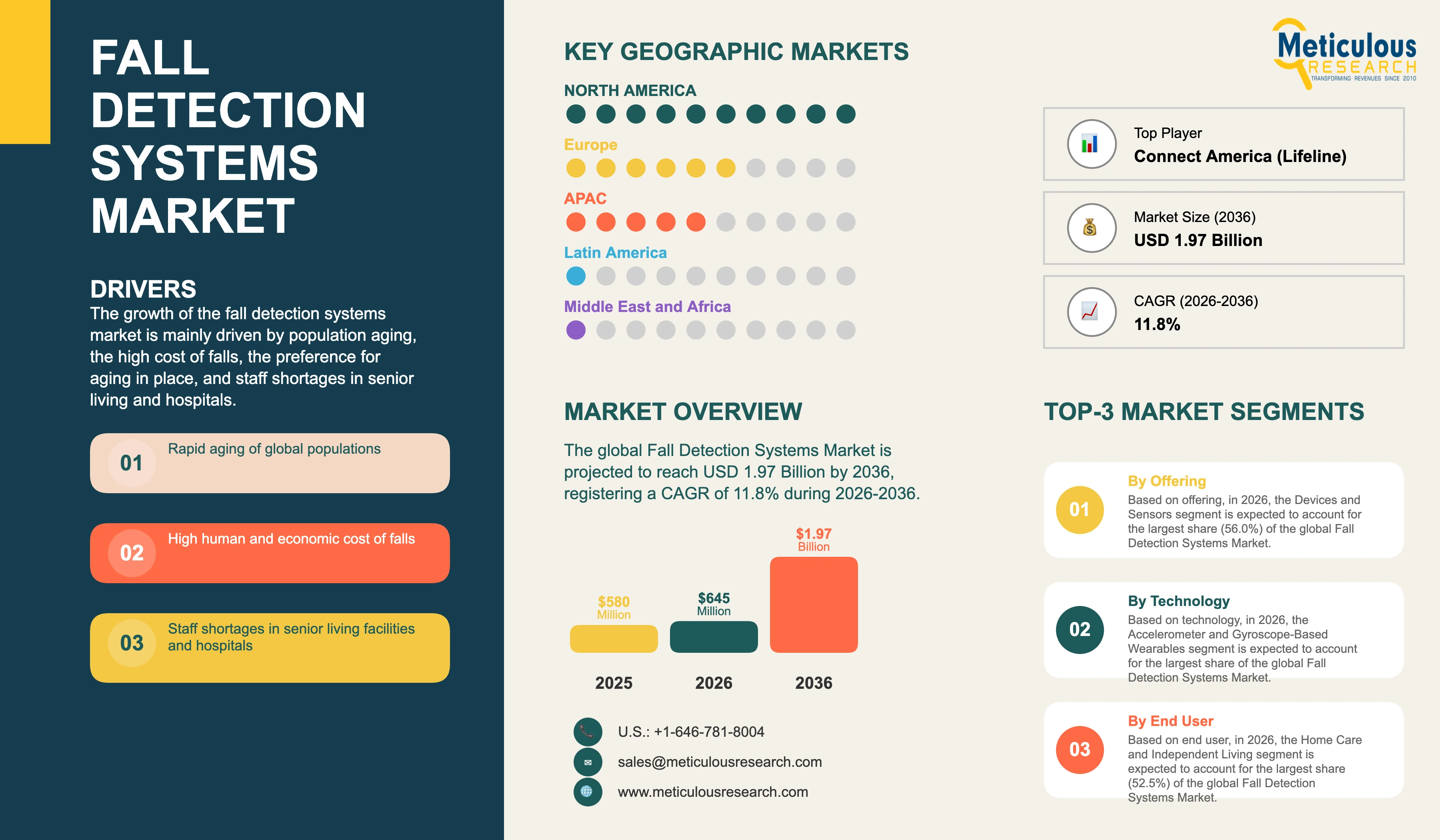
The global fall detection systems market was valued at USD 580.0 million in 2025. This market is expected to reach USD 1.97 billion by 2036 from an estimated USD 645.0 million in 2026, registering a CAGR of 11.8% during the forecast period (2026-2036).
- Published
- Nov 2026
- Pages
- 255
- Format
- PDF + Excel
- Report ID
- MRHC - 1042588
- Base year
- 2025
- 2025 · BASELINE
- $580.0M
- 2036
- $1.97B
- CAGR 2026–2036
- 11.8%
2025 baseline · 2026–2036 forecast at 11.8% CAGR · hover a bar for the value
Key highlights
According to the U.S. Centers for Disease Control and Prevention (CDC), falls are the leading cause of injury among adults aged 65 and older, and more than 14 million older Americans, or about one in four, report falling each year. The CDC recorded about 41,400 deaths from unintentional falls among adults aged 65 and older in 2023, and the National Safety Council reports that this number rose to about 43,000 in 2024.
National Safety Council analysis of National Center for Health Statistics data shows that more than 3.8 million older adults were treated in U.S. emergency departments for fall-related injuries in 2023, and that fall deaths among older adults increased by 51% over the past ten years, which highlights the growing need for faster detection and response after a fall.
Fall detection has moved from an optional add-on to a standard feature in personal emergency response systems, as providers such as Lifeline, Medical Guardian, Bay Alarm Medical, ADT Health, and MobileHelp offer automatic fall detection pendants and mobile devices with cellular and GPS connectivity for a small additional monthly fee.
Consumer smartwatches have brought fall detection to a much wider audience, since Apple has offered automatic fall detection on the Apple Watch since the Series 4 model and enables it by default for users aged 55 and older, while Samsung and Google offer similar features on their smartwatches.
Privacy-preserving radar sensors are gaining adoption in senior living communities and homes, as companies such as Vayyar Imaging use 4D imaging radar to detect falls without cameras or wearables, and radar-based solutions are increasingly deployed by senior living operators and home care providers through partner channels.
Senior living operators and hospitals are adopting AI-based camera and sensor systems from companies such as SafelyYou, Inspiren, and Teton.ai to detect falls and alert staff in real time, in response to staff shortages and the high cost of resident injuries and liability claims.
By offering, devices and sensors account for the largest share of 56.0% in 2026, while software and analytics platforms register the highest CAGR.
By technology, accelerometer and gyroscope-based wearables account for the largest share in 2026, while radar and mmWave sensors register the highest CAGR.
By connectivity, mobile (cellular and GPS) accounts for the larger share in 2026 and also registers the higher CAGR.
By end user, home care and independent living accounts for the largest share of 52.5% in 2026, while senior living and assisted living facilities register the highest CAGR.
By geography, North America accounts for the largest share of 45.0% in 2026, while Asia-Pacific registers the highest CAGR of 15.4%.
Report summary
| Particulars | Details |
|---|---|
| Base Year | 2025 |
| Estimated Year | 2026 |
| Forecast Period | 2026-2036 |
| Market Size in 2025 | USD 580.0 million |
| Market Size in 2026 | USD 645.0 million |
| Market Size by 2036 | USD 1.97 billion |
| CAGR (2026-2036) | 11.8% |
| Format | PDF, Excel & Cloud Portal · 255 pages |
| Largest Segment by Offering (2026) | Devices and Sensors (56.0%) |
| Largest Segment by End User (2026) | Home Care and Independent Living (52.5%) |
| Largest Region (2026) | North America (45.0%) |
| Fastest-Growing Region | Asia-Pacific (CAGR 15.4%) |
| Companies Profiled | 17 companies and other companies |
| Segments Covered | Offering, Technology, Connectivity, End User, Geography |
| Countries Covered | U.S., Canada, U.K., Germany, France, Netherlands, Sweden, Norway, Denmark, Finland, Italy, Spain, Belgium, Switzerland, Austria, Ireland, Rest of Europe, Japan, China, Australia, South Korea, Singapore, Taiwan, New Zealand, India, Hong Kong, Rest of Asia-Pacific, Brazil, Mexico, Chile, Argentina, Colombia, Rest of Latin America, Israel, Saudi Arabia, U.A.E., South Africa, Rest of Middle East & Africa |
Report overview
Segments covered: offering, technology, connectivity, end user.
The growth of this market is mainly driven by the rapid aging of populations in North America, Europe, and Asia-Pacific, the high and rising human and economic cost of falls among older adults, the preference of older people to age in place in their own homes, staff shortages in senior living facilities and hospitals that increase the need for automated monitoring, the shift from basic pendants to automatic fall detection with cellular and GPS connectivity, and the arrival of privacy-preserving radar and AI-based ambient sensors that do not require the user to wear a device. However, factors such as false alarms and missed falls, low wearing compliance among older adults, privacy concerns about camera-based monitoring, and limited reimbursement for fall detection in many countries are expected to restrain the growth of this market to some extent.
Fall detection systems are devices, sensors, software, and monitoring services that automatically detect when a person has fallen and alert a caregiver, family member, monitoring center, or emergency services. They are used mainly by older adults living at home, residents of senior living and assisted living communities, patients in hospitals, and residents of nursing homes. This report covers the global revenue from fall detection devices and sensors, monitoring services attributable to fall detection, and software and analytics platforms, across wearable, radar, vision-based, and pressure sensor technologies.
Falls are one of the most serious health risks for older adults. They are the leading cause of injury-related death among people aged 65 and older in many countries, and they often lead to hip fractures, head injuries, hospital stays, loss of independence, and moves into long-term care. A major part of the harm comes from what is called a long lie, when a person who has fallen cannot get up or call for help for an extended period. Fall detection systems aim to reduce this harm by making sure that help is called quickly, even when the person cannot press a button.
The market has developed from personal emergency response systems (PERS), which began as simple pendants with a help button connected to a landline base unit. Over the past decade, PERS providers have added accelerometers and gyroscopes to pendants and wristbands so that they can detect a fall automatically, added cellular and GPS connectivity so that users are protected outside the home, and developed smartphone apps for caregivers. Today, most leading PERS providers in the U.S. and Europe offer automatic fall detection as an option on all their devices.
Consumer technology has also changed the market, since Apple introduced fall detection on the Apple Watch Series 4 in 2018, and fall detection is now available on most Apple Watch models and on Samsung Galaxy and Google Pixel watches. These devices have made fall detection familiar to many older adults and their adult children, although they usually rely on the user's phone and emergency contacts rather than a professional monitoring center. Several PERS providers now offer smartwatch-based products that combine fall detection with professional monitoring.
A major new development is the growth of ambient fall detection, which does not require the user to wear a device. Radar sensors, such as those from Vayyar Imaging, Xandar Kardian, and other companies, track body position and movement using radio waves and can detect falls in bathrooms and bedrooms without capturing images. AI-based camera systems, such as those from SafelyYou and Teton.ai, analyze video to detect falls and support staff in reviewing how a fall happened, while pressure mats and bed sensors detect when a person leaves a bed or chair. These ambient systems address the main weakness of wearables, which is that many older adults do not wear their devices consistently, especially at night or in the shower.
The business models in this market include outright device sales, monthly monitoring subscriptions, and software-as-a-service contracts with senior living operators and hospitals. In the home market, most users pay a monthly fee that includes the device, monitoring, and sometimes a small extra charge for automatic fall detection. In facilities, operators buy or lease sensors and pay for software and analytics that help staff respond to falls, analyze fall patterns, and reduce future falls.
The market is fragmented, with PERS providers, consumer electronics companies, radar and sensor specialists, AI software companies, nurse call system suppliers, and healthcare technology companies all competing. Leading companies include Lifeline (Connect America), Medical Guardian, ADT, Bay Alarm Medical, MobileHelp, Tunstall Healthcare, Essence Group, Vayyar Imaging, SafelyYou, Inspiren, Teton.ai, Nobi, and Kepler Vision Technologies.
Over the forecast period, the fall detection systems market is expected to grow steadily as the number of older adults rises, as more people choose to age at home, as senior living operators adopt automated monitoring to cope with staff shortages, and as radar and AI technologies improve accuracy and reduce false alarms. The market is also expected to shift from simple detection toward fall prevention, using data on movement, gait, and nighttime activity to identify people at high risk of falling before a fall occurs.
Our population is aging very quickly and we do not have enough caregivers, so we are supporting the use of monitoring sensors in homes and care facilities. Residents prefer sensors that do not use cameras.
In 2026, the mobile (cellular and GPS) segment is expected to account for the larger share of the fall detection systems market, and it is also projected to register the higher CAGR during the forecast period.
Report infographic
Market dynamics
16 factors across 5 forcesRapid aging of global populations
The most important driver of the fall detection systems market is the rapid growth of the older population. According to the United Nations, the number of people aged 65 and older worldwide is expected to more than double between 2020 and 2050, and the number of people aged 80 and older, who face the highest risk of falls, is growing even faster. Japan, Italy, Germany, South Korea, and China are among the countries aging most rapidly, while the U.S. population aged 65 and older continues to grow as baby boomers reach older ages.
The risk of falling increases sharply with age, as muscle strength, balance, vision, and reaction time decline, and as older adults are more likely to take medications that cause dizziness or to have conditions such as dementia, Parkinson's disease, and diabetes. Older adults are also more likely to live alone, which increases the danger of a long lie after a fall. As a result, the number of people who could benefit from fall detection is growing quickly in all major markets.
Families and healthcare providers are also more aware of fall risk than in the past. The CDC's STEADI initiative encourages healthcare providers to screen older adults for fall risk each year, and similar programs in Europe and Asia-Pacific promote fall prevention. Greater awareness leads more families to look for fall detection solutions for their older relatives.
High human and economic cost of falls
Falls impose a very large cost on healthcare systems and families, and the CDC estimates that older adult falls cost the U.S. healthcare system about USD 50 billion per year in medical costs, most of which is paid by Medicare and Medicaid, and hip fractures, head injuries, and long hospital stays after falls are major contributors. In senior living communities and nursing homes, falls also lead to liability claims, regulatory scrutiny, and reputational damage.
Fast detection and response after a fall can reduce these costs by lowering the risk of complications from a long lie, such as dehydration, pressure injuries, and pneumonia. For senior living operators, fall detection systems with video or sensor data can also help staff understand how falls happen, reduce unnecessary emergency department transfers, and design better prevention programs. SafelyYou, for example, reports that its AI-based system helps memory care communities reduce emergency room visits after falls, because staff can review what happened and determine whether the resident hit their head.
Preference for aging in place
Most older adults prefer to stay in their own homes for as long as possible rather than move into senior living or nursing homes. Surveys by AARP consistently show that a large majority of Americans aged 50 and older want to remain in their homes and communities as they age. Aging in place is also often less expensive than residential care, and governments in many countries are shifting long-term care funding toward home and community-based services.
Fall detection systems are one of the most important technologies that support aging in place, because they give older adults and their families confidence that help will be called if a fall occurs. As more older adults live alone and as adult children often live far from their parents, demand for automatic fall detection with remote alerts to family members is increasing. Home care agencies and Medicare Advantage plans are also offering PERS and fall detection devices as part of their services for at-risk members.
Staff shortages in senior living and hospitals
Senior living communities, nursing homes, and hospitals face severe staff shortages, especially among nursing assistants and nurses. With fewer staff available to check on residents and patients, operators need technology that can automatically detect falls and alert staff, so that they can respond quickly without constant rounding. Night shifts, when staffing is lowest and many falls occur, are a particular concern.
AI-based fall detection and ambient monitoring systems allow staff to focus their attention on residents who need help, reduce the time residents spend on the floor after a fall, and provide data that helps operators meet regulatory requirements and reduce liability. Several large senior living operators in the U.S. have deployed radar or camera-based fall detection across many communities, and hospitals are adopting AI-based virtual sitting and fall prevention systems in high-risk units.
Table of contents
12 chapters · 178 sections · 255 pages · click to expandSegmental analysis
| Segment | Largest share (2026) | Fastest growth (2026–2036) |
|---|---|---|
| By Offering | Devices and sensors | Software and analytics platforms |
| By Technology | Accelerometer and gyroscope-based wearables | Radar and mmWave sensors |
| By Connectivity | — | — |
| By End User | Home care and independent living | Senior living and assisted living facilities |
By Offering
- Fall Detection Systems Market Analysis by Offering
- The devices and sensors segment is expected to account for the largest share of 56.0% of the global fall detection systems market.
- The large share of this segment is mainly due to the large installed base of wearable fall detection pendants, wristbands, and mobile devices used by older adults living at home, the growing use of radar, camera, and pressure sensors in senior living communities and hospitals, and the need to replace devices regularly as technology changes, such as the move from 3G to 4G LTE networks.
- Devices are the foundation of every fall detection system, and providers are investing in smaller, lighter, and more accurate devices with longer battery life, water resistance for use in the shower, and better sensors to reduce false alarms.
- Device revenue in the home market is often bundled into monthly subscriptions, but the hardware itself remains a major part of the value delivered, and many providers now sell devices outright through retail and online channels.
- In facilities, operators typically buy or lease large numbers of sensors to cover resident rooms, bathrooms, and common areas, which creates significant device revenue per community.
- The shift toward radar and multi-sensor devices with higher prices than basic pendants is also supporting the value of this segment.
- However, the software and analytics platforms segment is projected to register the highest CAGR during the forecast period.
- The rapid growth of this segment is driven by the adoption of AI-based fall detection and prevention platforms in senior living communities and hospitals, the growing use of data analytics to identify residents at high risk of falls, the integration of fall detection with remote patient monitoring and care coordination platforms, and the shift by providers toward recurring software revenue.
- Operators increasingly value dashboards that show fall trends by unit, shift, and resident.
By Technology
- Fall Detection Systems Market Analysis by Technology
- The accelerometer and gyroscope-based wearables segment is expected to account for the largest share of the global fall detection systems market.
- The large share of this segment is mainly due to the very large installed base of wearable pendants, wristbands, and mobile devices with automatic fall detection offered by personal emergency response system providers, their relatively low cost, and their ability to protect users both at home and outside.
- Wearables are usually the first fall detection product that families buy for an older relative, and they are widely available through retail, online, healthcare, and insurer channels.
- Wearable fall detection uses motion sensors and algorithms to recognize the sudden movement and impact of a fall, followed by a period of inactivity.
- Providers have improved accuracy over time by combining accelerometers with gyroscopes and barometric pressure sensors, and by training algorithms on larger data sets of real falls.
- Modern devices also include cellular connectivity, GPS, two-way voice, and long battery life, which make them practical for active older adults.
- However, wearables depend on users wearing them consistently, which remains their main limitation.
- However, the radar and mmWave sensors segment is projected to register the highest CAGR during the forecast period.
- The rapid growth of this segment is driven by its ability to detect falls without requiring users to wear a device, its suitability for bathrooms and bedrooms where many falls occur, its strong privacy protection compared with cameras, falling sensor costs, and growing deployment by senior living operators and home care providers.
- Vision and AI camera systems are also growing quickly in memory care and hospitals, while pressure, floor, and bed sensors remain a mature segment used mainly for bed-exit and chair-exit alerts.
By Connectivity
- Fall Detection Systems Market Analysis by Connectivity
- The mobile (cellular and GPS) segment is expected to account for the larger share of the global fall detection systems market.
- The large share of this segment is mainly due to the shift by personal emergency response providers from landline-based home units to mobile devices that protect users both at home and outside, the decline of landline telephone services, and the preference of active older adults for devices they can carry when walking, shopping, or traveling.
- Built-in GPS also helps monitoring centers and responders locate users quickly after a fall.
- Mobile fall detection devices typically include a cellular module, GPS, an accelerometer-based fall detection algorithm, and two-way voice, all in a small pendant or wristband with battery life of several days.
- Providers have moved customers from 3G to 4G LTE devices, and some are adopting LTE-M networks that offer better coverage inside buildings and longer battery life.
- Mobile devices also support caregiver apps that show location, alerts, and device status.
- Many providers now offer mobile devices as their standard product and include fall detection as an option for a small monthly fee, which has made mobile fall detection the default choice for new customers in the U.S. and many European markets.
- Insurers and Medicare Advantage plans that fund devices for members also tend to choose mobile devices because they cover more of the daily life of the user.
- The mobile segment is also projected to register the higher CAGR during the forecast period, supported by the falling cost of cellular modules, the growth of smartwatch-based solutions, and the needs of older adults who live active lives outside the home.
- In-home systems that use landline or Wi-Fi connectivity remain common among older users who rarely leave home and among public telecare services in Europe, where digital home hubs are replacing analog units as part of national telephone network upgrades.
By End User
- Fall Detection Systems Market Analysis by End User
- The home care and independent living segment is expected to account for the largest share of 52.5% of the global fall detection systems market.
- The large share of this segment is mainly due to the very large number of older adults who live in their own homes, many of them alone, the strong preference for aging in place, the wide availability of PERS and wearable fall detection devices through retail, online, and healthcare channels, and the growing role of adult children in buying fall detection solutions for their parents.
- Home care agencies, Medicare Advantage plans, Medicaid waiver programs in the U.S., and public telecare services in Europe also provide fall detection devices to older adults who are at risk of falls and live at home.
- This segment is also benefiting from the arrival of new product types for the home, such as radar sensors for bathrooms and bedrooms, smartwatch-based devices with professional monitoring, and whole-home sensor kits that monitor daily activity.
- Older adults living at home are increasingly offered a choice between wearables and ambient sensors, and some households combine both.
- As the number of older adults living alone grows and as families seek more reliable protection, the home care segment is expected to remain the largest end user throughout the forecast period.
- However, the senior living and assisted living facilities segment is projected to register the highest CAGR during the forecast period.
- The rapid growth of this segment is driven by severe staff shortages, the high cost of resident falls and related liability claims, the adoption of AI-based camera and radar systems across large operator portfolios, and the use of fall data to improve care quality and reduce emergency department transfers.
- Hospitals and nursing homes also remain important end users, mainly for bed-exit alarms, virtual sitting, and fall prevention programs in high-risk units.
Geographic analysis
North America
Largest shareIn 2026, North America is expected to account for the largest share of 45.0% of the global fall detection systems market. The large share of this region is mainly due to the large and well-established personal emergency response system industry in the U.S., the high number of older adults living alone, the widespread availability of automatic fall detection from providers such as Lifeline, Medical Guardian, ADT, Bay Alarm Medical, and MobileHelp, high smartwatch use, and the rapid adoption of AI-based fall detection systems by senior living operators. Supplemental benefits offered by Medicare Advantage plans and Medicaid home and community-based services programs also fund fall detection devices for many older adults.
Europe
Europe is the second-largest market, supported by well-developed public telecare services in the U.K., Scandinavia, the Netherlands, Spain, and other countries, where local governments provide alarm and fall detection services to older adults living at home. The U.K. is moving its telecare services from analog to digital networks as part of the national switch-off of analog telephone lines, which is driving replacement of older devices with digital devices that often include fall detection. Tunstall Healthcare, Doro (Doro Care), Legrand, and Essence Group are important suppliers in Europe. Germany, France, Italy, and Spain have large and fast-aging populations and growing home care sectors, while Belgium, Switzerland, Austria, and Ireland are smaller but well-funded markets where insurers and regional health authorities support telecare.
Asia-Pacific
Fastest growthAsia-Pacific is projected to register the highest CAGR of 15.4% during the forecast period. The rapid growth of this region is mainly driven by very rapid population aging in Japan, China, South Korea, and Taiwan, government programs that promote smart elderly care and home-based care, the growth of senior living facilities in China and Japan, and the strong presence of local electronics and sensor companies. Japan's long-term care insurance system supports the use of monitoring technology in care facilities, and China's national policies on smart elderly care encourage the use of sensors and AI in homes and facilities. Taiwan, Singapore, Hong Kong, and New Zealand are also adopting fall detection in senior living and home care, while India is an emerging market where private hospitals and premium senior living projects are early adopters.
Latin America
Latin America and the Middle East & Africa currently account for smaller shares of the market, but they are expected to grow steadily as populations age, private healthcare and senior living sectors develop, and mobile fall detection devices become more affordable. Brazil, Mexico, Chile, Israel, the U.A.E., and Saudi Arabia are among the more important markets in these regions, with private hospitals and premium senior living developments as early adopters. Mobile devices with cellular connectivity are expected to be the main entry point in these markets. Affordable pricing will be essential. Local distributors and telecare partners will also help providers reach these buyers. Chile, Argentina, Colombia, and South Africa are also expected to see growing demand as private healthcare and home care services expand.
Competitive landscape
The global fall detection systems market is fragmented, with the top five players estimated to account for about 30% of the market in 2025. The market includes personal emergency response system providers, consumer electronics companies, radar and sensor technology companies, AI and computer vision companies, telecare and nurse call system suppliers, and healthcare technology companies.
Personal emergency response system providers, such as Lifeline (part of Connect America), Medical Guardian, ADT (ADT Health), Bay Alarm Medical, and MobileHelp, lead the home market in the U.S., offering wearable fall detection devices with professional monitoring. In Europe, Tunstall Healthcare, Doro, and Legrand are leading telecare suppliers. Apple, Samsung, and Google offer fall detection in their smartwatches, which reach a large number of users but are generally not counted as dedicated fall detection systems unless combined with monitoring services.
Radar and ambient sensor specialists, such as Vayyar Imaging, Xandar Kardian, Nobi, and Essence Group, are growing in senior living and home care, while AI and computer vision companies, such as SafelyYou, Inspiren, Teton.ai, and Kepler Vision Technologies, are expanding in senior living communities, nursing homes, and hospitals. Nurse call and patient safety companies, such as Baxter (Hillrom), Ascom, and Stryker, offer bed exit alarms and fall prevention systems for hospitals.
Companies compete on detection accuracy, false alarm rates, device design and comfort, battery life, privacy protection, monitoring center quality, integration with care workflows, data analytics, and price. Key strategies include product launches of smaller and more accurate devices, partnerships with senior living operators, health systems, insurers, and home care agencies, integration with remote patient monitoring platforms, and acquisitions to build broader aging-in-place platforms.
Consolidation is expected to continue, as larger providers acquire radar, AI, and software companies to add ambient monitoring and analytics capabilities, and as PERS providers merge to gain scale in monitoring operations. Companies that can combine devices, monitoring, and analytics in integrated platforms are expected to gain share. Smaller sensor and AI companies are also forming partnerships with larger PERS and telecare providers to reach customers through established sales channels, monitoring centers, and installation networks, which allows them to scale faster than they could on their own.
Some of the key players operating in the fall detection systems market are Connect America (Lifeline), Medical Guardian LLC, ADT Inc., Bay Alarm Medical, MobileHelp LLC, Tunstall Healthcare Group Limited, Vayyar Imaging Ltd., SafelyYou, Inc., Inspiren, Inc., Essence Group, Nobi, Teton.ai, Kepler Vision Technologies, and Xandar Kardian, among others.
- —
PERS providers have moved customers to 4G LTE mobile devices with automatic fall detection, senior living operators have expanded deployments of radar and AI camera systems, consumer smartwatches from Apple, Samsung, and Google have made fall detection widely available, and the U.K. telecare sector is replacing analog devices with digital devices as part of the analog phone line switch-off.
- Lifeline (part of Connect America)
- Medical Guardian
- ADT (ADT Health)
- Bay Alarm Medical
- MobileHelp
Expert perspectives
The fall detection systems market is moving from simple wearable pendants to a broader range of technologies and services, including mobile devices, smartwatches, radar sensors, AI cameras, and analytics platforms. This shift is driven by the clear limitations of wearables, especially low wearing compliance, and by the needs of senior living operators and hospitals facing staff shortages. We see the combination of wearables for outdoor protection and ambient sensors for the home and facilities as the model that will define the market over the next decade.
Over the forecast period, the market is expected to grow at a CAGR of 11.8%, from USD 645.0 million in 2026 to USD 1.97 billion in 2036. Growth will be supported by population aging, the preference for aging in place, and the adoption of radar and AI-based systems, while pricing pressure on basic wearables and limited reimbursement will moderate growth in some segments.
Devices and sensors remain the largest offering, while software and analytics platforms grow fastest. Within devices, wearables remain the largest category, while ambient sensors such as radar units and AI cameras are expected to gain share quickly. Wearables remain the largest technology, but radar and mmWave sensors grow fastest. Home care and independent living remains the largest end user, while senior living and assisted living facilities grow fastest. North America remains the largest region, and Asia-Pacific is the fastest-growing region at a CAGR of 15.4%.
For providers, the key priorities are to improve detection accuracy and reduce false alarms, offer privacy-preserving ambient options alongside wearables, integrate fall detection with care workflows and remote monitoring platforms, and provide evidence of reduced falls, injuries, and costs to win budgets from senior living operators, health systems, and insurers.
We expect fall prevention to become the main source of value in the market over time. Providers that can use movement and activity data to predict falls and guide preventive actions will be able to sell higher-value software and services, and they will be better positioned to win contracts with health systems and payers that are paid to keep older adults healthy and out of the hospital. In our view, clinical evidence from controlled studies and real-world deployments will become a key competitive factor, as buyers increasingly ask providers to prove outcomes rather than simply describe features.
Reimbursement will remain a key factor for growth, and wider coverage of fall detection and monitoring services through Medicare Advantage, Medicaid, long-term care insurance, and public telecare programs could significantly expand the market, while the lack of coverage will continue to limit adoption among lower-income older adults.
Customer perspectives
Adult daughter of an 84-year-old living alone - U.S.
My mother lives alone and refuses to move, so I need to know someone will be called if she falls. The automatic fall detection pendant gives us both peace of mind, but I worry that she takes it off at night, so we are looking at a sensor for the bathroom as well.
Executive Director - memory care community, U.S.
We cannot have staff in every room all night, and our residents often cannot tell us what happened when they fall. The AI system alerts our staff right away and lets us see whether a resident hit their head, which has reduced unnecessary emergency room visits.
Frequently asked questions
The global fall detection systems market was valued at USD 580.0 million in 2025, up from USD 520.0 million in 2024, and is estimated at USD 645.0 million in 2026. The market includes fall detection devices and sensors, monitoring services attributable to fall detection, and software and analytics platforms.
Cite this report
Meticulous Research. (2026). Fall Detection Systems Market - Global Opportunity Analysis and Industry Forecast (2026-2036) (Report No. MRHC - 1042588). Meticulous Market Research Pvt. Ltd. https://www.meticulousresearch.com/product/fall-detection-systems-market-7271