Europe Lipid Ingredients Market For Cosmetics (2021-2028)
Europe Lipid Ingredients Market for Cosmetics is expected to reach $3.6 billion by 2028, at a CAGR of 3.9% during the forecast period of 2021 to 2028.
- Published
- Sep 2021
- Pages
- 142
- Format
- PDF + Excel
- Report ID
- MR-515
- Base year
- 2020
- 2019 · HISTORICAL
- $89.39B
- 2028
- $3.60B
- CAGR 2021–2028
- 3.9%
2019–2020 baseline · 2021–2028 forecast at 3.9% CAGR · hover a bar for the value
Key highlights
The novel lipid sources segment to grow at the highest CAGR during the forecast period
The skincare segment is expected to dominate the lipid ingredients market for cosmetics in 2021
Germany: Largest market of the European lipid ingredients market for cosmetics
Report summary
| Particulars | Details |
|---|---|
| Base Year | 2020 |
| Estimated Year | 2021 |
| Forecast Period | 2021–2028 |
| Market Size (2020) | USD 87.61 billion |
| Market Size (2028) | USD 3.60 billion |
| CAGR (2021–2028) | 3.9% |
| Format | PDF, Excel & Cloud Portal · 142 pages |
| Segments Covered | By Source/Type: Plants Vegetable Oil, Nuts Oil, Fruit Seeds, Other Plant-sourced Lipid Ingredients, Fish Oil, Other Animal-sourced Lipid Ingredients, Microalgae, Insects · By Application: Skincare products, Haircare products, Others · By Source: Plant {Vegetable Oil}, Animal, Novel Lipid Sources {Insects, Microalgae} |
| Countries Covered | Europe (Germany, France, U.K., The Netherlands, Belgium, Poland, Norway, Sweden, Denmark, Austria, Finland, Switzerland, Czech Republic, The Baltic countries) |
| Key Companies | L’Oréal S.A., Unilever PLC (U.K.), Procter & Gamble Company (U.S.), Beiersdorf AG, Estée Lauder Companies Inc. (U.S.), Revlon Inc. (U.S.), Shiseido Company, Limited, Colgate-Palmolive Company (U.S.), Johnson & Johnson (U.S.), Kao Corporation, L'Occitane International S.A., LVMH Moët Hennessy Louis Vuitton |
Report overview
Segments covered: source/type, application, source. Regions: Europe.
This market's growth is mainly attributed to key factors such as the rising investment for developing innovative/customized lipid ingredients, growing consumer demand for cosmetics with nutrient-enriched vegetable oils, rising demand for natural cosmetic ingredients, and increasing demand for skincare products in the region. In addition, the increasing geriatric population, rising disposable incomes, and increasing urbanization are giving rise to a buoyant product market, particularly in the beauty and personal care industry, in turn, driving the demand for lipid ingredients in the region.
The outbreak of COVID-19 has had a significant impact on public health and all stages of the supply chain and various industries. Since the outbreak in December 2019, the disease has spread to almost 100 countries worldwide. As of August 12, 2021, there were more than 35,381,520 cases, killing 746,566 people in Europe (Source: European Centre for Disease Prevention and Control).
The lipid ingredients market is experiencing a negative impact mainly due to the slow sales of cosmetics, with a total lockdown in France, Italy, and Spain and strict restrictions in Germany and the U.K. Further, the lockdown in the first half of 2020 led to a decline in demand for certain categories of products as self-isolation and limited social interactions altered consumers ordinary purchasing habits. The pandemic has had a profound impact on individuals, communities, and almost every industry. According to Cosmetic Europe, cosmetic sales in Europe decreased from $89.39 billion in 2019 to $87.61 billion in 2020. Also, the consequences of the pandemic will continue to influence the performance of the cosmetics market in the years to come. Hence, the decreasing cosmetic market ultimately restricts the demand for lipid ingredients in the region. The current expectation is that the sector slowly returns to growth as consumer expenditure on cosmetics recovers, new trends emerge, and the industry adapts to change and innovate.
Source: Cosmetics Europe
Europe is one of the largest cosmetics markets globally, with the sector's sales reaching $87.61 billion in 2020 from $85.45 billion in 2015, according to Cosmetics Europe. However, over decades, the region has noticed a significantly rising demand for natural cosmetics (products made from natural ingredients, containing minimal levels of synthetic substances, such as petrochemicals and parabens) over conventional synthetic ingredient-based cosmetic products. For instance, according to Cosmetics Europe, the demand for natural cosmetic products in Europe has increased to $4.46 billion in 2020 from $3.28 billion in 2015.
This trend is expected to continue in the near future, majorly driven by consumer concerns for side effects of synthetic chemicals, rising awareness and belief in natural products, and the rising organizational initiatives towards building the sustainable operational process using natural raw materials. Thus, the growing demand for natural cosmetics is driving the demand for natural and organic ingredients, including lipid ingredients from the cosmetics sector in Europe.
Further, increasing awareness regarding clean-label cosmetic products has led to the development of environment-friendly green cosmetics. For instance, palm oil and coconut oil-based green surfactants are being used in the cosmetics ingredients industry.
Germany and France have the largest consumer markets and major production centers for cosmetics in Europe. Many conventional and natural cosmetics companies are based in Germany and France. After these two countries, the U.K. and Italy are the most attractive markets. The import of natural ingredients for cosmetics production has increased with the rising demand for natural cosmetics.
Thus, the growing demand for natural cosmetics and the related rise in demand for natural cosmetics ingredients is expected to boost the demand for the lipid ingredients market in the region.
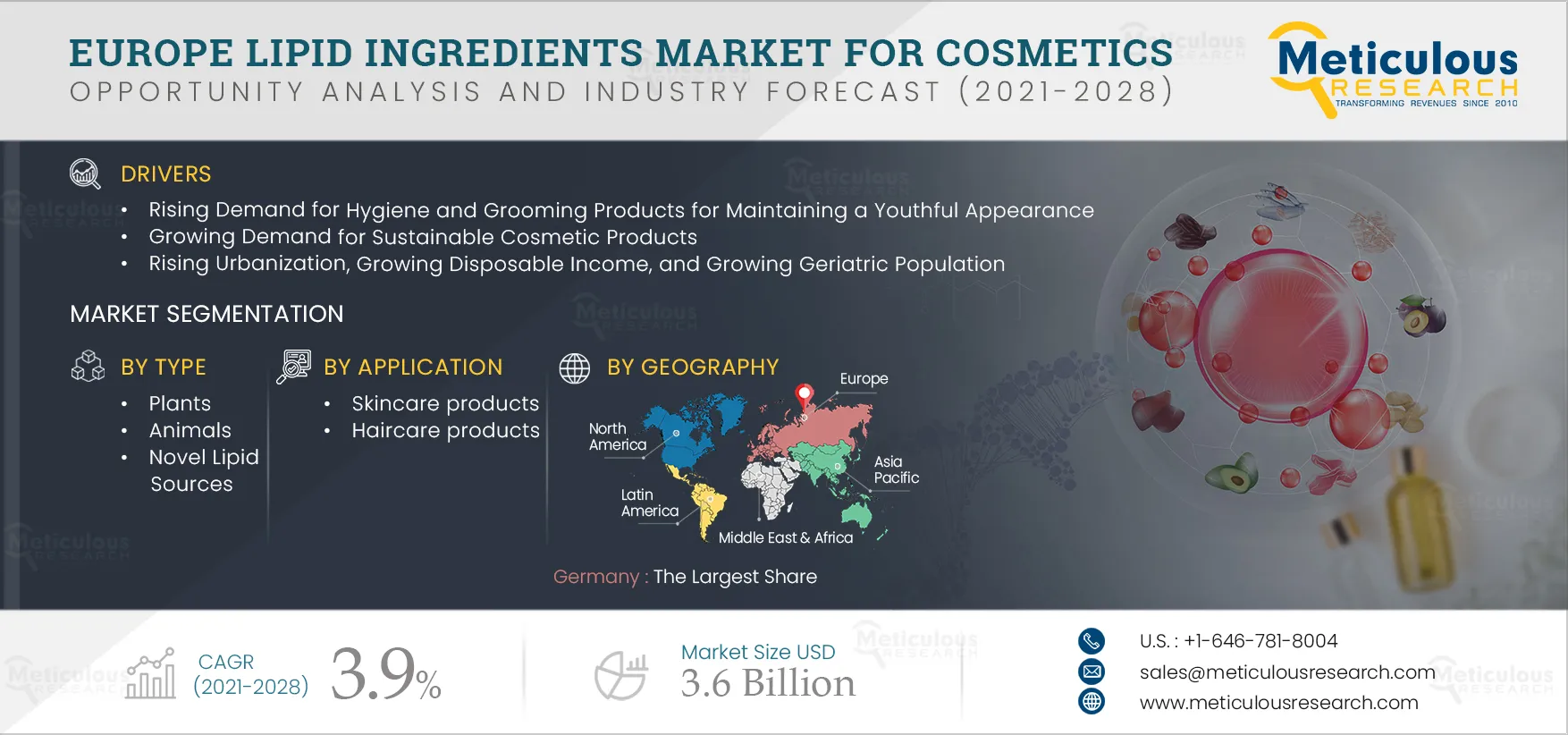
Table of contents
13 chapters · 220 sections · 142 pages · click to expandSegmental analysis
| Segment | Largest share (2021) | Fastest growth (2021–2028) |
|---|---|---|
| By Source | — | Novel lipid sources |
| By Application | Skincare | — |
By Source
- The novel lipid sources segment is expected to register at the highest CAGR during the forecast period 2021–2028.
- This segment's rapid growth is mainly attributed to the increasing interest in using microalgae and insect lipids in the cosmetic industries and growing attention towards microalgae cultivation and insect production for their cosmetic application.
- For instance, black soldier fly larvae oil has the same fatty acid profile as coconut oil and palm kernel oil, used in cosmetic products, majorly as a starting material for preparing surfactants.
- Therefore, BSF oil can be used in the same manner, a novel application.
By Application
- The skincare segment is expected to dominate the lipid ingredients market for cosmetics in 2021
- The skincare segment is estimated to account for the largest share of the Europe lipid ingredients market in 2021.
- This is mainly attributed to the shift in consumer focus towards anti-aging skincare products and acne-reducing solutions, growing demand for natural skincare products, and increasing demand for luxury skincare products.
- Furthermore, rising skin problems are also fueling the demand for skincare products in the region.
- Also, lipid ingredients have recently been found to reduce many skin problems, including hyperpigmentation, acne, stretch marks, and dry skin, ultimately driving its demand in the region.
Geographic analysis
Europe
Largest shareBased on country, Germany is estimated to account for the largest share of the overall Europe cosmetic lipid ingredients market in 2021. This country’s prominent position in this market is primarily attributed to the largest consumer market for cosmetics in Europe, and it has a robust processing sector for cosmetics. For instance, Beiersdorf is the most important cosmetics company. Important natural and organic cosmetics companies include Lavera, Logona (L’Oréal), Dr. Hauschka, and Primavera Life. Furthermore, there is also a high demand for organic ingredients on the German market. For example, SanaBio GmbH (suppliers of natural ingredients for cosmetics) advised targeting German buyers when supplying organic ingredients. Germany: Largest market of the European lipid ingredients market for cosmetics
Competitive landscape
- L’Oréal S.A. · France
- Unilever PLC (U.K.)
- Procter & Gamble Company (U.S.)
- Beiersdorf AG · Germany
- Estée Lauder Companies Inc. (U.S.)
- Revlon Inc. (U.S.)
- Shiseido Company, Limited · Japan
- Colgate-Palmolive Company (U.S.)
- Johnson & Johnson (U.S.)
- Kao Corporation · Japan
- L'Occitane International S.A. · France
- LVMH Moët Hennessy Louis Vuitton · France
Frequently asked questions
Cite this report
Meticulous Research. (2021). Europe Lipid Ingredients Market For Cosmetics - Opportunity Analysis And Industry Forecast (2021-2028) (Report No. MR-515). Meticulous Market Research Pvt. Ltd. https://www.meticulousresearch.com/reports/europe-lipid-ingredients-market-for-cosmetics-5206