Sweet Proteins Market (2026-2036)
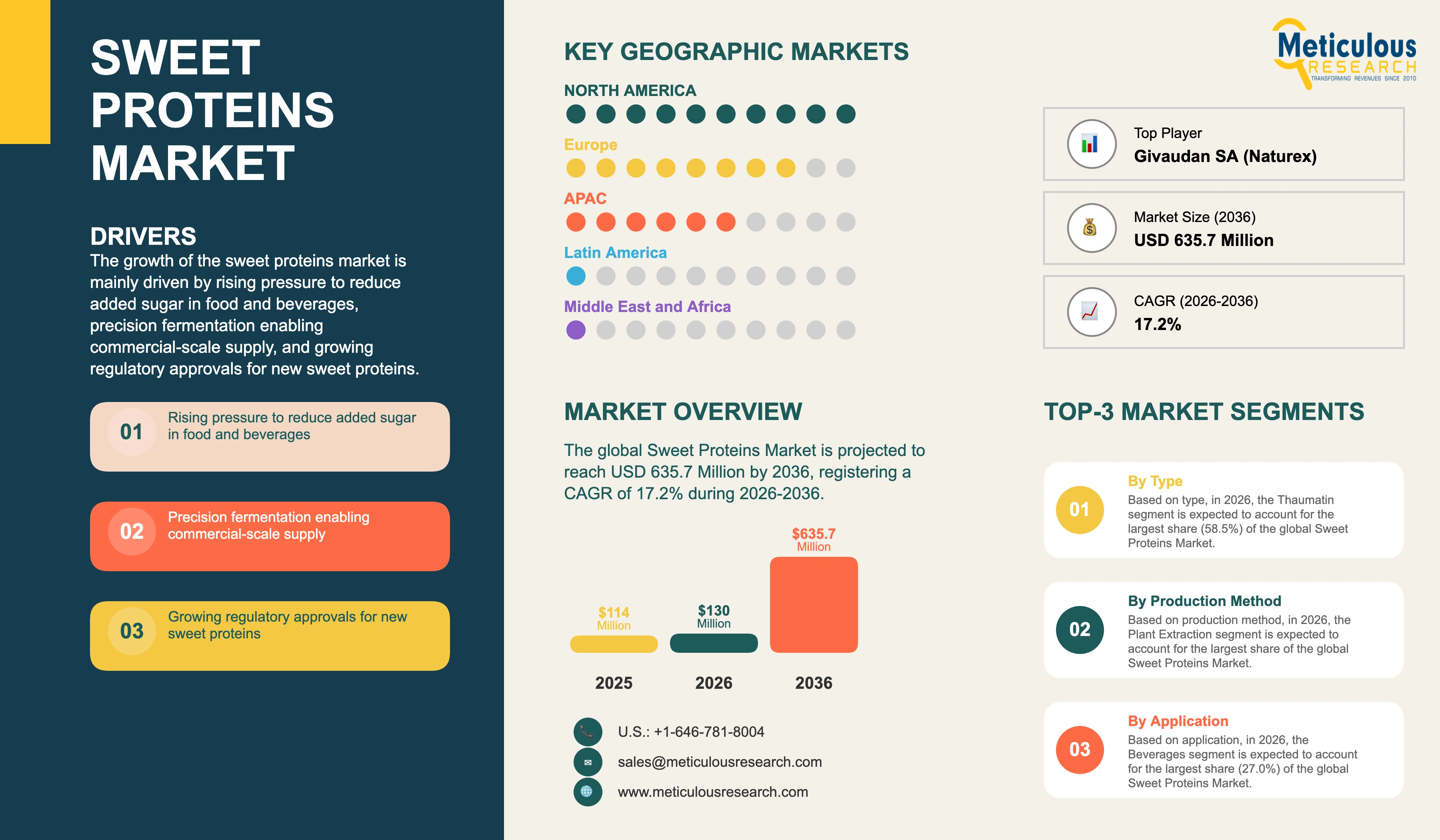
The global sweet proteins market was valued at USD 114.0 million in 2025. This market is expected to reach USD 635.7 million by 2036 from an estimated USD 130.0 million in 2026, registering a CAGR of 17.2% during the forecast period (2026-2036). In terms of volume, the global sweet proteins market is expected to reach 538.7 tons by 2036 from an estimated 78.8 tons in 2026, registering a CAGR of 21.2% during the forecast period (2026-2036).
- Published
- Nov 2026
- Pages
- 247
- Format
- PDF + Excel
- Report ID
- MRFB - 1042515
- Base year
- 2025
- 2025 · BASELINE
- $114.0M
- 2036
- $635.7M
- CAGR 2026–2036
- 17.2%
2025 baseline · 2026–2036 forecast at 17.2% CAGR · hover a bar for the value
Key highlights
Sweegen received an FDA GRAS "no questions" letter for its Ultratia Brazzein, produced by precision fermentation, in June 2026, adding it to a portfolio that already includes thaumatin and stevia sweeteners.
Ingredion invested in Oobli through Ingredion Ventures in an USD 18 million Series B1 round in February 2025, and the two companies are developing blended stevia and sweet protein sweetener systems for food and beverage brands.
Amai Proteins published the first human clinical trial on the metabolic effects of a sweet protein in the journal Food Chemistry in June 2026, showing that sweelin had no effect on blood glucose, insulin, or GLP-1 levels.
Amai Proteins' designer sweet protein sweelin received FDA GRAS status in February 2026, approval from the Singapore Food Agency in May 2026, and approval from the Israeli Ministry of Health in August 2026.
Pentasweet began building Europe's first dedicated brazzein production plant in Vilnius, Lithuania, in April 2026, a EUR 65 million project scheduled to begin operations in the first half of 2027.
Oobli holds FDA "no questions" letters for both brazzein and monellin, partnered with Ingredion in February 2025 to develop sweet protein and stevia systems, and signed an Andean regional manufacturing partnership with Magdalena in April 2026.
EFKO has invested about 1.3 billion rubles in brazzein production technology since 2020 and has certified its brazzein in the Eurasian Economic Union and the U.A.E., while Fraunhofer IME is working with Symrise and other partners on a brazzein-based sweetener in Germany.
Thaumatin (E 957) remains the only sweet protein approved as a food additive across the EU, while new fermentation-derived proteins such as brazzein and monellin still await EU authorization.
In terms of volume, the market is expected to grow faster than in value, as new fermentation capacity lowers the average selling price of sweet proteins over the forecast period.
Precision fermentation is the fastest-growing production method, sugar replacement and sweetening is the fastest-growing function, and dietary supplements and sports nutrition is the fastest-growing application.
By type, thaumatin accounts for the largest share of 58.5% in 2026, while brazzein registers the highest CAGR.
By production method, plant extraction accounts for the largest share in 2026, while precision fermentation registers the highest CAGR.
By function, flavor modification and masking accounts for the largest share in 2026, while sugar replacement and sweetening registers the highest CAGR.
By application, beverages account for the largest share of 27.0% in 2026, while dietary supplements and sports nutrition register the highest CAGR.
By geography, North America accounts for the largest share of 37.5% in 2026, while Asia-Pacific registers the highest CAGR of 19.5%.
Report summary
| Particulars | Details |
|---|---|
| Base Year | 2025 |
| Estimated Year | 2026 |
| Forecast Period | 2026-2036 |
| Market Size in 2025 (Value) | USD 114.0 million |
| Market Size in 2026 (Value) | USD 130.0 million |
| Market Size by 2036 (Value) | USD 635.7 million |
| CAGR (Value, 2026-2036) | 17.2% |
| Format | PDF, Excel & Cloud Portal · 247 pages |
| Market Size in 2026 (Volume) | 78.8 tons |
| Market Size by 2036 (Volume) | 538.7 tons |
| CAGR (Volume, 2026-2036) | 21.2% |
| Largest Segment by Type (2026) | Thaumatin (58.5%) |
| Largest Segment by Application (2026) | Beverages (27.0%) |
| Largest Region (2026) | North America (37.5%) |
| Fastest-Growing Region | Asia-Pacific (CAGR 19.5%) |
| Companies Profiled | 10 companies and other companies |
| Segments Covered | Type, Production Method, Function, Application, Geography |
| Countries Covered | U.S., Canada, Germany, U.K., France, Italy, Spain, Netherlands, Rest of Europe, Japan, China, India, South Korea, Australia, Singapore, Rest of Asia-Pacific, Mexico, Brazil, Chile, Rest of Latin America, Israel, U.A.E., Saudi Arabia, South Africa, Rest of Middle East & Africa |
Report overview
Segments covered: type, production method, function, application.
The growth of this market is mainly driven by government and consumer pressure to cut added sugar in food and beverages, the arrival of precision fermentation that makes rare sweet proteins available at commercial scale, a growing number of regulatory approvals for new sweet proteins, and the ability of sweet proteins to improve the taste of stevia and other natural sweeteners. However, factors such as the high production cost of sweet proteins compared with other sweeteners and the long and uneven regulatory approval process across countries are expected to restrain the growth of this market to some extent.
Sweet proteins are naturally occurring proteins, mostly found in the fruits of tropical plants in West and Central Africa and Southeast Asia, that taste hundreds to thousands of times sweeter than sugar by weight. The best-known sweet proteins are thaumatin from the katemfe fruit, brazzein from the oubli fruit, monellin from the serendipity berry, and miraculin from the miracle berry, which does not taste sweet itself but makes sour foods taste sweet. Because they are proteins, they are digested like other dietary proteins, add almost no calories at the levels used, and do not raise blood glucose, which makes them attractive for sugar reduction.
Thaumatin is the only sweet protein that has been sold at meaningful scale for several decades. It is approved as a food additive (E 957) in the EU, is used in Japan, the U.S., and many other countries, and is mostly used at very low levels as a flavor modifier that masks bitterness, rounds out sweetness, and improves the taste of other sweeteners. Givaudan, through its Naturex business and the Talin brand, and U.K.-based Natex are the main suppliers of thaumatin extracted from katemfe fruit, while Conagen and Sweegen produce thaumatin by fermentation. Thaumatin also has a long history in animal feed, pet food, pharmaceuticals, and chewing gum.
The next generation of sweet proteins is being produced by precision fermentation, in which microbes are programmed to make the protein in fermentation tanks. This removes the dependence on wild-harvested tropical fruit, which has kept supply small and prices high. Oobli produces brazzein and monellin by fermentation and holds FDA "no questions" letters for both, Sweegen received an FDA GRAS "no questions" letter for its Ultratia Brazzein in June 2026, and Amai Proteins has developed sweelin, an engineered version of monellin designed to stay stable during heating and processing. These products are positioned as true sweeteners that can replace a large part of the sugar in a recipe rather than only as flavor modifiers.
Regulatory approvals are opening new markets for these proteins, though the pace differs by country. Amai Proteins received approvals for sweelin in the U.S., Singapore, and Israel within about seven months in 2026, and Russia's EFKO certified its fermentation-produced brazzein in the Eurasian Economic Union and the U.A.E. In the EU, new sweet proteins still require novel food or food additive authorization, which takes several years, so European activity is focused on building production capacity and preparing dossiers. Pentasweet's brazzein plant in Lithuania and the Fraunhofer IME BeyondSugar project, which works with Symrise and other partners on a brazzein-based sweetener, show how Europe is preparing for future approval.
Large ingredient companies are entering the market mainly through partnerships, as Ingredion partnered with Oobli and invested in the company in February 2025 to develop blends of stevia and sweet proteins, Ajinomoto Health & Nutrition partnered with AI protein discovery company Shiru in 2024 to find and develop new sweet proteins, and Oobli and Cosun are offering a sugar replacement system for chocolate to selected brands. These partnerships give sweet protein developers access to the customer networks and application expertise of large suppliers, which is critical for a new ingredient that food companies must test in many recipes before launch.
Despite strong interest, the market is still small and at an early stage of commercialization. Production costs for fermented sweet proteins remain high, food companies are still learning how to use these ingredients, and most new products launched so far are in premium and niche categories such as chocolate, functional beverages, and supplements. Growth over the forecast period will depend on how quickly fermentation capacity grows, how fast prices fall, and how many countries approve the new proteins for general food use. Suppliers that can offer a broad portfolio of approved proteins, application support, and reliable supply at falling prices are expected to shape how quickly the market moves from niche launches to mainstream products.
We have used thaumatin for years and trust its safety record. The new fermented proteins look promising, but we need local approval and a stable supply at a sensible price before we can put them into our main products.
Regulatory approval and supply cost are the main conditions for wider adoption in Asia-Pacific, which is the fastest-growing region at a CAGR of 19.5% as approvals expand and capacity grows. Established thaumatin users in the region provide a base for new proteins.
Precision fermentation is projected to register the highest CAGR, while plant extraction holds the largest share in 2026.
North America is expected to account for the largest share of 37.5% of the market in 2026.
Asia-Pacific is projected to register the highest CAGR of 19.5% during the forecast period, led by Japan, China, South Korea, and Singapore.
The report profiles 10 companies, including Givaudan SA (Naturex), Natex, Sweegen, Inc., Conagen, Inc., Oobli, Inc., Amai Proteins Ltd., and Ingredion Incorporated. The top five players account for an estimated 71.4% of the market in 2025.
Precision fermentation allows companies to produce sweet proteins such as brazzein, monellin, and thaumatin in fermentation tanks instead of extracting them from rare tropical fruits. This provides reliable, scalable supply with consistent quality, enables engineered proteins with better stability and taste, and is expected to lower costs as new plants such as Pentasweet's facility in Lithuania start production.
In terms of volume, the market is expected to grow from an estimated 78.8 tons in 2026 to 538.7 tons by 2036, at a CAGR of 21.2%. Volume grows faster than value because average selling prices are expected to fall as fermentation capacity increases.
Report infographic
Market dynamics
15 factors across 5 forcesRising pressure to reduce added sugar in food and beverages
Governments in many countries are acting to reduce sugar intake through sugar taxes, front-of-pack warning labels, and reformulation targets, and health authorities such as the WHO recommend limiting free sugars to less than 10% of daily energy intake. At the same time, consumers increasingly read labels and look for products with less sugar, especially as interest in blood sugar management and weight control grows. Food and beverage companies are therefore under pressure to reduce sugar without losing the taste that consumers expect.
Sweet proteins help meet this need because they deliver a clean, sugar-like sweetness at very low use levels and do not raise blood glucose. Amai Proteins has published a clinical study in the journal Food Chemistry showing that sweelin had no effect on blood glucose, insulin, or GLP-1 levels, which supports the positioning of sweet proteins in diabetic-friendly and low-sugar products and encourages food companies to test them in reformulation projects. Sweet proteins also avoid some of the concerns that consumers raise about artificial sweeteners and sugar alcohols, such as digestive discomfort or a chemical image, which makes them easier to position in products aimed at health-conscious shoppers.
Precision fermentation enabling commercial-scale supply
For decades, the use of sweet proteins was limited by supply, because the fruits that contain them grow in tropical forests, are hard to harvest at scale, and yield only small amounts of protein. Precision fermentation removes this limit by producing the same proteins in fermentation tanks with consistent quality. Sweegen states that its fermentation process solves the supply challenge that has held back brazzein, and Oobli produces brazzein and monellin by fermentation at commercial scale.
New production capacity is being built to serve the expected demand, as Pentasweet is investing EUR 65 million in a brazzein plant in Lithuania with operations planned for the first half of 2027, EFKO has invested about 1.3 billion rubles in developing its brazzein production technology, and Oobli signed a manufacturing partnership with Magdalena in April 2026 to build a regional production and development hub in the Andean region. As capacity grows, costs are expected to fall and supply to become more reliable. Reliable supply is especially important for large food and beverage companies, which will not reformulate their main brands until they are confident that an ingredient can be delivered in the required volumes for many years.
Growing regulatory approvals for new sweet proteins
Regulatory approval is the gateway to commercial sales for any new sweetener, and the number of approvals for sweet proteins has increased quickly. In the U.S., Oobli received FDA "no questions" letters for brazzein and monellin, Sweegen received one for its brazzein in June 2026, and Amai Proteins received GRAS status for sweelin in February 2026. Singapore and Israel approved sweelin in 2026, and EFKO's brazzein is certified in the Eurasian Economic Union and the U.A.E.
Each approval allows food and beverage companies in that country to launch products with sweet proteins and builds confidence in the safety of the ingredient class. As more countries approve sweet proteins, the addressable market expands and ingredient suppliers can sign larger supply agreements with multinational brands that need approvals in several markets before they reformulate. Approvals also give smaller developers a stronger position when they raise funds or seek partners, as shown by the partnerships and investments that followed recent FDA clearances in the U.S.
Ability to improve the taste of stevia and other natural sweeteners
Stevia, monk fruit, and other high-intensity sweeteners often have bitter, metallic, or lingering aftertastes that limit how much sugar they can replace. Sweet proteins act on the sweet taste receptor differently from these sweeteners and can round out their taste, reduce bitterness, and make the sweetness feel more like sugar. Sweegen reports strong synergies between its brazzein and its stevia sweeteners, and Ingredion is working with Oobli on blended stevia and sweet protein systems.
This blending role allows sweet proteins to enter the market even while their cost is high, because only small amounts are needed to improve the taste of a sweetener system. It also gives large sweetener suppliers a reason to add sweet proteins to their portfolios, which helps expand distribution and adoption across food and beverage categories. In practice, many of the first commercial uses of new sweet proteins are as minor components of sweetener blends, which allows food companies to test the ingredient at low cost before moving to higher use levels.
Table of contents
12 chapters · 128 sections · 247 pages · click to expandSegmental analysis
| Segment | Largest share (2026) | Fastest growth (2026–2036) |
|---|---|---|
| By Type | Thaumatin | Brazzein |
| By Production Method | Plant extraction | Precision fermentation |
| By Function | Flavor modification and masking | Sugar replacement and sweetening |
| By Application | Beverages | Dietary supplements and sports nutrition |
| Other segments | Sugar replacement and sweetening | Sugar replacement and sweetening |
By Type
- The thaumatin segment is expected to account for the largest share of 58.5% of the global sweet proteins market.
- The large share of this segment is mainly due to thaumatin's long history of use and its broad regulatory approval as a food additive and flavor in the EU, the U.S., Japan, and many other countries.
- Thaumatin is widely used as a flavor modifier in beverages, confectionery, chewing gum, pharmaceuticals, and animal feed, and is supplied by established companies such as Givaudan (Naturex) and Natex, as well as by fermentation-based producers.
- Thaumatin is used mostly at very low levels as a flavor modifier rather than as a main sweetener, which makes it cost-effective despite its high price per kilogram.
- In beverages, flavored waters, and dairy products, it rounds out sweetness and masks the bitter or metallic aftertaste of stevia and other high-intensity sweeteners.
- In chewing gum and confectionery, it extends flavor release, and in pharmaceuticals, such as syrups and chewable tablets, it masks the bitterness of active ingredients.
- Thaumatin also has an established role in animal feed and pet food, where it improves palatability.
- Givaudan's Naturex business sells thaumatin under the Talin brand through its global flavor and ingredients network, and Natex focuses entirely on thaumatin production, while Conagen and Sweegen offer fermentation-produced thaumatin as an alternative to fruit-based supply.
- Because thaumatin is already approved and trusted by food, pharmaceutical, and feed companies, it is expected to remain the largest type for several years, even though newer sweet proteins will grow much faster.
- However, the brazzein segment is projected to register the highest CAGR during the forecast period.
- The rapid growth of this segment is driven by recent FDA clearances for Oobli and Sweegen, new production capacity from Pentasweet and EFKO, and brazzein's good stability under heat and a wide range of pH conditions, which makes it suitable for many food and beverage products.
- The monellin and engineered monellin variants segment, which includes Oobli's Serendipity Berry Sweet Protein and Amai Proteins' sweelin, is also expected to grow quickly, while miraculin and other sweet proteins make up the rest of the market.
- Miraculin is mainly sold as dried miracle berry for supplements and taste-modifying products, while other sweet proteins include mabinlin, pentadin, curculin, and newly discovered or designed proteins at an early stage of development.
- The monellin and engineered monellin variants segment is also important because it includes both natural monellin and proteins designed to overcome monellin's natural weakness under heat.
- Oobli is expanding commercial access to its non-GMO monellin, sold as Serendipity Berry Sweet Protein, which can be used alone or blended with brazzein, while Amai Proteins' sweelin is an engineered protein built for processing stability and has been approved in the U.S., Singapore, and Israel.
- These products target general-purpose sweetening in beverages, dairy, bakery, and supplements, where stability during heating and storage is essential.
- Thaumatin is expected to account for the largest share of 58.5% of the market in 2026, while brazzein is projected to register the highest CAGR.
By Production Method
- Sweet Proteins Market Analysis by Production Method
- The plant extraction segment is expected to account for the largest share of the market.
- The large share of this segment is mainly due to the established supply of thaumatin extracted from katemfe fruit and the use of dried miracle berry ingredients, which have been sold for many years.
- Plant extraction covers thaumatin taken from the arils of the katemfe fruit and miracle berry ingredients, such as Baïa Food's dried miracle berry, which have long histories of use and established regulatory approvals.
- Extraction-based thaumatin has been sold for several decades, and food, pharmaceutical, and feed companies have built it into many of their existing products, which gives this segment a stable base of recurring demand.
- Buyers value the natural origin of extracted ingredients, which supports clean-label positioning.
- However, supply depends on wild-harvested fruit from West Africa, which limits how quickly this segment can grow and keeps prices high, so most new capacity is being built for fermentation instead.
- However, the precision fermentation segment is projected to register the highest CAGR during the forecast period.
- The rapid growth of this segment is driven by the need for reliable, scalable supply that does not depend on wild-harvested fruit, the fact that most new sweet proteins such as brazzein, monellin, and sweelin are produced only by fermentation, and the large investments being made in new fermentation capacity.
- Fermentation also allows producers to make engineered versions of sweet proteins with better stability or taste, which is not possible with extraction from fruit.
- Extraction from katemfe fruit depends on wild-harvested supply from West Africa, mainly Ghana and neighboring countries, and the volume available each year can vary with harvests and local conditions.
- This makes it difficult for extraction-based supply to keep up with strong growth in demand and is one of the main reasons why ingredient companies are investing in fermentation-based production of both thaumatin and newer sweet proteins.
By Function
- Sweet Proteins Market Analysis by Function
- The flavor modification and masking segment is expected to account for the largest share of the market.
- The large share of this segment is mainly due to the established use of thaumatin at very low levels to mask bitterness, enhance flavor, and improve the taste of other sweeteners in beverages, pharmaceuticals, and animal feed.
- Flavor modification uses only tiny amounts of sweet protein per product, so it is affordable even at current prices and can be applied across a wide range of products.
- Food and beverage makers use thaumatin and other sweet proteins to improve the taste of stevia, monk fruit, and other sweeteners, to enhance fruit and mint flavors, and to reduce bitterness in products with added protein, vitamins, or botanicals.
- Pharmaceutical and supplement makers use the same properties to mask unpleasant tastes in medicines and nutritional products, and feed makers use them to improve palatability.
- Flavor houses and sweetener suppliers often include sweet proteins in ready-made taste modulation systems, which helps spread their use without food companies needing to reformulate from scratch.
- However, the sugar replacement and sweetening segment is projected to register the highest CAGR during the forecast period.
- The rapid growth of this segment is driven by the commercialization of new sweet proteins that are approved and positioned as general-purpose sweeteners, and by food and beverage companies' growing efforts to replace large shares of sugar in their products.
- As production costs fall, sweet proteins are expected to move from minor ingredients in blends to main sweeteners in a growing number of products.
- Thaumatin's role as a flavor modifier is well established in products such as chewing gum, flavored waters, pharmaceutical syrups, and animal feed, where it improves palatability and masks off-notes at levels too low to add noticeable sweetness.
- This use is expected to continue growing steadily, supported by demand for natural flavor solutions that can replace artificial taste maskers.
By Application
- Sweet Proteins Market Analysis by Application
- The beverages segment is expected to account for the largest share of 27.0% of the market.
- The large share of this segment is mainly due to the high pressure on beverage companies to reduce sugar, especially in countries with sugar taxes, and the use of sweet proteins to improve the taste of stevia and other sweeteners in soft drinks, flavored waters, teas, and functional drinks.
- Beverage companies face strong pressure to reduce sugar because sugar taxes in many countries, such as the U.K., Mexico, and several others, apply mainly to sweetened drinks, and because soft drinks are a major source of added sugar in many diets.
- Most reduced-sugar and zero-sugar beverages rely on stevia, sucralose, or other high-intensity sweeteners, and sweet proteins are increasingly used in small amounts to improve the taste of these sweetener systems.
- Beverages also need sweeteners that stay stable in acidic conditions and during heat treatment, which favors brazzein and engineered proteins with good stability.
- Functional drinks, ready-to-drink teas, and protein beverages are early categories for new sweet proteins, as Oobli has shown with its sweet teas and beverage prototypes, while large carbonated soft drink brands are expected to adopt sweet proteins more widely as costs fall and approvals expand.
- However, the dietary supplements and sports nutrition segment is projected to register the highest CAGR during the forecast period.
- The rapid growth of this segment is driven by the rising demand for low-sugar, high-protein products, the growth of blood sugar management and GLP-1 support products, and the willingness of supplement buyers to pay more for clean-label sweetness.
- Confectionery and chocolate, dairy and frozen desserts, bakery and cereals, tabletop sweeteners, pharmaceuticals and oral care, and animal feed and pet food make up the rest of the market.
- Within these, confectionery and chocolate is a key early category because protein-sweetened chocolate has already been launched in the U.S., while pharmaceuticals and oral care and animal feed and pet food are established uses of thaumatin that are growing more slowly.
- Beverages are expected to account for the largest share of 27.0% of the market in 2026, while dietary supplements and sports nutrition are projected to register the highest CAGR.
Other segments
- Sugar replacement and sweetening is projected to register the highest CAGR, while flavor modification and masking holds the largest share in 2026.
Geographic analysis
North America
Largest shareIn 2026, North America is expected to account for the largest share of 37.5% of the global sweet proteins market. The large share of this region is mainly due to the U.S. FDA's clearance of several new sweet proteins, including brazzein and monellin from Oobli, brazzein from Sweegen, and sweelin from Amai Proteins, which makes the U.S. the main launch market for protein-sweetened products. The presence of leading sweet protein companies such as Oobli, Sweegen, and Conagen, strong consumer demand for low-sugar and blood sugar-friendly products, and a large supplements and functional beverage industry further support the region. The U.S. is the main launch market for new sweet proteins because the FDA GRAS process has allowed several companies to bring products to market faster than in other regions. U.S. consumers show strong interest in low-sugar, high-protein, and blood sugar-friendly products, and the country has a large supplements, sports nutrition, and functional beverage industry that can absorb higher ingredient costs. Leading sweet protein companies such as Oobli, Sweegen, and Conagen are based in the U.S., and ingredient suppliers such as Ingredion are working with them to bring sweet protein blends to food and beverage customers.
Asia-Pacific
Fastest growthAsia-Pacific is projected to register the highest CAGR of 19.5% during the forecast period. Growth is driven by high and rising rates of diabetes in China, India, and Southeast Asia, Japan's long history of using thaumatin, Singapore's approval of sweelin as a sweetening agent in May 2026, and growing interest from regional food and beverage companies in sugar reduction. Japan, China, South Korea, Singapore, and Australia are expected to be the main markets in the region. Japan is the most established market for thaumatin in the region, while China's large food and beverage industry and rising diabetes rates make it a key long-term opportunity once new sweet proteins are approved.
Europe
Europe holds a significant share of the market, mainly because thaumatin is widely used as an approved food additive and flavor, and because Givaudan (Naturex) and Natex are based in the region. However, new sweet proteins still await EU novel food or food additive authorization, which slows their adoption. Germany, the U.K., France, Italy, and Spain are the largest markets, and Pentasweet's brazzein plant in Lithuania and the Fraunhofer IME BeyondSugar project show that the region is building capacity for future approvals. The U.K. has its own novel food process and has assessed Baïa Food's dried miracle berry ingredient.
Latin America
Latin America and the Middle East & Africa account for smaller shares of the market. In Latin America, Mexico, Brazil, and Chile are key markets because of high sugar intake, sugar taxes, and front-of-pack warning labels, and Oobli is building its customer base and manufacturing partnerships in the region.
Middle East & Africa
In the Middle East & Africa, Israel approved sweelin in August 2026, the U.A.E. has certified EFKO's brazzein, and West African countries such as Ghana and Nigeria supply the fruits used in extracted sweet proteins.
Competitive landscape
The sweet proteins market includes two main groups of companies, the first of which consists of established thaumatin suppliers, led by Givaudan through its Naturex business and Talin brand and by U.K.-based Natex, which extract thaumatin from katemfe fruit and supply flavor, food, pharmaceutical, and feed customers. Conagen and Sweegen also produce thaumatin by fermentation, giving buyers an alternative to wild-harvested supply.
The second group consists of companies commercializing new fermentation-derived sweet proteins, where Oobli offers brazzein and monellin and has FDA "no questions" letters for both, Sweegen sells Ultratia Brazzein alongside its stevia portfolio, and Amai Proteins offers its engineered sweet protein sweelin with approvals in the U.S., Singapore, and Israel. Pentasweet in Lithuania and EFKO in Russia are building brazzein production capacity, and Baïa Food supplies dried miracle berry ingredients in Europe.
Large ingredient These companies compete on regulatory approvals, production scale, cost, and the taste performance of their proteins in real food and beverage products.
Large ingredient companies are entering mainly through partnerships and investments, as Ingredion invested in Oobli and works with the company on stevia and sweet protein blends, Ajinomoto Health & Nutrition is developing sweet proteins with Shiru, and Symrise is involved in the Fraunhofer IME BeyondSugar project. The top five players are estimated to account for 71.4% of the market in 2025, reflecting the concentration of thaumatin supply and the small number of companies with approved new sweet proteins. This share is expected to decline over the forecast period as new producers such as Pentasweet and EFKO begin commercial production.
Competition is expected to increase as more companies receive regulatory approvals and new fermentation capacity comes online. Established sweetener suppliers such as Ingredion and Sweegen can bundle sweet proteins with stevia and other sweeteners and offer them through existing customer relationships, which gives them an advantage in reaching large food and beverage brands. Start-ups with strong protein discovery and engineering capabilities, such as Amai Proteins and Shiru, compete on patented proteins with better stability and taste. Over time, the market is likely to see more licensing agreements, supply partnerships, and acquisitions as large ingredient companies seek to secure access to the best sweet proteins and production capacity.
Some of the key players operating in the sweet proteins market are Givaudan SA (Naturex), Natex, Sweegen, Inc., Conagen, Inc., Oobli, Inc., Amai Proteins Ltd., Ingredion Incorporated, Pentasweet UAB, EFKO Group, and Baïa Food Co., among others.
- —
Sweegen received an FDA GRAS "no questions" letter for Ultratia Brazzein in June 2026, Amai Proteins' sweelin was approved in the U.S., Singapore, and Israel in 2026, Pentasweet began building a EUR 65 million brazzein plant in Lithuania in April 2026, and Oobli signed an Andean manufacturing partnership with Magdalena in April 2026.
- Givaudan SA · Naturex
- Natex
- Sweegen, Inc.
- Conagen, Inc.
- Oobli, Inc.
- Amai Proteins Ltd.
- Ingredion Incorporated
- Pentasweet UAB
- EFKO Group
- Baïa Food Co.
Expert perspectives
This market is at a turning point, because for decades sweet proteins were a small specialty ingredient, with thaumatin used mainly in tiny amounts as a flavor modifier. Precision fermentation and recent regulatory approvals have changed this, allowing companies to produce brazzein, monellin, and engineered proteins at commercial scale and sell them as sweeteners. The market is still small, but its growth rate is well above that of the broader sweetener market.
Thaumatin will remain the largest type for several years because of its broad approvals and established uses, but brazzein and monellin-based proteins will drive most of the market's growth. Precision fermentation is the fastest-growing production method, and sugar replacement and sweetening is the fastest-growing function, as new proteins are used to replace sugar rather than only to improve flavor. Volume is expected to grow faster than value because prices will fall as fermentation capacity expands.
Cost is the biggest swing factor in this market, since if new fermentation plants bring prices down quickly, sweet proteins could move into mass-market beverages, dairy, and confectionery, but if costs stay high, use will remain focused on blends, premium products, and supplements. Regulatory progress, especially in the EU, China, and Japan, is the second key factor, because multinational brands need approvals in many markets before they reformulate their main products. Food companies are likely to adopt sweet proteins first in blends and premium products, and then expand to larger categories as costs fall and approvals spread.
North America leads the market today because the U.S. has approved the most new sweet proteins, while Asia-Pacific is the fastest-growing region at a CAGR of 19.5%, supported by high diabetes rates and new approvals such as Singapore's. Dietary supplements and sports nutrition is the fastest-growing application, as these products can absorb higher ingredient costs and their buyers value blood sugar-friendly sweetness.
Overall, suppliers that combine low-cost fermentation capacity, broad regulatory approvals, and strong application support through partnerships with large ingredient companies are best placed to capture the growth of this market.
Price trends will shape the size of the market in both value and volume. Volume is expected to grow faster than value because average selling prices will fall as fermentation plants scale up, and lower prices will in turn open new applications. This means that suppliers will need to win on volume and cost efficiency over time, rather than relying on the high prices that come from scarce supply. Partnerships with large food and beverage brands will be central to this transition.
Customer perspectives
Head of Sweetener Applications - global beverage company, U.S.
Stevia alone gets us partway, but the aftertaste always shows up when we push the sugar cut further. A very small amount of brazzein in the blend smooths that out, and that is how we are using it today until the price comes down.
Sweet proteins are currently used mainly in small amounts to improve sweetener blends in beverages, which is why beverages hold 27.0% of the market and why blended systems are a key trend. Wider use at higher levels will depend on lower prices.
R&D Director - sports nutrition brand, U.S.
Our customers read every line on the label and many of them are watching their blood sugar. A sweetener that is a protein and shows no glucose response is an easy story for us, and the cost works in a protein powder in a way it would not in a soft drink.
Strong demand for clean-label, blood sugar-friendly sweetness in protein powders and functional products is making dietary supplements and sports nutrition the fastest-growing application. Supplement brands can also launch products faster than large food companies.
Frequently asked questions
The market was valued at USD 114.0 million in 2025 and USD 101.0 million in 2024, and is estimated at USD 130.0 million in 2026.
Cite this report
Meticulous Research. (2026). Sweet Proteins Market - Global Opportunity Analysis and Industry Forecast (2026-2036) (Report No. MRFB - 1042515). Meticulous Market Research Pvt. Ltd. https://www.meticulousresearch.com/product/sweet-proteins-market-7198