Upcycled Food Ingredients Market (2026-2036)
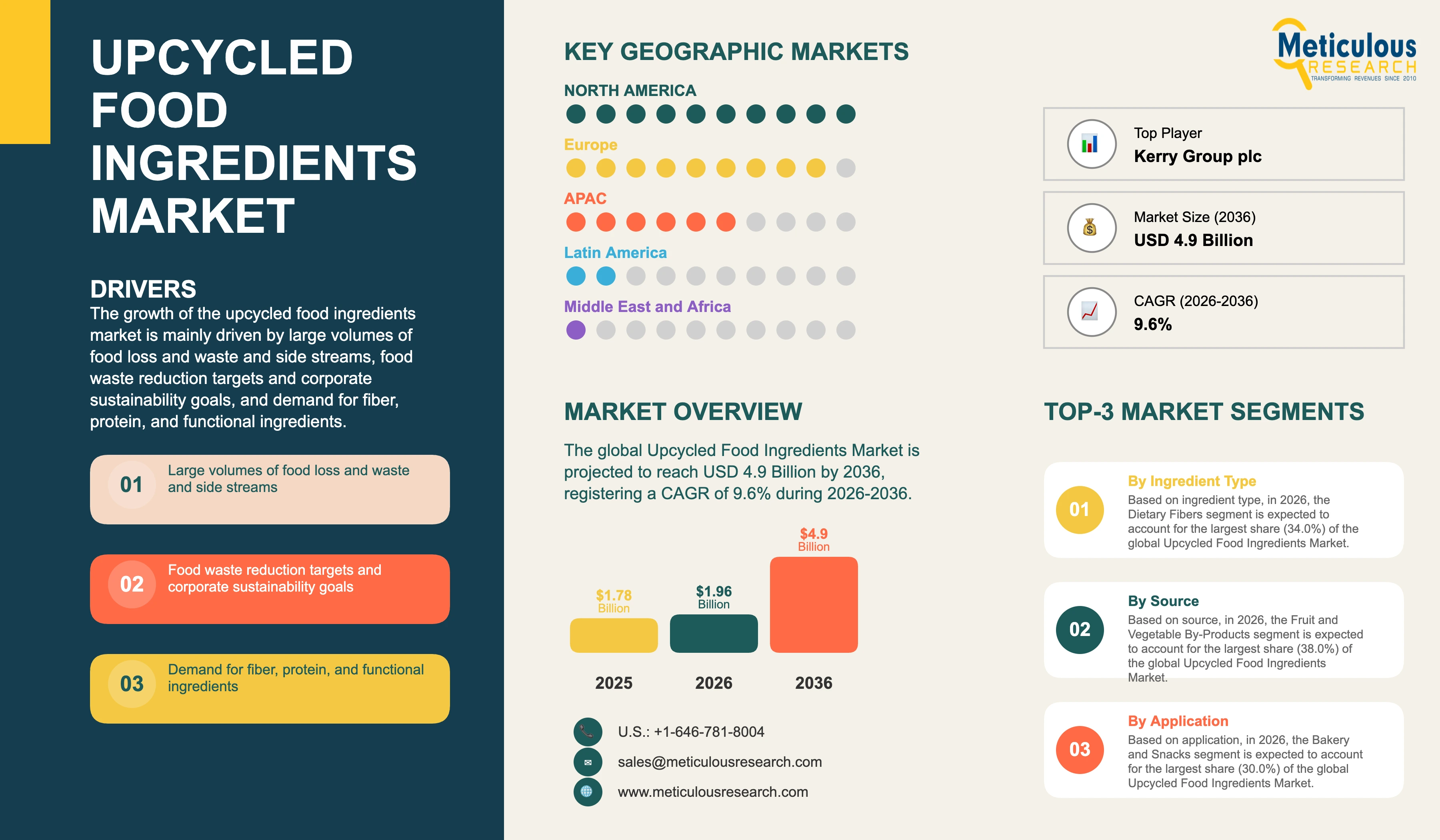
The global upcycled food ingredients market was valued at USD 1.78 billion in 2025. This market is expected to reach USD 4.90 billion by 2036 from an estimated USD 1.96 billion in 2026, registering a CAGR of 9.6% during the forecast period (2026-2036).
- Published
- Nov 2026
- Pages
- 315
- Format
- PDF + Excel
- Report ID
- MRFB - 1042512
- Base year
- 2025
- 2025 · BASELINE
- $1.78B
- 2036
- $4.90B
- CAGR 2026–2036
- 9.6%
2025 baseline · 2026–2036 forecast at 9.6% CAGR · hover a bar for the value
Key highlights
The Upcycled Certified program, administered by Where Food Comes From, Inc., included more than 100 participating companies and about 620 certified items in 2025, with certified products diverting about 1.35 million tons of food waste each year, and the program had diverted more than 6.36 million tons of food waste in total by 2026.
The Upcycled Food Association reported that the U.S. upcycled product market reached about USD 109.3 million at retail, up 30% year on year, and it launched a Canada hub in 2026 to support the growth of the sector in North America.
The United Nations Environment Programme's Food Waste Index Report 2024 estimated that about 1.05 billion tons of food were wasted in 2022 across households, food service, and retail, in addition to food lost earlier in the supply chain, which shows the large volume of potential raw materials for upcycled ingredients.
The European Union adopted binding food waste reduction targets in 2025 as part of the revised Waste Framework Directive, requiring Member States to reduce food waste in processing and manufacturing by 10% and in retail, food service, and households by 30% per capita by 2030, compared with a 2021 to 2023 baseline.
Large food and beverage companies are investing in upcycled ingredients, such as AB InBev's EverGrain, which produces proteins and fibers from brewers' spent grain, and Barry Callebaut's Cabosse Naturals, which makes ingredients from cacao fruit pulp and husks that were previously discarded.
Specialist ingredient companies are scaling up production of fibers and proteins from side streams, including citrus and apple fibers from juice processing, sugar beet fibers from sugar production, coffee flour from coffee cherry pulp, and sunflower protein from oil press cakes, which is widening the range of upcycled ingredients available to food manufacturers.
Rising demand for dietary fiber and protein, together with clean-label reformulation in bakery, dairy, meat, and beverage products, is expanding the use of upcycled ingredients beyond specialty brands into mainstream products sold by large food manufacturers and retailers.
By ingredient type, dietary fibers account for the largest share of 34.0% in 2026, while proteins register the highest CAGR.
By source, fruit and vegetable by-products account for the largest share in 2026, while brewer's spent grain registers the highest CAGR.
By application, bakery and snacks account for the largest share of 30.0% in 2026, while nutrition and dietary supplements register the highest CAGR.
By geography, North America accounts for the largest share of 36.0% in 2026, while Europe registers the highest CAGR of 10.5%.
Report summary
| Particulars | Details |
|---|---|
| Forecast Period | 2026-2036 |
| Base Year | 2025 |
| Estimated Year | 2026 |
| CAGR (Value) | 9.6% |
| Format | PDF, Excel & Cloud Portal · 315 pages |
| Market Size (Value) in 2025 | USD 1.78 billion |
| Market Size (Value) in 2026 | USD 1.96 billion |
| Market Size (Value) in 2036 | USD 4.90 billion |
| Segments Covered | Ingredient Type, Source, Application, and Geography |
| Countries Covered | North America, Europe, Asia-Pacific, Latin America, and Middle East and Africa |
| Key Companies | AB InBev (EverGrain), Barry Callebaut (Cabosse Naturals), Kerry, CP Kelco, Fiberstar, Herbafood, Döhler, Arla Foods Ingredients, Cosun Beet Company, Comet Bio, ReGrained, The Coffee Cherry Co., Outcast Foods, and Planetarians |
| Largest Segment by Ingredient Type (2026) | Dietary Fibers (34.0%) |
| Largest Segment by Application (2026) | Bakery and Snacks (30.0%) |
| Largest Region (2026) | North America (36.0%) |
| Fastest-Growing Region | Europe (CAGR 10.5%) |
Report overview
Segments covered: ingredient type, source, application.
The growth of this market is mainly driven by the large amount of food lost and wasted along the supply chain, growing pressure on food and beverage companies to reduce food waste and greenhouse gas emissions, including binding food waste reduction targets in the European Union, rising demand for fiber, protein, and other nutritious ingredients, the development of new processing technologies that turn side streams into stable, food-grade ingredients, and consumer interest in sustainable products supported by certification programs such as Upcycled Certified. However, factors such as the cost and complexity of collecting and stabilizing perishable side streams, inconsistent quality and supply, regulatory requirements for novel foods in some regions, limited consumer awareness, and competition from conventional ingredients are expected to restrain the growth of this market to some extent.
Upcycled food ingredients are ingredients made from food materials that would otherwise be wasted or used for low-value purposes, such as animal feed, compost, or energy. They are produced from side streams and by-products of food processing, such as fruit and vegetable pomace and peels, brewers' spent grain, oilseed press cakes, okara from soy milk production, bran and germ from grain milling, coffee cherry pulp and cacao fruit, and acid whey from dairy processing, as well as from surplus and imperfect produce. These materials are processed into food-grade fibers, proteins, flours, powders, sweeteners, extracts, and oils that can be used in a wide range of food and beverage products.
This market covers the global sales of upcycled food ingredients, measured in value. It includes dietary fibers, proteins, flours and powders, sweeteners and extracts, and oils and other ingredients produced from fruit and vegetable by-products, brewer's spent grain, oilseed and legume by-products, cereal and grain milling by-products, coffee and cocoa by-products, and dairy by-products, used in bakery and snacks, beverages, nutrition and dietary supplements, dairy and dairy alternatives, meat alternatives and processed meat, confectionery, and other applications. It is segmented by ingredient type, source, application, and geography. Long-established by-product commodities, such as standard whey protein concentrates, molasses, and wheat bran sold for feed, as well as finished upcycled consumer products, are not included.
Food loss and waste is a major global problem that affects every stage of the food system, and a large share of the food produced in the world is lost or wasted between the farm and the consumer, which wastes the land, water, energy, and labor used to produce it and creates greenhouse gas emissions when it decomposes. Food processing alone generates large volumes of side streams, many of which are nutritious and safe but have been used as animal feed or discarded because they are perishable, bulky, or not valued by the food industry. Upcycling turns these materials into higher-value food ingredients, which reduces waste and creates new revenue for processors.
Upcycled ingredients are often rich in nutrients, such as fiber, protein, polyphenols, and minerals, which makes them attractive for health-focused products. Brewers' spent grain, for example, contains high levels of protein and fiber; fruit pomace is rich in fiber and antioxidants; coffee cherry pulp contains polyphenols and natural sugars; and oilseed press cakes from sunflower, rapeseed, and other crops contain high-quality protein. Processing technologies, such as drying, milling, enzymatic hydrolysis, fractionation, extraction, and fermentation, are used to stabilize these materials and turn them into functional ingredients.
The value of upcycled ingredients is increasingly recognized across the food industry. For processors, upcycling turns a disposal cost or low-value feed sale into a new ingredient business with higher margins. For food manufacturers, upcycled ingredients provide fiber, protein, and functional benefits along with a credible sustainability claim, and they help companies report progress on food waste and scope 3 emissions targets. For consumers, products made with upcycled ingredients offer a simple way to reduce food waste through everyday purchases, and the Upcycled Certified mark helps them identify such products on the shelf.
The market includes a wide range of companies, from global food and ingredient groups to specialist start-ups. Large food, beverage, and ingredient companies, such as AB InBev through EverGrain, Barry Callebaut through Cabosse Naturals, Kerry, CP Kelco, Döhler, Arla Foods Ingredients, and Cosun Beet Company, produce upcycled ingredients from their own side streams or those of partners. Specialist companies, such as Fiberstar, Herbafood Ingredients, Comet Bio, ReGrained, The Coffee Cherry Co., Outcast Foods, and Planetarians, develop ingredients from specific side streams and sell them to food manufacturers.
Certification and standards help build trust in upcycled ingredients among food manufacturers, retailers, and consumers. The Upcycled Food Association defined upcycled foods and created the Upcycled Certified program, now administered by Where Food Comes From, which verifies that products and ingredients use food that would otherwise have been wasted. Certification allows brands to make credible claims about food waste reduction, and some retailers and food service companies are using upcycled ingredients as part of their sustainability strategies.
Over the forecast period, the upcycled food ingredients market is expected to grow strongly, supported by food waste regulations, corporate sustainability goals, demand for fiber and protein, investment in processing technology, and growing consumer awareness. Europe is expected to see particularly strong growth because of binding food waste reduction targets and support for the circular bioeconomy, while North America remains the largest market.
We want suppliers who can deliver consistent quality at scale. Upcycled fibers have reached that point, and we are now testing upcycled proteins as well.
This shows how consistency and scale are moving upcycled ingredients from small brands to large manufacturers, and how buyers expect proteins to follow fibers into mainstream use.
Operations Director - brewery group, U.S.
Spent grain used to be a low-value product that we sold to local farmers for animal feed. Turning it into food ingredients gives us a better return and helps us meet our sustainability goals.
This explains why brewer's spent grain is the fastest-growing source in this market and why brewing companies are investing in upcycling.
The EU food waste targets mean we must use our side streams better. Upcycling them into ingredients is the best option.
This explains why Europe is the fastest-growing region.
For European manufacturers, regulation is turning upcycling from a voluntary sustainability project into a business requirement, which supports faster growth in the region.
Product Manager - sports nutrition brand, U.K.
Upcycled proteins give us a lower-carbon protein with a good story for our customers.
This explains why proteins and nutrition are growing fastest.
Fruit and vegetable by-products are expected to account for the largest share of the market in 2026, due to the large volumes of pomace, peels, and trimmings from juice and processing, while brewer's spent grain is projected to register the highest CAGR.
Binding EU targets require Member States to reduce food waste in processing and manufacturing by 10% and in retail and consumption by 30% per capita by 2030, which encourages processors to find higher-value uses for side streams. National programs in the U.S., the U.K., Japan, and South Korea also support food waste reduction.
The Upcycled Certified program verifies that ingredients and products use food that would otherwise have been wasted, which allows brands to make credible claims. The program included more than 100 companies and about 620 certified items in 2025.
Key technologies include rapid drying, milling, enzymatic hydrolysis, wet fractionation, membrane filtration, extraction, and fermentation, which turn perishable side streams into stable, food-grade fibers, proteins, flours, and extracts.
Report infographic
Market dynamics
16 factors across 5 forcesLarge volumes of food loss and waste and side streams
The food system generates very large volumes of side streams and waste, from crop residues and imperfect produce on farms to by-products in food processing and surplus food in retail and food service. According to the United Nations Environment Programme's Food Waste Index Report 2024, about 1.05 billion tons of food were wasted in 2022 across households, food service, and retail, and additional food is lost earlier in the supply chain. Food processing side streams, such as pomace, spent grain, peels, hulls, press cakes, and whey, are particularly suitable for upcycling because they are generated in large volumes at a few locations and are often clean and traceable.
Turning these materials into food ingredients creates value from resources that are already produced, without additional land or water use. For processors, upcycling can turn a disposal cost or low-value feed sale into a profitable ingredient business, which is a strong economic incentive. Fruit and vegetable by-products account for the largest share of the market by source, reflecting the large volumes of pomace, peels, and trimmings from juice, canning, and processing.
The supply of side streams is also stable and predictable, since it is linked to the production of juice, beer, vegetable oil, flour, coffee, chocolate, and dairy products, which are large and established industries. This gives ingredient companies a reliable raw material base, provided they can secure long-term supply agreements with processors and build processing capacity close to where side streams are generated.
Food waste reduction targets and corporate sustainability goals
Governments and companies have set targets to reduce food waste, in line with United Nations Sustainable Development Goal 12.3, which aims to halve food waste at retail and consumer levels and reduce food losses along supply chains by 2030. The European Union adopted binding food waste reduction targets in 2025, requiring Member States to reduce food waste in processing and manufacturing by 10% and in retail, food service, and households by 30% per capita by 2030. Other countries, such as the U.S., the U.K., Japan, and South Korea, have national food waste reduction goals and programs.
Many large food and beverage companies have committed to reducing food waste in their operations and supply chains and to reducing greenhouse gas emissions, including scope 3 emissions from their supply chains. Using upcycled ingredients helps companies meet these goals and report progress, and some companies have set specific targets for upcycling their side streams. These commitments create demand for upcycled ingredients and encourage investment in processing capacity.
Retailers are also setting food waste targets and asking their suppliers to reduce waste, and some retailers in Europe and North America report food waste data publicly. These requirements are pushing food manufacturers to find higher-value uses for their side streams and to consider upcycled ingredients when reformulating products, which supports demand across the value chain.
Demand for fiber, protein, and functional ingredients
Consumers are increasingly looking for foods that are high in fiber and protein and that support digestive health, satiety, and overall wellbeing, and many upcycled ingredients are naturally rich in these nutrients. Fruit and vegetable fibers, such as citrus, apple, and sugar beet fibers, are used for fiber enrichment, texture, and water binding in bakery, dairy, meat, and beverage products, while proteins from spent grain, oilseed press cakes, and other side streams are used in protein bars, beverages, and meat alternatives.
Food manufacturers are also looking for clean-label alternatives to synthetic additives, and upcycled fibers can replace modified starches, gums, and other additives in some applications. These functional benefits make upcycled ingredients attractive beyond their sustainability credentials. Dietary fibers account for the largest share of the market by ingredient type, while proteins are the fastest-growing ingredient type.
Advances in processing technology
New processing technologies are making it possible to turn perishable and variable side streams into stable, consistent, food-grade ingredients at commercial scale. Technologies such as rapid drying, enzymatic processing, wet fractionation, membrane filtration, and fermentation can extract proteins, fibers, and other components from side streams with good functionality and taste. Investments by large companies, such as AB InBev's EverGrain plant for spent grain proteins and fibers, show that upcycling can be done at industrial scale.
Co-location of upcycling plants with breweries, juice plants, mills, and other processors reduces transport and stabilization costs, and partnerships between processors and ingredient companies are making it easier to secure raw materials. Brewer's spent grain is the fastest-growing source in this market, supported by investment in spent grain protein and fiber production.
Advances in sensory science and ingredient formulation are also reducing the off-flavors, gritty textures, and dark colors that limited the use of earlier upcycled ingredients, which allows them to be used at higher inclusion levels in mainstream products. As processing costs fall and quality improves, upcycled ingredients are becoming competitive with conventional fibers, flours, and proteins in a growing number of applications.
Table of contents
11 chapters · 119 sections · 315 pages · click to expandSegmental analysis
| Segment | Largest share (2026) | Fastest growth (2026–2036) |
|---|---|---|
| By Ingredient Type | Dietary fibers | Proteins |
| By Source | Fruit and vegetable by-products | Brewer's spent grain |
| By Application | Bakery and snacks | Nutrition and dietary supplements |
By Ingredient Type
- Upcycled Food Ingredients Market Analysis by Ingredient Type
- The dietary fibers segment is expected to account for the largest share of 34.0% of the market.
- The large share of this segment is mainly due to the wide use of fibers from fruit and vegetable by-products, such as citrus, apple, sugar beet, and pea hulls, in bakery, dairy, meat, beverages, and other products for fiber enrichment, texture, water binding, and clean-label reformulation.
- Citrus fibers made from peels left after juice production, apple fibers from pomace, and sugar beet fibers from pulp left after sugar extraction are among the most widely used upcycled fibers, produced by companies such as Fiberstar, CP Kelco, Herbafood Ingredients, Döhler, and Cosun Beet Company.
- These fibers can replace modified starches, gums, eggs, and fats in some applications, and they help manufacturers increase fiber content and meet clean-label demand.
- Fibers from spent grain, cacao husks, and other sources are also growing.
- Dietary fibers are expected to remain the largest ingredient type over the forecast period, supported by demand for fiber enrichment and clean-label texturizers.
- Demand for fiber enrichment in everyday foods is a major driver of growth in the dietary fibers segment.
- Dietary guidelines in many countries recommend higher fiber intake, and most consumers do not meet these recommendations, which encourages food manufacturers to add fiber to everyday products.
- Fibers from cereal side streams, such as bran and arabinoxylan from wheat and corn, are used for their prebiotic benefits, and companies such as Comet Bio produce prebiotic fibers from upcycled plant materials.
- Fiber producers are also investing in new capacity and in processing technologies that improve the functionality and taste of their fibers, which supports the continued growth of the segment.
- The dietary fibers segment benefits from a long history of commercial production, established supply chains, and clear functional benefits, which makes fibers the easiest upcycled ingredients for food manufacturers to adopt.
- Fibers from fruit and vegetable side streams can hold several times their weight in water, which helps manufacturers improve the texture, moisture, and shelf life of bakery and meat products, reduce fat and sugar in some recipes, and replace eggs or hydrocolloids in plant-based products.
- They are also used in beverages and dairy products for stability and mouthfeel.
- However, the proteins segment is projected to register the highest CAGR during the forecast period.
- The rapid growth of this segment is driven by demand for alternative proteins and investment in spent grain and oilseed proteins.
- Flours and powders, sweeteners and extracts, and oils and other ingredients make up the rest of the market.
- Flours and powders, such as spent grain flour, coffee flour, okara flour, and fruit powders, are used in bakery, snacks, and pasta for nutrition and flavor.
- Sweeteners and extracts, such as cacao fruit pulp concentrates, fruit juice concentrates from surplus produce, and polyphenol extracts from grape pomace and coffee cherry, are used in beverages, confectionery, and supplements.
- Oils and other ingredients include oils extracted from fruit seeds and other side streams, as well as specialty ingredients for food and nutrition.
By Source
- Upcycled Food Ingredients Market Analysis by Source
- The fruit and vegetable by-products segment is expected to account for the largest share of the market, due to the large volumes of pomace, peels, and trimmings from juice, canning, and processing and the established production of fruit fibers.
- However, the brewer's spent grain segment is projected to register the highest CAGR during the forecast period, driven by investment in spent grain proteins and fibers.
- Oilseed and legume by-products, cereal and grain milling by-products, coffee and cocoa by-products, and dairy by-products make up the rest of the market.
- Fruit and vegetable by-products include pomace from juice and cider production, citrus peels, sugar beet pulp, vegetable trimmings and peels, and surplus or imperfect produce, which are generated in large volumes around the world.
- Brewer's spent grain is generated by breweries in every major market and is rich in protein and fiber.
- Oilseed and legume by-products include press cakes from sunflower, rapeseed, and other oilseeds, okara from soy processing, and hulls and side streams from pulse protein production.
- Cereal and grain milling by-products include bran, germ, and hulls.
- Coffee and cocoa by-products include coffee cherry pulp, cascara, and silverskin, and cacao fruit pulp and pod husks.
- Dairy by-products include acid whey from yogurt production and other side streams.
By Application
- Upcycled Food Ingredients Market Analysis by Application
- The bakery and snacks segment is expected to account for the largest share of 30.0% of the market.
- The large share of this segment is mainly due to the wide use of upcycled fibers, flours, and proteins in bread, biscuits, crackers, bars, and snacks, where they add fiber, protein, and texture and can be easily incorporated into existing recipes.
- Spent grain flour, fruit fibers, and okara are commonly used in bakery and snack products, and many brands that use the Upcycled Certified mark are in this category.
- Bakery and snacks are expected to remain the largest application over the forecast period.
- Bakery and snack manufacturers use upcycled ingredients to increase fiber and protein content, reduce the use of refined flour, and improve the nutritional profile of their products, which supports health claims on packaging.
- Upcycled ingredients also add flavor and color, such as the nutty flavor of spent grain flour or the fruity notes of coffee flour, which helps brands differentiate their products.
- The bakery and snacks segment also benefits from the fact that dry, shelf-stable upcycled ingredients can be easily handled by existing bakery equipment, and many upcycled food brands, such as those making crackers, bars, chips, and cookies, are in this category.
- However, the nutrition and dietary supplements segment is projected to register the highest CAGR during the forecast period.
- The rapid growth of this segment is driven by demand for upcycled proteins and bioactive extracts.
- Beverages, dairy and dairy alternatives, meat alternatives and processed meat, confectionery, and other applications make up the rest of the market.
- Beverages use upcycled ingredients such as fruit fibers, cacao fruit juice, cascara extracts, and proteins in juices, smoothies, functional drinks, and ready-to-drink protein beverages.
- Dairy and dairy alternatives use fibers for texture and stability, and dairy side streams for protein.
- Meat alternatives and processed meat use fibers and proteins for texture, binding, and moisture retention, while confectionery uses cacao fruit ingredients, fruit powders, and fibers.
Geographic analysis
North America
Largest shareIn 2026, North America is expected to account for the largest share of 36.0% of the global upcycled food ingredients market. The large share of this region is mainly due to the strong presence of upcycled food companies and the Upcycled Food Association in the U.S., the Upcycled Certified program, investment by large companies such as AB InBev's EverGrain, and strong consumer interest in sustainable products. The U.S. has the largest number of upcycled food companies and certified products, and many start-ups have developed ingredients from spent grain, fruit pomace, okara, coffee cherry, and other side streams. The Upcycled Food Association reported that the U.S. upcycled product market grew about 30% at retail, and it launched a Canada hub in 2026. North America is expected to remain the largest region throughout the forecast period. Large food, brewing, and ingredient companies are also investing in upcycling capacity across North America. AB InBev's EverGrain operates a spent grain processing plant in the U.S., and food and ingredient companies such as Kerry, CP Kelco, and Fiberstar produce and sell fruit and vegetable fibers to manufacturers across the region. Retailers and food service companies in the U.S. and Canada are introducing products made with upcycled ingredients, and the U.S. Environmental Protection Agency and U.S. Department of Agriculture support food waste reduction through national goals and programs. Canada also has a growing upcycled food sector, with companies such as Outcast Foods.
Europe
Fastest growthEurope is projected to register the highest CAGR of 10.5% during the forecast period. Growth is driven by binding EU food waste reduction targets, circular bioeconomy policies, and strong ingredient industries in Germany, the Netherlands, Denmark, and other countries. The EU Waste Framework Directive now sets binding food waste reduction targets for 2030, and the EU Bioeconomy Strategy and circular economy policies support the use of side streams for higher-value products. Germany, the Netherlands, Denmark, France, and other countries have large food processing and ingredient industries, and companies such as Herbafood, Döhler, Cosun Beet Company, Arla Foods Ingredients, and Barry Callebaut are based in Europe. Start-ups, such as Planetarians, which makes sunflower protein, are also growing in the region. Strict novel food rules may slow the approval of some new ingredients, but demand from food manufacturers and retailers is expected to drive strong growth.
Asia-Pacific
Asia-Pacific holds a significant share, supported by large food processing industries and growing interest in upcycling, while Latin America and the Middle East and Africa are smaller markets. In Asia-Pacific, Japan and South Korea have long traditions of using side streams, such as okara and rice bran, in food, and both countries have national food waste reduction programs. China and India have very large food processing industries that generate large volumes of side streams, and interest in upcycling is growing in Australia and Singapore.
Latin America
Latin America is a major producer of coffee, cocoa, fruit, and juice, which offers large volumes of side streams, and some companies are developing coffee cherry and cacao fruit ingredients in the region.
Middle East & Africa
The Middle East and Africa is a small market but has potential as food processing grows.
Competitive landscape
The upcycled food ingredients market is fragmented, with large food, beverage, and ingredient companies and many specialist start-ups. Leading companies include AB InBev (EverGrain), Barry Callebaut (Cabosse Naturals), Kerry Group, CP Kelco, Fiberstar, Herbafood Ingredients, Döhler, Arla Foods Ingredients, Cosun Beet Company, Comet Bio, ReGrained, The Coffee Cherry Co., Outcast Foods, and Planetarians.
Companies compete on access to side streams, processing technology, ingredient functionality and nutrition, cost, consistency, certification, and relationships with food manufacturers.
Established fiber and ingredient producers, such as Kerry, CP Kelco, Fiberstar, Herbafood, Döhler, and Cosun Beet Company, have strong positions in fruit and vegetable fibers, with established products, large production capacity, and long relationships with food manufacturers. Brewing and food companies, such as AB InBev and Barry Callebaut, use their own side streams to develop new ingredient businesses. Arla Foods Ingredients uses dairy side streams to develop whey-based ingredients. Specialist companies, such as Comet Bio, ReGrained, The Coffee Cherry Co., Outcast Foods, and Planetarians, focus on specific side streams and ingredients and often partner with processors and food manufacturers.
The top five players are estimated to account for 30.0% of the upcycled food ingredients market in 2025, reflecting the presence of established fiber producers and many small specialists.
Players use several strategies to grow in this market, including partnering with processors to secure side streams, building processing plants next to breweries and factories, obtaining certification, developing new ingredients, and working with food manufacturers on product development.
For example, companies are building processing plants next to breweries, juice plants, and oil mills, signing long-term supply agreements with processors, and obtaining Upcycled Certified status for their ingredients. Large companies are partnering with or acquiring start-ups to gain access to new technologies, while start-ups are raising funding to build capacity. Companies are also working closely with food manufacturers to develop applications and recipes, which helps them win customers and shows the functional benefits of their ingredients.
Competition is expected to center on scale, functionality, and cost.
Companies that can secure reliable side stream supply, produce consistent high-quality ingredients at competitive prices, and support customers with application expertise are expected to gain share over the forecast period. Consolidation is also likely as large ingredient companies acquire successful start-ups and as smaller players seek partners to fund the expansion of their production capacity.
Some of the key players operating in the upcycled food ingredients market are Anheuser-Busch InBev SA/NV (EverGrain), Barry Callebaut AG (Cabosse Naturals), Kerry Group plc, CP Kelco U.S., Inc., Fiberstar, Inc., Herbafood Ingredients GmbH, Döhler GmbH, Arla Foods Ingredients Group P/S, Cosun Beet Company, Comet Bio, ReGrained, The Coffee Cherry Co., Outcast Foods Inc., and Planetarians.
- —
The Upcycled Certified program passed 620 certified items, the Upcycled Food Association launched a Canada hub in 2026, and the EU adopted binding food waste reduction targets.
- AB InBev (EverGrain)
- Barry Callebaut · Cabosse Naturals
- Kerry
- CP Kelco
- Fiberstar
- Herbafood
- Döhler
- Arla Foods Ingredients
- Cosun Beet Company
- Comet Bio
- ReGrained
- Coffee Cherry Co.
- Outcast Foods
- Planetarians
Expert perspectives
Upcycled food ingredients are moving from a niche sustainability trend to a growing part of the food ingredients industry, supported by food waste regulations, corporate commitments, and demand for fiber and protein.
The market benefits from strong structural drivers that are expected to remain in place throughout the forecast period. The food system generates very large volumes of nutritious side streams, governments and companies have committed to reducing food waste, and consumers want foods that are higher in fiber and protein and better for the environment. Upcycled ingredients can meet all of these needs, and the main barriers are the cost of processing and the need for consistent quality and supply, which are being addressed by investment and new technology.
Over the forecast period, the market is expected to grow at about 9.6% per year, supported by investment in processing, new ingredients, and growing adoption by food manufacturers.
Growth is expected to be strongest in proteins and in the nutrition and supplements application, where upcycled ingredients can command higher prices and where demand for alternative proteins and functional ingredients is rising. Fibers will remain the core of the market, with steady demand from bakery, dairy, and meat manufacturers, and new fibers from cereal, spent grain, and cacao side streams will add to the established fruit and vegetable fibers.
Dietary fibers are the largest ingredient type because of their broad use in bakery, dairy, meat, and beverage products, while proteins grow fastest on the back of demand for alternative and lower-carbon proteins. Fruit and vegetable by-products are the largest source, while brewer's spent grain grows fastest. Bakery and snacks are the largest application, while nutrition and supplements grow fastest.
North America remains the largest region, while Europe is the fastest-growing region at a CAGR of 10.5%. The main swing factors are processing costs, regulation, and consumer awareness.
In Europe, binding food waste reduction targets and circular economy policies are expected to encourage processors to find higher-value uses for their side streams, and food manufacturers and retailers are expected to increase the use of upcycled ingredients to meet their own targets. In North America, a strong upcycled food sector and growing certification are expected to support steady growth, while Asia-Pacific offers large long-term potential because of the size of its food processing industry.
For ingredient companies, the key priorities are securing side streams, improving functionality and cost, and building partnerships with food manufacturers.
For food processors, the key priority is to treat side streams as food-grade raw materials rather than waste, which opens new revenue opportunities. For food manufacturers, upcycled ingredients offer a way to improve nutrition, meet clean-label demand, and reduce food waste across their supply chains, and early adopters can build strong sustainability credentials with consumers and retailers.
Overall, upcycling is expected to become a standard part of how the food industry manages side streams over the forecast period.
Customer perspectives
Head of Product Development - bakery company, U.S.
Upcycled fibers and spent grain flour let us add fiber and protein while telling a strong sustainability story.
This explains why bakery and snacks account for 30.0% of the market and fibers 34.0%.
For bakery and snack brands, upcycled ingredients offer both nutrition and a story that consumers understand, which supports their use in mainstream products.
Frequently asked questions
The market was valued at USD 1.78 billion in 2025 and USD 1.62 billion in 2024, and is estimated at USD 1.96 billion in 2026.
Cite this report
Meticulous Research. (2026). Upcycled Food Ingredients Market - Global Opportunity Analysis and Industry Forecast (2026-2036) (Report No. MRFB - 1042512). Meticulous Market Research Pvt. Ltd. https://www.meticulousresearch.com/product/upcycled-food-ingredients-market-7195