Salt Reduction Ingredients Market (2026-2036)
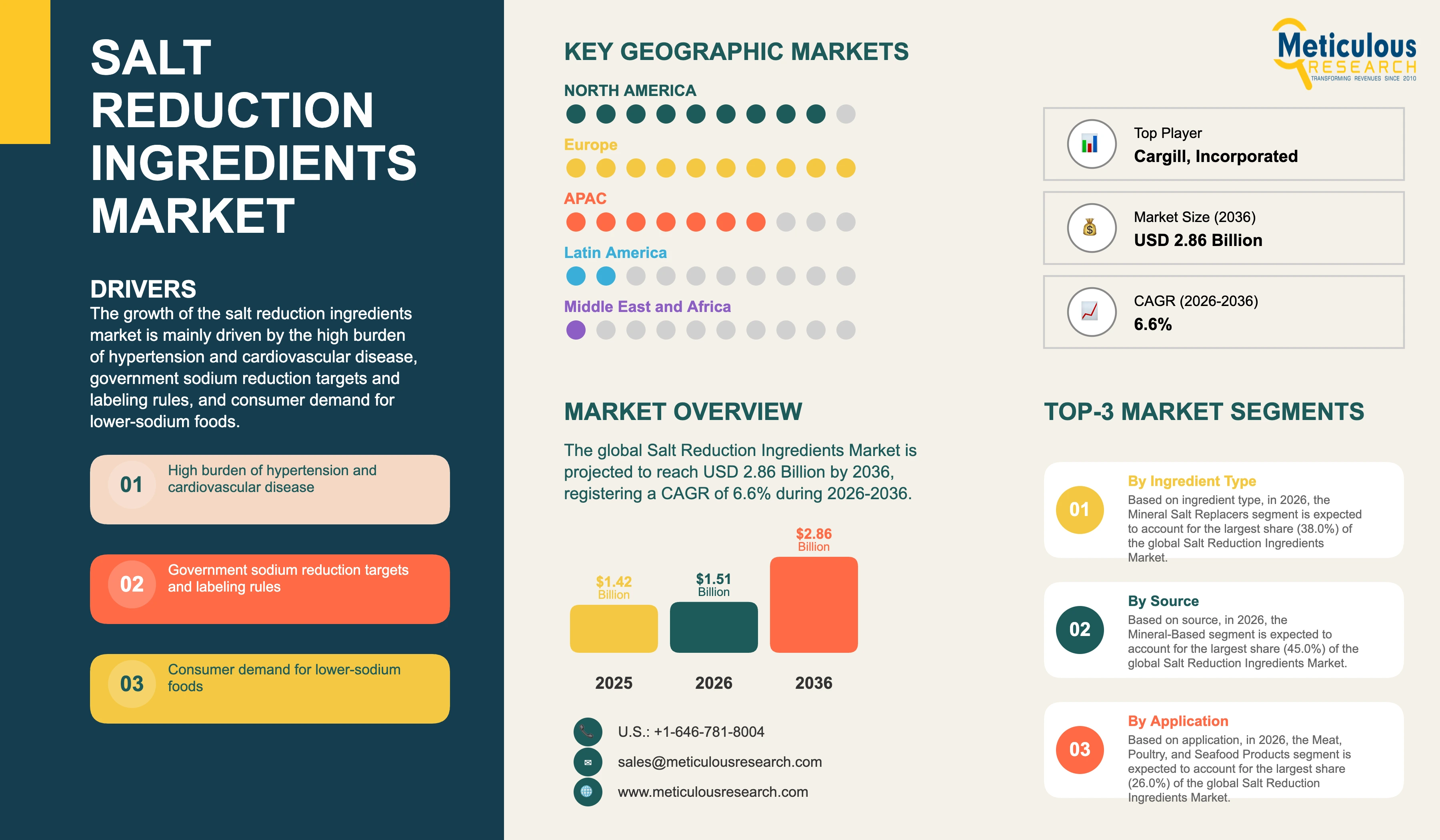
The global salt reduction ingredients market was valued at USD 1.42 billion in 2025. This market is expected to reach USD 2.86 billion by 2036 from an estimated USD 1.51 billion in 2026, registering a CAGR of 6.6% during the forecast period (2026-2036).
- Published
- Nov 2026
- Pages
- 310
- Format
- PDF + Excel
- Report ID
- MRFB - 1042531
- Base year
- 2025
- 2025 · BASELINE
- $1.42B
- 2036
- $2.86B
- CAGR 2026–2036
- 6.6%
2025 baseline · 2026–2036 forecast at 6.6% CAGR · hover a bar for the value
Key highlights
The World Health Organization's Global Report on Sodium Intake Reduction, published in 2023, found that the world is off track to achieve the global target of reducing sodium intake by 30% by 2025, with average global salt intake estimated at about 10.8 grams per day, more than double the WHO recommendation of less than 5 grams of salt, and only about 5% of WHO Member States protected by mandatory and comprehensive sodium reduction policies.
In January 2025, the World Health Organization issued its first guideline on lower-sodium salt substitutes, conditionally recommending that adults who use table salt replace it with lower-sodium salt substitutes that contain potassium, which is expected to raise awareness and demand for potassium-based salt replacers.
In August 2024, the U.S. Food and Drug Administration issued draft Phase II voluntary sodium reduction goals covering 163 food categories, aimed at reducing average sodium intake to about 2,750 milligrams per day, after preliminary data showed that about 40% of the Phase I targets were very close to being met or had already been met.
The FDA notes that more than 70% of the sodium Americans consume comes from sodium added during the manufacturing and commercial preparation of foods rather than from the salt shaker, which places packaged food and food service companies at the center of sodium reduction efforts and supports demand for salt reduction ingredients.
Countries such as South Africa and Argentina have set mandatory sodium limits for selected processed foods, while the U.K., Canada, Australia, and several other countries use voluntary salt reduction targets for food categories, and front-of-pack warning labels for high sodium are mandatory in several Latin American countries.
Ingredient suppliers are expanding their portfolios of salt reduction solutions, including potassium chloride with improved taste, sodium-reduced sea salts, yeast extracts designed to enhance saltiness, and natural salt taste modulators, and they are investing in application centers that help food manufacturers reformulate meat, bakery, snack, and sauce products.
By ingredient type, mineral salt replacers account for the largest share of 38.0% in 2026, while salt taste enhancers and flavor modulators register the highest CAGR.
By source, mineral-based ingredients account for the largest share in 2026, while plant and seaweed-based ingredients register the highest CAGR.
By application, meat, poultry, and seafood products account for the largest share of 26.0% in 2026, while plant-based meat and dairy alternatives register the highest CAGR.
By geography, Europe accounts for the largest share of 34.0% in 2026, while Asia-Pacific registers the highest CAGR of 8.1%.
Report summary
| Particulars | Details |
|---|---|
| Base Year | 2025 |
| Estimated Year | 2026 |
| Forecast Period | 2026-2036 |
| Market Size in 2025 | USD 1.42 billion |
| Market Size in 2026 | USD 1.51 billion |
| Market Size by 2036 | USD 2.86 billion |
| CAGR (2026-2036) | 6.6% |
| Format | PDF, Excel & Cloud Portal · 310 pages |
| Largest Segment by Ingredient Type (2026) | Mineral Salt Replacers (38.0%) |
| Largest Segment by Application (2026) | Meat, Poultry, and Seafood Products (26.0%) |
| Largest Region (2026) | Europe (34.0%) |
| Fastest-Growing Region | Asia-Pacific (CAGR 8.1%) |
| Segments Covered | Ingredient Type, Source, Application, and Geography |
| Geographic Scope | North America, Europe, Asia-Pacific, Latin America, and Middle East and Africa |
| Key Companies Profiled | Cargill, K+S, Tate & Lyle, Kerry, Givaudan, Symrise, Ajinomoto, Lesaffre (Biospringer), Angel Yeast, Ohly, Jungbunzlauer, Nu-Tek Food Science, Saltwell, and Innophos |
Report overview
Segments covered: ingredient type, source, application.
The growth of this market is mainly driven by the high global burden of hypertension and cardiovascular disease linked to excess sodium intake, government sodium reduction targets and labeling rules, including the U.S. Food and Drug Administration's voluntary sodium reduction goals and national salt targets in Europe and elsewhere, rising consumer demand for lower-sodium packaged foods, the World Health Organization's 2025 recommendation on potassium-enriched salt substitutes, and steady improvements in the taste of mineral salt replacers, yeast extracts, and salt taste enhancers. However, factors such as the bitter and metallic taste of potassium chloride at high use levels, the role of salt in food safety, texture, and processing, the higher cost of salt replacers compared with regular salt, and the voluntary nature of most sodium reduction policies are expected to restrain the growth of this market to some extent.
Salt reduction ingredients are ingredients that food manufacturers and food service operators use to lower the sodium content of foods while maintaining acceptable saltiness, flavor, texture, and shelf life. They include mineral salt replacers, such as potassium chloride, magnesium and calcium salts, and mineral salt blends; yeast extracts, which provide savory and umami taste that compensates for reduced salt; glutamates and nucleotides, such as monosodium glutamate, which contain less sodium than salt and enhance savory flavor; salt taste enhancers and flavor modulators, which boost the perception of saltiness or mask the off-notes of salt replacers; structured and micronized salt, which uses smaller or hollow salt crystals to deliver more saltiness per gram; and other ingredients, such as seaweed-based salts, herbs and spices, and amino acids.
This market covers the global sales of salt reduction ingredients to food and beverage manufacturers and food service operators, as well as lower-sodium salt substitutes sold for household use, measured in value. It is segmented by ingredient type, source, application, and geography. Regular salt, sea salt, and other sodium chloride products are not included, nor are finished low-sodium consumer products. Glutamates and yeast extracts used purely for flavor rather than for sodium reduction are counted only to the extent that they are used in sodium reduction applications.
Excess sodium intake is one of the leading dietary risk factors for death and disability worldwide, because it raises blood pressure and increases the risk of heart disease, stroke, and kidney disease. The World Health Organization recommends that adults consume less than 2 grams of sodium per day, equivalent to less than 5 grams of salt, but average global sodium intake was estimated at about 4.3 grams per day in 2019, more than double the recommendation. In most high-income countries, the majority of sodium comes from processed and packaged foods and from meals prepared in restaurants and food service, while in some Asian countries a large share comes from salt and sauces added during home cooking.
Reducing sodium is technically challenging because salt has many functions in food. It provides saltiness and enhances other flavors, controls microbial growth and extends shelf life, binds water and proteins in meat products, controls yeast fermentation and strengthens gluten in bread, and affects texture and melt in cheese. Manufacturers therefore use combinations of ingredients and process changes to reduce sodium, such as replacing part of the salt with potassium chloride, adding yeast extracts or flavor modulators to restore taste, and using structured salt in snacks. Gradual stepwise reduction, which allows consumers to adapt to lower saltiness over time, is also widely used.
The market includes a wide range of suppliers, from salt and mineral companies to yeast, flavor, and ingredient companies. Mineral companies, such as Cargill and K+S, supply potassium chloride and salt blends, and specialists such as Nu-Tek Food Science, Saltwell, and Jungbunzlauer offer potassium chloride with improved taste, sodium-reduced sea salt, and mineral salt blends. Yeast extract producers, such as Lesaffre through Biospringer, Angel Yeast, and Ohly, supply savory ingredients that help restore flavor. Flavor and ingredient companies, such as Givaudan, Symrise, Kerry, and Tate & Lyle, provide salt taste enhancers, flavor modulators, and structured salt solutions, and Ajinomoto supplies glutamates and umami seasonings as well as reduced-sodium salt products.
Public health policy is a key force shaping demand for salt reduction ingredients in every major region. Many countries have national salt reduction programs, often based on voluntary targets for sodium levels in food categories, while a smaller number of countries have mandatory limits. The FDA's voluntary sodium reduction goals in the U.S., the U.K. salt reduction targets, and similar programs in Canada, Australia, and other countries encourage manufacturers to reformulate products across many food categories. Front-of-pack labels that flag high sodium content, such as the warning labels used in Latin America, provide a further incentive.
Over the forecast period, the salt reduction ingredients market is expected to grow steadily, supported by public health policies, consumer demand, the WHO recommendation on salt substitutes, and improvements in taste and cost. Europe is expected to remain the largest market, while Asia-Pacific is expected to grow fastest because of high salt intake, large populations with hypertension, and growing government focus on salt reduction in China, Japan, India, and other countries.
Mineral-based ingredients, led by potassium chloride and mineral salt blends, are expected to account for the largest share of the market in 2026, while plant and seaweed-based ingredients are projected to register the highest CAGR because of clean-label demand.
In January 2025, WHO conditionally recommended that adults who use table salt replace it with lower-sodium salt substitutes containing potassium. The recommendation does not apply to pregnant women, children, or people with kidney impairment.
The FDA issued voluntary Phase I goals in 2021 and draft Phase II goals in August 2024, covering 163 food categories and aiming to reduce average U.S. sodium intake to about 2,750 milligrams per day. The FDA notes that more than 70% of sodium intake comes from sodium added during food manufacturing and commercial preparation.
Salt provides saltiness and flavor, controls microbial growth, binds water and proteins in meat, controls fermentation in bread, and affects texture in cheese, so manufacturers must use combinations of ingredients and process changes to maintain taste, safety, and quality.
Report infographic
Market dynamics
16 factors across 5 forcesHigh burden of hypertension and cardiovascular disease
Hypertension affects a large share of the world's adult population and is a major risk factor for heart attacks, strokes, and kidney disease, which are among the leading causes of death worldwide. Excess sodium intake is one of the main modifiable causes of high blood pressure, and the World Health Organization estimates that reducing sodium intake is one of the most cost-effective measures for preventing cardiovascular disease. The WHO's Global Report on Sodium Intake Reduction found that the world is off track to meet the target of a 30% reduction in sodium intake by 2025, which has increased pressure on governments and the food industry to act.
Large clinical studies have also shown the health benefits of replacing regular salt with potassium-enriched salt substitutes. The Salt Substitute and Stroke Study, conducted in rural China and published in 2021, found that replacing regular salt with a potassium-enriched salt substitute reduced the risk of stroke, major cardiovascular events, and death. These findings, together with the WHO's 2025 guideline on lower-sodium salt substitutes, have increased interest in potassium-based salt replacers among health authorities, food companies, and consumers.
The economic burden of cardiovascular disease, including the cost of treatment and lost productivity, is a major concern for governments and health systems, and sodium reduction is widely considered one of the best-value public health interventions. This gives governments a strong reason to continue and strengthen sodium reduction programs, which in turn supports demand for ingredients that help the food industry reduce sodium.
Government sodium reduction targets and labeling rules
Governments around the world have introduced sodium reduction programs that encourage or require food manufacturers to lower the sodium content of their products. In the U.S., the FDA published Phase I voluntary sodium reduction goals in 2021 and draft Phase II goals in August 2024, covering 163 food categories and aiming to reduce average sodium intake to about 2,750 milligrams per day. The FDA reported that about 40% of the Phase I targets were very close to being met or had already been met based on preliminary 2022 data, showing that industry reformulation is under way. The U.K. has had voluntary salt reduction targets for food categories since 2006, and the most recent targets set levels for 2024, while Canada, Australia, and New Zealand also use category targets.
Some countries have gone further than voluntary targets and set mandatory sodium limits for selected foods. South Africa introduced mandatory sodium limits for categories such as bread, processed meats, snacks, and soup powders, and Argentina set maximum sodium levels for processed meats, soups, and bakery products. Front-of-pack warning labels for high sodium are mandatory in Chile, Mexico, Peru, Colombia, Argentina, Brazil, and other countries, and Canada's front-of-package nutrition symbol for foods high in sodium, sugars, or saturated fat has a compliance date in 2026. These policies give manufacturers strong incentives to reformulate and support demand for salt reduction ingredients.
Consumer demand for lower-sodium foods
Consumers are increasingly aware of the health risks of excess sodium, particularly older consumers and those with high blood pressure, and many look for products labeled as low sodium, reduced sodium, or no added salt. Retailers are expanding their ranges of lower-sodium products, and food service companies are reducing sodium in menu items to meet the expectations of customers and institutional clients, such as schools, hospitals, and workplaces.
At the same time, consumers expect reduced-sodium foods to taste as good as the original products, which means that manufacturers need ingredients that deliver saltiness and flavor without bitterness or off-notes. This creates demand for better-tasting salt replacers, yeast extracts, and salt taste enhancers, and for blends that combine several ingredients.
Improvements in taste and functionality of salt reduction ingredients
Ingredient suppliers have improved the taste of potassium chloride through purification, masking agents, and blending with other minerals and flavors, which allows higher levels of sodium replacement without bitterness. Yeast extracts and flavor modulators have become more targeted, with products designed to enhance saltiness or mask the off-notes of potassium chloride. Structured and micronized salt technologies, such as hollow salt microspheres and fine salt crystals, deliver more saltiness per gram on the surface of snacks.
These technical advances allow manufacturers to achieve greater sodium reduction in more categories while keeping taste and functionality, and they are supported by application research and sensory testing by ingredient suppliers. Salt taste enhancers and flavor modulators are the fastest-growing ingredient type in this market.
Suppliers are also developing ingredients tailored to specific applications, such as potassium chloride blends for processed meats that maintain water binding, yeast extracts for soups and sauces that add savory depth, and structured salt for chips and crackers that delivers an immediate salty impact on the tongue. These application-specific solutions make it easier for manufacturers to adopt salt reduction ingredients.
Table of contents
11 chapters · 126 sections · 310 pages · click to expandSegmental analysis
| Segment | Largest share (2026) | Fastest growth (2026–2036) |
|---|---|---|
| By Ingredient Type | Mineral salt replacers | Salt taste enhancers and flavor modulators |
| By Source | Mineral-based | Plant and seaweed-based |
| By Application | Meat, poultry, and seafood products | Plant-based meat and dairy alternatives |
By Ingredient Type
- Salt Reduction Ingredients Market Analysis by Ingredient Type
- The mineral salt replacers segment is expected to account for the largest share of 38.0% of the market.
- The large share of this segment is mainly due to the wide use of potassium chloride and mineral salt blends in meat products, snacks, bakery, soups, sauces, and seasonings, where they directly replace part of the sodium chloride while providing saltiness, and the growing use of potassium-enriched salt substitutes for household and food service use.
- Potassium chloride is the most widely used mineral salt replacer because it provides a salty taste and many of the functional properties of sodium chloride, such as water binding and microbial control, at a reasonable cost.
- Suppliers such as Cargill, K+S, and Nu-Tek Food Science offer food-grade potassium chloride with improved taste, and mineral blends that combine potassium, magnesium, and sodium chloride, such as sodium-reduced sea salts from Saltwell and mineral salts from Jungbunzlauer, are used to reduce sodium with fewer off-notes.
- Mineral salt replacers are expected to remain the largest ingredient type over the forecast period, supported by sodium reduction policies and the WHO recommendation on salt substitutes.
- Suppliers are improving the taste of potassium chloride through purification, particle engineering, and coating, and they are developing blends with magnesium salts, calcium salts, and natural flavors.
- Low-sodium sea salts, which naturally contain higher levels of potassium and magnesium, are also gaining popularity because they offer a clean-label way to reduce sodium.
- Demand for mineral salt replacers is expected to grow steadily as sodium targets tighten and as potassium-enriched salt becomes more widely available for household use.
- The mineral salt replacers segment benefits from strong regulatory support and a growing body of scientific evidence on potassium-enriched salt.
- The WHO guideline on lower-sodium salt substitutes and the results of the Salt Substitute and Stroke Study have increased confidence in potassium-based replacers, and several governments and health organizations are encouraging their use.
- Food manufacturers use potassium chloride in processed meats, bread, snacks, soups, sauces, seasonings, and cheese, often replacing between a quarter and a half of the sodium chloride, and they combine it with yeast extracts and flavor modulators to mask bitterness.
- Household and food service sales of potassium-enriched salt substitutes are also growing, particularly in Europe and Asia.
- However, the salt taste enhancers and flavor modulators segment is projected to register the highest CAGR during the forecast period.
- The rapid growth of this segment is driven by demand for deeper sodium reduction with good taste and clean-label solutions.
- Yeast extracts, glutamates and nucleotides, structured and micronized salt, and other ingredients make up the rest of the market.
- Yeast extracts are widely used in soups, sauces, snacks, ready meals, and meat products to add savory and umami taste that compensates for reduced salt, and producers such as Lesaffre, Angel Yeast, and Ohly offer extracts designed for salt reduction.
- Glutamates and nucleotides, such as monosodium glutamate, contain about a third of the sodium of table salt and enhance savory flavor, and they are used in seasonings, sauces, and snacks, particularly in Asia.
- Structured and micronized salt, such as hollow salt microspheres, delivers more saltiness per gram in topical applications.
- Other ingredients include seaweed salts, herbs and spices, and amino acids.
By Source
- Salt Reduction Ingredients Market Analysis by Source
- The mineral-based segment is expected to account for the largest share of the market, due to the wide use of potassium chloride and mineral salt blends.
- However, the plant and seaweed-based segment is projected to register the highest CAGR during the forecast period, driven by clean-label demand.
- Fermentation-derived ingredients, such as yeast extracts and glutamates, make up the rest of the market.
- Mineral-based ingredients include potassium chloride, magnesium and calcium salts, mineral salt blends, sodium-reduced sea salts, and structured salt.
- Fermentation-derived ingredients include yeast extracts, monosodium glutamate, nucleotides, and fermented flavors.
- Plant and seaweed-based ingredients include seaweed salts, mushroom and vegetable extracts, herbs, spices, and plant-based salt taste modulators, which appeal to consumers seeking natural and clean-label products.
By Application
- Salt Reduction Ingredients Market Analysis by Application
- The meat, poultry, and seafood products segment is expected to account for the largest share of 26.0% of the market.
- The large share of this segment is mainly due to the high sodium content of processed meats, such as bacon, ham, sausages, deli meats, and cured products, which are major sources of sodium in many diets, and the inclusion of processed meats in sodium reduction targets in the U.S., Europe, and other regions.
- Salt plays important roles in meat products, including flavor, water binding, protein extraction, and microbial control, which makes reduction challenging and creates demand for mineral replacers, phosphates, yeast extracts, and flavor modulators that restore these functions.
- Meat, poultry, and seafood products are expected to remain the largest application over the forecast period.
- Processed meat manufacturers have made progress in reducing sodium by using potassium chloride, mineral blends, and yeast extracts, combined with process changes and other functional ingredients, and many have reduced sodium by a quarter or more in some products.
- Regulatory targets, such as the FDA's Phase II goals and U.K. salt targets for bacon, ham, sausages, and other products, continue to push for further reduction.
- Seafood products, such as smoked and cured fish, and poultry products, such as marinated and processed chicken, also use salt reduction ingredients.
- Meat manufacturers work closely with ingredient suppliers to develop solutions that maintain taste, texture, yield, and shelf life.
- However, the plant-based meat and dairy alternatives segment is projected to register the highest CAGR during the forecast period.
- The rapid growth of this segment is driven by efforts to reduce the high sodium content of plant-based products.
- Soups, sauces, seasonings, and dressings, bakery products, snacks, ready meals and convenience foods, dairy and cheese, and other applications make up the rest of the market.
- Soups, sauces, seasonings, and dressings use yeast extracts, glutamates, flavor modulators, and potassium chloride to reduce sodium while keeping savory flavor.
- Bakery products, particularly bread, are major sources of sodium, and manufacturers use potassium chloride and mineral blends to reduce salt while maintaining dough handling and fermentation.
- Snacks use structured salt and flavor enhancers on the surface of chips and crackers.
- Ready meals and convenience foods use combinations of ingredients to reduce sodium in complex recipes, while dairy and cheese use mineral salts carefully because salt affects texture, ripening, and safety.
Geographic analysis
Europe
Largest shareIn 2026, Europe is expected to account for the largest share of 34.0% of the global salt reduction ingredients market. The large share of this region is mainly due to long-standing national salt reduction programs, such as those in the U.K. and Finland, strong consumer awareness, Nutri-Score and other front-of-pack labels that reflect sodium content, and the presence of major salt, yeast, and flavor companies. The U.K. salt reduction program, which began in the mid-2000s, is widely seen as a model for other countries, and many European food manufacturers have reformulated their products to meet salt targets. Europe is expected to remain the largest region throughout the forecast period. The U.K. program helped reduce average salt intake in the population and led to significant reductions in the salt content of bread, breakfast cereals, sauces, and processed meats. Finland was one of the first countries to reduce salt intake through labeling, reformulation, and public education, and other countries, such as France, the Netherlands, Germany, and Italy, have national programs or agreements with the food industry. Nutri-Score labeling, used in several European countries, gives lower scores to products with high sodium, which encourages reformulation. Major salt and ingredient companies, such as K+S, Cargill, Lesaffre, Ohly, Givaudan, Symrise, Jungbunzlauer, and Saltwell, have strong operations in Europe, and potassium-enriched salt substitutes are widely available in European retail.
Asia-Pacific
Fastest growthAsia-Pacific is projected to register the highest CAGR of 8.1% during the forecast period. Growth is driven by very high salt intake in China, Japan, South Korea, and other countries, the evidence from Chinese salt substitute studies, and growing government focus on salt reduction. China has very high average salt intake, much of it from salt and sauces added during cooking, and the Salt Substitute and Stroke Study conducted in rural China showed large benefits from potassium-enriched salt. The Healthy China 2030 plan includes salt reduction goals, and Japan and South Korea have long-running programs to reduce sodium intake. India, Southeast Asia, and Australia are also expanding salt reduction efforts, and rapid growth of packaged and convenience foods in the region is increasing demand for salt reduction ingredients.
North America
North America holds a large share, supported by the FDA's sodium reduction goals, while Latin America and the Middle East and Africa are smaller markets. In the U.S., the FDA's voluntary sodium reduction goals, sodium standards for school meals, and sodium warning requirements for chain restaurants in some cities support demand, and Canada is implementing front-of-package labels for foods high in sodium.
Latin America
In Latin America, front-of-pack warning labels and Argentina's mandatory sodium limits drive reformulation, while South Africa's mandatory sodium regulations support demand in the Middle East and Africa.
Competitive landscape
The salt reduction ingredients market is moderately fragmented, with salt and mineral companies, yeast extract producers, flavor companies, and specialist suppliers. Leading companies include Cargill, K+S, Tate & Lyle, Kerry, Givaudan, Symrise, Ajinomoto, Lesaffre (Biospringer), Angel Yeast, Ohly, Jungbunzlauer, Nu-Tek Food Science, Saltwell, and Innophos.
Companies compete on taste, functionality, cost, clean-label positioning, regulatory compliance, and application support.
Salt and mineral companies, such as Cargill, K+S, and Nu-Tek Food Science, focus on potassium chloride and mineral salt blends and benefit from large production capacity and control of raw materials. Yeast extract producers, such as Lesaffre through Biospringer, Angel Yeast, and Ohly, offer savory ingredients for salt reduction in soups, sauces, snacks, and meat products. Flavor companies, such as Givaudan, Symrise, and Kerry, offer salt taste enhancers and integrated taste solutions, while Tate & Lyle offers structured salt and texturants. Ajinomoto supplies glutamates, umami seasonings, and reduced-sodium salt products, particularly in Asia. Specialists such as Jungbunzlauer and Saltwell offer mineral salts and sodium-reduced sea salt, and Innophos supplies mineral ingredients used in sodium reduction.
The top five players are estimated to account for 32.0% of the salt reduction ingredients market in 2025.
Players use several strategies to grow in this market, including new product launches, partnerships with food manufacturers, and investment in application centers.
For example, suppliers are launching potassium chloride with improved taste, yeast extracts designed for specific applications, and natural salt taste modulators, and they are working with food manufacturers on reformulation projects to meet FDA and U.K. targets. Companies are also expanding production capacity for yeast extracts and mineral salts in Asia and investing in sensory research and application centers close to customers.
Competition is expected to center on taste and cost.
Suppliers that can deliver salt-like taste at competitive cost, with clean labels, broad application expertise, and reliable supply are expected to gain share. Integrated solutions that combine mineral salts, yeast extracts, and flavor modulators are expected to become increasingly important, which favors larger suppliers with broad portfolios and companies that form partnerships to offer complete systems, while smaller specialists compete through niche natural ingredients and close customer service.
Some of the key players operating in the salt reduction ingredients market are Cargill, Incorporated, K+S Aktiengesellschaft, Tate & Lyle PLC, Kerry Group plc, Givaudan SA, Symrise AG, Ajinomoto Co., Inc., Lesaffre (Biospringer), Angel Yeast Co., Ltd., Ohly GmbH, Jungbunzlauer Suisse AG, Nu-Tek Food Science, LLC, Saltwell AB, and Innophos, Inc.
- —
WHO issued its first guideline on lower-sodium salt substitutes in January 2025, and the FDA issued draft Phase II voluntary sodium reduction goals in August 2024.
- Cargill
- K+S
- Tate & Lyle
- Kerry
- Givaudan
- Symrise
- Ajinomoto
- Lesaffre · Biospringer
- Angel Yeast
- Ohly
- Jungbunzlauer
- Nu-Tek Food Science
- Saltwell
- Innophos
Expert perspectives
Salt reduction is a long-term public health priority, and pressure on the food industry to reduce sodium is expected to increase over the forecast period.
The WHO's finding that the world is off track to meet its sodium reduction target, together with its 2025 guideline on lower-sodium salt substitutes, signals that governments are likely to strengthen salt reduction efforts over the forecast period. In the U.S., the FDA's Phase II goals and proposed front-of-package labeling are expected to keep sodium reduction on the agenda of food manufacturers, while in Europe and Asia national programs are expanding. Mandatory limits, which are already in place in South Africa and Argentina, may be adopted by more countries if voluntary programs do not deliver sufficient progress.
Over the forecast period, the market is expected to grow at about 6.6% per year, supported by policy, consumer demand, and better-tasting ingredients.
Growth is expected to be strongest in salt taste enhancers and flavor modulators and in plant and seaweed-based ingredients, which offer better taste and clean labels, while mineral salt replacers will remain the foundation of the market. The household and food service market for potassium-enriched salt substitutes offers significant upside if governments actively promote these products.
Mineral salt replacers are the largest ingredient type, while salt taste enhancers grow fastest. Meat products are the largest application, while plant-based alternatives grow fastest.
Meat products, soups and sauces, bakery, and snacks will continue to account for most demand, because they are the largest sources of sodium in packaged foods. Plant-based alternatives and ready meals are expected to grow faster as brands improve the nutritional profile of these products.
Europe remains the largest region, while Asia-Pacific is the fastest-growing region at a CAGR of 8.1%.
Europe benefits from long-standing salt reduction programs and strong consumer awareness, while Asia-Pacific offers the largest long-term potential because of very high salt intake, large populations with hypertension, and growing government action. North America is expected to see steady growth supported by the FDA's goals.
For ingredient suppliers, the key priorities are taste, cost, and application support, together with clean-label options and secure supply of potassium chloride and yeast extracts.
For food manufacturers, the key priorities are to plan for tighter sodium targets and labeling rules, to adopt combination approaches that maintain taste, and to reduce sodium gradually across their portfolios so that consumers can adapt. Overall, salt reduction ingredients are expected to become a standard part of food formulation as sodium reduction moves from a voluntary goal to a regulatory and commercial expectation.
Customer perspectives
R&D Manager - processed meat company, Germany
We have reduced sodium in our sausages and hams by blending potassium chloride with yeast extract. The challenge is to keep the taste and shelf life.
This explains why meat products account for 26.0% of the market and mineral salt replacers 38.0%.
For meat processors, salt reduction must be achieved without compromising food safety, yield, or texture, which is why they rely on proven mineral replacers combined with savory ingredients and close support from suppliers.
Head of Nutrition - snack company, U.S.
The FDA targets push us to cut sodium across our range. Structured salt and flavor enhancers help us do it without losing customers.
This explains why salt taste enhancers and flavor modulators are the fastest-growing ingredient type in this market.
For snack makers, reformulation must keep the immediate salty impact that consumers expect, which favors structured salt and targeted flavor enhancers over simple replacement.
Category Buyer - supermarket chain, U.K.
We ask our own-label suppliers to meet the salt targets, and we now stock potassium-enriched salt next to regular salt in most stores.
This explains why Europe is the largest region and why retail sales of potassium-enriched salt substitutes are growing alongside food industry demand.
Public Health Program Manager - provincial health department, China
Switching households and canteens to salt substitutes is one of the most practical ways to reduce blood pressure in our population.
This explains why Asia-Pacific is the fastest-growing region and why household and institutional use of potassium-enriched salt offers a large opportunity.
Frequently asked questions
The market was valued at USD 1.42 billion in 2025 and USD 1.34 billion in 2024, and is estimated at USD 1.51 billion in 2026.
Cite this report
Meticulous Research. (2026). Salt Reduction Ingredients Market - Global Opportunity Analysis and Industry Forecast (2026-2036) (Report No. MRFB - 1042531). Meticulous Market Research Pvt. Ltd. https://www.meticulousresearch.com/product/salt-reduction-ingredients-market-7214