Enteric Coating Polymers Market (2026-2036)
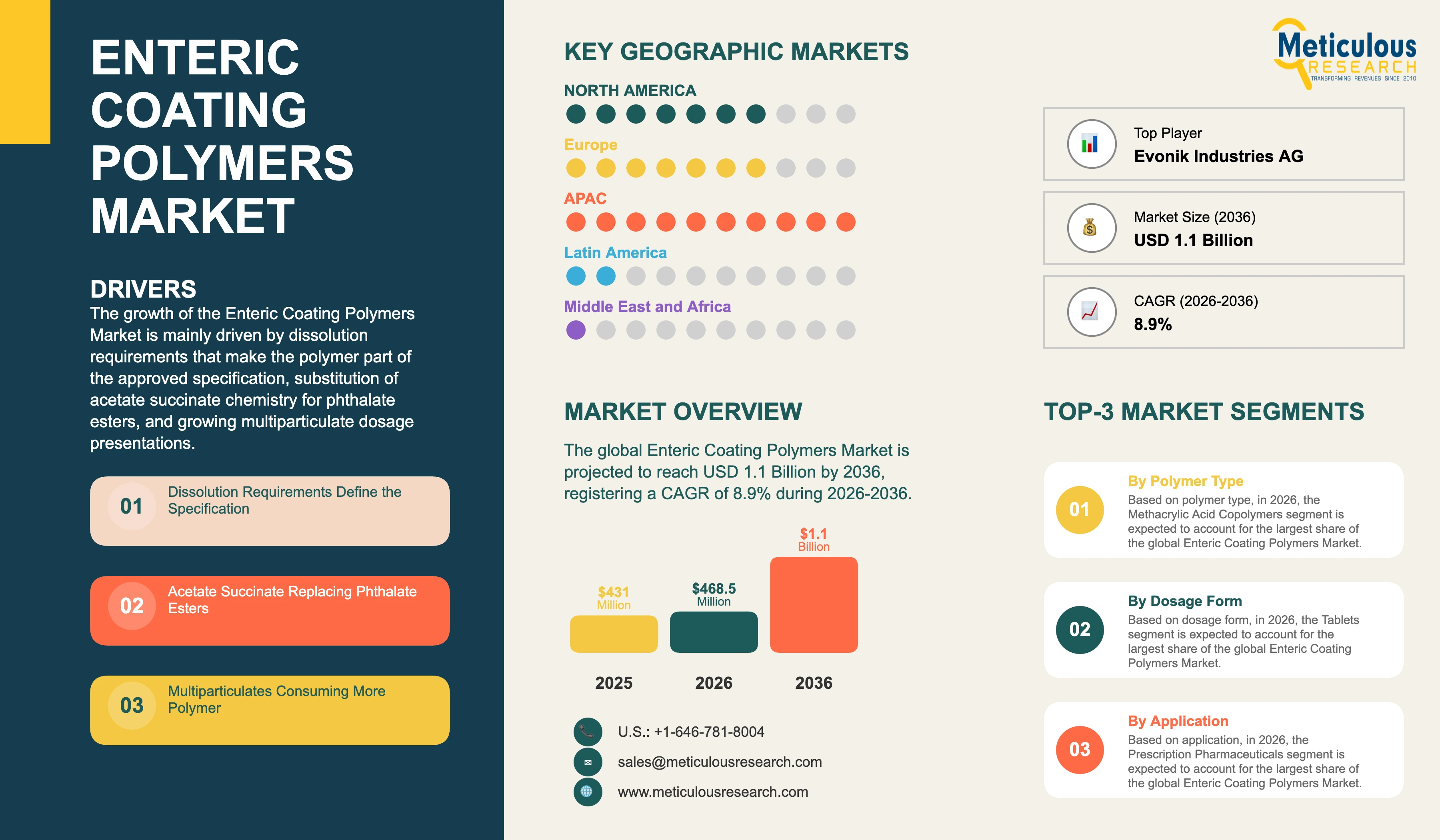
The global Enteric Coating Polymers Market was valued at USD 431.0 million in 2025. This market is expected to reach USD 1.10 billion by 2036 from an estimated USD 468.5 million in 2026, registering a CAGR of 8.9% during the forecast period (2026-2036).
- Published
- Nov 2026
- Pages
- 257
- Format
- PDF + Excel
- Report ID
- MRCHM - 1042781
- Base year
- 2025
- 2025 · BASELINE
- $431.0M
- 2036
- $1.10B
- CAGR 2026–2036
- 8.9%
2025 baseline · 2026–2036 forecast at 8.9% CAGR · hover a bar for the value
Key highlights
The global Enteric Coating Polymers Market is projected to reach USD 1.10 billion by 2036, driven by dissolution specification requirements, acetate succinate substitution for phthalate esters, multiparticulate dosage growth, and nutraceutical expansion.
Asia-Pacific is expected to account for the largest market share in 2026 and is also projected to register the fastest growth during the forecast period, supported by the concentration of generic and contract pharmaceutical manufacturing in the region, where oral solid dosage output is largest and expanding fastest.
By polymer type, Methacrylic Acid Copolymers are expected to account for the largest market share, whereas Hypromellose Acetate Succinate grades are projected to witness the fastest growth through 2036.
By dosage form, Tablets are expected to account for the largest market share, whereas Pellets, Granules & Multiparticulates are projected to witness the fastest growth through 2036.
By supply form, Powder for Organic or Aqueous Dispersion grades are expected to account for the largest market share, whereas Fully Formulated Coating Systems are projected to witness the fastest growth through 2036.
A representative regulatory dissolution method for a delayed-release mesalamine product specifies paddle apparatus at 100 revolutions per minute for 2 hours in 750 milliliters of 0.1 normal hydrochloric acid, 1 hour at pH 6.4, then pH 6.5, 6.8, 7.2 and 7.5 to 8 hours, which makes the coating polymer and its application part of the approved specification rather than a formulation preference.
Methacrylic acid copolymer grades are supplied with dissolution thresholds at pH 5.5, 6.0 and 7.0, allowing release to be targeted to the duodenum, jejunum or colon by selecting the polymer rather than by changing the coating process.
Hypromellose acetate succinate grades carry acid contents of 1.52, 1.19 and 0.76 millimoles per gram with dissociation constants of 4.91, 4.97 and 5.06 and surface pH values of 4.52, 4.61 and 4.73 for the low, medium and high substitution grades respectively.
The low-substitution grade dissolves approximately three times faster than the high-substitution grade at both pH 6.8 and pH 7.5, with solubility of 4 to 8 milligrams per milliliter at pH 6.0, which provides a graded release profile within a single polymer family.
Fully formulated aqueous coating systems disperse in approximately 20 minutes and require no curing step, which removes a process stage from the coating suite and is driving the fastest growth among supply forms at 10.4%.
Hypromellose acetate succinate is projected to register the fastest polymer growth at 13.6% while cellulose acetate phthalate grows slowest at 4.2%, reflecting substitution away from phthalate ester chemistry on toxicological grounds.
A major ingredient supplier completed the acquisition of a pharmaceutical solutions business on 1 May 2025, consolidating excipient and coating polymer supply among a small number of global producers.
Report summary
| Particulars | Details |
|---|---|
| Forecast Period | 2026-2036 |
| Base Year | 2025 |
| Estimated Year | 2026 |
| CAGR (Value) | 8.9% |
| Format | PDF, Excel & Cloud Portal · 257 pages |
| CAGR (Volume) | 6.0% |
| Market Size (Value) in 2026 | USD 468.5 million |
| Market Size (Value) in 2036 | USD 1.10 billion |
| Market Size (Volume) in 2026 | 9,600 tons of polymer as supplied |
| Market Size (Volume) in 2036 | 17,200 tons |
| Average Selling Price, 2026 | USD 48,800 per ton |
| Average Selling Price, 2036 | USD 63,900 per ton |
| Segments Covered | By Polymer Type: Methacrylic Acid Copolymers, Hypromellose Acetate Succinate, Cellulose Acetate Phthalate, Hypromellose Phthalate, Polyvinyl Acetate Phthalate, Shellac & Other Natural Polymers. By Dosage Form: Tablets, Capsules, Pellets, Granules & Multiparticulates, Other Forms. By Supply Form: Powder for Organic or Aqueous Dispersion, Ready-to-Use Aqueous Dispersion, Fully Formulated Coating System. By Application: Prescription Pharmaceuticals, Over-the-Counter Products, Nutraceuticals & Dietary Supplements, Veterinary & Other Applications. |
| Countries Covered | Asia-Pacific: China, India, Japan, South Korea, Rest of Asia-Pacific. North America: U.S., Canada. Europe: Germany, France, Italy, U.K., Rest of Europe. Latin America: Brazil, Mexico, Rest of Latin America. Middle East & Africa: Rest of Middle East & Africa. |
| Key Companies | Evonik Industries AG, Shin-Etsu Chemical Co., Ltd., Roquette Freres, Ashland Inc., Colorcon, Inc., and Biogrund GmbH |
Report overview
Segments covered: polymer type, dosage form, supply form, application.
In volume terms, the market is estimated at 9,600 tons of polymer as supplied in 2026 and is expected to reach 17,200 tons by 2036, registering a CAGR of 6.0% during the forecast period. The average selling price is estimated at USD 48,800 per ton in 2026 and USD 63,900 per ton in 2036.
The growth of this market is mainly driven by dissolution requirements that make the coating polymer part of the approved product specification, growing substitution of acetate succinate chemistry for phthalate esters, increasing use of multiparticulate and pellet presentations that consume more polymer per dose, and expanding nutraceutical and dietary supplement applications. However, factors such as polymer selection being locked inside an approved product specification that freezes the market for the life of the product, long qualification cycles tied to bioequivalence and stability data, the exclusion of amorphous solid dispersion tonnage from the coating application, and a small number of global suppliers that limits formulation choice are expected to restrain the growth of this market to some extent.
Among applications, Prescription Pharmaceutical applications are expected to account for the largest market share in 2026, while Nutraceutical & Dietary Supplement applications are projected to register the highest CAGR during the forecast period. Geographically, Asia-Pacific is expected to account for the largest share of this market in 2026 and is also expected to register the highest CAGR during the forecast period.
The Enteric Coating Polymers Market comprises pH-responsive film-forming polymers applied to oral solid dosage forms in order to prevent release in the stomach and to target release in a defined region of the intestine. The market includes methacrylic acid copolymers, hypromellose acetate succinate, cellulose acetate phthalate, hypromellose phthalate, polyvinyl acetate phthalate, and shellac and other natural polymers, supplied as powder for organic or aqueous dispersion, as ready-to-use aqueous dispersion, or as fully formulated coating systems. The market ecosystem extends from polymer producers through excipient distributors and contract coating service providers to pharmaceutical manufacturers, nutraceutical formulators and the regulatory authorities that approve the resulting dissolution specification.
The defining commercial feature of this market is that the polymer is part of the approved product rather than a consumable chosen by the manufacturer. A representative regulatory dissolution method for a delayed-release mesalamine product specifies paddle apparatus at 100 revolutions per minute for 2 hours in 750 milliliters of 0.1 normal hydrochloric acid, 1 hour at pH 6.4, then pH 6.5, 6.8, 7.2 and 7.5 to 8 hours. Because the dissolution profile that the finished product must reproduce depends on the polymer, its substitution grade and the applied film weight, the polymer cannot be substituted without generating bioequivalence and stability data and filing a variation.
Release targeting is achieved through polymer selection rather than through process change. Methacrylic acid copolymer grades are supplied with dissolution thresholds at pH 5.5, 6.0 and 7.0, which allows a formulator to direct release to the duodenum, jejunum or colon by choosing the grade. Hypromellose acetate succinate provides a comparable graded series through substitution ratio, with acid contents of 1.52, 1.19 and 0.76 millimoles per gram, dissociation constants of 4.91, 4.97 and 5.06, and surface pH values of 4.52, 4.61 and 4.73 for the low, medium and high substitution grades.
Dissolution rate differences within a single polymer family are substantial and commercially useful. The low-substitution hypromellose acetate succinate grade dissolves approximately three times faster than the high-substitution grade at both pH 6.8 and pH 7.5, with solubility of 4 to 8 milligrams per milliliter at pH 6.0, so a formulator can tune the onset of release without changing polymer chemistry and without revalidating the coating process. This graded behavior is the principal reason acetate succinate chemistry is displacing phthalate esters.
Phthalate ester substitution is the central structural shift in the market. Cellulose acetate phthalate and polyvinyl acetate phthalate have long service histories and remain in approved products, but new development work has moved away from phthalate ester chemistry on toxicological grounds, and hypromellose acetate succinate is projected to grow at 13.6% against 4.2% for cellulose acetate phthalate. Because existing approved products are effectively frozen on their original polymer, this substitution appears in new filings and in reformulated products rather than as conversion of the installed base.
Supply form is moving toward systems that remove process steps. Powder for organic or aqueous dispersion remains the largest supply form at 46.0%, but fully formulated coating systems disperse in approximately 20 minutes and require no curing step, which removes a stage from the coating suite, shortens batch cycle time and reduces the validation burden on the coating process. These systems are projected to grow fastest among supply forms at 10.4%, and they are particularly attractive to contract manufacturers running multiple products through shared equipment.
The measurement basis of this market excludes a large adjacent tonnage. Hypromellose acetate succinate is also used in substantial quantities as a polymer matrix for amorphous solid dispersions, where it functions as a solubility enhancer rather than as a coating, and that volume is not part of the enteric coating application. Supply is concentrated among a small number of global producers, and consolidation has continued, with a major ingredient supplier completing the acquisition of a pharmaceutical solutions business on 1 May 2025.
Asia-Pacific is expected to account for the largest regional share at 38.0% in 2026, reflecting the concentration of generic and contract pharmaceutical manufacturing capacity in the region, since coating polymer is consumed where the dosage form is manufactured.
Europe is expected to hold 25.0% of the market and to grow at 7.4%. The region originated methacrylic acid copolymer enteric chemistry and holds the largest concentration of polymer production capacity, with Germany carrying the leading national position across both polymer supply and pharmaceutical manufacturing.
The Middle East & Africa is expected to grow fastest of all regions at 11.0% from a 4.0% share on pharmaceutical manufacturing investment and local generic production. Latin America is expected to grow at 8.6% from a 6.0% share, with Brazil and Mexico carrying the regional generic and nutraceutical positions.
Some of the key players operating in the enteric coating polymers market are Evonik Industries AG, Shin-Etsu Chemical Co., Ltd., Roquette Freres, Ashland Inc., Colorcon, Inc., and Biogrund GmbH, among others.
Leading companies are focusing on graded acetate succinate series for region-specific delivery, fully formulated aqueous systems that remove the curing step, and formulation development services that place the supplier inside customer development programs before a specification is fixed, while maintaining drug master files and dual-site supply assurance. Consolidation continued with a major ingredient supplier completing the acquisition of a pharmaceutical solutions business on 1 May 2025.
Report infographic
Market dynamics
10 factors across 4 forcesDissolution Requirements That Make the Polymer Part of the Specification
Regulatory dissolution requirements are a major factor driving the Enteric Coating Polymers Market, because they convert the coating polymer from a formulation choice into an element of the approved product. A representative method for a delayed-release mesalamine product specifies paddle apparatus at 100 revolutions per minute for 2 hours in 750 milliliters of 0.1 normal hydrochloric acid, 1 hour at pH 6.4, then pH 6.5, 6.8, 7.2 and 7.5 to 8 hours, and the profile a finished product must reproduce depends on the polymer, its substitution grade and the applied film weight. Because substitution requires bioequivalence and stability data and a regulatory variation, demand is highly stable once a product is approved, and polymer suppliers hold positions for the commercial life of the dosage form.
Acetate Succinate Chemistry Replacing Phthalate Esters
Substitution away from phthalate ester chemistry is significantly increasing demand for hypromellose acetate succinate. New development work has moved away from cellulose acetate phthalate and polyvinyl acetate phthalate on toxicological grounds, and acetate succinate chemistry offers a graded alternative with acid contents of 1.52, 1.19 and 0.76 millimoles per gram, dissociation constants of 4.91, 4.97 and 5.06, and surface pH values of 4.52, 4.61 and 4.73 across the low, medium and high substitution grades. The low-substitution grade dissolves approximately three times faster than the high-substitution grade at pH 6.8 and 7.5, which allows release onset to be tuned without changing polymer family. Hypromellose acetate succinate is accordingly projected to grow at 13.6% against 4.2% for cellulose acetate phthalate.
Multiparticulate and Pellet Presentations Consuming More Polymer
The shift toward pellets, granules and multiparticulate presentations is increasing polymer consumption per dose and is therefore a direct volume driver. A multiparticulate dose divides the same quantity of active into many small units, each of which must be individually coated, so the total surface area requiring an enteric film is far greater than for a single monolithic tablet of equivalent strength. These presentations also deliver a more reproducible gastric emptying profile and permit dose flexibility and sprinkle administration, which supports their use in pediatric and geriatric products. Pellets, Granules & Multiparticulates are projected to register the fastest dosage form growth in this market at 10.6%, ahead of Tablets which hold the largest share at 54.0%.
Table of contents
12 chapters · 131 sections · 257 pages · click to expandSegmental analysis
| Segment | Largest share (2026) | Fastest growth (2026–2036) |
|---|---|---|
| By Polymer Type | Methacrylic Acid Copolymers | Hypromellose Acetate Succinate grades |
| By Dosage Form | Tablets | Pellets, Granules & Multiparticulates |
| By Supply Form | Powder for Organic or Aqueous Dispersion grades | Fully Formulated Coating Systems |
| By Application | Prescription Pharmaceutical | Nutraceutical & Dietary Supplement |
| Other segments | Tablets | Fully Formulated Coating Systems |
By Polymer Type
- Methacrylic Acid Copolymers are expected to account for the largest share of the global Enteric Coating Polymers Market.
- The large share of this segment is mainly due to the availability of grades with dissolution thresholds at pH 5.5, 6.0 and 7.0 that allow release to be targeted by polymer selection, together with the longest approved-product service history of any synthetic enteric polymer.
- However, Hypromellose Acetate Succinate grades are projected to register the highest CAGR during the forecast period.
- The rapid growth of this segment is attributed to substitution away from phthalate ester chemistry on toxicological grounds and a graded substitution series in which the low-substitution grade dissolves approximately three times faster than the high-substitution grade at pH 6.8 and 7.5.
- Methacrylic Acid Copolymers are expected to account for the largest market share in 2026.
- Hypromellose Acetate Succinate grades are projected to register the highest CAGR during the forecast period, owing to substitution away from phthalate ester chemistry on toxicological grounds and a graded substitution series in which the low-substitution grade dissolves approximately three times faster than the high-substitution grade at pH 6.8 and 7.5.
- Pellets, Granules & Multiparticulates are projected to register the highest CAGR during the forecast period, owing to the far greater surface area requiring an enteric film when a dose is divided into many small units, together with more reproducible gastric emptying, dose flexibility and sprinkle administration.
By Dosage Form
- Tablets are expected to account for the largest market share.
- The large share of this segment is mainly due to the dominance of tablet presentations in oral solid dosage manufacture and the lower coating surface area per dose that makes them the most economical form to coat.
- However, Pellets, Granules & Multiparticulates are projected to register the highest CAGR during the forecast period.
- The rapid growth of this segment is attributed to the far greater surface area requiring an enteric film when a dose is divided into many small units, together with more reproducible gastric emptying, dose flexibility and sprinkle administration.
By Supply Form
- Powder for Organic or Aqueous Dispersion grades are expected to account for the largest market share.
- The large share of this segment is mainly due to the flexibility it gives formulators to adjust plasticizer, anti-tack and pigment levels and the long approved-product history of powder-based coating suspensions.
- However, Fully Formulated Coating Systems are projected to register the highest CAGR during the forecast period.
- The rapid growth of this segment is attributed to dispersion in approximately 20 minutes with no curing step, which removes a process stage, shortens batch cycle time and reduces the validation burden on shared coating equipment.
By Application
- Prescription Pharmaceutical applications are expected to account for the largest market share.
- The large share of this segment is mainly due to dissolution requirements written into approved product specifications, which make the polymer part of the registration and stabilize demand for the commercial life of the dosage form.
- However, Nutraceutical & Dietary Supplement applications are projected to register the highest CAGR during the forecast period.
- The rapid growth of this segment is attributed to protection of acid-sensitive probiotics and enzymes, prevention of gastric irritation from fish oils and botanical extracts, and the absence of bioequivalence and variation requirements that allows rapid formulation change.
Other segments
- Tablets are expected to account for the largest market share in 2026.
- Powder for Organic or Aqueous Dispersion grades are expected to account for the largest market share in 2026.
- Fully Formulated Coating Systems are projected to register the highest CAGR during the forecast period, owing to dispersion in approximately 20 minutes with no curing step, which removes a process stage, shortens batch cycle time and reduces the validation burden on shared coating equipment.
- Prescription Pharmaceutical applications are expected to account for the largest market share in 2026.
- Nutraceutical & Dietary Supplement applications are projected to register the highest CAGR during the forecast period, owing to protection of acid-sensitive probiotics and enzymes, prevention of gastric irritation from fish oils and botanical extracts, and the absence of bioequivalence and variation requirements that allows rapid formulation change.
Geographic analysis
Asia-Pacific
Largest shareIn 2026, Asia-Pacific is expected to account for the largest share of the global Enteric Coating Polymers Market at 38.0% and is also projected to register a high rate of growth during the forecast period. The region holds the largest concentration of generic and contract pharmaceutical manufacturing capacity and the fastest-growing oral solid dosage output, and because enteric coating is applied where the dosage form is manufactured rather than where it is consumed, polymer consumption is recorded in the region regardless of the destination market. India is projected to register the fastest country growth at 12.8% on generic and contract manufacturing expansion, China holds the largest country position across both pharmaceutical and nutraceutical coating, and South Korea contributes specialty and contract manufacturing. Japan is expected to record the slowest country growth at 5.4% on a mature domestic market. India is the fastest-growing country at 12.8% and Japan the slowest at 5.4%.
North America
North America is expected to account for the second-largest share of the market at 27.0%. The region sets the dissolution methods that define delayed-release specifications globally, which makes it the reference market for polymer qualification, and it holds a large innovator pharmaceutical base together with the fastest-developing nutraceutical sector. The United States carries almost all of the regional position across prescription, over-the-counter and supplement applications, while Canada contributes generic manufacturing and contract coating services.
Europe
Europe is expected to account for 25.0% of the market and to grow at 7.4%. The region is the origin of methacrylic acid copolymer enteric chemistry and holds the largest concentration of polymer production capacity, with Germany carrying the leading national position across both polymer supply and pharmaceutical manufacturing, and France, Italy and the United Kingdom contributing generic and contract manufacturing demand.
Middle East & Africa
The Middle East & Africa region is expected to record the highest regional CAGR at 11.0% from a 4.0% share, supported by pharmaceutical manufacturing investment and growing local generic production. The Middle East & Africa is expected to register the highest regional CAGR at 11.0% on pharmaceutical manufacturing investment, while Asia-Pacific grows at 10.6% from the largest base.
Latin America
Latin America is expected to grow at 8.6% from a 6.0% share, with Brazil and Mexico carrying the regional generic manufacturing and nutraceutical positions.
Competitive landscape
The global Enteric Coating Polymers Market is highly consolidated, with competition among global specialty polymer producers, pharmaceutical excipient suppliers and formulated coating system providers. Market participants compete primarily on dissolution reproducibility against the approved specification, grade range and release targeting capability, regulatory documentation and drug master file support, batch-to-batch consistency, formulation development service, and supply security over the commercial life of a dosage form.
Leading companies are investing in graded hypromellose acetate succinate series that allow release onset to be tuned within one polymer family, in fully formulated aqueous systems that disperse in approximately 20 minutes without a curing step, and in formulation development services that place the supplier inside the customer development program before a specification is fixed. Because polymer selection is locked once a product is approved, suppliers compete for new filings and reformulations rather than for installed products, and they maintain drug master files, change control discipline and audit readiness as a condition of participation. Consolidation has continued, with a major ingredient supplier completing the acquisition of a pharmaceutical solutions business on 1 May 2025, and capacity investment and dual-site supply assurance remain key strategies adopted by major vendors.
The report provides a comprehensive competitive assessment of the leading companies operating in the global Enteric Coating Polymers Market. The key players profiled in the report include Evonik Industries AG (Germany), Shin-Etsu Chemical Co., Ltd. (Japan), Roquette Freres (France), Ashland Inc. (U.S.), Colorcon, Inc. (U.S.), and Biogrund GmbH (Germany).
- Evonik Industries AG
- Shin-Etsu Chemical Co., Ltd.
- Roquette Freres
- Ashland Inc.
- Colorcon, Inc.
- Biogrund GmbH
Expert perspectives
The Enteric Coating Polymers Market behaves unlike other coating markets because the polymer is part of the approved product rather than a consumable the manufacturer selects. A representative regulatory dissolution method specifies paddle apparatus at 100 revolutions per minute for 2 hours in 750 milliliters of 0.1 normal hydrochloric acid, 1 hour at pH 6.4, then pH 6.5, 6.8, 7.2 and 7.5 to 8 hours, and the profile depends on the polymer, its substitution grade and the applied film weight. Substitution therefore requires comparative dissolution data, bioequivalence work where release changes, stability studies and a regulatory variation.
That structure makes demand exceptionally stable and the installed base effectively closed, so competitive position is decided at the point of formulation development rather than in procurement. Growth comes from new filings, reformulated products and applications outside prescription pharmaceuticals, which is why Nutraceuticals & Dietary Supplements grow fastest at 11.8% and why hypromellose acetate succinate grows at 13.6% while cellulose acetate phthalate declines in relevance at 4.2%. Suppliers that are present during development hold the product for its commercial life; those that are not cannot reach it at any price.
For companies planning entry or expansion, the most attractive positions over the forecast period are likely to be found in graded acetate succinate series for region-specific delivery, fully formulated systems growing at 10.4% that remove a process stage from the coating suite, multiparticulate presentations growing at 10.6% that consume more polymer per dose, and nutraceutical applications where formulation change is not constrained by variation requirements. Two cautions apply: the amorphous solid dispersion tonnage that uses the same polymers is a solubility enhancement application and not part of this market, and supply concentration among a small number of qualified producers makes dual-site assurance a specification criterion rather than a commercial preference.
Customer perspectives
“The polymer goes into the dossier, so the decision we make in development is the decision for the life of the product. That means we are not really buying on price, we are buying on whether the supplier can reproduce the dissolution profile batch after batch for fifteen years and whether their documentation will survive an inspection. Changing grade later means comparative dissolution at minimum and bioequivalence if the release shifts.”
“We run many products through the same coating pans, so changeover and validation time costs us more than the coating material does. A system that disperses in twenty minutes and needs no cure step takes a stage out of the batch record and off the equipment. We will pay a premium per kilogram for that, because the throughput we recover is worth considerably more.”
“We are protecting probiotics and enzymes, and we need delayed release that consumers can see on the label. The advantage we have over pharma is that we can change a formulation in a few months rather than filing a variation, so we adopt the newer grades and the ready-to-use systems much faster. The constraint for us is cost per dose, because we are selling into a retail price point.”
Frequently asked questions
The global Enteric Coating Polymers Market is estimated at USD 468.5 million in 2026.
The market is projected to reach USD 1.10 billion by 2036.
The market is expected to grow at a CAGR of 8.9% during 2026-2036.
The market is driven by dissolution requirements that make the coating polymer part of the approved product specification, substitution of acetate succinate chemistry for phthalate esters, growing use of multiparticulate presentations that consume more polymer per dose, and expanding nutraceutical and dietary supplement applications.
The dissolution profile the finished product must reproduce depends on the polymer, its substitution grade and the applied film weight. Substitution therefore requires comparative dissolution testing, bioequivalence data where release characteristics change, stability data on the new configuration and a regulatory variation, which fixes the polymer for the commercial life of the dosage form.
Through polymer selection. Methacrylic acid copolymer grades are supplied with dissolution thresholds at pH 5.5, 6.0 and 7.0, allowing release to be directed to the duodenum, jejunum or colon, while hypromellose acetate succinate provides a graded series through substitution ratio.
No. Hypromellose acetate succinate is used in substantial quantities as a polymer matrix for amorphous solid dispersions, where it acts as a solubility enhancer rather than as a coating. That tonnage is excluded from the enteric coating measurement basis.
Polymer selection locked inside approved specifications that close the installed base to competitors, qualification cycles measured in years, supply concentrated among a small number of documented producers, and the exclusion of amorphous solid dispersion tonnage from the coating application remain the major market challenges.
Graded hypromellose acetate succinate substitution series, methacrylic acid copolymer grades with pH 5.5, 6.0 and 7.0 thresholds, fully formulated aqueous systems dispersing in approximately 20 minutes without curing, multiparticulate coating platforms, and colonic and microbiome-directed delivery systems are transforming the market.
Suppliers must support product-specific dissolution methods such as paddle apparatus at 100 revolutions per minute through sequential pH stages from 0.1 normal hydrochloric acid to pH 7.5, maintain drug master files and change control documentation, meet pharmacopoeial monograph requirements for each polymer grade, and support bioequivalence and stability data where release characteristics change.
Methacrylic Acid Copolymers are expected to account for the largest market share in 2026.
Hypromellose Acetate Succinate grades are projected to register the highest CAGR during the forecast period, owing to substitution away from phthalate ester chemistry on toxicological grounds and a graded substitution series in which the low-substitution grade dissolves approximately three times faster than the high-substitution grade at pH 6.8 and 7.5.
Tablets are expected to account for the largest market share in 2026.
Pellets, Granules & Multiparticulates are projected to register the highest CAGR during the forecast period, owing to the far greater surface area requiring an enteric film when a dose is divided into many small units, together with more reproducible gastric emptying, dose flexibility and sprinkle administration.
Powder for Organic or Aqueous Dispersion grades are expected to account for the largest market share in 2026.
Fully Formulated Coating Systems are projected to register the highest CAGR during the forecast period, owing to dispersion in approximately 20 minutes with no curing step, which removes a process stage, shortens batch cycle time and reduces the validation burden on shared coating equipment.
Prescription Pharmaceutical applications are expected to account for the largest market share in 2026.
Nutraceutical & Dietary Supplement applications are projected to register the highest CAGR during the forecast period, owing to protection of acid-sensitive probiotics and enzymes, prevention of gastric irritation from fish oils and botanical extracts, and the absence of bioequivalence and variation requirements that allows rapid formulation change.
Asia-Pacific is expected to account for the largest regional share at 38.0% in 2026, reflecting the concentration of generic and contract pharmaceutical manufacturing capacity in the region, since coating polymer is consumed where the dosage form is manufactured.
The Middle East & Africa is expected to register the highest regional CAGR at 11.0% on pharmaceutical manufacturing investment, while Asia-Pacific grows at 10.6% from the largest base. India is the fastest-growing country at 12.8% and Japan the slowest at 5.4%.
Europe is expected to hold 25.0% of the market and to grow at 7.4%. The region originated methacrylic acid copolymer enteric chemistry and holds the largest concentration of polymer production capacity, with Germany carrying the leading national position across both polymer supply and pharmaceutical manufacturing.
The Middle East & Africa is expected to grow fastest of all regions at 11.0% from a 4.0% share on pharmaceutical manufacturing investment and local generic production. Latin America is expected to grow at 8.6% from a 6.0% share, with Brazil and Mexico carrying the regional generic and nutraceutical positions.
Some of the key players operating in the enteric coating polymers market are Evonik Industries AG, Shin-Etsu Chemical Co., Ltd., Roquette Freres, Ashland Inc., Colorcon, Inc., and Biogrund GmbH, among others.
Leading companies are focusing on graded acetate succinate series for region-specific delivery, fully formulated aqueous systems that remove the curing step, and formulation development services that place the supplier inside customer development programs before a specification is fixed, while maintaining drug master files and dual-site supply assurance. Consolidation continued with a major ingredient supplier completing the acquisition of a pharmaceutical solutions business on 1 May 2025.
Cite this report
Meticulous Research. (2026). Enteric Coating Polymers Market - Global Opportunity Analysis and Industry Forecast (2026-2036) (Report No. MRCHM - 1042781). Meticulous Market Research Pvt. Ltd. https://www.meticulousresearch.com/product/enteric-coating-polymers-market-7464