Seed Coating Polymers Market (2026-2036)
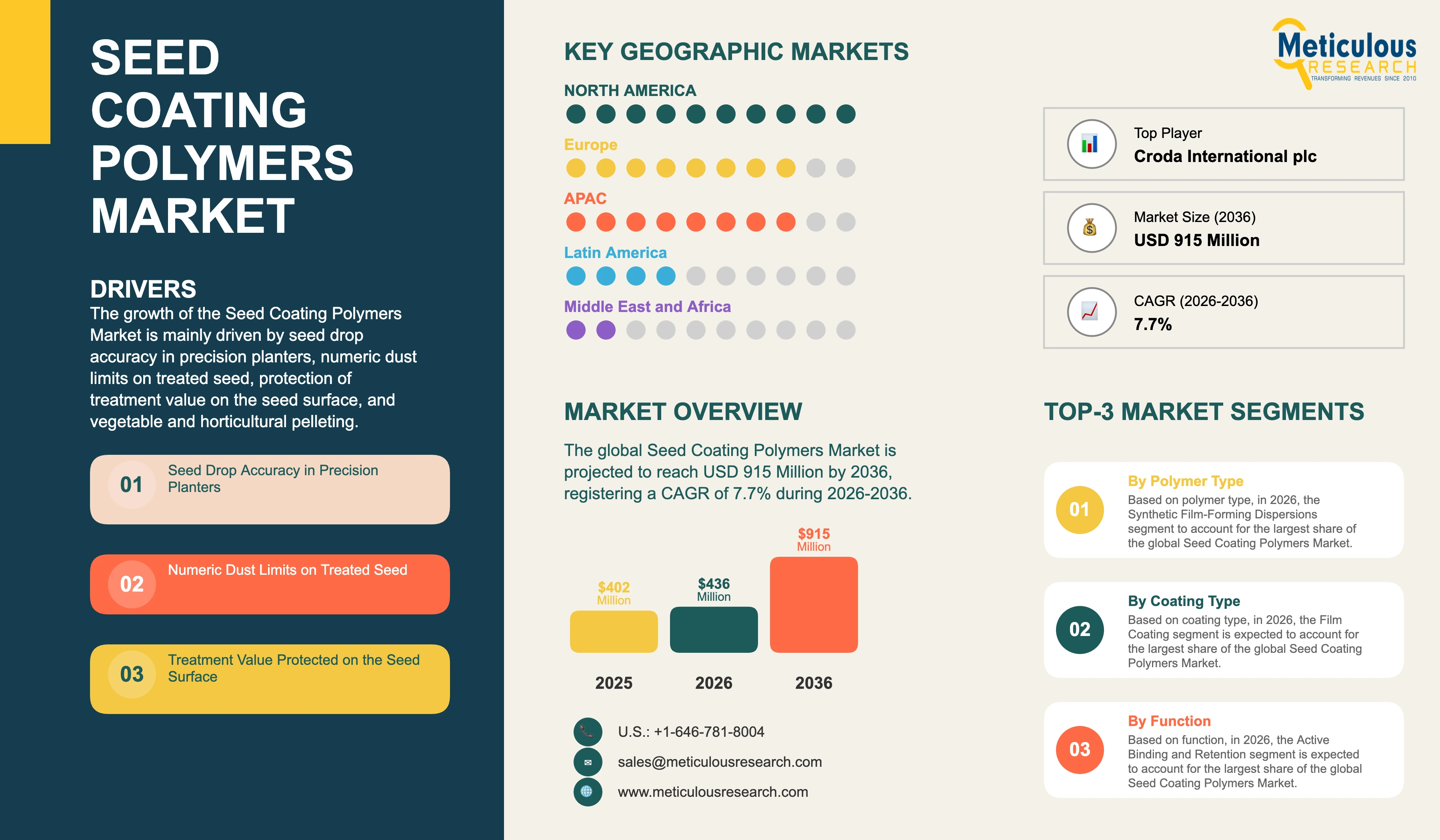
The global Seed Coating Polymers Market was valued at USD 402.0 million in 2025. This market is expected to reach USD 915.0 million by 2036 from an estimated USD 436.0 million in 2026, registering a CAGR of 7.7% during the forecast period (2026-2036).
- Published
- Nov 2026
- Pages
- 250
- Format
- PDF + Excel
- Report ID
- MRCHM - 1042825
- Base year
- 2025
- 2025 · BASELINE
- $402.0M
- 2036
- $915.0M
- CAGR 2026–2036
- 7.7%
2025 baseline · 2026–2036 forecast at 7.7% CAGR · hover a bar for the value
Key highlights
The global Seed Coating Polymers Market is projected to reach USD 915.0 million by 2036, driven by seed drop accuracy in precision planters, numeric dust limits on treated seed, protection of treatment value on the seed surface, and vegetable and horticultural pelleting.
North America is expected to account for the largest market share in 2026 and is also projected to register the fastest growth during the forecast period, supported by the scale of precision-planted corn, soybean and cotton area in the region together with the concentration of professional seed treatment capacity.
By polymer type, Synthetic Film-Forming Dispersions are expected to account for the largest market share, whereas Biodegradable and Bio-Based Polymers are projected to witness the fastest growth through 2036.
By coating type, Film Coating are expected to account for the largest market share, whereas Encrusting are projected to witness the fastest growth through 2036.
By function, Active Binding and Retention are expected to account for the largest market share, whereas Controlled Release and Water Management are projected to witness the fastest growth through 2036.
A commercial plantability polymer is applied at 1.0 fluid ounce per 100 pounds of seed, about 65 milliliters per 100 kilograms, which places the polymer at a fraction of a percent of seed weight.
Published funnel test data put a leading plantability polymer at 2, 438.8 grams of seed through the funnel in 2.5 seconds against 2,357.6 and 2,294.2 grams for two competing products, a spread of about 6% across the commercial field.
Seed coating polymers are synthetic polymer microparticles under the European chemicals framework, restricted from 17 October 2028 for agricultural and horticultural products and from 17 October 2031 where applied to seed treated with plant protection products.
The restriction captures solid polymers that make up at least 1% by weight of particles and bars placing them on the market at 0.01% by weight or more, with exemptions for naturally occurring and unmodified polymers, degradable polymers, polymers soluble above 2 grams per liter and polymers with no carbon atoms.
Seed coating must be performed only in professional seed treatment facilities using the best available techniques to limit dust release during application, storage and transport, a requirement in force across the European Union from 1 November 2010.
Dust reference values under the European seed treatment assurance scheme stand at 0.75 grams per 100,000 seeds for corn, 0.50 grams per 700,000 seeds for oilseed rape, 0.25 grams per 100,000 pellets for sugar beet and 0.40 grams per 75,000 seeds for sunflower, with vegetable crops at 0.1 grams per 100,000 seeds for carrots and endives against 4 grams per 100 kilograms for cereals, and a revised reference dust test method applying from 1 July 2026.
Precision-planted crops are sown by seed count rather than by weight, at 76,000 seeds per hectare for grain maize, 110,000 for sugar beet, 471,000 for winter oilseed rape and 65,000 for sunflower in a large-scale European farmer survey, while cereals are sown by weight at 176 kilograms per hectare for winter wheat and 165 for spring barley.
United States seed labeling rules define coating material as any substance that changes the size, shape or weight of the original seed and expressly exclude polymers from that definition, an amendment effective 6 August 2020.
Report summary
| Particulars | Details |
|---|---|
| Forecast Period | 2026-2036 |
| Base Year | 2025 |
| Estimated Year | 2026 |
| CAGR (Value) | 7.7% |
| Format | PDF, Excel & Cloud Portal · 250 pages |
| CAGR (Volume) | 5.4% |
| Market Size (Value) in 2026 | USD 436.0 million |
| Market Size (Value) in 2036 | USD 915.0 million |
| Market Size (Volume) in 2026 | 79.00 kilotons of polymer as supplied |
| Market Size (Volume) in 2036 | 134.00 kilotons |
| Average Selling Price, 2026 | USD 5,519 per ton |
| Average Selling Price, 2036 | USD 6,828 per ton |
| Segments Covered | By Polymer Type: Synthetic Film-Forming Dispersion, Polyvinyl Alcohol and Polyvinylpyrrolidone, Cellulose Ether and Starch Based, Biodegradable and Bio-Based Polymer, Superabsorbent Polymer, Other Polymers. By Coating Type: Film Coating, Encrusting, Pelleting. By Function: Active Binding and Retention, Dust-Off Reduction, Flowability and Plantability, Controlled Release and Water Management, Color and Identification Carrier. By Crop: Cereals and Grains, Corn, Oilseeds, Sugar Beet, Vegetables and Horticulture, Other Crops. |
| Countries Covered | U.S.; Canada; Germany; France; Netherlands; Spain; China; India; Japan; Australia; Mexico; Brazil |
| Key Companies | Croda International plc, Associated British Foods plc, BASF SE, Bayer AG, Syngenta Group Co., Ltd., and Roquette Freres |
Report overview
Segments covered: polymer type, coating type, function, crop.
In volume terms, the market is estimated at 79.00 kilotons of polymer as supplied in 2026 and is expected to reach 134.00 kilotons by 2036, registering a CAGR of 5.4% during the forecast period. The average selling price is estimated at USD 5,519 per ton in 2026 and USD 6,828 per ton in 2036.
The growth of this market is mainly driven by seed drop accuracy requirements that reduce skips and doubles in precision planters, dust reference values of 0.75 grams per 100,000 seeds for corn and 0.25 grams per 100,000 pellets for sugar beet, biodegradable and bio-based polymers growing at 13.0%, and controlled release and water management functions growing at 11.2%. However, factors such as the classification of seed coating polymers as synthetic polymer microparticles restricted in the European Union from 17 October 2028, an applied dose of around 65 milliliters per 100 kilograms of seed that keeps tonnage structurally small, measured flowability differences of only a few percent between competing commercial polymers, and legal pressure on the treated seed market that carries much of the demand are expected to restrain the growth of this market to some extent.
Among functions, Active Binding and Retention are expected to account for the largest market share in 2026, while Controlled Release and Water Management are projected to register the highest CAGR during the forecast period. Geographically, North America is expected to account for the largest share of this market in 2026 and is also expected to register the highest CAGR during the forecast period.
The Seed Coating Polymers Market comprises film-forming and binding polymers applied to seed in film coating, encrusting and pelleting, taken at the manufacturer gate on a ton basis as supplied. The market includes Synthetic Film-Forming Dispersion, Polyvinyl Alcohol and Polyvinylpyrrolidone, Cellulose Ether and Starch Based, Biodegradable and Bio-Based Polymer, Superabsorbent Polymer and other polymers, serving active binding and retention, dust-off reduction, flowability and plantability, controlled release and water management, and color and identification carrier functions, across cereals and grains, corn, oilseeds, sugar beet, vegetables and horticulture. Pesticide and biological actives, colorants and pigments, inoculants, mineral fillers and pellet bulking agents, seed treatment equipment and the seed itself fall outside the scope.
The polymer is a small part of what is on the seed and a large part of whether the seed performs. A commercial plantability polymer is applied at 1.0 fluid ounce per 100 pounds of seed, about 65 milliliters per 100 kilograms, which places it at a fraction of a percent of seed weight. That dose determines how much of the treatment stays on the seed through handling, how much dust is released and how consistently the seed meters through a planter, which is why the function is specified rather than bought as a commodity.
Precision planting is the mechanism behind the demand. Precision-planted crops are sown by seed count rather than by weight, at 76,000 seeds per hectare for grain maize, 110,000 for sugar beet, 471,000 for winter oilseed rape and 65,000 for sunflower in a large-scale European farmer survey. A skip or a double is a lost or wasted plant, and seed flow through the metering unit depends on the surface the polymer creates. Cereals, by contrast, are sown by weight at 176 kilograms per hectare for winter wheat and 165 for spring barley, which is why cereals carry the largest tonnage share while precision crops carry the formulation value.
Dust limits are written as numbers rather than as principles. Dust reference values under the European seed treatment assurance scheme stand at 0.75 grams per 100,000 seeds for corn, 0.50 grams per 700,000 seeds for oilseed rape, 0.25 grams per 100,000 pellets for sugar beet and 0.40 grams per 75,000 seeds for sunflower, with vegetable crops tightest at 0.1 grams per 100,000 seeds for carrots and endives and 0.2 grams for onions and vegetable peas, against 4 grams per 100 kilograms for cereals. Seed coating must be performed only in professional seed treatment facilities using the best available techniques to limit dust release during application, storage and transport, in force across the European Union from 1 November 2010.
Measured performance differences between competing polymers are narrow. Published funnel test data put a leading plantability polymer at 2,438.8 grams of seed through the funnel in 2.5 seconds against 2,357.6 and 2,294.2 grams for two competing products, a spread of about 6% across the commercial field. A revised version of the reference dust test method applies from 1 July 2026, which resets the measurement against which binder performance is demonstrated and gives suppliers a fresh basis on which to differentiate.
The binding constraint on this market is chemical regulation rather than agronomy. Seed coating polymers are synthetic polymer microparticles under the European chemicals framework, restricted from 17 October 2028 for agricultural and horticultural products and from 17 October 2031 where applied to seed treated with plant protection products. The restriction captures solid polymers making up at least 1% by weight of particles and bars placing them on the market at 0.01% by weight or more, with exemptions for naturally occurring and unmodified polymers, degradable polymers, polymers soluble above 2 grams per liter and polymers with no carbon atoms.
Reformulation is already under way ahead of those dates, with microplastic-free seed coating offered as a distinct product line alongside conventional seed coating polymers and film coats. Biodegradable and Bio-Based Polymers are projected to grow at 13.0%, the fastest of the polymer types, while Synthetic Film-Forming Dispersions hold the largest share at 38.0% in 2026 and grow at 6.4%. Value grows ahead of volume throughout at 7.7% against 5.4%, because the mix moves toward biodegradable, superabsorbent and controlled release chemistries.
Pelleting has been confined largely to sugar beet and high-value vegetables, but any crop sown by seed count benefits from a uniform, singulable pellet. Encrusting growing at 8.2% and the polymer content per seed being far higher in an encrusted or pelleted seed than in a film coat mean each crop that converts adds disproportionately to volume. Hybrid vegetables, herbs and specialty crops carry the seed values that justify it.
The restriction turns on whether a polymer is degradable within the terms of the framework, which is a test result rather than a marketing position. Suppliers able to document degradability under the applicable method, alongside funnel flow and dust performance against the revised reference test method applying from 1 July 2026, hold a dossier that seed companies need for their own compliance. That documentation is itself the differentiator in a field where measured performance spreads only about 6%.
North America is expected to account for the largest share of this market in 2026 at 31.0%, supported by the largest precision-planted area in corn, soybean and cotton and by the deepest concentration of professional seed treatment capacity.
Europe accounts for 26.0% of this market in 2026 and is projected to grow at 6.8%. The region sets the numeric framework the rest of the market works to, with dust reference values at 0.75 grams per 100,000 seeds for corn and 0.1 grams per 100,000 seeds for carrots and endives, coating confined to professional seed treatment facilities since 1 November 2010, and a revised reference dust test method applying from 1 July 2026. It is also where the synthetic polymer microparticle restriction takes effect from 17 October 2028 and from 17 October 2031 on treated seed. Germany, France, the Netherlands and Spain hold most regional volume.
The Middle East & Africa region holds 5.0% of this market in 2026 with projected growth of 8.0%, concentrated in vegetable and horticultural seed for irrigated production and in cereal seed treatment, with superabsorbent and water management chemistries carrying a stronger case than elsewhere. Latin America holds 13.0% with projected growth of 8.6%, with Brazil accounting for most regional volume across soybean, corn and cotton where precision planting and high treatment loadings make binding and plantability functions central, and Mexican demand spanning corn, vegetable and horticultural seed.
Some of the key players operating in the seed coating polymers market are Croda International plc, Associated British Foods plc, BASF SE, Bayer AG, Syngenta Group Co., Ltd., and Roquette Freres, among others.
Key strategies include reformulating toward degradable and naturally occurring chemistries that meet the restriction exemptions, offering microplastic-free lines alongside conventional polymers ahead of the 2028 and 2031 dates, documenting degradability under the applicable method rather than claiming it, extending into controlled release and superabsorbent functions, and qualifying with seed companies as regional treatment capacity commissions.
Report infographic
Market dynamics
17 factors across 4 forcesSeed Drop Accuracy in Precision Planters
Precision-planted crops are sown by seed count rather than by weight, at 76,000 seeds per hectare for grain maize, 110,000 for sugar beet, 471,000 for winter oilseed rape and 65,000 for sunflower in a large-scale European farmer survey. Every skip is a lost plant and every double is wasted seed, and the consistency with which seed passes through a metering unit depends on the surface the coating polymer creates. Published funnel test data put a leading plantability polymer at 2,438.8 grams of seed through the funnel in 2.5 seconds, and the economics of hybrid maize or sugar beet seed make even a small improvement in stand establishment worth more than the polymer costs. Flowability and Plantability is therefore a specified function rather than an incidental property.
Numeric Dust Limits on Treated Seed
Dust reference values under the European seed treatment assurance scheme are stated as numbers: 0.75 grams per 100,000 seeds for corn, 0.50 grams per 700,000 seeds for oilseed rape, 0.25 grams per 100,000 pellets for sugar beet and 0.40 grams per 75,000 seeds for sunflower, with vegetable crops at 0.1 grams per 100,000 seeds for carrots and endives. Seed coating must be performed only in professional seed treatment facilities using the best available techniques to limit dust release, in force since 1 November 2010. Because the limit is measured rather than assessed, the binder is the component that determines whether a treated seed lot passes. A revised reference dust test method applies from 1 July 2026, which resets the measurement and requires suppliers to redemonstrate performance against it.
Treatment Value Protected on the Seed Surface
The dose of active that reaches the seedling depends on what stays on the seed through bagging, transport, auger handling and metering. Where a seed carries an insecticide, fungicide and inoculant package worth many times the seed itself, loss of coating is loss of the treatment investment and of the agronomic protection it was bought for. Active Binding and Retention accordingly holds the largest function share of this market in 2026. The polymer is specified by the treatment formulator rather than by the grower, which places the purchasing decision with the seed company and makes qualification against a named treatment package the route to volume.
Vegetable and Horticultural Pelleting
Vegetable and horticultural seeds are small, irregular and expensive, and pelleting builds them into a uniform sphere that a precision seeder can place singly. The pellet also carries the tightest dust limits in the scheme, at 0.1 grams per 100,000 seeds for carrots and endives and 0.2 grams for onions and vegetable peas, which requires binder performance well beyond what cereal coating demands. Vegetables and Horticulture is projected to be the fastest-growing crop segment in this market at 10.4%, and Encrusting the fastest-growing coating type at 8.2%. The polymer content per seed is far higher in a pellet than in a film coat, so the segment contributes to value well ahead of its share of seed count.
Controlled Release and Water Management Functions
Polymers are being formulated to do more than bind, regulating the release of actives from the seed surface and holding moisture around the germinating seed through superabsorbent chemistry. Both extend the agronomic role of the coating from protecting the treatment to influencing establishment under stress. Controlled Release and Water Management is projected to be the fastest-growing function in this market at 11.2%, and Superabsorbent Polymer is among the chemistries behind the rise in average selling price from USD 5,519 per ton in 2026 to USD 6,828 per ton in 2036. The function also moves the polymer from a plantability component to one with a measurable yield argument.
Table of contents
12 chapters · 135 sections · 250 pages · click to expandSegmental analysis
| Segment | Largest share (2026) | Fastest growth (2026–2036) |
|---|---|---|
| By Polymer Type | Synthetic Film-Forming Dispersions | Biodegradable and Bio-Based Polymers |
| By Coating Type | Film Coating | Encrusting |
| By Function | Active Binding and Retention | Controlled Release and Water Management |
| By Crop | Cereals and Grains | Vegetables and Horticulture |
| Other segments | Film Coating | — |
By Polymer Type
- Synthetic Film-Forming Dispersions are expected to account for the largest share of the global Seed Coating Polymers Market.
- The large share of this segment is mainly due to the established qualification of these dispersions within commercial treatment packages, their measured flow performance and their cost position at an applied dose of about 65 milliliters per 100 kilograms of seed.
- However, Biodegradable and Bio-Based Polymers are projected to register the highest CAGR during the forecast period.
- The rapid growth of this segment is attributed to the synthetic polymer microparticle restriction applying from 17 October 2028 and from 17 October 2031 on treated seed, which exempts degradable and naturally occurring polymers and therefore defines the replacement chemistry precisely.
- Synthetic Film-Forming Dispersions are expected to account for the largest market share in 2026.
- Biodegradable and Bio-Based Polymers are projected to register the highest CAGR during the forecast period, owing to the synthetic polymer microparticle restriction applying from 17 October 2028 and from 17 October 2031 on treated seed, which exempts degradable and naturally occurring polymers and therefore defines the replacement chemistry precisely.
- Encrusting are projected to register the highest CAGR during the forecast period, owing to the spread of seed building beyond sugar beet and high-value vegetables as more area is sown by seed count, and the far higher polymer content per seed in an encrusted seed than in a film coat.
- Controlled Release and Water Management are projected to register the highest CAGR during the forecast period, owing to the extension of the coating role from protecting the treatment to influencing establishment, through regulated release of actives and superabsorbent chemistry holding moisture around the germinating seed.
- Vegetables and Horticulture are projected to register the highest CAGR during the forecast period, owing to the pelleting of small, irregular and expensive seed into uniform spheres for precision seeders, under the tightest dust limits in the scheme at 0.1 grams per 100,000 seeds for carrots and endives, which requires binder performance beyond what cereal coating demands.
By Coating Type
- Film Coating are expected to account for the largest market share.
- The large share of this segment is mainly due to its position as the standard finish on cereals, maize, soybean and cotton, which covers the largest planted area and the largest tonnage of treated seed.
- However, Encrusting are projected to register the highest CAGR during the forecast period.
- The rapid growth of this segment is attributed to the spread of seed building beyond sugar beet and high-value vegetables as more area is sown by seed count, and the far higher polymer content per seed in an encrusted seed than in a film coat.
By Function
- Active Binding and Retention are expected to account for the largest market share.
- The large share of this segment is mainly due to the dependence of the dose reaching the seedling on what stays on the seed through bagging, transport, auger handling and metering, where loss of coating is loss of a treatment package worth many times the seed.
- However, Controlled Release and Water Management are projected to register the highest CAGR during the forecast period.
- The rapid growth of this segment is attributed to the extension of the coating role from protecting the treatment to influencing establishment, through regulated release of actives and superabsorbent chemistry holding moisture around the germinating seed.
By Crop
- Cereals and Grains are expected to account for the largest market share.
- The large share of this segment is mainly due to sowing by weight at 176 kilograms per hectare for winter wheat and 165 for spring barley, which puts the largest seed tonnage through treatment even though the dust limit for cereals is the loosest in the scheme at 4 grams per 100 kilograms.
- However, Vegetables and Horticulture are projected to register the highest CAGR during the forecast period.
- The rapid growth of this segment is attributed to the pelleting of small, irregular and expensive seed into uniform spheres for precision seeders, under the tightest dust limits in the scheme at 0.1 grams per 100,000 seeds for carrots and endives, which requires binder performance beyond what cereal coating demands.
Other segments
- Film Coating are expected to account for the largest market share in 2026.
- Active Binding and Retention are expected to account for the largest market share in 2026.
- Cereals and Grains are expected to account for the largest market share in 2026.
Geographic analysis
Asia-Pacific
Fastest growthAsia-Pacific holds 25.0% of this market in 2026 and is projected to be the fastest-growing region at 9.6%, with India projected to be the fastest-growing country at 12.4%. Professional seed treatment capacity is being built in the region, and because coating must be applied in treatment facilities rather than on farm, that capacity is the gating factor on polymer demand. Suppliers qualifying with regional seed companies as plants commission establish positions before the treatment packages are fixed. Asia-Pacific represents 25.0% of this market in 2026 and is projected to be the fastest-growing region at 9.6%. India is projected to be the fastest-growing country in this market at 12.4%, with demand following the construction of professional seed treatment capacity, since coating must be applied in treatment facilities rather than on farm. China holds the largest regional volume across cereal, corn and vegetable seed. Japan is projected to be the slowest-growing country at 4.6%, where planted area is static and seed treatment practice is already established. Australian demand is concentrated in cereals and canola. Asia-Pacific is projected to register the highest CAGR at 9.6%, following the construction of professional seed treatment capacity in the region, with India projected to be the fastest-growing country at 12.4%. Asia-Pacific Seed Treatment Capacity Geographic Analysis
North America
Largest shareNorth America holds the largest share of this market in 2026 at 31.0% and is projected to grow at 6.4%. The United States carries the largest precision-planted area in corn, soybean and cotton, where seed is metered by count and plantability polymer is applied as a matter of course, together with the deepest concentration of professional seed treatment capacity. United States seed labeling rules define coating material as any substance that changes the size, shape or weight of the original seed and expressly exclude polymers from that definition, an amendment effective 6 August 2020, which keeps the polymer outside the labeled coating declaration. Canadian demand follows canola and cereal seed treatment.
Europe
Europe accounts for 26.0% of this market in 2026 with projected growth of 6.8%. The region sets the numeric framework the rest of the market works to, with dust reference values at 0.75 grams per 100,000 seeds for corn, 0.25 grams per 100,000 pellets for sugar beet and 0.1 grams per 100,000 seeds for carrots and endives, coating confined to professional seed treatment facilities since 1 November 2010, and a revised reference dust test method applying from 1 July 2026. It is also where the synthetic polymer microparticle restriction takes effect from 17 October 2028 and from 17 October 2031 on treated seed. Germany, France, the Netherlands and Spain hold most regional volume, with the Netherlands concentrated in high-value vegetable seed pelleting.
Latin America
Latin America holds 13.0% of this market in 2026 and is projected to grow at 8.6%. Brazil accounts for most regional volume across soybean, corn and cotton, where precision planting and high treatment loadings on seed make binding and plantability functions central, and Mexican demand spans corn, vegetable and horticultural seed. Regional growth follows planted area expansion and the adoption of treatment packages that require a binder to hold them on the seed through long-distance handling.
Middle East & Africa
The Middle East & Africa region accounts for 5.0% of this market in 2026 and is projected to grow at 8.0% from a small base. Demand is concentrated in vegetable and horticultural seed for irrigated production and in cereal seed treatment in South Africa and the Nile basin. Superabsorbent and water management chemistries have a stronger case in the region than elsewhere, since moisture around the germinating seed is the limiting factor on establishment across much of the planted area.
Competitive landscape
The global Seed Coating Polymers Market is moderately consolidated, with competition among specialty chemicals and ingredient producers, crop science companies with seed treatment businesses and seed enhancement specialists. Market participants compete primarily on measured funnel flow and dust performance against the reference test method, compatibility and qualification with commercial treatment packages, position against the synthetic polymer microparticle restriction, and availability of pelleting and encrusting systems.
reformulating toward degradable and naturally occurring chemistries that meet the restriction exemptions, offering microplastic-free lines alongside conventional polymers ahead of the 2028 and 2031 dates, extending into controlled release and superabsorbent functions, and qualifying with seed companies as regional treatment capacity commissions
The report provides a comprehensive competitive assessment of the leading companies operating in the global Seed Coating Polymers Market. The key players profiled in the report include Croda International plc (U.K.), Associated British Foods plc (U.K.), BASF SE (Germany), Bayer AG (Germany), Syngenta Group Co., Ltd. (China), and Roquette Freres (France).
- Croda International plc
- Associated British Foods plc
- BASF SE
- Bayer AG
- Syngenta Group Co., Ltd.
- Roquette Freres
Expert perspectives
This market is small by tonnage and will stay that way. At about 65 milliliters per 100 kilograms of seed the polymer is a fraction of a percent of seed weight, volume grows at 5.4% and the whole of the gap to 7.7% value growth is chemistry mix. Suppliers chasing seed tonnage are chasing a number that cannot move much. The growth is in pelleting, where polymer content per seed is far higher, and in controlled release and water management at 11.2%, where the polymer earns a price for what it does rather than for what it holds.
Regulation has set the product roadmap and removed the need to guess at it. The synthetic polymer microparticle restriction applies from 17 October 2028 and from 17 October 2031 on treated seed, and it exempts degradable polymers, naturally occurring and unmodified polymers, polymers soluble above 2 grams per liter and polymers with no carbon atoms. That is a specification, not a direction of travel, and Biodegradable and Bio-Based Polymers growing at 13.0% is the market responding to it. The commercial question is whether the compliant chemistry can match a 2,438.8 gram funnel result before the seed companies have to choose.
Defensible positions sit with the treatment package rather than with the grower. Active Binding and Retention holds the largest function share because the polymer protects an insecticide, fungicide and inoculant investment worth many times the seed, and the polymer is selected by the formulator who owns that package. With measured flow spreads of about 6% across the commercial field, qualification inside a named treatment rather than performance in isolation is what holds volume, and the revised reference dust test method applying from 1 July 2026 is the next point at which those qualifications are reopened.
Customer perspectives
“The polymer is cents on a bag and it decides whether the lot ships. If dust is over the reference value the lot does not leave, and if the seed does not meter the grower calls us about stand, not about dust. We qualify a binder inside a treatment recipe and we do not change it for a few percent on a funnel test.”
“On carrots the dust limit is a tenth of a gram per hundred thousand seeds, which is an order tighter than cereals, and the pellet has to break down in the furrow at the same time. We use far more polymer per seed than a film coater does, so a price difference that nobody notices on wheat is a real number for us.”
“The restriction dates are fixed, so we are running two portfolios: the conventional dispersions and a microplastic-free line that has to prove degradability under the method, not in a brochure. Our customers want the compliant product qualified now because their variety and treatment registrations run on longer cycles than the deadline does.”
Frequently asked questions
The global Seed Coating Polymers Market is estimated at USD 436.0 million in 2026.
The market is projected to reach USD 915.0 million by 2036.
The market is expected to grow at a CAGR of 7.7% during 2026-2036.
Growth is driven by seed drop accuracy requirements in precision planters, numeric dust reference values, the need to hold a treatment package on the seed surface, vegetable and horticultural pelleting growing at 10.4%, and controlled release and water management functions growing at 11.2%.
A commercial plantability polymer is applied at 1.0 fluid ounce per 100 pounds of seed, about 65 milliliters per 100 kilograms, a fraction of a percent of seed weight. Volume grows at 5.4% against value growth of 7.7%, the difference reflecting the shift toward biodegradable, superabsorbent and controlled release chemistries.
Dust reference values under the European seed treatment assurance scheme stand at 0.75 grams per 100,000 seeds for corn, 0.50 grams per 700,000 seeds for oilseed rape, 0.25 grams per 100,000 pellets for sugar beet and 0.40 grams per 75,000 seeds for sunflower. Vegetable crops carry the tightest limits at 0.1 grams per 100,000 seeds for carrots and endives, and a revised reference dust test method applies from 1 July 2026.
Seed coating polymers are synthetic polymer microparticles under the European chemicals framework, restricted from 17 October 2028 for agricultural and horticultural products and from 17 October 2031 where applied to seed treated with plant protection products. Exemptions cover naturally occurring and unmodified polymers, degradable polymers, polymers soluble above 2 grams per liter and polymers with no carbon atoms.
The principal challenges are the classification as synthetic polymer microparticles requiring replacement of incumbent dispersions holding 38.0% of the market, a dose that keeps tonnage structurally small, narrow funnel flow spreads of about 6%, exposure to treated seed policy, and the cost of carrying two portfolios through the transition.
Emerging technologies include degradable and bio-based binder systems growing at 13.0%, superabsorbent polymers, controlled release systems growing at 11.2%, and encrusting and pelleting systems growing at 8.2%.
The principal factors are the synthetic polymer microparticle restriction applying from 17 October 2028 and 17 October 2031 on treated seed, the requirement that coating be performed only in professional seed treatment facilities since 1 November 2010, the numeric dust reference values and revised test method from 1 July 2026, and United States seed labeling rules excluding polymers from coating material, effective 6 August 2020.
Synthetic Film-Forming Dispersions are expected to account for the largest market share in 2026.
Biodegradable and Bio-Based Polymers are projected to register the highest CAGR during the forecast period, owing to the synthetic polymer microparticle restriction that exempts degradable and naturally occurring polymers and therefore defines the replacement chemistry precisely.
Film Coating are expected to account for the largest market share in 2026.
Encrusting are projected to register the highest CAGR during the forecast period, owing to the spread of seed building beyond sugar beet and high-value vegetables and the far higher polymer content per seed in an encrusted seed than in a film coat.
Active Binding and Retention are expected to account for the largest market share in 2026.
Controlled Release and Water Management are projected to register the highest CAGR during the forecast period, owing to the extension of the coating role from protecting the treatment to influencing establishment.
Cereals and Grains are expected to account for the largest market share in 2026.
Vegetables and Horticulture are projected to register the highest CAGR during the forecast period, owing to the pelleting of small, irregular and expensive seed under the tightest dust limits in the scheme.
North America is expected to account for the largest share of this market in 2026 at 31.0%, supported by the largest precision-planted area in corn, soybean and cotton and the deepest concentration of professional seed treatment capacity.
Asia-Pacific is projected to register the highest CAGR at 9.6%, following the construction of professional seed treatment capacity, with India projected to be the fastest-growing country at 12.4%.
Europe accounts for 26.0% of this market in 2026 and is projected to grow at 6.8%. The region sets the numeric dust framework and is where the synthetic polymer microparticle restriction takes effect from 17 October 2028 and from 17 October 2031 on treated seed.
The Middle East & Africa region holds 5.0% of this market in 2026 with projected growth of 8.0%, while Latin America holds 13.0% with projected growth of 8.6%, led by Brazil across soybean, corn and cotton.
Some of the key players are Croda International plc, Associated British Foods plc, BASF SE, Bayer AG, Syngenta Group Co., Ltd., and Roquette Freres, among others.
Key strategies include reformulating toward degradable and naturally occurring chemistries, offering microplastic-free lines alongside conventional polymers, documenting degradability, extending into controlled release and superabsorbent functions, and qualifying with seed companies as regional treatment capacity commissions.
Cite this report
Meticulous Research. (2026). Seed Coating Polymers Market - Global Opportunity Analysis and Industry Forecast (2026-2036) (Report No. MRCHM - 1042825). Meticulous Market Research Pvt. Ltd. https://www.meticulousresearch.com/product/seed-coating-polymers-market-7508