Embodied Carbon Software Market (2026-2036)
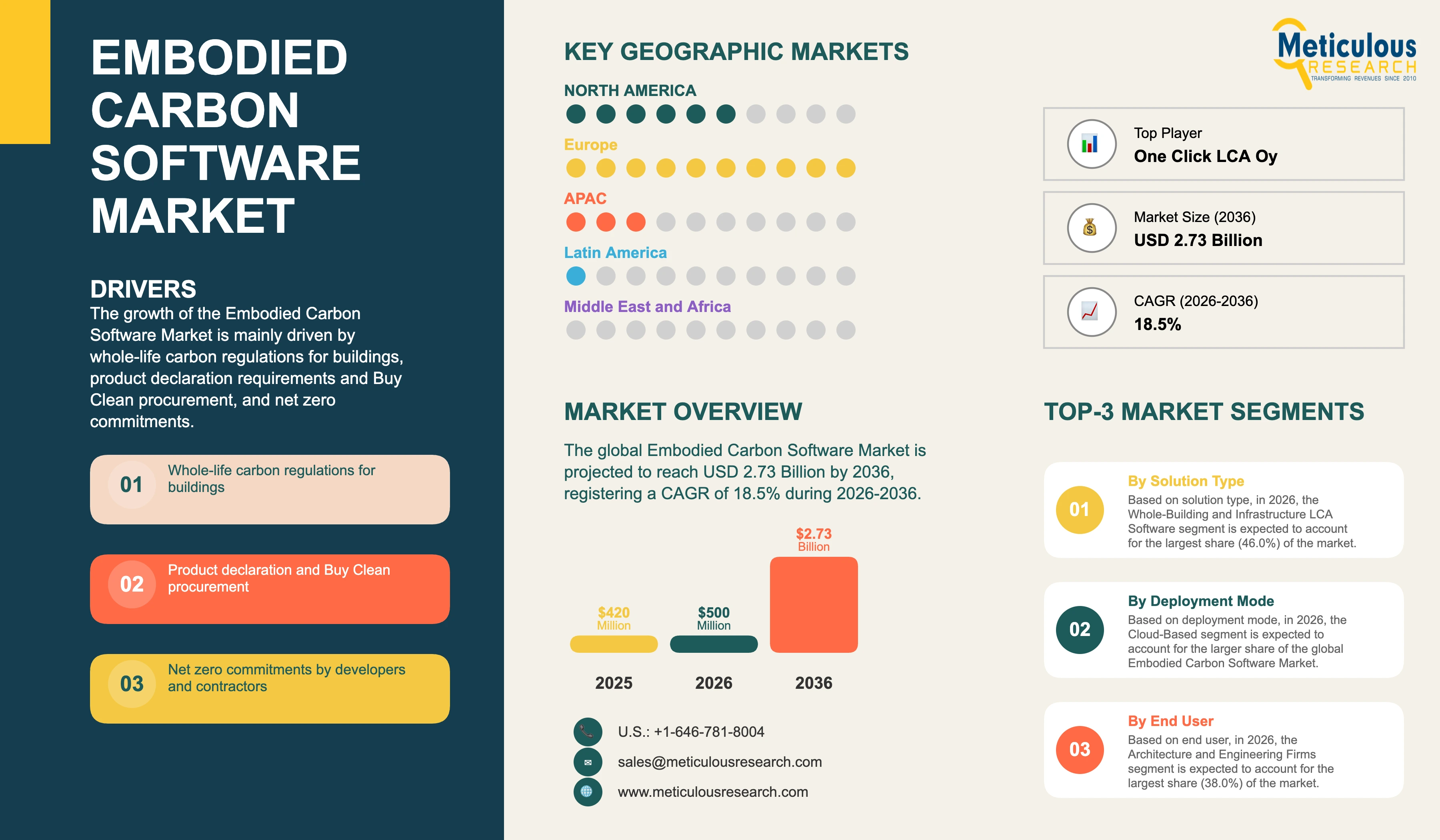
The global embodied carbon software market was valued at USD 420.0 million in 2025. This market is expected to reach USD 2.73 billion by 2036 from an estimated USD 500.0 million in 2026, registering a CAGR of 18.5% during the forecast period (2026-2036).
- Published
- Nov 2026
- Pages
- 238
- Format
- PDF + Excel
- Report ID
- MRICT - 1042544
- Base year
- 2025
- 2025 · BASELINE
- $420.0M
- 2036
- $2.73B
- CAGR 2026–2036
- 18.5%
2025 baseline · 2026–2036 forecast at 18.5% CAGR · hover a bar for the value
Key highlights
The recast EU Energy Performance of Buildings Directive, Directive (EU) 2024/1275, requires member states to ensure that the life-cycle global warming potential of new buildings is calculated and disclosed in energy performance certificates from 1 January 2028 for new buildings with a useful floor area of more than 1,000 square meters, and from 1 January 2030 for all new buildings, and requires member states to publish roadmaps for introducing limit values, which creates mandatory demand for whole-life carbon assessment tools across the EU.
The revised EU Construction Products Regulation, Regulation (EU) 2024/3110, which entered into force in January 2025, introduces requirements for manufacturers to declare environmental sustainability information, starting with global warming potential, for construction products as technical specifications are adopted, which is expected to sharply increase demand for environmental product declaration (EPD) generation and product life-cycle assessment software.
Several European countries already regulate embodied carbon, including France through its RE2020 regulation, Denmark through carbon limits in its building regulations since 2023, Sweden through mandatory climate declarations for new buildings since 2022, the Netherlands through its environmental performance calculation for buildings, and Finland through climate declarations under its new building legislation, which has made Europe the largest market for embodied carbon software.
In the U.S., states such as California, Colorado, New York, Minnesota, Washington, Oregon, and New Jersey have adopted Buy Clean or embodied carbon procurement policies that require EPDs or set limits for materials such as concrete, steel, and glass, while the U.S. Green Building Council's LEED v5 rating system, launched in 2025, includes a prerequisite to assess and quantify embodied carbon.
The UN Environment Programme's Global Alliance for Buildings and Construction has reported that buildings and construction account for around 37% of global energy and process-related carbon dioxide emissions, and that embodied emissions from materials such as cement, steel, and aluminum are a large and growing share of the sector's total emissions as buildings become more energy efficient.
By solution type, whole-building and infrastructure LCA software accounts for the largest share of 46.0% in 2026, while BIM-integrated carbon design tools register the highest CAGR.
By deployment mode, cloud-based solutions account for the larger share in 2026 and register the higher CAGR.
By end user, architecture and engineering firms account for the largest share of 38.0% in 2026, while building product manufacturers register the highest CAGR.
By geography, Europe accounts for the largest share of 48.0% in 2026, while Asia-Pacific registers the highest CAGR of 22.7%.
Report summary
| Particulars | Details |
|---|---|
| Forecast Period | 2026-2036 |
| Base Year | 2025 |
| Estimated Year | 2026 |
| CAGR (Value) | 18.5% |
| Format | PDF, Excel & Cloud Portal · 238 pages |
| Market Size in 2025 | USD 420.0 million |
| Market Size in 2026 | USD 500.0 million |
| Market Size by 2036 | USD 2.73 billion |
| Largest Segment by Solution Type (2026) | Whole-Building and Infrastructure LCA Software (46.0%) |
| Largest Segment by End User (2026) | Architecture and Engineering Firms (38.0%) |
| Largest Region (2026) | Europe (48.0%) |
| Fastest-Growing Region | Asia-Pacific (CAGR 22.7%) |
| Segments Covered | Solution Type, Deployment Mode, End User, and Geography |
| Geographic Scope | Europe, North America, Asia-Pacific, Latin America, and Middle East and Africa |
| Key Companies Profiled | One Click LCA, Autodesk, Bentley Systems, Sphera, PRé Sustainability, Ecochain, Makersite, Sustainable Minds, cove.tool, Preoptima, Vizcab, Building Transparency, and ecoinvent |
Report overview
Segments covered: solution type, deployment mode, end user.
The growth of this market is mainly driven by new regulations that require whole-life carbon assessments of buildings in the EU and several European countries, the revised EU Energy Performance of Buildings Directive's requirement to calculate and disclose life-cycle global warming potential for new buildings from 2028, the revised EU Construction Products Regulation, which requires manufacturers to declare environmental information for construction products, Buy Clean procurement policies in U.S. states that require environmental product declarations, green building certifications such as LEED v5 and BREEAM that reward or require embodied carbon assessment, corporate net zero commitments by developers, investors, and contractors, and the integration of carbon analysis into building information modeling (BIM) and design workflows. However, factors such as inconsistent methodologies and data across countries, limited availability of product-specific data in some regions, the cost and skills needed for life-cycle assessment, and changes in U.S. federal policy support are expected to restrain the growth of this market to some extent.
Embodied carbon refers to the greenhouse gas emissions associated with the materials and construction processes of buildings and infrastructure over their life cycle, including the extraction and manufacturing of materials such as concrete, steel, aluminum, glass, and insulation, their transport, construction, maintenance and replacement, and demolition and disposal at the end of life. Operational carbon, in contrast, refers to emissions from the energy used to heat, cool, light, and power buildings during use. As buildings become more energy efficient and electricity grids become cleaner, embodied carbon accounts for a growing share of the total life-cycle emissions of new buildings, which has made it a major focus for regulators, designers, and developers.
Embodied carbon software helps architects, engineers, contractors, developers, building product manufacturers, and public agencies measure, compare, and reduce embodied carbon. Whole-building and infrastructure life-cycle assessment (LCA) software calculates the embodied and whole-life carbon of entire projects using material quantities and environmental data. EPD generation and product LCA software helps manufacturers calculate the environmental impacts of their products and publish verified environmental product declarations. BIM-integrated carbon design tools bring carbon calculations into design software, allowing designers to compare options early. Carbon databases and benchmarking platforms provide environmental data on materials and products and allow projects to be compared with benchmarks and limits.
This market covers the global revenue from embodied carbon software, including whole-building and infrastructure LCA software, EPD generation and product LCA software, BIM-integrated carbon design tools, and carbon databases and benchmarking platforms, delivered through cloud-based or on-premises deployment, along with related subscriptions and data licenses. It is segmented by solution type, deployment mode, end user, and geography. Consulting services for LCA studies, EPD verification fees, operational energy modeling software, and general corporate carbon accounting software that does not address building and product embodied carbon are not included.
Regulation has been the main driver of the market's growth, because it turns embodied carbon assessment from a voluntary activity into a legal requirement. France's RE2020 regulation was among the first to set embodied carbon limits for new buildings, and Denmark, Sweden, the Netherlands, and Finland have introduced climate declarations or limits. At the EU level, the recast Energy Performance of Buildings Directive requires life-cycle global warming potential to be calculated and disclosed for large new buildings from 2028 and for all new buildings from 2030, while the revised Construction Products Regulation will require manufacturers to declare environmental information for their products. These rules make LCA a standard part of building design and product marketing in Europe, and they create recurring demand for software and data.
In North America, embodied carbon policy has developed through public procurement and green building certification. California's Buy Clean California Act set limits on the global warming potential of structural steel, rebar, flat glass, and mineral wool insulation in state projects, and several other states have adopted similar policies or EPD requirements. Cities such as Vancouver and Toronto have introduced embodied carbon requirements for new buildings, and LEED v5 includes a prerequisite to assess embodied carbon. Federal Buy Clean programs, which expanded under the Inflation Reduction Act, have been scaled back since 2025, but state and city policies and private sector commitments continue to support demand.
Private sector commitments are another important driver, especially in countries where regulation is still developing. Many developers, real estate investors, contractors, and design firms have committed to net zero carbon targets that include embodied carbon, and initiatives such as the World Green Building Council's net zero commitments and the Science Based Targets initiative's buildings guidance encourage companies to measure and reduce embodied emissions. Large contractors and engineering firms now use embodied carbon software routinely on major projects, and many clients require embodied carbon reporting as part of their sustainability strategies.
The market includes specialist embodied carbon software companies, design software providers, product LCA software companies, and data providers. Leading participants include One Click LCA, Autodesk, Bentley Systems, Sphera Solutions, PRé Sustainability, Ecochain, Makersite, Sustainable Minds, cove.tool, Preoptima, and Vizcab, as well as data and benchmarking organizations such as Building Transparency, which operates the EC3 tool, and the ecoinvent Association, which provides life-cycle inventory data. Many software tools rely on EPD databases and background data from these organizations.
Over the forecast period, the embodied carbon software market is expected to grow rapidly, as EU requirements take effect, more countries adopt whole-life carbon rules, manufacturers produce more EPDs, and carbon analysis becomes part of everyday design workflows. Europe is expected to remain the largest market, while Asia-Pacific is expected to grow fastest at a CAGR of 22.7%.
Developers, investors, and lenders increasingly need reliable embodied carbon data for procurement decisions, green financing, EU taxonomy alignment, and sustainability reporting under the CSRD and other frameworks. Platforms that connect project-level LCA data with corporate reporting and procurement systems, and that provide benchmarks for portfolios, create new opportunities for software vendors.
Green bonds and sustainability-linked loans for real estate increasingly include embodied carbon criteria, and the EU taxonomy requires life-cycle global warming potential calculations for large new buildings to qualify as sustainable investments. These financial uses make embodied carbon data more valuable and create opportunities for platforms that can provide auditable, standardized results for investors and lenders.
Report infographic
Market dynamics
14 factors across 5 forcesWhole-life carbon regulations for buildings
Governments are increasingly regulating the whole-life carbon of buildings, which makes embodied carbon assessment mandatory for many projects. The recast EU Energy Performance of Buildings Directive requires the life-cycle global warming potential of new buildings with a useful floor area of more than 1,000 square meters to be calculated and disclosed from 2028, and of all new buildings from 2030, and it requires member states to publish roadmaps for limit values. Several countries already go further. France's RE2020 regulation sets embodied carbon thresholds that become stricter over time, Denmark has set carbon limits for new buildings since 2023, Sweden requires climate declarations, the Netherlands requires an environmental performance calculation, and Finland has introduced climate declarations under its new building legislation.
These regulations require architects, engineers, and developers to calculate embodied carbon using standardized methods, often at several stages of design and at completion, which creates recurring demand for whole-building LCA software. Because calculations must follow national methods and use approved data, software providers must offer country-specific tools and databases, and users increasingly rely on software rather than spreadsheets. Whole-building and infrastructure LCA software accounts for the largest share of the market by solution type, and Europe accounts for the largest share by region.
In the U.K., the RICS Whole Life Carbon Assessment standard, updated in its second edition in 2024, has become the common methodology for the built environment, and the Greater London Authority requires whole-life carbon assessments for large planning applications, while industry groups have proposed national embodied carbon regulation. Outside Europe, cities such as Vancouver and Toronto and states such as California have introduced embodied carbon requirements, and other countries are studying similar rules. As more jurisdictions adopt such requirements, demand for compliant assessment software is expected to grow steadily throughout the forecast period.
Product declaration requirements and Buy Clean procurement
Building product manufacturers face growing requirements to provide verified environmental data for their products in Europe, North America, and other regions. The revised EU Construction Products Regulation, which entered into force in January 2025, will require manufacturers to declare environmental sustainability information, starting with global warming potential, as technical specifications are adopted for different product families. In the U.S., state Buy Clean policies require EPDs for materials such as concrete, steel, glass, and insulation used in public projects, and some set maximum global warming potential limits. Green building rating systems such as LEED, BREEAM, and others reward projects that use products with EPDs.
These requirements are driving rapid growth in the number of EPDs published worldwide. Manufacturers, especially concrete producers, steel makers, and producers of insulation, glass, and other materials, need software that allows them to calculate product impacts efficiently and to produce EPDs for many products and plants. Concrete producers, for example, may need EPDs for thousands of mix designs. Building product manufacturers form the fastest-growing end user segment in this market, and EPD generation and product LCA software is one of the fastest-growing solution types.
Net zero commitments by developers, investors, and contractors
Many real estate developers, investors, contractors, and design firms have committed to net zero carbon targets, and embodied carbon is a large part of the emissions of new construction. Real estate investors increasingly report the carbon footprint of their development pipelines under frameworks such as the GHG Protocol and sustainability reporting rules such as the EU Corporate Sustainability Reporting Directive. Contractors and engineering firms use embodied carbon software to help clients meet targets, compare design options, and win projects that require low-carbon solutions.
Green building certifications are also raising expectations among developers, investors, and tenants. LEED v5, launched in 2025, includes a prerequisite to assess and quantify embodied carbon, and BREEAM, DGNB, and other certification systems include life-cycle assessment credits. These certifications are widely used by developers and investors, which makes embodied carbon software a routine part of many projects. Architecture and engineering firms account for the largest share of the market by end user, since they carry out most assessments during design.
Integration with BIM and digital design workflows
Embodied carbon software is increasingly integrated with BIM and design tools, such as Autodesk Revit, Graphisoft Archicad, Rhino, and Tekla, as well as with cost estimating and quantity takeoff software. Integration allows designers to calculate embodied carbon automatically from building models, compare structural systems and materials early in design when changes are cheapest, and update calculations as designs change. Design software providers, such as Autodesk and Bentley Systems, are adding carbon analysis features to their platforms, and specialist vendors offer plug-ins and direct integrations.
This integration makes embodied carbon analysis faster and more accessible to non-specialists, which expands the user base beyond sustainability consultants to architects, structural engineers, and cost planners. BIM-integrated carbon design tools form the fastest-growing solution type in this market, and cloud-based solutions account for the largest and fastest-growing deployment mode.
Table of contents
11 chapters · 106 sections · 238 pages · click to expandGeographic analysis
Asia-Pacific
Fastest growthAsia-Pacific accounts for the majority of global construction activity and cement and steel consumption, and countries such as Singapore, Australia, New Zealand, Japan, South Korea, and China are introducing green building requirements, EPD programs, and embodied carbon guidance. Singapore's Green Mark scheme includes whole-life carbon criteria, Australia's NABERS is introducing an embodied emissions rating, and New Zealand has developed whole-of-life embodied carbon guidance. Asia-Pacific is the fastest-growing region in this market. Large Asian developers, contractors, and engineering firms working on international projects are also adopting embodied carbon tools to meet client requirements and green building certifications such as LEED and BREEAM, and EPD programs in Japan, South Korea, Australia, and China are growing. As national methods and databases are developed in the region, demand for localized software and data is expected to increase significantly. Asia-Pacific is projected to register the highest CAGR of 22.7% during the forecast period. The rapid growth of this region is mainly driven by the very large volume of construction in the region, green building requirements and embodied carbon guidance in Singapore, Australia, New Zealand, Japan, and South Korea, Australia's work on a NABERS embodied emissions rating, the growth of EPD programs, and the decarbonization commitments of large developers and contractors in the region. Asia-Pacific and emerging markets Geographic Analysis
Europe
Largest shareIn 2026, Europe is expected to account for the largest share of 48.0% of the global embodied carbon software market by value. The large share of this region is mainly due to existing national whole-life carbon regulations in France, Denmark, Sweden, the Netherlands, and Finland, preparation for the EPBD's requirements from 2028, the Construction Products Regulation's environmental declaration requirements, widely used certification systems such as BREEAM and DGNB, the U.K.'s RICS standard and London's planning requirements, and the presence of leading embodied carbon software companies such as One Click LCA, Ecochain, PRé Sustainability, Vizcab, and Preoptima. France is one of the largest national markets in Europe because RE2020 requires embodied carbon calculations for all new residential and many non-residential buildings, while the Nordic countries have high adoption because of national regulations and early industry action. Germany, the U.K., and the Netherlands also have large markets driven by certifications such as DGNB and BREEAM, planning requirements, national databases, and corporate commitments. Europe is expected to remain the largest region throughout the forecast period, as all EU member states implement the EPBD's life-cycle requirements and as the Construction Products Regulation increases EPD production by manufacturers across the region.
North America
North America is the second-largest region, supported by state Buy Clean policies, city requirements in Vancouver and Toronto, LEED v5, the use of free tools such as EC3 alongside commercial software, and strong commitments by large design firms and contractors. Although federal support has been reduced, state procurement policies in California, New York, Colorado, and other states continue to drive EPD demand.
Latin America
Latin America and the Middle East and Africa are smaller but growing with green building certifications and large construction programs in the Gulf, where developers of major projects increasingly require carbon assessments.
Competitive landscape
The embodied carbon software market includes specialist whole-building LCA providers, design software companies, product LCA and EPD software companies, and data and benchmarking organizations. Leading participants include One Click LCA, Autodesk, Bentley Systems, Sphera Solutions, PRé Sustainability, Ecochain, Makersite, Sustainable Minds, cove.tool, Preoptima, and Vizcab, as well as Building Transparency and the ecoinvent Association, which provide widely used data and tools.
Companies compete mainly on coverage of national methods and certification schemes, data quality and quantity, integration with BIM and design tools, ease of use, automation, EPD generation capabilities, and price. Specialist LCA vendors benefit from deep methodological expertise, regulatory knowledge, and large databases, while design software companies benefit from their large user bases and the ability to embed carbon analysis into everyday workflows. Product LCA vendors serve manufacturers across many industries and are expanding their construction offerings.
The top five players are estimated to account for 40.0% of the global embodied carbon software market in 2025. This moderate concentration reflects the strong position of a few leading whole-building LCA and product LCA vendors, alongside many national and specialist tools.
Players use several strategies to grow in this market, including expanding coverage of national methods and data, launching EPD generators and verification tools, integrating with BIM and design platforms, adding AI features, forming partnerships with design software companies, EPD program operators, and industry associations, and acquiring complementary tools, national compliance tools, and data providers. Design software companies are partnering with or building on open data platforms such as EC3 to bring carbon data into design tools, which increases the reach of carbon analysis to millions of design software users.
Competition is expected to intensify as design software providers expand their carbon features and as regulations create larger markets. Vendors that offer reliable data, broad regulatory coverage across many countries, and seamless integration with design and manufacturing workflows are expected to gain market share, and consolidation is expected as larger software companies acquire specialist tools. Partnerships with EPD program operators, industry associations, and national governments are also important, since they help vendors secure access to data and become the preferred tools for national compliance.
Some of the key participants operating in the embodied carbon software market are One Click LCA Oy, Autodesk, Inc., Bentley Systems, Incorporated, Sphera Solutions, Inc., PRé Sustainability B.V., Ecochain Technologies B.V., Makersite GmbH, Sustainable Minds, LLC, cove.tool, Inc., Preoptima Ltd, Vizcab SAS, Building Transparency, and the ecoinvent Association.
- —
The revised Construction Products Regulation entered into force in January 2025, LEED v5 introduced an embodied carbon prerequisite in 2025, EU member states are preparing to implement EPBD life-cycle requirements from 2028, and vendors are adding AI and BIM integration features.
- One Click LCA
- Autodesk
- Bentley Systems
- Sphera
- PRé Sustainability
- Ecochain
- Makersite
- Sustainable Minds
- Preoptima
- Vizcab
- Building Transparency
Expert perspectives
Embodied carbon software is moving quickly from a niche tool used by sustainability specialists to a mainstream requirement for designing buildings and making construction products. The main reason for this shift is regulation: the EPBD, the Construction Products Regulation, national rules in Europe, Buy Clean policies, and green building certifications are making embodied carbon assessment mandatory or expected on a growing share of projects and products. As limit values are introduced, the market will shift from measuring and reporting embodied carbon to actively reducing it, which will increase the value of design and procurement tools.
Over the forecast period, the embodied carbon software market is expected to grow at a CAGR of 18.5%, driven mainly by EU requirements from 2028 and 2030, rapid growth in EPD production, BIM integration, and expanding regulations in Asia-Pacific and North America. Changes in U.S. federal policy since 2025 create some near-term uncertainty, but state and city policies, certifications, and private sector commitments continue to support demand.
Whole-building and infrastructure LCA software remains the largest solution type, while BIM-integrated carbon design tools grow fastest. Cloud-based solutions account for the larger share and grow fastest. Architecture and engineering firms remain the largest end user, while building product manufacturers grow fastest because of product declaration requirements.
Europe remains the largest region because of its strong regulatory framework, while Asia-Pacific is the fastest-growing region at a CAGR of 22.7%, driven by the scale of construction and new green building requirements in the region.
For embodied carbon software vendors, the key priorities are to keep pace with changing national methods and data, integrate deeply with design and manufacturing systems, automate EPD generation, and make assessments easier for non-specialists. For building product manufacturers, the priority is to build product-specific data and EPDs efficiently and use them to develop and market lower-carbon products. For designers and developers, the priority is to use carbon analysis early in design, when the largest reductions are possible at the lowest cost, and to set clear carbon targets for each project. We believe that vendors combining reliable data, deep regulatory expertise, and seamless workflow integration will gain the most from this fast-growing market.
We also expect embodied carbon data to become a normal part of building permits, procurement, financing, and product specifications over the next decade, in the same way that energy performance data has become standard. This would create steady, recurring demand for software and data across the construction value chain, from manufacturers to designers, contractors, owners, and regulators.
Customer perspectives
Sustainability Director - architecture firm, Denmark
Our national carbon limits mean we must calculate whole-life carbon on every new building, often several times during design. We need a tool that follows the national method, works with our BIM models, and gives us results quickly so we can change the design.
Head of Sustainability - ready-mix concrete producer, U.S.
Public projects in our state now require EPDs for every concrete mix we supply, so we automated EPD generation with software connected to our batch plant data. It has also helped us market lower-carbon mixes to contractors.
Design Technology Manager - engineering firm, Australia
Clients now ask for carbon comparisons at concept stage, so we use carbon tools inside our design software and compare structural options before detailed design begins.
Frequently asked questions
The market was valued at USD 420.0 million in 2025 and USD 345.0 million in 2024, and is estimated at USD 500.0 million in 2026. These values cover software subscriptions and data licenses for whole-building LCA, EPD generation, BIM-integrated tools, and carbon databases, excluding consulting and verification services.
The market is expected to reach USD 2.73 billion by 2036, supported by whole-life carbon regulations, product declaration requirements, Buy Clean procurement, net zero commitments, and BIM integration.
The market is expected to register a CAGR of 18.5% from 2026 to 2036, one of the faster growth rates among construction software categories. Growth is supported by EU life-cycle requirements from 2028 and 2030, rising EPD production, and more countries adopting whole-life carbon rules.
Embodied carbon software is a category of software that helps architects, engineers, contractors, developers, and manufacturers measure, compare, and reduce the greenhouse gas emissions associated with building materials and construction over the life cycle. It does so through whole-building LCA, EPD generation, BIM-integrated design tools, and carbon databases.
Growth is driven by whole-life carbon regulations for buildings, product declaration requirements and Buy Clean procurement, net zero commitments by developers, investors, and contractors, and integration with BIM and digital design workflows.
Inconsistent methodologies and data quality and cost, skills, and policy uncertainty restrain growth. The availability of local data and EPDs and integration across the project life cycle remain key challenges.
Cloud-based solutions are expected to account for the larger share of the market in 2026 and to register the higher CAGR. This is driven by regularly updated data, collaboration between project teams, and integration with cloud design platforms.
Key opportunities include EPD automation for building product manufacturers, expansion into infrastructure and civil engineering, Asia-Pacific and emerging markets, and carbon data for procurement, finance, and reporting.
Whole-building and infrastructure LCA software is expected to account for the largest share of 46.0% of the market in 2026, mainly due to mandatory whole-life carbon assessments in Europe and certification requirements. BIM-integrated carbon design tools are projected to register the highest CAGR.
Architecture and engineering firms are expected to account for the largest share of 38.0% of the market in 2026, mainly due to their central role in carrying out assessments during design. Building product manufacturers are projected to register the highest CAGR.
Among regions, Europe is expected to account for the largest share of 48.0% of the market in 2026, mainly due to national whole-life carbon regulations, the EPBD, the Construction Products Regulation, and leading software vendors.
Asia-Pacific is projected to register the highest CAGR of 22.7% during the forecast period. This is driven by the scale of construction and new green building and embodied carbon requirements in Singapore, Australia, and other countries.
The report profiles 13 companies and organizations, including One Click LCA, Autodesk, Bentley Systems, Sphera, PRé Sustainability, Ecochain, Makersite, Sustainable Minds, cove.tool, Preoptima, Vizcab, Building Transparency, and ecoinvent. The top five players account for an estimated 40.0% of the market in 2025.
The revised Construction Products Regulation entered into force in January 2025, LEED v5 introduced an embodied carbon prerequisite in 2025, and EU member states are preparing to implement EPBD life-cycle requirements from 2028. Vendors are also adding AI and BIM integration features.
Cite this report
Meticulous Research. (2026). Embodied Carbon Software Market - Global Opportunity Analysis and Industry Forecast (2026-2036) (Report No. MRICT - 1042544). Meticulous Market Research Pvt. Ltd. https://www.meticulousresearch.com/product/embodied-carbon-software-market-7227