Carbon Management Software Market (2026-2036)
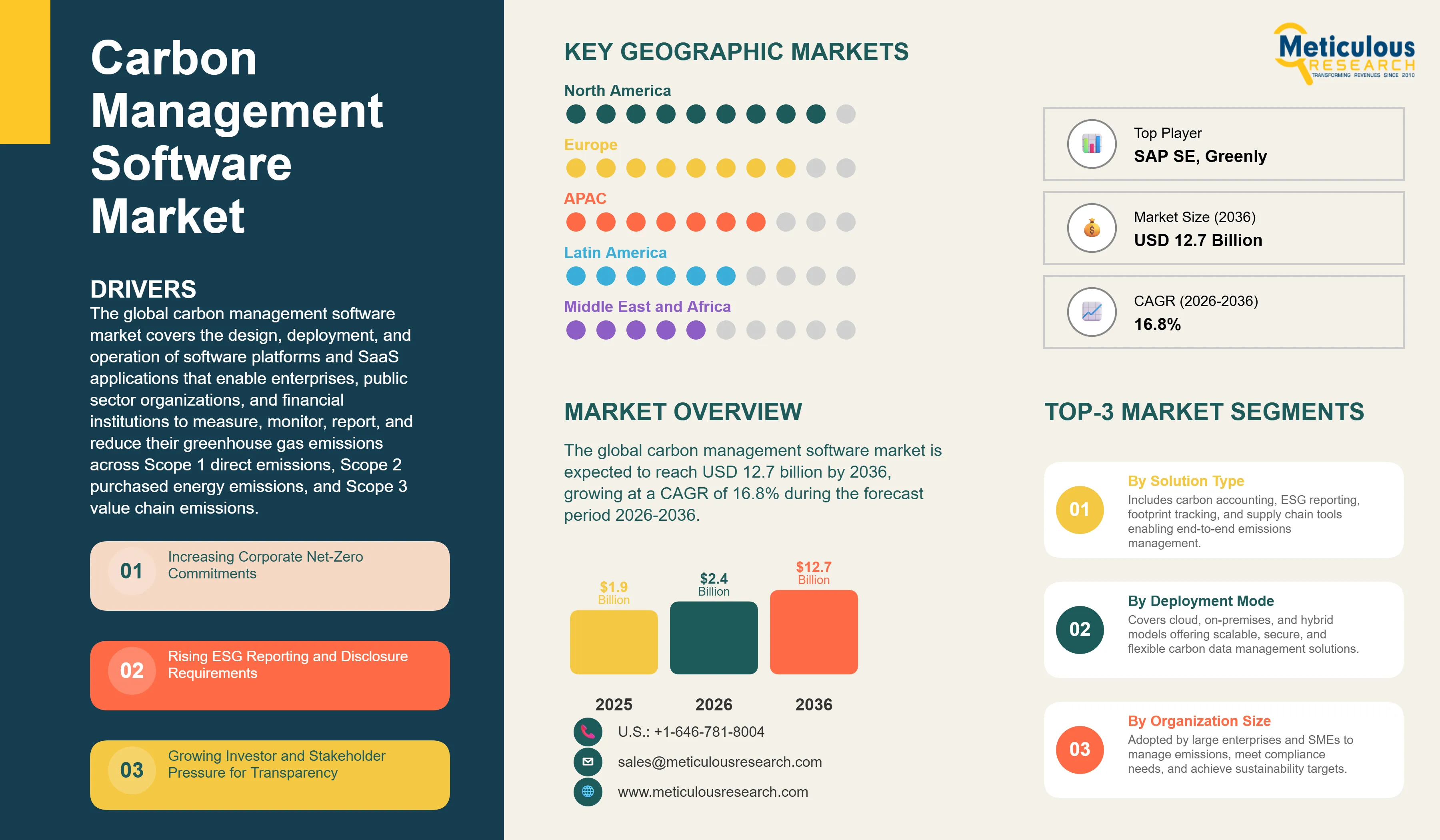
The global carbon management software market was valued at USD 1.9 billion in 2025. This market is expected to reach USD 12.7 billion by 2036 from an estimated USD 2.4 billion in 2026, growing at a CAGR of 16.8% during the forecast period 2026-2036.
- Published
- Apr 2026
- Pages
- 279
- Format
- PDF + Excel
- Report ID
- MR-1887
- Base year
- 2025
- 2025 · BASELINE
- $1.90B
- 2036
- $12.70B
- CAGR 2026–2036
- 16.8%
2025 baseline · 2026–2036 forecast at 16.8% CAGR · hover a bar for the value
Key highlights
The global carbon management software market is projected to reach USD 12.7 billion by 2036.
The market is expected to grow at a CAGR of 16.8% during the forecast period 2026-2036.
The global carbon management software market was valued at USD 1.9 billion in 2025 and is estimated to reach USD 2.4 billion in 2026.
North America is expected to dominate the global carbon management software market with the largest market share in 2026.
By solution type, the carbon accounting software segment is expected to hold the largest share of the global carbon management software market in 2026.
By deployment mode, the cloud-based (SaaS) segment is expected to hold the largest share in 2026.
By organization size, the large enterprises segment is expected to hold the largest share in 2026.
By application, the emissions monitoring & reporting segment is expected to hold the largest share in 2026.
By end-use industry, the energy & utilities segment is expected to hold the largest share in 2026.
By emission scope coverage, the full scope (1, 2, and 3) integrated platforms segment is expected to register the highest CAGR during the forecast period.
Report summary
| Particulars | Details |
|---|---|
| Market Size by 2036 | USD 12.7 Billion |
| Market Size in 2026 | USD 2.4 Billion |
| Market Size in 2025 | USD 1.9 Billion |
| Revenue Growth Rate (2026-2036) | CAGR of 16.8% |
| Format | PDF, Excel & Cloud Portal · 279 pages |
| Dominating Solution Type | Carbon Accounting Software |
| Fastest Growing Solution Type | Supply Chain Carbon Management Solutions |
| Dominating Deployment Mode | Cloud-Based (SaaS) |
| Fastest Growing Deployment Mode | Hybrid Deployment |
| Dominating Organization Size | Large Enterprises |
| Fastest Growing Organization Size | Small & Medium Enterprises (SMEs) |
| Dominating Application | Emissions Monitoring & Reporting |
| Fastest Growing Application | Carbon Reduction & Decarbonization Planning |
| Dominating End-Use Industry | Energy & Utilities |
| Fastest Growing End-Use Industry | BFSI |
| Dominating Emission Scope Coverage | Scope 1 & 2 Management |
| Fastest Growing Scope Coverage | Full Scope (1, 2, and 3) Integrated Platforms |
| Dominating Geography | North America |
| Fastest Growing Geography | Asia-Pacific |
| Base Year | 2025 |
| Forecast Period | 2026 to 2036 |
Report overview
Segments covered: solution type, deployment mode, organization size, application, end-use industry.
The global carbon management software market covers the design, deployment, and operation of software platforms and SaaS applications that enable enterprises, public sector organizations, and financial institutions to measure, monitor, report, and reduce their greenhouse gas emissions across Scope 1 direct emissions, Scope 2 purchased energy emissions, and Scope 3 value chain emissions. The market encompasses the full spectrum of solution categories including dedicated carbon accounting engines, corporate carbon footprint management platforms, ESG reporting and disclosure tools, energy management integration solutions, carbon offset and credit management platforms, and supply chain emissions tracking systems as well as the supporting ecosystem of data providers, implementation consultants, and systems integrators that collectively constitute the carbon management software value chain.
The growth of the global carbon management software market is primarily driven by the accelerating convergence of binding regulatory disclosure mandates, expanding corporate net-zero commitments, and investor-led ESG due diligence requirements that are simultaneously obligating and incentivizing organizations across sectors and geographies to implement structured, auditable, and technology-enabled carbon management capabilities. The European Union’s Corporate Sustainability Reporting Directive, which entered phased application from fiscal year 2024 for large listed companies and will extend to all large companies and listed SMEs by 2027, mandates detailed greenhouse gas inventory reporting aligned with the GHG Protocol and European Sustainability Reporting Standards that cannot be practically fulfilled without dedicated carbon accounting software. The U.S. Securities and Exchange Commission’s climate-related disclosure rules, requiring material climate risk and Scope 1 and 2 emissions disclosure from registered public companies, and the International Sustainability Standards Board’s IFRS S1 and S2 standards gaining adoption across the United Kingdom, Australia, Canada, Japan, and Singapore, are collectively expanding the regulatory compliance demand for carbon management software beyond its European origin market to encompass the full spectrum of global capital market participants.
However, the market faces important structural constraints. The persistent fragmentation and inconsistency of emissions data across enterprise IT systems including ERP platforms, utility billing systems, fleet management tools, IoT sensor networks, and supplier reporting portals creates data integration complexity that substantially increases implementation timelines and costs for enterprise carbon management deployments and limits the real-time accuracy of emissions calculations for organizations with large and geographically dispersed operational footprints. The absence of a universally adopted, mandatory methodology standard for Scope 3 value chain emissions calculation where the GHG Protocol’s Scope 3 Standard provides a framework but affords substantial methodological discretion in spend-based versus activity-based versus supplier-specific emission factor selection creates comparability limitations in disclosed emissions data that undermine investor confidence and complicate regulatory verification.
Despite these challenges, the market outlook is strongly positive. The rapid maturation of AI-powered emissions forecasting, scenario modeling, and decarbonization pathway optimization capabilities within leading carbon management platforms is substantially expanding the decision-support value proposition of carbon software beyond compliance reporting toward strategic business intelligence that resonates with C-suite and board-level sustainability leadership. The integration of carbon management APIs with ERP systems from SAP, Oracle, and Microsoft Dynamics, IoT emissions monitoring infrastructure from Schneider Electric, Siemens, and Honeywell, and financial accounting platforms is progressively reducing the data integration burden that has historically been the primary implementation barrier for enterprise carbon management adoption. The strategic entry of global technology leaders including SAP, Salesforce, and Microsoft into the carbon management software market is validating the category’s commercial scale and accelerating enterprise buyer confidence in committing to multi-year SaaS subscriptions.
Report infographic
Market dynamics
6 factors across 3 forcesIncreasing Corporate Net-Zero Commitments
The proliferation of corporate net-zero and science-based emissions reduction targets across multinational enterprises with the Science Based Targets initiative reporting over 7,000 companies globally with approved or committed science-based targets as of 2025 represents the foundational commercial demand driver for carbon management software by creating an enduring organizational requirement for structured, consistent, and technically defensible GHG inventory data that demonstrates credible progress against disclosed emissions reduction commitments. Net-zero commitments require enterprises to establish accurate emissions baselines across Scope 1, 2, and 3 categories, track year-on-year performance against interim reduction milestones, identify and prioritize decarbonization initiatives based on marginal abatement cost analysis, and report progress to investor, customer, and regulatory audiences in a manner that withstands third-party assurance verification. None of these requirements are practically achievable at enterprise scale through spreadsheet-based manual processes, creating an organizational technology mandate for dedicated carbon management software that is independent of the regulatory compliance driver and persists regardless of the pace of mandatory disclosure rule adoption. The growing market expectation that supplier decarbonization is a condition of continued commercial relationship with major enterprise buyers reflected in the CDP Supply Chain program’s 280 signatory member companies requesting emissions data from over 24,000 suppliers is progressively extending the carbon management software demand from first-tier enterprise adopters down through supply chain tiers to mid-market and SME organizations.
Rising ESG Reporting and Disclosure Requirements
The rapid expansion of mandatory ESG reporting and climate disclosure requirements across major capital market jurisdictions is creating a binding regulatory demand for carbon management software among public companies, large private enterprises, and financial institutions that must now produce externally assured, regulator-auditable GHG emissions data as part of their statutory reporting obligations. The EU Corporate Sustainability Reporting Directive, replacing the Non-Financial Reporting Directive, mandates double materiality-based sustainability reporting under European Sustainability Reporting Standards that include detailed GHG inventory disclosure, climate-related risk and opportunity assessment aligned with TCFD recommendations, and biodiversity, water, social, and governance metrics, applicable to approximately 50,000 companies operating in European markets. The International Sustainability Standards Board’s IFRS S1 and S2 climate disclosure standards, endorsed for application by the U.K., Australia, Canada, Japan, Singapore, and multiple other jurisdictions, are establishing a converging global mandatory climate disclosure baseline that is expanding the enterprise carbon management software addressable market well beyond its initial European regulatory anchor. Financial institutions face additional regulatory pressure from the European Central Bank’s supervisory expectations for climate risk integration, the Task Force on Climate-related Financial Disclosures adoption by the Bank of England, and national green finance taxonomies in the EU, U.K., and Singapore that require portfolio-level emissions and climate alignment metrics.
Table of contents
14 chapters · 125 sections · 279 pages · click to expandSegmental analysis
| Segment | Largest share (2026) | Fastest growth (2026–2036) |
|---|---|---|
| By Solution Type | Carbon Accounting Software | Supply chain carbon management solutions |
| By Application | Emissions Monitoring & Reporting | Carbon reduction and decarbonization planning |
| By End-Use Industry | Energy & Utilities | BFSI |
| By Emission Scope Coverage | Scope 1 & 2 Management | 3) integrated platforms |
By Solution Type
- Carbon Accounting Software to Dominate
- The carbon accounting software segment is expected to account for the largest share of the global carbon management software market.
- The large share of this segment is attributed to carbon accounting software’s status as the foundational technology requirement for all downstream carbon management activities with accurate GHG inventory data being a prerequisite for ESG reporting, decarbonization planning, regulatory disclosure, and carbon credit management and the maturity of dedicated carbon accounting platforms from established vendors including Sphera, Enablon, and Persefoni that have accumulated large enterprise client bases over multiple regulatory reporting cycles.
- The mandatory Scope 1 and 2 emissions disclosure requirements of the EU CSRD and SEC climate rules are creating immediate compliance-driven demand for carbon accounting software across the population of obligated reporting entities.
- However, the supply chain carbon management solutions segment is poised to register the highest CAGR during the forecast period.
- The high growth of this segment is attributed to the rapidly intensifying enterprise demand for supplier-level Scope 3 emissions data driven by regulatory Scope 3 disclosure requirements, CDP Supply Chain program participation, and SBTi supplier engagement criteria, combined with the technical complexity of multi-tier supply chain emissions data collection and calculation that requires purpose-built software infrastructure beyond the capabilities of general-purpose carbon accounting platforms.
- Cloud-Based (SaaS) to Hold the Largest Share
- The cloud-based segment is expected to account for the largest share of the global carbon management software market.
- This dominance reflects the structural advantages of SaaS deployment for carbon management applications including automatic regulatory content updates, multi-party supplier data collaboration, scalable data storage for large-volume emissions activity datasets, and lower total cost of ownership relative to on-premise alternatives that are particularly valuable given the continuous evolution of carbon accounting standards and the multi-stakeholder data sharing requirements of Scope 3 supply chain emissions calculation.
- The dominant SaaS delivery model of all major pure-play carbon management software vendors, including Persefoni, Watershed, Plan A, Sweep, Greenly, and Normative, reflects the native cloud architecture of the new-generation purpose-built carbon management platforms that are capturing the majority of new enterprise buyer adoption.
- However, the hybrid deployment segment is projected to register the highest CAGR during the forecast period.
- This growth is driven by the requirements of regulated industries including financial services, energy utilities, and government entities where data sovereignty regulations, internal IT security policies, and sensitive operational data governance frameworks require certain emissions data components to be processed and stored on-premise while leveraging cloud-based reporting, benchmarking, and regulatory disclosure submission capabilities.
- Large Enterprises to Hold the Largest Share
- The large enterprises segment is expected to account for the largest share of the global carbon management software market.
- This dominance reflects the concentration of mandatory regulatory disclosure obligations, investor ESG scrutiny, and CDP response requirements in the large enterprise segment, the availability of dedicated sustainability team resources and IT integration budgets required for full-scope carbon management software deployment, and the established multi-year procurement relationships between enterprise software vendors and large corporate buyers that are being leveraged for carbon management solution sales by ERP-native vendors including SAP and Microsoft.
- However, the small and medium enterprises segment is projected to register the highest CAGR during the forecast period.
- This growth is driven by the extension of EU CSRD mandatory reporting obligations to listed SMEs from fiscal year 2026, the escalating Scope 3 supplier data requests from large enterprise CDP Supply Chain program participants, the proliferation of simplified SME-focused SaaS carbon management platforms at accessible price points, and the growing availability of SME sustainability financing incentives from European banking institutions that require carbon footprint assessment and management plan documentation.
By Application
- Emissions Monitoring & Reporting to Hold the Largest Share
- The emissions monitoring and reporting segment is expected to account for the largest share of the global carbon management software market.
- This dominance reflects the foundational role of emissions monitoring and reporting as the entry-point application driving the majority of initial carbon management software adoption as organizations implement GHG measurement capabilities to fulfill immediate regulatory disclosure obligations and investor ESG data requests before progressing to more advanced decarbonization planning and offset management capabilities.
- The immediate compliance deadline pressure of CSRD, SEC climate rules, and ISSB S2 adoption across multiple jurisdictions is ensuring that emissions monitoring and reporting remains the primary procurement driver for carbon management software through the near term of the forecast period.
- However, the carbon reduction and decarbonization planning segment is projected to register the highest CAGR during the forecast period.
- This growth is driven by the maturation of enterprise carbon management programs beyond initial compliance reporting toward strategic decarbonization planning, the SBTi’s requirement for net-zero pathway documentation and interim milestone progress reporting that necessitates structured decarbonization roadmap planning software capabilities, and the growing enterprise investment in AI-assisted scenario modeling and marginal abatement cost analysis tools that optimize decarbonization investment allocation across operational, supply chain, and product portfolio dimensions.
By End-Use Industry
- Energy & Utilities to Hold the Largest Share
- The energy and utilities segment is expected to account for the largest share of the global carbon management software market.
- This dominance reflects the energy and utilities sector’s position as the economy’s largest direct greenhouse gas emitter, its long-established obligation to participate in emissions trading systems including the EU ETS and California Cap-and-Trade Program that require precise emissions metering and registry-linked reporting, and the sector’s advanced regulatory sophistication in carbon data management relative to other industries.
- The energy sector’s dense IoT instrumentation of generation, transmission, and distribution assets, combined with the regulatory requirement for facility-level emissions reporting under EPA’s Mandatory Greenhouse Gas Reporting Rule and EU ETS monitoring, reporting, and verification requirements, creates both the data infrastructure and the compliance driver for advanced carbon management software deployment at greater functional depth than most other sectors.
- However, the BFSI segment is projected to register the highest CAGR during the forecast period.
- This growth is driven by the financial services sector’s rapidly escalating regulatory pressure to measure and disclose financed emissions across loan and investment portfolios under PCAF methodology, the ECB’s supervisory expectations for climate risk integration in bank risk management frameworks, the Net-Zero Banking Alliance’s and Net-Zero Asset Managers Initiative’s commitments covering over USD 130 trillion in assets under management, and the specialized technical complexity of financial institution carbon accounting that is driving significant investment in purpose-built financial sector carbon management software from vendors including Persefoni, Watershed, and Carbon Account.
By Emission Scope Coverage
- Scope 1 & 2 Management to Hold the Largest Share
- The Scope 1 and 2 management segment is expected to account for the largest share of the global carbon management software market.
- This dominance reflects the greater data availability, methodological maturity, and immediate regulatory compliance priority of Scope 1 and 2 emissions calculation relative to the technically more complex and data-scarce Scope 3 category with the initial phase of regulatory mandatory disclosure under CSRD and SEC climate rules focusing primarily on Scope 1 and 2 emissions with external assurance requirements, providing the immediate compliance deadline that is driving the majority of current enterprise carbon management software procurement decisions.
- However, the full scope (1, 2, and 3) integrated platforms segment is projected to register the highest CAGR during the forecast period.
- This growth reflects the increasing regulatory and investor pressure for comprehensive Scope 3 disclosure, the SBTi’s requirement that near-term science-based targets cover Scope 3 emissions for companies where Scope 3 exceeds 40% of total footprint, and the growing enterprise recognition that value chain emissions reduction which requires Scope 3 measurement as the foundation for supplier engagement and procurement decarbonization strategies is essential for achieving net-zero commitments when Scope 3 represents the dominant share of most corporate carbon footprints.
- This segment is particularly critical for differentiation and premium pricing within the carbon management software market.
Geographic analysis
North America
Largest shareIn 2026, North America is expected to account for the largest share of the global carbon management software market. The largest share of this region is mainly due to North America’s concentration of the world’s largest technology software companies including SAP America, Salesforce, Microsoft, IBM, and a dense ecosystem of venture-backed carbon management SaaS startups including Persefoni, Watershed, Sweep, and Watershed whose global enterprise customer relationships, established software procurement channels, and integration with dominant U.S. ERP and CRM platforms provide structural distribution advantages for carbon management software adoption. The United States’ population of approximately 6,600 SEC-registered public companies subject to phased climate disclosure compliance obligations, combined with the voluntary adoption of SBTi targets and CDP response commitments across the S&P 500 and Russell 1000 corporate universe, provides a large and commercially sophisticated enterprise buyer base for carbon management software that is driving the region’s revenue leadership. California’s Climate Corporate Data Accountability Act, requiring large companies doing business in California to report Scope 1, 2, and 3 emissions from 2026, adds a significant state-level regulatory compliance driver that reinforces the federal SEC disclosure mandate for the large corporate population conducting significant California business.
Europe
Europe represents the second largest regional market for carbon management software and the regulatory epicenter of mandatory climate disclosure, anchored by the EU Corporate Sustainability Reporting Directive’s application to approximately 50,000 European and non-EU companies with substantial European operations. Germany’s industrial enterprise base, the U.K.’s TCFD mandatory reporting framework for premium listed companies and large private enterprises, France’s Grenelle II law requirements, and the Netherlands’ strong financial services sector facing PCAF financed emissions disclosure obligations collectively make Europe the highest regulatory compliance intensity market for carbon management software globally. The European carbon management software ecosystem is anchored by established vendors including Enablon, Plan A, Sweep, and Normative alongside the European operations of global enterprise platform vendors, with the GreenTech sector’s strong investment activity across Germany, the U.K., Sweden, and France providing ongoing innovation in purpose-built European carbon management software.
Asia-Pacific
Fastest growthHowever, the Asia-Pacific carbon management software market is expected to grow at the fastest CAGR during the forecast period. The region’s rapid growth is driven by Japan’s mandatory climate-related financial disclosure requirements for Tokyo Stock Exchange Prime Market-listed companies under the Financial Services Agency’s TCFD-aligned framework, Australia’s Treasury Laws Amendment Act mandating ISSB-aligned climate disclosure for large corporations from fiscal year 2025, Singapore’s Sustainability Reporting Advisory Committee roadmap for mandatory climate reporting under SGX listing rules, and South Korea’s mandatory ESG disclosure framework for KOSPI-listed companies expanding to cover all listed companies by 2030. China’s national carbon emissions trading system expansion from power generation to cement, steel, aluminum, aviation, and petrochemicals, combined with the Chinese Securities Regulatory Commission’s sustainability disclosure guidelines for A-share listed companies, is creating a large and rapidly expanding regulatory compliance demand for carbon management software in the world’s largest emitting economy. The concentration of global manufacturing supply chains in Asia-Pacific particularly in China, India, Bangladesh, and Vietnam is creating growing Scope 3 supplier data provision obligations for Asian manufacturers serving European and North American enterprise customers subject to CSRD and SBTi supply chain engagement requirements.
Competitive landscape
- SAP SE · Germany
- Salesforce Inc. / Net Zero Cloud (U.S.)
- IBM Corporation (U.S.)
- Schneider Electric SE · France
- Sphera Solutions (U.S.)
- Enablon / Wolters Kluwer · France/Netherlands
- Persefoni AI Inc. (U.S.)
- Plan A · Germany
- Watershed Technology Inc. (U.S.)
- Sweep · France
- Normative.io · Sweden
- Greenly · France
- Diligent Corporation (U.S.)
- Intelex Technologies · Canada
Frequently asked questions
The global carbon management software market is expected to reach USD 12.7 billion by 2036 from an estimated USD 2.4 billion in 2026, at a CAGR of 16.8% during the forecast period 2026-2036.
Cite this report
Meticulous Research. (2026). Carbon Management Software Market - Global Opportunity Analysis and Industry Forecast (2026-2036) (Report No. MR-1887). Meticulous Market Research Pvt. Ltd. https://www.meticulousresearch.com/product/carbon-management-software-market-6570