Electric Arc Furnace Dust Recovery Market (2026-2036)
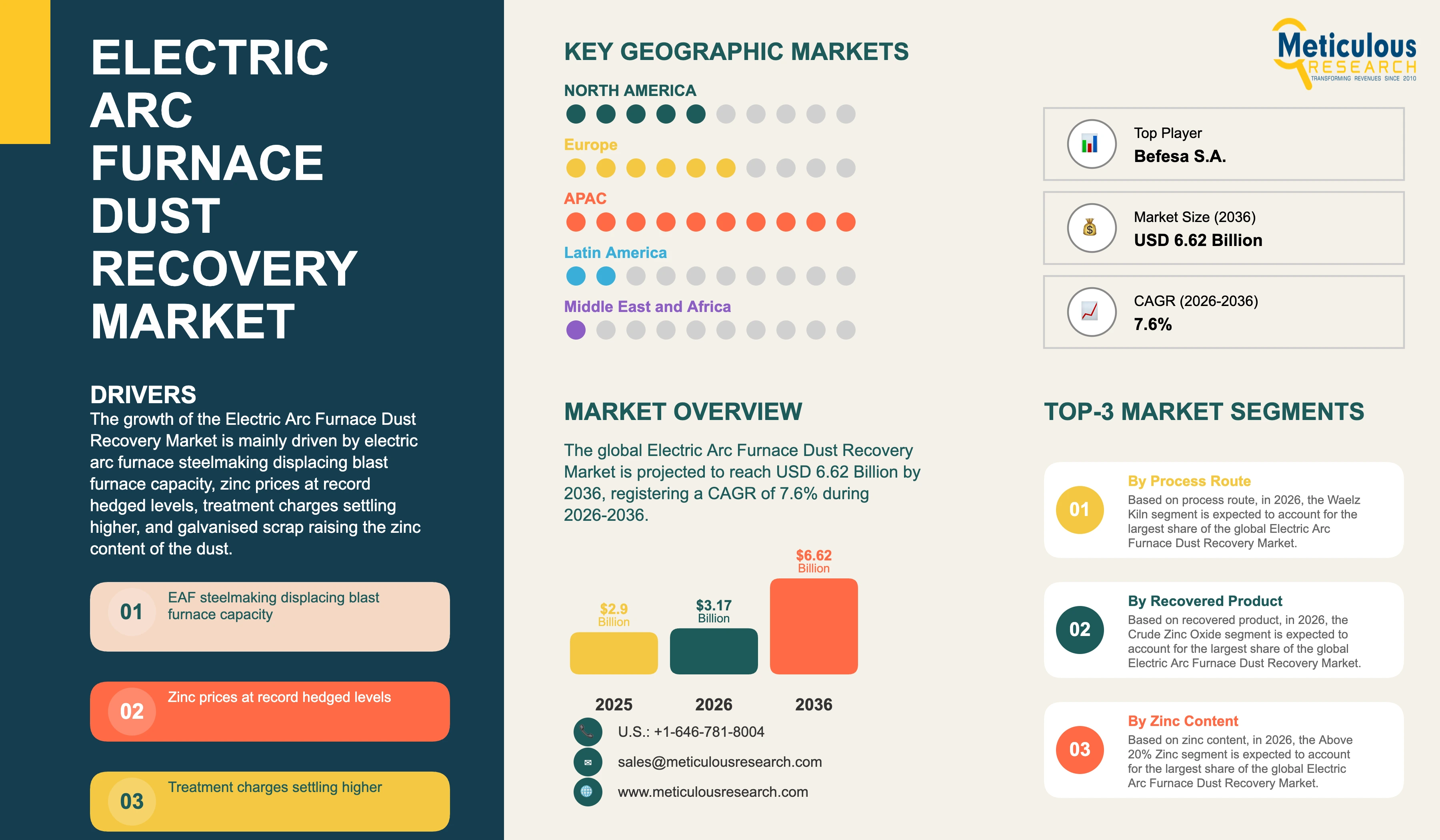
The electric arc furnace dust recovery market is valued at USD 3.17 billion in 2026 and is projected to reach USD 6.62 billion by 2036, at a CAGR of 7.6% during the forecast period. The market was valued at USD 2.90 billion in 2025 and at USD 2.64 billion in 2024.
- Published
- Nov 2026
- Pages
- 244
- Format
- PDF + Excel
- Report ID
- MRCHM - 1042768
- Base year
- 2025
- 2024 · HISTORICAL
- $2.64B
- 2036
- $6.62B
- CAGR 2026–2036
- 7.6%
2024–2025 baseline · 2026–2036 forecast at 7.6% CAGR · hover a bar for the value
Key highlights
This market measures the recovery and treatment of electric arc furnace dust, combining the treatment charge received from the steelmaker with the realised value of the zinc-bearing and other products recovered, on a tonne of dust treated basis at the recycler gate.
Refined zinc metal production is excluded, because crude zinc oxide is refined by a zinc smelter whose output is counted in the zinc market. Steel slag is counted in the steel slag valorisation title in this series.
Befesa treated 588 kilotonnes of electric arc furnace steel dust in the first half of 2026, 7% above a year earlier, at average capacity utilisation of 67% against 64%, with the improvement credited to its United States operations.
Utilisation at two thirds means roughly a third of the installed capacity of the largest operator stood idle while throughput grew, which indicates that dust availability and gate economics rather than plant capacity set the pace of this market.
Segment adjusted earnings rose 8% to EUR 104 million in that half, with the margin widening to 27% from 25%, implying segment revenue of about EUR 655 per tonne of dust treated.
London Metal Exchange zinc averaged USD 3, 353 per tonne in the first half of 2026, up 22% year on year, against about USD 2,866 per tonne across 2025 on the United States Geological Survey series.
The blended zinc price realised by that operator averaged EUR 2, 655 per tonne, a discount of 7.6% to the exchange average, which is the payability penalty for selling crude oxide rather than refined metal.
The 2026 zinc treatment charge was settled at USD 85 per tonne against USD 80 per tonne in 2025, so the fixed element of recycler revenue rose 6.3% in a single annual negotiation.
Zinc price hedging was extended to the second half of 2028 at USD 3, 100 per tonne, described as an all-time high level, which fixes a substantial part of forward earnings and shows where the risk in this market actually sits.
The United States Geological Survey records United States refined zinc being recovered from secondary materials including crude zinc oxide recovered from electric arc furnace dust.
World zinc mine production reached 13.0 million tonnes in 2025 against 11.9 million in 2024, with China at 4.1 million tonnes, and global refined production was forecast to rise slightly to 13.8 million tonnes.
Most reported zinc consumption goes to galvanised steel production, so the zinc that enters a steel coating returns to an electric arc furnace with the scrap and reports to the dust, which is what makes this market a closed loop rather than a waste stream.
United States refined zinc production has been flat at 220 kilotonnes a year since 2021 against apparent consumption of 808 to 820 kilotonnes and net import reliance of 73%.
The largest operator holds plants in Germany, Spain, Sweden, France, Turkey, South Korea, China and the United States, and treated about a quarter of world electric arc furnace dust on an annualised basis in 2026.
Its outlook for the second half of 2026 expects higher United States dust volumes supported by new steelmaker contracts, which is the mechanism by which idle capacity is filled in this market.
Group adjusted earnings guidance for 2026 was reaffirmed at EUR 250 million to EUR 270 million, with the ratio of net debt to earnings falling to 2.18 times from 2.70 times.
Among recovered products, crude zinc oxide is expected to hold the largest share in 2026, while lead and other metals are expected to grow fastest.
Among zinc contents, dust above 20% zinc is expected to hold the largest share in 2026, while dust below 15% zinc is expected to grow fastest as lower grade material becomes economic.
Report summary
| Particulars | Details |
|---|---|
| Base Year | 2025 |
| Actual Years | 2024-2025 |
| Forecast Period | 2026-2036 |
| Market Size in 2024 | USD 2.64 billion |
| Market Size in 2025 | USD 2.90 billion |
| Market Size in 2026 | USD 3.17 billion |
| Market Size in 2036 | USD 6.62 billion |
| Value CAGR (2026-2036) | 7.6% |
| Format | PDF, Excel & Cloud Portal · 244 pages |
| Historical Value Growth | 9.7% in 2025 and 9.5% in 2026, above the forecast rate, because the zinc price rose sharply; forward value growth is lower because zinc is hedged to the second half of 2028 at USD 3,100 per tonne rather than assumed to keep rising |
| Volume in 2025 | 4.36 million tonnes |
| Volume in 2026 | 4.60 million tonnes |
| Volume in 2036 | 7.93 million tonnes |
| Volume CAGR (2026-2036) | 5.6% |
| Revenue Realised per Tonne, 2026 | USD 690 per tonne of dust treated |
| Revenue Realised per Tonne, 2036 | USD 835 per tonne of dust treated |
| Units | Value in USD million; volume in million tonnes of electric arc furnace dust treated; revenue in USD per tonne of dust treated |
| Measurement Basis | Recovery and treatment of electric arc furnace dust, combining the treatment charge received from the steelmaker with the realised value of the zinc-bearing and other products recovered, measured at the recycler gate on a tonne of dust treated basis |
| Payability Note | The recycler produces crude zinc oxide rather than refined metal, so part of the zinc value accrues to the smelter; the blended zinc price realised by the largest operator was 7.6% below the exchange average in the first half of 2026 |
| Exclusions | Refined zinc metal production, which is counted in the zinc market; steel slag, counted in the steel slag valorisation title in this series; blast furnace and basic oxygen furnace dusts and sludges; mill scale; aluminium dross and salt slag, counted in their own title; landfill and disposal services; the steel itself |
| Segments: Process Route | Waelz Kiln; Rotary Hearth Furnace; Hydrometallurgical; Plasma and Electric Furnace; Direct Recycling to Furnace |
| Segments: Recovered Product | Crude Zinc Oxide; Treatment Charge Revenue; Iron-Bearing Product; Lead and Other Metals |
| Segments: Zinc Content of Dust | Above 20% Zinc; 15% to 20% Zinc; Below 15% Zinc |
| Largest Segment by Process Route, 2026 | Waelz Kiln, at 62.0% |
| Fastest-Growing Segment by Process Route | Hydrometallurgical, at 11.4% |
| Largest Segment by Recovered Product, 2026 | Crude Zinc Oxide, at 68.0% |
| Fastest-Growing Segment by Recovered Product | Lead and Other Metals, at 9.6% |
| Largest Segment by Zinc Content, 2026 | Above 20% Zinc |
| Fastest-Growing Segment by Zinc Content | Below 15% Zinc, at 9.2% |
| Largest Region, 2026 | Asia-Pacific, at 42.0% |
| Fastest-Growing Region | Middle East & Africa, at 8.6% |
| Fastest-Growing Country | Turkey, at 9.4% |
| Slowest-Growing Country | Germany, at 6.2% |
| Regions Covered | Asia-Pacific; Europe; North America; Latin America; Middle East & Africa |
| Countries Covered | China; India; Japan; South Korea; Germany; Spain; Sweden; France; U.S.; Canada; Mexico; Brazil; Turkey |
| Key Players | Befesa S.A.; Korea Zinc Co., Ltd.; Zinc Nacional, S.A.; Toho Zinc Co., Ltd.; Mitsui Mining & Smelting Co., Ltd. |
| Top Five Share, 2026 | 52.8% |
| Profiled Companies Share, 2026 | 52.8% |
| Currency | USD |
Report overview
Market value is measured in in USD million; volume in million tonnes of electric arc furnace dust treated; revenue in USD per tonne of dust treated. Segments covered: process route, recovered product, zinc content.
In volume terms, the market is estimated at 4.60 million tonnes of electric arc furnace dust treated in 2026, rising to 7.93 million tonnes by 2036, at a CAGR of 5.6%. The revenue realised is estimated at USD 690 per tonne of dust treated in 2026 and USD 835 per tonne in 2036, combining the treatment charge received from the steelmaker with the value of the zinc-bearing and other products recovered.
The growth of this market is mainly driven by electric arc furnace steelmaking displacing blast furnace capacity, zinc prices that have risen to record hedged levels, treatment charges that have settled higher, and galvanised scrap raising the zinc content of the dust. However, factors such as installed capacity running at only two thirds utilisation, revenue that depends on a zinc price outside the control of the recycler, payability on crude oxide rather than metal, and steelmakers that may stockpile or landfill dust rather than deliver it are expected to restrain the growth of this market to some extent.
Among process routes, the Waelz kiln is expected to hold the largest share of this market in 2026, while hydrometallurgical treatment is expected to record the highest CAGR during the forecast period. Geographically, Asia-Pacific is expected to account for the largest share of this market in 2026, while the Middle East & Africa is expected to register the highest CAGR during the forecast period.
An electric arc furnace melts steel scrap, and the scrap carries whatever was applied to the steel in its first life. Most reported zinc consumption goes to galvanised steel production, so a substantial part of the zinc coating applied to sheet returns to a furnace with the scrap. At melting temperature the zinc volatilises, oxidises in the offgas and is captured in the baghouse as a fine dust, typically at 15 to 20 kilograms of dust for each tonne of steel produced.
That dust is classified as hazardous in most jurisdictions because of its lead, cadmium and soluble metal content, so it cannot be landfilled untreated in regulated markets. It is also the most zinc-rich material a steelworks produces, commonly carrying 15% to 25% zinc, which is comparable to the grade of a mined concentrate without any of the mining.
Those two facts together define this market. A steelmaker must dispose of the dust and would prefer not to pay much for the privilege; a recycler can extract zinc worth more than the disposal cost. The result is a dual revenue line in which the recycler receives a treatment charge from the steelmaker and also sells the zinc it recovers, and the balance between those two determines who captures the value.
The 2026 zinc treatment charge was settled at USD 85 per tonne against USD 80 per tonne in 2025, and that charge is negotiated annually across the industry rather than set per contract, so it functions as an industry benchmark in the way a smelter treatment charge does for concentrate.
The dominant process is the Waelz kiln. Dust is pelletised with a carbon reductant, fed to a long inclined rotary kiln and heated to around 1,200 degrees Celsius, where zinc ferrite is reduced, the zinc volatilises again, reoxidises in the freeboard and is collected as crude zinc oxide, known as Waelz oxide, at 55% to 60% zinc. The iron-bearing residue leaves as kiln slag.
Rotary hearth furnaces achieve the same reduction on a rotating annular hearth with shorter residence time and better control of the iron product, which can be returned to the furnace as direct reduced iron rather than discarded, and they are favoured where the steelmaker wants the iron back as well as the dust removed.
Hydrometallurgical routes leach the dust in acid or alkali and recover zinc by solvent extraction and electrowinning, which can yield refined metal directly and handles low-grade dust that a kiln cannot carry economically, but carries higher reagent and effluent cost and the smallest installed base.
Plasma and electric furnace routes and direct recycling of dust back into the melting furnace occupy the balance, the latter raising zinc content in the dust with each pass until it is rich enough to justify external treatment.
The recovered product is not metal. Crude zinc oxide leaves the recycler and is refined by a zinc smelter, and the United States Geological Survey records that United States refined zinc was recovered from secondary materials including galvanising residues and crude zinc oxide recovered from electric arc furnace dust.
That intermediate position caps realised value. The blended zinc price achieved by the largest operator averaged EUR 2,655 per tonne in the first half of 2026 against a London Metal Exchange average of EUR 2,874 per tonne, a discount of 7.6%, which is the payability penalty for selling oxide into a smelter rather than metal into a market.
Zinc price does most of the work in this market. London Metal Exchange zinc averaged USD 3,353 per tonne in the first half of 2026, up 22% year on year, against an average of about USD 2,866 per tonne across 2025 on the United States Geological Survey series, and segment earnings at the largest operator rose 8% with the margin widening from 25% to 27%.
Forward exposure is managed rather than accepted. That operator extended zinc price hedging to the second half of 2028 at USD 3,100 per tonne, described as an all-time high level, which fixes a large part of forward earnings and makes the hedge book rather than the spot price the determinant of realised revenue across the near forecast period.
Capacity rather than demand is the surprise in the published data. Average capacity utilisation at the largest operator was 67% in the first half of 2026, up from 64% a year earlier, on throughput of 588 kilotonnes that rose 7%, which implies about 1.76 million tonnes a year of installed capacity at that company alone.
A third of that capacity standing idle while electric arc furnace steel output grows indicates that the binding constraint is the delivery of dust rather than the ability to treat it. Steelmakers can stockpile, landfill where permitted, or recycle internally, and the outlook for the second half of 2026 expects higher United States volumes specifically on the strength of new steelmaker contracts.
Supply of feedstock nonetheless grows structurally. Electric arc furnace steelmaking is displacing blast furnace capacity as steelmakers reduce process emissions, and because the electric route runs on scrap it generates dust where the blast furnace route does not, so every tonne of capacity converted adds to the feedstock of this market.
World zinc mine production reached 13.0 million tonnes in 2025 against 11.9 million in 2024, with global refined production forecast to rise slightly to 13.8 million tonnes, so recovered oxide competes against an expanding primary supply and the treatment charge negotiation is conducted against that backdrop each year.
Asia-Pacific is expected to account for 42.0% of this market in 2026, holding the largest electric arc furnace steel capacity and the largest zinc smelting industry, with China producing 4.1 million tonnes of mined zinc in 2025. The Middle East & Africa is projected to grow fastest at 8.6%, and Turkey is the fastest growing country at 9.4%.
Europe holds 26% and grows slowest at 6.8%, because treatment is long established and the installed base already covers most of the regional steel industry. The Middle East & Africa grows fastest at 8.6% as new steel capacity is built on the electric route without an established disposal practice, and Latin America grows at 7.4% on Mexican and Brazilian capacity.
The recycler produces crude zinc oxide, typically at 55% to 60% zinc, which a zinc smelter then refines. That refined output is counted in the zinc market, and the United States Geological Survey records United States refined zinc being recovered from secondary materials including crude zinc oxide recovered from electric arc furnace dust.
Average capacity utilisation at the largest operator was 67% in the first half of 2026, up from 64%, because dust delivery is a commercial decision rather than an automatic consequence of production. A steelmaker can stockpile, landfill where permitted, or recycle internally, and the improvement was credited to new steelmaker contracts rather than to a tightening obligation.
Crude zinc oxide is 68% of recovered value against 16% for treatment charge revenue, so the larger part is a metal price exposure. London Metal Exchange zinc averaged USD 3,353 per tonne in the first half of 2026, up 22% year on year, against about USD 2,866 per tonne across 2025.
Value grew 9.7% in 2025 and 9.5% in 2026 on a sharply rising zinc price, while the forecast rate of 7.6% reflects zinc hedged to the second half of 2028 at USD 3,100 per tonne, described as an all-time high level, rather than an assumption that the price keeps rising.
The blended zinc price realised by the largest operator averaged EUR 2,655 per tonne in the first half of 2026 against a London Metal Exchange average of EUR 2,874 per tonne, a discount of 7.6%. That split accrues to the smelter refining the oxide and is set in smelter terms rather than by recycler performance.
Befesa S.A., Korea Zinc Co., Ltd., Zinc Nacional, S.A., Toho Zinc Co., Ltd. and Mitsui Mining & Smelting Co., Ltd. Those five companies are profiled and hold 52.8% of this market in 2026, with Befesa alone treating about a quarter of world volume from plants in eight countries.
Report infographic
Market dynamics
20 factors across 5 forcesElectric arc furnace steelmaking displacing blast furnace capacity
The electric route melts scrap rather than reducing iron ore, which cuts process emissions sharply and is the principal decarbonisation route available to steelmakers without hydrogen or carbon capture. Every tonne of capacity converted from the blast furnace route adds feedstock to this market, because the electric furnace generates 15 to 20 kilograms of zinc-bearing dust per tonne of steel and the blast furnace route does not.
Volume in this market therefore grows with the structure of steelmaking rather than with steel demand, which is why treated tonnage grows at 5.6% while world steel output grows far more slowly.
The largest operator expects higher United States dust volumes in the second half of 2026 supported by new steelmaker contracts, which is how that structural growth converts into throughput at a specific plant.
Zinc prices at record hedged levels
London Metal Exchange zinc averaged USD 3,353 per tonne in the first half of 2026, up 22% year on year, against an average of about USD 2,866 per tonne across 2025, and the largest operator extended hedging to the second half of 2028 at USD 3,100 per tonne, described as an all-time high level.
Because the recycler sells the zinc it recovers as well as charging for treatment, the zinc price passes almost directly into revenue per tonne of dust, and segment earnings rose 8% with the margin widening from 25% to 27% in that half.
A hedge book extending more than two years forward at record levels converts a commodity exposure into contracted revenue, which is what allows capacity to be financed in a business whose output price it does not control.
Treatment charges settling higher
The 2026 zinc treatment charge was settled at USD 85 per tonne against USD 80 per tonne in 2025, a rise of 6.3% negotiated annually across the industry rather than contract by contract.
That charge is the element of revenue independent of the zinc price, so an increase raises the floor under recycler economics and makes low-grade dust economic that would otherwise not be.
Treatment charge revenue holds 16% of recovered value in 2026 and grows at 7.4%, slightly ahead of crude zinc oxide at 7.2%, so the fixed element is becoming marginally more important rather than less.
Galvanised scrap raising the zinc content of the dust
Most reported zinc consumption goes to galvanised steel production, and galvanised sheet applied in construction, automotive and appliance manufacture returns as scrap after a service life measured in decades, carrying its coating with it.
Rising galvanised content in the scrap pool raises the zinc grade of the dust, and dust above 20% zinc already holds 54% of treated volume, which improves the value recovered per tonne treated without any change in process.
Internal recycling of dust back into the melting furnace concentrates it further with each pass, so a steelmaker practising that route delivers a richer material when it finally sends dust out for treatment.
Table of contents
11 chapters · 123 sections · 244 pages · click to expandSegmental analysis
| Segment | Largest share (2026) | Fastest growth (2026–2036) |
|---|---|---|
| By Process Route | Waelz kiln | Hydrometallurgical routes |
| By Recovered Product | Crude zinc oxide | Lead and other metals |
| By Zinc Content | Dust above 20% zinc | Dust below 15% zinc |
| Other segments | Crude zinc oxide | Lead and other metals |
By Process Route
- Electric Arc Furnace Dust Recovery Market Analysis by Process Route
- The Waelz kiln is expected to account for the largest share of this market in 2026, at 62%.
- Pelletised dust with a carbon reductant is heated to around 1, 200 degrees Celsius in a long inclined rotary kiln, zinc ferrite is reduced, the zinc volatilises and reoxidises in the freeboard, and it is collected as crude zinc oxide at 55% to 60% zinc.
- The route holds the installed base because it accepts variable feed, tolerates the lead and halide content that complicates other processes, and is proven across decades of operation at the scale a large steelworks requires.
- It grows slowest at 6.6%, because the iron-bearing residue leaves as kiln slag rather than as a saleable product and because the process cannot carry low-grade dust economically, having to heat the whole mass regardless of its zinc content.
- Rotary hearth furnaces grow at 7.4%, achieving the same reduction on a rotating annular hearth with shorter residence time and better control of the iron product, which can be returned to the steelmaker as direct reduced iron rather than discarded.
- Hydrometallurgical routes are projected to register the highest CAGR of 11.4% during the forecast period, leaching the dust in acid or alkali and recovering zinc by solvent extraction and electrowinning.
- They can yield refined metal directly, avoiding the payability discount on oxide, and they handle low-grade dust because leaching is less sensitive to feed grade than carbothermic reduction.
- Plasma and electric furnace routes grow at 9.4% from a small base, applied where very high zinc recovery or a particular residue specification justifies the energy cost, and where a non-hazardous slag that can be sold rather than landfilled changes the overall economics.
- Direct recycling of dust back into the melting furnace grows at 8.0% and functions as a concentration step rather than a final route, since each pass raises the zinc content until the dust is rich enough to justify external treatment, which is one reason high-grade material dominates treated volume.
- The Waelz kiln is expected to hold the largest share in 2026 at 62.0%, accepting variable feed and proven at the scale a large steelworks requires.
- Hydrometallurgical treatment is projected to grow fastest at 11.4%, followed by plasma and electric furnace routes at 9.4%.
By Recovered Product
- Electric Arc Furnace Dust Recovery Market Analysis by Recovered Product
- Crude zinc oxide is expected to account for the largest share of this market in 2026 at 68%.
- Waelz oxide at 55% to 60% zinc is the principal product of the dominant route, and the United States Geological Survey records that United States refined zinc was recovered from secondary materials including crude zinc oxide recovered from electric arc furnace dust.
- It grows at 7.2%, tracking the zinc price and treated volume together, and it carries a payability discount of about 7.6% to the exchange price because a smelter must refine it.
- Halide and lead content set that payability as much as zinc grade does, since chlorine and fluorine carried through from the dust interfere with electrowinning downstream.
- Treatment charge revenue holds 16% and grows slightly faster at 7.4%, having settled at USD 85 per tonne for 2026 against USD 80 per tonne in 2025, a rise of 6.3%.
- It is the element of recycler revenue independent of the metal price, and because it is negotiated annually as an industry benchmark rather than contract by contract, its direction is a published measure of recycler bargaining power.
- Iron-bearing product holds 9% and grows at 9.0%, above the market rate, as rotary hearth and reduction routes deliver direct reduced iron back to the steelmaker rather than discarding kiln slag, which converts a disposal cost into a credit against the metallic charge.
- Lead and other metals are projected to register the highest CAGR of 9.6% during the forecast period, covering lead, cadmium, silver and halide by-products that were historically fixed in residue and are increasingly recovered as separate streams where the chemistry and the permit allow.
By Zinc Content
- Electric Arc Furnace Dust Recovery Market Analysis by Zinc Content of Dust
- Dust above 20% zinc is expected to hold the largest share of this market in 2026 at 54%.
- High-grade dust arises where the scrap diet is rich in galvanised sheet and where the steelmaker recycles dust internally to concentrate it, and it is the material every route can treat economically.
- It grows slowest at 7.0%, because it is already fully collected wherever a treatment route exists within economic haulage distance and because its grade cannot rise indefinitely with internal recycling, which concentrates lead and halides alongside the zinc and eventually limits what the furnace can tolerate.
- Dust between 15% and 20% zinc holds 31% and grows at 7.8%, representing the ordinary output of a mixed scrap diet and the volume most sensitive to the treatment charge negotiation, since a higher charge brings marginal tonnage into treatment.
- Dust below 15% zinc is projected to register the highest CAGR of 9.2% during the forecast period.
- A treatment charge of USD 85 per tonne and zinc hedged at USD 3, 100 per tonne together make material economic that a lower price environment left in landfill, and hydrometallurgical routes extend the range further because leaching is less sensitive to feed grade.
Other segments
- Crude zinc oxide is expected to hold the largest share in 2026 at 68.0%, as Waelz oxide at 55% to 60% zinc.
- Lead and other metals are projected to grow fastest at 9.6%, followed by iron-bearing product at 9.0%.
- Dust above 20% zinc is expected to hold the largest share in 2026 at 54%, arising where the scrap diet is rich in galvanised sheet.
- Dust below 15% zinc is projected to grow fastest at 9.2%, as current treatment charges and zinc prices make material economic that was previously landfilled.
Geographic analysis
Asia-Pacific
Largest shareAsia-Pacific is expected to account for the largest share of this market in 2026, at 42%. The region holds the largest electric arc furnace steel capacity and the largest zinc smelting industry to consume the oxide, with China producing 4.1 million tonnes of mined zinc in 2025 and holding treatment capacity alongside its steelworks. The region grows at 8.0%, above the world rate, as electric furnace capacity is added and converted across China, India, Japan and South Korea, and the largest international operator holds plants in both South Korea and China.
Europe
Europe holds 26% of this market and grows slowest at 6.8%, because treatment is long established, the hazardous classification of the dust has been enforced for decades and the installed base already covers most of the regional steel industry, with plants in Germany, Spain, Sweden and France. Turkey, where the largest operator already holds a plant, anchors that growth.
North America
North America grows at 7.8% and holds 21%, and it is where the recent volume improvement originated, with the largest operator crediting a strong contribution from its United States operations for utilisation rising from 64% to 67% and expecting higher United States volumes in the second half of 2026 on new steelmaker contracts. United States refined zinc production has been flat at 220 kilotonnes a year since 2021 against apparent consumption of 808 to 820 kilotonnes and net import reliance of 73%, so recovered oxide has a domestic outlet that does not depend on export.
Latin America
Latin America grows at 7.4% and holds 7%, with Mexico producing 780 kilotonnes of mined zinc in 2025 alongside established dust treatment capacity, and Brazil holding electric furnace steel capacity and zinc smelting within the same region.
Middle East & Africa
Fastest growthThe Middle East & Africa is projected to register the highest CAGR of 8.6% during the forecast period, from the smallest base, as new steel capacity is built on the electric route from the outset and arrives without an established disposal practice, which allows a treatment contract to be written at commissioning.
Competitive landscape
This market is concentrated, with the five companies profiled holding 52.8% of it in 2026. Entry requires a permitted hazardous waste installation, a long-term relationship with a cluster of steelworks within economic haulage distance, and an outlet for crude zinc oxide at a zinc smelter, so position is held through permits and contracts rather than through technology.
Befesa S.A. holds the largest position by a wide margin, treating 588 kilotonnes of electric arc furnace steel dust in the first half of 2026, about a quarter of world treated volume on an annualised basis, from plants in Germany, Spain, Sweden, France, Turkey, South Korea, China and the United States. Segment adjusted earnings were EUR 104 million in that half at a 27% margin, with utilisation at 67% and zinc hedged to the second half of 2028 at USD 3,100 per tonne.
Korea Zinc Co., Ltd. holds the largest Asian position, combining dust treatment with primary and secondary zinc smelting at Onsan, which allows it to capture the refining margin that a standalone recycler cedes through the payability discount on crude oxide.
Zinc Nacional, S.A. holds the established Mexican position serving the North American steel industry, while Toho Zinc Co., Ltd. and Mitsui Mining & Smelting Co., Ltd. hold Japanese positions that likewise pair dust treatment with zinc smelting, which is the structural advantage in this market because it internalises the oxide-to-metal step.
The structural division in this market is between standalone recyclers and integrated zinc producers. A standalone operator cedes about 7.6% of the zinc value to the smelter as payability, while an integrated producer captures the refining margin as well, and that difference is larger than any operating cost advantage available from the treatment process itself.
Competitive activity has concentrated on contracting volume into existing plants and on extending zinc hedges rather than on building capacity, since a third of installed capacity at the largest operator stood idle in the first half of 2026 and the annual treatment charge negotiation rather than tendering sets the price.
Some of the key players operating in the electric arc furnace dust recovery market are Befesa S.A., Korea Zinc Co., Ltd., Zinc Nacional, S.A., Toho Zinc Co., Ltd., and Mitsui Mining & Smelting Co., Ltd., among others.
- —
Befesa reported first half 2026 results on 29 July 2026 showing dust throughput up 7% to 588 kilotonnes, utilisation up from 64% to 67%, segment adjusted earnings up 8% to EUR 104 million and zinc hedging extended to the second half of 2028 at USD 3,100 per tonne; and the 2026 zinc treatment charge settled at USD 85 per tonne against USD 80 per tonne in 2025.
- Befesa S.A.
- Korea Zinc Co., Ltd.
- Zinc Nacional, S.A.
- Toho Zinc Co., Ltd.
- Mitsui Mining & Smelting Co., Ltd
Expert perspectives
The stated demand driver for this market is zinc recovery and waste rules, and the published figures show the first doing most of the work. Crude zinc oxide is 68% of recovered value against 16% for the treatment charge, London Metal Exchange zinc rose 22% year on year in the first half of 2026, and segment earnings rose 8% with the margin widening from 25% to 27%.
Waste rules are not yet binding on all the dust. Average capacity utilisation at the largest operator was 67%, up from 64%, so roughly a third of its installed capacity stood idle while electric arc furnace steel output grew, and the improvement was credited to new steelmaker contracts rather than to a tightening obligation.
That combination defines the investment case. The capital is already built, so the prize is filling an idle third of it at very high marginal margin rather than constructing new kilns, and the effect is visible in a margin that widened two points on 7% volume growth.
Revenue is a commodity exposure rather than a service fee, and the operators have responded accordingly. Hedging extended to the second half of 2028 at USD 3,100 per tonne, an all-time high level, fixes a large part of forward earnings, which is why the forecast value rate of 7.6% sits below the 9.5% to 9.7% the market recorded across 2024 to 2026 on a rising zinc price.
The structural growth is real and independent of price. Electric arc furnace steelmaking is displacing blast furnace capacity because it is the principal decarbonisation route available without hydrogen or carbon capture, and the electric route generates 15 to 20 kilograms of zinc-bearing dust per tonne of steel where the blast furnace route generates none.
The structural weakness is the value split. Crude oxide realised EUR 2,655 per tonne against an exchange average of EUR 2,874, a discount of 7.6% that accrues to the smelter, which is why the operators pairing dust treatment with their own zinc smelting hold the better position and why hydrometallurgical routes yielding refined metal grow fastest at 11.4%.
Frequently asked questions
The market is valued at USD 3.17 billion in 2026, having stood at USD 2.90 billion in 2025 and USD 2.64 billion in 2024, and is projected to reach USD 6.62 billion by 2036.
A CAGR of 7.6% in value terms and 5.6% in volume terms between 2026 and 2036, with revenue realised rising from USD 690 per tonne to USD 835 per tonne of dust treated.
Electric arc furnace steelmaking displacing blast furnace capacity and generating 15 to 20 kilograms of zinc-bearing dust per tonne of steel; zinc prices at record hedged levels, with hedging extended to the second half of 2028 at USD 3,100 per tonne; treatment charges settling higher at USD 85 per tonne for 2026; and galvanised scrap raising the zinc content of the dust.
Installed capacity running at 67% utilisation, revenue dependent on a zinc price outside the control of the recycler, a payability discount of 7.6% for selling crude oxide rather than refined metal, steelmakers that may stockpile or landfill rather than deliver dust, and capacity fixed to a site it cannot move.
Filling the idle third of installed capacity at very high marginal margin; low-grade dust becoming economic at current treatment charges and zinc prices; returning the iron fraction to the steelmaker as direct reduced iron rather than discarding kiln slag; and electric arc furnace conversion in emerging steel regions where no disposal practice is established.
The Waelz kiln is expected to hold the largest share in 2026 at 62.0%, accepting variable feed and proven at the scale a large steelworks requires. Hydrometallurgical treatment is projected to grow fastest at 11.4%, followed by plasma and electric furnace routes at 9.4%.
Crude zinc oxide is expected to hold the largest share in 2026 at 68.0%, as Waelz oxide at 55% to 60% zinc. Lead and other metals are projected to grow fastest at 9.6%, followed by iron-bearing product at 9.0%.
Dust above 20% zinc is expected to hold the largest share in 2026 at 54%, arising where the scrap diet is rich in galvanised sheet. Dust below 15% zinc is projected to grow fastest at 9.2%, as current treatment charges and zinc prices make material economic that was previously landfilled.
Asia-Pacific is expected to account for 42.0% of this market in 2026, holding the largest electric arc furnace steel capacity and the largest zinc smelting industry, with China producing 4.1 million tonnes of mined zinc in 2025. The Middle East & Africa is projected to grow fastest at 8.6%, and Turkey is the fastest growing country at 9.4%.
Europe holds 26% and grows slowest at 6.8%, because treatment is long established and the installed base already covers most of the regional steel industry. The Middle East & Africa grows fastest at 8.6% as new steel capacity is built on the electric route without an established disposal practice, and Latin America grows at 7.4% on Mexican and Brazilian capacity.
The recycler produces crude zinc oxide, typically at 55% to 60% zinc, which a zinc smelter then refines. That refined output is counted in the zinc market, and the United States Geological Survey records United States refined zinc being recovered from secondary materials including crude zinc oxide recovered from electric arc furnace dust.
Average capacity utilisation at the largest operator was 67% in the first half of 2026, up from 64%, because dust delivery is a commercial decision rather than an automatic consequence of production. A steelmaker can stockpile, landfill where permitted, or recycle internally, and the improvement was credited to new steelmaker contracts rather than to a tightening obligation.
Crude zinc oxide is 68% of recovered value against 16% for treatment charge revenue, so the larger part is a metal price exposure. London Metal Exchange zinc averaged USD 3,353 per tonne in the first half of 2026, up 22% year on year, against about USD 2,866 per tonne across 2025.
Value grew 9.7% in 2025 and 9.5% in 2026 on a sharply rising zinc price, while the forecast rate of 7.6% reflects zinc hedged to the second half of 2028 at USD 3,100 per tonne, described as an all-time high level, rather than an assumption that the price keeps rising.
The blended zinc price realised by the largest operator averaged EUR 2,655 per tonne in the first half of 2026 against a London Metal Exchange average of EUR 2,874 per tonne, a discount of 7.6%. That split accrues to the smelter refining the oxide and is set in smelter terms rather than by recycler performance.
Befesa S.A., Korea Zinc Co., Ltd., Zinc Nacional, S.A., Toho Zinc Co., Ltd. and Mitsui Mining & Smelting Co., Ltd. Those five companies are profiled and hold 52.8% of this market in 2026, with Befesa alone treating about a quarter of world volume from plants in eight countries.
Befesa reported first half 2026 results on 29 July 2026 showing dust throughput up 7% to 588 kilotonnes, utilisation up from 64% to 67%, segment adjusted earnings up 8% to EUR 104 million and zinc hedging extended to the second half of 2028 at USD 3,100 per tonne; and the 2026 zinc treatment charge settled at USD 85 per tonne against USD 80 per tonne in 2025.
Cite this report
Meticulous Research. (2026). Electric Arc Furnace Dust Recovery Market - Global Opportunity Analysis and Industry Forecast (2026-2036) (Report No. MRCHM - 1042768). Meticulous Market Research Pvt. Ltd. https://www.meticulousresearch.com/product/electric-arc-furnace-dust-recovery-market-7451