
Distributed Control Systems Market (2026-2036)
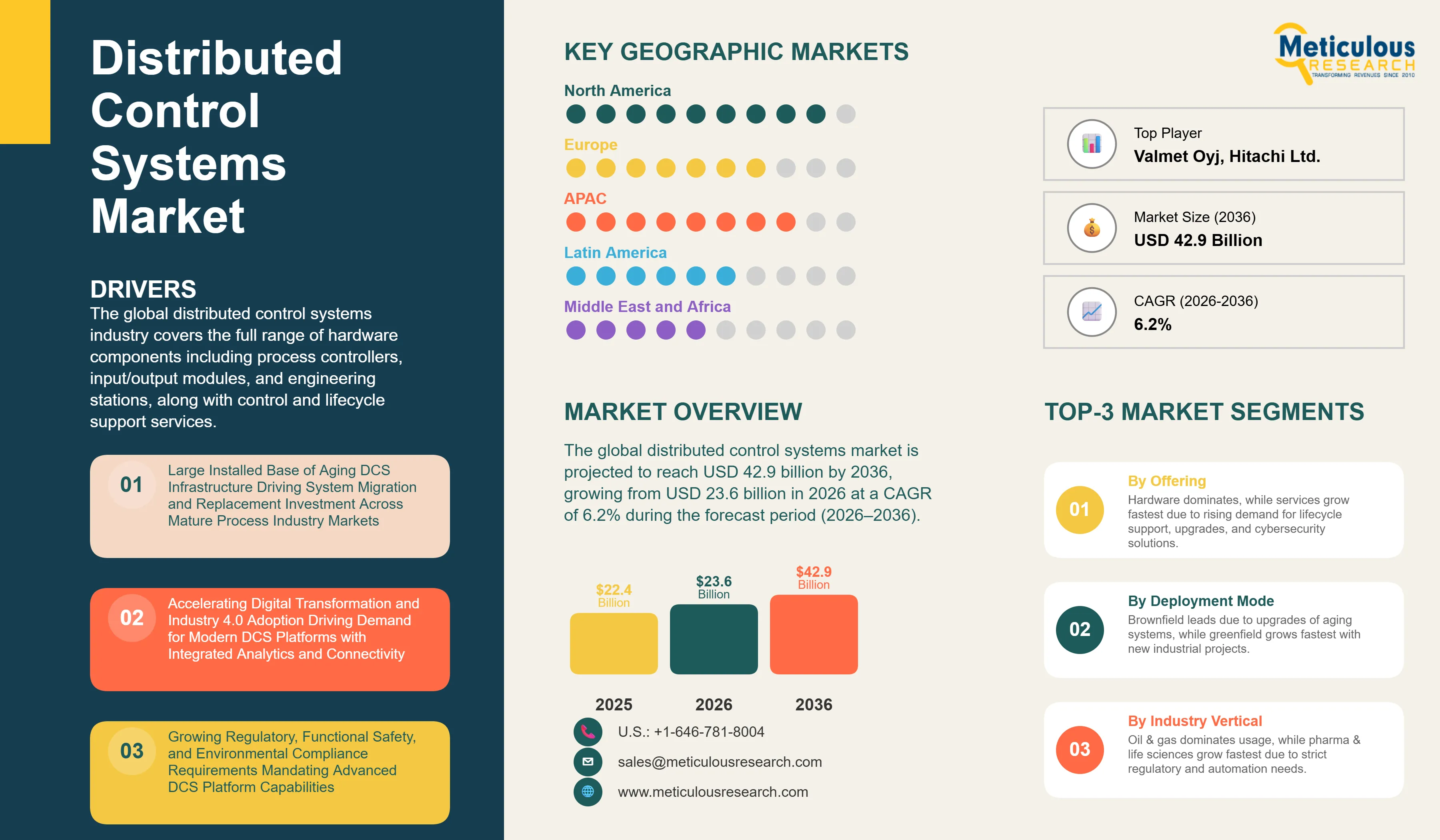
The global distributed control systems market was valued at USD 22.4 billion in 2025. The market is projected to reach USD 42.9 billion by 2036, growing from USD 23.6 billion in 2026 at a CAGR of 6.2% during the forecast period (2026–2036).
- Published
- Apr 2026
- Pages
- 283
- Format
- PDF + Excel
- Report ID
- MREP - 1041950
- Base year
- 2025
- 2025 · BASELINE
- $22.40B
- 2036
- $42.90B
- CAGR 2026–2036
- 6.2%
2025 baseline · 2026–2036 forecast at 6.2% CAGR · hover a bar for the value
Key highlights
The global distributed control systems market is projected to reach USD 42.9 billion by 2036.
The market is expected to grow at a CAGR of 6.2% during the forecast period 2026–2036.
The global distributed control systems industry was valued at USD 22.4 billion in 2025 and is estimated to reach USD 23.6 billion in 2026.
North America is expected to dominate this market with the largest market share in 2026, driven by the extensive installed base of process industry facilities requiring continuous DCS lifecycle management and system upgrade investment, high capital spending by oil and gas operators and chemical manufacturers on automation modernization programs, and the presence of leading DCS platform vendors with deep application expertise across the region's core process industry verticals.
Asia Pacific is projected to witness the fastest growth during the forecast period, driven by rapid expansion of refining, petrochemical, power generation, and pharmaceutical manufacturing capacity across China, India, South Korea, and Southeast Asia, strong government-led industrial digitalization programs, and the accelerating adoption of modern DCS platforms as part of smart manufacturing and Industry 4.0 initiatives across the region.
By offering, the hardware segment is expected to hold the largest market share in 2026.
By offering, the services segment is projected to register the highest CAGR during the forecast period, driven by growing demand for lifecycle management, system migration engineering, cybersecurity integration, and remote monitoring services across the large installed base of aging DCS deployments worldwide.
By deployment mode, the brownfield segment is expected to account for the largest share of the global distributed control systems market in 2026.
By deployment mode, the greenfield segment is projected to register the highest CAGR during the forecast period, driven by large-scale new industrial capacity investments in developing economies across Asia Pacific and the Middle East.
By industry vertical, the oil and gas segment is expected to account for the largest share in 2026, while the pharmaceutical and life sciences segment is projected to register the highest CAGR during the forecast period.
By geography, North America is expected to dominate the market in 2026, while Asia Pacific is expected to witness the fastest growth during the forecast period.
Report summary
| Particulars | Details |
|---|---|
| Market Size by 2036 | USD 42.9 Billion |
| Market Size in 2026 | USD 23.6 Billion |
| Market Size in 2025 | USD 22.4 Billion |
| Revenue Growth Rate (2026–2036) | CAGR of 6.2% |
| Format | PDF, Excel & Cloud Portal · 283 pages |
| Dominating Offering | Hardware |
| Fastest Growing Offering | Services |
| Dominating Deployment Mode | Brownfield |
| Fastest Growing Deployment Mode | Greenfield |
| Dominating Industry Vertical | Oil & Gas |
| Fastest Growing Industry Vertical | Pharmaceutical & Life Sciences |
| Dominating Geography | North America |
| Fastest Growing Geography | Asia Pacific |
| Base Year | 2025 |
| Forecast Period | 2026 to 2036 |
Report overview
Segments covered: offering, deployment mode, industry vertical.
The global distributed control systems industry covers the full range of hardware components including process controllers, input/output modules, operator workstations, and engineering stations, along with control and supervisory software, advanced process control applications, and lifecycle support services. These systems are deployed across process industries to provide real-time monitoring, control, and optimization of complex continuous and batch industrial operations. DCS platforms are deployed across oil and gas, chemical and petrochemical, power generation, pharmaceutical and life sciences, food and beverage, pulp and paper, water and wastewater treatment, and mining and metals industries, where continuous process control, high system availability, and stringent regulatory compliance are fundamental operational requirements.
The growth of this market is primarily driven by the accelerating pace of digital transformation across process industries, as operators invest in modern DCS platforms that combine industrial IoT connectivity, advanced analytics, and cloud-based data management to enhance efficiency and minimize unplanned downtime. At the same time, a substantial installed base of aging DCS systems many deployed in the 1990s and early 2000s is reaching the end of its supported lifecycle, prompting increased spending on migration and replacement programs, particularly in mature markets across North America and Europe. Additionally, a stronger emphasis on operational safety, regulatory compliance, and energy efficiency is accelerating the shift toward advanced DCS solutions that incorporate safety instrumented systems and sophisticated alarm management within a unified control environment.
Despite strong growth prospects, the market faces challenges related to the high capital cost and operational disruption associated with large-scale DCS migration projects in brownfield facilities. The proprietary nature of legacy DCS architectures creates significant switching costs and technical complexity that often extend project timelines and limit the pace of technology adoption. The growing exposure of operational technology environments to cybersecurity threats is also creating new compliance obligations and investment requirements for asset operators, adding cost and complexity to DCS upgrade programs.
The transition toward open process automation standards, led by the Open Process Automation Forum's O-PAS standard and backed by major global end users including ExxonMobil, Shell, and BASF, is creating significant opportunities for next-generation DCS platforms that offer hardware-agnostic, interoperable architectures. These reduce vendor lock-in for asset operators and enable more competitive procurement of control system components. The increasing integration of artificial intelligence and machine learning capabilities into DCS platforms for predictive maintenance, process optimization, and real-time anomaly detection is expanding the value proposition of modern distributed control systems well beyond traditional regulatory control functions. The rapid buildup of new industrial capacity across Asia Pacific and the Middle East, particularly in refining, petrochemicals, and power generation, is also generating large greenfield DCS deployment opportunities for leading system vendors.
Report infographic
Market dynamics
3 factors across 1 forceOpen Process Automation Emerging as a Structural Disruption to Proprietary DCS Ecosystems
The Open Process Automation Forum’s O-PAS standard, developed under The Open Group and backed by major global end users such as ExxonMobil, Shell, BASF, and Dow, represents one of the most significant structural shifts in the distributed control systems industry in decades. It establishes a hardware agnostic, interoperable control architecture based on open connectivity frameworks like OPC Unified Architecture, allowing asset owners to integrate components from multiple vendors within a single control system rather than being locked into a single proprietary ecosystem over the lifecycle of a facility.
The competitive impact of this transition is substantial. Leading end users such as ExxonMobil have openly committed to adopting open process automation architectures for new facilities, directly challenging the vendor-locked procurement models that have long shaped the DCS market. Although fully compliant commercial deployments are still in the early stages as of 2026, pilot projects at sites operated by major oil, gas, and chemical companies are proving the architecture’s technical feasibility and strengthening operator confidence in the approach.
In response, established DCS vendors including ABB, Emerson, Honeywell, and Yokogawa are adapting their platform strategies to align with open connectivity standards while seeking to maintain competitive differentiation through application software depth, domain expertise, and lifecycle service capabilities. This transition is fundamentally reshaping the basis of competition in the DCS market, shifting emphasis from proprietary hardware control to software applications, advanced analytics, and service value, creating both strategic risks and growth opportunities for vendors across the competitive landscape.
Cloud-Native DCS Architectures and Centralized Remote Operations Redefining Industrial Operating Models
The integration of cloud computing and edge processing into distributed control system architectures is creating a new category of hybrid and cloud-native DCS platforms that are fundamentally changing how process industry operators manage, optimize, and staff their facilities. Leading DCS vendors including Honeywell, ABB, Emerson, and Siemens have introduced cloud-enabled platforms and complementary remote operations center solutions that allow operators to consolidate real-time monitoring, advanced control, and performance optimization of geographically distributed assets from unified enterprise operations hubs.
These platforms allow asset operators to centralize engineering and operational expertise, reduce staffing requirements at remote or hazardous locations, and deploy advanced analytics and artificial intelligence applications that perform most effectively when integrated with cloud-scale data management infrastructure. Honeywell's Connected Plant suite and Emerson's DeltaV Live with cloud-connected historians exemplify the growing commercial availability of these capabilities from leading DCS platform vendors. The commercial viability of remote operations models was significantly accelerated during the COVID-19 period and has since translated into sustained demand for cloud-connected DCS platforms capable of supporting hybrid on-premises and remote operational architectures.
This shift toward cloud-native and hybrid architectures is also allowing new commercial delivery models, including subscription based licensing for advanced process control and process optimization applications, which are expanding the addressable market for DCS software beyond traditional capital project procurement. This is particularly relevant in pharmaceutical manufacturing and specialty chemical production, where regulatory requirements for electronic batch records and real-time process data management align directly with the data governance capabilities of modern cloud-enabled DCS platforms.
Cybersecurity Integration Becoming a Non-Negotiable Criterion in DCS Platform Selection and Procurement
The escalating frequency and sophistication of cyberattacks targeting industrial control systems and operational technology environments is elevating cybersecurity from a secondary compliance consideration to a primary criterion in DCS platform evaluation, procurement, and lifecycle management. High-profile attacks on industrial infrastructure, including incidents affecting energy, water, and chemical facilities globally, have fundamentally raised awareness among process industry operators of the risks associated with legacy DCS architectures that were designed for isolated operational technology environments and lack the security capabilities required for safe integration with enterprise networks and cloud services.
Regulatory frameworks including the IEC 62443 series of industrial cybersecurity standards, the North American Electric Reliability Corporation Critical Infrastructure Protection standards, and the European Union's NIS2 Directive are establishing binding cybersecurity capability requirements for control system deployments across critical infrastructure sectors. Leading DCS vendors including Honeywell, Siemens, ABB, and Rockwell Automation have substantially invested in embedding cybersecurity capabilities into their platform architectures, including secure remote access management, role-based access controls, behavioral anomaly detection, and certified security development lifecycles aligned with IEC 62443-4-1 requirements.
This trend is generating meaningful incremental services revenue as asset operators engage DCS vendors and specialized operational technology security providers for vulnerability assessments, security architecture design, and ongoing managed security services. The alignment between cybersecurity investment and DCS modernization programs is also accelerating replacement of legacy systems that cannot be adequately secured in connected operational environments, creating additional tailwinds for the brownfield upgrade segment of the market.
Table of contents
11 chapters · 133 sections · 283 pages · click to expandSegmental analysis
| Segment | Largest share (2026) | Fastest growth (2026–2036) |
|---|---|---|
| By Offering | Hardware | Services |
| By Deployment Mode | Brownfield | Greenfield |
| By Industry Vertical | Oil & Gas | Pharmaceutical and life sciences |
By Offering
- The Hardware Segment to Dominate the Global Distributed Control Systems Market
- The distributed control systems industry is segmented into hardware, software, and services.
- The hardware segment is expected to account for the largest share of this market.
- The large market share of this segment reflects the high capital value of DCS hardware components, including process controllers, redundant input/output modules, operator workstations, engineering stations, and communication infrastructure, which collectively represent the majority of capital expenditure in new DCS project investments across both greenfield installations and major brownfield upgrade programs.
- Modern DCS hardware platforms such as Honeywell's Experion PKS with C300 process controllers, ABB's System 800xA with AC800M controllers, and Emerson's DeltaV platform with electronic marshalling capabilities continue to command significant capital investment per installation, particularly in large-scale refinery, petrochemical, and power generation facilities.
- However, the services segment is projected to register the highest growth during the forecast period.
- The high growth of this segment is driven by expanding demand for lifecycle management services, system migration and upgrade engineering, cybersecurity assessment and remediation services, remote monitoring and diagnostic services, and advanced process control consulting, as asset operators seek to extend the performance and security of their DCS investments across increasingly connected and digitally enabled operational environments.
By Deployment Mode
- The Brownfield Segment to Hold the Largest Share
- The distributed control systems industry is segmented into brownfield and greenfield deployments.
- The brownfield segment is expected to account for the largest share of this market.
- This growth is driven by the scale of the global installed DCS base, with a significant proportion of systems deployed across mature process industry markets in North America, Europe, and Japan having reached or approaching the end of their supported operational lifetimes.
- As a result, migration and upgrade initiatives focused on replacing aging DCS hardware and software while maintaining uninterrupted operations in live environments have become the dominant area of capital investment in these regions.
- The complexity of managing migrations from legacy proprietary platforms such as Honeywell TDC 3000, ABB Advant, and Bailey INFI 90 to modern control system architectures is also sustaining strong demand for high-value engineering and project management services.
- However, the greenfield segment is projected to grow at the highest rate from 2026 to 2036.
- The high growth of this segment is driven by large-scale new industrial capacity investments in refining, petrochemical, power generation, and pharmaceutical manufacturing across Asia Pacific, the Middle East, and Africa, where governments and private operators are committing substantial capital to build new process industry infrastructure equipped with modern DCS platforms as a foundational automation requirement.
By Industry Vertical
- The Oil & Gas Segment to Account for the Largest Share
- The distributed control systems industry is segmented into oil and gas, chemical and petrochemical, power generation, pharmaceutical and life sciences, food and beverage, pulp and paper, water and wastewater treatment, mining and metals, and other industry verticals.
- The oil and gas segment is projected to hold the largest share of the market, indicating its role as the leading end user of DCS technology in terms of both capital spending and installed base.
- The sector’s need for continuous process control, high system availability, integrated functional safety, and real-time optimization—across upstream production, midstream transportation and processing, and downstream refining—makes it the most complex and high-value application area for distributed control systems worldwide.
- Large-scale system integrations, such as those deployed at liquefied natural gas terminals and major grassroots refineries in the Middle East and Asia, often involve individual DCS contracts exceeding USD 50 million, highlighting the segment’s substantial contribution to overall market revenue.
- However, the pharmaceutical and life sciences segment is projected to register the highest growth during the forecast period.
- The high growth of this segment is driven by the accelerating adoption of electronic batch record management systems, U.S. FDA 21 CFR Part 11 compliant data management platforms, and continuous pharmaceutical manufacturing process control technologies, alongside rapid global expansion of biopharmaceutical production capacity that requires highly instrumented, tightly regulated DCS deployments to ensure product quality and full regulatory compliance.
- The convergence of batch and continuous manufacturing approaches in pharmaceutical production is further driving investment in advanced DCS platforms with integrated ISA-88 batch management and real-time process analytical technology capabilities.
Geographic analysis
North America
Largest shareIn 2026, North America is expected to account for the largest share of this market. This leading position is driven by the region's extensive installed base of process industry facilities in oil and gas, chemicals, and power generation requiring continuous DCS lifecycle management and upgrade investment; the presence of leading DCS platform vendors including Honeywell International, Emerson Electric, Rockwell Automation, and GE Vernova; and high capital spending by asset operators on digital transformation programs that treat DCS modernization as a core workstream. The U.S. market additionally benefits from substantial reindustrialization investment stimulated by the CHIPS and Science Act and the Inflation Reduction Act, which are driving new chemical, semiconductor, and clean energy manufacturing capacity investments that include modern DCS platforms as a baseline process automation requirement.
Asia-Pacific
Fastest growthHowever, the Asia Pacific distributed control systems market is expected to grow at the fastest rate from 2026 to 2036. The rapid growth of this market is driven by massive expansion of refinery, petrochemical, power generation, and pharmaceutical manufacturing capacity across China, India, South Korea, and Southeast Asia; the growing adoption of smart manufacturing and digital twin technologies among Asian process industry operators creating demand for advanced DCS platforms with integrated analytics and remote operations capabilities; and strong government-led industrial policy programs in China, India, and Vietnam that are directing large capital flows into new process industry infrastructure, making modern distributed control systems a baseline automation investment in newly commissioned facilities.
Competitive landscape
- ABB Ltd.
- Honeywell International Inc.
- Siemens AG
- Emerson Electric Co.
- Yokogawa Electric Corporation
Frequently asked questions
The global distributed control systems market is expected to reach USD 42.9 billion by 2036 from an estimated USD 23.6 billion in 2026, at a CAGR of 6.2% during the forecast period 2026–2036.
Cite this report
Meticulous Research. (2026). Distributed Control Systems Market - Global Opportunity Analysis and Industry Forecast (2026-2036) (Report No. MREP - 1041950). Meticulous Market Research Pvt. Ltd. https://www.meticulousresearch.com/product/distributed-control-systems-market-6633