Superconducting Cables Market (2026-2036)
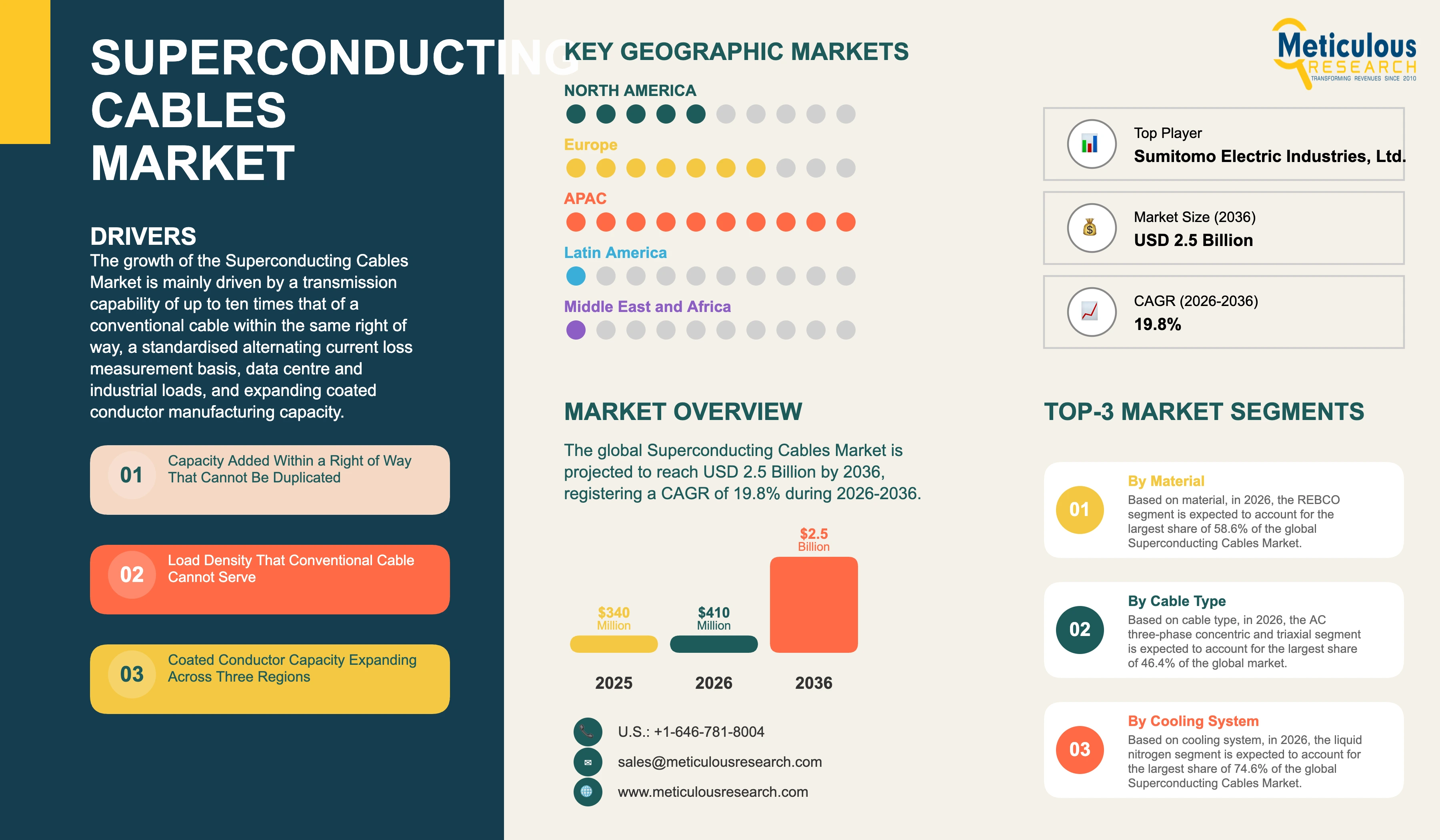
The global Superconducting Cables Market was valued at USD 340.0 million in 2025. This market is expected to reach USD 2,500.0 million by 2036 from an estimated USD 410.0 million in 2026, registering a CAGR of 19.8% during the forecast period (2026-2036).
- Published
- Nov 2026
- Pages
- 260
- Format
- PDF + Excel
- Report ID
- MREP - 1042461
- Base year
- 2025
- 2025 · BASELINE
- $340.0M
- 2036
- $2.50B
- CAGR 2026–2036
- 19.8%
2025 baseline · 2026–2036 forecast at 19.8% CAGR · hover a bar for the value
Key highlights
The market is valued at USD 410.0 million in 2026 and is projected to reach USD 2.50 billion by 2036.
Volume grows far faster than value, at a CAGR of 26.6% against 19.8%, as the price per km falls from USD 2.46 million to USD 1.42 million.
An alternating current cable can carry up to ten times the power of a conventional cable within the same right of way.
Second-generation REBCO coated conductor is the largest and the fastest-growing material at a CAGR of 22.4%.
Direct current cables are the fastest-growing cable type at a CAGR of 24.2%, since the absence of alternating current loss removes the dominant cryogenic penalty.
Data centre and high-density load supply is the fastest-growing application at a CAGR of 27.4%.
Liquid hydrogen and other cryogens form the fastest-growing cooling approach at a CAGR of 25.8%, on cables that carry power and fuel in one route.
By material, REBCO forms the largest and the fastest-growing segment.
By cable type, AC three-phase concentric and triaxial forms the largest segment and DC the fastest growing.
By cooling system, liquid nitrogen forms the largest segment and liquid hydrogen and other cryogens the fastest growing.
By application, urban grid reinforcement forms the largest segment and data centre and high-density load supply the fastest growing.
By voltage, medium voltage up to 72.5 kV forms the largest segment and 72.5 kV to 245 kV the fastest growing.
By geography, Asia-Pacific forms the largest regional market and the Middle East & Africa the fastest growing.
Report summary
| Particulars | Details |
|---|---|
| Base Year | 2025 |
| Forecast Period | 2026-2036 |
| Market Size (2025) | USD 340.0 million (133.3 km) |
| Estimated Market Size (2026) | USD 410.0 million (166.7 km) |
| Forecast Market Size (2036) | USD 2.50 billion (1,760.6 km) |
| CAGR (2026-2036) | 19.8% by value and 26.6% by volume |
| Format | PDF, Excel & Cloud Portal · 260 pages |
| Average Selling Price | USD 2.46 million per km in 2026, declining to USD 1.42 million per km by 2036 |
| Units | Value (USD million/billion) and Volume (km) |
| Segments Covered | Material, Cable Type, Cooling System, Application, Voltage, and Geography |
| Geographies Covered | Asia-Pacific (China, Japan, South Korea, India, Rest of Asia-Pacific), Europe (Germany, Netherlands, U.K., Denmark, Ireland, Rest of Europe), North America (U.S., Canada), Middle East & Africa (Saudi Arabia, UAE, South Africa, Rest of Middle East & Africa), Latin America (Brazil, Chile, Rest of Latin America) |
| Scope Inclusions | Power cables in which the current-carrying conductor operates below its critical temperature, comprising the superconducting conductor, the cryostat, the terminations and the cryogenic cooling system supplied with the circuit; by material across REBCO second-generation coated conductor, BSCCO first-generation tape, magnesium diboride and low-temperature superconductors; by cable type across AC three-phase concentric and triaxial, DC, fault current limiting and other configurations including single-phase, co-axial and hybrid hydrogen arrangements; by cooling system across liquid nitrogen, liquid and gaseous helium and liquid hydrogen and other cryogens; applied to urban grid reinforcement and substation interconnection, industrial and high-current process supply, data centre and high-density load supply, renewable and offshore collection and export, research, accelerator and fusion feeders and rail and marine electrification; at voltages up to 72.5 kV, 72.5 kV to 245 kV and above 245 kV |
| Scope Exclusions | Superconducting magnets and coils for magnetic resonance imaging, nuclear magnetic resonance, accelerators, fusion confinement and magnetic levitation, superconducting fault current limiters supplied as standalone devices rather than as cable, superconducting motors, generators, transformers and energy storage, superconducting wire and tape sold into magnet and non-cable applications, conventional and high-voltage direct current cables, standalone industrial gas supply and cryocoolers sold outside a cable project, civil works, ducting and installation services, and research funding and demonstration grants |
| Key Companies | Sumitomo Electric Industries, Ltd., Furukawa Electric Co., Ltd., Fujikura Ltd., Nexans S.A., LS Cable & System Ltd., Prysmian S.p.A., American Superconductor Corporation, Shanghai Superconductor Technology Co., Ltd., Shanghai Creative Superconductor Technologies Co., Ltd., Western Superconducting Technologies Co., Ltd., Faraday Factory Japan K.K., MetOx International, Inc., THEVA Dunnschichttechnik GmbH, VEIR, Inc., SuperNode Limited, Vision Electric Super Conductors GmbH, Sumitomo Heavy Industries, Ltd., and Linde plc |
Report overview
Market value is measured in USD million/billion) and volume (km. Segments covered: material, cable type, cooling system, application, voltage. Regions: Asia-Pacific, Europe, North America, Middle East & Africa, Latin America.
In volume terms, installations are expected to reach 1,760.6 km by 2036 from an estimated 166.7 km in 2026 and 133.3 km in 2025, registering a CAGR of 26.6% during the forecast period, with the average selling price declining from USD 2.46 million per km in 2026 to USD 1.42 million per km by 2036 as coated conductor manufacturing capacity expands and cryogenic systems move from bespoke engineering to catalogue products.
The growth of this market is mainly driven by a transmission capability of up to ten times that of a conventional cable within the same right of way, which is the only way to raise transfer capacity through corridors in dense urban areas that cannot be duplicated, by a standardised alternating current loss measurement basis that allows a utility to specify and compare cable performance rather than rely on supplier declarations, by data centre and industrial loads concentrating power demand at densities conventional cable cannot serve within available duct space, by coated conductor manufacturing capacity expanding across Asia, Europe and North America and lowering the cost per kiloamp metre, and by direct current links where the absence of alternating current loss removes the dominant cryogenic penalty. A superconducting cable competes against the cost of a route that cannot be obtained rather than against the price of conventional cable.
However, factors such as a cryogenic plant that must run continuously and whose failure takes the circuit out of service, which adds an availability risk conventional cable does not carry, capital cost per kilometre that remains several times that of conventional cable and is justified only where the alternative is unobtainable, a service record measured in a small number of installations over about fifteen years against an asset life expectation of forty, and utility engineering practice, protection settings and maintenance capability that have no precedent for the technology are expected to restrain the growth of this market to some extent. The cable itself is rarely the obstacle, and the decision turns on whether a utility is prepared to operate a refrigeration plant as part of a transmission circuit.
A superconducting cable carries current in a ceramic or metallic conductor held below its critical temperature, where electrical resistance disappears, inside a cryostat that maintains that temperature against heat ingress. The practical consequence is a cable that carries very large currents at modest voltage in a small cross section, so a circuit can be built with less excavation, less duct space and lower voltage than an equivalent conventional cable would require. Second-generation coated conductor based on rare-earth barium copper oxide has displaced first-generation bismuth-based tape for most new work because it carries more current in magnetic field and is manufactured by continuous deposition rather than by powder-in-tube drawing.
Under the installation announced on 29 September 2011 by American Superconductor Corporation with Korea Electric Power Corporation and LS Cable & System, a 22.9 kV alternating current cable system energized at the I’cheon substation near Seoul capable of carrying about 50 megawatts, described as the longest distribution-voltage superconductor cable to be energized in a grid using second-generation wire, and the same announcement states that alternating current superconductor cables can conduct up to ten times the power of conventional cables and that they can be used in urban grids to add capacity within the same right of way or to replace overhead lines, which is the commercial proposition this market rests on. Capacity added within an existing right of way is the whole case, because the alternative in a dense urban area is a new route that will not be granted at any price, and that is why deployment has concentrated on substation interconnection and urban reinforcement rather than on long transmission distances.
What governs the economics is loss, and the basis for measuring it is defined rather than negotiated. Under IEC 61788-8:2010, Edition 2.0, Superconductivity Part 8, AC loss measurements, total AC loss measurement of round superconducting wires exposed to a transverse alternating magnetic field at liquid helium temperature by a pickup coil method, published on 24 June 2010 by Technical Committee 90 on superconductivity with a stability date of 2027 and replacing the first edition of 2003, which specifies a pickup coil method for measuring total AC loss in round metallic and oxide composite superconducting wires placed in a transverse alternating magnetic field. Further, that standard covers total loss which may comprise hysteresis, coupling and eddy current components, allows those components to be separated for wires with fine filaments with the hysteresis loss estimated from a low-frequency extrapolation, applies up to the commercial frequency range of 50 and 60 Hz, and leaves hysteresis loss measured alone to IEC 61788-13, so the measurement basis on which an alternating current cable is specified and compared is defined rather than supplier-determined. Alternating current loss matters far beyond the cable, because every watt dissipated in the conductor must be removed by refrigeration at a cost of many watts of electrical input, so the measured loss sets the size, capital cost and running cost of the cryogenic plant and therefore the whole operating case. A standardised measurement is what allows a utility to compare two suppliers on the figure that decides the project.
A direct current superconducting cable carries no alternating current loss at all, so its cryogenic load reduces to heat ingress through the cryostat and the terminations, which is why direct current configurations grow fastest despite a smaller installed base and why they are the form proposed for long links. Fault current limiting cables exploit the opposite property, using the transition out of the superconducting state during a fault to limit current inherently, which allows a circuit to be added to a network whose switchgear is already at its interrupting limit.
Cooling is a separate engineering system with its own suppliers and its own failure modes. Liquid nitrogen at around 77 kelvin serves the great majority of installations because it is inexpensive, widely available and adequate for high-temperature superconductors, while helium is required only for low-temperature materials and is costly and supply-constrained. Liquid hydrogen is the development that changes the proposition, since a cable cooled by hydrogen can deliver electrical power and chemical energy through one route, and that dual function is why it is the fastest-growing cooling approach despite a very small base.
Coated conductor manufacture is the capital intensive and technically differentiated step, cable design and cryostat engineering is a separate discipline held by cable groups and specialist developers, and the refrigeration plant is supplied by industrial gas and cryocooler companies. A project therefore assembles a consortium rather than placing an order, which lengthens procurement and means wire capacity, cable capability and cryogenic supply all have to be available at once for a project to proceed.
Geographic distribution follows urban density and industrial policy rather than electricity demand. Asia-Pacific holds the largest share on Korean, Japanese and Chinese programmes that have funded wire manufacture and grid demonstration together, and on the installation at a Korean substation that remains the most cited distribution-voltage reference. Europe follows on dense city networks, constrained corridors and research-led projects, North America on urban reinforcement and data centre loads, and the Middle East & Africa grows fastest from a very small base on new-build cities and industrial zones specified without legacy infrastructure.
American Superconductor Corporation announced on 29 September 2011 that a 22.9 kV alternating current cable system capable of carrying about 50 megawatts had been energized at the I’cheon substation near Seoul with Korea Electric Power Corporation and LS Cable & System, described as the longest distribution-voltage superconductor cable to be energized in a grid using second-generation wire. The same announcement states that alternating current superconductor cables can conduct up to ten times the power of conventional cables and can be used in urban grids to add capacity within the same right of way or to replace overhead lines.
IEC 61788-8:2010, Edition 2.0, Superconductivity Part 8, AC loss measurements, published on 24 June 2010 by Technical Committee 90 with a stability date of 2027 and replacing the first edition of 2003, specifies a pickup coil method for measuring total AC loss in round metallic and oxide composite superconducting wires exposed to a transverse alternating magnetic field at liquid helium temperature. It covers total loss comprising hysteresis, coupling and eddy current components, allows those to be separated for wires with fine filaments with hysteresis loss estimated from a low-frequency extrapolation, and applies up to the commercial frequency range of 50 and 60 Hz, with hysteresis loss measured alone covered by IEC 61788-13.
Asia-Pacific is expected to account for the largest share of 42.6% of the market in 2026, valued at USD 174.7 million, on Korean, Japanese and Chinese programmes that funded coated conductor manufacture and grid demonstration together.
The Middle East & Africa is projected to record the highest CAGR of 24.6% during the forecast period, accounting for a share of 3.6% of the market in 2026, valued at USD 14.8 million, on new cities and industrial zones specified without legacy infrastructure and on hydrogen production programmes that make a combined power and hydrogen corridor relevant.
The European superconducting cables market is valued at USD 116.4 million in 2026 and is projected to grow at a CAGR of 20.2% during the forecast period. Germany is the largest country market on urban projects and domestic tape manufacture, with the Netherlands, the United Kingdom, Denmark and Ireland contributing cable engineering and interconnector development, and the European position is weighted toward direct current and hydrogen-cooled concepts more than any other region.
North America is expected to account for 22.6% of the market in 2026, valued at USD 92.7 million, at a CAGR of 19.4%, with the U.S. at USD 83.6 million, concentrated in urban reinforcement in the largest cities, data centre campuses and coated conductor manufacture. Latin America is expected to account for 2.8% of the market in 2026, valued at USD 11.5 million, at a CAGR of 21.2%, with Brazil and Chile carrying most of the activity on urban reinforcement and mining supply.
Some of the key players operating in the superconducting cables market are Sumitomo Electric Industries, Ltd., Furukawa Electric Co., Ltd., Fujikura Ltd., Nexans S.A., LS Cable & System Ltd., Prysmian S.p.A., American Superconductor Corporation, Shanghai Superconductor Technology Co., Ltd., Shanghai Creative Superconductor Technologies Co., Ltd., Western Superconducting Technologies Co., Ltd., Faraday Factory Japan K.K., MetOx International, Inc., THEVA Dunnschichttechnik GmbH, VEIR, Inc., SuperNode Limited, Vision Electric Super Conductors GmbH, Sumitomo Heavy Industries, Ltd., and Linde plc, among others. In 2025, the eighteen profiled companies accounted for an estimated 86.4% of the market, and the five largest for 48.2%.
Report infographic
Market dynamics
15 factors across 5 forcesCapacity Added Within a Right of Way That Cannot Be Duplicated
Under the installation announced on 29 September 2011 by American Superconductor Corporation with Korea Electric Power Corporation and LS Cable & System, a 22.9 kV alternating current cable system energized at the I’cheon substation near Seoul capable of carrying about 50 megawatts, described as the longest distribution-voltage superconductor cable to be energized in a grid using second-generation wire, and the same announcement states that alternating current superconductor cables can conduct up to ten times the power of conventional cables and that they can be used in urban grids to add capacity within the same right of way or to replace overhead lines, which is the commercial proposition this market rests on. A circuit carrying up to ten times the power of a conventional cable in the same duct or trench is the only measure that raises transfer capability through a corridor where no new route can be obtained, and in dense city centres, under rivers, through protected districts and across constrained industrial sites that condition is routine rather than exceptional. The comparison the utility makes is therefore against the cost and the probability of securing a new route, which in many locations is unobtainable at any price, rather than against the price of conventional cable. The same capability also allows a network to be reinforced at distribution voltage instead of building a new transmission-voltage circuit and substation, which avoids a land acquisition as well as a cable.
A Standardised Loss Measurement That Makes Suppliers Comparable
Through IEC 61788-8:2010, Edition 2.0, Superconductivity Part 8, AC loss measurements, total AC loss measurement of round superconducting wires exposed to a transverse alternating magnetic field at liquid helium temperature by a pickup coil method, published on 24 June 2010 by Technical Committee 90 on superconductivity with a stability date of 2027 and replacing the first edition of 2003, which specifies a pickup coil method for measuring total AC loss in round metallic and oxide composite superconducting wires placed in a transverse alternating magnetic field, and that standard covers total loss which may comprise hysteresis, coupling and eddy current components, allows those components to be separated for wires with fine filaments with the hysteresis loss estimated from a low-frequency extrapolation, applies up to the commercial frequency range of 50 and 60 Hz, and leaves hysteresis loss measured alone to IEC 61788-13, so the measurement basis on which an alternating current cable is specified and compared is defined rather than supplier-determined. Alternating current loss is the variable that decides whether a project is viable, because each watt dissipated in the conductor must be removed by refrigeration at a cost of many watts of input power, so it sets the size and capital cost of the cryogenic plant and the running cost of the circuit for its whole life. Before a standardised method existed, a utility comparing two cables was comparing two measurement approaches as much as two products, and the figure that mattered most was the least verifiable. A defined pickup coil method covering total loss with hysteresis, coupling and eddy current components separable for fine-filament wires, applying up to 50 and 60 Hz, allows a specification to be written and tendered, which is a precondition for competitive procurement in any market.
Load Density That Conventional Cable Cannot Serve in Available Space
Data centre campuses, electrified industrial processes, electrolysers, electric arc furnaces and port and airport electrification concentrate demand at densities that require either many parallel conventional circuits or a higher voltage with its own substation, and in each case the constraint is physical space rather than available generation. A single superconducting circuit replaces the parallel set in a fraction of the duct area and at a voltage the site already uses, which avoids both the civil works and the transformation. Demand from this group differs from utility demand in that the buyer owns the site, makes the decision on a commercial rather than a regulatory basis and is willing to accept a novel technology where it removes a constraint on revenue, which is why it is the fastest-growing application in this market.
Coated Conductor Capacity Expanding Across Three Regions
Second-generation rare-earth barium copper oxide tape is produced by continuous deposition on a metal substrate, which is a capital intensive process whose unit cost falls with throughput, and capacity additions in Japan, China, Korea, Germany and the United States have moved the material from a laboratory supply constraint to a traded product with more than one qualified source. Falling cost per kiloamp metre changes the set of projects that clear an investment case, and the availability of a second source removes the single supplier risk that previously stopped utilities proceeding. The effect is visible in the forecast as volume growth running well ahead of value growth, since the installed kilometres rise faster than the revenue they generate.
Table of contents
13 chapters · 152 sections · 260 pages · click to expandSegmental analysis
| Segment | Largest share (2026) | Fastest growth (2026–2036) |
|---|---|---|
| By Material | REBCO | Large share and rapid growth of this |
| By Cable Type | AC three-phase concentric and triaxial | Rapid growth of this |
| By Cooling System | Liquid nitrogen | Rapid growth of this |
| By Application | Urban grid reinforcement and substation interconnection | Rapid growth of this |
| By Voltage | Medium voltage up to 72.5 kV | High voltage 72.5 kV |
| Other segments | Urban grid reinforcement and substation interconnection | Data centre and high-density load supply |
By Material
- Superconducting Cables Market Analysis by Material
- The REBCO segment is expected to account for the largest share of 58.6% of the global superconducting cables market, valued at USD 240.3 million, and is also projected to register the highest CAGR of 22.4% during the forecast period.
- The large share and rapid growth of this segment are mainly due to a second-generation coated conductor that carries more current in magnetic field than first-generation tape and is produced by continuous deposition on a metal substrate, a process whose unit cost falls with throughput rather than with batch yield, and due to capacity additions across Japan, China, Korea, Germany and the United States that have moved the material from a single-source laboratory supply to a traded product with more than one qualified manufacturer.
- Almost all new cable designs are specified on this material, which concentrates both the value and the technical risk of a project in deposition capacity.
- BSCCO accounts for USD 108.2 million in 2026 at a CAGR of 14.6%, retained where the mechanical properties of a powder-in-tube tape are preferred and in replacement supply for installed circuits, and growing well below the market rate because the cost curve of a drawing and sintering process does not improve with volume the way continuous deposition does.
- Magnesium diboride accounts for USD 34.4 million at 20.8%, applied where an intermediate operating temperature allows a simpler refrigeration arrangement than helium at a lower material cost than coated conductor, principally in direct current and hydrogen-cooled configurations.
- Low-temperature superconductors account for USD 27.1 million at 16.2%, confined to research, accelerator and fusion feeders where helium cooling is present for other reasons.
- The REBCO segment is expected to account for the largest share of 58.6% of the market in 2026, valued at USD 240.3 million, followed by BSCCO at 26.4% and USD 108.2 million, magnesium diboride at 8.4% and USD 34.4 million and low-temperature superconductors at 6.6% and USD 27.1 million.
- The REBCO segment is projected to record the highest CAGR of 22.4% during the forecast period, which makes it both the largest and the fastest-growing material, with magnesium diboride next at 20.8% and low-temperature superconductors at 16.2%.
By Cable Type
- Superconducting Cables Market Analysis by Cable Type
- The AC three-phase concentric and triaxial segment is expected to account for the largest share of 46.4% of the global superconducting cables market, valued at USD 190.2 million.
- The large share of this segment is mainly due to the concentration of installed and planned projects in urban substation interconnection and distribution reinforcement, where the existing network is alternating current and a cable must match it, and due to a concentric or triaxial arrangement that carries three phases within one cryostat and so shares the cryogenic envelope across the whole circuit.
- However, the DC segment, valued at USD 117.3 million in 2026 and accounting for a share of 28.6%, is projected to register the highest CAGR of 24.2% during the forecast period.
- The rapid growth of this segment is attributed to the absence of alternating current loss, which reduces the cryogenic load to heat ingress through the cryostat and the terminations and means that load does not grow with the current carried, so the economics improve with both capacity and length.
- Fault current limiting cables account for USD 67.2 million in 2026 at a CAGR of 19.4%, using the transition out of the superconducting state to limit fault current inherently, which allows a circuit to be added to a substation whose switchgear is already at its interrupting capability and places the purchase against a switchgear replacement budget.
- Other configurations, covering single-phase, co-axial and hybrid hydrogen arrangements, account for USD 35.3 million at 20.6%, concentrated in industrial and demonstration applications where the cable is designed around a specific site constraint rather than to a standard network configuration.
- The AC three-phase concentric and triaxial segment is expected to account for the largest share of 46.4% of the market in 2026, valued at USD 190.2 million, with DC at 28.6% and USD 117.3 million and fault current limiting cables at 16.4% and USD 67.2 million.
- The DC segment is projected to record the highest CAGR of 24.2% during the forecast period, accounting for a share of 28.6% of the market in 2026, valued at USD 117.3 million, with other configurations next at 20.6% and fault current limiting cables at 19.4%.
By Cooling System
- Superconducting Cables Market Analysis by Cooling System
- The liquid nitrogen segment is expected to account for the largest share of 74.6% of the global superconducting cables market, valued at USD 305.9 million.
- The large share of this segment is mainly due to a boiling point around 77 kelvin that is sufficient for both generations of high-temperature superconductor, and due to a cryogen that is inexpensive, produced at industrial scale everywhere and handled under procedures industrial gas suppliers already operate, which removes both the cost and the supply risk from the cooling system.
- However, the liquid hydrogen and other cryogens segment, valued at USD 53.3 million in 2026 and accounting for a share of 13.0%, is projected to register the highest CAGR of 25.8% during the forecast period.
- The rapid growth of this segment is attributed to a cable that delivers electrical power and chemical energy through one corridor, which halves route acquisition where both are required and gives the cryogen an economic purpose beyond cooling.
- Liquid and gaseous helium accounts for USD 50.8 million in 2026 at a CAGR of 15.4%, required only for low-temperature superconductors and growing below the market rate because the cryogen is costly, supply-constrained and demands a closed recovery system, which confines it to research, accelerator and fusion applications where that infrastructure already exists for other reasons.
- The liquid nitrogen segment is expected to account for the largest share of 74.6% of the market in 2026, valued at USD 305.9 million, with liquid hydrogen and other cryogens at 13.0% and USD 53.3 million and liquid and gaseous helium at 12.4% and USD 50.8 million.
- The liquid hydrogen and other cryogens segment is projected to record the highest CAGR of 25.8% during the forecast period, accounting for a share of 13.0% of the market in 2026, valued at USD 53.3 million, with liquid nitrogen next at 19.5% and helium at 15.4%.
By Application
- Superconducting Cables Market Analysis by Application
- The urban grid reinforcement and substation interconnection segment is expected to account for the largest share of 38.6% of the global superconducting cables market, valued at USD 158.3 million.
- The large share of this segment is mainly due to city networks where no new route can be obtained at any price, which leaves raising the capability of an existing duct as the only available measure, and due to the ability to reinforce at distribution voltage instead of building a new transmission-voltage circuit and substation, which avoids a land acquisition as well as a cable.
- However, the data centre and high-density load supply segment, valued at USD 59.9 million in 2026 and accounting for a share of 14.6%, is projected to register the highest CAGR of 27.4% during the forecast period.
- The rapid growth of this segment is attributed to buyers that own their site, decide on a commercial rather than a regulatory basis and accept a novel technology where it removes a constraint on revenue.
- Industrial and high-current process supply accounts for USD 75.4 million in 2026 at a CAGR of 19.2%, serving electric arc furnaces, electrolysers and smelters where very large currents at low voltage are the normal operating condition and a superconducting busbar or cable replaces a large parallel conventional arrangement.
- Renewable and offshore collection and export accounts for USD 52.5 million at 22.6%, research, accelerator and fusion feeders for USD 38.5 million at 17.6%, where the application is a current lead rather than a transmission circuit, and rail and marine electrification for USD 25.4 million at 18.2%, applied to traction feeders and shipboard distribution where weight and space are constrained.
By Voltage
- Superconducting Cables Market Analysis by Voltage
- The medium voltage up to 72.5 kV segment is expected to account for the largest share of 54.6% of the global superconducting cables market, valued at USD 223.9 million.
- The large share of this segment is mainly due to the central proposition of the technology, which is to carry transmission-scale power at distribution voltage and so avoid the transformation, the substation and the land that a higher voltage would require, and due to the installed reference base being concentrated at these voltages.
- However, the high voltage 72.5 kV to 245 kV segment, valued at USD 128.7 million in 2026 and accounting for a share of 31.4%, is projected to register the highest CAGR of 21.4% during the forecast period.
- The rapid growth of this segment is attributed to projects moving from substation interconnection toward network circuits that must match existing transmission voltages, and to terminations and cryostat designs qualified at these levels becoming available.
- The extra high voltage above 245 kV segment accounts for USD 57.4 million in 2026 at a CAGR of 18.4%, applied to proposed interconnector and long direct current links where the capacity justifies the engineering, and growing below the market rate because no such circuit has yet been built at scale and the segment therefore depends on a small number of programmes reaching a decision.
Other segments
- The urban grid reinforcement and substation interconnection segment is expected to account for the largest share of 38.6% of the market in 2026, valued at USD 158.3 million, followed by industrial and high-current process supply at 18.4% and USD 75.4 million.
- The data centre and high-density load supply segment is projected to record the highest CAGR of 27.4% during the forecast period, accounting for a share of 14.6% of the market in 2026, valued at USD 59.9 million, with renewable and offshore collection and export next at 22.6%.
- The medium voltage up to 72.5 kV segment is expected to account for the largest share of 54.6% of the market in 2026, valued at USD 223.9 million, with 72.5 kV to 245 kV at 31.4% and USD 128.7 million and above 245 kV at 14.0% and USD 57.4 million.
- The 72.5 kV to 245 kV segment is projected to record the highest CAGR of 21.4% during the forecast period, accounting for a share of 31.4% of the market in 2026, valued at USD 128.7 million, with above 245 kV next at 18.4% and up to 72.5 kV at 19.2%.
Geographic analysis
Asia-Pacific
Largest shareIn 2026, Asia-Pacific is expected to account for the largest share of 42.6% of the global superconducting cables market, valued at USD 174.7 million. The large share of this region is mainly due to Korean, Japanese and Chinese programmes that funded coated conductor manufacture and grid demonstration together rather than separately, which produced both a supply base and an installed reference, and due to the 22.9 kV alternating current installation at a Korean substation carrying about 50 megawatts that remains the most cited distribution-voltage reference in the industry. Chinese urban projects and industrial installations now account for the largest share of installed kilometres in the region, and Japanese and Korean suppliers hold the manufacturing capability.
Europe
Europe is expected to account for 28.4% of the market in 2026, valued at USD 116.4 million, at a CAGR of 20.2% during the forecast period. Demand is led by dense city networks in which corridors cannot be duplicated, by constrained industrial and port sites, and by research and demonstration programmes that have sustained both cable engineering and coated conductor manufacture through periods when commercial demand was absent. Germany is the largest country market on urban projects and domestic tape manufacture, with the Netherlands, the United Kingdom, Denmark and Ireland contributing cable engineering and interconnector development, and the European position is weighted toward direct current and hydrogen-cooled concepts more than any other region.
North America
North America is expected to account for 22.6% of the market in 2026, valued at USD 92.7 million, of which the U.S. accounts for USD 83.6 million and Canada for USD 9.0 million, at a CAGR of 19.4%. Demand is concentrated in urban reinforcement in the largest cities, in data centre campuses where duct space and substation footprint limit how much power a site can take, and in coated conductor manufacture, where domestic capacity has been added to serve both cable and magnet markets. Fault current limiting applications have also had more utility attention here than elsewhere, because the substations concerned are mature and their switchgear is at its interrupting limit.
Middle East & Africa
Fastest growthThe Middle East & Africa is expected to account for 3.6% of the market in 2026, valued at USD 14.8 million, and is projected to register the highest CAGR of 24.6% during the forecast period. The rapid growth of this region is attributed to new cities and industrial zones specified without legacy infrastructure, where a superconducting circuit can be designed into the layout rather than retrofitted into a constrained route, and to hydrogen production programmes in Saudi Arabia and the United Arab Emirates that make a combined power and hydrogen corridor commercially relevant.
Latin America
Latin America is expected to account for 2.8% of the market in 2026, valued at USD 11.5 million, at a CAGR of 21.2%, with Brazil and Chile carrying most of the activity on urban reinforcement and mining supply.
Competitive landscape
Coated conductor manufacture is the capital intensive and technically differentiated layer, and the suppliers that hold it set the pace of the market. Fujikura Ltd., Furukawa Electric Co., Ltd., Shanghai Superconductor Technology Co., Ltd., Shanghai Creative Superconductor Technologies Co., Ltd., Faraday Factory Japan K.K., MetOx International, Inc. and THEVA Dünnschichttechnik GmbH produce second-generation rare-earth barium copper oxide tape, American Superconductor Corporation supplies wire alongside system engineering and holds the reference position from early utility projects, and Sumitomo Electric Industries, Ltd. produces first-generation bismuth-based tape and complete cable systems. Western Superconducting Technologies Co., Ltd. supplies low-temperature material for research and fusion applications, and the qualification of a second and third tape source for a given cable design is now the step that unblocks procurement rather than the availability of material in total.
Cable and cryostat engineering is a separate discipline, held by established cable groups and by specialist developers. Nexans S.A., Prysmian S.p.A., LS Cable & System Ltd. and Sumitomo Electric Industries, Ltd. bring cable manufacturing, termination design and utility qualification experience, with LS Cable & System Ltd. holding the Korean reference installation, while VEIR, Inc., SuperNode Limited and Vision Electric Super Conductors GmbH are developing cable architectures aimed at specific propositions covering high-capacity overhead and underground links, long direct current interconnection and industrial high-current supply respectively.
Sumitomo Heavy Industries, Ltd., which supplies the layer utilities understand least, supplies cryocoolers and Linde plc supplies industrial cryogenic plant, circulation and cryogen itself, and both are increasingly offering standardised packages sized to cable rating with defined redundancy rather than bespoke engineering. Competition across the market is decided by whether a consortium can be assembled with wire capacity, cable capability and cryogenic supply available at the same time, because a project cannot proceed without all three, and the participants able to lead that assembly capture a larger share of project value than their own layer would suggest. Vertical integration has not emerged, because the three layers have different capital cycles and different customers outside this market, and the practical consequence is that share here is better read by layer than in aggregate across the market as a whole.
- —
Recent developments include the displacement of first-generation bismuth-based tape by second-generation rare-earth barium copper oxide coated conductor in new cable designs, which concentrates value in continuous deposition capacity rather than in drawing and sintering capability, the movement of cryogenic systems from bespoke engineering toward standardised packages sized to cable rating with defined redundancy and remote monitoring, and the delivery of projects by consortia bringing wire manufacture, cable and cryostat design and refrigeration supply together with a civil contractor and the utility rather than through a single supply contract.
- Sumitomo Electric Industries, Ltd.
- Furukawa Electric Co., Ltd.
- Fujikura Ltd.
- Nexans S.A.
- LS Cable & System Ltd.
- Prysmian S.p.A
- American Superconductor Corporation
- Shanghai Superconductor Technology Co., Ltd.
- Shanghai Creative Superconductor Technologies Co., Ltd.
- Western Superconducting Technologies Co., Ltd.
- Faraday Factory Japan K.K
- MetOx International, Inc.
- THEVA Dunnschichttechnik GmbH
- VEIR, Inc.
- SuperNode Limited
- Vision Electric Super Conductors GmbH
- Sumitomo Heavy Industries, Ltd.
- Linde plc
Expert perspectives
Superconducting cables compete against routes that cannot be obtained rather than against conventional cable, and nothing about this market makes sense without that framing. A circuit carrying up to ten times the power of a conventional cable in the same right of way is worth paying for only where a new right of way is unavailable, which is why deployment concentrates in dense urban substation interconnection and constrained industrial sites rather than spreading with demand. The binding constraint is therefore shifting from cable cost to utility willingness to operate a refrigeration plant as part of a transmission circuit, since the conductor is now a traded product and the cryogenic system is not yet a familiar asset.
Spending will move toward direct current configurations, toward second-generation material and toward buyers outside the utility. Direct current grows fastest among cable types at 24.2%, because the absence of alternating current loss removes the dominant cryogenic penalty and the load stops rising with the current carried, which is what makes length and capacity work in its favour. REBCO holds both the largest share and the fastest growth at 22.4%, as continuous deposition capacity across three regions turns a single-source material into a traded one. Data centre and high-density load supply grows fastest among applications at 27.4%, because that buyer owns its site and decides commercially. Volume grows at 26.6% against 19.8% by value, as the price per kilometre falls from USD 2.46 million to USD 1.42 million.
For companies planning entry or expansion, the question is which of three layers to occupy. Coated conductor manufacture is capital intensive, improves with throughput and is where the technical differentiation sits, but it is now contested by several qualified suppliers. Cable and cryostat engineering is where utility qualification and termination experience count, and it is held by established cable groups and a small number of specialist developers. Refrigeration is the least contested and the most commercially overlooked, because it is the layer utilities are least equipped to assess. The decisive capability in all three cases is the ability to lead a consortium, since no project proceeds unless wire, cable and cooling are available together.
Four qualifications bear directly on how the growth in this market should be read. First, revenue arrives through a small number of large projects rather than through steady adoption, so a single programme slipping moves a year materially and the forecast should be read as a trajectory rather than a run rate. Second, the installed base amounts to a handful of circuits with roughly fifteen years of operating experience against a forty-year asset expectation, which keeps approval with individual engineers rather than with a standard. Third, the cryogenic plant creates an availability exposure conventional cable does not carry, and utilities resolve it by declining the technology wherever any conventional option remains. Fourth, the outcome of a business case depends on whether the comparison is drawn against conventional cable or against the route, substation and transformation avoided, and that is a budget question rather than an engineering one.
Overall, this market grows because urban and industrial corridors cannot be widened while the power they must carry keeps rising, and the participants that capture the growth will be those able to assemble wire, cable and cooling into a circuit a utility is prepared to operate.
Customer perspectives
Capacity added within an existing right of way is the proposition, and operating responsibility for the cryogenic system is the obstacle, which together explain why urban grid reinforcement accounts for 38.6% of this market in 2026 while adoption remains concentrated among a small number of utilities.
Buyers that own their site and decide commercially rather than against a regulatory availability standard are why data centre and high-density load supply is projected to grow at 27.4%, the fastest of any application in this market.
Project delivery through consortia rather than through a single supply contract is the structural feature of this market, and it is why revenue arrives through a small number of large projects rather than as a steady run rate, and why a single programme slipping moves a year materially.
“In the city centre we will not get another route, whatever we are prepared to pay for it. That is the whole reason we looked at this. The price of the cable is not really the question, the question is whether my people are willing to run a refrigeration plant as part of a circuit.”
“Our constraint is how much power we can physically bring into the campus, not whether the power exists. If one circuit does the work of several in the duct space we have, that is a commercial decision and we can take it ourselves. We are not waiting for a standard to be written.”
“No single company sells this. We need the tape, the cable and cryostat, and the cooling plant all available in the same window, and if any one of them slips the project moves a year. Putting that group together is most of the work.”
Frequently asked questions
The global superconducting cables market is valued at USD 410.0 million in 2026, up from USD 340.0 million in 2025 and USD 280.0 million in 2024. In volume terms it is estimated at 166.7 km in 2026, up from 133.3 km in 2025.
Cite this report
Meticulous Research. (2026). Superconducting Cables Market - Global Opportunity Analysis and Industry Forecast (2026-2036) (Report No. MREP - 1042461). Meticulous Market Research Pvt. Ltd. https://www.meticulousresearch.com/product/superconducting-cables-market-7144