Dermal Fillers Market (2026-2036)
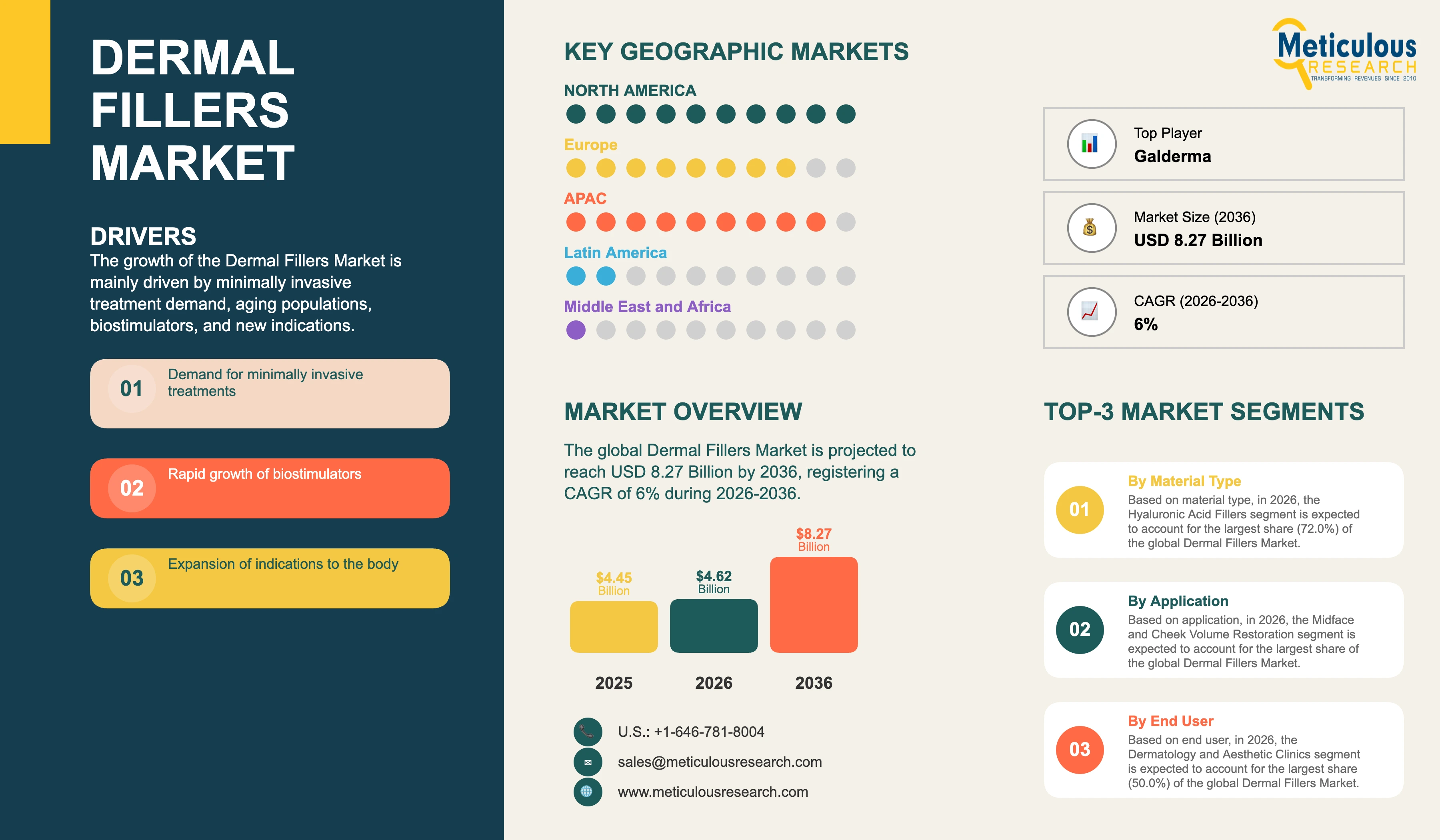
The global dermal fillers market was valued at USD 4.45 billion in 2025. This market is expected to reach USD 8.27 billion by 2036 from an estimated USD 4.62 billion in 2026, registering a CAGR of 6.0% during the forecast period (2026-2036).
- Published
- Nov 2026
- Pages
- 255
- Format
- PDF + Excel
- Report ID
- MRHC - 1042627
- Base year
- 2025
- 2025 · BASELINE
- $4.45B
- 2036
- $8.27B
- CAGR 2026–2036
- 6.0%
2025 baseline · 2026–2036 forecast at 6.0% CAGR · hover a bar for the value
Key highlights
Galderma reported that its Fillers and Biostimulators net sales grew 8.0% at constant currency to USD 1.101 billion in 2025, driven especially by Sculptra and new launches, including Sculptra in China and Restylane SHAYPE in Brazil, while noting that fillers globally continued to be affected by market softness and important pricing pressure due to lower consumer demand and aggressive promotional activity from competitors in the midface, according to the company's full-year 2025 results.
AbbVie reported global Juvederm net revenues of USD 993 million in 2025, with fourth-quarter sales down 10.8% on an operational basis due to continued headwinds in key dermal filler markets, and the company expected Juvederm sales of about USD 950 million in 2026 as aesthetics category growth remains challenged, according to AbbVie and Zacks.
The International Society of Aesthetic Plastic Surgery's global survey released in September 2026 reported that hyaluronic acid filler procedures performed by plastic surgeons fell 25% to 4.7 million in 2025, after increasing 5.2% to 6.3 million in 2024, while botulinum toxin remained the most common non-surgical procedure with 7.3 million procedures, according to ISAPS and the Korea Herald.
In December 2025, Galderma received European Union Medical Device Regulation certification expanding Sculptra's approved applications beyond the face to include the gluteal area, posterior thighs, décolletage, and upper arms, and in November 2025 the FDA approved Restylane Lyft with Lidocaine for chin augmentation in patients over 21, according to Galderma.
Galderma has noted that it is shaping the aesthetics journey for patients undergoing medication-driven weight loss with its Restylane and Sculptra portfolio, reflecting growing interest in treatments to restore facial volume lost during weight loss with GLP-1 medications.
Botulinum toxin and hyaluronic acid fillers remained the two most popular non-surgical aesthetic procedures worldwide in the ISAPS surveys, and practitioners commonly combine the two treatments, which links demand for dermal fillers to the broader injectable aesthetics market and to the marketing and loyalty programs of manufacturers with both product categories. Manufacturers are adjusting promotions and loyalty programs accordingly.
By material type, hyaluronic acid fillers account for the largest share of 72.0% in 2026, while biostimulatory fillers register the highest CAGR.
By application, midface and cheek volume restoration accounts for the largest share in 2026, while body and skin quality registers the highest CAGR.
By gender, female accounts for the larger share in 2026, while male registers the higher CAGR.
By end user, dermatology and aesthetic clinics account for the largest share of 50.0% in 2026, while medical spas register the highest CAGR.
By geography, North America accounts for the largest share of 33.0% in 2026, while Asia-Pacific registers the highest CAGR of 7.9%.
Report summary
| Particulars | Details |
|---|---|
| Forecast Period | 2026-2036 |
| Base Year | 2025 |
| Estimated Year | 2026 |
| CAGR (Value) | 6.0% |
| Format | PDF, Excel & Cloud Portal · 255 pages |
| Market Size (Value) in 2025 | USD 4.45 billion |
| Market Size (Value) in 2026 | USD 4.62 billion |
| Market Size (Value) in 2036 | USD 8.27 billion |
| Segments Covered | Material Type, Application, Gender, End User, Geography |
| Countries Covered | U.S., Canada, Rest of North America, Germany, U.K., France, Italy, Spain, Switzerland, Russia, Netherlands, Belgium, Sweden, Denmark, Norway, Finland, Austria, Poland, Ireland, Rest of Europe, China, South Korea, Japan, India, Australia, Thailand, Singapore, Indonesia, Malaysia, Vietnam, Philippines, Taiwan, New Zealand, Rest of Asia-Pacific, Brazil, Mexico, Colombia, Argentina, Chile, Peru, Rest of Latin America, Saudi Arabia, U.A.E., Israel, South Africa, Turkey, Egypt, Rest of Middle East & Africa |
| Key Companies | 14 companies and other companies |
| Largest Segment by Material Type (2026) | Hyaluronic Acid Fillers (72.0%) |
| Largest Segment by End User (2026) | Dermatology and Aesthetic Clinics (50.0%) |
| Largest Region (2026) | North America (33.0%) |
| Fastest-Growing Region | Asia-Pacific (CAGR 7.9%) |
Report overview
Segments covered: material type, application, end user.
The growth of this market is mainly driven by the growing demand for minimally invasive aesthetic treatments, the aging population and the desire to maintain a youthful appearance, the rapid growth of biostimulatory fillers that stimulate the body's own collagen production, the expansion of approved indications to new facial areas and to the body, growing demand among men and younger consumers, rising disposable incomes and aesthetic awareness in Asia-Pacific and Latin America, and the need for facial volume restoration among patients experiencing rapid weight loss with GLP-1 medications. However, factors such as softer consumer demand and pricing pressure in key markets in 2025 and 2026, safety concerns and complications associated with fillers, the growing preference of some patients for natural-looking and regenerative treatments over volumizing fillers, competition from other aesthetic treatments, and the presence of counterfeit and unregulated products are expected to restrain the growth of this market to some extent.
Dermal fillers are injectable medical devices used to restore lost volume, smooth wrinkles and folds, enhance facial contours, and improve skin quality. They are among the most popular non-surgical aesthetic treatments worldwide, second only to botulinum toxin injections. Most dermal fillers are made from hyaluronic acid, a naturally occurring substance in the skin that attracts water and provides volume, and their effects typically last from several months to two years, depending on the product and treatment area. Hyaluronic acid fillers can be dissolved with an enzyme if needed, which adds to their safety profile and popularity.
This report covers the global dermal fillers market, including hyaluronic acid fillers, biostimulatory fillers, such as poly-L-lactic acid, calcium hydroxylapatite, and polycaprolactone fillers that stimulate the body's own collagen production, and other fillers, such as polymethyl methacrylate and collagen-based fillers. The market is analyzed by material type, application, end user, and geography. Botulinum toxins, skin boosters sold as cosmetic products rather than medical devices, and surgical aesthetic procedures are analyzed in separate reports. The market is measured on a revenue basis at manufacturer selling prices, on a sales basis in each country, and does not include practitioner fees.
Dermal fillers are used to treat a wide range of facial areas, including the cheeks and midface, nasolabial folds, marionette lines, lips, chin, jawline, temples, and under-eye area, and increasingly for skin quality and body areas such as the hands, décolletage, buttocks, and thighs. Practitioners often combine fillers with botulinum toxin and energy-based treatments to achieve comprehensive facial rejuvenation. Treatments are performed by dermatologists, plastic surgeons, aesthetic physicians, nurses, and other trained injectors in clinics, medical spas, and hospitals.
The dermal fillers market experienced a period of softer demand in 2025 and 2026 after several years of strong growth. Major manufacturers reported pricing pressure and lower consumer demand in key markets. Galderma noted that fillers globally were affected by market softness and important pricing pressure due to lower consumer demand and aggressive promotional activity from competitors in the midface, while AbbVie reported declining Juvederm sales and expected aesthetics category growth to remain challenged in 2026. The ISAPS global survey reported a 25% decline in hyaluronic acid filler procedures performed by plastic surgeons in 2025. Economic pressures on consumers, concerns about an overfilled appearance, and a shift toward natural-looking and regenerative treatments have contributed to this softness.
At the same time, biostimulatory fillers have continued to grow strongly despite the broader softness in the filler market. Galderma reported double-digit net sales growth in biostimulators in 2025, led by Sculptra, which stimulates collagen production for gradual and natural-looking results. Patients and practitioners are increasingly interested in regenerative aesthetics, which aim to improve skin quality and structure rather than simply add volume. New indications for biostimulators, such as body areas approved under the EU Medical Device Regulation for Sculptra in December 2025, are expanding the opportunity.
Hyaluronic acid fillers account for the largest share of the market by material type, while biostimulatory fillers are the fastest-growing material type. Midface and cheek volume restoration is the largest application, while body and skin quality is the fastest-growing application. Dermatology and aesthetic clinics are the largest end user, while medical spas are the fastest-growing end user. Female patients account for the larger share by gender, while male patients are the faster-growing group. North America accounts for the largest share of the market, while Asia-Pacific is the fastest-growing region.
The market is led by Galderma and AbbVie's Allergan Aesthetics, followed by Merz Aesthetics, Teoxane, and other international companies, as well as a growing number of Korean and Chinese manufacturers, such as LG Chem, Hugel, Imeik Technology, Bloomage Biotechnology, and Hangzhou Singclean, which have significant positions in Asia-Pacific. Competition is intense, particularly in hyaluronic acid fillers, where many products are available and pricing pressure has increased.
Over the forecast period, the dermal fillers market is expected to return to steady growth, supported by population aging, the continued popularity of minimally invasive treatments, the growth of biostimulators and new indications, demand from men and younger consumers, expansion in Asia-Pacific, and demand for volume restoration after weight loss. However, growth is expected to be more moderate than in the past, reflecting market maturity in some regions and changing consumer preferences.
Facial contouring of the chin and nose is very popular here, and patients are well informed about different products and techniques.
This comment explains why Asia-Pacific is the fastest-growing region.
Medical Spa Owner, U.S.
Many of our new patients are on weight-loss medications and want help with facial volume and skin laxity, often treating the face and body together.
This comment explains why body and skin quality is the fastest-growing application and why midface and cheek volume restoration is the largest application.
North America is expected to account for the largest share of 33.0% of the market in 2026, mainly due to high demand for aesthetic treatments, high disposable incomes, a large number of practitioners and medical spas, and the presence of major manufacturers.
Asia-Pacific is projected to register the highest CAGR of 7.9% during the forecast period, driven by rising incomes, strong aesthetic culture in South Korea and China, new product launches, and strong domestic manufacturers.
The report profiles 14 companies, including Galderma, AbbVie (Allergan Aesthetics), Merz Aesthetics, Teoxane, Croma-Pharma, Revance (Crown Laboratories), LG Chem, Hugel, Sinclair, Imeik, Bloomage, Hangzhou Singclean, Prollenium, and Suneva Medical.
Biostimulatory fillers, such as poly-L-lactic acid, calcium hydroxylapatite, and polycaprolactone products, stimulate the body's own collagen production, producing gradual and natural-looking results that improve skin quality and firmness. Examples include Sculptra, Radiesse, and Ellanse.
Patients experiencing rapid weight loss with GLP-1 medications often develop facial volume loss and skin laxity, which increases demand for hyaluronic acid fillers and biostimulators to restore volume and improve skin quality on the face and body.
In 2026, the female segment is expected to account for the larger share of the dermal fillers market, while the male segment is projected to register the higher CAGR during the forecast period.
Report infographic
Market dynamics
18 factors across 5 forcesGrowing demand for minimally invasive aesthetic treatments
Consumers increasingly prefer minimally invasive aesthetic treatments over surgery because they involve little or no downtime, lower costs, lower risks, and natural-looking results that can be adjusted over time. Dermal fillers are one of the most popular minimally invasive treatments, allowing patients to restore volume, smooth wrinkles, and enhance facial features in a short office visit. Social media, video calls, and greater public discussion of aesthetic treatments have increased awareness and acceptance of fillers.
Although demand softened in 2025 and 2026 in some markets, the long-term trend toward minimally invasive aesthetics is expected to continue to support demand for dermal fillers over the forecast period, as consumers seek treatments that fit into busy lifestyles.
Practitioners are also increasingly combining fillers with botulinum toxin, skin boosters, and energy-based treatments in personalized treatment plans, which increases the number of patients who use fillers as part of a broader aesthetic routine. Loyalty programs offered by manufacturers, such as rewards for repeat treatments, also encourage patients to return regularly.
Aging population and desire to maintain a youthful appearance
The global population is aging, and people are living and working longer, which increases the number of consumers who want to address signs of facial aging, such as volume loss, wrinkles, and sagging skin. Facial aging involves loss of fat, bone, and collagen, which dermal fillers and biostimulators can help address. Older consumers often have higher disposable incomes and are willing to invest in aesthetic treatments.
The large and growing population of consumers aged 40 and older in North America, Europe, and Asia-Pacific represents a significant and durable source of demand for dermal fillers. Women entering perimenopause and menopause often experience accelerated loss of collagen and skin elasticity, which increases interest in volume restoration and skin quality treatments. Many consumers also begin treatments earlier, in their late twenties and thirties, as a preventive approach, which extends the period over which they use aesthetic treatments.
Rapid growth of biostimulatory fillers
Biostimulatory fillers, such as poly-L-lactic acid, calcium hydroxylapatite, and polycaprolactone products, stimulate the body's own collagen production, which produces gradual, natural-looking, and longer-lasting results. These products align with the growing consumer preference for regenerative and natural-looking treatments. Galderma reported double-digit net sales growth in biostimulators in 2025, with Sculptra gaining share in China in its first year and receiving EU certification for body areas.
Biostimulators are also used to improve skin quality and firmness on the face and body, which expands the range of patients and indications. The rapid growth of biostimulators is expected to be a major driver of market growth over the forecast period. Biostimulators also typically command higher prices per treatment than many hyaluronic acid fillers, which supports revenue growth.
Expansion of indications to new facial areas and the body
Manufacturers are expanding the approved indications for dermal fillers to new facial areas, such as the chin, jawline, temples, and under-eye area, and to body areas, such as the hands, décolletage, buttocks, and thighs. In November 2025, the FDA approved Restylane Lyft with Lidocaine for chin augmentation, and in December 2025, Sculptra received EU certification for use in the gluteal area, posterior thighs, décolletage, and upper arms, according to Galderma.
New indications allow practitioners to treat more areas and offer more comprehensive treatments, which increases the amount of filler used per patient and supports market growth. Manufacturers are also conducting clinical studies to support further indications, such as temple hollowing and under-eye correction, which are expected to receive approvals in more markets during the forecast period.
Volume restoration after medication-driven weight loss
The rapid growth in the use of GLP-1 medications for weight loss has created a new group of patients who experience facial volume loss and skin laxity as they lose weight. Many of these patients seek aesthetic treatments to restore facial volume and improve skin quality, creating demand for both hyaluronic acid fillers and biostimulators. Galderma has noted that it is shaping the aesthetics journey for patients undergoing medication-driven weight loss with its Restylane and Sculptra portfolio.
As the number of people using GLP-1 medications continues to grow, demand for facial volume restoration and body skin quality treatments is expected to increase, which supports growth in dermal fillers and biostimulators. Practitioners report that these patients often need treatment for both the face and body, which increases the volume of product used per patient.
Table of contents
12 chapters · 162 sections · 255 pages · click to expandSegmental analysis
| Segment | Largest share (2026) | Fastest growth (2026–2036) |
|---|---|---|
| By Material Type | Hyaluronic acid fillers | Biostimulatory fillers |
| By Application | Midface and cheek volume restoration | Body and skin quality |
| By Gender | According to ISAPS, women | Rapid growth of this |
| By End User | Dermatology and aesthetic clinics | Medical spas |
| Other segments | Dermatology and aesthetic clinics | Medical spas |
By Material Type
- Dermal Fillers Market Analysis by Material Type
- The hyaluronic acid fillers segment is expected to account for the largest share of 72.0% of the global dermal fillers market.
- The large share of this segment is mainly due to the widespread use of hyaluronic acid fillers for a broad range of facial applications, their immediate and predictable results, their reversibility with hyaluronidase, which provides an important safety advantage, their long track record and strong brand recognition, and the large number of products available from manufacturers such as AbbVie's Juvederm, Galderma's Restylane, Teoxane's RHA, Merz's Belotero, Croma, LG Chem's YVOIRE, and many others.
- Hyaluronic acid fillers are used for the cheeks, lips, nasolabial folds, chin, jawline, temples, and under-eye area.
- However, the hyaluronic acid fillers segment has been affected by softer demand and pricing pressure in 2025 and 2026.
- AbbVie reported that Juvederm sales declined in 2025 due to continued headwinds in key dermal filler markets, and Galderma noted important pricing pressure in fillers.
- As a result, the growth of this segment is expected to be moderate over the forecast period, supported by new indications, product innovation, and growth in Asia-Pacific.
- However, the biostimulatory fillers segment is projected to register the highest CAGR during the forecast period.
- The rapid growth of this segment is driven by the growing consumer preference for natural-looking and regenerative results, the ability of biostimulators to stimulate collagen production and improve skin quality, the expansion of approved indications to body areas, such as Sculptra's EU certification for the gluteal area, posterior thighs, décolletage, and upper arms in December 2025, strong growth in new markets such as China, and demand from patients experiencing volume loss after weight loss.
- Biostimulatory fillers include poly-L-lactic acid products such as Galderma's Sculptra, calcium hydroxylapatite products such as Merz's Radiesse, and polycaprolactone products such as Sinclair's Ellanse.
- Galderma reported double-digit growth in biostimulators in 2025.
- The other fillers segment accounts for the remaining share of the market and includes polymethyl methacrylate fillers, such as Suneva Medical's Bellafill, collagen-based fillers, and other materials.
- This segment is expected to grow slowly, as practitioners and patients generally prefer biodegradable hyaluronic acid fillers and biostimulators.
- Product innovation in hyaluronic acid fillers, such as new cross-linking technologies that improve tissue integration, flexibility, and duration, is also expected to help manufacturers differentiate their products and defend prices in a competitive market.
- Manufacturers are also developing products tailored to specific facial areas and tissue types, which allows practitioners to choose the most suitable product for each area and patient.
- Clinical evidence on duration, safety, and patient satisfaction is increasingly important in product selection, and manufacturers that invest in long-term studies can strengthen their positions with practitioners.
By Application
- Dermal Fillers Market Analysis by Application
- The midface and cheek volume restoration segment is expected to account for the largest share of the global dermal fillers market.
- The large share of this segment is mainly due to the importance of midface volume loss as a key sign of facial aging, the large volumes of filler used to restore cheek and midface volume, the availability of many products approved for midface augmentation, and the growing demand for volume restoration among patients experiencing facial volume loss after weight loss.
- However, Galderma has noted aggressive promotional activity from competitors in the midface, which has created pricing pressure in this segment.
- However, the body and skin quality segment is projected to register the highest CAGR during the forecast period.
- The rapid growth of this segment is driven by the expansion of approved indications for biostimulators and fillers to body areas, such as the hands, décolletage, buttocks, thighs, and arms, growing consumer interest in improving skin quality and firmness, demand from patients experiencing skin laxity after weight loss, and the larger product volumes used in body treatments.
- Sculptra's EU certification for body areas in December 2025 is an example of this trend.
- The nasolabial folds and facial lines segment forms a significant segment and includes the treatment of nasolabial folds, marionette lines, and other facial wrinkles and folds, which were among the first approved indications for dermal fillers.
- The lip enhancement segment includes lip augmentation and contouring, which is particularly popular among younger consumers.
- The chin and jawline contouring segment is one of the faster-growing applications, supported by demand from men and new approvals such as the FDA's November 2025 approval of Restylane Lyft with Lidocaine for chin augmentation.
- The other applications segment includes the temples, under-eye area, nose, and other areas.
- Temple and under-eye treatments are growing as manufacturers obtain approvals and practitioners develop safer techniques for these delicate areas.
By Gender
- The female segment is expected to account for the larger share of the global dermal fillers market.
- The large share of this segment is mainly due to the long-standing popularity of dermal fillers among women for facial volume restoration, lip enhancement, wrinkle correction, and skin quality treatments, the high level of awareness and acceptance of aesthetic treatments among women, and the focus of manufacturers' marketing and loyalty programs on female consumers.
- According to ISAPS, women account for the large majority of non-surgical aesthetic procedures performed worldwide.
- Women typically begin filler treatments in their thirties and forties to address early volume loss and lines, and many continue regular treatments over many years, often combining fillers with botulinum toxins and skin boosters.
- Demand among women is also being supported by midface and body treatments for patients who have lost weight with GLP-1 medications and by the growing popularity of biostimulators for gradual skin quality improvement.
- However, the male segment is projected to register the higher CAGR during the forecast period.
- The rapid growth of this segment is driven by the growing acceptance of aesthetic treatments among men, demand for jawline and chin contouring to create a more defined facial profile, the influence of social media and professional image, and the development of treatment approaches and marketing tailored to men.
- Practitioners report that men often seek subtle, natural-looking results and prefer treatments with little downtime, which makes fillers and biostimulators attractive options.
By End User
- Dermal Fillers Market Analysis by End User
- The dermatology and aesthetic clinics segment is expected to account for the largest share of 50.0% of the global dermal fillers market.
- The large share of this segment is mainly due to the large number of dermatologists and aesthetic physicians who perform filler treatments, the trust patients place in medical specialists for injectable treatments, the ability of clinics to offer comprehensive aesthetic treatment plans combining fillers, botulinum toxins, and energy-based treatments, and the strong relationships between manufacturers and leading clinics.
- However, the medical spas segment is projected to register the highest CAGR during the forecast period.
- The rapid growth of this segment is driven by the expansion of medical spa chains and franchises in North America and other regions, their convenient locations and consumer-friendly experience, their focus on minimally invasive aesthetic treatments, membership and loyalty programs that encourage repeat treatments, and their appeal to younger consumers.
- The hospitals and plastic surgery centers segment accounts for the remaining share of the market and includes plastic surgeons who offer fillers alongside surgical procedures, as well as hospital-based aesthetic and reconstructive services.
- Hospitals also use dermal fillers in a range of medical and reconstructive applications, such as correcting facial lipoatrophy and contour deformities.
- These uses are a small but stable and clinically important part of demand.
Other segments
- The dermatology and aesthetic clinics segment is expected to account for the largest share of 50.0% of the dermal fillers market, while the medical spas segment is projected to register the highest CAGR during the forecast period.
Geographic analysis
North America
Largest shareIn 2026, North America is expected to account for the largest share of 33.0% of the global dermal fillers market. The large share of this region is mainly due to the high demand for aesthetic treatments in the U.S., high disposable incomes, the large number of dermatologists, plastic surgeons, aesthetic practitioners, and medical spas, the strong presence of major manufacturers such as AbbVie's Allergan Aesthetics and Galderma, and the early approval and adoption of new products and indications, such as the FDA's approval of Restylane Lyft with Lidocaine for chin augmentation in November 2025. However, the U.S. market experienced softer demand in 2025, with AbbVie reporting declining U.S. Juvederm sales. Canada also contributes to the regional market, with strong demand for aesthetic treatments in major cities.
Asia-Pacific
Fastest growthAsia-Pacific is projected to register the highest CAGR of 7.9% during the forecast period. The rapid growth of this region is mainly driven by rising disposable incomes, strong cultural interest in aesthetic treatments in South Korea, China, Japan, and other countries, the large and growing middle class in China, the expansion of aesthetic clinics and medical tourism, the launch of new products such as Sculptra in China in 2025, and the presence of strong domestic manufacturers in Korea and China, such as LG Chem, Hugel, Imeik Technology, Bloomage Biotechnology, and Hangzhou Singclean. Asian consumers often seek facial contouring treatments, such as chin, nose, and forehead enhancement, which supports demand for fillers.
Europe
Europe accounts for a significant share of the market, supported by high aesthetic awareness, a large number of aesthetic practitioners, the presence of companies such as Galderma, Merz, Teoxane, and Croma, and the EU Medical Device Regulation, which governs the approval of dermal fillers and has led to new certifications such as Sculptra's body indications in December 2025.
Latin America
Latin America accounts for a notable share of the market, with Brazil being one of the largest aesthetic markets in the world, where Galderma launched Restylane SHAYPE in 2025, while the Middle East & Africa accounts for the smallest share, with growing demand in Saudi Arabia, the U.A.E., and other Gulf countries. Regional differences in disposable income, aesthetic culture, regulation, practitioner availability, and economic conditions shape the demand for dermal fillers around the world. Regions with rising incomes and strong aesthetic cultures are expected to see the fastest growth over the forecast period. Latin America and the Middle East & Africa account for smaller shares of the market but include important aesthetic markets. Brazil is one of the world's largest markets for aesthetic procedures, and Mexico, Colombia, Argentina, and Chile have growing aesthetic clinic sectors that attract both local patients and medical tourists.
Middle East & Africa
In the Middle East, Saudi Arabia, the U.A.E., Israel, and Turkey have strong demand for aesthetic treatments, supported by high disposable incomes in the Gulf, medical tourism in Turkey, and a large number of dermatology and aesthetic clinics. Rising incomes and medical tourism will support demand in these regions.
Competitive landscape
The global dermal fillers market is moderately consolidated, with the top five players estimated to account for about 60% of the market in 2025. The market is led by Galderma and AbbVie's Allergan Aesthetics, followed by Merz Aesthetics, Teoxane, and a large number of international and regional manufacturers.
Galderma offers the Restylane range of hyaluronic acid fillers and Sculptra, the leading poly-L-lactic acid biostimulator, and reported Fillers and Biostimulators net sales of USD 1.101 billion in 2025. AbbVie's Allergan Aesthetics offers the Juvederm range, which generated net revenues of USD 993 million in 2025. Merz Aesthetics offers Belotero hyaluronic acid fillers and Radiesse calcium hydroxylapatite biostimulator, Teoxane offers the RHA and Teosyal ranges, Croma-Pharma offers hyaluronic acid fillers, and Revance, now part of Crown Laboratories, markets RHA fillers in the U.S. LG Chem, Hugel, Imeik Technology, Bloomage Biotechnology, and Hangzhou Singclean are important manufacturers in Asia-Pacific, Sinclair offers Ellanse and other products, Prollenium Medical offers Revanesse fillers, and Suneva Medical offers Bellafill.
Companies in this market compete on product performance, safety, duration, natural-looking results, range of approved indications, clinical evidence, brand recognition, practitioner training and education, pricing, and customer loyalty programs. Key strategies include launching new products and indications, expanding biostimulator portfolios, investing in practitioner education and training, expanding in Asia-Pacific and Latin America, developing combination treatment approaches, and using direct-to-consumer marketing and loyalty programs.
Recent competitive activity in the dermal fillers market has focused mainly on new indications, biostimulators, and geographic expansion. Galderma received FDA approval for Restylane Lyft with Lidocaine for chin augmentation in November 2025 and EU certification for Sculptra body indications in December 2025, launched Sculptra in China, and launched Restylane SHAYPE in Brazil. Competitive promotional activity has increased in the midface segment, which has contributed to pricing pressure.
We expect competition to remain intense in hyaluronic acid fillers, with continued pricing pressure, while biostimulators become an increasingly important battleground. Korean and Chinese manufacturers are expected to strengthen their positions in Asia-Pacific and expand internationally. Product innovation, clinical evidence, and practitioner education will remain key differentiators for international brands facing lower-priced competitors.
Some of the key players operating in the dermal fillers market are Galderma Group AG, AbbVie Inc. (Allergan Aesthetics), Merz Aesthetics, Teoxane SA, Croma-Pharma GmbH, Revance Therapeutics (Crown Laboratories), LG Chem Ltd., Hugel, Inc., Sinclair Pharma, Imeik Technology Development Co., Ltd., Bloomage Biotechnology Corporation Limited, Hangzhou Singclean Medical Products Co., Ltd., Prollenium Medical Technologies, and Suneva Medical, Inc., among others.
- —
Galderma received FDA approval for Restylane Lyft with Lidocaine for chin augmentation in November 2025 and EU certification for Sculptra body indications in December 2025, while ISAPS reported a decline in hyaluronic acid filler procedures in its survey released in September 2026.
- Galderma Group AG
- AbbVie Inc. · Allergan Aesthetics
- Merz Aesthetics
- Teoxane SA
- Croma-Pharma GmbH
- Revance Therapeutics · Crown Laboratories
- LG Chem Ltd.
- Hugel, Inc.
- Sinclair Pharma
- Imeik Technology Development Co., Ltd.
- Bloomage Biotechnology Corporation Limited
- Hangzhou Singclean Medical Products Co., Ltd.
- Prollenium Medical Technologies
- Suneva Medical, Inc.
Expert perspectives
The dermal fillers market is at an important inflection point after several years of strong growth. After years of strong growth, the market experienced softer demand and pricing pressure in 2025 and 2026, as economic conditions, concerns about overfilled appearances, and changing aesthetic preferences affected consumer behavior. At the same time, biostimulators and regenerative aesthetics are growing strongly, and new indications and patient groups are creating new demand.
Over the forecast period, the market is expected to grow at a CAGR of 6.0%, from USD 4.62 billion in 2026 to USD 8.27 billion in 2036. Growth will be supported by population aging, minimally invasive treatment demand, biostimulators, new indications, demand from men and younger consumers, expansion in Asia-Pacific, and volume restoration after weight loss.
Among the market segments, hyaluronic acid fillers are the largest material type, while biostimulatory fillers grow fastest. Midface and cheek volume restoration is the largest application, while body and skin quality grows fastest, and dermatology and aesthetic clinics are the largest end user, while medical spas grow fastest. Female patients account for the larger share by gender, while male patients grow faster. North America is the largest region, and Asia-Pacific is the fastest-growing region at a CAGR of 7.9%.
In our view, the most important factor for the market over the forecast period will be the shift toward regenerative and natural-looking treatments. Companies with strong biostimulator portfolios and the ability to combine fillers, biostimulators, and skin boosters in personalized treatment plans are best positioned to benefit. Traditional volumizing hyaluronic acid fillers are expected to grow more slowly, with continued pricing pressure. Companies may also need to rethink promotional strategies, as aggressive discounting in the midface has contributed to price erosion without significantly increasing overall demand.
We also expect the market's near-term recovery to depend on consumer confidence and economic conditions, while long-term growth will be driven by demographic trends and expansion in Asia-Pacific. Demand from patients using GLP-1 medications could provide an important new source of growth. We expect the market to stabilize in 2026 and 2027 as manufacturers adjust inventory and pricing, with growth gradually improving thereafter as new indications and products are launched. Asia-Pacific is expected to be the main source of incremental growth during the early part of the forecast period.
Overall, we believe the dermal fillers market will grow steadily over the forecast period, with biostimulators, body and skin quality treatments, medical spas, and Asia-Pacific providing the fastest growth. Manufacturers that combine innovation in biostimulators with strong practitioner education and responsible marketing will be best positioned to capture this growth.
Customer perspectives
Customers in the dermal fillers market include dermatologists, plastic surgeons, aesthetic physicians, nurse injectors, medical spas, and clinics, while end consumers are patients seeking aesthetic treatments. Practitioners choose products based on performance, safety, natural-looking results, duration, approved indications, ease of injection, clinical evidence, manufacturer training and support, pricing, and patient demand. Patients focus on natural-looking results, safety, practitioner expertise, cost, and downtime. Practitioners also increasingly value manufacturer support for complication management, such as access to hyaluronidase and training in safe injection techniques. Medical spa operators place greater emphasis on pricing, promotional support, and loyalty programs that help attract and retain patients. Patients increasingly research products, prices, and practitioners online before choosing a treatment or clinic. Men and younger consumers increasingly look for subtle results and research products, prices, and practitioners online before booking treatments. Medical spas also value manufacturer marketing support and flexible pricing programs.
Dermatologist, U.S.
Patients today want to look refreshed, not filled. We use less hyaluronic acid than before and more biostimulators to improve skin quality over time.
This comment explains why dermatology and aesthetic clinics account for 50.0% of the market, why biostimulatory fillers are the fastest-growing material type, and why hyaluronic acid fillers account for 72.0% of the market.
Frequently asked questions
The global dermal fillers market was valued at USD 4.45 billion in 2025, up from USD 4.40 billion in 2024, and is estimated at USD 4.62 billion in 2026. The market includes hyaluronic acid fillers, biostimulatory fillers, and other fillers at manufacturer selling prices.
The global dermal fillers market is expected to reach USD 8.27 billion by 2036, supported by demand for minimally invasive treatments, population aging, biostimulators, new indications, demand from men and younger consumers, and expansion in Asia-Pacific.
The market is expected to register a CAGR of 6.0% from 2026 to 2036.
Leading manufacturers reported softer consumer demand and significant pricing pressure in key markets during 2025. Galderma cited lower consumer demand and aggressive promotional activity in the midface, AbbVie reported declining Juvederm sales, and ISAPS reported a 25% decline in hyaluronic acid filler procedures performed by plastic surgeons in 2025.
Market growth is mainly driven by the growing demand for minimally invasive aesthetic treatments, an aging population, the rapid growth of biostimulatory fillers, the expansion of indications to new facial areas and the body, and volume restoration after medication-driven weight loss.
Softer consumer demand and pricing pressure and safety concerns and changing aesthetic preferences restrain growth, while counterfeit products and untrained injectors and intense competition in developed markets are key challenges.
Key growth opportunities include regenerative aesthetics and biostimulators, body and skin quality treatments, growing demand among men and younger consumers, and expansion in Asia-Pacific and Latin America.
Hyaluronic acid fillers are expected to account for the largest share of 72.0% of the market in 2026, while biostimulatory fillers are projected to register the highest CAGR.
Midface and cheek volume restoration is expected to account for the largest share of the market in 2026, while body and skin quality is projected to register the highest CAGR.
In 2026, the dermatology and aesthetic clinics segment is expected to account for the largest share of 50.0% of the dermal fillers market, while the medical spas segment is projected to register the highest CAGR during the forecast period.
In 2026, the female segment is expected to account for the larger share of the dermal fillers market, while the male segment is projected to register the higher CAGR during the forecast period.
North America is expected to account for the largest share of 33.0% of the market in 2026, mainly due to high demand for aesthetic treatments, high disposable incomes, a large number of practitioners and medical spas, and the presence of major manufacturers.
Asia-Pacific is projected to register the highest CAGR of 7.9% during the forecast period, driven by rising incomes, strong aesthetic culture in South Korea and China, new product launches, and strong domestic manufacturers.
The report profiles 14 companies, including Galderma, AbbVie (Allergan Aesthetics), Merz Aesthetics, Teoxane, Croma-Pharma, Revance (Crown Laboratories), LG Chem, Hugel, Sinclair, Imeik, Bloomage, Hangzhou Singclean, Prollenium, and Suneva Medical.
Galderma received FDA approval for Restylane Lyft with Lidocaine for chin augmentation in November 2025 and EU certification for Sculptra body indications in December 2025, while ISAPS reported a decline in hyaluronic acid filler procedures in its survey released in September 2026.
Biostimulatory fillers, such as poly-L-lactic acid, calcium hydroxylapatite, and polycaprolactone products, stimulate the body's own collagen production, producing gradual and natural-looking results that improve skin quality and firmness. Examples include Sculptra, Radiesse, and Ellanse.
Patients experiencing rapid weight loss with GLP-1 medications often develop facial volume loss and skin laxity, which increases demand for hyaluronic acid fillers and biostimulators to restore volume and improve skin quality on the face and body.
Cite this report
Meticulous Research. (2026). Dermal Fillers Market - Global Opportunity Analysis and Industry Forecast (2026-2036) (Report No. MRHC - 1042627). Meticulous Market Research Pvt. Ltd. https://www.meticulousresearch.com/product/dermal-fillers-market-7310