Defense Rare Earth Materials Market (2026-2036)
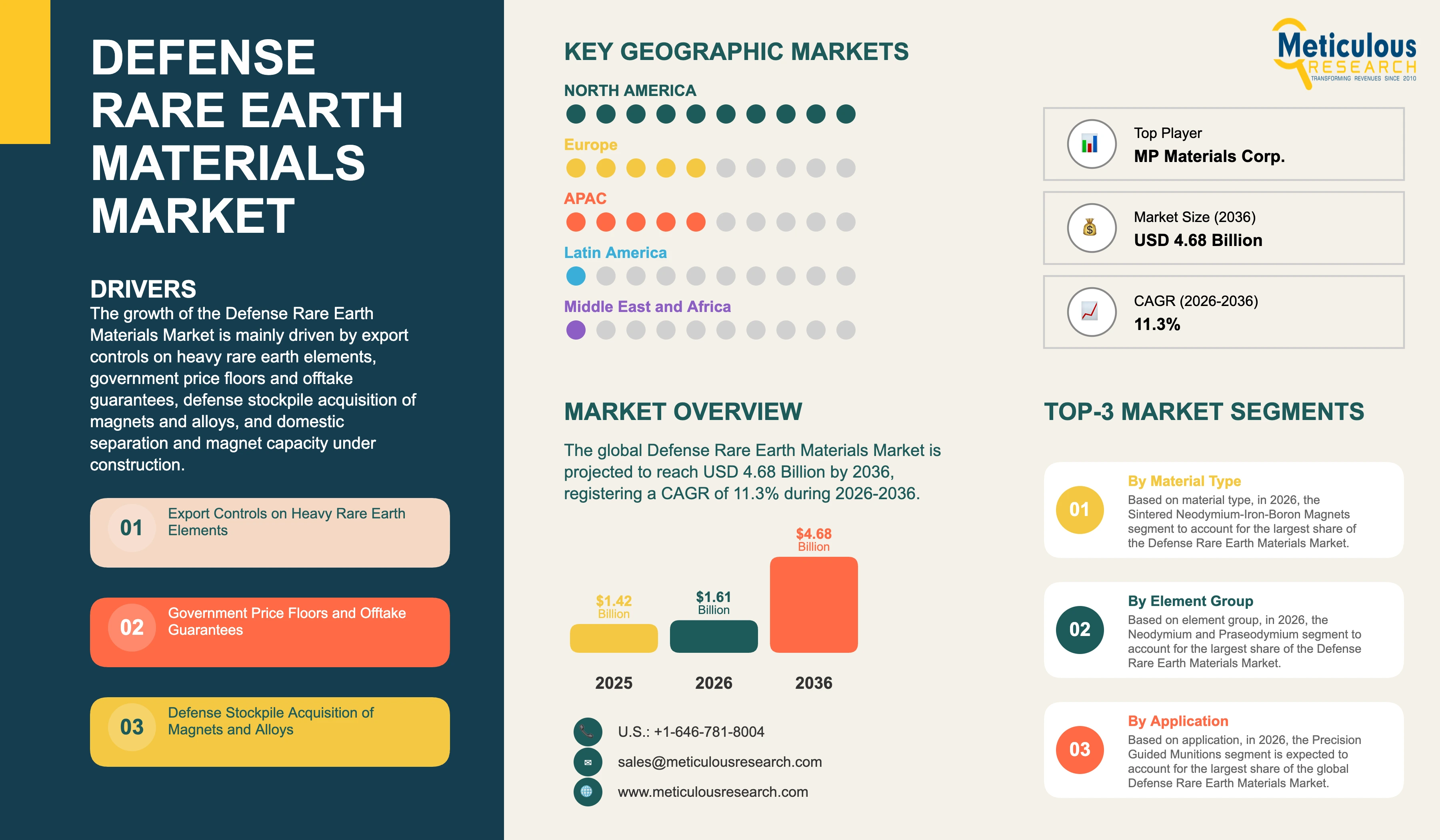
The global Defense Rare Earth Materials Market was valued at USD 1.42 billion in 2025. This market is expected to reach USD 4.68 billion by 2036 from an estimated USD 1.61 billion in 2026, registering a CAGR of 11.3% during the forecast period (2026-2036).
- Published
- Nov 2026
- Pages
- 270
- Format
- PDF + Excel
- Report ID
- MRAD - 1042846
- Base year
- 2025
- 2024 · HISTORICAL
- $168.0M
- 2036
- $4.68B
- CAGR 2026–2036
- 11.3%
2024–2025 baseline · 2026–2036 forecast at 11.3% CAGR · hover a bar for the value
Key highlights
The global Defense Rare Earth Materials Market is projected to reach USD 4.68 billion by 2036, driven by export controls on heavy rare earth elements, government price floors and offtake guarantees, defense stockpile acquisition of magnets and alloys, and domestic separation and magnet capacity under construction.
North America is expected to account for the largest market share in 2026 and is also projected to register the fastest growth during the forecast period, supported by the concentration of precision munitions, radar, aircraft and naval programs in the region together with the government instruments and domestic capacity being built to supply them.
By material type, Sintered Neodymium-Iron-Boron Magnets are expected to account for the largest market share, whereas Samarium-Cobalt Magnets are projected to witness the fastest growth through 2036.
By element group, Neodymium and Praseodymium are expected to account for the largest market share, whereas Dysprosium and Terbium are projected to witness the fastest growth through 2036.
By application, Precision Guided Munitions are expected to account for the largest market share, whereas Military Satellites and Space Systems are projected to witness the fastest growth through 2036.
China tightened export controls on samarium, gadolinium, terbium, dysprosium, lutetium, scandium and yttrium in April 2025, expanded them to europium, holmium, erbium, thulium and ytterbium in October 2025, then suspended the October controls for one year in November 2025 while the April controls remained in effect.
China produced 270, 000 tons of rare earth oxide equivalent in 2025 out of a world total of 390,000 tons and holds 44,000,000 tons of the more than 85,000,000 tons of world reserves.
United States mine production reached 51, 000 tons of rare earth oxide equivalent in 2025 valued at USD 240 million, against 45,500 tons in 2024, placing the country second to China in mine output.
Domestic production of rare earth compounds and metals rose from 120 tons in 2021 to an estimated 8,900 tons in 2025, and net import reliance fell from above 95% in 2021 and 2022 to 53% in 2024 and 67% in 2025.
Imports of rare earth compounds and metals rose 169% in 2025 while their estimated value fell to USD 165 million from USD 168 million in 2024, and leading sources over 2021 to 2024 were China including Hong Kong at 71%, Malaysia at 13%, Japan at 5% and Estonia at 5%.
The Department of Defense agreed a 10-year price floor of USD 110 per kilogram for neodymium and praseodymium products on 10 July 2025, took USD 400 million of convertible preferred stock with a warrant equal to 15% of shares outstanding at an initial conversion price of USD 30.03, and extended a USD 150 million loan for heavy rare earth separation at Mountain Pass.
Under the same agreement the Department of Defense committed for 10 years after construction to ensure that 100% of the output of a new magnet facility is purchased by defense and commercial customers, against a USD 1.0 billion construction financing commitment from JPMorgan Chase Funding and Goldman Sachs Bank USA.
The site was selected on 26 February 2026 at Northlake, Texas, a 120-acre campus representing more than USD 1.25 billion of capital investment with more than 1,500 direct jobs, commissioning from 2028 and contributing to total capacity of about 10,000 metric tons of neodymium-iron-boron magnets a year.
National defense stockpile potential acquisitions for fiscal year 2025 covered 1, 100 tons of lanthanum, 300 tons of neodymium-praseodymium oxide, 450 tons of neodymium-iron-boron magnet block and 60 tons of samarium-cobalt alloy.
Average 2025 oxide prices were USD 73 per kilogram for neodymium, USD 74 for praseodymium, USD 69 for the combined neodymium-praseodymium product, USD 30 for gadolinium, USD 27 for europium and USD 2.82 for samarium.
Report summary
| Particulars | Details |
|---|---|
| Forecast Period | 2026-2036 |
| Base Year | 2025 |
| Estimated Year | 2026 |
| CAGR (Value) | 11.3% |
| Format | PDF, Excel & Cloud Portal · 270 pages |
| CAGR (Volume) | 7.0% |
| Market Size (Value) in 2026 | USD 1.61 billion |
| Market Size (Value) in 2036 | USD 4.68 billion |
| Market Size (Volume) in 2026 | 8,950 metric tons |
| Market Size (Volume) in 2036 | 17,600 metric tons |
| Average Selling Price, 2026 | USD 180,000 per metric ton |
| Average Selling Price, 2036 | USD 266,000 per metric ton |
| Segments Covered | By Material Type: Sintered Neodymium-Iron-Boron Magnets, Samarium-Cobalt Magnets, Separated Rare Earth Oxides, Rare Earth Metals and Alloys, Other Rare Earth Materials. By Element Group: Neodymium and Praseodymium, Dysprosium and Terbium, Samarium, Yttrium and Scandium, Other Rare Earth Elements. By Application: Precision Guided Munitions, Radar and Electronic Warfare Systems, Aircraft Actuation and Flight Controls, Naval Propulsion and Sonar, Military Satellites and Space Systems, Ground Vehicles and Soldier Systems, Lasers and Optics. By Supply Source: Imported Separated Material and Magnets, Domestic Mining and Separation, Domestic Metal, Alloy and Magnet Production, Recycled and Recovered Material, Stockpiled Material. |
| Countries Covered | U.S.; Canada; Germany; France; U.K.; Italy; China; Japan; India; South Korea; Mexico; Brazil |
| Key Companies | MP Materials Corp., Lynas Rare Earths Limited, Shin-Etsu Chemical Co., Ltd., Proterial, Ltd., TDK Corporation, Neo Performance Materials Inc., and USA Rare Earth, Inc. |
Report overview
Segments covered: material type, element group, application, supply source.
In volume terms, the market is estimated at 8,950 metric tons in 2026 and is expected to reach 17,600 metric tons by 2036, registering a CAGR of 7.0% during the forecast period. The average selling price is estimated at USD 180,000 per metric ton in 2026 and USD 266,000 per metric ton in 2036.
The growth of this market is mainly driven by export controls on heavy rare earth elements imposed in April 2025 and extended in October 2025, government price floors and offtake guarantees that remove price risk from new capacity, defense stockpile acquisition of magnets and alloys, precision munitions production and inventory replenishment, and domestic separation and magnet capacity under construction. However, factors such as separation capacity concentrated in one country that produced 270,000 tons of rare earth oxide equivalent in 2025 against a world total of 390,000 tons, heavy rare earth availability for high-temperature grades, magnet qualification lead times on defense platforms, and metal, alloy and sintering capacity limits are expected to restrain the growth of this market to some extent.
Among applications, Precision Guided Munitions are expected to account for the largest market share in 2026, while Military Satellites and Space Systems are projected to register the highest CAGR during the forecast period. Geographically, North America is expected to account for the largest share of this market in 2026 and is also expected to register the highest CAGR during the forecast period.
The Defense Rare Earth Materials Market comprises rare earth materials delivered into military programs as sintered neodymium-iron-boron magnets, samarium-cobalt magnets, separated rare earth oxides, rare earth metals and alloys, and other rare earth materials, measured once at the point of delivery into a defense supply chain so that intermediate sales between separation, metallization and magnet manufacture are not counted twice. The market spans neodymium and praseodymium, dysprosium and terbium, samarium, yttrium and scandium and other elements, applied to precision guided munitions, radar and electronic warfare systems, aircraft actuation and flight controls, naval propulsion and sonar, military satellites and space systems, ground vehicles and soldier systems, and lasers and optics, supplied from imported separated material and magnets, domestic mining and separation, domestic metal, alloy and magnet production, recycled and recovered material, and stockpiled material. Rare earth mineral concentrates sold as feedstock, commercial automotive and wind magnet demand, pigments and polishing powders outside defense use, and the finished systems themselves fall outside the scope.
Access rather than availability defines this market. China tightened export controls on samarium, gadolinium, terbium, dysprosium, lutetium, scandium and yttrium in April 2025 and expanded them in October 2025 to europium, holmium, erbium, thulium and ytterbium, suspending the October measures for one year in November 2025 while the April controls remained in force and general export licenses were issued to selected exporters. Every element on the April list has a defense use that has no substitute, and the controls apply to the stage at which material becomes usable rather than to the ore.
Concentration sits in separation rather than in mining, which is where policy has been misread. China produced 270,000 tons of rare earth oxide equivalent in 2025 against a world total of 390,000 tons, yet the United States produced 51,000 tons valued at USD 240 million and is a net exporter of mineral concentrates. The constraint is the chemical separation of mixed concentrate into individual oxides and the metal, alloy and sintering steps beyond it, and that is why Domestic Metal, Alloy and Magnet Production is projected to be the fastest-growing supply source in this market at 18.4%.
Public capital has replaced price risk as the basis for new capacity. The Department of Defense agreed a 10-year floor of USD 110 per kilogram for neodymium and praseodymium products on 10 July 2025, took USD 400 million of convertible preferred stock with a warrant equal to 15% of shares outstanding at an initial conversion price of USD 30.03, lent USD 150 million for heavy rare earth separation at Mountain Pass, and committed for 10 years after construction to ensure that 100% of the output of a new magnet facility is purchased. A government that guarantees both the price and the offtake has removed the two risks that kept this capacity from being financed.
Construction is now underway rather than announced. The new magnet campus was sited on 26 February 2026 at Northlake, Texas on 120 acres, representing more than USD 1.25 billion of capital investment and more than 1,500 direct jobs, with commissioning from 2028 against a USD 1.0 billion financing commitment from JPMorgan Chase Funding and Goldman Sachs Bank USA and roughly USD 200 million of state and local incentives. Total capacity is expected at about 10,000 metric tons of neodymium-iron-boron magnets a year once complete.
Heavy elements and high-temperature chemistries carry the growth in this market. Dysprosium and Terbium is projected to be the fastest-growing element group at 13.6% because both are required to hold magnet performance at temperature and both sit under the April 2025 controls, while Samarium-Cobalt Magnets is projected to be the fastest-growing material type at 12.8% on actuation and munitions duty cycles that neodymium grades cannot meet. Samarium oxide averaged USD 2.82 per kilogram in 2025 against USD 73 for neodymium oxide, so the exposure in samarium-cobalt supply is access rather than cost.
North America is expected to account for the largest share of this market in 2026, supported by the precision munitions, radar, aircraft and naval programs that consume the material, mine production of 51,000 tons of rare earth oxide equivalent in 2025 valued at USD 240 million, and the price floor, equity, loan and offtake instruments supporting domestic separation and magnet capacity.
Europe is projected to be the fastest-growing region in this market at 12.4%. Germany grows at 12.8% on defense budget increases applied to munitions, armored vehicle, naval and aircraft programs, while France, the United Kingdom and Italy carry the missile, radar, submarine and aircraft programs that consume the material. The region holds magnet manufacture and some separation capability with little mining, so incremental demand arrives at converters dependent on imported separated material, and Estonia accounted for 5% of United States rare earth compound and metal imports over 2021 to 2024, which indicates processing capability present in the region.
The Middle East & Africa region is projected to grow at 10.0%, with demand following defense procurement and the manufacturing capability established alongside it, where magnet content arrives inside imported systems rather than as material purchased locally, and with South Africa holding 860,000 tons and Tanzania 890,000 tons of rare earth reserves so that resource development and defense consumption sit in different parts of the region. Latin America is projected to grow at 8.6% from the smallest regional base, with Brazil holding 21,000,000 tons of reserves and raising mine production to 2,000 tons of rare earth oxide equivalent in 2025 from 560 tons in 2024, and Mexico accounting for component and assembly work within North American programs.
Some of the key players operating in the defense rare earth materials market are MP Materials Corp., Lynas Rare Earths Limited, Shin-Etsu Chemical Co., Ltd., Proterial, Ltd., TDK Corporation, Neo Performance Materials Inc., and USA Rare Earth, Inc., among others.
Key strategies include integrating vertically from mine through separation to finished magnet, as in a magnet campus drawing light and heavy rare earth raw materials from a mine and separation site under the same ownership; securing government price floors, equity and offtake commitments to finance capacity, as in the 10-year USD 110 per kilogram floor and the commitment covering 100% of new facility output agreed on 10 July 2025; adding heavy rare earth separation where concentration is greatest, supported by a USD 150 million loan at Mountain Pass; developing grain boundary diffusion and recycling routes that reduce heavy element consumption; and qualifying material on defense platforms ahead of capacity commissioning in 2028.
Report infographic
Market dynamics
20 factors across 5 forcesExport Controls on Heavy Rare Earth Elements
China tightened export controls on samarium, gadolinium, terbium, dysprosium, lutetium, scandium and yttrium in April 2025, expanded them in October 2025 to europium, holmium, erbium, thulium and ytterbium, and suspended the October measures for one year in November 2025 while the April controls remained in effect and general export licenses were issued to selected exporters. The country produced 270,000 tons of rare earth oxide equivalent in 2025 out of a world total of 390,000 tons. Terbium and dysprosium hold magnet coercivity at temperature, samarium is the basis of the high-temperature magnet chemistry, and yttrium and scandium serve coatings, lasers and alloys, so the April list reads as a list of defense-critical elements. Dysprosium and Terbium is projected to be the fastest-growing element group in this market at 13.6%, and the growth is a function of securing supply rather than of rising consumption.
Government Price Floors and Offtake Guarantees
On 10 July 2025 the Department of Defense agreed a 10-year price floor of USD 110 per kilogram for neodymium and praseodymium products stockpiled or sold, took USD 400 million of convertible preferred stock together with a warrant equal to 15% of common shares outstanding at an initial conversion and exercise price of USD 30.03, and committed for 10 years after construction to ensure that 100% of the output of a new magnet facility is purchased by defense and commercial customers with shared upside. Neodymium oxide averaged USD 73 per kilogram in 2025 and the combined neodymium-praseodymium product USD 69, so the floor sits materially above the prevailing price. Removing price and offtake risk at once is what allowed a USD 1.0 billion construction financing commitment to be raised from commercial banks, and it is the instrument other governments are now examining.
Defense Stockpile Acquisition of Magnets and Alloys
National defense stockpile potential acquisitions for fiscal year 2025 covered 1,100 tons of lanthanum, 300 tons of neodymium-praseodymium oxide, 450 tons of neodymium-iron-boron magnet block and 60 tons of samarium-cobalt alloy. The list reaches past oxides into magnet block and finished alloy, which is the form a program actually consumes. Buying magnet block rather than oxide shortens the time between a supply interruption and a usable part, since separation, metallization and sintering all sit between the two. Stockpiled Material is a small part of this market in 2026 and grows at 12.2%, and the acquisition pattern is the clearest published indication of which forms defense buyers regard as the binding constraint.
Precision Munitions Production and Inventory Replenishment
Precision Guided Munitions holds the largest application share of this market in 2026 because the magnets in a seeker, a fin actuation system and a control section are expended with the round rather than recovered, so consumption tracks production and expenditure rather than fleet size. Replenishment of inventories drawn down since 2022 proceeds alongside new program starts. A munition consumes a small mass of magnet material and a large amount of qualification, which is why value in this market grows at 11.3% against tonnage at 7.0%. Rates that had been set by peacetime training consumption are now set by replenishment schedules, and those schedules are contracted years forward.
Domestic Separation and Magnet Capacity Construction
The new magnet campus was sited on 26 February 2026 at Northlake, Texas, a 120-acre site representing more than USD 1.25 billion of capital investment with more than 1,500 direct manufacturing and engineering jobs, commissioning from 2028 and drawing light and heavy rare earth raw materials from Mountain Pass, California. A USD 150 million loan supports heavy rare earth separation at that site. Domestic production of rare earth compounds and metals rose from 120 tons in 2021 to an estimated 8,900 tons in 2025, and net import reliance fell from above 95% to 67% over the same period. Domestic Metal, Alloy and Magnet Production is projected to grow at 18.4% in this market, the fastest of any supply source, from a base that barely existed five years earlier.
Table of contents
12 chapters · 143 sections · 270 pages · click to expandSegmental analysis
| Segment | Largest share (2026) | Fastest growth (2026–2036) |
|---|---|---|
| By Material Type | Sintered Neodymium-Iron-Boron Magnets | Samarium-Cobalt Magnets |
| By Element Group | Neodymium and Praseodymium | Dysprosium and Terbium |
| By Application | Precision Guided Munitions | Military Satellites and Space Systems |
| By Supply Source | Imported Separated Material and Magnets | Domestic Metal, Alloy and Magnet Production |
| Other segments | Neodymium and Praseodymium | — |
By Material Type
- Defense Rare Earth Materials Market Analysis by Material Type
- Sintered Neodymium-Iron-Boron Magnets are expected to account for the largest share of the global Defense Rare Earth Materials Market.
- The large share of this segment is mainly due to the energy density these magnets deliver across actuation, radar, propulsion and seeker applications, which makes them the default chemistry on most defense part numbers, together with the capacity of about 10,000 metric tons a year being built toward commissioning from 2028.
- However, Samarium-Cobalt Magnets are projected to register the highest CAGR during the forecast period.
- The rapid growth of this segment is attributed to actuation and munitions duty cycles reaching temperatures at which neodymium grades lose coercivity, with samarium under the export controls imposed in April 2025 so that access rather than cost governs supply.
- Sintered Neodymium-Iron-Boron Magnets are expected to account for the largest market share in 2026.
- Samarium-Cobalt Magnets are projected to register the highest CAGR during the forecast period, owing to actuation and munitions duty cycles reaching temperatures at which neodymium grades lose coercivity, with samarium under the export controls imposed in April 2025 so that access rather than cost governs supply.
- Dysprosium and Terbium are projected to register the highest CAGR during the forecast period, owing to the requirement for both elements to hold magnet coercivity at the temperatures defense systems reach, their low concentrations in most deposits requiring additional separation stages, and their inclusion in the controls imposed in April 2025.
- Military Satellites and Space Systems are projected to register the highest CAGR during the forecast period, owing to satellite and launch manufacture moving from one-off builds to repeating production, where reaction wheels, actuators and traveling wave tubes each require magnet material qualified for vacuum and temperature extremes.
- Domestic Metal, Alloy and Magnet Production are projected to register the highest CAGR during the forecast period, owing to domestic compound and metal production rising from 120 tons in 2021 to an estimated 8,900 tons in 2025 alongside magnet capacity of about 10,000 metric tons a year under construction at a capital cost above USD 1.25 billion for one campus.
By Element Group
- Defense Rare Earth Materials Market Analysis by Element Group
- Neodymium and Praseodymium are expected to account for the largest market share.
- The large share of this segment is mainly due to the mass of these elements in every sintered magnet and the price they carry, with neodymium oxide averaging USD 73 per kilogram and praseodymium USD 74 in 2025 against a contracted floor of USD 110 for the combined product.
- However, Dysprosium and Terbium are projected to register the highest CAGR during the forecast period.
- The rapid growth of this segment is attributed to the requirement for both elements to hold magnet coercivity at the temperatures defense systems reach, their low concentrations in most deposits requiring additional separation stages, and their inclusion in the controls imposed in April 2025.
By Application
- Defense Rare Earth Materials Market Analysis by Application
- Precision Guided Munitions are expected to account for the largest market share.
- The large share of this segment is mainly due to magnets in seekers, fin actuation systems and control sections being expended with the round rather than recovered, so consumption follows production and expenditure, with inventory replenishment running alongside new program starts.
- However, Military Satellites and Space Systems are projected to register the highest CAGR during the forecast period.
- The rapid growth of this segment is attributed to satellite and launch manufacture moving from one-off builds to repeating production, where reaction wheels, actuators and traveling wave tubes each require magnet material qualified for vacuum and temperature extremes.
By Supply Source
- Defense Rare Earth Materials Market Analysis by Supply Source
- Imported Separated Material and Magnets are expected to account for the largest market share.
- The large share of this segment is mainly due to leading import sources accounting for the majority of rare earth compound and metal supply over 2021 to 2024, led by China including Hong Kong at 71%, with imports rising 169% in 2025 as inventory was built ahead of controls.
- However, Domestic Metal, Alloy and Magnet Production are projected to register the highest CAGR during the forecast period.
- The rapid growth of this segment is attributed to domestic compound and metal production rising from 120 tons in 2021 to an estimated 8,900 tons in 2025 alongside magnet capacity of about 10,000 metric tons a year under construction at a capital cost above USD 1.25 billion for one campus.
Other segments
- Neodymium and Praseodymium are expected to account for the largest market share in 2026.
- Precision Guided Munitions are expected to account for the largest market share in 2026.
- Imported Separated Material and Magnets are expected to account for the largest market share in 2026.
Geographic analysis
North America
Largest shareNorth America is expected to account for the largest share of this market in 2026 and is projected to grow at 11.2%. The United States holds the precision munitions, radar, aircraft and naval programs that consume the material and the government instruments being used to supply them, including a 10-year price floor of USD 110 per kilogram agreed on 10 July 2025, a USD 400 million convertible preferred investment, a USD 150 million loan for heavy rare earth separation at Mountain Pass and an offtake commitment covering the full output of a new magnet facility. Mine production reached 51,000 tons of rare earth oxide equivalent in 2025 valued at USD 240 million, and the magnet campus sited at Northlake, Texas on 26 February 2026 represents more than USD 1.25 billion of investment. Canadian demand follows component supply and separation development. Mexico accounts for component and assembly work within North American programs. Regional defense consumption follows aircraft and naval procurement rather than domestic magnet manufacture.
Europe
Fastest growthEurope is projected to be the fastest-growing region in this market at 12.4%. Germany grows at 12.8% on defense budget increases applied to munitions, armored vehicle, naval and aircraft programs, and the region holds magnet manufacture and some separation capability with little mining, so incremental demand arrives at converters dependent on imported separated material. Estonia accounted for 5% of United States rare earth compound and metal imports over 2021 to 2024, which indicates processing capability present in the region. France, the United Kingdom and Italy carry the missile, radar, submarine and aircraft programs that consume the material. Europe is projected to register the highest CAGR at 12.4%, as rising defense budgets are applied to munitions, armored vehicle, naval and aircraft programs across a region holding magnet manufacture and some separation capability with little mining, with Germany growing at 12.8%.
Asia-Pacific
Asia-Pacific is projected to grow at 10.8% and holds the separation and magnet capacity on which other regions depend. China produced 270,000 tons of rare earth oxide equivalent in 2025 against a world total of 390,000 tons and administers the export controls imposed in April 2025 and extended in October 2025. Japan accounted for 5% of United States compound and metal imports over 2021 to 2024 and is projected to be the slowest-growing country in this market at 8.0%, where magnet manufacture is long established and defense consumption is small relative to that base. India is projected to be the fastest-growing country at 14.2% as indigenous missile, radar and naval programs scale alongside domestic separation development.
Latin America
Latin America is projected to grow at 8.6% from the smallest regional base in this market. Brazil holds 21,000,000 tons of rare earth reserves, the second largest national total after China, and raised mine production to 2,000 tons of rare earth oxide equivalent in 2025 from 560 tons in 2024, so the regional position is a resource position rather than a defense consumption position.
Middle East & Africa
The Middle East & Africa region is projected to grow at 10.0%. Demand follows defense procurement and the manufacturing capability established alongside it, where magnet content arrives inside imported systems rather than as material purchased locally. South Africa holds 860,000 tons and Tanzania 890,000 tons of rare earth reserves, so resource development and defense consumption sit in different parts of the region. Local programs entering production carry qualification requirements on material origin that regional supply cannot yet satisfy.
Competitive landscape
The global Defense Rare Earth Materials Market is consolidated, with competition among integrated mine-to-magnet producers, separation and processing specialists and established magnet manufacturers. Market participants compete primarily on separation capability across light and heavy elements, magnet qualification records held on defense platforms, control of metal and alloy conversion capacity, origin traceability for domestic sourcing requirements, and contracted price and offtake terms.
integrating vertically from mine through separation to finished magnet, securing government price floors, equity and offtake commitments to finance capacity, adding heavy rare earth separation where concentration is greatest, developing grain boundary diffusion and recycling routes that reduce heavy element consumption, and qualifying material on defense platforms ahead of capacity commissioning
The report provides a comprehensive competitive assessment of the leading companies operating in the global Defense Rare Earth Materials Market. The key players profiled in the report include MP Materials Corp. (U.S.), Lynas Rare Earths Limited (Australia), Shin-Etsu Chemical Co., Ltd. (Japan), Proterial, Ltd. (Japan), TDK Corporation (Japan), Neo Performance Materials Inc. (Canada), and USA Rare Earth, Inc. (U.S.).
- MP Materials Corp.
- Lynas Rare Earths Limited
- Shin-Etsu Chemical Co., Ltd.
- Proterial, Ltd.
- TDK Corporation
- Neo Performance Materials Inc.
- USA Rare Earth, Inc
Expert perspectives
Every element named in the April 2025 export controls has a defense use for which no substitute is qualified, and the controls apply to separation and beyond rather than to the ore. The United States mined 51,000 tons of rare earth oxide equivalent in 2025 and remains a net exporter of mineral concentrates while importing the compounds and metals that concentrate becomes, which locates the vulnerability precisely. Programs buying magnets rather than oxides are exposed at every stage between the two.
The financing model has changed and that is the development with the longest consequences. A 10-year floor of USD 110 per kilogram against a 2025 average of USD 69 for the combined neodymium-praseodymium product, USD 400 million of convertible preferred stock with a warrant worth 15% of the company, a USD 150 million separation loan and a commitment covering 100% of a new facility output for 10 years together removed the price and demand risk that had kept this capacity unfinanced. Commercial banks then committed USD 1.0 billion, and a 120-acre campus was sited at Northlake, Texas on 26 February 2026 at more than USD 1.25 billion.
Capacity arriving in 2028 is not supply available in 2028, and buyers should plan on that basis. A magnet enters a defense platform against a material specification and a named supplier, so qualification follows commissioning rather than preceding it, and the elements that hold performance at temperature remain the scarce ones. Dysprosium and Terbium grows at 13.6% in this market and Samarium-Cobalt Magnets at 12.8% while tonnage overall grows at 7.0%, and the stockpile acquisition list reaching into magnet block and samarium-cobalt alloy rather than stopping at oxide reflects the same judgment.
Customer perspectives
“We do not buy dysprosium, we buy a qualified magnet to a part number, and that magnet has a named supplier behind it. When an element two steps upstream goes under license, the first thing we learn is that a delivery slipped, not that a control changed. We have started asking suppliers where every element in the alloy was separated, which is a question nobody used to answer.”
“Oxide is the easy part of this problem. Turning it into metal, then strip cast alloy, then a pressed and sintered magnet takes four separate plants and people who have done it before, and that is what nobody outside Asia has at scale. Money has arrived for the magnet plants. The metallization step in the middle is still where the queue forms.”
“A price floor and an offtake guarantee are worth more to this industry than a grant, because what stopped investment was never the capital cost, it was the risk that prices collapse once the plant is running. We took equity so the taxpayer shares the upside if that does not happen. The part we still have to solve is qualification, because a plant starting in 2028 is not approved material in 2028.”
Frequently asked questions
The global Defense Rare Earth Materials Market is estimated at USD 1.61 billion in 2026.
The market is projected to reach USD 4.68 billion by 2036.
The market is expected to grow at a CAGR of 11.3% during 2026-2036.
Growth is driven by export controls on heavy rare earth elements, government price floors and offtake guarantees, and defense stockpile acquisition reaching into magnet block and samarium-cobalt alloy. Precision munitions production and inventory replenishment and domestic capacity construction also contribute, with Domestic Metal, Alloy and Magnet Production growing at 18.4%.
China tightened export controls on samarium, gadolinium, terbium, dysprosium, lutetium, scandium and yttrium in April 2025, and expanded them in October 2025 to europium, holmium, erbium, thulium and ytterbium. In November 2025 it suspended the October controls for one year while the April controls remained in effect, and began issuing general export licenses to selected exporters.
On 10 July 2025 the Department of Defense agreed a 10-year price floor of USD 110 per kilogram for neodymium and praseodymium products, purchased USD 400 million of convertible preferred stock with a warrant equal to 15% of common shares outstanding, and extended a USD 150 million loan for heavy rare earth separation at Mountain Pass. It also committed for 10 years after construction to ensure 100% of a new magnet facility's output is purchased, alongside a USD 1.0 billion construction financing commitment from JPMorgan Chase Funding and Goldman Sachs Bank USA.
The new magnet campus sited on 26 February 2026 at Northlake, Texas represents more than USD 1.25 billion of capital investment, with commissioning from 2028 and total capacity of about 10,000 metric tons of neodymium-iron-boron magnets a year. Domestic production of rare earth compounds and metals rose from 120 tons in 2021 to an estimated 8,900 tons in 2025.
The principal challenges are separation capacity concentrated in one country, heavy rare earth availability for high-temperature grades, and magnet qualification lead times. Metal, alloy and sintering capacity between oxide and finished magnet, and traceability of element origin through several conversion steps, are also challenges.
Emerging technologies include grain boundary diffusion, which reduces dysprosium and terbium content for the same temperature performance, and samarium-cobalt and other high-temperature magnet chemistries growing at 12.8%. Magnet recycling and swarf recovery growing at 14.6%, solvent extraction and alternative separation routes, and motor architectures that reduce or avoid permanent magnets are also named.
China's export controls of April 2025 cover seven elements, with an October 2025 expansion to five more suspended for one year in November 2025 while the April controls remained in effect. Domestic sourcing requirements apply to the origin of magnet material in defense articles rather than the location of final assembly, placing traceability obligations through separation, alloying and sintering.
Sintered Neodymium-Iron-Boron Magnets are expected to account for the largest market share in 2026.
Samarium-Cobalt Magnets are projected to register the highest CAGR during the forecast period, owing to actuation and munitions duty cycles reaching temperatures at which neodymium grades lose coercivity, with samarium under the April 2025 export controls so that access rather than cost governs supply.
Neodymium and Praseodymium are expected to account for the largest market share in 2026.
Dysprosium and Terbium are projected to register the highest CAGR during the forecast period, owing to the requirement for both elements to hold magnet coercivity at defense temperatures, their low concentrations in most deposits, and their inclusion in the April 2025 controls.
Precision Guided Munitions are expected to account for the largest market share in 2026.
Military Satellites and Space Systems are projected to register the highest CAGR during the forecast period, owing to satellite and launch manufacture moving from one-off builds to repeating production, where reaction wheels, actuators and traveling wave tubes each require qualified magnet material.
Imported Separated Material and Magnets are expected to account for the largest market share in 2026.
Domestic Metal, Alloy and Magnet Production are projected to register the highest CAGR during the forecast period, owing to domestic compound and metal production rising from 120 tons in 2021 to an estimated 8,900 tons in 2025 alongside magnet capacity of about 10,000 metric tons a year under construction.
North America is expected to account for the largest share of this market in 2026, supported by the precision munitions, radar, aircraft and naval programs that consume the material and by the price floor, equity, loan and offtake instruments supporting domestic capacity.
Europe is projected to register the highest CAGR at 12.4%, as rising defense budgets are applied to munitions, armored vehicle, naval and aircraft programs, with Germany growing at 12.8%.
Europe is projected to be the fastest-growing region at 12.4%, with Germany growing at 12.8%. The region holds magnet manufacture and some separation capability with little mining, so incremental demand arrives at converters dependent on imported separated material.
The Middle East & Africa region is projected to grow at 10.0%, with magnet content arriving inside imported systems rather than as material purchased locally. Latin America is projected to grow at 8.6% from the smallest regional base, with Brazil holding 21,000,000 tons of reserves.
Some of the key players are MP Materials Corp., Lynas Rare Earths Limited, Shin-Etsu Chemical Co., Ltd., Proterial, Ltd., TDK Corporation, Neo Performance Materials Inc., and USA Rare Earth, Inc., among others.
Key strategies include integrating vertically from mine through separation to finished magnet, securing government price floors, equity and offtake commitments to finance capacity, and adding heavy rare earth separation. Companies are also developing grain boundary diffusion and recycling routes and qualifying material on defense platforms ahead of capacity commissioning in 2028.
Cite this report
Meticulous Research. (2026). Defense Rare Earth Materials Market - Global Opportunity Analysis and Industry Forecast (2026-2036) (Report No. MRAD - 1042846). Meticulous Market Research Pvt. Ltd. https://www.meticulousresearch.com/product/defense-rare-earth-materials-market-7529