Defense Titanium Market (2026-2036)
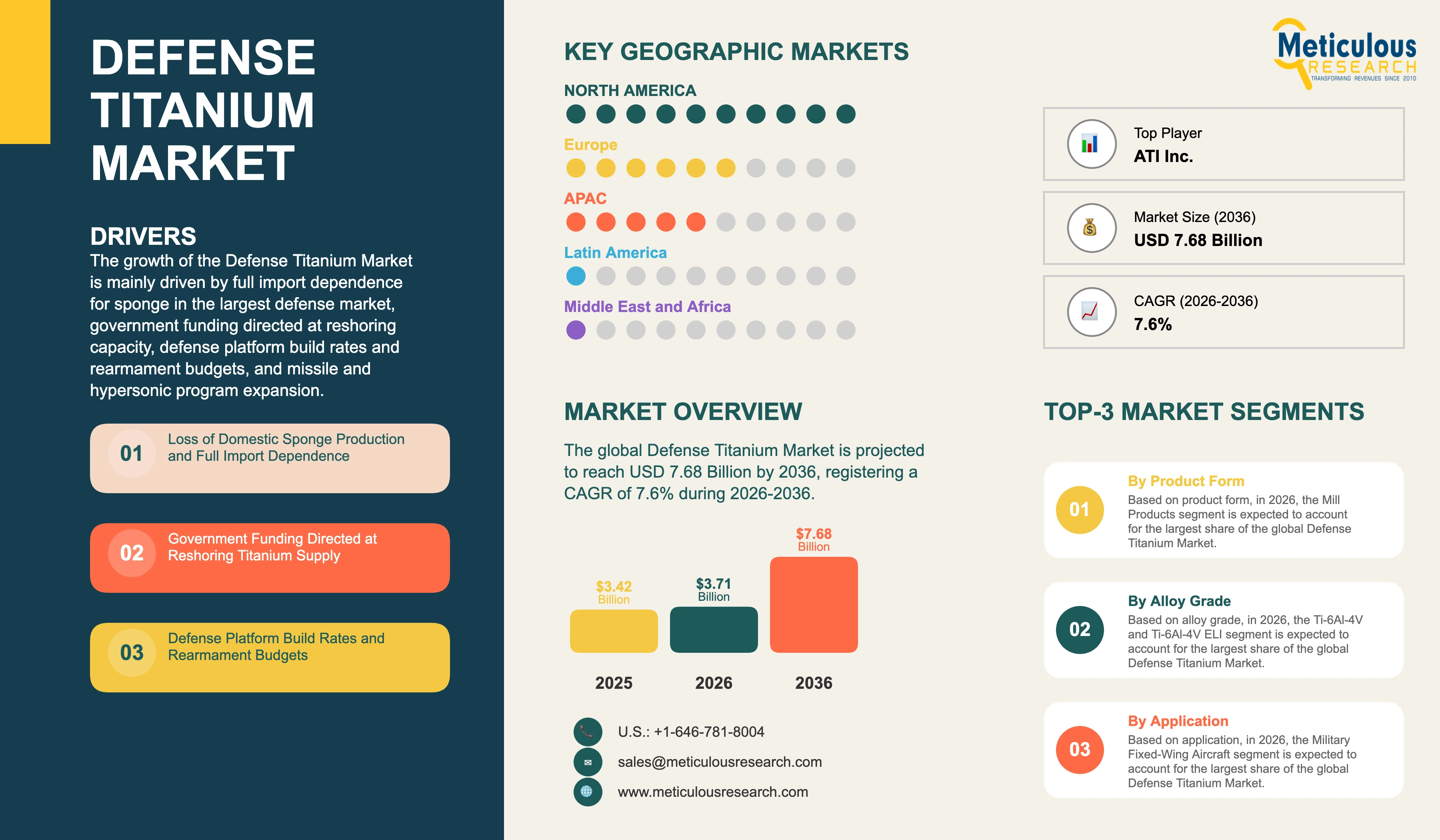
The global Defense Titanium Market was valued at USD 3.42 billion in 2025. This market is expected to reach USD 7.68 billion by 2036 from an estimated USD 3.71 billion in 2026, registering a CAGR of 7.6% during the forecast period (2026-2036).
- Published
- Nov 2026
- Pages
- 258
- Format
- PDF + Excel
- Report ID
- MRAD - 1042843
- Base year
- 2025
- 2025 · BASELINE
- $3.42B
- 2036
- $7.68B
- CAGR 2026–2036
- 7.6%
2025 baseline · 2026–2036 forecast at 7.6% CAGR · hover a bar for the value
Key highlights
The global Defense Titanium Market is projected to reach USD 7.68 billion by 2036, driven by full import dependence for sponge in the largest defense market, government funding directed at reshoring capacity, military platform build rates and rearmament budgets, and missile and hypersonic program expansion.
North America is expected to account for the largest market share in 2026 and is also projected to register the fastest growth during the forecast period, supported by the concentration of military aircraft, naval and missile manufacture in the region together with the largest base of titanium melting, forging and mill product conversion capacity serving defense programs.
By product form, Mill Products are expected to account for the largest market share, whereas Powder and Additive Feedstock are projected to witness the fastest growth through 2036.
By alloy grade, Ti-6Al-4V and Ti-6Al-4V ELI are expected to account for the largest market share, whereas High-Strength Beta and Near-Beta Alloys are projected to witness the fastest growth through 2036.
By application, Military Fixed-Wing Aircraft are expected to account for the largest market share, whereas Missiles, Munitions and Hypersonic Systems are projected to witness the fastest growth through 2036.
The United States produced no titanium sponge in 2025 and the last domestic sponge plant closed in 2024, taking net import reliance for sponge to 100% from above 95% over 2021 to 2024.
Sponge imports for consumption reached an estimated 44, 000 metric tons in 2025 against 39,800 metric tons in 2024, at a customs value of about USD 460 million compared with USD 447 million.
Sponge import sources through July 2025 were Japan at 73%, Kazakhstan at 13% and Saudi Arabia at 13%, so three supplying countries account for the whole of the delivered volume.
Two idle domestic sponge plants remain in place, at Henderson, Nevada with 12,600 tons per year of capacity idle since 2020 and at Rowley, Utah with 10,900 tons per year idle since 2016.
IperionX was awarded a Department of Defense Small Business Innovation Research Phase III indefinite delivery, indefinite quantity contract on 5 June 2025 with task orders collectively capped at USD 99 million, with initial task orders focused on titanium fasteners.
A further USD 25 million was obligated on 26 September 2025 under a previously awarded USD 47.1 million Industrial Base Analysis and Sustainment award, taking total obligations to USD 42.5 million and funding capacity of up to 1,400 metric tons per year at the Titanium Manufacturing Campus in Virginia.
ATI recorded aerospace and defense sales of USD 994.5 million in the third quarter of 2026, about 69% of total sales of USD 1,423.7 million, with defense sales of USD 171.9 million.
Titanium and titanium-based alloys accounted for 16% of ATI third quarter 2026 sales against 19% a year earlier, so titanium revenue grew more slowly than the 26% recorded across the business.
Landed duty-paid sponge was priced at about USD 12 per kilogram in 2025 against USD 13.30 in 2024, while imported scrap carried an average duty-paid unit value of about USD 7.70 per kilogram through July 2025 against USD 8.50 per kilogram in 2024.
Report summary
| Particulars | Details |
|---|---|
| Forecast Period | 2026-2036 |
| Base Year | 2025 |
| Estimated Year | 2026 |
| CAGR (Value) | 7.6% |
| Format | PDF, Excel & Cloud Portal · 258 pages |
| CAGR (Volume) | 5.6% |
| Market Size (Value) in 2026 | USD 3.71 billion |
| Market Size (Value) in 2036 | USD 7.68 billion |
| Market Size (Volume) in 2026 | 80,650 metric tons |
| Market Size (Volume) in 2036 | 139,000 metric tons |
| Average Selling Price, 2026 | USD 46,000 per metric ton |
| Average Selling Price, 2036 | USD 55,250 per metric ton |
| Segments Covered | By Product Form: Mill Products, Forgings, Castings, Powder and Additive Feedstock, Sponge and Ingot. By Alloy Grade: Ti-6Al-4V and Ti-6Al-4V ELI, Commercially Pure Titanium Grades, High-Strength Beta and Near-Beta Alloys, High-Temperature Titanium Alloys, Other Alloy Grades. By Application: Military Fixed-Wing Aircraft, Military Rotorcraft, Naval Vessels and Submarines, Missiles, Munitions and Hypersonic Systems, Armor and Ground Vehicles, Military Space and Launch Systems. By Supply Source: Imported Sponge and Mill Products, Domestic Primary Production, Recycled Scrap and Revert, Stockpiled and Strategic Reserve Material. |
| Countries Covered | U.S.; Canada; Germany; France; U.K.; Italy; China; Japan; India; South Korea; Mexico; Brazil |
| Key Companies | ATI Inc., Precision Castparts Corp., Howmet Aerospace Inc., Carpenter Technology Corporation, Toho Titanium Co., Ltd., and IperionX Limited |
Report overview
Segments covered: product form, alloy grade, application, supply source.
In volume terms, the market is estimated at 80,650 metric tons in 2026 and is expected to reach 139,000 metric tons by 2036, registering a CAGR of 5.6% during the forecast period. The average selling price is estimated at USD 46,000 per metric ton in 2026 and USD 55,250 per metric ton in 2036.
The growth of this market is mainly driven by the loss of domestic sponge production in the largest defense market and the move to full import dependence, government funding directed at reshoring titanium capacity, military platform build rates and European rearmament budgets, missile, munitions and hypersonic program expansion, and naval and submarine industrial base investment. However, factors such as sponge capacity concentrated in a small number of countries, with 73% of United States sponge imports arriving from Japan through July 2025, mill product qualification lead times, the energy cost of the Kroll process, and melt and forging capacity limits ahead of demand are expected to restrain the growth of this market to some extent.
Among applications, Military Fixed-Wing Aircraft are expected to account for the largest market share in 2026, while Missiles, Munitions and Hypersonic Systems are projected to register the highest CAGR during the forecast period. Geographically, North America is expected to account for the largest share of this market in 2026 and is also expected to register the highest CAGR during the forecast period.
The Defense Titanium Market comprises titanium metal delivered into military programs in the form of mill products, forgings, castings, powder and additive feedstock, and sponge and ingot, measured once at the point of delivery into a defense supply chain so that intermediate sales between melting, conversion and forging stages are not counted twice. The market spans Ti-6Al-4V and Ti-6Al-4V ELI, commercially pure grades, high-strength beta and near-beta alloys, high-temperature alloys and other grades, applied to military fixed-wing aircraft, rotorcraft, naval vessels and submarines, missiles, munitions and hypersonic systems, armor and ground vehicles, and military space and launch systems, supplied from imported sponge and mill products, domestic primary production, recycled scrap and revert, and stockpiled and strategic reserve material. Titanium dioxide pigment, titanium mineral concentrates sold as feedstock to the pigment industry, commercial aerospace, medical, chemical processing and consumer applications, and the finished platforms themselves fall outside the scope.
Supply rather than demand defines the condition of this market. The United States produced no titanium sponge in 2025 after the last domestic sponge plant closed in 2024, which took net import reliance for sponge to 100%, and the 44,000 metric tons imported in 2025 arrived from Japan at 73%, Kazakhstan at 13% and Saudi Arabia at 13% through July. A defense ministry buying titanium for a fighter bulkhead or a submarine hull section is therefore buying the output of three national industries, none of them domestic.
Capacity to change that position exists physically but not operationally. Henderson, Nevada holds 12,600 tons per year of sponge capacity idle since 2020 and Rowley, Utah holds 10,900 tons per year idle since 2016, together more than half of 2025 import volume. Restarting a Kroll process plant is an energy and working capital decision taken against a landed sponge price of about USD 12 per kilogram in 2025, down from USD 13.30 in 2024, which is why the capacity has stayed idle through a period of widening defense demand.
Government money is being directed at the gap rather than at the idle plants. IperionX holds a Department of Defense Small Business Innovation Research Phase III indefinite delivery, indefinite quantity contract awarded on 5 June 2025 with task orders collectively capped at USD 99 million, and a USD 47.1 million Industrial Base Analysis and Sustainment award under which USD 42.5 million had been obligated by 26 September 2025 to scale capacity to up to 1,400 metric tons per year at the Titanium Manufacturing Campus in Virginia. The route being funded produces metal from minerals or scrap at lower energy and cost than the incumbent process, and Domestic Primary Production is accordingly projected to be the fastest-growing supply source in this market at 14.8%.
Scrap is the other domestic feedstock and it is already moving at scale. Imported scrap reached an estimated 32,000 metric tons in 2025 at an average duty-paid unit value of about USD 7.70 per kilogram through July, against USD 8.50 per kilogram in 2024, which places revert material at roughly two thirds of the sponge price. Recycled Scrap and Revert grows at 8.4% in this market, and the material only enters defense hardware where the melt route and the specification permit it.
Demand is being set by two different budget cycles at once. Missiles, Munitions and Hypersonic Systems is projected to be the fastest-growing application in this market at 11.2%, where consumption is expendable rather than recoverable, while Military Fixed-Wing Aircraft holds the largest application share on the weight of titanium in fighter airframes and engine hardware. ATI recorded aerospace and defense sales of USD 994.5 million in the third quarter of 2026 against total sales of USD 1,423.7 million, with defense sales of USD 171.9 million, and titanium and titanium-based alloys at 16% of sales against 19% a year earlier.
North America is expected to account for the largest share of this market in 2026, supported by the largest concentration of military aircraft, naval and missile manufacture and the deepest base of titanium melting, forging and mill product conversion capacity, against a position of no domestic sponge production in 2025 and net import reliance of 100%.
Europe is projected to be the fastest-growing region in this market at 8.2%. Germany grows at 8.8% on defense budget increases applied to armored vehicle, naval and aircraft programs, while France, the United Kingdom and Italy carry the combat aircraft, rotorcraft, submarine and missile programs that consume the material. The region holds melting, forging and mill conversion capacity without primary sponge production of its own, so incremental demand arrives at converters buying imported sponge and at scrap recovery, and the United Kingdom was the leading source of United States titanium scrap imports at 19% through July 2025.
The Middle East & Africa region is projected to grow at 7.0%, with Saudi Arabia supplying 13% of United States sponge imports through July 2025, which places primary production capacity in the region ahead of titanium consumption by its own defense industries, and demand concentrated in maintenance and overhaul of imported platforms and in capability established alongside procurement programs. Latin America is projected to grow at 5.8% from the smallest regional base, with Mexico taking a growing share through machining and component capacity alongside the Querétaro and Chihuahua clusters, and Brazilian demand following military aircraft manufacture and naval construction.
Some of the key players operating in the defense titanium market are ATI Inc., Precision Castparts Corp., Howmet Aerospace Inc., Carpenter Technology Corporation, Toho Titanium Co., Ltd., and IperionX Limited, among others.
Key strategies include securing melt source approvals on platforms before build rates rise, since qualification rather than availability governs substitution; contracting volume forward under multi-year supply agreements that reserve press time and finance capacity additions; investing in vacuum arc and electron beam melting and large press capacity, with ATI spending USD 216.6 million on property, plant and equipment in the first nine months of 2026; developing lower-energy and scrap-capable production routes with government funding support obligated against production milestones; and integrating forging and machining to capture conversion margin on material the mill already supplies.
Report infographic
Market dynamics
20 factors across 5 forcesLoss of Domestic Sponge Production and Full Import Dependence
The United States produced no titanium sponge in 2025 and the last domestic sponge plant closed in 2024, which moved net import reliance for sponge from above 95% over 2021 to 2024 to 100% in 2025. The 44,000 metric tons imported for consumption that year arrived at a customs value of about USD 460 million, against 39,800 metric tons and USD 447 million in 2024. A defense program qualified on a specific sponge source now depends on a foreign plant for a material with no domestic substitute at the primary stage. That exposure is what converts titanium from a purchasing question into an industrial base question, and it is the reason government funding has entered the market at the primary production stage rather than at conversion.
Government Funding Directed at Reshoring Titanium Supply
IperionX was awarded a Department of Defense Small Business Innovation Research Phase III indefinite delivery, indefinite quantity contract on 5 June 2025 with task orders collectively capped at USD 99 million, with initial task orders focused on titanium fasteners and later orders extending to higher-value aerospace components. A further USD 25 million was obligated on 26 September 2025 under a previously awarded USD 47.1 million Industrial Base Analysis and Sustainment award, taking total obligations to USD 42.5 million including earlier tranches of USD 12.5 million and USD 5 million, with the remaining USD 4.6 million expected over the contract term. The funded capacity target is up to 1,400 metric tons per year at the Titanium Manufacturing Campus in Virginia, produced from titanium minerals or scrap at lower energy, cost and carbon emissions than the incumbent route. Domestic Primary Production is projected to be the fastest-growing supply source in this market at 14.8%, and the pattern of obligation in tranches against production milestones is how that capacity is being paid for.
Defense Platform Build Rates and Rearmament Budgets
ATI recorded third quarter 2026 sales of USD 1,423.7 million, up 26% year over year, with aerospace and defense sales of USD 994.5 million representing about 69% of the total and defense sales of USD 171.9 million. Aerospace and defense sales within the Advanced Alloys & Solutions segment grew 34% year over year, and the company raised full-year adjusted EBITDA guidance to USD 1,190 million to USD 1,200 million. European rearmament adds a second demand cycle on top of United States procurement, and Europe is projected to be the fastest-growing region in this market at 8.2%. Titanium enters a platform at the airframe and engine design stage rather than at order, so build rate increases on existing designs convert into tonnage with a short lag and without requalification.
Missile, Munitions and Hypersonic Program Expansion
Missiles, Munitions and Hypersonic Systems is projected to be the fastest-growing application in this market at 11.2%. Titanium in a missile airframe, motor case or control actuation assembly is consumed when the round is expended rather than recovered at overhaul, so demand tracks production and expenditure rather than fleet size. Hypersonic airframes and high-temperature structures draw on high-temperature titanium alloys in particular. Replenishment of inventories drawn down since 2022 is proceeding alongside new program starts, which puts repeat annual tonnage behind what had been low-rate production. That changes the purchasing pattern from program-specific buys to recurring volume, and recurring volume is what justifies long-term supply agreements at the mill.
Naval and Submarine Industrial Base Investment
Titanium is specified in naval service for seawater corrosion resistance and for non-magnetic properties, in heat exchangers, piping, pumps, valves, fasteners and hull penetrations, and submarine construction programs carry the longest material lead times of any defense platform. Naval Vessels and Submarines is accordingly a large and steady application in this market rather than a cyclical one. Shipbuilding industrial base funding is being committed against multi-year build plans, which gives mills visibility on plate and tube requirements years ahead of fabrication. Material for a hull section is ordered against a construction schedule rather than an annual budget, so this application supports the base load that makes melting capacity viable between aircraft program peaks.
Table of contents
12 chapters · 143 sections · 258 pages · click to expandSegmental analysis
| Segment | Largest share (2026) | Fastest growth (2026–2036) |
|---|---|---|
| By Product Form | Mill Products | Powder and Additive Feedstock |
| By Alloy Grade | Ti-6Al-4V and Ti-6Al-4V ELI | High-Strength Beta and Near-Beta Alloys |
| By Application | Military Fixed-Wing Aircraft | Missiles, Munitions and Hypersonic Systems |
| By Supply Source | Imported Sponge and Mill Products | Domestic Primary Production |
| Other segments | Ti-6Al-4V and Ti-6Al-4V ELI | — |
By Product Form
- Defense Titanium Market Analysis by Product Form
- Mill Products are expected to account for the largest share of the global Defense Titanium Market.
- The large share of this segment is mainly due to the weight of bar, billet, plate, sheet and tube consumed across airframe structure, naval piping and heat exchangers and missile bodies, and the position of mill products as the form in which most qualified material is delivered to defense fabricators.
- However, Powder and Additive Feedstock are projected to register the highest CAGR during the forecast period.
- The rapid growth of this segment is attributed to the removal of machining loss that forged and plate-machined titanium components carry, together with the use of additive routes to produce spares for which no forging die remains.
- Mill Products are expected to account for the largest market share in 2026.
- Powder and Additive Feedstock are projected to register the highest CAGR during the forecast period, owing to the removal of machining loss that forged and plate-machined titanium components carry, together with the use of additive routes to produce spares for which no forging die remains.
- High-Strength Beta and Near-Beta Alloys are projected to register the highest CAGR during the forecast period, owing to the substitution of beta and near-beta grades for high-strength steel in landing gear and highly loaded airframe fittings, where weight and corrosion performance justify the cost of the change.
- Missiles, Munitions and Hypersonic Systems are projected to register the highest CAGR during the forecast period, owing to consumption of titanium in missile airframes, motor cases and control actuation assemblies being expended with the round rather than recovered at overhaul, alongside inventory replenishment and hypersonic program starts.
- Imported Sponge and Mill Products are expected to account for the largest market share in 2026.
- Domestic Primary Production are projected to register the highest CAGR during the forecast period, owing to government funding placed at the primary production stage, including a USD 47.1 million Industrial Base Analysis and Sustainment award supporting capacity of up to 1,400 metric tons per year, against a base of effectively zero domestic output.
By Alloy Grade
- Defense Titanium Market Analysis by Alloy Grade
- Ti-6Al-4V and Ti-6Al-4V ELI are expected to account for the largest market share.
- The large share of this segment is mainly due to the position of Ti-6Al-4V as the general-purpose structural titanium alloy approved on more defense part numbers than any other grade, supported by an established supply base and the widest range of available product forms.
- However, High-Strength Beta and Near-Beta Alloys are projected to register the highest CAGR during the forecast period.
- The rapid growth of this segment is attributed to the substitution of beta and near-beta grades for high-strength steel in landing gear and highly loaded airframe fittings, where weight and corrosion performance justify the cost of the change.
By Application
- Defense Titanium Market Analysis by Application
- Military Fixed-Wing Aircraft are expected to account for the largest market share.
- The large share of this segment is mainly due to the quantity of titanium carried in fighter airframes, bulkheads, engine hardware and fasteners, and the build rates of combat aircraft programs in production across several countries at once.
- However, Missiles, Munitions and Hypersonic Systems are projected to register the highest CAGR during the forecast period.
- The rapid growth of this segment is attributed to consumption of titanium in missile airframes, motor cases and control actuation assemblies being expended with the round rather than recovered at overhaul, alongside inventory replenishment and hypersonic program starts.
By Supply Source
- Defense Titanium Market Analysis by Supply Source
- Imported Sponge and Mill Products are expected to account for the largest market share.
- The large share of this segment is mainly due to the absence of United States sponge production in 2025 and net import reliance of 100%, with 44,000 metric tons imported for consumption at a customs value of about USD 460 million.
- However, Domestic Primary Production are projected to register the highest CAGR during the forecast period.
- The rapid growth of this segment is attributed to government funding placed at the primary production stage, including a USD 47.1 million Industrial Base Analysis and Sustainment award supporting capacity of up to 1,400 metric tons per year, against a base of effectively zero domestic output.
Other segments
- Ti-6Al-4V and Ti-6Al-4V ELI are expected to account for the largest market share in 2026.
- Military Fixed-Wing Aircraft are expected to account for the largest market share in 2026.
Geographic analysis
North America
Largest shareNorth America is expected to account for the largest share of this market in 2026 and is projected to grow at 7.4%. The United States holds the largest concentration of military aircraft, naval and missile manufacture together with the deepest base of titanium melting, forging and mill product conversion capacity, and it produced no titanium sponge in 2025 after the last domestic sponge plant closed in 2024. Net import reliance for sponge reached 100%, with 44,000 metric tons imported for consumption at a customs value of about USD 460 million, and two idle plants remain at Henderson, Nevada with 12,600 tons per year of capacity and Rowley, Utah with 10,900 tons per year. Canadian demand follows component and structural supply into United States programs. Mexico accounts for a growing share through machining and component capacity built alongside the aerospace clusters in Querétaro and Chihuahua, where titanium parts are produced for delivery into North American programs. Brazilian demand follows military aircraft manufacture and naval construction, including the submarine program. Regional consumption is concentrated in conversion and machining rather than in melting, so material arrives as qualified mill product from outside the region.
Europe
Fastest growthEurope is projected to be the fastest-growing region in this market at 8.2%. Germany grows at 8.8% on defense budget increases applied to armored vehicle, naval and aircraft programs, and the region holds melting, forging and mill conversion capacity without primary sponge production of its own, so incremental demand arrives at converters buying imported sponge and at scrap recovery. France, the United Kingdom and Italy carry the combat aircraft, rotorcraft, submarine and missile programs that consume the material, and the United Kingdom was the leading source of United States titanium scrap imports at 19% through July 2025. Europe is projected to register the highest CAGR at 8.2%, as rising defense budgets are applied to armored vehicle, naval, rotorcraft and combat aircraft programs across a region holding melting, forging and mill conversion capacity but no primary sponge production, with Germany growing at 8.8%.
Asia-Pacific
Asia-Pacific is projected to grow at 8.1% and holds the primary sponge capacity on which other regions depend. Japan supplied 73% of United States sponge imports through July 2025 and is projected to be the slowest-growing country in this market at 4.6%, where domestic defense consumption is small relative to the production base. China holds the largest regional consumption across its own military programs and a substantial domestic mill product industry. India is projected to be the fastest-growing country at 10.2% as indigenous aircraft, naval and missile programs move into production and domestic titanium conversion capability is built alongside them, and South Korea follows its combat aircraft and shipbuilding programs.
Latin America
Latin America is projected to grow at 5.8% from the smallest regional base in this market.
Middle East & Africa
The Middle East & Africa region is projected to grow at 7.0%. Saudi Arabia supplied 13% of United States sponge imports through July 2025, which places primary production capacity in the region ahead of titanium consumption by its own defense industries. Demand is concentrated in maintenance and overhaul of imported platforms and in manufacturing capability established alongside defense procurement programs, where titanium content follows the platforms being assembled or sustained locally rather than domestic design work.
Competitive landscape
The global Defense Titanium Market is consolidated, with competition among integrated specialty metals producers, titanium sponge and primary metal producers, and forging and component groups holding their own melting capacity. Market participants compete primarily on melt source approvals held on defense platforms, alloy and product form range, melting and large press capacity, delivery performance against multi-year agreements, and the ability to supply qualified material from domestic or allied sources.
securing melt source approvals on platforms before build rates rise, contracting volume forward under multi-year supply agreements, investing in vacuum arc and electron beam melting and large press capacity, developing lower-energy and scrap-based production routes with government funding support, and integrating forging and machining to capture conversion margin
The report provides a comprehensive competitive assessment of the leading companies operating in the global Defense Titanium Market. The key players profiled in the report include ATI Inc. (U.S.), Precision Castparts Corp. (U.S.), Howmet Aerospace Inc. (U.S.), Carpenter Technology Corporation (U.S.), Toho Titanium Co., Ltd. (Japan), and IperionX Limited (Australia).
- ATI Inc.
- Precision Castparts Corp.
- Howmet Aerospace Inc.
- Carpenter Technology Corporation
- Toho Titanium Co., Ltd.
- IperionX Limited
Expert perspectives
The largest defense market in the world produced no titanium sponge in 2025, closed its last domestic plant in 2024 and bought 44,000 metric tons from three countries, of which Japan supplied 73% through July. That is the fact from which every other conclusion in this market follows, because qualification is held at the melt source and a program approved against a foreign plant cannot be re-sourced domestically when nothing domestic exists. Buyers facing that position are contracting volume forward rather than purchasing against programs.
Idle capacity is not the answer the market is choosing, and the price explains why. Henderson holds 12,600 tons per year idle since 2020 and Rowley 10,900 tons per year idle since 2016, together more than half of 2025 import volume, while landed sponge fell to about USD 12 per kilogram in 2025 from USD 13.30 in 2024. Government money has instead gone to a lower-energy production route, with USD 42.5 million of a USD 47.1 million Industrial Base Analysis and Sustainment award obligated by 26 September 2025 against capacity of up to 1,400 metric tons per year and a separate contract capped at USD 99 million. Domestic Primary Production grows at 14.8% in this market, and that growth is policy-funded rather than price-led.
Value in this market is moving faster than tonnage and the mix is the reason. Volume grows at 5.6% against value at 7.6%, average realized value rises from USD 46,000 per metric ton in 2026 to USD 55,250 in 2036, and the fast segments are Powder and Additive Feedstock at 13.4%, Missiles, Munitions and Hypersonic Systems at 11.2% and High-Strength Beta and Near-Beta Alloys at 9.6%. Suppliers positioned on qualified alloy approvals and large press capacity capture that shift, while those selling commercial-grade tonnage into defense do not.
Customer perspectives
Insights gathered during primary interviews with specialty metals producers, defense prime material and supply chain managers, forging and component suppliers, and government industrial base program offices operating in this market highlight where specification priorities are shifting. The following perspectives reflect recurring themes raised across these discussions.
This reflects melt source qualification rather than availability being the binding constraint, which pushes buyers toward multi-year forward contracting instead of inventory held against spot purchasing.
This indicates that forging and press capacity rather than feedstock limits delivery, and that long-term agreements are the mechanism by which capacity additions are financed.
This points to funding being directed at lower-energy and scrap-capable production rather than at restarting Kroll capacity, with obligations released against production milestones.
“Our titanium is qualified against a melt source, and the melt source for a good part of it is outside this country. When people talk about resilience they usually mean holding more inventory, but the real exposure is that we cannot switch suppliers without requalifying the part. That takes quarters, not weeks, so we buy years forward instead.”
“Press time is the scarce asset, not metal. We can buy sponge and we can melt it, but the large press slots are booked and defense sections compete with commercial engine work for the same hours. Multi-year agreements are what let us commit capital to another furnace, because nobody adds that capacity on the strength of an annual order book.”
“Restarting an idle sponge plant looks like the obvious move until you price the electricity and the working capital against imported sponge. We have put money behind production routes that use less energy and can run on scrap, and we obligate it in tranches against milestones. The point is to have qualified domestic metal, not simply tons.”
Frequently asked questions
The global Defense Titanium Market is estimated at USD 3.71 billion in 2026.
Cite this report
Meticulous Research. (2026). Defense Titanium Market - Global Opportunity Analysis and Industry Forecast (2026-2036) (Report No. MRAD - 1042843). Meticulous Market Research Pvt. Ltd. https://www.meticulousresearch.com/product/defense-titanium-market-7526