Compressed Air Energy Storage (CAES) Market (2026-2036)
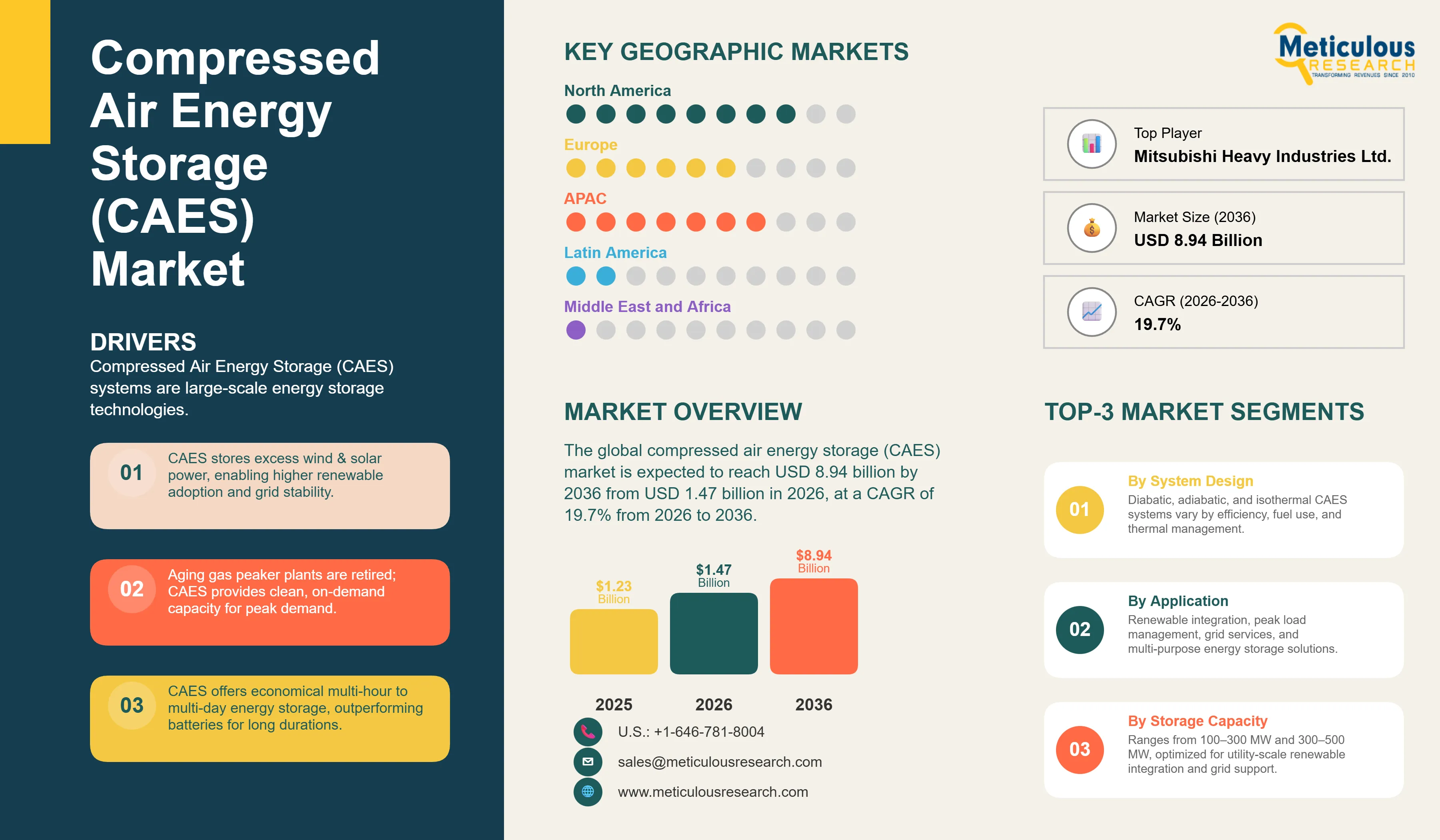
The global compressed air energy storage (CAES) market is expected to reach USD 8.94 billion by 2036 from USD 1.47 billion in 2026, at a CAGR of 19.7% from 2026 to 2036.
- Published
- Jan 2026
- Pages
- 281
- Format
- PDF + Excel
- Report ID
- MR-1688
- Base year
- 2025
- 2026 · ESTIMATED
- $1.47B
- 2036
- $8.94B
- CAGR 2026–2036
- 19.7%
2025 baseline · 2026–2036 forecast at 19.7% CAGR · hover a bar for the value
Key highlights
In 2026, North America is estimated to account for the largest share of the global CAES market, driven by existing commercial CAES facilities, renewable energy integration needs, grid reliability requirements, and favorable geological conditions in multiple regions.
Asia-Pacific is projected to register the highest CAGR during the forecast period, fueled by massive renewable energy capacity additions in China and India, government energy storage mandates, grid modernization investments, and geological storage potential.
Based on system design, the diabatic CAES segment is estimated to hold the largest share of the market in 2026, driven by proven technology with commercial deployments, lower capital costs compared to advanced designs, and operational experience spanning decades.
Based on storage capacity, the 100-300 MW segment is estimated to dominate the market in 2026, owing to optimal scale for utility applications, proven project economics, and alignment with typical grid support requirements.
Based on round-trip efficiency, the 50-70% efficiency range segment is expected to account for substantial share, driven by diabatic systems dominating current deployments despite lower efficiency than emerging technologies.
Based on project scale, the utility-scale segment (>100 MW) is expected to account for the largest share of the market in 2026, fueled by CAES economics favoring large-scale implementations and utility energy storage requirements.
The adiabatic CAES segment is expected to grow at the highest CAGR during the forecast period, driven by superior round-trip efficiency (70-80%), elimination of fossil fuel requirements, and advancing thermal storage technologies.
The U.S. CAES market is projected to grow at a CAGR of around 18% during the forecast period 2026 to 2036, driven by renewable portfolio standards, aging peaker plant replacement, and extensive suitable geological formations.
China is expected to lead the Asia-Pacific CAES market, driven by government energy storage targets, massive wind and solar capacity requiring storage, successful pilot projects, and suitable geology in multiple regions.
In 2026, Germany is projected to account for the largest share of the European CAES market, driven by Energiewende renewable integration needs, research leadership in advanced CAES, and depleted gas field availability.
Report summary
| Particulars | Details |
|---|---|
| Market Size Value in 2026 | USD 1.47 Billion |
| Revenue Forecast in 2036 | USD 8.94 Billion |
| Growth Rate | CAGR of 19.7% from 2026 to 2036 |
| Format | PDF, Excel & Cloud Portal · 281 pages |
| Base Year for Estimation | 2025 |
| Historical Data | 2021–2025 |
| Forecast Period | 2026–2036 |
| Quantitative Units | Revenue in USD Billion and CAGR from 2026 to 2036 |
| Report Coverage | Revenue forecast, company ranking, competitive landscape, growth factors, and trends |
| Segments Covered | System Design, Storage Capacity, Round-Trip Efficiency, Storage Duration, Project Scale, Application, End-User, Region |
| Regional Scope | North America, Europe, Asia-Pacific, Latin America, Middle East & Africa |
| Countries Covered | U.S., Canada, Mexico, Germany, U.K., France, Italy, Spain, Netherlands, China, India, Japan, South Korea, Australia, Saudi Arabia, UAE, Brazil, Chile, South Africa |
| Key Companies Profiled | Hydrostor Inc., Energy Dome S.p.A., Apex Compressed Air Energy Storage LLC, Storelectric Limited, General Compression Inc., SustainX Inc., LightSail Energy, Siemens Energy AG, General Electric Company, MAN Energy Solutions SE, Dresser-Rand (Siemens), Ingersoll Rand Inc., Atlas Copco AB, Pacific Gas and Electric Company, RWE AG, China Energy Engineering Corporation, China Huaneng Group, Shell plc, TotalEnergies SE, Mitsubishi Heavy Industries Ltd. |
Report overview
Segments covered: system design, storage capacity, round-trip efficiency, project scale.
Compressed Air Energy Storage (CAES) systems are large-scale energy storage technologies. They store energy by compressing air into underground caverns, depleted gas fields, or above-ground vessels during off-peak times. Later, they release and expand the compressed air through turbines to generate electricity during peak demand. These systems provide grid-scale energy storage for renewable integration. They also enable load shifting and peak shaving, improve grid stability and reliability, reduce electricity costs through arbitrage, and offer ancillary services such as frequency regulation and spinning reserves.
CAES systems use advanced technologies. These include multi-stage compression with intercooling, underground geological storage formations or engineered pressure vessels, heat management systems for recovering thermal energy, expansion turbines with generators, and control systems that coordinate charge and discharge cycles with grid conditions. CAES systems can store hundreds of megawatt-hours to gigawatt-hours of energy. They provide discharge durations from hours to days, can respond within minutes for grid support, and operate for 30-40 years with little degradation. They scale economically to utility-scale capacities.
These systems offer utilities and grid operators flexible, long-duration energy storage. They enable high renewable energy integration by storing excess production. They deliver grid services similar to conventional power plants and provide a lower cost of storage than batteries for long-duration needs. They also support the reduction of carbon emissions from the grid by firming renewable energy. This helps utilities manage variable renewable energy, delay transmission and distribution upgrades, improve grid reliability, lessen dependence on fossil fuel peaker plants, and reach renewable energy goals.
Compressed Air Energy Storage is one of the few proven technologies for large-scale, long-duration energy storage that competes with pumped hydro storage. Unlike battery systems designed for short durations of 2 to 4 hours, CAES offers economical storage for over 4 hours, extending to days. This makes it suitable for stabilizing renewable energy, seasonal storage, and supporting the grid over multiple days. The technology uses established industrial compression equipment and proven geological storage, along with conventional power generation turbines. This familiar setup helps utilities feel more secure about using it and reduces the risks associated with newer storage options. CAES tackles major grid challenges, such as renewable intermittency. It does this by storing excess solar and wind energy for later use, managing peak demand by shifting off-peak generation to peak times, enhancing grid flexibility with fast ramping and frequency response, replacing capacity as fossil plants retire, and easing transmission congestion by storing energy to avoid transmission limits. As grids move to higher renewable generation (over 50%), long-duration storage becomes vital, making CAES an important part of the strategy for decarbonizing the grid.
Several key trends are transforming the CAES market. These include the shift from diabatic systems, which need natural gas combustion, to more advanced adiabatic and isothermal designs that do not rely on fossil fuels. There is also the development of above-ground CAES using engineered vessels that can be deployed in a wider range of locations. Integrating CAES with renewable generation is creating hybrid power plants. Advances in thermal energy storage improve efficiency in adiabatic operations. New business models, such as merchant storage and energy-as-a-service, are emerging. The combination of increasing renewable energy adoption driving storage demand, the understanding that battery storage alone cannot economically meet all grid storage needs, improvements in CAES technology that boost efficiency and cut costs, supportive policy and regulatory frameworks for long-duration storage, and a proven operational history that lowers technology risk have moved CAES from a niche solution to a main option for utility-scale energy storage portfolios.
Key Trends Shaping the Market:
The CAES market is shifting toward improved system designs that offer higher efficiency, lower costs, and wider geographic use. Current CAES systems incorporate advanced features like adiabatic designs that capture and store heat from compression for later use, which removes the need for combustion fuels and achieves 70-80% round-trip efficiency. Isothermal compression keeps a constant temperature during both compression and expansion, coming close to maximum theoretical efficiency. Modular above-ground systems use steel or composite materials, making them suitable for areas without geological storage opportunities. Hybrid renewable-CAES plants combine wind or solar generation with storage to create a reliable renewable power source. Additionally, using artificial intelligence to optimize dispatch helps coordinate storage operations with grid conditions and market prices. The transition from first-generation diabatic systems to newer designs marks a significant shift, making CAES more competitive with other options.
The characterization and development of geological storage sites are progressing rapidly thanks to better exploration methods, a deeper understanding of suitable formations, engineered cavern development techniques, and regulatory agreements for underground storage rights. Modern CAES projects use advanced geological assessments, including 3D seismic surveys to find suitable formations, geomechanical modeling to predict cavern stability, hydrogeological analysis to ensure containment, and thorough feasibility studies that lower development risks. Salt cavern development through solution mining allows for custom-sized storage volumes, while depleted gas reservoirs and aquifer storage take advantage of existing natural formations. The growing knowledge and established cavern development methods are making CAES feasible in more regions.
The combination of CAES with renewable energy is leading to integrated hybrid power plants that merge generation and storage. Current setups often co-locate wind farms or solar power plants with CAES. This creates facilities that produce renewable energy, store excess generation during high production times, and release stored energy during low production or peak demand periods. These hybrid plants deliver reliable renewable capacity eligible for capacity payments and offer grid services like frequency response and voltage support. This approach maximizes renewable energy use and avoids curtailment while providing dispatchable renewable generation that competes with traditional power sources. Notable projects include wind-CAES hybrids in Texas and Iowa, solar-CAES plans in desert areas rich in solar resources and geological storage, and multi-generation hybrid plants that integrate wind, solar, and CAES.
Market dynamics
4 factors across 2 forcesRenewable Energy Integration and Grid Flexibility Requirements
The rapid growth of variable renewable energy generation is creating a huge need for large-scale, long-duration energy storage that CAES can effectively fulfill. Global wind and solar capacity continues to expand quickly, with installations exceeding 300 GW each year. This growth leads to challenges in grid integration. These challenges include generation variability on different timescales, hefty excess generation during peak renewable production times, and a lack of generation when renewables are low. Moreover, there is transmission congestion, especially when moving power from areas rich in renewable energy to load centers. As renewable energy adoption increases, these issues become more pronounced. Grids with 30-50% or more of their energy from renewables often face frequent curtailment, negative pricing during oversupply, and reliability concerns during low renewable production. CAES helps manage renewable variability by storing excess energy during high production for use in low production times, firming renewable output with dispatchable capacity backed by stored energy, providing storage for multi-hour to multi-day durations that batteries can’t handle economically, and enabling higher renewable adoption by addressing integration issues. The economics favor CAES, as the levelized cost of storage for 8+ hour duration CAES is usually 50-70% lower than battery options. As global renewable energy targets rise (many regions aim for 50-80% by 2030-2040), the demand for long-duration storage like that from CAES will grow significantly.
Peaker Plant Replacement and Capacity Market Participation
Aging natural gas peaker plants are due for replacement, and policy pushes to retire fossil fuel generation are opening doors for CAES to provide clean, reliable capacity. Peaker plants, which are combustion turbines that operate during peak demand, have significant global installed capacity but function at low capacity factors (5-15%). This reality makes them economically weak and environmentally damaging due to emissions. Many peaker plants that were installed 30-50 years ago are nearing their end of life, creating a need for replacements. Furthermore, climate policies and mandates for renewable energy are speeding up the timing for retiring fossil fuel sources. CAES offers a strong alternative for replacing peaker plants by delivering reliable, on-demand capacity during peak times. It can respond within minutes, similar to combustion turbines, and provides crucial grid services like frequency response and voltage support, all while operating without emissions in adiabatic or isothermal designs. CAES also qualifies for capacity payments in organized markets. In deregulated electricity markets with capacity mechanisms (such as PJM, ISO-NE, CAISO), CAES can earn significant revenue from capacity payments, energy trading, and ancillary services. Economic analyses often show that CAES revenues surpass those of batteries for applications needing 6+ hour durations and participation in capacity markets. The combination of aging peaker plants that need to be replaced and policies promoting clean energy creates strong market incentives for utility-scale CAES deployment.
Table of contents
16 chapters · 41 sections · 281 pages · click to expandSection breakdown available in the full table of contents.
Geographic analysis
North America
Largest shareIn 2026, North America is expected to hold the largest share of the global CAES market. This leadership comes from existing commercial CAES facilities that provide operational experience and validate technology, like the McIntosh facility in Alabama, which has been operating since 1991. The area has extensive suitable geology, including salt formations in the Gulf Coast and Midwest, depleted gas reservoirs, and aquifers. Strong drivers for renewable integration, especially wind power in Texas, the Midwest, and the Great Plains, support this market. Additionally, regulatory frameworks that back energy storage, such as tax credits and renewable mandates, also contribute. There is an active project pipeline with several large-scale projects moving forward. The United States especially leads with numerous CAES projects in development across Texas, California, the Pacific Northwest, and other areas driven by renewable portfolio standards, the need to replace aging peaker plants, and favorable economics in wholesale markets. Canadian projects focus on renewable integration in provinces rich in wind and hydro resources.
Asia-Pacific
Fastest growthAsia-Pacific is expected to grow at the fastest rate during this period due to China’s massive renewable capacity additions, leading to huge storage needs. The wind and solar capacity exceeds 1,000 GW and continues to expand aggressively. Government mandates and targets support energy storage deployment, and successful CAES pilot projects demonstrate technical feasibility. There is also suitable geology in many areas, including salt formations and depleted fields, and state-owned utilities have the capital for large infrastructure projects. China drives regional growth through the National Energy Administration's policies that mandate energy storage deployment, with the State Grid Corporation and regional utilities procuring storage for renewable integration. Domestic technology developers are advancing CAES systems, which are integrating with large renewable energy bases in northern and western regions. India offers emerging opportunities with its growing renewable capacity and grid flexibility needs. Japan and South Korea pursue CAES to enhance energy security and integrate renewables, despite geological challenges that favor above-ground systems.
Europe
Europe has a significant market driven by Germany’s Energiewende initiative, which requires large-scale storage for renewable integration. The pioneering Huntorf CAES facility showcases long-term reliability, and research leadership in adiabatic CAES continues with RWE and others advancing the technology. Depleted gas fields, especially in the North Sea region, offer storage potential, and supportive policy frameworks boost clean energy storage. The UK is exploring CAES for offshore wind integration and grid balancing, while the Netherlands and other countries are investigating CAES using depleted gas infrastructure.
Competitive landscape
- Hydrostor Inc. · Canada
- Energy Dome S.p.A · Italy
- Apex Compressed Air Energy Storage LLC (U.S.)
- Storelectric Limited (U.K.)
- General Compression Inc. (U.S.)
- SustainX Inc. (U.S.)
- LightSail Energy (U.S.)
- Siemens Energy AG · Germany
- General Electric Company (U.S.)
- MAN Energy Solutions SE · Germany
- Dresser-Rand (Siemens) (U.S./Germany)
- Ingersoll Rand Inc. (U.S.)
- Atlas Copco AB · Sweden
- Pacific Gas and Electric Company (U.S.)
- RWE AG · Germany
- China Energy Engineering Corporation · China
- China Huaneng Group · China
- Shell plc (U.K./Netherlands)
- TotalEnergies SE · France
- Mitsubishi Heavy Industries Ltd. · Japan
Frequently asked questions
The CAES market is expected to grow from USD 1.47 billion in 2026 to USD 8.94 billion by 2036.
Cite this report
Meticulous Research. (2026). Compressed Air Energy Storage (CAES) Market - Global Opportunity Analysis and Industry Forecast (2026-2036) (Report No. MR-1688). Meticulous Market Research Pvt. Ltd. https://www.meticulousresearch.com/product/compressed-air-energy-storage-market-6371