Bipolar Plate Coatings Market (2026-2036)
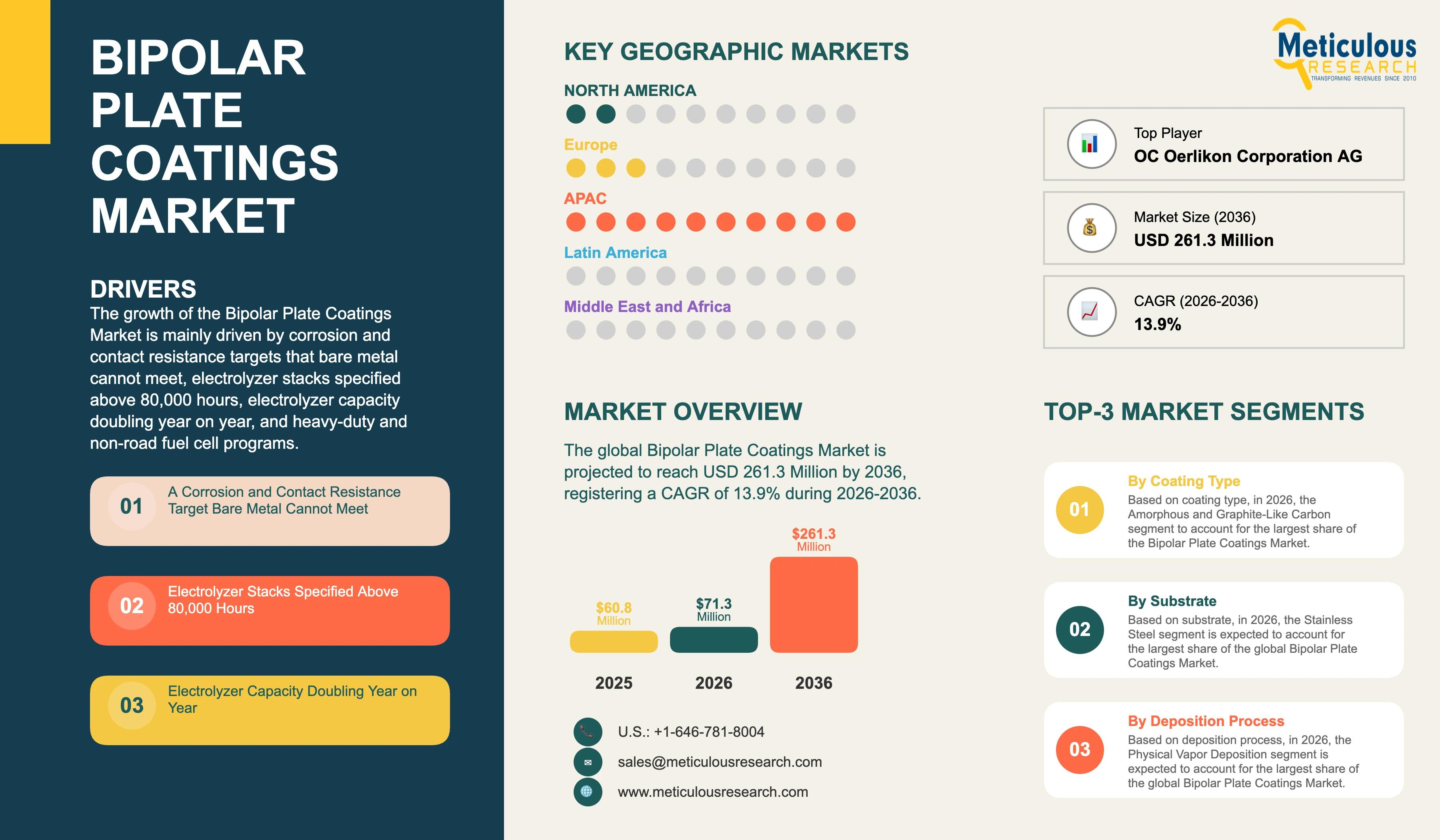
The global Bipolar Plate Coatings Market was valued at USD 60.8 million in 2025. This market is expected to reach USD 261.3 million by 2036 from an estimated USD 71.3 million in 2026, registering a CAGR of 13.9% during the forecast period (2026-2036).
- Published
- Nov 2026
- Pages
- 253
- Format
- PDF + Excel
- Report ID
- MRCHM - 1042780
- Base year
- 2025
- 2025 · BASELINE
- $60.8M
- 2036
- $261.3M
- CAGR 2026–2036
- 13.9%
2025 baseline · 2026–2036 forecast at 13.9% CAGR · hover a bar for the value
Key highlights
The global Bipolar Plate Coatings Market is projected to reach USD 261.3 million by 2036, driven by corrosion and contact resistance targets bare metal cannot meet, electrolyzer stacks specified above 80,000 hours, electrolyzer capacity doubling year on year, and heavy-duty and non-road fuel cell programs.
Asia-Pacific is expected to account for the largest market share in 2026 and is also projected to register the fastest growth during the forecast period, supported by the concentration of electrolyzer installation and fuel cell vehicle production in the region, with China accounting for nearly three-quarters of new electrolyzer installations.
By coating type, Amorphous and Graphite-Like Carbon coatings are expected to account for the largest market share, whereas Metal Carbide and MAX Phase coatings are projected to witness the fastest growth through 2036.
By substrate, Stainless Steel plates are expected to account for the largest market share, whereas Aluminum and Other Metals are projected to witness the fastest growth through 2036.
By deposition process, Physical Vapor Deposition are expected to account for the largest market share, whereas Chemical and Plasma-Assisted Chemical Vapor Deposition are projected to witness the fastest growth through 2036.
United States Department of Energy technical targets for bipolar plates set a plate cost of USD 3 a kilowatt net against a 2015 status of USD 7, costed to 500,000 systems of 80 kilowatts a year.
The same target set requires anode and cathode corrosion below 1 microamp a square centimeter with no active peak, against a 2015 anode status based on a nanometer-range gold coating on a stainless steel substrate, with anode corrosion assessed by a potentiodynamic scan in a pH 3 solution containing 0.1 parts per million hydrogen fluoride at 80 degrees Celsius.
Areal specific resistance, which includes interfacial contact resistance measured on both faces at 138 newtons a square centimeter, carries a target of below 0.01 ohm square centimeter against a 2015 status of 0.006, alongside electrical conductivity above 100 siemens a centimeter, plate weight of 0.4 kilograms a kilowatt net and forming elongation of 40%.
Industry material presented to a Department of Energy workshop states the central design conflict directly, namely that corrosion resistance calls for low electrochemical conductivity while electrical performance calls for high conductivity, and sets required service lives of 5,000 to 10,000 hours for passenger cars, 20,000 to 30,000 hours for heavy duty and above 80,000 hours for electrolyzers.
A physical vapor deposition stack for stainless steel plates is described as a metal base layer of about 100 nanometers with a carbon top layer of about 50 nanometers, with titanium base layers tested at 50, 100 and 200 nanometers.
A droplet deposition route sprays gold onto the cathode face and platinum onto the anode face, with gold splats of 1 to 5 microns in diameter and 0.1 to 0.3 microns in cross-section, and interfacial contact resistance on that route is reported as acceptable at about 2% gold surface coverage with corrosion current around 0.05 microamps a square centimeter on stainless steel.
A single inline physical vapor deposition coater configured with three coating chambers and one loading chamber is rated at a throughput of up to 3 million plates a year, which is of the order of 8,100 passenger-car stacks at about 370 plates a stack.
The International Energy Agency recorded installed electrolyzer capacity above 4 GW in 2025 at roughly double the 2024 level with China accounting for nearly three-quarters of new installations, global fuel cell electric vehicle stock growing 20% to almost 130,000 vehicles, and committed and strong-potential low-emissions hydrogen production for 2030 revised down from 10 million tons to just above 6 million tons against an announced pipeline of 27 million tons.
Report summary
| Particulars | Details |
|---|---|
| Forecast Period | 2026-2036 |
| Base Year | 2025 |
| Estimated Year | 2026 |
| CAGR (Value) | 13.9% |
| Format | PDF, Excel & Cloud Portal · 253 pages |
| CAGR (Volume) | 16.1% |
| Market Size (Value) in 2026 | USD 71.3 million |
| Market Size (Value) in 2036 | USD 261.3 million |
| Market Size (Volume) in 2026 | 0.75 million square meters of plate area coated |
| Market Size (Volume) in 2036 | 3.35 million square meters |
| Average Selling Price, 2026 | USD 95 per square meter |
| Average Selling Price, 2036 | USD 78 per square meter |
| Segments Covered | By Coating Type: Amorphous and Graphite-Like Carbon, Noble Metal, Metal Nitride, Metal Carbide and MAX Phase, Conductive Oxide and Other Coating Types. By Substrate: Stainless Steel, Titanium, Aluminum and Other Metals, Graphite and Composite. By Deposition Process: Physical Vapor Deposition, Thermal Spray and Droplet Deposition, Electroplating and Electroless Plating, Chemical and Plasma-Assisted Chemical Vapor Deposition, Other Deposition Processes. By Application: Fuel Cell Stacks for Road Transport, Proton Exchange Membrane Electrolyzer Stacks, Stationary and Backup Fuel Cells, Non-Road Transport Fuel Cells, Other Electrochemical Stacks. |
| Countries Covered | China; South Korea; Japan; India; Germany; France; U.K.; Italy; U.S.; Canada; Mexico; Brazil |
| Key Companies | OC Oerlikon Corporation AG, IHI Corporation, Impact Coatings AB, Alleima AB, Treadstone Technologies, Inc., ElringKlinger AG, Dana Incorporated, and Nippon Steel Corporation |
Report overview
Segments covered: coating type, substrate, deposition process, application.
In volume terms, the market is estimated at 0.75 million square meters of plate area coated in 2026 and is expected to reach 3.35 million square meters by 2036, registering a CAGR of 16.1% during the forecast period. The average selling price is estimated at USD 95 per square meter in 2026 and USD 78 per square meter in 2036.
The growth of this market is mainly driven by a corrosion target of below 1 microamp a square centimeter that bare stainless steel cannot meet, an areal specific resistance requirement of below 0.01 ohm square centimeter measured at 138 newtons a square centimeter, proton exchange membrane electrolyzer stacks specified for service lives above 80,000 hours, and installed electrolyzer capacity that passed 4 GW in 2025 at roughly double the 2024 level. However, factors such as a global fuel cell electric vehicle stock of almost 130,000 units, a plate cost target of USD 3 a kilowatt against a status of USD 7, committed low-emissions hydrogen production for 2030 revised down from 10 million tons to just above 6 million tons, and a single inline coater rated at up to 3 million plates a year are expected to restrain the growth of this market to some extent.
Among deposition processs, Physical Vapor Deposition are expected to account for the largest market share in 2026, while Chemical and Plasma-Assisted Chemical Vapor Deposition are projected to register the highest CAGR during the forecast period. Geographically, Asia-Pacific is expected to account for the largest share of this market in 2026 and is also expected to register the highest CAGR during the forecast period.
The Bipolar Plate Coatings Market comprises coatings and surface treatments applied to metallic bipolar and separator plates for electrochemical stacks, taken at the coating supplier or coating service gate and expressed per square meter of plate area coated across both faces. The market includes Amorphous and Graphite-Like Carbon, Noble Metal, Metal Nitride, Metal Carbide and MAX Phase, and Conductive Oxide coatings, applied to stainless steel, titanium, aluminum and graphite substrates by physical vapor deposition, thermal spray and droplet deposition, electroplating and electroless plating, or chemical and plasma-assisted chemical vapor deposition, serving fuel cell stacks for road transport, proton exchange membrane electrolyzer stacks, stationary and backup fuel cells and non-road transport fuel cells. The plate substrate and the forming of it, uncoated graphite and carbon-composite plates, membrane electrode assemblies, gas diffusion layers, porous transport layers, catalyst coatings, gaskets and sealing, and deposition equipment sold as capital fall outside the scope.
A bipolar plate separates adjacent cells in a stack, carries reactant gases through flow channels, conducts electrons from one cell to the next and carries away heat and product water, all in a hot, humid, acidic environment at a thickness of around a tenth of a millimeter. Only two material families can be formed that thin at volume, stainless steel and titanium, and both corrode and both grow a passive oxide that is an electrical insulator. The coating exists to resolve that, and industry material presented to a Department of Energy workshop states the conflict directly: corrosion resistance calls for low electrochemical conductivity while electrical performance calls for high conductivity, so the surface has to be simultaneously inert and conductive.
The numbers the coating must satisfy are tight and published. Department of Energy targets require anode and cathode corrosion below 1 microamp a square centimeter with no active peak, areal specific resistance below 0.01 ohm square centimeter including interfacial contact resistance measured on both faces at 138 newtons a square centimeter, and electrical conductivity above 100 siemens a centimeter, alongside plate weight of 0.4 kilograms a kilowatt net, flexural strength above 25 megapascals and forming elongation of 40%. The 2015 status that clears the corrosion half of that target is a nanometer-range gold coating on a stainless steel substrate.
Cost is where that technically settled answer fails. The same target table sets a plate cost of USD 3 a kilowatt net against a 2015 status of USD 7, costed to high-volume production of 500,000 systems of 80 kilowatts a year, which rules out a precious metal film across the whole plate surface at automotive volume. Development since has consisted of thrifting and substitution: droplet deposition sprays gold onto the cathode face and platinum onto the anode face with gold splats of 1 to 5 microns in diameter and 0.1 to 0.3 microns in cross-section, and interfacial contact resistance is reported as acceptable at about 2% gold surface coverage with corrosion current around 0.05 microamps a square centimeter.
Carbon and ceramic systems remove the precious metal altogether. A physical vapor deposition stack of a metal base layer around 100 nanometers with a carbon top layer around 50 nanometers serves medium-lifetime passenger-car stacks, and ceramic MAX-phase coatings are offered against the standard test protocol without gold or platinum. Amorphous and Graphite-Like Carbon accordingly holds the largest coating type share at 34.0% in 2026 while Metal Carbide and MAX Phase grows fastest at 18.4% and Noble Metal grows slowest at 9.8%.
Durability requirements differ by an order of magnitude across applications, at 5,000 to 10,000 hours for passenger cars, 20,000 to 30,000 hours for heavy duty and above 80,000 hours for electrolyzers, so the same plate geometry carries three coating specifications and three cost ceilings. Electrolyzers are the position where the precious metal cannot yet be thrifted away, since proton exchange membrane water electrolysis runs the anode at a potential and an acidity that only gold, platinum or a gold-platinum combination has been shown to survive for the life required, on a titanium rather than a stainless steel substrate. Proton Exchange Membrane Electrolyzer Stacks record the highest application CAGR at 17.4% from a 29.0% share in 2026.
Volume rather than requirement is the constraint. Global fuel cell electric vehicle stock grew 20% to almost 130,000 vehicles in 2025 on truck sales in China and a rebound in car sales in Korea, installed electrolyzer capacity passed 4 GW at roughly double the 2024 level, and low-emissions hydrogen production reached almost 1 million tons, around 1% of global hydrogen production. Coating capacity is not scarce against that demand, since a single inline tool with three coating chambers and one loading chamber is rated at up to 3 million plates a year, of the order of 8,100 passenger-car stacks at about 370 plates a stack. Average selling price therefore falls from USD 95 per square meter in 2026 to USD 78 in 2036 while coated area grows at 16.1%.
Asia-Pacific is expected to account for the largest share of this market in 2026 at 61.0%, because China takes nearly three-quarters of new electrolyzer installations and because the fuel cell vehicle growth of 2025 came from Chinese trucks and Korean cars.
Europe accounts for 21.0% of this market in 2026 and is projected to grow at 13.2%. Regional demand rests on electrolyzer projects and heavy-duty fuel cell programs rather than on passenger car volume, which places the mix toward the 20,000 to 30,000 hour and above 80,000 hour service life specifications. Germany, France, the United Kingdom and Italy hold most regional volume across stack assembly, coating service and precoated strip supply. The revision of committed low-emissions hydrogen production for 2030 from 10 million tons to just above 6 million tons bears most directly on the regional electrolyzer pipeline.
The Middle East & Africa region holds 1.5% of this market in 2026 with projected growth of 12.0%, tied to large announced hydrogen production projects in the Gulf states and North Africa whose electrolyzer capacity would carry the 80,000 hour plate specification, with the requirement for final investment decisions by early 2027 on a further 22 million tons of announced potential bearing directly on whether that demand materializes. Latin America holds 1.5% with projected growth of 11.0%, with Brazil the slowest-growing country at 10.6% and demand tied to announced green hydrogen projects rather than to local stack manufacturing.
Some of the key players operating in the bipolar plate coatings market are OC Oerlikon Corporation AG, IHI Corporation, Impact Coatings AB, Alleima AB, Treadstone Technologies, Inc., ElringKlinger AG, Dana Incorporated, and Nippon Steel Corporation, among others.
Key strategies include thrifting precious metal coverage toward the minimum that clears the published protocol, developing carbon and MAX-phase systems that remove gold and platinum from heavy-duty specifications, moving coating upstream onto strip that is formed after deposition, installing inline capacity close to stack assembly, and building graded portfolios qualified across passenger car, heavy-duty and electrolyzer service lives.
Report infographic
Market dynamics
20 factors across 4 forcesA Corrosion and Contact Resistance Target Bare Metal Cannot Meet
Department of Energy targets require anode and cathode corrosion below 1 microamp a square centimeter with no active peak, assessed by a potentiodynamic scan in a pH 3 solution containing 0.1 parts per million hydrogen fluoride at 80 degrees Celsius and by a potentiostatic hold at plus 0.6 volts for more than 24 hours in aerated solution. The same table requires areal specific resistance below 0.01 ohm square centimeter including interfacial contact resistance measured on both faces at 138 newtons a square centimeter. The passive oxide that protects bare stainless steel from the corrosion requirement is what breaks the resistance requirement, so no uncoated metal satisfies both. Coating is therefore not an optional improvement on a metallic plate but a condition of using one at all, which ties the market directly to metallic plate adoption rather than to any coating preference.
Electrolyzer Stacks Specified Above 80,000 Hours
Industry material presented to a Department of Energy workshop sets required service lives of 5,000 to 10,000 hours for passenger cars, 20,000 to 30,000 hours for heavy duty and above 80,000 hours for electrolyzers. Proton exchange membrane water electrolysis runs the anode at a potential and an acidity that only gold, platinum or a gold-platinum combination has been shown to survive for that duration, on a titanium rather than a stainless steel substrate. Proton Exchange Membrane Electrolyzer Stacks are projected to record the highest application CAGR in this market at 17.4% from a 29.0% share in 2026, against 12.2% for fuel cell stacks in road transport, and titanium holds 27.0% of the substrate mix. The segment also carries the highest coating value per plate, because the thrifting that works on a vehicle stack does not yet hold at electrolyzer potentials.
Electrolyzer Capacity Doubling Year on Year
The International Energy Agency recorded installed electrolyzer capacity above 4 GW in 2025, roughly double the 2024 level, with China accounting for nearly three-quarters of new installations, and low-emissions hydrogen production at almost 1 million tons, up 20% on 2024. Each gigawatt of proton exchange membrane capacity installed carries a plate area that must be coated to the 80,000 hour specification. That installation rate is the reason Asia-Pacific holds 61.0% of this market in 2026 and is also the fastest-growing region at 14.6%. Because the coating specification on an electrolyzer plate is the most demanding in the market, capacity growth translates into value at a higher rate than into area.
Heavy-Duty and Non-Road Fuel Cell Programs
Heavy-duty stacks are specified for 20,000 to 30,000 hours, two to six times the passenger car requirement, which lifts the coating specification from a medium-lifetime carbon system toward a thrifted precious metal or a MAX-phase ceramic. Fuel cell vehicle stock growth of 20% in 2025 came from truck sales in China alongside a rebound in car sales in Korea, which is where that specification step is being taken. Non-Road Transport Fuel Cells carry similar duty cycles in rail, marine and materials handling applications. The commercial consequence is that the fastest-growing part of vehicle demand is also the part that cannot use the cheapest coating, which supports coating value per plate even as average price per square meter falls.
Precoated Strip Forming a Second Route to the Plate
Coating can be applied to formed plates on an inline vacuum line or to strip steel before forming, and Alleima AB positions coated strip steel explicitly as the route from raw material directly to the bipolar plate. Coating the strip removes the handling and fixturing of individual formed plates from the deposition step, which is the throughput constraint on a batch or inline plate coater. Because the coating must then survive a forming elongation requirement of 40%, the route places a mechanical demand on the film that a post-forming coating does not face. Where it is met, the cost per coated plate falls well below the inline route, which is the mechanism behind the projected decline in average selling price.
Table of contents
12 chapters · 133 sections · 253 pages · click to expandSegmental analysis
| Segment | Largest share (2026) | Fastest growth (2026–2036) |
|---|---|---|
| By Coating Type | Amorphous and Graphite-Like Carbon coatings | Metal Carbide and MAX Phase coatings |
| By Substrate | Stainless Steel plates | Aluminum and Other Metals |
| By Deposition Process | Physical Vapor Deposition | Chemical and Plasma-Assisted Chemical Vapor Deposition |
| By Application | Fuel Cell Stacks for Road Transport | Proton Exchange Membrane Electrolyzer Stacks |
| Other segments | Stainless Steel plates | — |
By Coating Type
- Bipolar Plate Coatings Market Analysis by Coating Type
- Amorphous and Graphite-Like Carbon coatings are expected to account for the largest share of the global Bipolar Plate Coatings Market.
- The large share of this segment is mainly due to the combination of conductivity and corrosion resistance delivered by a metal base layer of about 100 nanometers with a carbon top layer of about 50 nanometers, which clears the passenger car service life requirement without any precious metal content.
- However, Metal Carbide and MAX Phase coatings are projected to register the highest CAGR during the forecast period.
- The rapid growth of this segment is attributed to their qualification against the standard corrosion and areal specific resistance protocol without gold or platinum, which positions them for the heavy-duty service lives of 20,000 to 30,000 hours where carbon systems have not yet been proven and noble metal cost is prohibitive.
- Amorphous and Graphite-Like Carbon coatings are expected to account for the largest market share in 2026.
- Metal Carbide and MAX Phase coatings are projected to register the highest CAGR during the forecast period, owing to their qualification against the standard corrosion and areal specific resistance protocol without gold or platinum, which positions them for the heavy-duty service lives of 20,000 to 30,000 hours where carbon systems have not yet been proven and noble metal cost is prohibitive.
- Aluminum and Other Metals are projected to register the highest CAGR during the forecast period, owing to the weight advantage available where the duty cycle permits it, against a plate weight target of 0.4 kilograms a kilowatt net, and the development of coating systems able to protect a substrate less corrosion-resistant than stainless steel.
- Chemical and Plasma-Assisted Chemical Vapor Deposition are projected to register the highest CAGR during the forecast period, owing to the move toward carbon and carbide films, where plasma-assisted routes deposit the required layers at higher throughput than line-of-sight deposition achieves on a channelled plate surface.
- Proton Exchange Membrane Electrolyzer Stacks are projected to register the highest CAGR during the forecast period, owing to service lives specified above 80,000 hours that only gold, platinum or a gold-platinum combination has been shown to survive, on a titanium substrate, together with installed electrolyzer capacity that passed 4 GW in 2025 at roughly double the 2024 level.
By Substrate
- Bipolar Plate Coatings Market Analysis by Substrate
- Stainless Steel plates are expected to account for the largest market share.
- The large share of this segment is mainly due to its ability to be rolled and stamped at around a tenth of a millimeter at automotive volume and cost while accepting both vapor-deposited and plated coatings, which makes it the default metallic plate material for fuel cell stacks.
- However, Aluminum and Other Metals are projected to register the highest CAGR during the forecast period.
- The rapid growth of this segment is attributed to the weight advantage available where the duty cycle permits it, against a plate weight target of 0.4 kilograms a kilowatt net, and the development of coating systems able to protect a substrate less corrosion-resistant than stainless steel.
By Deposition Process
- Bipolar Plate Coatings Market Analysis by Deposition Process
- Physical Vapor Deposition are expected to account for the largest market share.
- The large share of this segment is mainly due to its ability to lay down the nanometer-scale metal and carbon layers the specification requires, with inline tools rated at up to 3 million plates a year across three coating chambers and one loading chamber.
- However, Chemical and Plasma-Assisted Chemical Vapor Deposition are projected to register the highest CAGR during the forecast period.
- The rapid growth of this segment is attributed to the move toward carbon and carbide films, where plasma-assisted routes deposit the required layers at higher throughput than line-of-sight deposition achieves on a channelled plate surface.
By Application
- Bipolar Plate Coatings Market Analysis by Application
- Fuel Cell Stacks for Road Transport are expected to account for the largest market share.
- The large share of this segment is mainly due to the plate count per stack at about 370 plates and the scale of passenger car and truck stack assembly relative to other electrochemical applications, with vehicle stock growing 20% in 2025.
- However, Proton Exchange Membrane Electrolyzer Stacks are projected to register the highest CAGR during the forecast period.
- The rapid growth of this segment is attributed to service lives specified above 80, 000 hours that only gold, platinum or a gold-platinum combination has been shown to survive, on a titanium substrate, together with installed electrolyzer capacity that passed 4 GW in 2025 at roughly double the 2024 level.
Other segments
- Stainless Steel plates are expected to account for the largest market share in 2026.
- Physical Vapor Deposition are expected to account for the largest market share in 2026.
- Fuel Cell Stacks for Road Transport are expected to account for the largest market share in 2026.
Geographic analysis
Asia-Pacific
Largest shareAsia-Pacific holds the largest share of this market in 2026 at 61.0% and is projected to be the fastest-growing region at 14.6%. China accounts for nearly three-quarters of new electrolyzer installations and is projected to be the fastest-growing country in this market at 15.8%, with the fuel cell vehicle growth of 2025 coming from Chinese truck sales alongside a rebound in car sales in Korea. South Korea and Japan carry established stack and plate manufacturing with coating capacity installed alongside it, and Indian demand is developing around electrolyzer projects. Because plate coating is a step on a part worth little until it is coated, capacity sits close to stack assembly rather than being served across distance. Asia-Pacific is also projected to register the highest CAGR at 14.6%, with China projected to be the fastest-growing country at 15.8% on electrolyzer installation and heavy-duty fuel cell production.
Europe
Europe accounts for 21.0% of this market in 2026 with projected growth of 13.2%. Regional demand rests on electrolyzer projects and on heavy-duty fuel cell programs rather than on passenger car volume, which places the mix toward the 20,000 to 30,000 hour and above 80,000 hour service life specifications and away from the cheapest carbon systems. Germany, France, the United Kingdom and Italy hold most regional volume across stack assembly, coating service and precoated strip supply. The revision of committed low-emissions hydrogen production for 2030 from 10 million tons to just above 6 million tons bears most directly on the regional electrolyzer pipeline.
North America
North America represents 15.0% of this market in 2026 with projected growth of 12.4%. The United States holds most regional volume and is where the published Department of Energy target set defines the specification the whole market works to, including corrosion below 1 microamp a square centimeter, areal specific resistance below 0.01 ohm square centimeter and a plate cost of USD 3 a kilowatt net. Regional demand spans heavy-duty vehicle programs, electrolyzer projects and stationary fuel cells, with Canadian activity concentrated in stack and component manufacture.
Latin America
Latin America holds 1.5% of this market in 2026 and is projected to grow at 11.0%. Brazil accounts for most regional volume and is projected to be the slowest-growing country in this market at 10.6%, with demand tied to announced green hydrogen projects rather than to any installed stack manufacturing base. Mexican activity is limited to component supply into North American programs. Plate coating is performed outside the region, so regional growth depends on projects reaching final investment decision rather than on local capacity.
Middle East & Africa
The Middle East & Africa region accounts for 1.5% of this market in 2026 and is projected to grow at 12.0%. Demand is tied to large announced hydrogen production projects in the Gulf states and North Africa, where electrolyzer capacity would carry the 80,000 hour plate specification. The downward revision of committed 2030 production and the requirement for final investment decisions by early 2027 on a further 22 million tons of announced potential bear directly on whether that demand materializes within the forecast period.
Competitive landscape
The global Bipolar Plate Coatings Market is fragmented, with competition among surface treatment and coating equipment groups, specialist coating service houses, stainless steel strip producers and stack component manufacturers. Market participants compete primarily on qualification against the published corrosion and areal specific resistance protocol at the required service life, precious metal content per plate, inline throughput and cost per coated plate, and coverage of passenger car, heavy-duty and electrolyzer specifications.
thrifting precious metal coverage toward the minimum that clears the protocol, developing carbon and MAX-phase systems that remove gold and platinum, moving coating upstream onto strip formed after deposition, and installing inline capacity close to stack assembly
The report provides a comprehensive competitive assessment of the leading companies operating in the global Bipolar Plate Coatings Market. The key players profiled in the report include OC Oerlikon Corporation AG (Switzerland), IHI Corporation (Japan), Impact Coatings AB (Sweden), Alleima AB (Sweden), Treadstone Technologies, Inc. (U.S.), ElringKlinger AG (Germany), Dana Incorporated (U.S.), and Nippon Steel Corporation (Japan).
- OC Oerlikon Corporation AG
- IHI Corporation
- Impact Coatings AB
- Alleima AB
- Treadstone Technologies, Inc.
- ElringKlinger AG
- Dana Incorporated
- Nippon Steel Corporation
Expert perspectives
The specification in this market is a contradiction rather than a target, and that is why no single coating wins it. Corrosion resistance calls for low electrochemical conductivity while electrical performance calls for high conductivity, so a surface that clears corrosion below 1 microamp a square centimeter and areal specific resistance below 0.01 ohm square centimeter is a compromise between two opposed properties. The settled answer, a nanometer-range gold film, fails only on a plate cost target of USD 3 a kilowatt against a 2015 status of USD 7. Everything since has been thrifting and substitution against that one number.
Price falls while area rises, and suppliers should plan against that rather than around it. Average selling price moves from USD 95 per square meter in 2026 to USD 78 in 2036 while coated area grows at 16.1%, because a single inline tool with three coating chambers and one loading chamber handles up to 3 million plates a year, of the order of 8,100 passenger-car stacks. A handful of lines covers the world market, so no scarcity rent accrues to the coating step and the mix shift from noble metal at 9.8% growth toward carbide and MAX phase at 18.4% does the rest.
Defensible positions sit at the durability end and upstream of the plate. Electrolyzers specified above 80,000 hours still require gold, platinum or a gold-platinum combination on titanium, and that application grows at 17.4% from a 29.0% share while the fuel cell vehicle population stands at almost 130,000 units worldwide. Coated strip formed after deposition is the other position, since it removes plate handling from the coating step entirely and places the burden on a film that survives 40% forming elongation. Both are harder to enter than inline plate coating, which is precisely why they hold price.
Customer perspectives
Insights gathered during primary interviews with fuel cell and electrolyzer stack manufacturers, plate formers, coating service providers, and strip steel producers operating in this market highlight where specification priorities are shifting. The following perspectives reflect recurring themes raised across these discussions.
This reflects coating selection driven by service life rather than by material preference, which is why a single qualified system does not serve the market and suppliers carry graded portfolios.
This indicates that the electrolyzer position remains dependent on precious metal coatings at the anode, which sustains coating value per plate in that application even as vehicle plate coating prices decline.
This points to installed coating capacity exceeding current demand, which removes availability as a commercial lever and concentrates competition on metal loading, cost per plate and the threat from coating applied upstream on strip.
“The coating is not a finish for us, it is what makes a metal plate usable at all. Bare steel either corrodes or grows an oxide that kills the contact resistance, and there is no setting where it does neither. What we buy is a compromise, and which compromise depends entirely on whether the stack has to last ten thousand hours or eighty thousand.”
“On the anode side we have not found anything that survives the duty without precious metal, so we are still buying gold or platinum on titanium and we accept the cost. On the vehicle side our colleagues pay a fraction of what we do per plate. Same geometry, completely different purchase.”
“One of our inline tools will take three million plates a year, and that is more than the market needs from us today. So the conversation with a customer is never about availability, it is about cost per plate and whether we can hold the protocol at a lower metal loading. Precoated strip is the thing we watch, because if that works the plate never comes to us.”
Frequently asked questions
The global Bipolar Plate Coatings Market is estimated at USD 71.3 million in 2026.
The market is projected to reach USD 261.3 million by 2036.
The market is expected to grow at a CAGR of 13.9% during 2026-2036.
Growth is driven by corrosion and areal specific resistance targets that bare stainless steel cannot meet simultaneously, PEM electrolyzer stacks specified for service lives above 80,000 hours, installed electrolyzer capacity that passed 4 GW in 2025 at roughly double the 2024 level, and heavy-duty and non-road fuel cell programs specified at 20,000 to 30,000 hours.
Only stainless steel and titanium can be formed at around a tenth of a millimeter at volume, and both corrode and grow a passive oxide that is an electrical insulator. The surface therefore has to be simultaneously inert and conductive, which a coating provides.
Department of Energy targets require anode and cathode corrosion below 1 microamp a square centimeter with no active peak, areal specific resistance below 0.01 ohm square centimeter, electrical conductivity above 100 siemens a centimeter, plate weight of 0.4 kilograms a kilowatt net and forming elongation of 40%, at a plate cost of USD 3 a kilowatt net against a 2015 status of USD 7.
Droplet deposition sprays gold onto the cathode face and platinum onto the anode face, with acceptable interfacial contact resistance at about 2% gold surface coverage. Carbon and ceramic systems remove the precious metal altogether, such as a metal base layer around 100 nanometers with a carbon top layer around 50 nanometers.
The principal challenges are a global fuel cell electric vehicle stock of almost 130,000 units, a plate cost target of USD 3 a kilowatt net, committed 2030 low-emissions hydrogen production revised down from 10 million tons to just above 6 million tons, coating capacity ahead of demand, and a specification that requires the surface to be inert and conductive at once.
Emerging technologies include droplet deposition at around 2% surface coverage, ceramic MAX-phase coatings growing at 18.4%, amorphous and graphite-like carbon stacks, plasma-assisted chemical vapor deposition growing at 17.8%, and precoated strip steel formed after coating.
There is no product approval regime for these coatings; the governing framework is the published United States Department of Energy technical target set for bipolar plates and its test protocols. Qualification is carried out per application and per required service life against that protocol.
Amorphous and Graphite-Like Carbon coatings are expected to account for the largest market share in 2026.
Metal Carbide and MAX Phase coatings are projected to register the highest CAGR during the forecast period, owing to their qualification against the standard protocol without gold or platinum, which positions them for heavy-duty service lives of 20,000 to 30,000 hours.
Stainless Steel plates are expected to account for the largest market share in 2026.
Aluminum and Other Metals are projected to register the highest CAGR during the forecast period, owing to the weight advantage and the development of coating systems able to protect a substrate less corrosion-resistant than stainless steel.
Physical Vapor Deposition are expected to account for the largest market share in 2026.
Chemical and Plasma-Assisted Chemical Vapor Deposition are projected to register the highest CAGR during the forecast period, owing to the move toward carbon and carbide films, where plasma-assisted routes deposit the required layers at higher throughput.
Fuel Cell Stacks for Road Transport are expected to account for the largest market share in 2026.
Proton Exchange Membrane Electrolyzer Stacks are projected to register the highest CAGR during the forecast period, owing to service lives above 80,000 hours that only gold, platinum or a gold-platinum combination has been shown to survive, and rapidly growing installed electrolyzer capacity.
Asia-Pacific is expected to account for the largest share of this market in 2026 at 61.0%, because China takes nearly three-quarters of new electrolyzer installations and because the fuel cell vehicle growth of 2025 came from Chinese trucks and Korean cars.
Asia-Pacific is also projected to register the highest CAGR at 14.6%, with China projected to be the fastest-growing country at 15.8% on electrolyzer installation and heavy-duty fuel cell production.
Europe accounts for 21.0% of this market in 2026 and is projected to grow at 13.2%, with demand resting on electrolyzer projects and heavy-duty fuel cell programs rather than passenger car volume. Germany, France, the United Kingdom and Italy hold most regional volume.
The Middle East & Africa region holds 1.5% of this market in 2026 with projected growth of 12.0%, tied to large announced hydrogen projects in the Gulf states and North Africa. Latin America holds 1.5% with projected growth of 11.0%, with demand tied to announced green hydrogen projects rather than local stack manufacturing.
Some of the key players are OC Oerlikon Corporation AG, IHI Corporation, Impact Coatings AB, Alleima AB, Treadstone Technologies, Inc., ElringKlinger AG, Dana Incorporated, and Nippon Steel Corporation, among others.
Key strategies include thrifting precious metal coverage, developing carbon and MAX-phase systems that remove gold and platinum, moving coating upstream onto strip formed after deposition, installing inline capacity close to stack assembly, and building graded portfolios qualified across passenger car, heavy-duty and electrolyzer service lives.
Cite this report
Meticulous Research. (2026). Bipolar Plate Coatings Market - Global Opportunity Analysis and Industry Forecast (2026-2036) (Report No. MRCHM - 1042780). Meticulous Market Research Pvt. Ltd. https://www.meticulousresearch.com/product/bipolar-plate-coatings-market-7463