Biostorage and Cryopreservation Market (2026-2036)
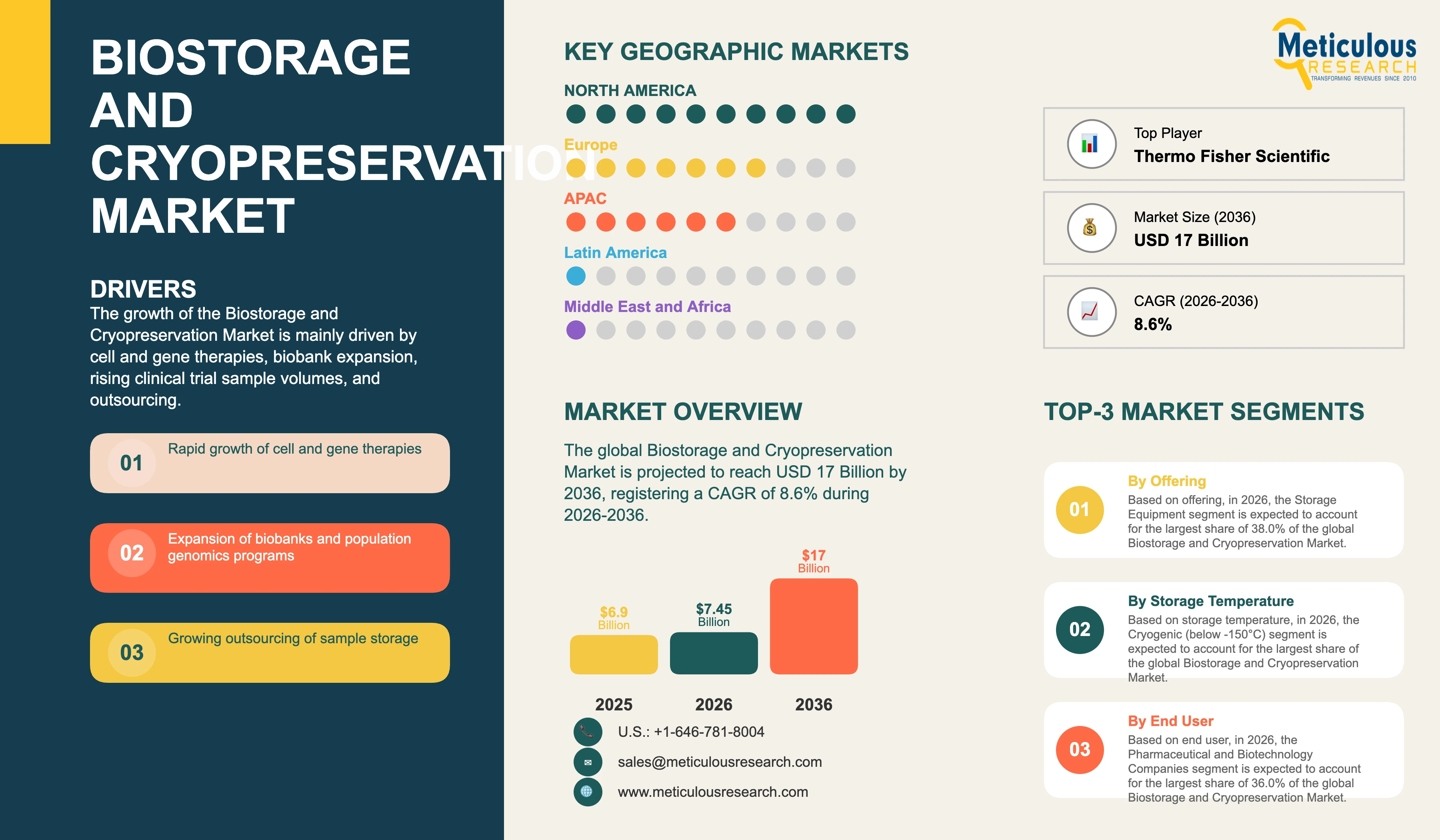
The global biostorage and cryopreservation market was valued at USD 6.90 billion in 2025. This market is expected to reach USD 17.00 billion by 2036 from an estimated USD 7.45 billion in 2026, registering a CAGR of 8.6% during the forecast period (2026-2036).
- Published
- Nov 2026
- Pages
- 255
- Format
- PDF + Excel
- Report ID
- MRHC - 1042597
- Base year
- 2025
- 2025 · BASELINE
- $6.90B
- 2036
- $17.00B
- CAGR 2026–2036
- 8.6%
2025 baseline · 2026–2036 forecast at 8.6% CAGR · hover a bar for the value
Key highlights
BioLife Solutions, a leading supplier of cryopreservation media for cell and gene therapies, reported first-quarter 2026 revenue of USD 27.5 million, up 25% year-over-year, and guided to full-year 2026 revenue of USD 112.5 million to USD 115.0 million, while noting that its biopreservation media are used in more than 250 commercially sponsored cell and gene therapy clinical trials in the U.S. and are embedded in 17 approved therapies.
Azenta, a leading provider of sample storage and biorepository solutions, raised its fiscal 2026 revenue outlook to USD 613 million to USD 618 million in August 2026 after its Sample Management Solutions segment reported quarterly revenue of USD 88 million, up 14% as reported, and it later reported double-digit year-over-year growth in sample repository services and consumables and instruments in the fourth quarter of fiscal 2026.
Azenta expanded its biorepository network through the acquisition of UK Biocentre, which contributed to its fiscal 2026 revenue, and it completed the sale of B Medical Systems to focus on its core sample management and multiomics businesses, reflecting the growing importance of recurring storage services in the market.
BioLife Solutions agreed to be acquired by Repligen in a cash-and-stock merger expected to close in the fourth quarter of 2026, which will combine BioLife's cryopreservation media and cell processing tools with Repligen's bioprocessing portfolio and illustrates growing consolidation among suppliers to the cell and gene therapy workflow.
BioLife reported that its biopreservation media hold more than 70% share of commercially sponsored cell and gene therapy clinical trials in the U.S., with visibility into an additional nine approvals, expanded indications, and geographic expansions over the following 12 months, which points to continued growth in demand for cryopreservation of advanced therapies. Its customers include developers of several approved CAR-T therapies.
By offering, storage equipment accounts for the largest share of 38.0% in 2026, while software and monitoring solutions register the highest CAGR.
By storage temperature, cryogenic (below -150°C) accounts for the largest share in 2026 and also registers the highest CAGR.
By sample type, cells and cell therapy materials account for the largest share in 2026 and also register the highest CAGR.
By end user, pharmaceutical and biotechnology companies account for the largest share of 36.0% in 2026, while CROs and CDMOs register the highest CAGR.
By geography, North America accounts for the largest share of 40.0% in 2026, while Asia-Pacific registers the highest CAGR of 11.1%.
Report summary
| Particulars | Details |
|---|---|
| Forecast Period | 2026-2036 |
| Base Year | 2025 |
| Estimated Year | 2026 |
| CAGR (Value) | 8.6% |
| Format | PDF, Excel & Cloud Portal · 255 pages |
| Market Size (Value) in 2025 | USD 6.90 billion |
| Market Size (Value) in 2026 | USD 7.45 billion |
| Market Size (Value) by 2036 | USD 17.00 billion |
| Largest Segment by Offering (2026) | Storage Equipment (38.0%) |
| Largest Segment by End User (2026) | Pharmaceutical and Biotechnology Companies (36.0%) |
| Largest Region (2026) | North America (40.0%) |
| Fastest-Growing Region | Asia-Pacific (CAGR 11.1%) |
| Segments Covered | Offering, Storage Temperature, Sample Type, End User, Geography |
| Countries Covered | U.S., Canada, U.K., Germany, France, Switzerland, Netherlands, Italy, Spain, Belgium, Sweden, Denmark, Rest of Europe, China, Japan, South Korea, India, Australia, Singapore, Taiwan, Rest of Asia-Pacific, Brazil, Mexico, Argentina, Rest of Latin America, Saudi Arabia, U.A.E., Israel, South Africa, Rest of Middle East & Africa |
| Key Companies | 15 companies and other companies |
Report overview
Segments covered: offering, storage temperature, sample type, end user.
The growth of this market is mainly driven by the rapid growth of cell and gene therapies, which depend on cryopreserved starting materials and finished products, the expansion of biobanks and large population genomics programs, rising volumes of clinical trial samples that must be stored under controlled conditions, the growing outsourcing of sample storage to specialized biorepositories, and the increasing use of fertility preservation and cord blood banking. However, factors such as the high cost of cryogenic and automated storage equipment, shortages of liquid nitrogen and skilled staff in some regions, the risk of sample loss from equipment failures, and regulatory and data management requirements are expected to restrain the growth of this market to some extent.
Biostorage and cryopreservation refer to the products and services used to preserve and store biological materials, such as cells, tissues, blood, nucleic acids, reproductive cells, and cell and gene therapy products, under controlled conditions so that they remain viable and usable over time. Cryopreservation involves cooling biological materials to very low temperatures, typically below minus 150 degrees Celsius in liquid nitrogen or its vapor phase, using cryoprotective media and controlled-rate freezing to protect cells from damage. Biostorage more broadly includes storage at ultra-low, frozen, refrigerated, and ambient temperatures in biobanks and biorepositories. This report covers storage equipment, such as cryogenic freezers and liquid nitrogen storage systems, ultra-low temperature freezers, and automated sample stores, cryopreservation media and consumables, such as cryopreservation solutions, cryovials, bags, and labels, biostorage services provided by biorepositories, and software and monitoring solutions. Cold chain transportation and general laboratory refrigerators are analyzed in separate reports. The market is measured on a revenue basis.
Preserving biological materials safely over long periods is essential for modern life sciences research and medicine. Biobanks store millions of samples of blood, tissue, and DNA for research into the genetic and environmental causes of disease. Pharmaceutical and biotechnology companies store cell lines, master and working cell banks, and clinical trial samples. Clinical trials generate large numbers of samples that must be stored under validated conditions for years, often for regulatory purposes. Fertility clinics cryopreserve eggs, sperm, and embryos, and cord blood banks store umbilical cord blood for potential future use.
Cell and gene therapies have become the most important new source of demand. Most autologous cell therapies, such as CAR-T therapies, require patients' cells to be collected, cryopreserved, shipped to manufacturing sites, processed, cryopreserved again, and shipped back to treatment centers, and allogeneic therapies require large banks of cryopreserved donor cells and finished doses. Cryopreservation media, controlled-rate freezers, cryogenic storage, and validated biostorage services are therefore critical parts of the cell and gene therapy supply chain. BioLife Solutions, the leading supplier of cryopreservation media for these therapies, reports that its products are used in more than 250 commercially sponsored cell and gene therapy clinical trials in the U.S. and are embedded in 17 approved therapies.
Storage equipment accounts for the largest share of the market by offering, reflecting the high cost of cryogenic freezers, liquid nitrogen storage systems, ultra-low temperature freezers, and automated sample stores. Biostorage services and cryopreservation media and consumables are other large segments, and software and monitoring solutions are the fastest-growing segment, as organizations invest in sample tracking, temperature monitoring, and chain of custody systems. Cryogenic storage is the largest and fastest-growing storage temperature segment, and cells and cell therapy materials are the largest and fastest-growing sample type.
Pharmaceutical and biotechnology companies are the largest end users, followed by biobanks, academic and research institutes, hospitals, cord blood banks, and fertility clinics, and contract research organizations and contract development and manufacturing organizations, which are the fastest-growing end users. North America is the largest regional market, supported by large pharmaceutical, biotechnology, and cell therapy industries and major biobanking programs, while Asia-Pacific is the fastest-growing region.
The market is served by equipment manufacturers, such as Thermo Fisher Scientific, PHC Holdings, Eppendorf, Haier Biomedical, Azenta, Hamilton, LiCONiC, Cryoport's MVE Biological Solutions, and Taylor-Wharton, cryopreservation media and consumables suppliers, such as BioLife Solutions, Merck KGaA, STEMCELL Technologies, Corning, and Thermo Fisher Scientific, and biostorage service providers, such as Azenta, Thermo Fisher Scientific, Cryoport, Avantor, and Precision for Medicine. Many companies offer integrated solutions that combine equipment, consumables, services, and software.
Outsourcing of sample storage is increasing, as pharmaceutical companies, biotechnology companies, and research organizations seek to reduce the cost and risk of maintaining their own storage facilities and to access validated, compliant storage with disaster recovery capabilities. Azenta reported double-digit growth in its sample repository services in the fourth quarter of fiscal 2026, reflecting this trend.
Over the forecast period, the biostorage and cryopreservation market is expected to grow steadily, supported by cell and gene therapy growth, biobanking expansion, clinical research, and outsourcing. At the same time, capital spending cycles, liquid nitrogen supply, regulatory requirements, and data management will influence growth across the market.
North America is expected to account for the largest share of 40.0% of the market in 2026, mainly due to large pharmaceutical, biotechnology, and cell and gene therapy industries, many clinical trials, major biobanking programs, and the presence of leading companies.
Asia-Pacific is projected to register the highest CAGR of 11.1% during the forecast period, driven by rapid growth of biotechnology and cell therapy industries, national biobanking programs, increasing clinical trials, and expanding fertility and cord blood banking services.
The report profiles 15 companies, including Thermo Fisher Scientific, Azenta, BioLife Solutions, Cryoport, PHC Holdings, Eppendorf, Haier Biomedical, Merck KGaA, Corning, Hamilton, LiCONiC, Avantor, STEMCELL Technologies, Taylor-Wharton, and Precision for Medicine.
Cell and gene therapies require patients' cells, donor cells, and finished doses to be cryopreserved so they can be shipped between collection sites, manufacturing facilities, and treatment centers without losing viability, which makes cryopreservation media and cryogenic storage critical parts of the supply chain.
Report infographic
Market dynamics
18 factors across 5 forcesRapid growth of cell and gene therapies
The number of approved cell and gene therapies and clinical trials has grown rapidly, and cryopreservation is essential for almost all of them. Autologous therapies such as CAR-T require patients' cells to be cryopreserved before and after manufacturing, allogeneic therapies require cryopreserved cell banks and finished doses, and gene therapies require storage of viral vectors and plasmids at ultra-low temperatures. As these therapies move into larger patient populations, including autoimmune diseases, and into earlier lines of treatment, the volume of materials requiring cryopreservation is increasing.
BioLife Solutions reported 25% revenue growth in the first quarter of 2026 and guided to 17% to 20% growth for the full year, driven mainly by demand for its biopreservation media from cell and gene therapy developers. The company's media are embedded in 17 approved therapies, and it expects additional approvals, expanded indications, and geographic expansions to support further demand.
Cell and gene therapy developers also require GMP-compliant biostorage services for starting materials, intermediates, and finished products, which supports demand for specialized biorepositories and cryogenic logistics providers.
Expansion of biobanks and population genomics programs
Biobanks are expanding worldwide to support research into disease, drug discovery, and precision medicine. Large national programs, such as UK Biobank, the U.S. National Institutes of Health's All of Us Research Program, FinnGen, China Kadoorie Biobank, Biobank Japan, and many others, collect and store samples from hundreds of thousands to millions of participants. Hospitals, universities, and disease-focused organizations also operate biobanks for cancer, rare diseases, and other conditions. These biobanks require large-scale storage capacity, automated storage systems, sample tracking software, and long-term storage services.
Growing interest in precision medicine and the use of samples for genomic, proteomic, and other multiomics analyses is increasing the value of high-quality, well-annotated samples, which encourages investment in modern biobanking infrastructure.
Azenta's acquisition of UK Biocentre, which provides sample processing and storage services for large population studies, illustrates the importance of these programs for biostorage service providers.
Rising clinical trial sample volumes
Clinical trials generate large numbers of biological samples for safety testing, pharmacokinetics, biomarker analysis, and future research, and these samples must be stored under validated conditions, often for many years after trials end. The growing number and complexity of clinical trials, the increasing use of biomarkers and precision medicine approaches, and regulatory requirements for sample retention are increasing demand for clinical biorepository services. Contract research organizations, central laboratories, and specialized biorepositories provide these services to pharmaceutical and biotechnology sponsors.
Decentralized clinical trials, in which samples are collected at many sites and in patients' homes, also increase the need for reliable sample logistics and storage. Regulators in several countries require trial sponsors to retain samples and associated data for extended periods, which increases the total volume of stored samples over time.
Growing outsourcing of sample storage
Pharmaceutical companies, biotechnology companies, and research institutions are increasingly outsourcing sample storage to specialized biorepositories, which offer validated storage at multiple temperatures, GMP compliance, disaster recovery, backup power, continuous monitoring, and sample management services. Outsourcing reduces the capital cost and operational risk of maintaining in-house storage, frees laboratory space, and gives access to expertise in regulatory compliance. Azenta reported double-digit growth in its sample repository services in the fourth quarter of fiscal 2026, and Thermo Fisher Scientific, Cryoport, Avantor, and others are expanding their biorepository networks.
Small and mid-sized biotechnology companies, which often lack the resources to build their own storage facilities, are particularly important customers for outsourced biostorage services.
Growth of fertility preservation and cord blood banking
Demand for fertility preservation is increasing as more people delay having children, as awareness of egg freezing grows, and as more employers offer fertility benefits. In vitro fertilization involves cryopreserving embryos, and egg and sperm freezing are becoming more common, including for medical reasons such as cancer treatment. Cord blood banks store umbilical cord blood and tissue for potential use in stem cell transplants and future therapies. These applications require cryopreservation media, vitrification kits, cryogenic storage tanks, and long-term storage services.
The growth of fertility clinic networks in Asia-Pacific, North America, and Europe is supporting demand for cryopreservation products and services in this segment. Private equity investment in fertility clinic chains has also accelerated the professionalization of storage practices in this segment.
Table of contents
12 chapters · 157 sections · 255 pages · click to expandSegmental analysis
| Segment | Largest share (2026) | Fastest growth (2026–2036) |
|---|---|---|
| By Offering | Storage equipment | Software and monitoring solutions |
| By Storage Temperature | Cryogenic (below -150°C) | Rapid growth of this |
| By Sample Type | Cells and cell therapy materials | Cells and cell therapy materials |
| By End User | Pharmaceutical and biotechnology companies | CROs and CDMOs |
| Other segments | Cryogenic (below -150°C) | — |
By Offering
- Biostorage and Cryopreservation Market Analysis by Offering
- The storage equipment segment is expected to account for the largest share of 38.0% of the global biostorage and cryopreservation market.
- The large share of this segment is mainly due to the high cost of cryogenic freezers, liquid nitrogen storage systems, ultra-low temperature freezers, controlled-rate freezers, and automated sample stores, the need for storage equipment in biobanks, pharmaceutical and biotechnology companies, research institutions, hospitals, fertility clinics, and biorepositories, and the replacement of aging equipment with more reliable and energy-efficient models.
- Equipment demand is influenced by capital spending cycles in biopharmaceutical and academic markets, and some suppliers, such as Azenta, reported weaker demand for automated stores and cryogenic systems in fiscal 2026 due to customer capital constraints, while demand for consumables and services remained stronger.
- Within this segment, automated storage systems and mechanical cryogenic freezers are attracting growing interest, since they improve sample integrity and reduce dependence on manual handling and liquid nitrogen.
- Replacement of aging freezers also provides a steady base of demand.
- Energy-efficient models are favored.
- However, the software and monitoring solutions segment is projected to register the highest CAGR during the forecast period.
- The rapid growth of this segment is driven by the need for real-time temperature and equipment monitoring, sample tracking and chain of custody management, regulatory requirements for data integrity, and the integration of storage systems with laboratory information management systems.
- Biostorage services form the second-largest segment, supported by growing outsourcing to biorepositories, while cryopreservation media and consumables, which include cryopreservation solutions, cryovials, bags, and labels, account for the remaining share and benefit from recurring demand driven by cell and gene therapies.
- Cryopreservation media are a particularly attractive part of the market, since they are used in every batch of many cell therapies and are rarely changed once a therapy has been approved, which creates stable recurring revenues for suppliers such as BioLife Solutions.
By Storage Temperature
- Biostorage and Cryopreservation Market Analysis by Storage Temperature
- The cryogenic segment, which includes storage below minus 150 degrees Celsius, is expected to account for the largest share of the global biostorage and cryopreservation market.
- The large share of this segment is mainly due to the use of cryogenic storage for cell therapies, stem cells, cell lines, reproductive cells and embryos, and cord blood, which require the lowest temperatures to maintain viability over long periods, the high value of cryogenic equipment and services, and the rapid growth of cell and gene therapies.
- Cryogenic storage in the vapor phase of liquid nitrogen is the standard for cell therapy materials and many biobank samples, and mechanical cryogenic freezers are increasingly used as an alternative where liquid nitrogen supply is limited.
- This segment is also projected to register the highest CAGR during the forecast period.
- The rapid growth of this segment is driven by the growth of cell and gene therapies, fertility preservation, and stem cell banking.
- The ultra-low segment, which includes storage between minus 40 and minus 86 degrees Celsius and is widely used for blood, tissue, nucleic acids, proteins, and clinical trial samples, forms the second-largest segment, while refrigerated and frozen storage and ambient storage, which is used for dried samples and some nucleic acids, account for the remaining share.
- Room-temperature storage technologies for DNA and RNA are also attracting interest, since they reduce energy use and shipping costs.
- Ultra-low storage at minus 80 degrees Celsius remains the standard for most research biobanks, and the large installed base of ultra-low freezers generates steady replacement demand as units age.
By Sample Type
- Biostorage and Cryopreservation Market Analysis by Sample Type
- The cells and cell therapy materials segment is expected to account for the largest share of the global biostorage and cryopreservation market.
- The large share of this segment is mainly due to the cryopreservation requirements of cell and gene therapies, cell lines, stem cells, and induced pluripotent stem cells, the high value of these materials, and the use of specialized media, cryogenic storage, and GMP-compliant services for cell therapy starting materials and finished products.
- Cell and gene therapy developers require strict control over cryopreservation and storage conditions, since post-thaw viability directly affects product quality and patient outcomes.
- Cells and cell therapy materials are also projected to register the highest CAGR during the forecast period.
- The rapid growth of this segment is driven by increasing numbers of cell therapy approvals and clinical trials, expansion into new indications such as autoimmune diseases, growth of allogeneic therapies, and investment in cell banks.
- Blood and blood components form the second-largest segment, followed by tissue samples, nucleic acids, reproductive cells and embryos, and other samples, such as organs, microorganisms, and environmental samples.
- Reproductive cells and embryos are also a fast-growing area, supported by increasing use of egg freezing and in vitro fertilization, which requires reliable long-term cryogenic storage.
By End User
- Biostorage and Cryopreservation Market Analysis by End User
- The pharmaceutical and biotechnology companies segment is expected to account for the largest share of 36.0% of the global biostorage and cryopreservation market.
- The large share of this segment is mainly due to the large volumes of cell lines, cell banks, clinical trial samples, and therapeutic materials stored by these companies, the cryopreservation requirements of cell and gene therapies, regulatory requirements for sample retention, and investment in research and development and manufacturing.
- Pharmaceutical and biotechnology companies use a combination of in-house storage and outsourced biorepository services, and they are major buyers of cryopreservation media, cryogenic equipment, and sample management software.
- Large pharmaceutical companies often maintain multiple storage sites and backup locations to protect critical materials, while smaller biotechnology companies increasingly rely on outsourced storage to avoid capital investment.
- However, the CROs and CDMOs segment is projected to register the highest CAGR during the forecast period.
- The rapid growth of this segment is driven by the outsourcing of clinical research, cell and gene therapy manufacturing, and sample management to contract research organizations and contract development and manufacturing organizations, which require large-scale storage capacity and GMP-compliant cryopreservation.
- Biobanks form the second-largest segment, followed by academic and research institutes and hospitals, cord blood banks, and fertility clinics.
- Biobanks are expected to grow steadily, supported by national population genomics programs and disease-focused collections, while fertility clinics and cord blood banks benefit from rising demand for egg freezing and in vitro fertilization.
Other segments
- The cryogenic (below -150°C) segment is expected to account for the largest share of the biostorage and cryopreservation market, and it is also projected to register the highest CAGR during the forecast period.
- The cells and cell therapy materials segment is expected to account for the largest share of the biostorage and cryopreservation market, and it is also projected to register the highest CAGR during the forecast period.
Geographic analysis
North America
Largest shareIn 2026, North America is expected to account for the largest share of 40.0% of the global biostorage and cryopreservation market. The large share of this region is mainly due to the large pharmaceutical, biotechnology, and cell and gene therapy industries in the U.S., the large number of clinical trials, major biobanking programs such as the NIH All of Us Research Program, a large fertility services market, and the presence of leading companies such as Thermo Fisher Scientific, Azenta, BioLife Solutions, Cryoport, Corning, Hamilton, Avantor, and Precision for Medicine. The U.S. is the largest market in the region, followed by Canada. Most approved cell and gene therapies have been developed in the U.S., which supports strong demand for cryopreservation media and cryogenic storage.
Asia-Pacific
Fastest growthAsia-Pacific is projected to register the highest CAGR of 11.1% during the forecast period. The rapid growth of this region is mainly driven by rapid growth of the biotechnology and cell therapy industries in China, Japan, South Korea, and India, large national biobanking programs, increasing clinical trial activity, growth of fertility clinics and cord blood banks, government support for life sciences, and expanding local manufacturing of storage equipment by companies such as Haier Biomedical. China, Japan, South Korea, India, Australia, Singapore, and Taiwan are important markets, and China has become a major center for cell therapy development and clinical trials.
Europe
Europe accounts for a significant share of the global market, supported by large biobanking programs such as UK Biobank and FinnGen, strong pharmaceutical and biotechnology industries, growing cell and gene therapy activity, and established fertility and cord blood banking services. The U.K., Germany, France, Switzerland, the Netherlands, Italy, Spain, Belgium, Sweden, and Denmark are important markets, and leading European suppliers include Eppendorf, Merck KGaA, and LiCONiC. Azenta's acquisition of UK Biocentre strengthens its position in the European biorepository market.
Latin America
Latin America and the Middle East & Africa account for smaller shares of the market but are growing steadily, supported by investments in biobanking, cell therapy, fertility services, and clinical research in Brazil, Mexico, Saudi Arabia, the U.A.E., Israel, and South Africa. Brazil and Mexico are the largest markets in Latin America, supported by clinical research and fertility services.
Middle East & Africa
Saudi Arabia and the U.A.E. are investing in national genome programs that require large-scale biobanking capacity. Israel has an active cell therapy research sector. South Africa leads in Africa.
Competitive landscape
The global biostorage and cryopreservation market is moderately consolidated, with the top five players estimated to account for about 40% of the market in 2025. The market includes laboratory equipment manufacturers, cryogenic equipment manufacturers, cryopreservation media and consumables suppliers, biorepository service providers, and software providers.
Thermo Fisher Scientific is a leading player with a broad portfolio of ultra-low temperature freezers, cryogenic storage, cryopreservation media and consumables, and biorepository services. Azenta offers automated sample stores, cryogenic systems, consumables, and sample repository services, and has expanded through the acquisition of UK Biocentre. BioLife Solutions leads in cryopreservation media for cell and gene therapies and has agreed to be acquired by Repligen. Cryoport offers cryogenic logistics, biostorage, and cryogenic equipment through MVE Biological Solutions. PHC Holdings, Eppendorf, and Haier Biomedical are major suppliers of ultra-low temperature freezers, Hamilton and LiCONiC offer automated storage systems, Merck KGaA, STEMCELL Technologies, and Corning supply cryopreservation media and consumables, Taylor-Wharton supplies cryogenic storage tanks, and Avantor and Precision for Medicine provide biorepository services.
Companies in this market compete on product reliability, sample integrity, regulatory compliance, storage capacity, automation, monitoring and software capabilities, service quality, global network coverage, and price. Key strategies include acquisitions to build integrated workflow solutions, expansion of biorepository networks, launches of energy-efficient and automated storage systems, development of improved cryopreservation media, and partnerships with cell and gene therapy developers.
Recurring revenues from consumables, media, and storage services are becoming increasingly important, since they are less exposed to capital spending cycles than equipment. Companies with integrated offerings across equipment, consumables, services, and software are well positioned to serve large customers that seek fewer suppliers. Service providers also compete on the geographic reach of their facilities, since many customers require storage in multiple countries and backup sites in different locations.
We expect consolidation to continue, as larger life science tools companies acquire specialized suppliers to build end-to-end solutions for cell and gene therapy and biobanking customers. Chinese suppliers such as Haier Biomedical are also expanding internationally, which is increasing price competition in ultra-low temperature freezers. Japanese supplier PHC Holdings also holds a strong position in this equipment category.
Some of the key players operating in the biostorage and cryopreservation market are Thermo Fisher Scientific Inc., Azenta, Inc., BioLife Solutions, Inc., Cryoport, Inc., PHC Holdings Corporation, Eppendorf SE, Haier Biomedical Co., Ltd., Merck KGaA, Corning Incorporated, Hamilton Company, LiCONiC AG, Avantor, Inc., STEMCELL Technologies Inc., Taylor-Wharton, and Precision for Medicine, among others.
- —
BioLife Solutions reported first-quarter 2026 revenue growth of 25% and agreed to be acquired by Repligen, Azenta raised its fiscal 2026 revenue outlook in August 2026 and reported double-digit growth in sample repository services in the fourth quarter, and Azenta acquired UK Biocentre.
- Thermo Fisher Scientific Inc.
- Azenta, Inc.
- BioLife Solutions, Inc.
- Cryoport, Inc.
- PHC Holdings Corporation
- Eppendorf SE
- Haier Biomedical Co., Ltd.
- Merck KGaA
- Corning Incorporated
- Hamilton Company
- LiCONiC AG
- Avantor, Inc.
- STEMCELL Technologies Inc.
- Taylor-Wharton
Expert perspectives
Biostorage and cryopreservation are essential infrastructure for life sciences research, clinical trials, cell and gene therapies, and reproductive medicine. The market is growing steadily, with the strongest growth coming from cell and gene therapies, outsourced storage services, and software and monitoring solutions.
Over the forecast period, the market is expected to grow at a CAGR of 8.6%, from USD 7.45 billion in 2026 to USD 17.00 billion in 2036. Growth will be supported by cell and gene therapy expansion, biobanking, clinical trial sample volumes, outsourcing, and fertility preservation.
Among the market segments, storage equipment is the largest offering, while software and monitoring solutions grow fastest. Cryogenic storage is the largest and fastest-growing storage temperature segment, cells and cell therapy materials are the largest and fastest-growing sample type, and pharmaceutical and biotechnology companies are the largest end users, while CROs and CDMOs grow fastest. North America is the largest region, and Asia-Pacific is the fastest-growing region at a CAGR of 11.1%.
In our view, cell and gene therapies will remain the most important growth driver for the market. As these therapies expand into larger patient populations, demand for cryopreservation media, cryogenic storage, and GMP biostorage services will grow, and suppliers embedded in approved therapies will benefit from stable recurring revenues.
We also expect outsourcing of sample storage to continue to increase, as organizations seek to reduce costs and risks and to access compliant, monitored storage. Biorepository providers with global networks and integrated logistics will be well placed to benefit. Small and mid-sized biotechnology companies and clinical trial sponsors are likely to be the most important sources of new outsourcing demand.
Equipment demand will remain more cyclical, depending on biopharmaceutical and academic capital budgets, but the replacement of aging equipment and adoption of automated and energy-efficient systems will support long-term growth. Mechanical cryogenic freezers and automated stores are expected to gain share as customers seek to reduce manual handling and dependence on liquid nitrogen. We also expect Asia-Pacific to become an increasingly important market, as China, Japan, South Korea, and India expand their cell therapy industries, biobanks, and clinical research. Local suppliers will compete strongly with international companies in equipment, while international suppliers will continue to lead in specialized media and GMP services.
Overall, we believe the biostorage and cryopreservation market will grow steadily over the forecast period, with an increasing share of value coming from recurring consumables, services, and software. Regulatory compliance and sample integrity will remain the most important factors for buyers. Suppliers that combine these with cost efficiency will lead.
Customer perspectives
Head of Supply Chain - Cell therapy company, U.S.
Our patients' cells are irreplaceable, so cryopreservation media, cryogenic storage, and chain of custody must be validated at every step. Once a medium is in our approved process, we do not change it.
“We are moving to automated cryogenic storage and real-time monitoring to protect our collections and track every sample, but capital budgets are tight.”
“We outsource storage of our clinical trial samples to a specialized biorepository, since it gives us validated storage and disaster recovery without building our own facility.”
Frequently asked questions
The global biostorage and cryopreservation market was valued at USD 6.90 billion in 2025, up from USD 6.38 billion in 2024, and is estimated at USD 7.45 billion in 2026. The market includes storage equipment, cryopreservation media and consumables, biostorage services, and software and monitoring solutions.
Cite this report
Meticulous Research. (2026). Biostorage and Cryopreservation Market - Global Opportunity Analysis and Industry Forecast (2026-2036) (Report No. MRHC - 1042597). Meticulous Market Research Pvt. Ltd. https://www.meticulousresearch.com/product/biostorage-and-cryopreservation-market-7280