Battery Separator Coatings Market (2026-2036)
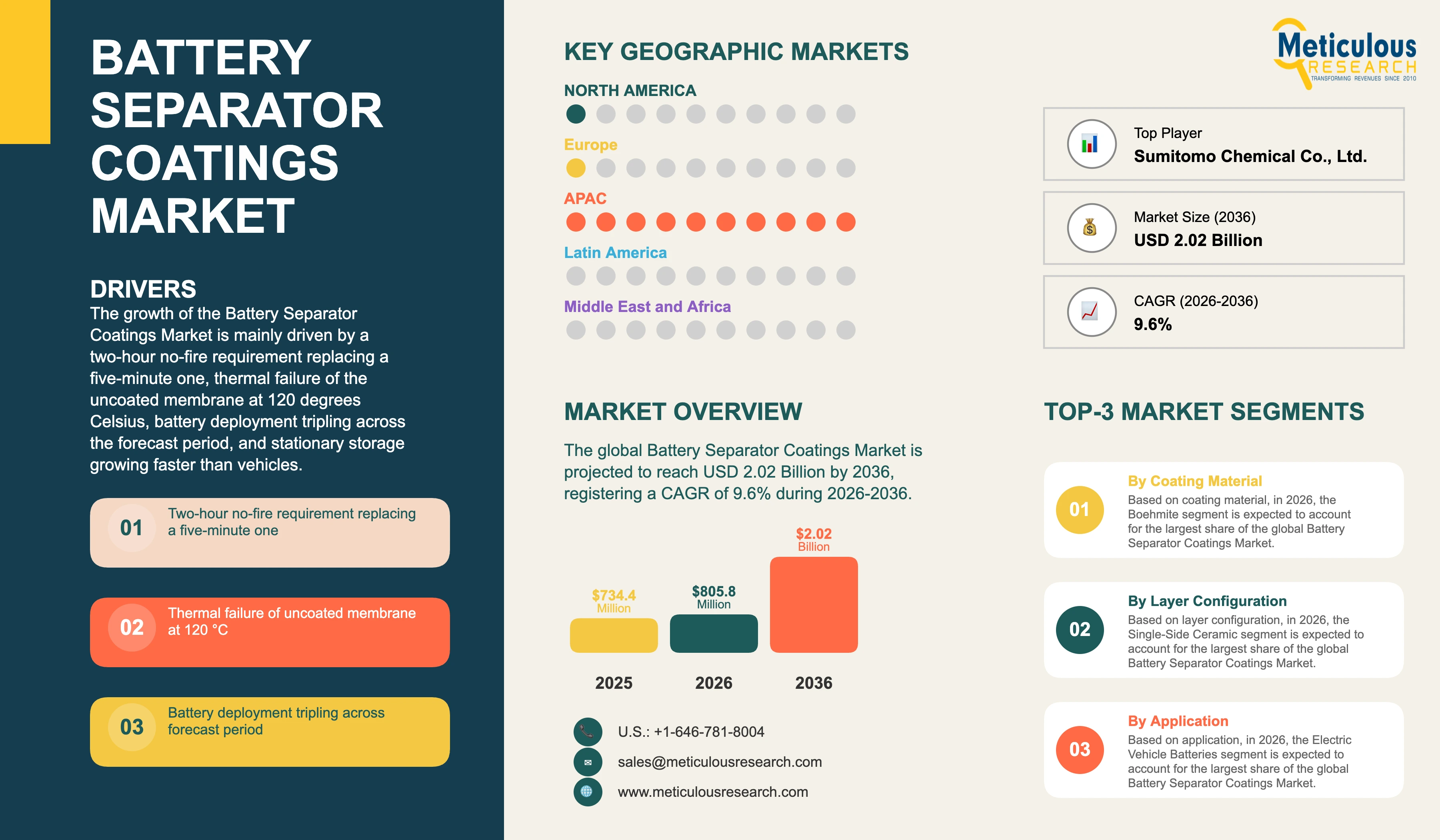
The battery separator coatings market is valued at USD 805.8 million in 2026 and is projected to reach USD 2.02 billion by 2036, at a CAGR of 9.6% during the forecast period. The market was valued at USD 734.4 million in 2025 and at USD 661.2 million in 2024.
- Published
- Nov 2026
- Pages
- 258
- Format
- PDF + Excel
- Report ID
- MRCHM - 1042798
- Base year
- 2025
- 2024 · HISTORICAL
- $661.2M
- 2036
- $2.02B
- CAGR 2026–2036
- 9.6%
2024–2025 baseline · 2026–2036 forecast at 9.6% CAGR · hover a bar for the value
Key highlights
This market measures coating materials applied to lithium-ion battery separators, namely ceramic fillers, fluoropolymer and other polymer binders and high-temperature polymer layers, taken at the material supplier gate on a tonne basis of coating solids.
Excluded are the base separator membrane itself, electrode binders and cathode or anode coatings, solid electrolytes and ceramic separators replacing a polyolefin membrane, coating and calendering equipment, and solvents recovered in processing.
Coated separator area is estimated at 22, 000 million square metres in 2026 rising to 62,000 million square metres by 2036, a CAGR of 10.9%, at an average coating load of 3.59 grams a square metre rising to 3.77 grams.
GB 38031-2025 requires no fire and no explosion over a two-hour observation period after thermal runaway is triggered, against five minutes under GB 38031-2020, with an alarm sounding within five minutes.
It applies to new type approvals from 1 July 2026 and to existing approved vehicles from 1 July 2027.
It adds a bottom impact test in which a 30 millimetre impactor strikes the pack underside three times at 150 joules with the pack charged to at least 95% state of charge, and the pack must not leak, rupture, burn or explode.
It also adds a fast-charge cycling safety test of 300 cycles between 20% and 80% state of charge in about 15 minutes or less, followed by a ten-minute external short circuit through a resistance of 5 milliohms or less.
Research published in Energy Materials records an uncoated polypropylene separator shrinking 2% at 100 degrees Celsius, 14.3% at 120 degrees, 34.7% at 140 degrees, 42.8% at 160 degrees and about 100% at 180 degrees after 30 minutes.
Impedance testing in the same work showed an internal short circuit in that uncoated separator at 120 degrees Celsius, attributed to the shrinkage.
Polyethylene melts at about 137 degrees Celsius and polypropylene at 161 to 165 degrees, which places the failure temperature of an uncoated polyolefin membrane well below the temperatures reached in a propagating cell.
A coated membrane in the same study held shrinkage below 4% from 150 to 275 degrees Celsius, with electrolyte uptake rising from 320% to 494% and the electrolyte contact angle falling from 46 to 24 degrees.
The International Energy Agency recorded electric vehicle battery deployment at about 1.2 TWh in 2025, up almost 30% on 2024 and more than seven times the 2020 level, with China at about 60% of deployment, the European Union at almost 15% and the United States at about 10%.
That agency expects deployment of about 3 TWh by 2030 and about 4 TWh to almost 5 TWh by 2035, depending on the scenario.
Lithium iron phosphate accounted for over 55% of electric vehicle batteries in 2025 against nearly 50% in 2024, while almost 80% of batteries made outside China used nickel-containing chemistries, and lithium iron phosphate took over 90% of stationary storage installations.
Global lithium-ion nameplate capacity exceeded 4 TWh at the end of 2025, up about 30% on 2024, with China holding over 80% of it and the European Union and the United States 6% to 7% each.
Average battery prices fell 8% in 2025, and lithium iron phosphate packs cost more than 40% less per kilowatt-hour than nickel manganese cobalt packs.
Separator plants of SK IE Technology ran at about 20% utilisation in the first quarter of 2026, with the China plant being sold and the Jeungpyeong plant suspended, and the company is to be absorbed into SK Innovation Co., Ltd. as a business division effective 1 January 2027.
Boehmite is expected to hold the largest coating material share of this market in 2026 at 34.0% while aramid and polyimide layers grow fastest at 14.2%, and ceramic plus polymer composite configurations record the highest layer configuration CAGR at 11.8%.
Report summary
| Particulars | Details |
|---|---|
| Base Year | 2025 |
| Actual Years | 2024-2025 |
| Forecast Period | 2026-2036 |
| Market Size in 2024 | USD 661.2 million |
| Market Size in 2025 | USD 734.4 million |
| Market Size in 2026 | USD 805.8 million |
| Market Size in 2036 | USD 2.02 billion |
| Value CAGR (2026-2036) | 9.6% |
| Format | PDF, Excel & Cloud Portal · 258 pages |
| Volume in 2025 | 68.00 kilotons |
| Volume in 2026 | 79.00 kilotons |
| Volume in 2036 | 234.00 kilotons |
| Volume CAGR (2026-2036) | 11.5% |
| Average Selling Price, 2026 | USD 10,200 per tonne |
| Average Selling Price, 2036 | USD 8,620 per tonne |
| Units | Value in USD million; volume in kilotons of coating solids; price in USD per tonne |
| Measurement Basis | Coating materials applied to lithium-ion battery separators, namely ceramic fillers, fluoropolymer and other polymer binders and high-temperature polymer layers, taken at the material supplier gate on a tonne basis of coating solids |
| Coated Area Reference | Coated separator area is estimated at 22,000 million square metres in 2026 rising to 62,000 million square metres by 2036, a CAGR of 10.9%, at an average coating load of 3.59 grams a square metre in 2026 and 3.77 grams by 2036 |
| Historical Value Growth | Value grew at 10.4% a year between 2024 and 2026 on volume growth of 16.7% a year and a price decline of 5.4% a year; the forecast of 9.6% carries volume growth of 11.5% and a price decline of 1.7%, so value grows more slowly than either tonnage or coated area throughout |
| Price Decline Note | The average selling price falls across the forecast period because cell nameplate capacity exceeded 4 TWh at the end of 2025 against electric vehicle battery deployment of about 1.2 TWh, average battery prices fell 8% in 2025, and the separator plants of SK IE Technology ran at about 20% utilisation in the first quarter of 2026; the decline moderates as the coating mix shifts toward aramid, polyimide and composite layers |
| Regulatory Basis | GB 38031-2025 requires no fire and no explosion over a two-hour observation period after thermal runaway is triggered, against five minutes under GB 38031-2020, with an alarm sounding within five minutes; it applies to new type approvals from 1 July 2026 and to existing approved vehicles from 1 July 2027 |
| Additional Test Basis | The same standard adds a bottom impact test in which a 30 millimetre impactor strikes the pack underside three times at 150 joules with the pack charged to at least 95% state of charge, and a fast-charge cycling safety test of 300 cycles between 20% and 80% state of charge in about 15 minutes or less followed by a ten-minute external short circuit through a resistance of 5 milliohms or less |
| Thermal Failure Basis | Research published in Energy Materials records an uncoated polypropylene separator shrinking 2% at 100 degrees Celsius, 14.3% at 120 degrees, 34.7% at 140 degrees, 42.8% at 160 degrees and about 100% at 180 degrees after 30 minutes, with impedance testing showing an internal short circuit at 120 degrees; polyethylene melts at about 137 degrees Celsius and polypropylene at 161 to 165 degrees |
| Coated Performance Basis | In the same work a coated membrane held shrinkage below 4% from 150 to 275 degrees Celsius, raised electrolyte uptake from 320% to 494%, lowered the electrolyte contact angle from 46 to 24 degrees and raised tensile strength from 22.2 to 41.0 megapascals |
| Battery Demand Basis | The International Energy Agency recorded electric vehicle battery deployment at about 1.2 TWh in 2025, up almost 30% on 2024 and more than seven times the 2020 level, with China at about 60%, the European Union at almost 15% and the United States at about 10%; deployment is expected to reach about 3 TWh by 2030 and about 4 TWh to almost 5 TWh by 2035 |
| Chemistry Mix Basis | Lithium iron phosphate accounted for over 55% of electric vehicle batteries in 2025 against nearly 50% in 2024 and over 90% of stationary storage installations; almost 80% of batteries made outside China used nickel-containing chemistries; lithium iron phosphate packs cost more than 40% less per kilowatt-hour than nickel manganese cobalt packs |
| Capacity Basis | Global lithium-ion nameplate capacity exceeded 4 TWh at the end of 2025, up about 30% on 2024, with China holding over 80% and the European Union and the United States 6% to 7% each; capacity grew about 50% in the European Union and the United States in 2025 against just over 25% in China; Chinese producers accounted for almost 75% of global electric vehicle battery deployment |
| Corporate Development Note | SK IE Technology is to be absorbed into SK Innovation Co., Ltd. as a business division effective 1 January 2027 through a small-scale merger at an exchange ratio of 1 to 0.1174540, with the China plant being sold, the Jeungpyeong plant suspended, about 2 trillion won invested in the Poland plant and the separator business targeted to reach positive earnings before interest, taxes, depreciation and amortisation within two to three years and operating profit in 2029 |
| Substitution Note | Semi-solid cells are already commercial and all-solid-state cells are produced at small scale for testing, with the first all-solid-state vehicle planned for 2028 and mass production from 2030, but the technology is expected to stay in premium segments until the first half of the 2030s; sodium-ion cell capacity stood at just over 1% of lithium-ion capacity in 2025 and uses a coated separator in the same way |
| Overlap Note | The base separator membrane is counted in the relevant separator film titles and electrode binders in the relevant binder titles, so those titles are non-additive with this one on the cells they share |
| Exclusions | The base separator membrane; electrode binders and cathode or anode coatings; solid electrolytes and ceramic separators replacing a polyolefin membrane; coating, calendering and slitting equipment; solvents recovered in processing; cell enclosures, current collectors and pack-level thermal barriers |
| Segments: Coating Material | Boehmite; Alumina; Polyvinylidene Fluoride; Aramid and Polyimide; Other Coating Materials |
| Segments: Layer Configuration | Single-Side Ceramic; Double-Side Ceramic; Ceramic plus Polymer Composite; Polymer Only |
| Segments: Base Separator Process | Wet-Process Polyethylene; Dry-Process Polypropylene; Non-Woven and Other Base Separators |
| Segments: Application | Electric Vehicle Batteries; Stationary Energy Storage; Consumer Electronics; Other Applications |
| Largest Segment by Coating Material, 2026 | Boehmite, at 34.0% |
| Fastest-Growing Segment by Coating Material | Aramid and Polyimide, at 14.2% |
| Slowest-Growing Segment by Coating Material | Alumina, at 6.0% |
| Largest Segment by Layer Configuration, 2026 | Single-Side Ceramic, at 38.0% |
| Fastest-Growing Segment by Layer Configuration | Ceramic plus Polymer Composite, at 11.8% |
| Largest Segment by Base Separator Process, 2026 | Wet-Process Polyethylene, at 72.0% |
| Fastest-Growing Segment by Base Separator Process | Dry-Process Polypropylene, at 11.2% |
| Largest Segment by Application, 2026 | Electric Vehicle Batteries, at 62.0% |
| Fastest-Growing Segment by Application | Stationary Energy Storage, at 12.4% |
| Slowest-Growing Segment by Application | Consumer Electronics, at 5.2% |
| Largest Region, 2026 | Asia-Pacific, at 87.5% |
| Fastest-Growing Region | Europe, at 13.4% |
| Fastest-Growing Country | Hungary, at 14.6% |
| Slowest-Growing Country | Japan, at 5.8% |
| Regions Covered | Asia-Pacific; Europe; North America; Latin America; Middle East & Africa |
| Countries Covered | China; South Korea; Japan; India; Germany; Hungary; Poland; France; U.S.; Canada; Mexico; Brazil |
| Key Players | Sumitomo Chemical Co., Ltd.; Nabaltec AG; Sasol Limited; Arkema S.A.; Syensqo SA; Kureha Corporation; Daikin Industries, Ltd.; Teijin Limited; Shandong Sinocera Functional Material Co., Ltd.; Anhui Estone Materials Technology Co., Ltd. |
| Top Five Share, 2026 | 51.0% |
| Profiled Companies Share, 2026 | 68.5% |
| Currency | USD |
Report overview
Market value is measured in in USD million; volume in kilotons of coating solids; price in USD per tonne. Segments covered: coating material, layer configuration, base separator process, application.
In volume terms, the market is estimated at 79.00 kilotons of coating solids in 2026, rising to 234.00 kilotons by 2036, at a CAGR of 11.5%. The average selling price is estimated at USD 10,200 per tonne in 2026 and USD 8,620 per tonne in 2036, the decline reflecting continued cost pass-back from cell makers and the scale-up of Chinese coating material supply.
The growth of this market is mainly driven by GB 38031-2025 replacing a five-minute no-fire requirement with a two-hour one from 1 July 2026, an uncoated polypropylene separator that shrinks 14.3% at 120 degrees Celsius and short-circuits at that temperature, electric vehicle battery deployment of about 1.2 TWh in 2025 heading toward about 3 TWh by 2030, and stationary storage in which lithium iron phosphate accounted for over 90% of installations in 2025. However, factors such as more than 4 TWh of nameplate cell capacity against about 1.2 TWh of deployment, average battery prices falling 8% in 2025, separator plants of a leading Korean producer running at about 20% utilisation in the first quarter of 2026, and lithium iron phosphate packs costing more than 40% less per kilowatt-hour than nickel manganese cobalt are expected to restrain the growth of this market to some extent.
Among applications, electric vehicle batteries are expected to hold the largest share of this market in 2026, while stationary energy storage is expected to record the highest CAGR during the forecast period. Geographically, Asia-Pacific is expected to account for the largest share of this market in 2026, while Europe is expected to register the highest CAGR during the forecast period.
A lithium-ion separator is a microporous polyolefin membrane between 5 and 16 microns thick whose job is to keep the electrodes apart while letting ions through. The material that does that best at room temperature is the material that fails first when the cell gets hot. Polyethylene melts at about 137 degrees Celsius and polypropylene at 161 to 165 degrees, and the membrane begins to shrink long before it melts.
Measured shrinkage puts the problem precisely. Research published in Energy Materials records an uncoated polypropylene separator shrinking 2% at 100 degrees Celsius, 14.3% at 120 degrees, 34.7% at 140 degrees, 42.8% at 160 degrees and about 100% at 180 degrees after 30 minutes, with impedance testing showing an internal short circuit at 120 degrees attributed to that shrinkage.
A membrane that pulls away from the electrode edge at 120 degrees cannot contain a cell that is already venting at 200 degrees and rising. Ceramic and high-temperature polymer coatings exist to hold the dimensional stability of the membrane past the point where the polymer itself has given up, and the same study shows a coated membrane holding shrinkage below 4% from 150 to 275 degrees Celsius.
The coating does other work on the way. Electrolyte uptake in that study rose from 320% to 494% and the electrolyte contact angle fell from 46 to 24 degrees, so wetting improves, filling time at the cell plant shortens and the ceramic layer also resists puncture by dendrites and by particulate contamination.
The named demand driver for this title is thermal stability requirements, and in this case the requirement became binding on a date. GB 38031-2025 requires no fire and no explosion over a two-hour observation period after thermal runaway is triggered, against five minutes under the 2020 edition, and applies to new type approvals from 1 July 2026 and to existing approved vehicles from 1 July 2027.
Two hours is a different engineering problem from five minutes. A five-minute criterion can be met by delaying propagation long enough for occupants to leave, which pack-level barriers and venting can achieve. A two-hour criterion requires the cell not to propagate at all, which puts the separator back at the centre of the safety case rather than at the periphery.
The standard adds two further tests that reach the separator. A bottom impact test drives a 30 millimetre impactor into the pack underside three times at 150 joules with the pack at least 95% charged, and a fast-charge cycling test runs 300 cycles between 20% and 80% state of charge in about 15 minutes or less before a ten-minute external short circuit through 5 milliohms or less.
Fast-charge cycling is the test that matters most for coating specification, because repeated rapid lithiation drives dendrite formation and the external short circuit that follows converts any mechanical weakness in the membrane into a propagation event.
Demand therefore has a firm technical floor, and the volume behind it is large. The International Energy Agency recorded electric vehicle battery deployment at about 1.2 TWh in 2025, up almost 30% on 2024 and more than seven times the 2020 level, and expects about 3 TWh by 2030 and about 4 TWh to almost 5 TWh by 2035.
Value does not follow that requirement, and the reason is capacity. Global lithium-ion nameplate capacity exceeded 4 TWh at the end of 2025, up about 30% on 2024, against deployment of about 1.2 TWh, and China holds over 80% of that capacity while the European Union and the United States hold 6% to 7% each.
Cell prices reflect it, with average battery prices falling 8% in 2025, and separator makers reflect it more sharply still. Separator plants of SK IE Technology ran at about 20% utilisation in the first quarter of 2026, the China plant is being sold, the Jeungpyeong plant is suspended, and the company is to be absorbed into SK Innovation Co., Ltd. as a business division effective 1 January 2027.
A coating supplier selling into that industry gains tonnes and loses price. Volume in this market grew 16.7% a year between 2024 and 2026 while the average selling price fell 5.4% a year, and the forecast carries volume growth of 11.5% against a price decline of 1.7%.
Chemistry mix pulls in the same direction. Lithium iron phosphate accounted for over 55% of electric vehicle batteries in 2025 against nearly 50% in 2024, and over 90% of stationary storage installations, while packs built on it cost more than 40% less per kilowatt-hour than nickel manganese cobalt packs.
Lithium iron phosphate has a higher thermal runaway onset temperature than high-nickel chemistry and a cell cost that leaves less room for a premium coating, so the chemistry carrying the volume growth is also the one least able to pay for the highest specification. Almost 80% of batteries made outside China used nickel-containing chemistries, which is where the aramid and composite work concentrates.
Base separator process is shifting with that chemistry. Wet-process polyethylene holds 72.0% of this market in 2026 and is almost always coated, while dry-process polypropylene, historically coated lightly or not at all and widely used in lithium iron phosphate cells, grows fastest at 11.2% as the new standard forces a coating onto it.
Solid-state architecture is the terminal risk rather than a forecast-period one. Semi-solid cells are already commercial and all-solid-state cells are produced at small scale for testing, with the first all-solid-state vehicle planned for 2028 and mass production from 2030, but the technology is expected to stay in premium segments until the first half of the 2030s.
Asia-Pacific holds 87.5% of this market in 2026 because over 80% of cell capacity and the whole of the Chinese separator industry sit there. Europe grows fastest at 13.4% from a 6.0% share, on cell plants built to supply European vehicle assembly where nickel-containing chemistry and the resulting higher coating specification still dominate.
Report infographic
Market dynamics
17 factors across 5 forcesA Two-Hour No-Fire Requirement Replacing a Five-Minute One
GB 38031-2025 requires no fire and no explosion over a two-hour observation period after thermal runaway is triggered, against five minutes under the 2020 edition, with an alarm sounding within five minutes, and applies to new type approvals from 1 July 2026 and existing approved vehicles from 1 July 2027.
A five-minute criterion can be met by delaying propagation long enough for occupants to leave, which pack barriers and directed venting can achieve, whereas a two-hour criterion requires the cell not to propagate, which returns the separator to the centre of the safety case.
China accounted for about 60% of global electric vehicle battery deployment in 2025 and Chinese producers for almost 75% of it, so a Chinese national standard sets the specification for most of the coated separator area in the world.
Thermal Failure of the Uncoated Membrane at 120 Degrees Celsius
An uncoated polypropylene separator shrinks 14.3% at 120 degrees Celsius, 34.7% at 140 degrees and about 100% at 180 degrees after 30 minutes, and impedance testing records an internal short circuit at 120 degrees attributed to that shrinkage.
Polyethylene melts at about 137 degrees Celsius and polypropylene at 161 to 165 degrees, so the membrane fails dimensionally well below the temperatures a venting cell reaches, and a coated membrane holding shrinkage below 4% from 150 to 275 degrees is the only route to a non-propagating cell on a polyolefin base.
Aramid and polyimide layers record the highest coating material CAGR in this market at 14.2% from a 9.0% share in 2026, on exactly that requirement in high-nickel cells where runaway onset is lowest.
Battery Deployment Tripling Across the Forecast Period
Electric vehicle battery deployment reached about 1.2 TWh in 2025, up almost 30% on 2024 and more than seven times the 2020 level, and is expected to reach about 3 TWh by 2030 and about 4 TWh to almost 5 TWh by 2035.
Coated separator area in this market rises from 22,000 million square metres in 2026 to 62,000 million square metres by 2036, a CAGR of 10.9%, which is the arithmetic that carries the tonnage even where price does not follow.
Electric trucks accounted for about 8% of battery deployment in 2025 against under 5% in 2024, and the larger cells and higher duty cycles in that application raise the coating specification rather than merely the area.
Regional concentration also shifts the specification, since China took about 60% of deployment in 2025, the European Union almost 15% and the United States about 10%, and emerging markets and developing economies a further 6%, so growth outside China carries the nickel-containing chemistry and the heavier coating with it.
Stationary Storage Growing Faster Than Vehicles
Lithium iron phosphate took over 90% of global stationary storage installations in 2025, and the duty cycle in a grid or commercial storage asset is continuous rather than intermittent, so calendar and cycle life carry more weight in the specification than peak energy density.
Coating improves electrolyte wetting, with uptake rising from 320% to 494% and the contact angle falling from 46 to 24 degrees in published testing, which supports cycle life and shortens electrolyte filling time at the cell plant.
Stationary energy storage records the highest application CAGR in this market at 12.4% from a 24.0% share in 2026, against 9.2% for electric vehicle batteries and 5.2% for consumer electronics.
Table of contents
12 chapters · 135 sections · 258 pages · click to expandSegmental analysis
| Segment | Largest share (2026) | Fastest growth (2026–2036) |
|---|---|---|
| By Coating Material | Boehmite | Aramid and polyimide |
| By Layer Configuration | Single-side ceramic | Ceramic plus polymer composite |
| By Base Separator Process | Wet-process polyethylene | Dry-process polypropylene |
| By Application | Electric vehicle batteries | Stationary energy storage |
By Coating Material
- Battery Separator Coatings Market Analysis by Coating Material
- This market is segmented into boehmite, alumina, polyvinylidene fluoride, aramid and polyimide, and other coating materials.
- Boehmite is expected to account for the largest share of this market in 2026.
- The aluminium oxide hydroxide structure holds water of constitution released only at high temperature, which delivers the dimensional stability the two-hour no-fire criterion requires, and lower hardness than alumina reduces abrasion of coating heads and slitting blades at the separator plant.
- Alumina holds the second position and is the slowest-growing coating material in this market.
- The filler remains in qualified cell designs and in cost-driven lithium iron phosphate work, but new qualifications default to boehmite on equipment wear and on thermal behaviour, so the segment declines as a proportion of the market across the forecast period.
- Polyvinylidene fluoride holds the third position and grows close to the market rate, functioning as a binder for the ceramic layer and as a standalone adhesive layer that bonds the membrane to the electrode, with European restriction proposals on per- and polyfluoroalkyl substances placing the chemistry under review as demand for it rises.
- Aramid and polyimide are projected to register the highest CAGR among coating materials during the forecast period.
- A high-temperature polymer layer holds shrinkage below 4% from 150 to 275 degrees Celsius and raises membrane tensile strength, which is the combination required in high-nickel cells where thermal runaway onset is lowest and where almost 80% of batteries made outside China sit.
- Other coating materials, including silica, polymethyl methacrylate and non-fluorinated adhesive polymers, grow above the market rate from the smallest base, qualified in parallel with fluoropolymer rather than after it.
By Layer Configuration
- Battery Separator Coatings Market Analysis by Layer Configuration
- This market is segmented into single-side ceramic, double-side ceramic, ceramic plus polymer composite, and polymer only.
- Single-side ceramic is expected to hold the largest share of this market in 2026 and is also the slowest-growing configuration.
- Coating the cathode-facing side alone is the minimum that satisfies a thermal stability requirement at the lowest cost in thickness and in material, which is why it carries the cost-driven lithium iron phosphate volume that took over 55% of electric vehicle batteries in 2025.
- Double-side ceramic holds the second position and grows above the market rate, specified where the anode side also needs protection against dendrite penetration, which the fast-charge cycling test of 300 cycles between 20% and 80% state of charge followed by an external short circuit brings directly into the type approval.
- Ceramic plus polymer composite is projected to register the highest CAGR among layer configurations during the forecast period, combining dimensional stability from the ceramic with electrode adhesion and electrolyte retention from the polymer in a single pass, which raises realised value a square metre without adding a coating line.
- Polymer only grows below the market rate, retained where adhesion and electrolyte wetting rather than thermal stability govern, and increasingly displaced as the two-hour criterion makes a ceramic component effectively mandatory on vehicle cells.
By Base Separator Process
- Battery Separator Coatings Market Analysis by Base Separator Process
- This market is segmented into wet-process polyethylene, dry-process polypropylene, and non-woven and other base separators.
- Wet-process polyethylene is expected to account for the largest share of this market in 2026.
- The process yields a thinner and more uniform membrane suited to high energy density cells, it is almost always coated, and it carries the nickel-containing chemistry that accounted for almost 80% of batteries made outside China in 2025.
- Dry-process polypropylene is projected to register the highest CAGR among base separator processes during the forecast period.
- The membrane has historically been coated lightly or not at all and is widely used in lithium iron phosphate cells, and a two-hour no-fire requirement cannot be met with a membrane that shrinks 14.3% at 120 degrees Celsius, so the standard converts previously uncoated area into coated area.
- Non-woven and other base separators grow above the market rate from the smallest base, used in high-temperature and high-power niches where a polyolefin membrane cannot meet the duty and where the coating carries a larger proportion of the function.
By Application
- Battery Separator Coatings Market Analysis by Application
- This market is segmented into electric vehicle batteries, stationary energy storage, consumer electronics, and other applications.
- Electric vehicle batteries are expected to account for the largest share of this market in 2026.
- Deployment reached about 1.2 TWh in 2025, up almost 30% on 2024 and more than seven times the 2020 level, and is the only application in which a national type approval standard sets the coating requirement directly.
- Stationary energy storage is projected to register the highest CAGR among applications during the forecast period.
- Lithium iron phosphate took over 90% of global storage installations in 2025, and the continuous duty cycle of a grid or commercial asset places calendar and cycle life ahead of peak energy density, which favours the electrolyte retention and wetting that coating delivers.
- Consumer electronics is the slowest-growing application in this market, with cell volumes growing slowly, thin high-energy cells leaving little thickness budget for coating, and a cell population that is not covered by vehicle type approval requirements.
- Other applications, including power tools, light electric mobility and industrial cells, grow below the market rate on a fragmented base where cell formats and qualification routes vary by customer.
Geographic analysis
Asia-Pacific
Largest shareAsia-Pacific is expected to account for the largest share of this market in 2026. China held over 80% of global lithium-ion nameplate capacity at the end of 2025 and about 60% of battery deployment, Chinese producers accounted for almost 75% of global deployment, and the whole of the Chinese separator and coating material industry sits in the region. China holds the largest country position by a wide margin and sets the specification for the rest of the market through GB 38031-2025, which applies to new type approvals from 1 July 2026. South Korea and Japan hold the high-specification positions in coating materials and in wet-process separator supply, with Japan the slowest-growing country in this market, and India grows ahead of the regional rate on new cell capacity.
Europe
Fastest growthEurope is projected to register the highest CAGR among regions during the forecast period, with Hungary the fastest-growing country in this market. Lithium-ion nameplate capacity grew about 50% in the European Union in 2025 from a base of 6% to 7% of global capacity, cells built for European vehicle assembly remain largely nickel-containing, and material qualified on those lines is being specified now rather than inherited. Germany, Hungary and Poland carry most of the European position, reflecting the cell plants built to supply vehicle assembly in the region, while France grows on newer capacity. Lithium iron phosphate stood above 10% of European Union battery demand in 2025, similar to 2024, so the regional coating specification remains the higher one.
North America
North America grows well above the market rate from a small base, with lithium-ion capacity also growing about 50% in 2025, the U.S. carrying almost all of the regional position and Canada following on cell and material investment. Lithium iron phosphate share in the U.S. almost halved in 2025 from an already low base, which keeps the specification high.
Latin America
Latin America and the Middle East & Africa together hold under 2% of this market in 2026, with Mexico the larger Latin American position on cell and module assembly for the North American market and Brazil following, while the Middle East & Africa grows on announced cell capacity rather than on installed production.
Competitive landscape
The supply side of this market has two layers that are priced differently. Ceramic fillers are mineral products sold by the tonne from a small number of specialty alumina producers, while fluoropolymer binders and high-temperature polymer layers are specialty polymers sold at several times the price per tonne, and the blended average selling price of this market moves with the mix between them rather than with either one.
The top five participants in this market account for a combined share of 51.0% in 2026 and the companies profiled in this report account for 68.5%, with the ceramic layer more concentrated than the polymer layer because battery-grade boehmite requires purity and particle size control that few alumina producers hold.
Qualification rather than capacity defines the competitive position, because a coating material is qualified into a specific cell design over 12 to 24 months of cell build and abuse testing and the qualification does not transfer between programmes, so incumbency on a cell platform is durable and entry requires a new platform rather than a better price.
Chinese coating material suppliers have taken position alongside the Chinese separator industry and compete on cost into cost-driven lithium iron phosphate work, while Japanese and European suppliers hold the aramid, polyimide and high-purity ceramic positions in the nickel-containing cells that accounted for almost 80% of batteries made outside China in 2025. That split is geographic as much as technical, since over 80% of cell capacity sits in China.
Competitive activity has moved to the new cell plants rather than the established ones, because lithium-ion nameplate capacity grew about 50% in the European Union and the United States in 2025 against just over 25% in China, and material on a new line is specified from scratch rather than inherited from an existing qualification.
Some of the key players operating in the battery separator coatings market are Sumitomo Chemical Co., Ltd., Nabaltec AG, Sasol Limited, Arkema S.A., Syensqo SA, Kureha Corporation, Daikin Industries, Ltd., Teijin Limited, Shandong Sinocera Functional Material Co., Ltd., and Anhui Estone Materials Technology Co., Ltd., among others.
- Sumitomo Chemical Co., Ltd.
- Nabaltec AG
- Sasol Limited
- Arkema S.A.
- Syensqo SA
- Kureha Corporation
- Daikin Industries, Ltd.
- Teijin Limited
- Shandong Sinocera Functional Material Co., Ltd.
- Anhui Estone Materials Technology Co., Ltd
Expert perspectives
The named demand driver for this title is thermal stability requirements, and it is the rare case where the requirement has a date attached. GB 38031-2025 requires no fire and no explosion over a two-hour observation period after thermal runaway is triggered, against five minutes under the 2020 edition, from 1 July 2026 for new type approvals and 1 July 2027 for existing ones.
That change is not incremental. Five minutes can be bought with pack barriers and directed venting; two hours requires the cell not to propagate. An uncoated polypropylene membrane shrinks 14.3% at 120 degrees Celsius and short-circuits at that temperature, and polyethylene melts at about 137 degrees, so a non-propagating cell on a polyolefin base is a coated-separator problem.
China accounted for about 60% of global battery deployment in 2025 and Chinese producers for almost 75% of it, so a Chinese national standard effectively writes the coating specification for most of the coated separator area in the world, and the bottom impact and fast-charge cycling tests extend the requirement from thermal into mechanical performance.
Value nonetheless does not follow the requirement, because the industry buying the coating is in surplus. Nameplate cell capacity exceeded 4 TWh at the end of 2025 against deployment of about 1.2 TWh, average battery prices fell 8% in 2025, and the separator plants of one leading Korean producer ran at about 20% utilisation in the first quarter of 2026 while its China plant was being sold and a Korean plant suspended.
The arithmetic of this market follows from that. Volume grew 16.7% a year between 2024 and 2026 while the average selling price fell 5.4% a year, and the forecast carries volume growth of 11.5% and coated area growth of 10.9% against a price decline of 1.7%, so value compounds at 9.6% and every supplier gains tonnes while losing margin.
Chemistry mix compounds it, since lithium iron phosphate took over 55% of electric vehicle batteries and over 90% of stationary storage in 2025 with packs costing more than 40% less per kilowatt-hour, so the growth is in the cells least able to pay for the best layer. The positions worth holding are the ones the standard creates rather than the ones it commoditises: aramid and polyimide at 14.2%, dry-process coating penetration at 11.2%, ceramic-polymer composites at 11.8% and European cell capacity at 13.4%.
Customer perspectives
A cell maker buys a coating material against a type approval it must pass and a cost target it has already committed to, so the specification is set by the hardest abuse test in the programme and the price by the cell contract signed before the material was qualified.
That buyer treats coating thickness as a direct charge against energy density, since every micron of coating on a 5 to 16 micron membrane displaces active material in a fixed cell volume.
A separator maker coating in-house judges the material on abrasion of coating heads and slitting blades, slurry stability, line speed and defect rate, which is why lower-hardness boehmite has displaced alumina in new qualifications.
A vehicle manufacturer seeking type approval under GB 38031-2025 needs the pack to show no fire and no explosion over two hours after thermal runaway is triggered, so the question put to the cell maker is whether propagation can be prevented rather than delayed.
A stationary storage developer buys calendar and cycle life over a twenty-year asset life and values the electrolyte retention and wetting that a coating provides, with peak energy density barely entering the specification.
A lithium iron phosphate cell programme carries a higher thermal runaway onset temperature and a pack cost more than 40% below nickel manganese cobalt, so it specifies the cheapest layer that clears the test rather than the best layer available.
A high-nickel cell programme has the opposite problem, with the lowest runaway onset and the hardest path to a two-hour criterion, which is where aramid, polyimide and composite layers are specified and where price sensitivity is lowest.
Across every buyer the purchase is of a qualification rather than of a material, and the qualification is specific to a cell design, so a supplier that loses a cell platform does not recover the volume elsewhere.
That structure gives the coating supplier durable position and no pricing power, since the buyer cannot switch quickly but is itself selling into a cell market whose prices fell 8% in 2025.
Frequently asked questions
The market is valued at USD 805.8 million in 2026 and is projected to reach USD 2.02 billion by 2036, at a CAGR of 9.6%. It was valued at USD 734.4 million in 2025 and USD 661.2 million in 2024.
It measures coating materials applied to lithium-ion battery separators, namely ceramic fillers, fluoropolymer and other polymer binders and high-temperature polymer layers, at the material supplier gate on a tonne basis of coating solids. Excluded are the base separator membrane, electrode binders and electrode coatings, solid electrolytes and ceramic separators replacing a polyolefin membrane, coating and slitting equipment, and recovered solvents.
It holds, and it acquired a date: GB 38031-2025 requires no fire and no explosion over a two-hour observation period after thermal runaway is triggered, against five minutes under the 2020 edition, from 1 July 2026 for new type approvals. An uncoated polypropylene separator shrinks 14.3% at 120 degrees Celsius and short-circuits at that temperature, but the driver does not deliver price.
A five-minute criterion can be met by delaying propagation, which pack-level barriers and directed venting achieve, while a two-hour criterion requires the cell not to propagate at all. That moves the requirement from the pack back to the cell and the component that keeps the electrodes apart.
A bottom impact test in which a 30 millimetre impactor strikes the pack underside three times at 150 joules with the pack charged to at least 95% state of charge, and a fast-charge cycling safety test of 300 cycles between 20% and 80% state of charge followed by a ten-minute external short circuit through a resistance of 5 milliohms or less. Both extend the requirement from thermal into mechanical performance of the membrane.
An uncoated polypropylene separator shrinks 14.3% at 120 degrees Celsius and about 100% at 180 degrees after 30 minutes, with an internal short circuit recorded at 120 degrees. A coated membrane in the same work held shrinkage below 4% from 150 to 275 degrees Celsius, raised electrolyte uptake from 320% to 494% and raised tensile strength from 22.2 to 41.0 megapascals.
Because the industry buying the coating is in surplus. Global lithium-ion nameplate capacity exceeded 4 TWh at the end of 2025 against electric vehicle battery deployment of about 1.2 TWh, average battery prices fell 8% in 2025, and the separator plants of SK IE Technology ran at about 20% utilisation in the first quarter of 2026.
Volume rises from 79.00 kilotons in 2026 to 234.00 kilotons by 2036 at 11.5%, and coated separator area from 22,000 million square metres to 62,000 million square metres at 10.9%. The coating load rises only from 3.59 to 3.77 grams a square metre, so tonnage growth comes from area rather than heavier coating.
Lithium iron phosphate accounted for over 55% of electric vehicle batteries in 2025 and over 90% of stationary storage installations, and its packs cost more than 40% less per kilowatt-hour than nickel manganese cobalt packs. A higher thermal runaway onset and a lower cell cost mean the fastest-growing chemistry specifies the cheapest layer that clears the test.
Boehmite holds the largest share in 2026 at 34.0% and grows at 11.3%, while aramid and polyimide grow fastest at 14.2% from 9.0%. Alumina grows slowest at 6.0% as new qualifications default to boehmite.
Because it was previously the least coated: dry-process membranes have historically carried a light coating or none, and a two-hour no-fire requirement cannot be met with a membrane that shrinks 14.3% at 120 degrees Celsius, so the standard converts uncoated area into coated area. The segment grows at 11.2% against 9.0% for wet-process polyethylene.
Stationary energy storage, at 12.4% from a 24.0% share in 2026. Lithium iron phosphate took over 90% of global storage installations in 2025, and the continuous duty cycle places calendar and cycle life ahead of peak energy density, which favours the electrolyte retention and wetting a coating delivers.
Asia-Pacific holds the largest share in 2026 at 87.5%, because China held over 80% of global lithium-ion nameplate capacity at the end of 2025 and about 60% of battery deployment. Europe grows fastest at 13.4% and Hungary is the fastest-growing country at 14.6%.
Not materially. Semi-solid cells are already commercial and all-solid-state cells are produced at small scale for testing, with mass production planned from 2030, but the technology is expected to stay in premium segments until the first half of the 2030s. Sodium-ion cell capacity stood at just over 1% of lithium-ion capacity in 2025 and uses a coated separator in the same way.
Key players include Sumitomo Chemical Co., Ltd., Nabaltec AG, Sasol Limited, Arkema S.A., Syensqo SA, Kureha Corporation, Daikin Industries, Ltd., Teijin Limited, Shandong Sinocera Functional Material Co., Ltd., and Anhui Estone Materials Technology Co., Ltd., among others. The top five hold an estimated 51.0% in 2026 and the profiled companies 68.5%.
Cell nameplate capacity exceeds deployment by more than three times, so price pass-back is continuous, and lithium iron phosphate carries the volume growth with the least headroom for a premium layer. Coating thickness is a direct charge against energy density, and qualification into a cell design takes 12 to 24 months and does not transfer between programmes.
Cite this report
Meticulous Research. (2026). Battery Separator Coatings Market - Global Opportunity Analysis and Industry Forecast (2026-2036) (Report No. MRCHM - 1042798). Meticulous Market Research Pvt. Ltd. https://www.meticulousresearch.com/product/battery-separator-coatings-market-7481