Autonomous Mining Equipment Market (2026-2036)
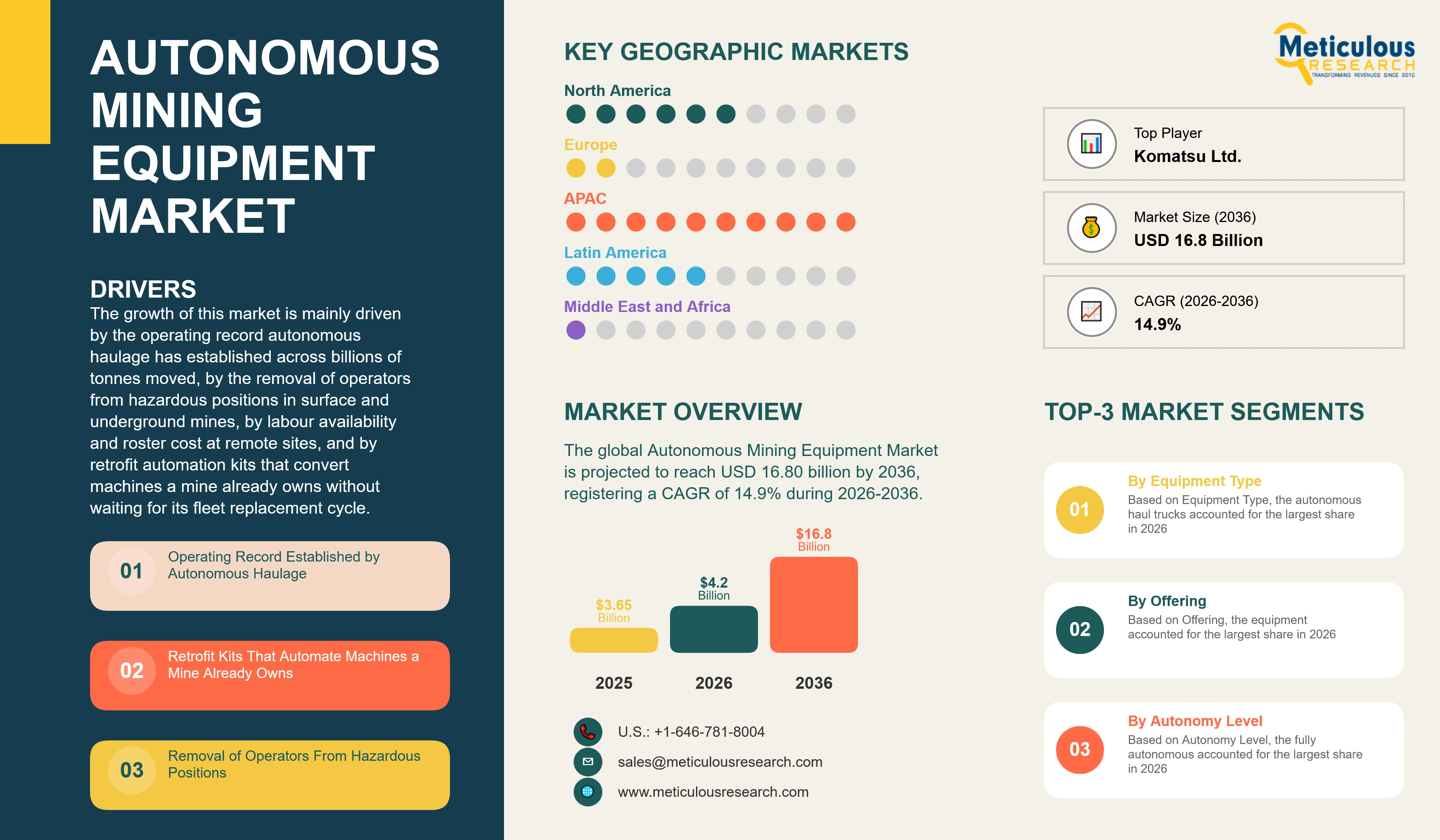
The global Autonomous Mining Equipment Market was valued at USD 3.65 billion in 2025. This market is expected to reach USD 16.80 billion by 2036 from an estimated USD 4.20 billion in 2026, registering a CAGR of 14.9% during the forecast period (2026-2036).
- Published
- Oct 2026
- Pages
- 387
- Format
- PDF + Excel
- Report ID
- MRAUTO - 1042420
- Base year
- 2025
- 2025 · BASELINE
- $3.65B
- 2036
- $16.80B
- CAGR 2026–2036
- 14.9%
2025 baseline · 2026–2036 forecast at 14.9% CAGR · hover a bar for the value
Key highlights
The global Autonomous Mining Equipment Market is valued at USD 4.20 billion in 2026 and is projected to reach USD 16.80 billion by 2036, at a CAGR of 14.9%.
Based on equipment type, the autonomous haul trucks segment is expected to account for the largest share of the market in 2026, while the autonomous load-haul-dump loaders segment is projected to register the highest CAGR during the forecast period.
Based on offering, the equipment segment is expected to account for the largest share of the market in 2026, while the retrofit automation kits segment is projected to register the highest CAGR during the forecast period.
Based on autonomy level, the fully autonomous segment is expected to account for the largest share of the market in 2026 and is also projected to register the highest CAGR during the forecast period.
Based on mining method, the surface mining segment is expected to account for the largest share of the market in 2026, while the underground mining segment is projected to register the highest CAGR during the forecast period.
Based on commodity, the iron ore segment is expected to account for the largest share of the market in 2026, while the copper segment is projected to register the highest CAGR during the forecast period.
Based on geography, Asia-Pacific is expected to account for the largest share of the market in 2026, while Latin America is projected to register the highest CAGR during the forecast period.
Report summary
| Particulars | Details |
|---|---|
| Base Year | 2025 |
| Estimated Year | 2026 |
| Forecast Period | 2026-2036 |
| Market Size in 2025 | USD 3.65 billion |
| Market Size in 2026 | USD 4.20 billion |
| Market Size by 2036 | USD 16.80 billion |
| CAGR (2026-2036) | 14.9% |
| Format | PDF, Excel & Cloud Portal · 387 pages |
| Largest Segment by Equipment Type (2026) | Autonomous Haul Trucks |
| Fastest-growing Segment by Equipment Type | Autonomous Load-Haul-Dump Loaders |
| Largest Segment by Offering (2026) | Equipment |
| Fastest-growing Segment by Offering | Retrofit Automation Kits |
| Largest and Fastest-growing Segment by Autonomy Level | Fully Autonomous |
| Fastest-growing Segment by Mining Method | Underground Mining |
| Largest Segment by Commodity (2026) | Iron Ore |
| Fastest-growing Segment by Commodity | Copper |
| Largest Region (2026) | Asia-Pacific |
| Fastest-growing Region | Latin America |
| Segments Covered | Equipment Type, Offering, Autonomy Level, Mining Method, Commodity, Geography |
| Company Naming Basis | Registered legal entity, with group capability attributed to its owner |
| Number of Companies Profiled | 16, plus other companies |
Report overview
Segments covered: equipment type, offering, autonomy level, mining method, commodity.
The autonomous mining equipment market covers haul trucks, drill rigs, load-haul-dump loaders, dozers, graders, underground trucks and ancillary machines that operate without an operator on board, together with the retrofit automation kits applied to conventional machines, the fleet management and automation software that controls them, and the support and monitoring services supplied with them, across surface and underground operations. The growth of this market is driven by the operating record autonomous haulage has established, by the removal of operators from hazardous positions, by labour availability at remote sites, and by retrofit kits that automate machines a mine already owns.
Komatsu Ltd. commissioned its 1,000th autonomous ultra-class haul truck in April 2026, a 930E-5AT placed at the Nevada Gold Mines operation of Barrick, and reported that customers using its autonomous haulage system have moved more than 11.5 billion metric tons of material. The company states that it was first to market with a commercial autonomous mining solution in 2008, and that the 930E model alone accounts for more than 500 autonomous trucks across customer sites. Komatsu reports deployment of its autonomous haulage system at mine sites across four regions, namely North America, South America, Australia and Europe. The technology question in autonomous haulage has therefore been settled for some time, and the number of trucks running autonomously remains small against a global ultra-class fleet measured in tens of thousands.
Eighteen years separate the first commercial deployment in 2008 from the thousandth truck in 2026, an average of about 56 trucks a year, and the reason for that pace is not capability. Autonomy is supplied with the truck and its fleet management system, so a mine running machines from more than one manufacturer cannot convert without standardising the fleet, and a mining truck remains in service for a decade or more. The rate at which a mine can adopt is therefore set by its replacement cycle rather than by its intent, which is why retrofit kits and third-party automation grow faster than new autonomous machines.
An autonomous mining machine follows a route and performs a work cycle under the control of a central system rather than an operator in the cab, using satellite positioning, perception sensors and a site network to locate itself, detect obstacles and coordinate with other machines. Haulage was the first function automated at scale because a haul route is fixed, repetitive and travelled continuously, and the operating record accumulated since then has removed the question of whether the technology works. A control room operator oversees several machines instead of driving one, so the number of people a pit requires falls while the number of machines it runs does not.
Komatsu Ltd. commissioned its 1,000th autonomous ultra-class haul truck in April 2026, a 930E-5AT placed at the Nevada Gold Mines operation of Barrick, and reported that customers using its autonomous haulage system have moved more than 11.5 billion metric tons of material. The company states that it was first to market with a commercial autonomous mining solution in 2008, and that the 930E model alone accounts for more than 500 autonomous trucks across customer sites. Komatsu reports deployment of its autonomous haulage system at mine sites across four regions, namely North America, South America, Australia and Europe. Caterpillar Inc. reported in May 2021 that its autonomous hauling trucks had passed 3 billion tonnes moved, across 17 mine locations on three continents operated by nine customers, with trucks having travelled more than 110 million km since 2013 and no lost-time injuries associated with automated truck operation, and customers seeing up to 30% higher productivity. The record across both suppliers covers billions of tonnes moved over more than a decade, which is why mine operators now assess these systems on commercial terms rather than on technical risk. Evaluation now centres on cost per tonne, fleet implications and the time a first approval takes. None of those three is a question about the machine.
Eighteen years between the first commercial deployment in 2008 and the thousandth truck in 2026 works out at about 56 trucks a year, against a global population of ultra-class haul trucks in the tens of thousands. The gap is explained by how autonomy is sold rather than by reluctance. A truck, its onboard controls and the fleet management system that dispatches it are supplied together, so a mine cannot automate a fleet assembled from more than one manufacturer without replacing machines, and a mining truck remains in service for a decade or longer. An operator that chose a different manufacturer for part of its fleet a decade ago is therefore carrying that decision into its automation options today.
Replacement cycle therefore sets the pace of conversion at any mine that is not building a new pit. A site replacing a tenth of its fleet each year converts over a decade even where the decision was taken at the start, and the only route to faster penetration is to automate machines already in the fleet. Retrofit kits applied to conventional trucks, drills and loaders address that directly, which is why the retrofit portion of this market grows faster than the equipment portion and why independent automation suppliers have established positions alongside the original equipment manufacturers.
Interoperability between systems remains limited, and a mine committing to one supplier is in practice committing its fleet procurement for the life of the installation. This has made the automation decision a procurement decision about the manufacturer as much as about the technology, and it has given the largest manufacturers a position in this market that reflects their installed truck population rather than any advantage in autonomy itself. Operators running mixed fleets have been the slowest to adopt for precisely this reason. Retrofit suppliers that work across manufacturers address that group directly, and the manufacturers cannot match the offer without opening their own systems.
Scale sets a threshold below which the economics do not work, because the central control room, the site network, the survey and mapping work and the operating procedures cost broadly the same whether a mine runs twenty autonomous trucks or two hundred. Large iron ore and copper operations with long haul routes and uniform ore bodies have therefore converted first, and the placement of the thousandth Komatsu truck at a gold operation marks the technology reaching commodities with shorter and more variable haul profiles. Operations in those commodities are generally smaller, which brings the scale threshold into play and makes conversion of existing machines more attractive than fleet replacement. The composition of demand therefore shifts towards retrofit as deployment widens.
Underground automation developed separately and under different constraints, since satellite positioning is unavailable below ground and machines work in confined spaces where an obstacle cannot be driven around. Load-haul-dump loaders and production drills are the machines automated first underground, operated tele-remotely from surface or running autonomously between shifts and during blast clearance periods, and the value comes from working through the hours when people cannot be underground rather than from removing operators from a running shift.
ISO 17757, Earth-moving machinery and mining, Autonomous and semi-autonomous machine system safety, sets the recognised requirements for these systems and is referenced in mine site safety cases and in regulatory approvals. A mine seeking approval for autonomous operation has to demonstrate that the system meets those requirements within its own site conditions, and the approval covers the mine rather than the machine, so a supplier cannot transfer an approval from one operation to another. Jurisdictions with established autonomous operations have developed assessment practice that newer mining regions have not, which affects how quickly a first deployment can proceed.
Growth in retrofit depends on the condition and age of the machines being converted, since a kit applied to a truck with limited remaining life returns less than the same kit on a newer machine, and a mine with an old fleet may find replacement the better option. The underground segment also depends on network coverage underground, which is a separate capital project that some operations have completed and many have not.
Report infographic
Market dynamics
21 factors across 5 forcesOperating Record Established by Autonomous Haulage
Komatsu Ltd. commissioned its 1,000th autonomous ultra-class haul truck in April 2026, a 930E-5AT placed at the Nevada Gold Mines operation of Barrick, and reported that customers using its autonomous haulage system have moved more than 11.5 billion metric tons of material. The company states that it was first to market with a commercial autonomous mining solution in 2008, and that the 930E model alone accounts for more than 500 autonomous trucks across customer sites. Caterpillar Inc. reported in May 2021 that its autonomous hauling trucks had passed 3 billion tonnes moved, across 17 mine locations on three continents operated by nine customers, with trucks having travelled more than 110 million km since 2013 and no lost-time injuries associated with automated truck operation, and customers seeing up to 30% higher productivity. Billions of tonnes moved over more than a decade removes technical risk from the assessment, so a mine operator now compares cost, productivity and fleet implications rather than deciding whether the technology is ready. This driver has moved the purchase decision from engineering departments to operations and procurement, and it shortens the evaluation a first-time adopter has to carry out. The reference base available to a buyer is now large enough that an operation can visit a comparable installation rather than relying on supplier data. A proposal supported by a visited reference site is approved more readily than one supported by a specification, and the number of such sites has grown with every deployment.
Removal of Operators From Hazardous Positions
A haul truck operator works a twelve hour shift in a vehicle weighing hundreds of tonnes on benches and ramps alongside other equipment, and collisions, roll-overs and fatigue events account for a large part of the serious injury record in surface mining. Caterpillar reported that its autonomous trucks had travelled more than 110 million km since 2013 with no lost-time injuries associated with automated truck operation, which is the figure operators cite when putting a proposal to a board. Underground, the same reasoning applies to loaders working near unsupported ground and to machines entering a heading after blasting. Safety outcomes also carry weight with insurers and lenders, which brings parties outside the mine into the business case. A reduction in high potential incidents is also reported publicly by listed operators, which gives the investment a visibility that a productivity gain does not have.
Labour Availability at Remote Sites
A large surface mine in a remote region needs several hundred operators working rosters that require them to live away from home, and recruitment and retention at those sites cost more than the wages alone. Autonomous haulage converts a proportion of those positions into control room roles that can be located in a city, which widens the available workforce and reduces the camp, flight and accommodation cost attached to each position. The driver strengthens where mines are furthest from population centres, which is why Australian and Chilean operations adopted earliest. Control room roles additionally draw on a different labour pool, since the skills required are closer to logistics and systems monitoring than to heavy vehicle operation.
Retrofit Kits That Automate Machines a Mine Already Owns
A mine cannot replace its fleet faster than its replacement cycle allows, and a kit fitted to an existing truck, drill or loader converts a machine the mine already owns without waiting for that cycle. Retrofit also allows a mixed fleet to be automated without standardising on one manufacturer, which is the obstacle that has held back operators running machines from more than one supplier. This driver is the principal reason the retrofit portion of this market grows faster than the equipment portion. It also converts a capital replacement decision into an operating improvement decision, which is approved at a lower level in most mining organisations.
Table of contents
13 chapters · 144 sections · 387 pages · click to expandGeographic analysis
Asia-Pacific
Largest shareIn 2026, Asia-Pacific is expected to account for the largest share of the market. The large share of this region is mainly due to the iron ore operations of the Pilbara in Western Australia, where the largest autonomous haulage fleets are deployed, to the remoteness of those sites making control room operation particularly valuable, and to the assessment practice regulators in the region have developed over more than a decade of autonomous operation. Australia accounts for most of the regional position, with China adding domestic coal and metal operations converting on locally supplied equipment.
Latin America
Fastest growthHowever, Latin America is projected to register the highest CAGR during the forecast period. The rapid growth of this region is attributed to investment in copper capacity in Chile and Peru, to the altitude and remoteness of many of those operations, and to declining ore grades requiring more material to be moved for each tonne of metal produced. Growth is also supported by iron ore operations in Brazil extending autonomy across equipment types beyond haulage. Chile accounts for the largest part of the regional opportunity, reflecting both the number of large copper operations and the altitude at which several of them work. Peru follows, with Brazil contributing through iron ore operations extending autonomy across equipment types.
North America
Mexico adds demand through copper and silver operations run by international groups. North America holds a position built on oil sands operations in Canada and on copper and gold mines in the United States and Mexico, with the placement of the thousandth Komatsu autonomous truck at a Nevada gold operation in April 2026 reflecting the entry of the technology into commodities with shorter haul profiles. Operations in the region run mixed fleets more often than the large single-manufacturer fleets of the Pilbara, which makes retrofit a larger part of regional demand than it is in Asia-Pacific.
Europe
Europe accounts for a smaller position concentrated in underground operations in the Nordic countries, where loader and production drill automation is well established and where the equipment manufacturers supplying underground automation are based.
Middle East & Africa
The Middle East & Africa remains an early market in which copper, gold and phosphate developments are specifying autonomous capability for new pits, and where first approvals require more work than in jurisdictions with established practice, so suppliers able to bring evidence from comparable approved operations hold an advantage.
Competitive landscape
The two largest mining equipment manufacturers hold most of the installed autonomous haulage base, having developed their systems alongside their own trucks and fleet management software, and their positions in this market reflect their installed truck populations as much as any advantage in autonomy. Underground automation is led by the Nordic equipment manufacturers whose loaders and production drills are the machines converted first below ground. Independent automation suppliers sell retrofit kits and control systems without supplying machines, and positioning and fleet technology companies supply the sensing and management layers into both groups. Chinese manufacturers supply domestic coal and metal operations and have begun to export.
Installed truck population rather than technology decides much of the competition, because autonomy is supplied with the machine and the fleet management system that dispatches it, so a mine already running one manufacturer is the natural customer for that manufacturer. Regulatory evidence separates suppliers on first deployments, since approval covers the mine rather than the machine and documented evidence from comparable approved operations shortens an assessment considerably. Ability to automate a mixed fleet is what the independent suppliers offer and the manufacturers structurally cannot.
Competition in retrofit runs on different terms from competition in new equipment. A retrofit buyer is choosing between converting what it owns and replacing it, so the comparison is against a manufacturer selling new autonomous machines rather than against another kit supplier, and the independent suppliers are therefore competing with the capital proposal rather than with each other. Manufacturers have responded by offering kits for their own installed base, which defends the fleet without accelerating replacement.
Key players operating in the global Autonomous Mining Equipment Market are Caterpillar Inc. (U.S.), Komatsu Ltd. (Japan), Sandvik AB (Sweden), Epiroc AB (Sweden), Hitachi Construction Machinery Co., Ltd. (Japan), Liebherr-International AG (Switzerland), AB Volvo (Sweden), Hexagon AB (Sweden), Trimble Inc. (U.S.), RCT Pty Ltd (Australia), SafeAI, Inc. (U.S.), Flanders Corporation (U.S.), OJSC BELAZ (Belarus), Xuzhou Construction Machinery Group Co., Ltd. (China), Sany Heavy Industry Co., Ltd. (China), and Beijing Tage Idriver Technology Co., Ltd. (China).
Companies are identified at registered legal entity level, and capability held within a group is attributed to the entity that owns it. Modular Mining Systems and MST Global are not listed separately, because both are held within Komatsu Ltd., Wenco International Mining Systems is not listed separately, because it is held within Hitachi Construction Machinery Co., Ltd., and Autonomous Solutions Inc. is not listed separately, because it is held within Epiroc AB. The companies profiled were verified as active in the supply of autonomous mining machines, retrofit automation kits or the automation software controlling them as of October 2026. Mining companies operating autonomous fleets rather than supplying them, communication network and connectivity suppliers, mine planning and geological software suppliers without an automation product, collision avoidance and proximity detection suppliers without an autonomous operation capability, and mining contractors were excluded.
- Caterpillar Inc. (U.S.)
- Komatsu Ltd. · Japan
- Sandvik AB · Sweden
- Epiroc AB · Sweden
- Hitachi Construction Machinery Co., Ltd. · Japan
- Liebherr-International AG (Switzerland), AB Volvo · Sweden
- Hexagon AB · Sweden
- Trimble Inc. (U.S.)
- RCT Pty Ltd · Australia
- SafeAI, Inc. (U.S.)
- Flanders Corporation (U.S.)
- OJSC BELAZ · Belarus
- Xuzhou Construction Machinery Group Co., Ltd. · China
- Sany Heavy Industry Co., Ltd. · China
- Beijing Tage Idriver Technology Co., Ltd. · China
Expert perspectives
Technical readiness is where assessment of this market usually begins and it has not been the question for some time. Komatsu Ltd. commissioned its 1,000th autonomous ultra-class haul truck in April 2026, a 930E-5AT placed at the Nevada Gold Mines operation of Barrick, and reported that customers using its autonomous haulage system have moved more than 11.5 billion metric tons of material. The company states that it was first to market with a commercial autonomous mining solution in 2008, and that the 930E model alone accounts for more than 500 autonomous trucks across customer sites, and Caterpillar Inc. reported in May 2021 that its autonomous hauling trucks had passed 3 billion tonnes moved, across 17 mine locations on three continents operated by nine customers, with trucks having travelled more than 110 million km since 2013 and no lost-time injuries associated with automated truck operation, and customers seeing up to 30% higher productivity. Eighteen years separate the first commercial deployment from the thousandth truck, an average of about 56 trucks a year against a global ultra-class fleet in the tens of thousands, and the explanation lies in how autonomy is sold rather than in whether it works. A truck, its onboard controls and the fleet management system that dispatches it are supplied together, so a mine running more than one manufacturer cannot convert without replacing machines, and a mining truck stays in service for a decade or longer. The binding constraint is therefore shifting from the capability of the equipment to the rate at which a fleet turns over and whether a mixed fleet can be automated at all.
Value is expected to continue moving towards retrofit and software through 2036, because no mine can replace its fleet faster than its replacement cycle allows and a kit converts a machine it already owns. Autonomy is expected to continue extending across the rest of the pit after haulage, since mixed manned and unmanned traffic limits how fully an operation can run without people in it and the remaining machine population is what closes that gap. Deployment is expected to continue broadening beyond iron ore and copper into commodities with shorter and more variable haul profiles, where mines are smaller and the scale threshold favours conversion over fleet replacement.
For companies planning entry or expansion, retrofit automation for mixed and ageing fleets reaches the largest group of operators in the industry rather than the small number of very large mines already converted, and it reaches them without requiring a fleet replacement decision. Underground loader and production drill automation is less constrained by standardisation, because loaders are replaced more frequently than ultra-class trucks. Buyers should establish what a supplier can demonstrate from comparable approved operations in the same jurisdiction, because approval covers the mine rather than the machine and that evidence shortens an assessment more than any specification does.
Fixed costs set a floor under which the economics fail, since the control room, the site network, the survey and mapping work and the operating procedures cost broadly the same for twenty autonomous trucks as for two hundred, so a mid-sized operation reaches a cost per tonne that a large one does not and the addressable market is a defined set of operations rather than the industry as a whole. Growth in underground automation also depends on network coverage below ground, which is a separate capital project many operations have not completed, so the segment carrying the fastest growth depends on spending that sits outside this market.
Overall, the core of demand through the forecast period will continue to sit in fully autonomous haul trucks supplied new to large surface iron ore operations across Asia-Pacific, while the fastest growth will come from retrofit automation kits, load-haul-dump loaders, underground operations, copper mines and Latin American installations.
Customer perspectives
General Manager, Iron Ore Operation
This perspective confirms that fleet replacement cycle rather than intent sets the pace of conversion, and that bundled automation ties the decision to a single manufacturer. It supports the conclusion that retrofit is the only route to faster penetration and that the addressable market is governed by fleet turnover rather than by the operating case.
Mining Manager, Mid-Sized Copper Operation
This perspective identifies the fixed cost of an installation as the reason mid-sized operations have not converted, and drills as the accessible entry point. It supports the conclusion that a scale threshold limits the addressable market and that autonomous drill rigs are frequently the first machine converted at a surface mine.
Technical Services Superintendent, Underground Mine
This perspective confirms that underground value comes from adding producing hours rather than from removing operators from a running shift, and that network coverage is the limiting factor. It supports the conclusion that underground automation is the fastest-growing mining method segment and that its growth depends on capital spending outside this market.
Frequently asked questions
The market was valued at USD 3.65 billion in 2025 and is estimated at USD 4.20 billion in 2026.
Cite this report
Meticulous Research. (2026). Autonomous Mining Equipment Market - Global Opportunity Analysis and Industry Forecasts (2026-2036) (Report No. MRAUTO - 1042420). Meticulous Market Research Pvt. Ltd. https://www.meticulousresearch.com/product/autonomous-mining-equipment-market-7103