Automotive Voice AI Assistants Market (2026-2036)
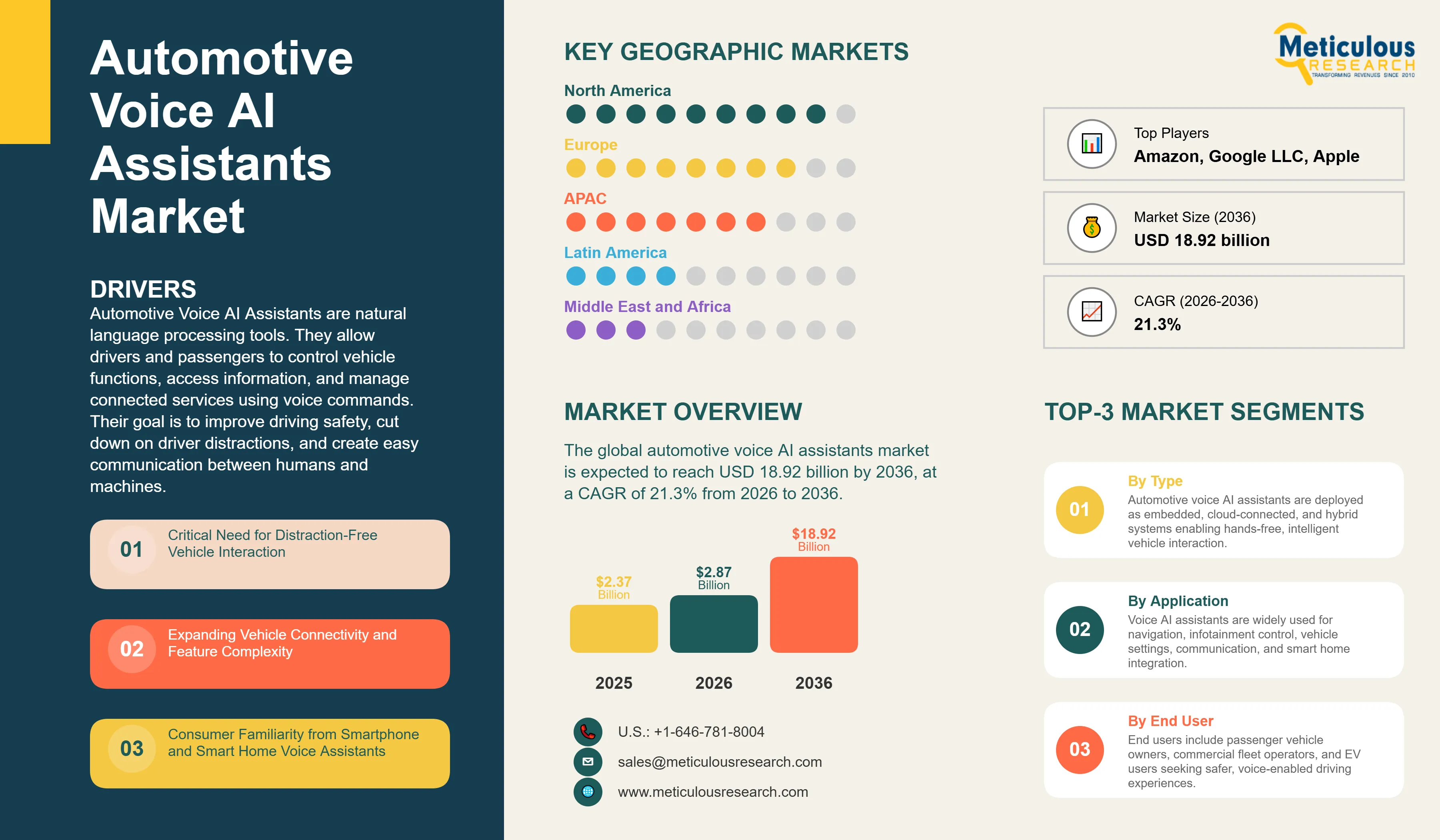
The global automotive voice AI assistants market is expected to reach USD 18.92 billion by 2036 from USD 2.87 billion in 2026, at a CAGR of 21.3% from 2026 to 2036.
- Published
- Jan 2026
- Pages
- 290
- Format
- PDF + Excel
- Report ID
- MR-1649
- Base year
- 2025
- 2026 · ESTIMATED
- $2.87B
- 2036
- $18.92B
- CAGR 2026–2036
- 21.3%
2025 baseline · 2026–2036 forecast at 21.3% CAGR · hover a bar for the value
Key highlights
In 2026, North America is estimated to account for the largest share of the global automotive voice AI assistants market, driven by high smartphone and connected services penetration, strong adoption of advanced infotainment systems, and presence of leading AI technology providers.
Asia-Pacific is projected to register the highest CAGR during the forecast period, fueled by rapidly growing automotive production, increasing demand for connected vehicles, rising smartphone integration, and aggressive voice AI deployment by Asian automakers.
Based on AI engine, the integrated NLU/NLP segment is estimated to hold the largest share of the market in 2026, driven by its comprehensive ability to understand context, intent, and conversational nuances for natural interactions.
Based on language support, the multi-language segment is estimated to dominate the market in 2026, owing to global automotive markets requiring support for diverse languages and regional dialects.
Based on integration type, the cloud-connected segment is expected to witness significant growth during the forecast period, driven by superior processing capabilities, continuous updates, and access to comprehensive knowledge databases.
Based on features, the navigation and location services segment is expected to account for a substantial share of the market in 2026, fueled by high user demand for voice-controlled route guidance and point-of-interest searches.
The vehicle control segment is expected to grow at a significant CAGR during the forecast period, driven by expanding voice control of climate, seating, lighting, and advanced vehicle settings.
The U.S. automotive voice AI assistants market is projected to grow at a CAGR of around 20% during the forecast period 2026 to 2036, driven by high technology adoption rates and strong integration with popular voice ecosystems like Amazon Alexa and Google Assistant.
China is expected to lead the Asia-Pacific automotive voice AI assistants market, driven by massive automotive production volumes, rapid connected vehicle adoption, domestic AI technology development, and integration with popular Chinese voice platforms.
In 2026, Germany is projected to account for the largest share of the European automotive voice AI assistants market, driven by its premium automotive segment and sophisticated voice AI integration by manufacturers like BMW, Mercedes-Benz, and Audi.
Report summary
| Particulars | Details |
|---|---|
| Market Size Value in 2026 | USD 2.87 Billion |
| Revenue Forecast in 2036 | USD 18.92 Billion |
| Growth Rate | CAGR of 21.3% from 2026 to 2036 |
| Format | PDF, Excel & Cloud Portal · 290 pages |
| Base Year for Estimation | 2025 |
| Historical Data | 2021–2025 |
| Forecast Period | 2026–2036 |
| Quantitative Units | Revenue in USD Billion and CAGR from 2026 to 2036 |
| Report Coverage | Revenue forecast, company ranking, competitive landscape, growth factors, and trends |
| Segments Covered | AI Engine, Language Support, Integration Type, Features, Deployment Model, Vehicle Type, Region |
| Regional Scope | North America, Europe, Asia-Pacific, Latin America, Middle East & Africa |
| Countries Covered | U.S., Canada, Germany, U.K., France, Italy, Spain, Sweden, China, Japan, South Korea, India, Australia, Brazil, Mexico, Saudi Arabia, UAE, South Africa |
| Key Companies Profiled | Amazon (Alexa Auto), Google LLC (Google Assistant), Apple Inc. (CarPlay/Siri), Microsoft Corporation (Nuance), Cerence Inc., SoundHound AI Inc., Visteon Corporation, Harman International (Samsung Electronics), Continental AG, Bosch GmbH, Nuance Communications (Microsoft), iFlytek Co. Ltd., BMW Group (Intelligent Personal Assistant), Mercedes-Benz AG (MBUX), Volkswagen Group, Tesla Inc., NIO Inc., Baidu Inc., Alibaba Cloud, Qualcomm Technologies Inc. |
Report overview
Segments covered: ai engine, language support, integration type, feature, deployment model, integration.
Automotive Voice AI Assistants are natural language processing tools. They allow drivers and passengers to control vehicle functions, access information, and manage connected services using voice commands. Their goal is to improve driving safety, cut down on driver distractions, and create easy communication between humans and machines. These AI systems use technologies like Natural Language Understanding (NLU), Natural Language Processing (NLP), speech recognition, and machine learning. They interpret voice commands, understand context and intent, and perform the right actions.
Voice AI assistants can manage navigation, climate settings, infotainment systems, phone calls, messaging, smart home devices, and vehicle features through simple conversations. The system enables hands-free use of vehicle functions, gives personalized responses based on driver preferences, supports multiple languages, and learns continuously. This ensures that drivers can focus on the road while safely and conveniently accessing vehicle features and connected services.
Automotive Voice AI Assistants represent a major change in how people interact with vehicles. They replace traditional physical controls and touchscreen interfaces with natural conversational commands, changing how occupants engage with complex vehicle systems. These intelligent assistants understand natural language, interpret context and intent, remember past interactions, and carry out multi-step tasks using simple voice commands. By allowing hands-free control of vehicle functions, infotainment, navigation, and connected services, voice AI assistants reduce dangerous distractions that come from manual controls while making advanced vehicle features easy to use.
Several key trends are transforming the automotive voice AI assistants market. These trends include moving from basic command-response systems to conversational AI that can handle natural dialogue. Rapid improvements in natural language understanding allow for context awareness and multi-turn conversations. There is also growing integration of voice assistants with both vehicle and connected home systems, along with a shift from basic function control to proactive assistance and personalization. The blend of improved AI capabilities, increasing vehicle connectivity, rising consumer comfort with voice assistants from smartphones and smart homes, and the urgent need to minimize driver distraction has pushed the adoption of voice AI from luxury features to standard equipment across all vehicle types.
The automotive voice AI assistants market is quickly evolving to feature advanced conversational AI systems that understand context, remember past interactions, and anticipate user needs. Modern voice AI solutions go beyond recognizing set commands. They create natural conversational experiences by understanding complex requests, handling unclear queries, maintaining conversation context through multiple exchanges, interpreting user intent even with imperfect wording, and learning individual user preferences and speaking styles. The move from wake-word triggered command systems to always-listening conversational assistants that can manage interruptions, corrections, and multi-step dialogues marks significant progress in user experience and practical utility.
AI and machine learning technologies are improving quickly. This progress allows voice assistants to provide more accurate speech recognition in challenging environments, like road noise, multiple voices, and various accents. Modern systems use advanced noise cancellation, speaker identification, context-aware processing, and personalized acoustic models to achieve recognition accuracy of over 95% even in real-world driving conditions. Edge computing capabilities are enabling more processing on the device itself, which reduces latency, enhances privacy, and ensures core functions continue to work without connectivity.
The integration of automotive voice assistants with larger digital systems is creating new benefits that go beyond controlling the vehicle. Modern systems connect smoothly with smartphone assistants, smart home devices, calendar and productivity apps, music streaming services, and connected vehicle services. This integration allows for scenarios such as voice-controlled preparation at home while driving, proactive navigation suggestions based on the calendar, synchronized music playback, and a unified voice experience across user devices. The extension of voice AI from isolated in-vehicle systems to parts of broader digital ecosystems greatly enhances utility and user engagement.
The combination of voice AI and self-driving vehicle development is creating new application scenarios and market opportunities. As vehicles move toward greater automation, voice assistants will become the main way to control the vehicle, manage passenger entertainment, set destinations, and communicate system status. In fully autonomous vehicles without steering wheels or traditional controls, voice AI will be the main interface for all interactions with the vehicle. This shift supports long-term growth for automotive voice AI technology beyond traditional driver-focused uses.
The rise of emotion AI and sentiment analysis is extending the functionality of voice assistants beyond just executing commands. These advanced systems can recognize user frustration, stress, fatigue, or distraction through voice analysis and adjust their responses. They can offer proactive assistance, change interaction styles, or suggest breaks during long drives. This focus on emotional intelligence improves user experience and opens up possibilities in driver monitoring, wellness assessment, and personalized comfort optimization.
Report infographic
Market dynamics
4 factors across 2 forcesCritical Need for Distraction-Free Vehicle Interaction
The growing awareness of the dangers of distracted driving is increasing the demand for technologies that allow safe vehicle interaction. The National Highway Traffic Safety Administration reports that manually interacting with vehicle systems adds significant cognitive and visual distractions. Traditional touchscreen infotainment systems force drivers to look away from the road, navigate complicated menus, and perform precise touch actions. All of these actions are dangerous while driving. Voice AI assistants help address this safety issue by enabling hands-free and eyes-free interaction through natural voice commands. Drivers can adjust climate settings, change music, start navigation, make phone calls, and control numerous vehicle functions without taking their hands off the wheel or eyes off the road. As vehicle systems grow more complex with additional features and connected services, using voice control becomes essential for safe operation. Regulatory bodies and safety organizations are increasingly recognizing voice interfaces as a best practice for reducing driver distraction while keeping access to vehicle features.
Expanding Vehicle Connectivity and Feature Complexity
The rapid growth of connected vehicle services and advanced features is creating strong demand for easy-to-use control interfaces. Modern vehicles come with many adjustable settings, multiple infotainment sources, navigation systems, smartphone integration, smart home device control, communication with infrastructure, and extensive vehicle customization options. Managing this complexity through traditional interfaces can become overwhelming. Deep menus and many physical controls often lead to poor user experiences and unused features. Voice AI assistants provide a great solution by allowing natural language access to complex features without users needing to grasp menu structures or memorize control locations. Commands such as "make it warmer," "play my driving playlist," or "take me home avoiding highways" are intuitive for users of all skill levels. As automotive features expand with increasing connectivity and automation, voice control becomes vital for accessing and using advanced capabilities.
Table of contents
15 chapters · 175 sections · 290 pages · click to expandGeographic analysis
North America
Largest shareIn 2026, North America is expected to dominate the automotive voice AI assistants market. This leadership results from high rates of smartphone and voice assistant adoption, which create consumer demands for in-car voice experiences. The strong presence of leading voice AI platforms (Amazon, Google, Apple), the high penetration of connected vehicles, consumer comfort with technology, and cultural acceptance of voice interaction in public spaces all contribute to this. The United States plays a significant role, with widespread use of Amazon Alexa and Google Assistant in homes creating a demand for automotive integration, high sales of premium vehicles featuring advanced voice AI, and robust domestic AI development by automakers and tech companies.
Asia-Pacific
Fastest growthThe Asia-Pacific region is expected to grow the fastest during the forecast period due to high automotive production in countries like China, Japan, South Korea, and growing markets. Connected vehicle adoption is particularly soaring in China. Strong development of domestic AI technology led by companies such as Baidu, iFlytek, and Alibaba also drives this growth. Regional automakers are aggressively deploying voice AI, especially in electric vehicles. China, being the largest automotive market, will heavily influence regional growth. Domestic voice AI platforms are increasingly sophisticated, optimized for the Chinese language, and government initiatives are promoting intelligent connected vehicles. Japan and South Korea contribute to this growth with their advanced automotive industries and leadership in technology.
Europe
Europe represents a significant market characterized by a concentration of premium vehicles with advanced voice AI systems. Strong consumer data privacy expectations impact design decisions. Multi-language support reflects the region's linguistic diversity, with extensive voice AI integration by German luxury manufacturers. The emphasis on data protection and privacy compliance in Europe is encouraging the adoption of hybrid and edge-processing architectures that limit data transfer while preserving functionality.
Competitive landscape
- Amazon (Alexa Auto) (U.S.)
- Google LLC (Google Assistant) (U.S.)
- Apple Inc. (CarPlay/Siri) (U.S.)
- Microsoft Corporation (Nuance) (U.S.)
- Cerence Inc. (U.S.)
- SoundHound AI Inc. (U.S.)
- Visteon Corporation (U.S.)
- Harman International (Samsung Electronics) · South Korea
- Continental AG · Germany
- Bosch GmbH · Germany
- Nuance Communications (Microsoft) (U.S.)
- iFlytek Co. Ltd. · China
- BMW Group (Intelligent Personal Assistant) · Germany
- Mercedes-Benz AG (MBUX) · Germany
- Volkswagen Group · Germany
- Tesla Inc. (U.S.)
- NIO Inc. · China
- Baidu Inc. · China
- Alibaba Cloud · China
- Qualcomm Technologies Inc. (U.S.)
Frequently asked questions
The automotive voice AI assistants market is expected to grow from USD 2.87 billion in 2026 to USD 18.92 billion by 2036.
Cite this report
Meticulous Research. (2026). Automotive Voice AI Assistants Market - Global Opportunity Analysis and Industry Forecast (2026-2036) (Report No. MR-1649). Meticulous Market Research Pvt. Ltd. https://www.meticulousresearch.com/product/automotive-voice-ai-assistants-market-6332