Automotive High-Performance Computing Market
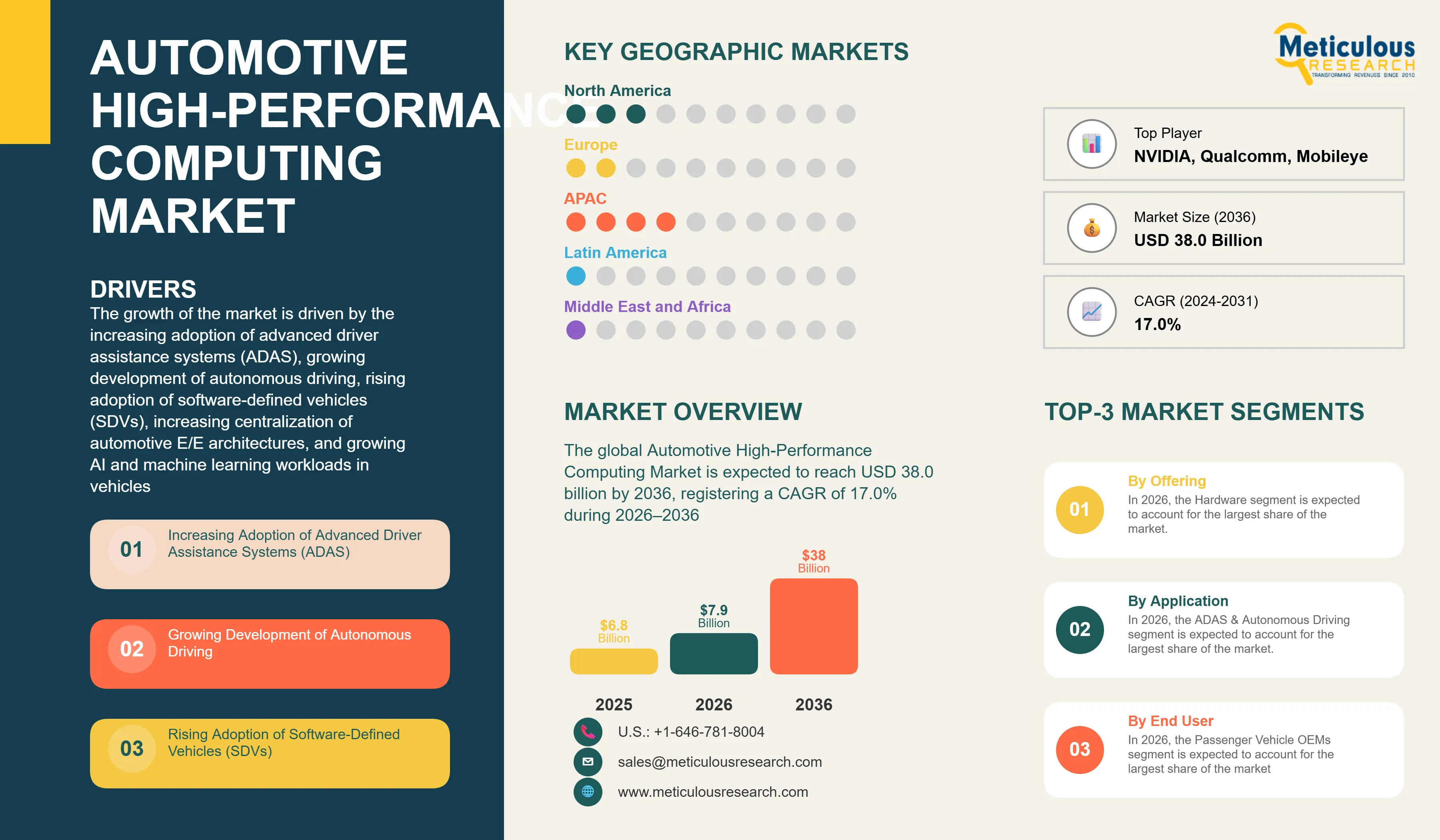
The global Automotive High-Performance Computing Market was valued at USD 6.8 billion in 2025 and is projected to reach USD 7.9 billion in 2026. The market is expected to reach USD 38.0 billion by 2036, registering a CAGR of 17.0% during the forecast period (2026-2036).
- Published
- Aug 2026
- Pages
- 310
- Format
- PDF + Excel
- Report ID
- MR-2145
- Base year
- 2025
- 2025 · BASELINE
- $6.80B
- 2036
- $38.00B
- CAGR 2026–2036
- 17.0%
2025 baseline · 2026–2036 forecast at 17.0% CAGR · hover a bar for the value
Key highlights
The global Automotive High-Performance Computing Market is projected to reach USD 38.0 billion by 2036, driven by increasing adoption of advanced driver assistance systems and growing development of autonomous driving.
Asia-Pacific is expected to account for the largest market share in 2026, while North America is projected to register the fastest growth during the forecast period.
By offering, Hardware is expected to account for the largest market share, whereas Software is projected to witness the fastest growth through 2036.
By computing architecture, Centralized HPC is expected to dominate the market, while Zonal HPC is projected to register the highest CAGR during the forecast period.
NVIDIA's DRIVE Thor centralized compute platform delivers up to 2, 000 TOPS of AI performance, roughly eight times its Orin predecessor's 254 TOPS, illustrating the scale of the compute leap underpinning the industry's shift toward single-chip, multi-domain vehicle architectures.
Industry analysts forecast that by 2030, more than half of new vehicles sold will feature centralized, high-performance compute architectures, which is expected to create significant long-term opportunities for automotive HPC hardware and software providers.
Report summary
| Particulars | Details |
|---|---|
| Forecast Period | 2026-2036 |
| Base Year | 2025 |
| Estimated Year | 2026 |
| CAGR (Value) | 17.0% |
| Format | PDF, Excel & Cloud Portal · 310 pages |
| Market Size (Value) in 2026 | USD 7.9 Billion |
| Market Size (Value) in 2036 | USD 38.0 Billion |
| Segments Covered | By Offering: Hardware, Software, Services. · By Computing Architecture: Domain-Based, Hybrid Domain-Zonal, Zonal, Centralized, Distributed HPC. · By Compute Platform: CPU-Based, GPU-Based, CPU-GPU Heterogeneous, AI Accelerator-Based, SoC-Based, Multi-SoC, Chiplet-Based HPC. · By Compute Performance: <10 TOPS, 10–50 TOPS, 51–100 TOPS, 101–500 TOPS, 501–1,000 TOPS, >1,000 TOPS. · By Application: ADAS & Autonomous Driving, Digital Cockpit & Infotainment, Vehicle Control, Connectivity & Telematics, AI & Generative AI Applications. · By Vehicle Architecture: Distributed, Domain-Centric, Hybrid Domain-Zonal, Zonal, Fully Centralized Architecture. · By Vehicle Type: Passenger Cars, Light Commercial Vehicles, Heavy Commercial Vehicles, Buses & Coaches, Autonomous & Robotic Vehicles. · By Propulsion Type: ICE, HEV, PHEV, BEV, FCEV. · By Level of Driving Automation: Level 0 through Level 5. · By End User: Passenger Vehicle OEMs, Commercial Vehicle OEMs, Automotive Tier-1 Suppliers, Autonomous Driving Technology Companies, Mobility & Robotaxi Companies, Fleet & Commercial Transportation Companies. |
| Countries Covered | North America: U.S., Canada. · Europe: Germany, France, U.K., Italy, Spain, Sweden, Netherlands, Rest of Europe. Asia-Pacific: China, Japan, South Korea, India, Taiwan, Singapore, Australia, Rest of Asia-Pacific. · Latin America: Brazil, Mexico, Argentina, Rest of Latin America. · Middle East & Africa: UAE, Saudi Arabia, Israel, South Africa, Rest of Middle East & Africa. |
| Key Companies | NVIDIA Corporation, Qualcomm Incorporated, NXP Semiconductors N.V., Mobileye Global Inc., Renesas Electronics Corporation, Intel Corporation, Advanced Micro Devices, Inc., Texas Instruments Incorporated, Infineon Technologies AG, Robert Bosch GmbH, Continental AG, ZF Friedrichshafen AG, Aptiv PLC, Valeo SE, and Harman International Industries, Inc. |
Report overview
Segments covered: offering, computing architecture, compute platform, compute performance, application, vehicle architecture, vehicle type, propulsion type, level of driving automation, end user.
The Automotive High-Performance Computing Market comprises the hardware, software, and services used to power centralized, domain, and zonal vehicle computing architectures that support ADAS, autonomous driving, digital cockpits, vehicle control, and connectivity functions. Hardware spans central vehicle computers, domain and zonal control units, automotive SoCs, CPUs, GPUs, AI/ML accelerators, memory and storage, and high-speed in-vehicle networking components, while software includes operating systems, hypervisors, middleware, and AI/ML software that together enable software-defined vehicle functionality across passenger cars, light and heavy commercial vehicles, and autonomous and robotic vehicles.
The market is undergoing a significant architectural transition as automakers consolidate the numerous distributed electronic control units found in conventional vehicles onto centralized, high-performance compute platforms. NVIDIA's latest DRIVE AGX Thor delivers up to 1,000 INT8 TOPS and 2,000 FP4 TFLOPS of AI compute, compared with up to 254 TOPS for DRIVE AGX Orin, representing roughly four times the INT8 AI performance. Thor combines automated driving, parking, driver and occupant monitoring, digital instrument cluster, and infotainment workloads within a centralized computing architecture. NVIDIA has also expanded its automotive ecosystem, with companies including BYD, GAC AION, XPENG, Li Auto, ZEEKR, and others adopting DRIVE Thor for next-generation vehicle programs.
The transition is being reinforced by the broader software-defined vehicle architecture. NVIDIA's 2026 DRIVE Hyperion platform uses two Thor-based in-vehicle computers and supports Level 2+ through Level 4 automated driving, illustrating the increasing compute requirements of centralized vehicle architectures and multimodal AI processing. The platform integrates 14 high-definition cameras, nine radars, one lidar, and 12 ultrasonic sensors, demonstrating the volume of sensor data that next-generation automotive computing platforms must process in real time. As OEMs increasingly consolidate ADAS, cockpit, connectivity, and vehicle-control workloads, demand is rising for high-performance automotive SoCs, AI accelerators, high-bandwidth memory, high-speed networking, and advanced thermal-management solutions.
Report infographic
Market dynamics
8 factors across 4 forcesIncreasing Adoption of Advanced Driver Assistance Systems
The rising penetration of ADAS features across passenger and commercial vehicles is a primary driver of demand for automotive HPC platforms. ADAS applications such as automatic braking and lane-keeping currently hold the largest application share of automotive AI processor demand at approximately 58-59%, and processing the real-time sensor fusion, computer vision, and object detection workloads these features require is driving sustained demand for high-performance CPUs, GPUs, and AI accelerators.
Growing Development of Autonomous Driving
The continued advancement of autonomous driving capabilities toward SAE Level 3 and Level 4 automation is a significant driver of automotive HPC demand, as these systems require substantially greater onboard compute performance than Level 2 ADAS functions. NVIDIA's DRIVE Thor, targeting Level 4 applications with up to 2,000 TOPS of performance, illustrates the scale of compute investment automakers and Tier-1 suppliers are committing to support next-generation autonomous driving programs.
Table of contents
18 chapters · 280 sections · 310 pages · click to expandSegmental analysis
| Segment | Largest share (2026) | Fastest growth (2026–2036) |
|---|---|---|
| By Offering | Hardware | Software |
| By Computing Architecture | Centralized HPC | Zonal HPC |
| By Compute Platform | SoC-Based HPC | Chiplet-Based HPC |
| By Application | ADAS & Autonomous Driving | Connectivity & Telematics |
| By End User | Passenger Vehicle OEMs | Mobility & Robotaxi Companies |
By Offering
- Hardware is expected to account for the largest market share, reflecting the substantial cost of central computing units, automotive SoCs, CPUs, GPUs, and AI/ML accelerators that form the foundation of automotive HPC platforms.
- However, Software is projected to register the fastest growth during the forecast period, driven by rising demand for operating systems, hypervisors, middleware, and AI/ML software that enable software-defined vehicle functionality.
By Computing Architecture
- Market Analysis by Computing Architecture
- Centralized HPC is expected to account for the largest market share, supported by growing automaker adoption of single-chip platforms such as NVIDIA DRIVE Thor that consolidate multiple vehicle functions.
- However, Zonal HPC is projected to register the highest CAGR during the forecast period, as automakers increasingly adopt zonal architectures to reduce wiring complexity ahead of full centralization.
By Compute Platform
- SoC-Based HPC is expected to account for the largest market share, reflecting the industry's preference for integrated system-on-chip solutions such as NVIDIA Orin and Thor that combine CPU, GPU, and AI accelerator functions on a single die.
- However, Chiplet-Based HPC is projected to register the highest CAGR during the forecast period, as automotive processor designers increasingly adopt chiplet architectures to improve yield economics and scalability.
By Application
- ADAS & Autonomous Driving is expected to account for the largest market share, with ADAS features such as automatic braking and lane-keeping holding an application share of approximately 58-59% of automotive AI processor demand.
- However, Connectivity & Telematics is projected to register the fastest growth during the forecast period, with a projected CAGR of approximately 33.8% as connected vehicle services and V2X applications scale.
By End User
- Passenger Vehicle OEMs are expected to account for the largest market share, reflecting the scale of global passenger vehicle production adopting centralized HPC platforms.
- However, Mobility & Robotaxi Companies are projected to register the highest CAGR during the forecast period, driven by platforms such as NVIDIA DRIVE Hyperion that pair dual Thor SoCs for Level 4 robotaxi deployment.
Geographic analysis
Asia-Pacific
Largest shareIn 2026, Asia-Pacific is expected to account for the largest share of the global Automotive High-Performance Computing Market, supported by the region's large vehicle production base and rapid adoption of centralized HPC platforms among Chinese automakers, including ZEEKR's early integration of NVIDIA DRIVE Thor into its centralized vehicle computer for next-generation intelligent electric vehicles.
North America
Fastest growthHowever, North America is projected to register the highest CAGR during the forecast period, driven by strong automaker and Tier-1 supplier investment in centralized compute platforms, including Bosch's initiative to integrate NVIDIA DRIVE AGX Thor into its future compute and ECU architectures, alongside rising demand for Level 3 and Level 4 autonomous driving capabilities among U.S.-based OEMs and autonomous driving technology companies.
Competitive landscape
The global Automotive High-Performance Computing Market is moderately consolidated, with competition among established automotive semiconductor suppliers, AI accelerator developers, and Tier-1 automotive suppliers. Companies compete primarily on compute performance measured in TOPS, functional safety certification, power efficiency, software ecosystem support, and the ability to deliver centralized platforms capable of consolidating multiple vehicle domains.
Leading market participants are investing in higher-performance automotive SoCs, expanded software and middleware ecosystems, and strategic partnerships with automotive OEMs and Tier-1 suppliers to accelerate centralized HPC adoption. Continued R&D investment in AI accelerator performance, functional safety certification, and generative AI capabilities for in-vehicle applications remains a key strategy adopted by major vendors.
The report provides a comprehensive competitive assessment of the leading companies operating in the global Automotive High-Performance Computing Market. The key players profiled in the report include NVIDIA Corporation, Qualcomm Incorporated, NXP Semiconductors N.V., Mobileye Global Inc., Renesas Electronics Corporation, Intel Corporation, Advanced Micro Devices, Inc., Texas Instruments Incorporated, Infineon Technologies AG, Robert Bosch GmbH, Continental AG, ZF Friedrichshafen AG, Aptiv PLC, Valeo SE, and Harman International Industries, Inc.
- NVIDIA Corporation
- Qualcomm Incorporated
- NXP Semiconductors N.V.
- Mobileye Global Inc.
- Renesas Electronics Corporation
- Intel Corporation
- Advanced Micro Devices, Inc.
- Texas Instruments Incorporated
- Infineon Technologies AG
- Robert Bosch GmbH
- Continental AG
- ZF Friedrichshafen AG
- Aptiv PLC
- Valeo SE
- Harman International Industries, Inc
Frequently asked questions
The global Automotive High-Performance Computing Market is estimated at USD 7.9 billion in 2026.
Cite this report
Meticulous Research. (2026). Automotive High-Performance Computing Market - Global Opportunity Analysis and Industry Forecast to 2036 (Report No. MR-2145). Meticulous Market Research Pvt. Ltd. https://www.meticulousresearch.com/product/automotive-high-performance-computing-market-6828