Automotive Head-Up Display (HUD) Market (2026-2036)
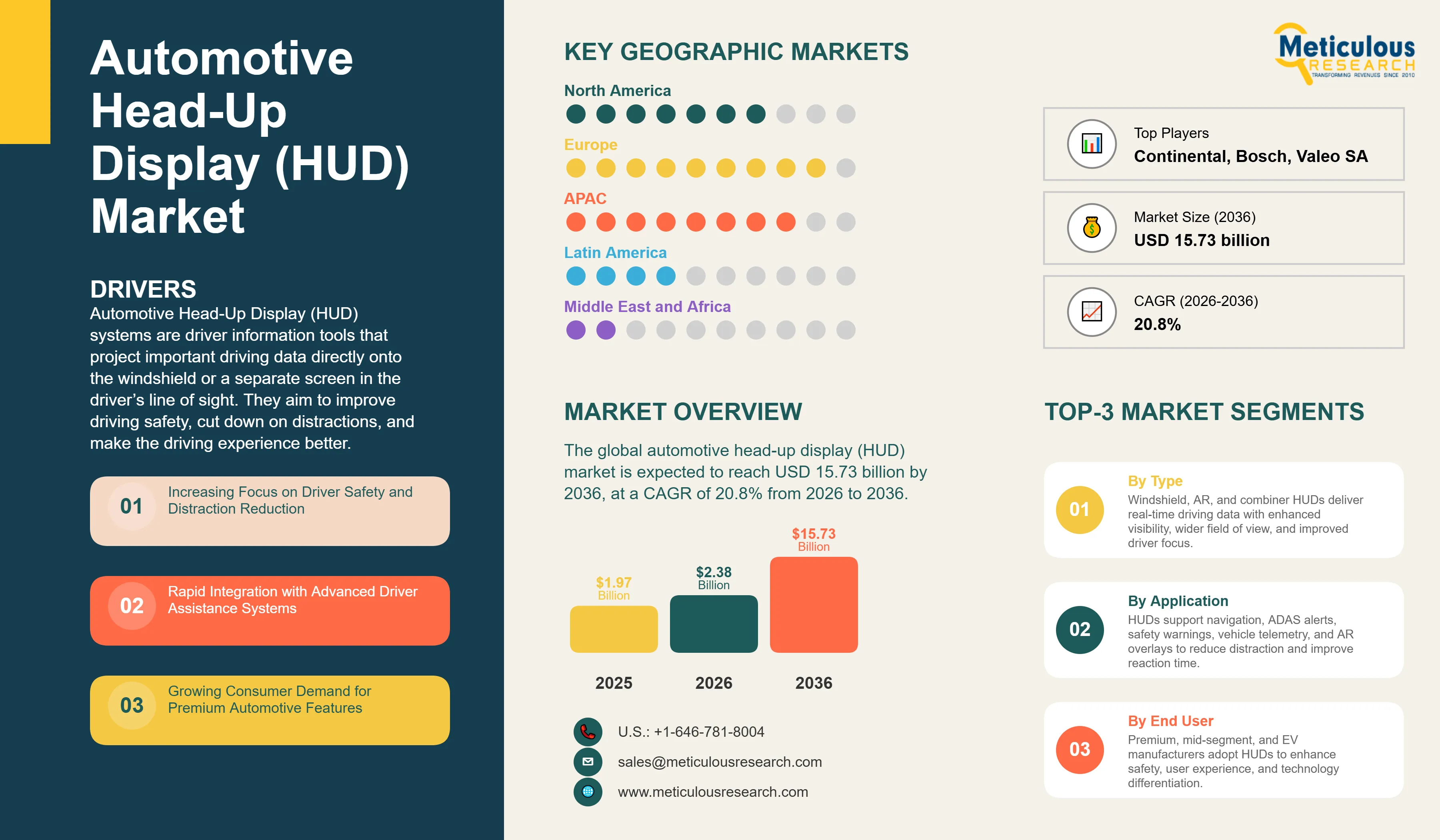
The global automotive head-up display (HUD) market is expected to reach USD 15.73 billion by 2036 from USD 2.38 billion in 2026, at a CAGR of 20.8% from 2026 to 2036.
- Published
- Jan 2026
- Pages
- 230
- Format
- PDF + Excel
- Report ID
- MRAUTO - 1041648
- Base year
- 2025
- 2026 · ESTIMATED
- $2.38B
- 2036
- $15.73B
- CAGR 2026–2036
- 20.8%
2025 baseline · 2026–2036 forecast at 20.8% CAGR · hover a bar for the value
Key highlights
In 2026, Europe is estimated to account for the largest share of the global automotive head-up display market, driven by high penetration of premium vehicles, strong adoption of advanced driver assistance systems, and consumer preference for cutting-edge automotive technologies.
Asia-Pacific is projected to register the highest CAGR during the forecast period, fueled by rapidly growing automotive production, increasing adoption of premium features in mid-segment vehicles, and aggressive HUD deployment by leading Asian automakers.
Based on HUD type, the windshield HUD segment is estimated to hold the largest share of the market in 2026, driven by its superior display area, enhanced visibility, and integration capabilities with augmented reality features.
Based on display technology, the DLP (Digital Light Processing) segment is estimated to dominate the market in 2026, owing to its superior image quality, brightness, color accuracy, and proven reliability in automotive applications.
Based on field of view, the wide FOV (10°-15°) segment is expected to witness significant growth during the forecast period, driven by increasing demand for comprehensive information display and augmented reality navigation features.
Based on content type, the ADAS alerts and safety warnings segment is expected to grow at the highest CAGR, fueled by integration with advanced driver assistance systems and regulatory push for enhanced driver awareness.
Based on OEM adoption, the premium and luxury vehicle segment is expected to account for the largest share of the market in 2026, driven by consumer expectations for advanced technology and manufacturers' differentiation strategies.
The mid-segment vehicle category is expected to grow at a significant CAGR during the forecast period, driven by technology cost reduction and democratization of premium features to mass-market vehicles.
The U.S. automotive head-up display market is projected to grow at a CAGR of around 19% during the forecast period 2026 to 2036, driven by increasing ADAS adoption and consumer demand for advanced infotainment and safety features.
China is expected to lead the Asia-Pacific automotive head-up display market, driven by massive automotive production volumes, rapid EV market expansion with integrated HUD systems, and strong domestic HUD technology development.
Report summary
| Particulars | Details |
|---|---|
| Market Size Value in 2026 | USD 2.38 Billion |
| Revenue Forecast in 2036 | USD 15.73 Billion |
| Growth Rate | CAGR of 20.8% from 2026 to 2036 |
| Format | PDF, Excel & Cloud Portal · 230 pages |
| Base Year for Estimation | 2025 |
| Historical Data | 2021–2025 |
| Forecast Period | 2026–2036 |
| Quantitative Units | Revenue in USD Billion and CAGR from 2026 to 2036 |
| Report Coverage | Revenue forecast, company ranking, competitive landscape, growth factors, and trends |
| Segments Covered | HUD Type, Display Technology, Field of View, Content Type, OEM Adoption, Vehicle Type, Region |
| Regional Scope | North America, Europe, Asia-Pacific, Latin America, Middle East & Africa |
| Countries Covered | U.S., Canada, Germany, U.K., France, Italy, Spain, Sweden, China, Japan, South Korea, India, Australia, Brazil, Mexico, Saudi Arabia, UAE, South Africa |
| Key Companies Profiled | Continental AG, Bosch GmbH, Denso Corporation, Nippon Seiki Co. Ltd., Panasonic Automotive Systems Co. Ltd., Visteon Corporation, Yazaki Corporation, Garmin Ltd., Pioneer Corporation, Hudway LLC, WayRay AG, Envisics Limited, DigiLens Inc., Crystal Optech Co. Ltd., Foryou Multimedia Electronics Co. Ltd., Carrobot Technology Co. Ltd., E-Lead Electronic Co. Ltd., Valeo SA, Aptiv PLC, Harman International (Samsung Electronics) |
Report overview
Segments covered: hud type, display technology, field of view, content type, oem adoption, content.
Automotive Head-Up Display (HUD) systems are driver information tools that project important driving data directly onto the windshield or a separate screen in the driver’s line of sight. They aim to improve driving safety, cut down on distractions, and make the driving experience better. These systems use display technologies like Digital Light Processing (DLP), Laser Beam Scanning (LBS), and Liquid Crystal Display (LCD) to show information such as speed, navigation directions, ADAS alerts, and augmented reality overlays. HUD technology removes the need for drivers to look away from the road to check dashboard instruments, keeping their eyes forward and focus on driving. The system provides real-time visual information at a suitable focal distance, which reduces eye strain and mental effort. This helps drivers stay aware of their surroundings while accessing important vehicle and navigation information.
Automotive Head-Up Display systems represent a significant change in vehicle design. They shift important information from traditional instrument clusters to the driver’s main line of sight. This change alters how drivers engage with vehicle systems. These display systems project information onto the windshield or a separate transparent screen. They create a virtual image that looks like it floats a few meters ahead of the vehicle. By showing data where drivers naturally look, HUD technology reduces the time spent looking down, lowers cognitive distraction, and allows for quicker data processing during critical driving moments.
Several key trends are changing the automotive head-up display market. These trends include the shift from basic combiner HUDs to full windshield augmented reality systems, fast improvements in display technologies that enable brighter, higher-resolution projections, the combining of HUD with Advanced Driver Assistance Systems (ADAS) and autonomous driving features, and the growth of displayable content from basic instrumentation to detailed navigation and safety information. The decrease in technology costs, rising consumer awareness of HUD advantages, expanding ADAS systems needing driver alerts, and automaker strategies for differentiation have sped up the adoption of HUD from luxury features to standard vehicle equipment.
The automotive head-up display market is quickly moving toward augmented reality (AR) HUD systems that place contextual information directly in the driver’s view. Modern AR HUD solutions do much more than show speed and navigation arrows. They offer immersive driving assistance by highlighting lane boundaries, identifying pedestrians and obstacles, projecting navigation guidance directly onto the road ahead, and providing ADAS warnings exactly where threats are located. The shift from traditional HUD to AR HUD is the biggest leap in this technology. It requires larger projection areas, a wider field of view, better image alignment with real-world objects, and advanced sensor integration.
Display technology is progressing quickly. This advancement allows HUD systems to produce more vivid, high-resolution images that are visible in all lighting conditions, including direct sunlight. Laser Beam Scanning (LBS) technology is emerging as a strong alternative to traditional DLP systems. It offers better brightness, infinite focus capability, and smaller form factors. MicroLED and holographic display technologies are being worked on for next-generation systems that may allow for even wider fields of view and more immersive augmented reality experiences.
Combining HUD with advanced driver assistance systems and autonomous driving features is creating new applications and market possibilities. Modern HUD systems act as the main way to communicate ADAS actions, showing lane departure warnings, forward collision alerts, adaptive cruise control status, and blind spot warnings. As vehicles move toward higher automation levels, HUD will be vital in managing the shift between human and machine. It will display system status and convey driving mode information to keep the driver aware and ready to take over when needed.
The convergence of HUD technology with connected vehicle ecosystems is expanding capabilities beyond traditional vehicle data display. Modern systems can integrate with smartphone navigation applications, display incoming call information, show traffic and weather updates, and even present personalized driver assistance based on learned preferences and routes. This connectivity enables dynamic content delivery, cloud-based augmented reality features, and integration with smart city infrastructure for V2X communication displays.
The emergence of electric vehicles is accelerating HUD adoption, as EV manufacturers seek to differentiate their products through advanced user interfaces and minimize physical controls in favor of digital displays. The clean-sheet design approach of many EV platforms facilitates HUD integration, while the focus on technology and innovation aligns perfectly with premium HUD offerings that enhance the perceived value and modern appeal of electric vehicles.
Report infographic
Market dynamics
4 factors across 2 forcesIncreasing Focus on Driver Safety and Distraction Reduction
Growing concern about distracted driving is increasing demand for technologies that keep drivers focused on the road. The National Highway Traffic Safety Administration reports that taking eyes off the road for just two seconds doubles the risk of a crash. Traditional dashboard instruments require drivers to look down and refocus, causing dangerous moments of inattention. HUD technology addresses this safety issue by projecting essential information directly in the driver's line of sight. This eliminates the need for looking down and helps maintain focus on the road ahead. Studies show that HUD systems can reduce eye accommodation time and improve reaction times in critical driving situations. As more consumers, regulators, and safety organizations recognize these safety benefits, demand for HUD-equipped vehicles is rising.
Rapid Integration with Advanced Driver Assistance Systems
The rise of ADAS features in modern vehicles is creating strong demand for effective driver communication interfaces. Systems like adaptive cruise control, lane keeping assist, blind spot monitoring, and forward collision warning generate alerts and information that drivers must quickly understand and act upon. HUD provides a great platform for delivering this important ADAS information. It displays warnings and system status where drivers naturally look, with clear visuals that allow for quick comprehension. The growing regulatory requirements for ADAS features, especially in Europe and Asia, along with voluntary safety commitments by car manufacturers, is driving ADAS adoption and boosting the demand for HUD systems as the preferred interface for communicating these complex safety features to drivers.
Table of contents
15 chapters · 167 sections · 230 pages · click to expandGeographic analysis
Europe
In 2026, Europe is expected to lead the global automotive head-up display market. This advantage comes from the area's concentration of premium and luxury automakers, high consumer demand for advanced automotive technologies, and significant ADAS penetration rates that require effective driver interfaces. Additionally, there is a cultural emphasis on driving dynamics and safety. Germany stands out in the European market, with brands like BMW, Mercedes-Benz, Audi, and Porsche at the forefront of HUD technology adoption and advancements in AR HUD features. These manufacturers have made HUD systems common in their products and continue to innovate in display technology and augmented reality enhancements.
Asia-Pacific
Fastest growthThe Asia-Pacific region is projected to grow at the fastest rate during the forecast period. This remarkable growth is fueled by high automotive production volumes, a rapidly growing middle class seeking premium features, and aggressive HUD deployment by Japanese, Korean, and Chinese automakers. The region is also a leader in electric vehicle production, where HUD systems are often standard. China will particularly drive growth as the world's largest automotive market, supported by local HUD technology suppliers, government promotion of smart connected vehicles, and consumer interest in advanced tech features. Japan and South Korea also contribute through their established automotive industries and key HUD component manufacturers.
North America
North America represents a significant market, marked by strong consumer demand for tech features and high sales of pickup trucks and SUVs, where HUD offers specific benefits. Increasing ADAS adoption is driving a need for driver communication interfaces, with existing automakers expanding HUD options and new EV manufacturers including it as standard equipment. The American preference for larger vehicles and long-distance driving makes HUD especially valuable for reducing driver fatigue and maintaining awareness during extended highway trips.
Competitive landscape
- Continental AG · Germany
- Bosch GmbH · Germany
- Denso Corporation · Japan
- Nippon Seiki Co. Ltd. · Japan
- Panasonic Automotive Systems Co. Ltd. · Japan
- Visteon Corporation (U.S.)
- Yazaki Corporation · Japan
- Garmin Ltd. (U.S./Switzerland)
- Pioneer Corporation · Japan
- Hudway LLC (U.S.)
- WayRay AG · Switzerland
- Envisics Limited (U.K.)
- DigiLens Inc. (U.S.)
- Crystal Optech Co. Ltd. · China
- Foryou Multimedia Electronics Co. Ltd. · China
- Carrobot Technology Co. Ltd. · China
- E-Lead Electronic Co. Ltd. · Taiwan
- Valeo SA · France
- Aptiv PLC · Ireland
- Harman International (Samsung Electronics) · South Korea
Frequently asked questions
The automotive head-up display market is expected to grow from USD 2.38 billion in 2026 to USD 15.73 billion by 2036.
Cite this report
Meticulous Research. (2026). Automotive Head-Up Display (HUD) Market - Global Opportunity Analysis and Industry Forecast (2026-2036) (Report No. MRAUTO - 1041648). Meticulous Market Research Pvt. Ltd. https://www.meticulousresearch.com/product/automotive-head-up-display-market-6331