Aircraft Disassembly and Recycling Services Market (2026-2036)
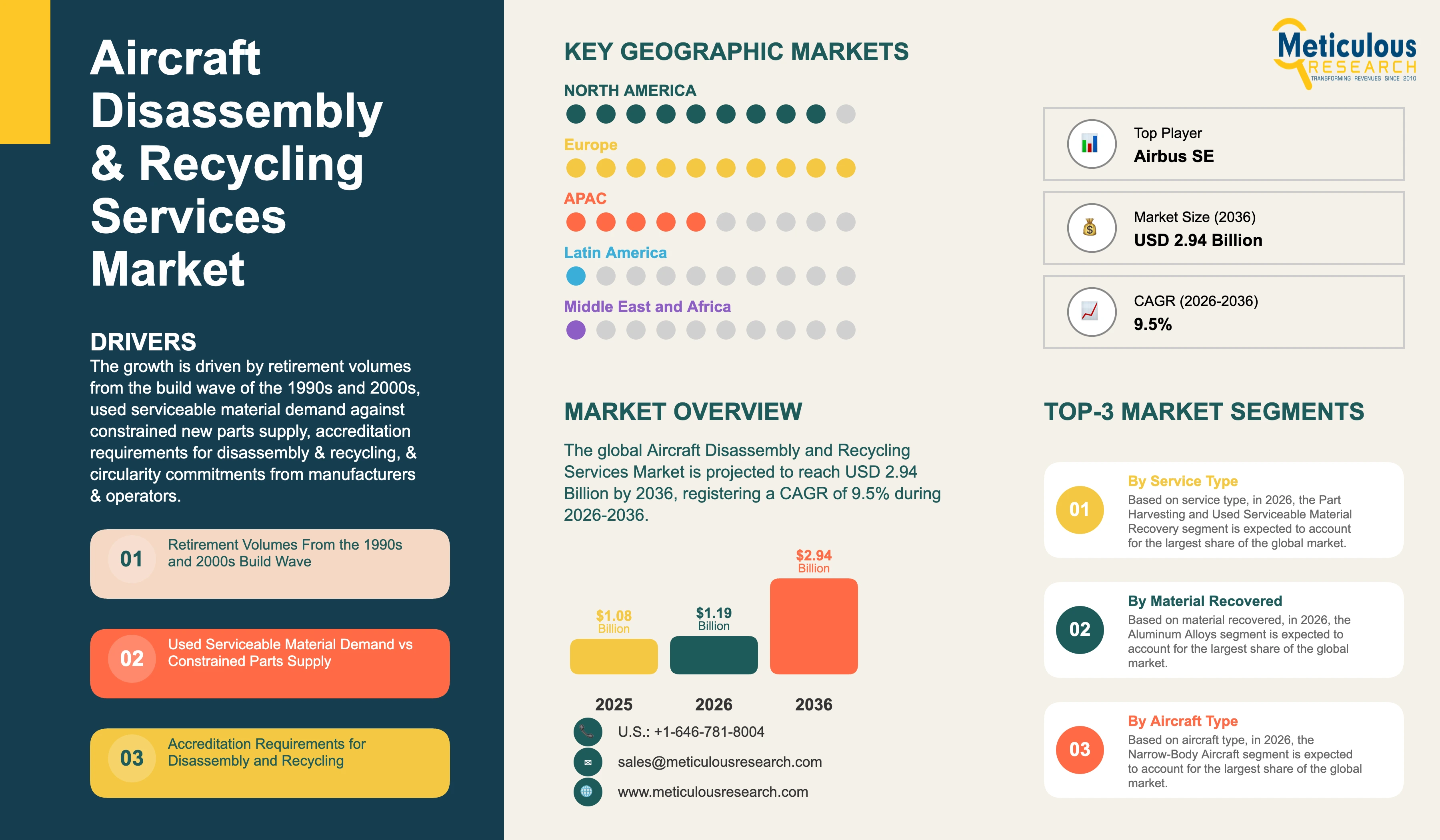
The global Aircraft Disassembly and Recycling Services Market was valued at USD 1.08 billion in 2025. This market is expected to reach USD 2.94 billion by 2036 from an estimated USD 1.19 billion in 2026, registering a CAGR of 9.5% during the forecast period (2026-2036).
- Published
- Nov 2026
- Pages
- 260
- Format
- PDF + Excel
- Report ID
- MRAD - 1042850
- Base year
- 2025
- 2025 · BASELINE
- $1.08B
- 2036
- $2.94B
- CAGR 2026–2036
- 9.5%
2025 baseline · 2026–2036 forecast at 9.5% CAGR · hover a bar for the value
Key highlights
The global Aircraft Disassembly and Recycling Services Market is projected to reach USD 2.94 billion by 2036, driven by retirement volumes from the build wave of the 1990s and 2000s, used serviceable material demand against constrained new parts supply, accreditation requirements for disassembly and recycling, and circularity commitments from manufacturers and operators.
Europe is expected to account for the largest market share in 2026 and is also projected to register the fastest growth during the forecast period, supported by the concentration of accredited disassembly and storage sites in the region, together with the lessor and manufacturer presence that directs end-of-life aircraft to them.
By service type, Part Harvesting and Used Serviceable Material Recovery are expected to account for the largest market share, whereas Material Recycling and Residual Value Recovery are projected to witness the fastest growth through 2036.
By material recovered, Aluminum Alloys are expected to account for the largest market share, whereas Carbon Fiber Composites are projected to witness the fastest growth through 2036.
By aircraft type, Narrow-Body Aircraft are expected to account for the largest market share, whereas Wide-Body Aircraft are projected to witness the fastest growth through 2036.
Industry accreditation for this activity is granted in three categories covering disassembly or contracted disassembly, dismantling, and recycling or contracted recycling, with each facility independently audited against the current Best Management Practice guide by an approved auditor.
The largest European disassembly operator is owned jointly by Safran Aircraft Engines, Airbus and Suez, and runs three sites at Tarbes, Teruel and Toulouse-Francazal.
That operator recycled 327 aircraft between 2007 and 2022 and dismantled 170 CFM56 engines from 2012, against 1,308 aircraft received and 844 returned to service over the same period.
It parks about 250 aircraft, described as 20% of grounded aircraft in Europe, and its Tarbes engine hangar covers 5,500 square meters at 7 meters high with 100 storage spaces for engines.
Up to 92% of the total mass of an aircraft can be recycled and more than 99% of engine parts, which places the commercial question on how much of that mass is recovered rather than on whether it can be.
Constellium remelted aluminum recovered by that operator from retired commercial aircraft, with support from Airbus and ValoER, and the resulting material met the performance requirements for new aircraft manufacturing.
Recycling aluminum consumes about 5% of the energy of primary production and emits 95% less carbon dioxide, and the next steps on that work are industrial scale-up and extension to any aluminum alloy used in metal aircraft.
The disassembly sequence runs from equipment removal following the customer manual, through reconditioning and recertification of parts for aftermarket resale, to greening by removal of electrical and hydraulic systems so the fuselage can be cut safely.
Non-repairable material is routed by stream rather than discarded, with windows passing to the interior design industry and cabin plastics converted into textile products.
Report summary
| Particulars | Details |
|---|---|
| Forecast Period | 2026-2036 |
| Base Year | 2025 |
| Estimated Year | 2026 |
| CAGR (Value) | 9.5% |
| Format | PDF, Excel & Cloud Portal · 260 pages |
| CAGR (Volume) | 6.8% |
| Market Size (Value) in 2026 | USD 1.19 billion |
| Market Size (Value) in 2036 | USD 2.94 billion |
| Market Size (Volume) in 2026 | 840 aircraft disassembled |
| Market Size (Volume) in 2036 | 1,620 aircraft disassembled |
| Average Selling Price, 2026 | USD 1,417,000 per aircraft |
| Average Selling Price, 2036 | USD 1,815,000 per aircraft |
| Segments Covered | By Service Type: Part Harvesting and Used Serviceable Material Recovery, Engine and Major Component Removal, Records Review, Certification and Trace Documentation, Airframe Dismantling and Hazardous Material Removal, Material Recycling and Residual Value Recovery. By Material Recovered: Aluminum Alloys, Titanium Alloys, Nickel and Specialty Alloys, Steel, Carbon Fiber Composites, Cabin Plastics and Other Materials. By Aircraft Type: Narrow-Body Aircraft, Wide-Body Aircraft, Regional Jets and Turboprops, Freighters, Military Transport and Government Aircraft. By Customer Type: Lessors and Asset Managers, Airlines and Operators, Parts Traders and Distributors, Original Equipment Manufacturers, Financial Institutions and Investors. |
| Countries Covered | Germany; France; U.K.; Italy; U.S.; Canada; China; Japan; India; South Korea; Mexico; Brazil |
| Key Companies | Airbus SE, Safran S.A., The Boeing Company, AerSale Corporation, AAR Corp., GA Telesis, LLC, and Aircraft End-of-Life Solutions B.V. |
Report overview
Segments covered: service type, material recovered, aircraft type, customer type.
The growth of this market is mainly driven by retirement volumes from the build wave of the 1990s and 2000s, used serviceable material demand against constrained new parts supply, accreditation requirements covering disassembly, dismantling and recycling, residual value realization for lessors and asset managers, and circularity commitments from manufacturers and operators. However, factors such as records and trace documentation gaps that leave recovered parts unsaleable, storage and dismantling site capacity, residual value dependence on parts demand cycles, and hazardous material removal and site permitting obligations are expected to restrain the growth of this market to some extent.
The Aircraft Disassembly and Recycling Services Market comprises services that take an aircraft at the end of its operating life and recover value from it, measured by the engagement value recognized by service providers with volume expressed as aircraft disassembled. The market covers part harvesting and used serviceable material recovery, engine and major component removal, records review, certification and trace documentation, airframe dismantling and hazardous material removal, and material recycling and residual value recovery, across aluminum alloys, titanium alloys, nickel and specialty alloys, steel, carbon fiber composites and cabin plastics and other materials, performed on narrow-body, wide-body, regional jet and turboprop, freighter and military transport and government aircraft, for lessors and asset managers, airlines and operators, parts traders and distributors, original equipment manufacturers and financial institutions and investors. Resale revenue from harvested parts recognized by traders and distributors, long-term aircraft storage sold without a teardown engagement, component repair and overhaul performed for operators, and scrap metal trading beyond the aircraft gate fall outside the scope.
Recovery rates are no longer the constraint in this market. Up to 92% of the total mass of an aircraft can be recycled and more than 99% of engine parts, so the commercial question is how much of that mass is actually recovered and at what cost rather than what is technically recoverable. The sequence runs from equipment removal following the customer manual, through reconditioning and recertification of parts for aftermarket resale, to greening by removal of electrical and hydraulic systems so the fuselage can be cut safely, with non-repairable material routed by stream rather than discarded.
Value sits overwhelmingly in the parts removed before anything is cut. Part Harvesting and Used Serviceable Material Recovery holds the largest service share of this market in 2026 because a single landing gear, auxiliary power unit or avionics suite carries more value than the metal in the airframe around it, and new parts supply conditions determine what that material is worth. The teardown decision is therefore taken against parts demand rather than against airframe age, which is why aircraft with years of airworthiness remaining are dismantled while older ones are stored.
Accreditation has become the commercial qualification for this work. It is granted in three categories covering disassembly or contracted disassembly, dismantling, and recycling or contracted recycling, with each facility independently audited against the current Best Management Practice guide by an approved auditor. A lessor placing an asset with an unaccredited yard cannot demonstrate the chain behind the parts it later sells, so accreditation governs access to the assets rather than only the quality of the work.
Manufacturers have taken positions in the activity rather than leaving it to the aftermarket. The largest European operator is owned jointly by Safran Aircraft Engines, Airbus and Suez and runs three sites at Tarbes, Teruel and Toulouse-Francazal, recycling 327 aircraft between 2007 and 2022 and dismantling 170 CFM56 engines from 2012, against 1,308 aircraft received and 844 returned to service. Original Equipment Manufacturers is projected to be the fastest-growing customer type in this market at 12.8%.
Material recovery is moving from downcycling toward return to aerospace use. Constellium remelted aluminum recovered from retired commercial aircraft with support from Airbus and ValoER, and the resulting material met the performance requirements for new aircraft manufacturing, against a position where recycling aluminum consumes about 5% of the energy of primary production and emits 95% less carbon dioxide. Material Recycling and Residual Value Recovery is projected to grow at 12.6% in this market, ahead of the harvesting work it follows.
Military transport and government aircraft reach disposal through programs rather than through lease returns, and the requirement includes demilitarization and controlled disposal of sensitive equipment alongside material recovery. Military Transport and Government Aircraft form a distinct segment in this market, and providers holding the clearances to handle those assets face a narrower competitive field than on commercial teardowns.
Europe is expected to account for the largest share of this market in 2026, supported by the largest operator in the activity running three accredited sites and parking about 250 aircraft described as 20% of grounded aircraft in Europe, together with the manufacturer and lessor presence that directs end-of-life aircraft to those sites.
Europe is projected to grow at 9.2% and holds the largest regional position in this market in 2026. France grows at 9.6% on the capacity of an operator owned jointly by Safran Aircraft Engines, Airbus and Suez, which runs three sites at Tarbes, Teruel and Toulouse-Francazal, holds 100 engine storage spaces in a 5,500 square meter hangar at Tarbes and carried out the aluminum recovery work with Constellium, Airbus and ValoER. Germany grows at 9.0%, while the United Kingdom and Italy hold independent disassembly and storage sites serving lessors across the region.
The Middle East & Africa region is projected to grow at 10.4%, with Gulf carriers retiring wide-body aircraft that generate high component value per airframe and regional storage and maintenance hubs providing the hardstanding and capability teardown requires, while African operators retiring older mixed fleets supply volume at lower value per airframe and documentation completeness rather than physical condition determines what can be recovered. Latin America is projected to grow at 9.0%, with Mexico taking a growing share through maintenance and storage capacity supporting part removal and Brazilian activity following regional jet and narrow-body retirements.
Some of the key players operating in the aircraft disassembly and recycling services market are Airbus SE, Safran S.A., The Boeing Company, AerSale Corporation, AAR Corp., GA Telesis, LLC, and Aircraft End-of-Life Solutions B.V., among others.
Key strategies include holding accreditation across all three activity categories so that owners can place assets without contracting separately for each stage; combining parking and transition capacity with teardown capability on one site, since most arriving airframes are stored while the owner defers the decision; segregating alloys to a standard that allows recovered metal to return to aerospace use rather than being downcycled; adding engine disassembly alongside airframe work, where more than 99% of engine parts can be recycled; and building composite recovery capability ahead of the first large composite retirement cohort, with that material growing at 15.4%.
Report infographic
Market dynamics
18 factors across 4 forcesRetirement Volumes From the Build Wave of the 1990s and 2000s
Aircraft delivered through the 1990s and 2000s are reaching the age at which maintenance cost, fuel burn and cabin expectation together make continued operation uneconomic, and the number reaching that point each year rises with the size of the delivery cohort behind it. Aircraft disassembled in this market grow from 840 in 2026 to 1,620 in 2036 at 6.8%. A retirement wave arrives as a supply of assets rather than as demand, so the constraint on this market is capacity to process them rather than availability of work. One European operator parks about 250 aircraft, described as 20% of grounded aircraft in Europe, which indicates how concentrated the holding capacity is relative to the volume now arriving.
Used Serviceable Material Demand Against Constrained New Parts Supply
A harvested landing gear, auxiliary power unit, thrust reverser or avionics suite substitutes directly for a new part at a fraction of the price and without the lead time, and demand for that substitution rises whenever new parts supply tightens. Part Harvesting and Used Serviceable Material Recovery holds the largest service share of this market in 2026 for that reason. Because the value of a teardown is set by what the removed parts will fetch, the decision to dismantle an airframe follows parts demand rather than airframe age. Aircraft with remaining airworthiness are therefore torn down when the parts market is strong, while older airframes are held in storage when it is not.
Accreditation Requirements for Disassembly and Recycling
Accreditation is granted in three categories covering disassembly or contracted disassembly, dismantling, and recycling or contracted recycling, with each facility independently audited against the current Best Management Practice guide by an approved auditor. The guide is the industry-developed basis for the audit and applicants must comply with the current version. A lessor or trader selling parts recovered from an aircraft has to demonstrate the chain behind them, and an accredited facility supplies that demonstration as part of the service. Accreditation therefore determines which operators are given assets to process, which concentrates volume on the accredited base rather than on the lowest-cost yard.
Residual Value Realization for Lessors and Asset Managers
Lessors and Asset Managers hold the largest customer share of this market in 2026 because an aircraft coming off lease at the end of its economic life is an asset the owner must convert to cash rather than an operating problem. Average engagement value in this market moves from USD 1,417,000 per aircraft in 2026 to USD 1,815,000 in 2036. Residual value assumptions written years earlier are tested at that point, and a teardown engagement that recovers more parts to saleable condition realizes more of the assumption. Owners therefore select providers on recovery performance and documentation quality rather than on disassembly price, since the price is small relative to the value at stake.
Circularity Commitments From Manufacturers and Operators
The largest European disassembly operator is owned jointly by Safran Aircraft Engines, Airbus and Suez, and Constellium remelted aluminum recovered from retired aircraft with support from Airbus and ValoER to a standard meeting the performance requirements for new aircraft manufacturing. Recycling aluminum consumes about 5% of the energy of primary production and emits 95% less carbon dioxide. Manufacturer involvement converts end-of-life processing from a disposal activity into a material supply route, and it gives the manufacturer a claim on the metal rather than only on the parts. Original Equipment Manufacturers is projected to be the fastest-growing customer type in this market at 12.8%.
Table of contents
12 chapters · 142 sections · 260 pages · click to expandSegmental analysis
| Segment | Largest share (2026) | Fastest growth (2026–2036) |
|---|---|---|
| By Service Type | Part Harvesting and Used Serviceable Material Recovery | Material Recycling and Residual Value Recovery |
| By Material Recovered | Aluminum Alloys | Carbon Fiber Composites |
| By Aircraft Type | Narrow-Body Aircraft | Wide-Body Aircraft |
| By Customer Type | Lessors and Asset Managers | Original Equipment Manufacturers |
| Other segments | Aluminum Alloys | Material Recycling and Residual Value Recovery |
By Service Type
- Part Harvesting and Used Serviceable Material Recovery are expected to account for the largest share of the global Aircraft Disassembly and Recycling Services Market.
- The large share of this segment is mainly due to the concentration of recoverable value in components removed before the airframe is cut, where a single landing gear, auxiliary power unit or avionics suite is worth more than the metal in the structure around it.
- However, Material Recycling and Residual Value Recovery are projected to register the highest CAGR during the forecast period.
- The rapid growth of this segment is attributed to the qualification of recovered aluminum to the performance requirements for new aircraft manufacturing, against recycling that consumes about 5% of the energy of primary production, which raises the price segregated material commands at the yard gate.
- Part Harvesting and Used Serviceable Material Recovery are expected to account for the largest market share in 2026.
- Carbon Fiber Composites are projected to register the highest CAGR during the forecast period, owing to composite-intensive airframes only now beginning to reach retirement, with recovery routes for cured carbon fiber laminate that differ entirely from the remelting used for metal and no established processing base in place.
- Wide-Body Aircraft are projected to register the highest CAGR during the forecast period, owing to the component value recoverable from a wide-body airframe, where engines, landing gear and avionics each carry a multiple of the narrow-body equivalent and the retirement cohort is now entering the market in quantity.
- Original Equipment Manufacturers are projected to register the highest CAGR during the forecast period, owing to manufacturer ownership of end-of-life capacity, including a European operator held jointly by an engine maker, an airframer and a waste management group, which gives manufacturers a claim on recovered material as well as visibility of returning parts.
By Material Recovered
- Aluminum Alloys are expected to account for the largest market share.
- The large share of this segment is mainly due to the proportion of airframe mass carried in aluminum across the metal aircraft now retiring, together with established remelting routes that allow the material to be recovered rather than disposed of.
- However, Carbon Fiber Composites are projected to register the highest CAGR during the forecast period.
- The rapid growth of this segment is attributed to composite-intensive airframes only now beginning to reach retirement, with recovery routes for cured carbon fiber laminate that differ entirely from the remelting used for metal and no established processing base in place.
By Aircraft Type
- Narrow-Body Aircraft are expected to account for the largest market share.
- The large share of this segment is mainly due to the number of narrow-body airframes delivered through the 1990s and 2000s now reaching retirement, which makes them the volume stream through every accredited disassembly site.
- However, Wide-Body Aircraft are projected to register the highest CAGR during the forecast period.
- The rapid growth of this segment is attributed to the component value recoverable from a wide-body airframe, where engines, landing gear and avionics each carry a multiple of the narrow-body equivalent and the retirement cohort is now entering the market in quantity.
By Customer Type
- Lessors and Asset Managers are expected to account for the largest market share.
- The large share of this segment is mainly due to the position of the owner at the end of an economic life as the party that must convert the asset to cash, with residual value assumptions written years earlier tested at the teardown.
- However, Original Equipment Manufacturers are projected to register the highest CAGR during the forecast period.
- The rapid growth of this segment is attributed to manufacturer ownership of end-of-life capacity, including a European operator held jointly by an engine maker, an airframer and a waste management group, which gives manufacturers a claim on recovered material as well as visibility of returning parts.
Other segments
- Material Recycling and Residual Value Recovery are projected to register the highest CAGR during the forecast period, owing to the qualification of recovered aluminum to the performance requirements for new aircraft manufacturing, against recycling that consumes about 5% of the energy of primary production, which raises the price segregated material commands at the yard gate.
- Aluminum Alloys are expected to account for the largest market share in 2026.
- Narrow-Body Aircraft are expected to account for the largest market share in 2026.
- Lessors and Asset Managers are expected to account for the largest market share in 2026.
Geographic analysis
Asia-Pacific
Fastest growthAsia-Pacific is projected to be the fastest-growing region in this market at 11.8%, with India the fastest-growing country at 14.6%. Fleets that expanded rapidly through the 2000s and 2010s are reaching retirement in a region holding limited accredited disassembly capacity, so aircraft are currently ferried to Europe and North America for processing. Capacity established locally captures both the engagement and the ferry cost that currently leaves the region. India is projected to be the fastest-growing country at 14.6%, where fleets that expanded through the 2000s and 2010s are reaching retirement with limited accredited disassembly capacity in place. China holds the largest regional fleet and is adding storage and dismantling sites. Japan is projected to be the slowest-growing country at 5.8%, where fleets are comparatively young and airframes leaving service are frequently traded rather than dismantled, and airframes across the region are currently ferried out for processing. Asia-Pacific is projected to register the highest CAGR at 11.8%, as fleets that expanded through the 2000s and 2010s reach retirement in a region holding limited accredited disassembly capacity so that airframes are currently ferried out for processing, with India projected to be the fastest-growing country at 14.6%. Asia-Pacific Retirement Volumes and Local Capacity Geographic Analysis
Europe
Largest shareEurope is expected to account for the largest share of this market in 2026 and is projected to grow at 9.2%. The largest operator in the activity is owned jointly by Safran Aircraft Engines, Airbus and Suez and runs three sites at Tarbes, Teruel and Toulouse-Francazal, parking about 250 aircraft described as 20% of grounded aircraft in Europe and holding 100 engine storage spaces in a 5,500 square meter hangar at Tarbes. France grows at 9.6% on that capacity and on the aluminum recovery work carried out with Constellium, Airbus and ValoER, while Germany grows at 9.0% and the United Kingdom and Italy hold independent disassembly and storage sites serving lessors across the region.
North America
North America is projected to grow at 8.6% and holds the second largest regional position in this market in 2026. Dry climate storage and dismantling sites in the southwestern United States hold large numbers of airframes at low preservation cost, and the parts trading and distribution base that buys harvested material is concentrated in the same market. Lessors and financial owners directing assets to teardown are also largely based there or transact in that market. Canadian activity follows regional and narrow-body fleets and the maintenance base serving them. Mexico accounts for a growing share through maintenance and storage capacity that supports part removal and preservation, with recovered material moving north for recycling and resale. Brazilian activity follows regional jet and narrow-body retirements together with a domestic maintenance base able to recondition harvested components. Limited local demand for used serviceable material means recovered parts are generally sold into North American and European trading channels.
Latin America
Latin America is projected to grow at 9.0% from the smallest regional base in this market.
Middle East & Africa
The Middle East & Africa region is projected to grow at 10.4%. Gulf carriers retiring wide-body aircraft generate high component value per airframe, and regional storage and maintenance hubs provide the hardstanding and capability that teardown requires. African operators retiring older mixed fleets supply volume at lower value per airframe, and documentation completeness rather than physical condition frequently determines what can be recovered from those assets.
Competitive landscape
The global Aircraft Disassembly and Recycling Services Market is fragmented, with competition among manufacturer-backed disassembly and storage operators, independent teardown and asset management specialists and parts traders with their own disassembly capability. Market participants compete primarily on accreditation held across disassembly, dismantling and recycling, parts recovery performance and documentation quality, storage and hardstanding capacity, material segregation discipline, and the ability to place recovered parts into aftermarket channels.
holding accreditation across all three activity categories, combining parking and transition capacity with teardown capability on one site, segregating alloys to a standard that allows recovered metal to return to aerospace use, adding engine disassembly alongside airframe work, and building composite recovery capability ahead of the first large composite retirement cohort
The report provides a comprehensive competitive assessment of the leading companies operating in the global Aircraft Disassembly and Recycling Services Market. The key players profiled in the report include Airbus SE (Netherlands), Safran S.A. (France), The Boeing Company (U.S.), AerSale Corporation (U.S.), AAR Corp. (U.S.), GA Telesis, LLC (U.S.), and Aircraft End-of-Life Solutions B.V. (Netherlands).
- Airbus SE
- Safran S.A.
- Boeing Company
- AerSale Corporation
- AAR Corp.
- GA Telesis, LLC
- Aircraft End-of-Life Solutions B.V
Expert perspectives
Up to 92% of the mass of an aircraft can be recycled and more than 99% of engine parts, so the technical ceiling in this market was reached some time ago. What decides returns is how much of that mass is recovered to a saleable standard and at what labor cost, and the sequence from equipment removal through recertification to greening and cutting is a maintenance operation for most of its length. Providers are competing on recovery discipline rather than on recycling capability.
Teardown volume follows the parts market, not the fleet age curve, and forecasts built on retirement projections alone will mistime this market. Engagement value rests on what harvested components fetch, so airframes with remaining airworthiness are dismantled when used serviceable material is scarce while older ones sit in storage when it is not. One European operator received 1,308 aircraft between 2007 and 2022 and returned 844 to service while recycling 327, which shows how much of the arriving volume is deferred rather than processed.
Manufacturer participation is the structural change worth watching. The largest European operator is held jointly by an engine maker, an airframer and a waste management group, and aluminum recovered through it has been remelted to a standard meeting the requirements for new aircraft manufacturing. Once recovered metal can re-enter aerospace at about 5% of the energy of primary production, segregated airframe aluminum stops being scrap and becomes feedstock, which is why Material Recycling and Residual Value Recovery grows at 12.6% against overall volume growth of 6.8%.
Customer perspectives
“When an aircraft comes back at the end of its life we are testing a residual value we wrote into a model a decade earlier. The disassembly fee is almost irrelevant next to how many components come off in saleable condition with paperwork behind them. We choose the yard on recovery record and on accreditation, because an unaccredited teardown leaves us with parts nobody will buy.”
“Most of the aircraft that arrive here never get cut up. They are parked while the owner decides, and that decision follows the parts market rather than the airframe. Our hardstanding and the permits behind it are the scarce asset, not the cutting equipment, and permitting takes far longer to obtain than capability does.”
“Recovered aluminum has historically gone into castings and construction, which is a one-way trip out of our supply chain. Getting that metal back to a specification we can build wings from changes what the airframe is worth at the end of its life. The work now is making the sorting reliable enough to do it at industrial volume.”
Frequently asked questions
The global Aircraft Disassembly and Recycling Services Market is estimated at USD 1.19 billion in 2026.
The market is projected to reach USD 2.94 billion by 2036.
The market is expected to grow at a CAGR of 9.5% during 2026-2036.
Growth is driven by retirement volumes from the build wave of the 1990s and 2000s, used serviceable material demand against constrained new parts supply, and accreditation requirements covering disassembly, dismantling and recycling. Residual value realization for lessors and asset managers and circularity commitments from manufacturers and operators also drive growth.
Up to 92% of the total mass of an aircraft can be recycled and more than 99% of engine parts. Qualified staff remove equipment following the customer manual, some parts are reconditioned and recertified for resale, and the aircraft is then greened so the fuselage can be cut safely.
Accreditation is granted in three categories covering disassembly or contracted disassembly, dismantling, and recycling or contracted recycling. Each facility is independently audited by an approved auditor against the current Best Management Practice guide.
Constellium remelted aluminum recovered from retired commercial aircraft, with support from Airbus and ValoER, and the material met the performance requirements for new aircraft manufacturing. The next steps are industrial scale-up and extension to any aluminum alloy used in metal aircraft.
The principal challenges are records and trace documentation gaps, storage and dismantling site capacity, residual value dependence on parts demand cycles, and hazardous material removal and site permitting. Skilled disassembly labor availability is also a challenge.
Emerging technologies include alloy sorting and material segregation, remelting and qualification of recovered aluminum, and composite recovery and pyrolysis routes. Digital records and component traceability systems and mechanized cutting and dismantling equipment are also transforming the market.
Accreditation in three categories with independent audit against the current Best Management Practice guide applies, along with part release and trace documentation requirements. Hazardous waste, environmental and site permitting rules govern the greening stage, and export, customs and deregistration requirements apply to assets moved across borders.
Part Harvesting and Used Serviceable Material Recovery are expected to account for the largest market share in 2026.
Material Recycling and Residual Value Recovery are projected to register the highest CAGR during the forecast period. This is owing to the qualification of recovered aluminum to the performance requirements for new aircraft manufacturing.
Aluminum Alloys are expected to account for the largest market share in 2026.
Carbon Fiber Composites are projected to register the highest CAGR during the forecast period. This is owing to composite-intensive airframes only now beginning to reach retirement, with no established processing base in place.
Narrow-Body Aircraft are expected to account for the largest market share in 2026.
Wide-Body Aircraft are projected to register the highest CAGR during the forecast period. This is owing to the component value recoverable from a wide-body airframe, where engines, landing gear and avionics each carry a multiple of the narrow-body equivalent.
Lessors and Asset Managers are expected to account for the largest market share in 2026.
Original Equipment Manufacturers are projected to register the highest CAGR during the forecast period. This is owing to manufacturer ownership of end-of-life capacity, which gives manufacturers a claim on recovered material as well as visibility of returning parts.
Europe is expected to account for the largest share of this market in 2026. This is supported by the largest operator in the activity running three accredited sites, together with the manufacturer and lessor presence that directs end-of-life aircraft to those sites.
Asia-Pacific is projected to register the highest CAGR at 11.8%, as fleets that expanded through the 2000s and 2010s reach retirement in a region with limited accredited disassembly capacity. India is projected to be the fastest-growing country at 14.6%.
Europe is projected to grow at 9.2% and holds the largest regional position in this market in 2026. France grows at 9.6% and Germany at 9.0%, while the United Kingdom and Italy hold independent disassembly and storage sites serving lessors across the region.
The Middle East & Africa region is projected to grow at 10.4%, with Gulf carriers retiring wide-body aircraft that generate high component value per airframe. Latin America is projected to grow at 9.0%, with Mexico taking a growing share through maintenance and storage capacity.
Some of the key players operating in the aircraft disassembly and recycling services market are Airbus SE, Safran S.A., The Boeing Company, AerSale Corporation, AAR Corp., GA Telesis, LLC, and Aircraft End-of-Life Solutions B.V., among others.
Key strategies include holding accreditation across all three activity categories and combining parking and transition capacity with teardown capability on one site. Leading companies also segregate alloys so recovered metal can return to aerospace use, add engine disassembly alongside airframe work, and build composite recovery capability.
Cite this report
Meticulous Research. (2026). Aircraft Disassembly and Recycling Services Market - Global Opportunity Analysis and Industry Forecast (2026-2036) (Report No. MRAD - 1042850). Meticulous Market Research Pvt. Ltd. https://www.meticulousresearch.com/product/aircraft-disassembly-and-recycling-services-market-7533