Aircraft Health Monitoring Systems Market (2026-2036)
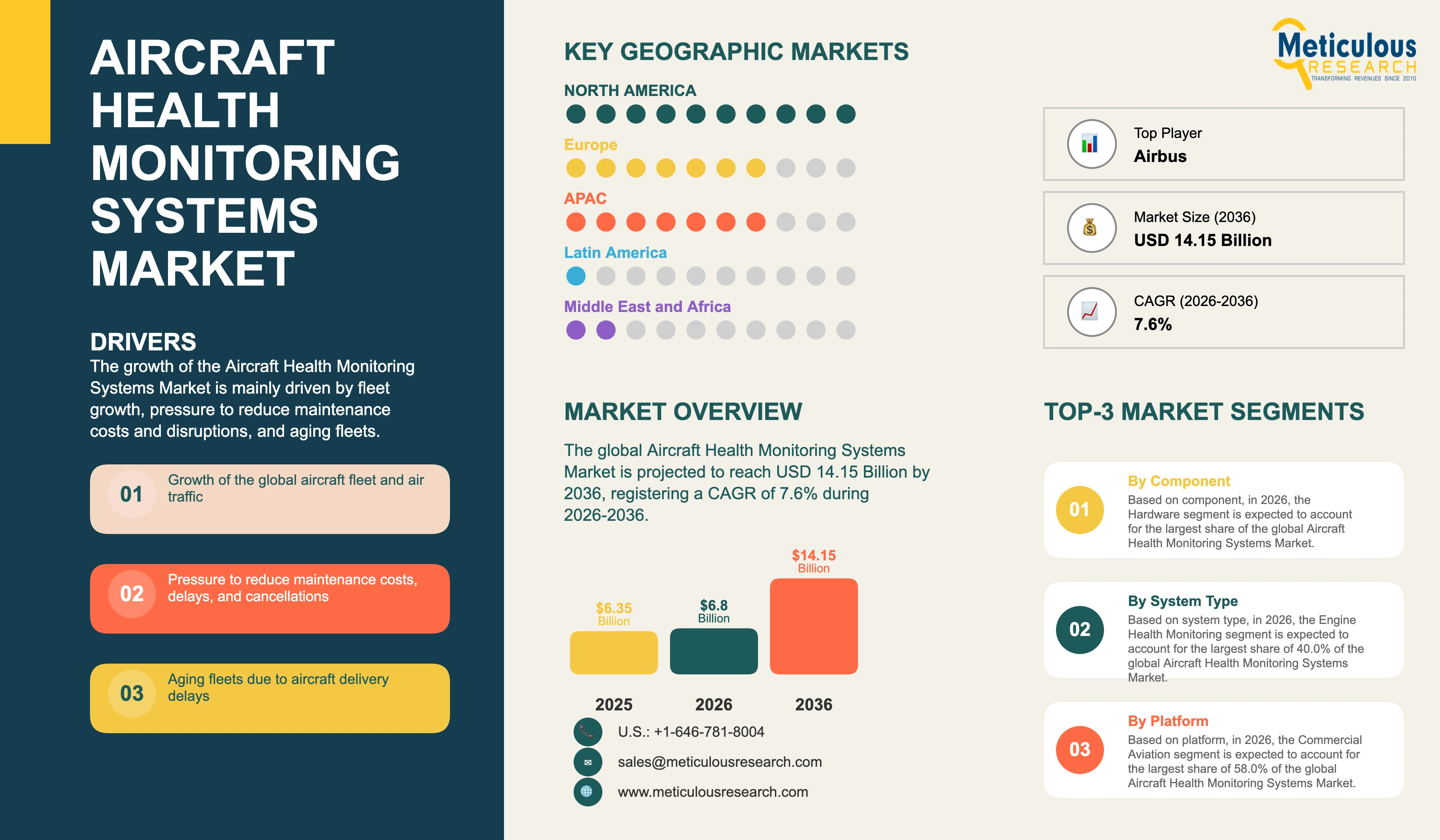
The global aircraft health monitoring systems market was valued at USD 6.35 billion in 2025. This market is expected to reach USD 14.15 billion by 2036 from an estimated USD 6.80 billion in 2026, registering a CAGR of 7.6% during the forecast period (2026-2036).
- Published
- Nov 2026
- Pages
- 253
- Format
- PDF + Excel
- Report ID
- MRAD - 1042599
- Base year
- 2025
- 2025 · BASELINE
- $6.35B
- 2036
- $14.15B
- CAGR 2026–2036
- 7.6%
2025 baseline · 2026–2036 forecast at 7.6% CAGR · hover a bar for the value
Key highlights
Airbus combined its Skywise data platform and Navblue flight operations software businesses into a new subsidiary named Skywise on April 1, 2026, with about 750 employees, and Airbus reports that the Skywise platform connects about 12,000 aircraft from more than 100 operators and has more than 50,000 users, with one airline avoiding 35 technical cancellations in a single month through predictive maintenance alerts.
JetBlue signed an agreement on April 21, 2026, to adopt Airbus's Skywise Fleet Performance+ (S.FP+) predictive maintenance solution for its Airbus fleet, and Collins Aerospace's health monitoring analytics are linked into S.FP+, reflecting growing collaboration between aircraft manufacturers and systems suppliers on aircraft health data.
Airbus estimates that the number of connected aircraft will grow from about 11, 000 today to more than 40,000 by 2044, and that the use of aircraft data and predictive maintenance could generate savings of about USD 83 billion per year for the aviation industry by that time.
IATA and Oliver Wyman reported in October 2025 that the need to keep older aircraft in service longer because of delivery delays added about USD 3.1 billion to airline maintenance costs in 2025, which is increasing the value of health monitoring and predictive maintenance for aging fleets. The same report highlighted shortages of spare parts and engines as a continuing source of disruption for airlines, which adds to the value of early warning of component failures.
GE Aerospace monitors more than 44, 000 engines through its engine health monitoring and analytics services and completed a predictive maintenance project with SAS Scandinavian Airlines on the CF34-powered Embraer E190 fleet, while Boeing renewed its Airplane Health Management agreements with All Nippon Airways and Oman Air. Engine manufacturers continue to expand the use of AI and digital twins in their monitoring services to improve predictions of engine condition and plan shop visits.
By component, hardware accounts for the largest share in 2026, while software and analytics register the highest CAGR.
By system type, engine health monitoring accounts for the largest share of 40.0% in 2026, while structural health monitoring registers the highest CAGR.
By platform, commercial aviation accounts for the largest share of 58.0% in 2026, while helicopters and UAVs register the highest CAGR.
By fit, line-fit accounts for the larger share in 2026, while retrofit registers the higher CAGR.
By geography, North America accounts for the largest share of 38.0% in 2026, while Asia-Pacific registers the highest CAGR of 9.4%.
Report summary
| Particulars | Details |
|---|---|
| Base Year | 2025 |
| Estimated Year | 2026 |
| Forecast Period | 2026-2036 |
| Market Size in 2025 | USD 6.35 billion |
| Market Size in 2026 | USD 6.80 billion |
| Market Size by 2036 | USD 14.15 billion |
| CAGR (2026-2036) | 7.6% |
| Format | PDF, Excel & Cloud Portal · 253 pages |
| Largest Segment by System Type (2026) | Engine Health Monitoring (40.0%) |
| Largest Segment by Platform (2026) | Commercial Aviation (58.0%) |
| Largest Region (2026) | North America (38.0%) |
| Fastest-Growing Region | Asia-Pacific (CAGR 9.4%) |
| Companies Profiled | 15 companies and other companies |
| Segments Covered | Component, System Type, Platform, Fit, Geography |
| Countries Covered | U.S., Canada, France, Germany, U.K., Italy, Spain, Netherlands, Ireland, Sweden, Switzerland, Rest of Europe, China, India, Japan, Singapore, Australia, South Korea, Indonesia, Rest of Asia-Pacific, U.A.E., Saudi Arabia, Qatar, Turkey, Israel, South Africa, Rest of Middle East & Africa, Brazil, Mexico, Chile, Colombia, Rest of Latin America |
Report overview
Segments covered: component, system type, platform, fit.
The growth of this market is mainly driven by the growth of the global commercial aircraft fleet and air traffic, the need for airlines to reduce maintenance costs, delays, and cancellations through predictive maintenance, the increasing age of fleets caused by aircraft delivery delays, the high connectivity and data generation of new-generation aircraft and engines, and the growing use of AI and big data analytics in aviation maintenance. However, factors such as the high cost of installing and certifying monitoring systems, especially on older aircraft, concerns over data ownership and sharing between airlines, manufacturers, and maintenance providers, and stringent certification requirements are expected to restrain the growth of this market to some extent.
Aircraft health monitoring systems are systems that collect, transmit, and analyze data on the condition and performance of aircraft engines, structures, avionics, electrical systems, and other components to detect faults, predict failures, and support maintenance decisions. They include onboard hardware, such as sensors, data acquisition units, data recorders, and health monitoring computers, software and analytics platforms that process aircraft data on the ground and in the air, and services such as engine and fleet monitoring, data analysis, and maintenance advisory services provided by manufacturers, systems suppliers, and maintenance providers. This report covers health monitoring systems for engines, components and subsystems, avionics and electrical systems, and structures across commercial aviation, military aviation, business and general aviation, and helicopters and unmanned aerial vehicles, sold for both new aircraft and retrofit installations. General aircraft maintenance, repair, and overhaul services and flight data monitoring for flight safety programs are analyzed in separate reports. The market is measured on a revenue basis.
Health monitoring has long been part of aviation, especially for engines, where manufacturers have monitored engine performance and vibration data for decades to detect deterioration and plan shop visits. However, the scope and value of health monitoring have grown significantly with the introduction of highly connected aircraft such as the Airbus A350 and Boeing 787, which generate very large volumes of data from thousands of parameters, the expansion of aircraft connectivity, and the use of big data analytics and AI to predict failures before they occur. Health monitoring is now a key tool for airlines to move from scheduled and reactive maintenance to predictive maintenance.
Unscheduled maintenance events, such as unexpected component failures, cause flight delays and cancellations, aircraft on ground situations, and high costs for airlines. Health monitoring systems allow airlines to detect issues early, order parts in advance, and perform maintenance during planned ground time, which improves aircraft availability and reduces costs. Airbus reports that one airline using its Skywise predictive maintenance solution avoided 35 technical cancellations in a single month, which illustrates the potential value.
Engine health monitoring accounts for the largest share of the market, since engines are the most valuable and maintenance-intensive aircraft systems, and engine manufacturers such as GE Aerospace, Pratt & Whitney, Rolls-Royce, and Safran monitor large fleets of engines as part of their service agreements. GE Aerospace alone monitors more than 44,000 engines. Component and subsystem health monitoring, which covers systems such as auxiliary power units, landing gear, brakes, hydraulics, fuel, and environmental control systems, and avionics and electrical systems health monitoring are other large segments. Structural health monitoring, which uses sensors to monitor fatigue, corrosion, and damage in aircraft structures, is the fastest-growing system type.
Commercial aviation accounts for the largest share of the market by platform, supported by the large global fleet of commercial aircraft and the strong focus of airlines on reliability and costs. Military aviation is the second-largest platform, since armed forces use health and usage monitoring systems to improve readiness and manage aging fleets, while helicopters and unmanned aerial vehicles are the fastest-growing platforms. North America is the largest regional market, while Asia-Pacific is the fastest-growing region.
The market is served by aircraft manufacturers, engine manufacturers, avionics and systems suppliers, maintenance providers, and specialized data and analytics companies. Airbus offers the Skywise platform and Skywise Fleet Performance+ predictive maintenance solution, and in April 2026 it combined Skywise and Navblue into a new subsidiary called Skywise. Boeing offers Airplane Health Management, which is used by many airlines. Engine manufacturers offer engine health monitoring services, while Collins Aerospace, Honeywell, Safran, Thales, Teledyne Controls, Curtiss-Wright, and Parker Meggitt offer onboard hardware and analytics. Lufthansa Technik, with its AVIATAR platform, and Air France Industries KLM Engineering & Maintenance, with its Prognos solution, offer predictive maintenance services to airlines.
The value of the market is shifting from hardware toward software, analytics, and services, as airlines and operators focus on extracting insights from aircraft data. Hardware remains the largest component, but software and analytics are growing fastest, supported by cloud platforms, AI, and the increasing number of connected aircraft. Airbus expects the number of connected aircraft to grow from about 11,000 to more than 40,000 by 2044.
Over the forecast period, the aircraft health monitoring systems market is expected to grow steadily, supported by fleet growth, cost pressure on airlines, aging fleets, connected aircraft, and advances in analytics. At the same time, certification requirements, retrofit costs, and data sharing issues will influence how quickly health monitoring is adopted across fleets.
We are adding many new aircraft over the next few years and want predictive maintenance from day one, using one platform across our fleet.
Health and usage monitoring is critical for our offshore operations, and better structural and drivetrain monitoring would help us reduce inspections and improve availability.
North America is expected to account for the largest share of 38.0% of the market in 2026, mainly due to large commercial, military, business aviation, and helicopter fleets and the presence of leading aircraft, engine, and systems manufacturers.
Asia-Pacific is projected to register the highest CAGR of 9.4% during the forecast period, driven by rapid air traffic and fleet growth, large aircraft orders, growing maintenance capabilities, and increasing military aircraft procurement.
The report profiles 15 companies, including Airbus, Boeing, GE Aerospace, RTX (Collins Aerospace and Pratt & Whitney), Honeywell, Safran, Rolls-Royce, Teledyne Controls, Lufthansa Technik, Thales, Curtiss-Wright, Leonardo, Embraer, Air France Industries KLM Engineering & Maintenance, and Parker-Hannifin (Meggitt).
They allow airlines to detect issues early, plan maintenance during scheduled ground time, order parts in advance, and avoid unscheduled removals, delays, and cancellations; Airbus reports that one airline using Skywise avoided 35 technical cancellations in a single month.
Report infographic
Market dynamics
18 factors across 5 forcesGrowth of the global aircraft fleet and air traffic
Global air passenger traffic has recovered strongly since the pandemic and continues to grow, supported by rising incomes, growing middle classes in Asia-Pacific, the Middle East, and other regions, and the expansion of low-cost carriers. To meet this demand, airlines have placed very large orders for new aircraft with Airbus, Boeing, Embraer, and other manufacturers, and the global commercial fleet is expected to grow significantly over the next two decades. New aircraft are typically delivered with advanced health monitoring capabilities, and growing fleets increase the number of aircraft that require monitoring and maintenance support.
The growth of air cargo, business aviation, helicopter services, and military aircraft programs also adds to the number of platforms using health monitoring systems.
Fleet growth is particularly strong in Asia-Pacific and the Middle East, where airlines are adding large numbers of new-generation narrowbody and widebody aircraft, and many of these airlines are adopting predictive maintenance from the start of their operations.
Pressure to reduce maintenance costs, delays, and cancellations
Maintenance accounts for a significant share of airline operating costs, and unscheduled maintenance events cause costly delays, cancellations, and aircraft on ground situations that disrupt operations and harm customer satisfaction. Airlines operate on thin margins and face rising labor, parts, and maintenance costs, as well as shortages of skilled technicians and spare parts. Health monitoring systems allow airlines to detect issues early, plan maintenance during scheduled ground time, optimize spare parts inventory, and reduce unscheduled removals, which lowers costs and improves aircraft availability.
The financial and operational benefits of predictive maintenance for airlines can be very large. Airbus reports that one airline using Skywise avoided 35 technical cancellations in a single month, and Airbus estimates that the use of aircraft data and predictive maintenance could generate industry savings of about USD 83 billion per year by 2044. These benefits are encouraging airlines to invest in health monitoring and predictive maintenance solutions.
Supply chain constraints for spare parts and engines have made predictive maintenance even more valuable, since early warning of failures gives airlines more time to obtain parts and avoid long aircraft on ground periods.
Aging fleets due to aircraft delivery delays
Delays in new aircraft deliveries, caused by supply chain problems and production constraints at Airbus, Boeing, and engine manufacturers, have forced many airlines to keep older aircraft in service longer than planned. IATA and Oliver Wyman reported in October 2025 that keeping older aircraft in service added about USD 3.1 billion to airline maintenance costs in 2025. Older aircraft require more maintenance and are more prone to failures, which increases the value of health monitoring and predictive maintenance for these fleets and encourages retrofit installations.
Engine durability issues on some new-generation engines have also led to increased shop visits and aircraft groundings, which has increased the focus of airlines and engine manufacturers on engine health monitoring and predictive analytics.
Rising connectivity and data generation of modern aircraft
New-generation aircraft, such as the Airbus A350, A320neo family, and A220, Boeing 787 and 737 MAX, and Embraer E2, generate far more data than older aircraft, with thousands of parameters recorded and transmitted during each flight. Aircraft connectivity through satellite communications and ground networks allows data to be transmitted in real time or shortly after landing, which enables faster analysis and response. The growing number of connected aircraft is greatly increasing the volume of data available for health monitoring.
Platforms such as Airbus Skywise, Boeing Airplane Health Management, and Lufthansa Technik AVIATAR aggregate data from large fleets, which allows them to identify patterns across many aircraft and improve the accuracy of predictive models.
Advances in AI and big data analytics
Advances in artificial intelligence, machine learning, and big data analytics have made it possible to analyze large volumes of aircraft data, maintenance records, and operational data to predict failures with greater accuracy and longer warning times. Cloud computing provides the scalable infrastructure needed to process data from large fleets, and digital twins of engines and components allow more accurate assessment of condition and remaining life. These advances are expanding the range of systems and components that can be monitored predictively and improving the business case for health monitoring.
Generative AI is also beginning to be used to help maintenance technicians and engineers diagnose problems, search technical documentation, and plan maintenance tasks, which further increases the value of health monitoring data.
Table of contents
12 chapters · 159 sections · 253 pages · click to expandSegmental analysis
| Segment | Largest share (2026) | Fastest growth (2026–2036) |
|---|---|---|
| By Component | Hardware | Software and analytics |
By Component
- The hardware segment is expected to account for the largest share of the aircraft health monitoring systems market, while the software and analytics segment is projected to register the highest CAGR during the forecast period.
- The line-fit segment is expected to account for the larger share of the aircraft health monitoring systems market, while the retrofit segment is projected to register the higher CAGR during the forecast period.
Geographic analysis
North America
Largest shareIn 2026, North America is expected to account for the largest share of 38.0% of the global aircraft health monitoring systems market. The large share of this region is mainly due to the large commercial aircraft fleet operated by U.S. and Canadian airlines, the largest military aviation fleet in the world, the large business aviation and helicopter fleets, and the presence of leading aircraft, engine, and systems manufacturers such as Boeing, GE Aerospace, Pratt & Whitney, Collins Aerospace, Honeywell, Teledyne Controls, Curtiss-Wright, and Parker. The U.S. is the largest market in the region, followed by Canada. U.S. airlines such as JetBlue are adopting predictive maintenance platforms, and the U.S. Department of Defense uses health monitoring extensively across its aircraft fleets.
Asia-Pacific
Fastest growthAsia-Pacific is projected to register the highest CAGR of 9.4% during the forecast period. The rapid growth of this region is mainly driven by rapid air traffic and fleet growth, very large aircraft orders by airlines in China, India, and Southeast Asia, growing maintenance, repair, and overhaul capabilities, increasing military aircraft procurement, and the adoption of predictive maintenance by airlines as they expand their fleets. China, India, Japan, Singapore, Australia, South Korea, and Indonesia are important markets, and Singapore is a major regional hub for aircraft maintenance. Japanese airlines such as All Nippon Airways are long-standing users of health monitoring, and Indian airlines are adopting predictive maintenance as they take delivery of very large numbers of new aircraft.
Europe
Europe accounts for a significant share of the global market, supported by large airline fleets, strong military aviation programs, and leading companies such as Airbus, Safran, Rolls-Royce, Thales, Leonardo, Lufthansa Technik, and Air France Industries KLM Engineering & Maintenance. France, Germany, the U.K., Italy, Spain, the Netherlands, Ireland, Sweden, and Switzerland are important markets, and Ireland is a global center for aircraft leasing, which is increasing interest in aircraft health data for asset management.
Latin America
The Middle East & Africa and Latin America account for smaller shares of the market but are growing steadily, supported by large widebody fleets operated by Gulf carriers, fleet expansion by airlines in Saudi Arabia, the U.A.E., Qatar, and Turkey, and the presence of Embraer in Brazil, which offers health monitoring solutions for its commercial and military aircraft. Gulf carriers such as Emirates, Qatar Airways, and Etihad operate some of the largest fleets of new-generation widebody aircraft, which generate large volumes of health data.
Competitive landscape
The global aircraft health monitoring systems market is moderately consolidated, with the top five players estimated to account for about 45% of the market in 2025. The market includes aircraft manufacturers, engine manufacturers, avionics and systems suppliers, maintenance, repair, and overhaul providers, and specialized data and analytics companies.
Airbus and Boeing are leading providers of aircraft-level health monitoring and predictive maintenance platforms, through Airbus Skywise and Skywise Fleet Performance+ and Boeing Airplane Health Management. GE Aerospace, Pratt & Whitney, Rolls-Royce, and Safran provide engine health monitoring as part of their engine service offerings. Collins Aerospace, Honeywell, Thales, Teledyne Controls, Curtiss-Wright, and Parker Meggitt provide onboard health monitoring hardware, data acquisition systems, and analytics. Leonardo provides health and usage monitoring for helicopters, and Embraer offers health monitoring for its aircraft. Lufthansa Technik and Air France Industries KLM Engineering & Maintenance offer independent predictive maintenance platforms and services to airlines.
Companies in this market compete on prediction accuracy, data coverage across aircraft systems, integration with airline maintenance and engineering systems, ease of use, certification expertise, data security, pricing, and customer support. Key strategies include expansion of predictive maintenance coverage, partnerships between manufacturers and suppliers, integration of AI and digital twins, long-term service agreements with airlines, and expansion in Asia-Pacific and the Middle East.
Aircraft and engine manufacturers benefit from deep knowledge of their products and access to design data, while independent maintenance providers can offer solutions that work across mixed fleets and are not tied to a single manufacturer. Airlines with mixed fleets often prefer platforms that combine data from different sources, which encourages collaboration and integration between providers. Long-term service relationships with airlines are an important competitive advantage for all groups.
We expect competition to intensify as manufacturers seek to capture more of the aftermarket value through data services and as independent providers expand their offerings. Partnerships, such as the integration of Collins Aerospace analytics into Airbus Skywise Fleet Performance+, are likely to become more common. Technology companies that provide cloud computing and AI tools are also partnering with aviation companies to support data platforms.
Some of the key players operating in the aircraft health monitoring systems market are Airbus SE, The Boeing Company, GE Aerospace, RTX Corporation (Collins Aerospace and Pratt & Whitney), Honeywell International Inc., Safran S.A., Rolls-Royce plc, Teledyne Controls LLC, Lufthansa Technik AG, Thales Group, Curtiss-Wright Corporation, Leonardo S.p.A., Embraer S.A., Air France Industries KLM Engineering & Maintenance, and Parker-Hannifin Corporation (Meggitt), among others.
- —
Airbus combined Skywise and Navblue into a new Skywise subsidiary in April 2026, JetBlue signed for Airbus Skywise Fleet Performance+ in April 2026, Boeing renewed Airplane Health Management agreements with All Nippon Airways and Oman Air, and IATA and Oliver Wyman reported that aging fleets added about USD 3.1 billion to airline maintenance costs in 2025.
- Airbus SE
- Boeing Company
- GE Aerospace
- Honeywell International Inc.
- Safran S.A.
- Rolls-Royce plc
- Teledyne Controls LLC
- Lufthansa Technik AG
- Thales Group
- Curtiss-Wright Corporation
- Leonardo S.p.A
- Embraer S.A.
- Air France Industries KLM Engineering & Maintenance
- Parker-Hannifin Corporation · Meggitt
Expert perspectives
Aircraft health monitoring is becoming a core part of how airlines and other aircraft operators manage maintenance and reliability. The combination of growing fleets, cost pressure, aging aircraft, connected aircraft, and advances in AI is shifting the industry from scheduled and reactive maintenance toward predictive maintenance, and health monitoring systems provide the data and insights needed for this shift.
Over the forecast period, the market is expected to grow at a CAGR of 7.6%, from USD 6.80 billion in 2026 to USD 14.15 billion in 2036. Growth will be supported by fleet growth, pressure to reduce maintenance costs and disruptions, aging fleets, rising aircraft connectivity, and advances in AI and analytics.
Among the market segments, hardware is the largest component, while software and analytics grow fastest. Engine health monitoring is the largest system type, while structural health monitoring grows fastest, commercial aviation is the largest platform, while helicopters and UAVs grow fastest, and line-fit is the larger fit type, while retrofit grows faster. North America is the largest region, and Asia-Pacific is the fastest-growing region at a CAGR of 9.4%.
In our view, the most important change over the forecast period will be the shift of value from hardware to software, analytics, and services. As more aircraft become connected and as AI improves predictive accuracy, airlines will increasingly pay for insights and outcomes rather than equipment, and companies with large data platforms and fleet-wide data will have an advantage.
We expect aircraft manufacturers to strengthen their positions in the aftermarket through data platforms such as Airbus Skywise, while independent maintenance providers and systems suppliers will compete by offering solutions for mixed fleets and specific systems. Collaboration and data sharing between these groups will be essential for airlines to realize the full benefits of predictive maintenance.
Aging fleets and delivery delays will continue to support demand for retrofit solutions in the near term, while the long-term growth of the market will be driven by new connected aircraft and the expansion of predictive maintenance to more aircraft systems and structures.
Regulatory acceptance will be important for unlocking the full value of health monitoring, since approval to change maintenance intervals based on monitoring data would allow larger savings. We expect regulators to gradually expand acceptance of data-driven maintenance approaches over the forecast period.
Overall, we believe aircraft health monitoring will become standard across commercial, military, and rotorcraft fleets, and the market will grow steadily as the aviation industry becomes more data-driven. The steady growth of this market reflects the long life cycles of aircraft and the gradual pace of change in aviation maintenance.
Customer perspectives
Vice President of Engineering and Maintenance - airline, U.S.
Engine and component health alerts let us replace parts during planned overnight checks instead of cancelling flights. With delivery delays keeping older aircraft in service, predictive maintenance has become essential for our operation.
Frequently asked questions
The global aircraft health monitoring systems market was valued at USD 6.35 billion in 2025, up from USD 5.95 billion in 2024, and is estimated at USD 6.80 billion in 2026. The market includes hardware, software and analytics, and services for engine, component and subsystem, avionics and electrical systems, and structural health monitoring.
Cite this report
Meticulous Research. (2026). Aircraft Health Monitoring Systems Market - Global Opportunity Analysis and Industry Forecast (2026-2036) (Report No. MRAD - 1042599). Meticulous Market Research Pvt. Ltd. https://www.meticulousresearch.com/product/aircraft-health-monitoring-systems-market-7282