Aircraft Component Pooling Services Market (2026-2036)
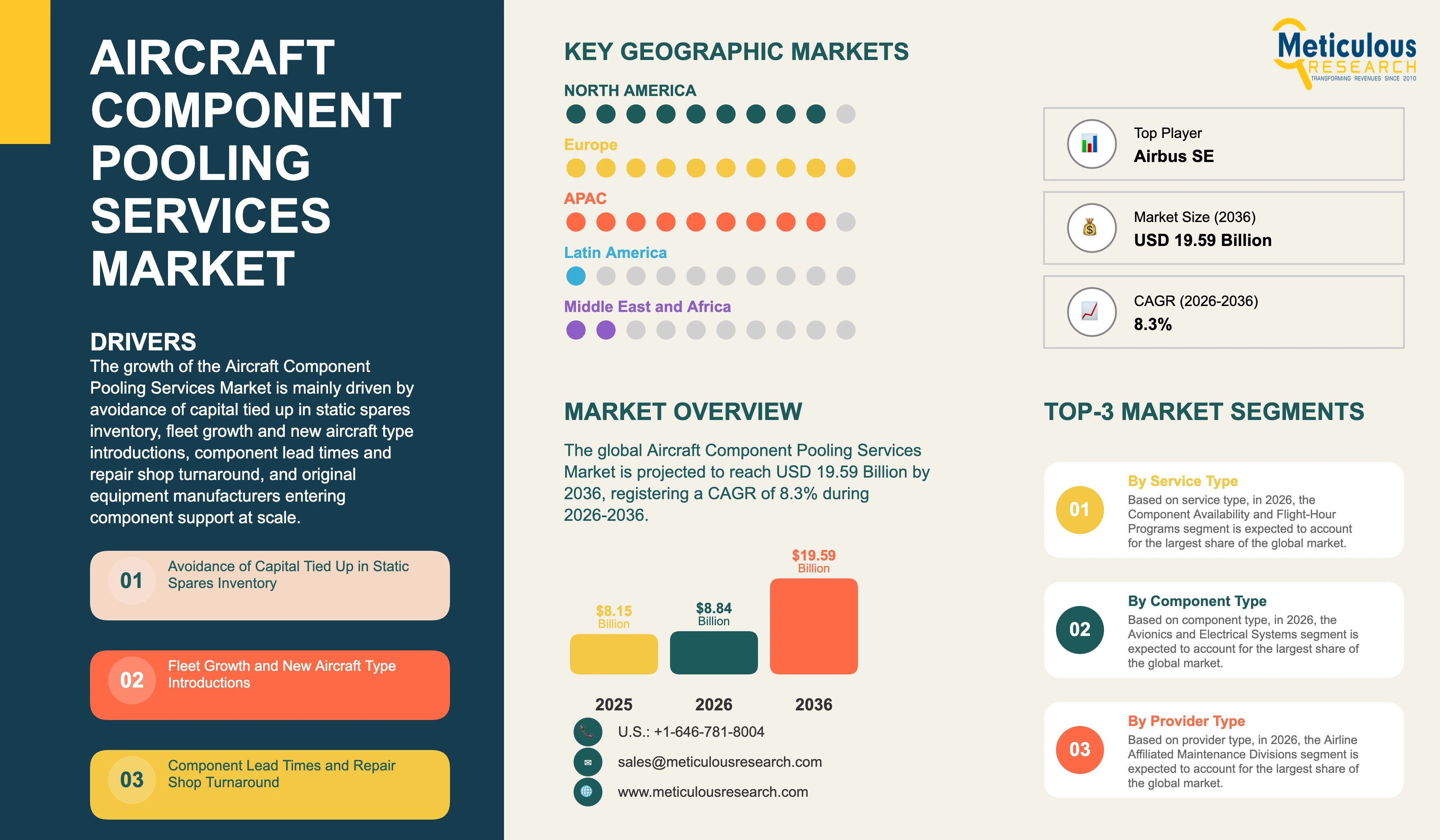
The global Aircraft Component Pooling Services Market was valued at USD 8.15 billion in 2025. This market is expected to reach USD 19.59 billion by 2036 from an estimated USD 8.84 billion in 2026, registering a CAGR of 8.3% during the forecast period (2026-2036).
- Published
- Nov 2026
- Pages
- 291
- Format
- PDF + Excel
- Report ID
- MRAD - 1042851
- Base year
- 2025
- 2025 · BASELINE
- $8.15B
- 2036
- $19.59B
- CAGR 2026–2036
- 8.3%
2025 baseline · 2026–2036 forecast at 8.3% CAGR · hover a bar for the value
Key highlights
The global Aircraft Component Pooling Services Market is projected to reach USD 19.59 billion by 2036, driven by avoidance of capital tied up in static spares inventory, fleet growth and new aircraft type introductions, component lead times and repair shop turnaround, and original equipment manufacturers entering component support at scale.
Europe is expected to account for the largest market share in 2026 and is also projected to register the fastest growth during the forecast period, supported by the concentration of airline affiliated component pools and manufacturer flight-hour programs in the region, together with the carriers that established pooling as a standard procurement route.
By service type, Component Availability and Flight-Hour Programs are expected to account for the largest market share, whereas Inventory Ownership and Asset Management are projected to witness the fastest growth through 2036.
By component type, Avionics and Electrical Systems are expected to account for the largest market share, whereas Interior and Cabin Components are projected to witness the fastest growth through 2036.
By provider type, Airline Affiliated Maintenance Divisions are expected to account for the largest market share, whereas Original Equipment Manufacturers are projected to witness the fastest growth through 2036.
Airbus Flight Hour Services supported almost 60 operators and more than 1, 800 aircraft as of October 2026, with operators paying a fixed rate per flight hour against guaranteed component availability, logistics management, repairs and inventory access.
On the A220 alone the program covered more than 400 aircraft across 12 airlines, representing over 70% of the in-service A220 fleet.
Airbus and Air France-KLM finalized a 50-50 joint venture named Alpha Component Solutions on 28 October 2026, operated by Air France Industries KLM Engineering & Maintenance, providing shared-access pooling of component assets, maintenance, supply chain management and repairs for the A350.
That joint venture already supports more than 500 aircraft under contract, combining a manufacturer flight-hour program with an airline affiliated maintenance capability in one pool.
Lufthansa Technik took on component support for the entire Air Europa Boeing 737 fleet on 20 August 2025, covering 28 aircraft comprising 26 737 NG and two 737 MAX, with 18 further 737 MAX on order for service entry by mid-2027.
That agreement combines component maintenance, repair and overhaul, access to a global spare parts pool, and logistical support through two homebase stock locations at Madrid and Mallorca.
Under the flight-hour model operators avoid tying up capital in static inventory and avoid the cost of buying and warehousing spare parts across multiple airports, with parts positioned at critical hubs and European stock buffers placed near airline operations.
AAR reported consolidated sales of USD 918.0 million in the quarter ended 31 August 2026, up 24% from USD 739.6 million, with Parts Supply up 31% including 23% organic growth in new parts distribution.
Commercial sales accounted for 73% of AAR consolidated sales in that quarter against 71% a year earlier, and the company agreed to acquire a 65% controlling interest in MRO Holdings.
Report summary
| Particulars | Details |
|---|---|
| Forecast Period | 2026-2036 |
| Base Year | 2025 |
| Estimated Year | 2026 |
| CAGR (Value) | 8.3% |
| Format | PDF, Excel & Cloud Portal · 291 pages |
| CAGR (Volume) | 5.8% |
| Market Size (Value) in 2026 | USD 8.84 billion |
| Market Size (Value) in 2036 | USD 19.59 billion |
| Market Size (Volume) in 2026 | 9,850 aircraft under contract |
| Market Size (Volume) in 2036 | 17,400 aircraft under contract |
| Average Selling Price, 2026 | USD 897,000 per aircraft per year |
| Average Selling Price, 2036 | USD 1,126,000 per aircraft per year |
| Segments Covered | By Service Type: Component Availability and Flight-Hour Programs, Main Base and Line Station Stock Provisioning, Component Exchange and Loan, Repair Management and Turnaround Services, Inventory Ownership and Asset Management. By Component Type: Avionics and Electrical Systems, Hydraulic and Pneumatic Components, Landing Gear, Wheels and Brakes, Airframe and Structural Components, Interior and Cabin Components, Auxiliary Power Units. By Provider Type: Airline Affiliated Maintenance Divisions, Original Equipment Manufacturers, Independent Maintenance, Repair and Overhaul Providers, Parts Distributors and Lessors. By Operator Type: Full-Service Carriers, Low-Cost Carriers, Regional Airlines, Cargo Operators, Lessors and Asset Managers, Military and Government Operators. |
| Countries Covered | Germany; France; U.K.; Italy; U.S.; Canada; China; Japan; India; South Korea; Mexico; Brazil |
| Key Companies | Airbus SE, The Boeing Company, Lufthansa Technik AG, Air France-KLM S.A., RTX Corporation, AAR Corp., and HEICO Corporation |
Report overview
Segments covered: service type, component type, provider type, operator type.
In volume terms, the market is estimated at 9,850 aircraft under contract in 2026 and is expected to reach 17,400 aircraft under contract by 2036, registering a CAGR of 5.8% during the forecast period. The average selling price is estimated at USD 897,000 per aircraft per year in 2026 and USD 1,126,000 per aircraft per year in 2036.
The growth of this market is mainly driven by avoidance of capital tied up in static spares inventory, fleet growth and new aircraft type introductions, component lead times and repair shop turnaround, low-cost and regional carriers operating without component shops of their own, and original equipment manufacturers entering component support at scale. However, factors such as pool investment and asset utilization risk carried by the provider, contract rate pressure on flight-hour programs, airline reluctance to surrender control of spares, and parts availability constraints in the supply chain are expected to restrain the growth of this market to some extent.
Among provider types, Airline Affiliated Maintenance Divisions are expected to account for the largest market share in 2026, while Original Equipment Manufacturers are projected to register the highest CAGR during the forecast period. Geographically, Europe is expected to account for the largest share of this market in 2026 and is also expected to register the highest CAGR during the forecast period.
The Aircraft Component Pooling Services Market comprises services that give aircraft operators access to a shared inventory of repairable components rather than requiring them to own spares, measured by the annual contract value recognized by providers with volume expressed as aircraft under contract. The market covers component availability and flight-hour programs, main base and line station stock provisioning, component exchange and loan, repair management and turnaround services, and inventory ownership and asset management, across avionics and electrical systems, hydraulic and pneumatic components, landing gear, wheels and brakes, airframe and structural components, interior and cabin components and auxiliary power units, supplied by airline affiliated maintenance divisions, original equipment manufacturers, independent maintenance providers and parts distributors and lessors, to full-service carriers, low-cost carriers, regional airlines, cargo operators, lessors and asset managers and military and government operators. Engine and engine module support, outright parts sales and distribution, airframe heavy maintenance, line maintenance labor and component repair sold on a time and material basis outside a pooling agreement fall outside the scope.
What an operator buys here is availability rather than parts. Under a flight-hour arrangement the operator pays a fixed rate per flight hour and the provider guarantees component availability, logistics management, repairs and inventory access, drawing on a shared global pool with stock positioned at critical hubs and buffers placed near airline operations. The operator avoids tying up capital in static inventory and avoids the cost of buying and warehousing spares across multiple airports, which is the whole commercial basis of this market.
Scale in these programs is now substantial enough to set the market structure. Airbus Flight Hour Services supported almost 60 operators and more than 1,800 aircraft as of October 2026, and on the A220 covered more than 400 aircraft across 12 airlines, representing over 70% of the in-service fleet of that type. A manufacturer holding that proportion of a type is no longer an alternative to airline affiliated pools but the reference against which they are priced, and Original Equipment Manufacturers is projected to be the fastest-growing provider type in this market at 10.8%.
The clearest signal of where competition is heading is that the two models have stopped competing on the A350. Airbus and Air France-KLM finalized a 50-50 joint venture named Alpha Component Solutions on 28 October 2026, operated by Air France Industries KLM Engineering & Maintenance, providing shared-access pooling of component assets, maintenance, supply chain management and repairs, and already supporting more than 500 aircraft under contract. Combining a manufacturer program with an airline affiliated capability removes duplicated pool investment on a single type rather than dividing the fleet between two pools.
Airline affiliated divisions nevertheless hold the largest provider share and continue to win fleet-wide work. Lufthansa Technik took on component support for the entire Air Europa 737 fleet on 20 August 2025, covering 28 aircraft with 18 further 737 MAX on order for service entry by mid-2027, combining component maintenance, repair and overhaul with pool access and logistical support through two homebase stock locations at Madrid and Mallorca. Main base stock placed at the operator rather than at a central warehouse is what converts pool access into dispatch reliability.
Contract value per aircraft rather than aircraft count carries most of the growth. Aircraft under contract grow at 5.8% against value at 8.3%, and average annual contract value rises from USD 897,000 per aircraft in 2026 to USD 1,126,000 in 2036, as wide-body and new-generation types enter pools, as cabin and interior content per aircraft increases and as agreements widen from type-specific coverage to fleet-wide scope. Parts supply conditions reinforce that, with AAR reporting Parts Supply up 31% in the quarter ended 31 August 2026 including 23% organic growth in new parts distribution.
A lessor moving an aircraft between operators needs components available through redelivery, storage and transition, periods in which the asset generates no revenue and the outgoing operator has no incentive to hold spares. Lessors and Asset Managers form a distinct operator segment in this market for that reason. Providers able to support an aircraft across a transition hold the relationship through successive lessees rather than losing it at redelivery.
Military transport and government fleets operate derivatives of commercial types and face the same availability economics, with the added constraint that annual budgets suit a fixed rate per flight hour better than unpredictable spares purchases. Military and Government Operators form a separate segment in this market, and providers already pooling the commercial equivalent of a type can serve those fleets from existing stock rather than from dedicated inventory.
Europe is expected to account for the largest share of this market in 2026, supported by the airline affiliated component pools and manufacturer flight-hour programs headquartered in the region, including a 50-50 joint venture finalized on 28 October 2026 that already supports more than 500 A350 aircraft, and by the carriers that established pooling as a standard procurement route.
Europe is projected to grow at 7.6% and holds the largest regional position in this market in 2026. Germany grows at 7.8% as the base of the largest independent component support provider, which took on support for an entire 28-aircraft Boeing 737 fleet in August 2025 with homebase stock at two operator sites, while France carries both the manufacturer flight-hour program and the airline affiliated division behind the 50-50 joint venture finalized on 28 October 2026 for A350 component support. Operators in Spain, Italy and the United Kingdom place fleet-wide component support with regional providers rather than provisioning inventory of their own.
The Middle East & Africa region is projected to grow at 8.6%, with Gulf carriers operating large wide-body fleets alongside substantial in-house component capability so that pooling is used selectively by type and category, while African operators with small mixed fleets depend on pooling almost entirely because owned provisioning across their type mix would be uneconomic, and regional transit and maintenance hubs allow stock placed for one operator to serve others. Latin America is projected to grow at 7.8%, with Mexico taking a growing share through low-cost carrier fleets operated without component shops and Brazilian demand following mainline and regional fleets.
Some of the key players operating in the aircraft component pooling services market are Airbus SE, The Boeing Company, Lufthansa Technik AG, Air France-KLM S.A., RTX Corporation, AAR Corp., and HEICO Corporation, among others.
Key strategies include forming joint ventures that combine manufacturer data and airline affiliated capability on single types, as finalized on 28 October 2026 for the A350 with more than 500 aircraft already under contract; taking ownership of rotable assets to remove capital from operator balance sheets, with inventory ownership services growing at 10.6%; placing homebase and line station stock at customer sites rather than in central warehouses; acquiring repair capability to lower pool replenishment cost, as in the agreement to acquire a 65% controlling interest in a maintenance group announced with results for the quarter ended 31 August 2026; and widening agreements from type-specific to fleet-wide scope, which raises contract value per aircraft without raising the rate.
Report infographic
Market dynamics
17 factors across 4 forcesAvoidance of Capital Tied Up in Static Spares Inventory
Under a flight-hour component arrangement the operator pays a fixed rate per flight hour and the provider guarantees component availability, logistics management, repairs and inventory access, with parts positioned at critical hubs and stock buffers placed near airline operations. The operator avoids tying up capital in static inventory and avoids the cost of buying and warehousing spare parts across multiple airports. A rotable inventory sized for an airline network sits idle for most of its life while carrying the full cost of acquisition, storage and obsolescence, and the same inventory serves far more flight hours when shared across operators. That utilization difference is the source of the saving, and it widens as the number of operators in a pool increases.
Fleet Growth and New Aircraft Type Introductions
A new type entering an airline fleet requires an initial provisioning inventory before the first revenue flight, at a cost unrelated to how many of the type the airline will eventually operate. Airbus Flight Hour Services covered more than 400 A220 aircraft across 12 airlines as of October 2026, representing over 70% of the in-service fleet of that type, which indicates how far operators of a newer type default to pooling rather than provisioning. Air Europa holds 18 further 737 MAX on order for service entry by mid-2027 against a current fleet of 28 737s under component support. Fleet additions therefore enter existing pool coverage rather than triggering fresh inventory purchases, which is why contract scope is increasingly written fleet-wide.
Component Lead Times and Repair Shop Turnaround
A component removed from an aircraft returns to service only after transport, induction, repair and return, and an operator holding its own spares must cover that cycle from owned stock at every station it serves. AAR reported Parts Supply up 31% in the quarter ended 31 August 2026 including 23% organic growth in new parts distribution, which reflects the demand conditions in the parts market that pooling customers are insulated from. A pool absorbs turnaround variability because the replacement unit is drawn from shared stock rather than from the operator own shelf. The value of that transfer rises with the cost and lead time of the component, which is why avionics and electrical systems hold the largest component share of this market in 2026.
Low-Cost and Regional Carriers Without Component Shops
Carriers built on single-type fleets and high utilization typically operate without component maintenance capability of their own, so every repairable removal is either an owned spare or a purchased service. Low-Cost Carriers is projected to be the fastest-growing operator type in this market at 10.0%. For these operators the choice is not between in-house and pooled support but between owning spares and renting availability, and the fixed rate per flight hour matches a cost structure built on predictable unit economics. Regional airlines face the same position with the added difficulty that their types have smaller global fleets and thinner parts markets.
Original Equipment Manufacturers Entering Component Support
Airbus Flight Hour Services supported almost 60 operators and more than 1,800 aircraft as of October 2026, with repairs performed to original equipment manufacturer standards. Airbus and Air France-KLM then finalized a 50-50 joint venture named Alpha Component Solutions on 28 October 2026, operated by Air France Industries KLM Engineering & Maintenance, which already supports more than 500 aircraft under contract on the A350. A manufacturer holds the design data, the initial provisioning relationship and the reliability record for every component it supplies, which allows it to price availability from a position no independent provider can match on a new type. Original Equipment Manufacturers is projected to be the fastest-growing provider type in this market at 10.8%.
Table of contents
12 chapters · 142 sections · 291 pages · click to expandSegmental analysis
| Segment | Largest share (2026) | Fastest growth (2026–2036) |
|---|---|---|
| By Service Type | Component Availability and Flight-Hour Programs | Inventory Ownership and Asset Management |
| By Component Type | Avionics and Electrical Systems | Interior and Cabin Components |
| By Provider Type | Airline Affiliated Maintenance Divisions | Original Equipment Manufacturers |
| By Operator Type | Full-Service Carriers | Low-Cost Carriers |
| Other segments | Avionics and Electrical Systems | Inventory Ownership and Asset Management |
By Service Type
- Component Availability and Flight-Hour Programs are expected to account for the largest share of the global Aircraft Component Pooling Services Market.
- The large share of this segment is mainly due to the position of the flight-hour agreement as the contract form through which availability is bought, covering guaranteed component availability, logistics management, repairs and inventory access on almost 60 operators and more than 1,800 aircraft under one manufacturer program alone.
- However, Inventory Ownership and Asset Management are projected to register the highest CAGR during the forecast period.
- The rapid growth of this segment is attributed to the transfer of rotable asset ownership from operators to providers, which removes capital from the airline balance sheet and places the acquisition, storage and obsolescence cost of the pool with the party able to spread it across many operators.
- Component Availability and Flight-Hour Programs are expected to account for the largest market share in 2026.
- Interior and Cabin Components are projected to register the highest CAGR during the forecast period, owing to high removal rates on seats, galley equipment and in-flight entertainment hardware together with retrofit cycles driven by cabin product changes, in a category operators have generally retained in house while pooling avionics.
- Original Equipment Manufacturers are projected to register the highest CAGR during the forecast period, owing to the holding of design data, initial provisioning relationships and component reliability records, which allows availability to be priced on a new type from a position independent providers cannot match, with one program covering over 70% of the in-service fleet of a recent type.
- Low-Cost Carriers are projected to register the highest CAGR during the forecast period, owing to single-type fleets operated at high utilization without component maintenance capability of their own, where the choice is between owning spares and buying availability and a fixed rate per flight hour matches the underlying cost structure.
By Component Type
- Avionics and Electrical Systems are expected to account for the largest market share.
- The large share of this segment is mainly due to the unit cost and lead time of line replaceable avionics units together with the removal rates they carry, which makes shared stock more valuable on these components than on any other category.
- However, Interior and Cabin Components are projected to register the highest CAGR during the forecast period.
- The rapid growth of this segment is attributed to high removal rates on seats, galley equipment and in-flight entertainment hardware together with retrofit cycles driven by cabin product changes, in a category operators have generally retained in house while pooling avionics.
By Provider Type
- Airline Affiliated Maintenance Divisions are expected to account for the largest market share.
- The large share of this segment is mainly due to the established pools and repair capability these divisions built from their own fleet requirements, and their record of taking fleet-wide component support from third-party operators alongside their parent airline work.
- However, Original Equipment Manufacturers are projected to register the highest CAGR during the forecast period.
- The rapid growth of this segment is attributed to the holding of design data, initial provisioning relationships and component reliability records, which allows availability to be priced on a new type from a position independent providers cannot match, with one program covering over 70% of the in-service fleet of a recent type.
By Operator Type
- Full-Service Carriers are expected to account for the largest market share.
- The large share of this segment is mainly due to the size and type diversity of these fleets, which multiplies the number of part numbers an operator would otherwise provision, and the network station count across which spares would have to be positioned.
- However, Low-Cost Carriers are projected to register the highest CAGR during the forecast period.
- The rapid growth of this segment is attributed to single-type fleets operated at high utilization without component maintenance capability of their own, where the choice is between owning spares and buying availability and a fixed rate per flight hour matches the underlying cost structure.
Other segments
- Inventory Ownership and Asset Management are projected to register the highest CAGR during the forecast period, owing to the transfer of rotable asset ownership from operators to providers, which removes capital from the airline balance sheet and places the acquisition, storage and obsolescence cost of the pool with the party able to spread it across many operators.
- Avionics and Electrical Systems are expected to account for the largest market share in 2026.
- Airline Affiliated Maintenance Divisions are expected to account for the largest market share in 2026.
- Full-Service Carriers are expected to account for the largest market share in 2026.
Geographic analysis
Asia-Pacific
Fastest growthAsia-Pacific is projected to be the fastest-growing region in this market at 10.4%, with India the fastest-growing country at 13.2%. Fleet additions in the region are outpacing the establishment of local component repair capability, so pooling supplies availability where repair capacity does not yet exist. A provider placing homebase and line station stock in the region serves that gap without needing shop capacity in the same market. India is projected to be the fastest-growing country at 13.2%, where fleet additions are outpacing the establishment of local component repair capability so pooling supplies availability where repair capacity does not yet exist. China holds the largest regional fleet and a growing domestic component support base. Japan is projected to be the slowest-growing country at 4.6%, where carriers maintain extensive component capability and owned inventory, and South Korea and Southeast Asian operators place wide-body and narrow-body fleets with manufacturer and airline affiliated programs. Asia-Pacific is projected to register the highest CAGR at 10.4%, as fleet additions outpace the establishment of local component repair capability so that pooling supplies availability where repair capacity does not yet exist, with India projected to be the fastest-growing country at 13.2%. Asia-Pacific Fleet Expansion Without Local Component Shops Geographic Analysis
Europe
Largest shareEurope is expected to account for the largest share of this market in 2026 and is projected to grow at 7.6%. The airline affiliated component pools and the manufacturer flight-hour programs that define this market are headquartered in the region, including the 50-50 joint venture finalized on 28 October 2026 between Airbus and Air France-KLM and operated by Air France Industries KLM Engineering & Maintenance, which already supports more than 500 A350 aircraft under contract. Germany grows at 7.8% as the base of the largest independent component support provider, while France carries both the manufacturer program and the airline affiliated division behind that joint venture, and operators in Spain, Italy and the United Kingdom place fleet-wide component support with regional providers.
North America
North America is projected to grow at 7.0% and holds the second largest regional position in this market in 2026. Pooling in the United States is supplied as much by parts distributors and independent providers as by airline divisions, and AAR reported consolidated sales of USD 918.0 million in the quarter ended 31 August 2026 with Parts Supply up 31% and commercial sales at 73% of the total. Major carriers retain substantial owned inventory alongside pool coverage, which moderates growth relative to regions where pooling is the default. Canadian demand follows narrow-body and regional fleet operations. Mexico accounts for a growing share through low-cost carrier fleets operated at high utilization without component shops of their own, which is the operator profile that adopts pooling most completely. Brazilian demand follows both mainline and regional fleets and a domestic maintenance base that performs repair without holding pool assets. Distance from provider stock locations makes homebase inventory placement the deciding element of a regional agreement rather than the rate itself.
Latin America
Latin America is projected to grow at 7.8%.
Middle East & Africa
The Middle East & Africa region is projected to grow at 8.6%. Gulf carriers operate large wide-body fleets with substantial in-house component capability, so pooling is used selectively on types and categories rather than fleet-wide, while African operators with small mixed fleets depend on pooling almost entirely because owned provisioning across their type mix would be uneconomic. The region also holds transit and maintenance hubs where stock placed for one operator serves others passing through.
Competitive landscape
The global Aircraft Component Pooling Services Market is consolidated, with competition among airline affiliated maintenance divisions, original equipment manufacturers and independent providers and parts distributors. Market participants compete primarily on pool depth and part number coverage, stock positioning relative to operator bases and line stations, rate per flight hour and the scope behind it, owned repair capability that lowers replenishment cost, and dispatch reliability performance against contract.
forming joint ventures that combine manufacturer data and airline affiliated capability on single types, taking ownership of rotable assets to remove capital from operator balance sheets, placing homebase and line station stock at customer sites, acquiring repair capability to lower pool replenishment cost, and widening agreements from type-specific to fleet-wide scope
The report provides a comprehensive competitive assessment of the leading companies operating in the global Aircraft Component Pooling Services Market. The key players profiled in the report include Airbus SE (Netherlands), The Boeing Company (U.S.), Lufthansa Technik AG (Germany), Air France-KLM S.A. (France), RTX Corporation (U.S.), AAR Corp. (U.S.), and HEICO Corporation (U.S.).
- Airbus SE
- Boeing Company
- Lufthansa Technik AG
- Air France-KLM S.A.
- RTX Corporation
- AAR Corp.
- HEICO Corporation
Expert perspectives
A manufacturer program covering over 70% of the in-service fleet of a recent type has changed what this market is. Airbus Flight Hour Services supported almost 60 operators and more than 1,800 aircraft as of October 2026 and more than 400 A220s across 12 airlines, which makes the manufacturer the reference price for component availability on newer types rather than one bidder among several. Original Equipment Manufacturers grows at 10.8% in this market, the fastest of any provider type, and the advantage rests on design data and initial provisioning rather than on pool size.
The joint venture finalized on 28 October 2026 is the most informative event in this market in years. Airbus and Air France-KLM placing A350 component support into a 50-50 venture operated by the airline maintenance division, already covering more than 500 aircraft, is an acknowledgment that two pools on one type destroy return for both owners. Where a type is concentrated enough, consolidation rather than competition is the rational outcome, and the same logic applies to other recent wide-body programs.
Growth here is scope growth and providers should price it as such. Aircraft under contract grow at 5.8% while value grows at 8.3%, taking average annual contract value from USD 897,000 per aircraft in 2026 to USD 1,126,000 in 2036, and the increase comes from fleet-wide agreements, wide-body and new-generation types, and cabin content rather than from rate increases. With Parts Supply up 31% in the quarter ended 31 August 2026, replenishment is becoming more expensive at the same time, so the providers that hold their own repair capability will carry pool growth at a lower cost than those buying new parts to fill it.
Customer perspectives
Insights gathered during primary interviews with airline technical and supply chain directors, component support providers, original equipment manufacturer service organizations, and lessors and asset managers operating in this market highlight where specification priorities are shifting. The following perspectives reflect recurring themes raised across these discussions.
This reflects stock positioning rather than rate being the decisive term for high-utilization operators, since dispatch depends on local inventory rather than on contractual coverage.
This indicates that pool economics depend on owned repair capability rather than on contract terms, with asset sizing against unknown removal rates as the primary commercial risk.
This points to cabin and interior components remaining outside existing coverage despite high removal rates, because the repair profile differs from the technical components pools were built around.
“We do not own component shops and we are not going to build them, so the only question is whether we buy spares or buy availability. An hourly rate matches how we think about every other cost in the business. What we negotiate hardest is not the rate, it is where the stock physically sits, because a part in another country at six in the morning is not availability.”
“We own the rotables behind these contracts, which means we carry the reliability risk before we know what the fleet will actually do. Size the pool too thin and you pay penalties, too deep and the return disappears. Having our own repair shops is what makes it work, because replenishing from our own capacity costs a fraction of buying new units in this parts market.”
“We pool most of the avionics and we still hold cabin spares ourselves, mostly because nobody has offered us a cabin program that works. Seats and galley equipment come off far more often than people expect and the defects are often cosmetic rather than technical, so the repair side is different work altogether.”
Frequently asked questions
The global Aircraft Component Pooling Services Market is estimated at USD 8.84 billion in 2026.
The market is projected to reach USD 19.59 billion by 2036.
The market is expected to grow at a CAGR of 8.3% during 2026-2036.
Growth is driven by avoidance of capital tied up in static spares inventory, fleet growth and new type introductions, component lead times and repair turnaround, low-cost and regional carriers operating without component shops, and original equipment manufacturers entering component support at scale.
Airbus Flight Hour Services supported almost 60 operators and more than 1,800 aircraft as of October 2026. On the A220 the program covered more than 400 aircraft across 12 airlines, representing over 70% of the in-service fleet of that type.
Airbus and Air France-KLM finalized a 50-50 joint venture named Alpha Component Solutions on 28 October 2026, operated by Air France Industries KLM Engineering & Maintenance. It provides shared-access pooling of component assets, maintenance, supply chain management and repairs for the Airbus A350, and already supports more than 500 aircraft under contract.
Lufthansa Technik took on component support for the entire Air Europa Boeing 737 fleet on 20 August 2025, covering 28 aircraft with 18 further 737 MAX on order. The agreement covers component maintenance, repair and overhaul, access to a global spare parts pool, and logistical support through two homebase stock locations in Madrid and Mallorca.
The principal challenges are pool investment and asset utilization risk, contract rate pressure, airline reluctance to surrender control of a dispatch-critical function, parts availability constraints, and used serviceable material sourcing where incomplete documentation leaves a unit with little value.
Emerging technologies include inventory planning and demand forecasting systems, component reliability monitoring using aircraft health data, digital logistics and parts tracking platforms, predictive removal and condition-based replacement, and electronic records with back-to-birth traceability.
Components released into service from a pool require airworthiness release by an approved organization, and part traceability and documentation requirements apply to every unit entering and leaving a pool. Customs and cross-border stock movement rules and contract and liability frameworks for pooled assets also apply.
Component Availability and Flight-Hour Programs are expected to account for the largest market share in 2026.
Inventory Ownership and Asset Management are projected to register the highest CAGR during the forecast period, owing to the transfer of rotable asset ownership from operators to providers, which removes capital from the airline balance sheet.
Avionics and Electrical Systems are expected to account for the largest market share in 2026.
Interior and Cabin Components are projected to register the highest CAGR during the forecast period, owing to high removal rates on seats, galley equipment and in-flight entertainment hardware together with retrofit cycles driven by cabin product changes.
Airline Affiliated Maintenance Divisions are expected to account for the largest market share in 2026.
Original Equipment Manufacturers are projected to register the highest CAGR during the forecast period, owing to their design data, initial provisioning relationships and component reliability records.
Full-Service Carriers are expected to account for the largest market share in 2026.
Low-Cost Carriers are projected to register the highest CAGR during the forecast period, owing to single-type fleets operated at high utilization without component maintenance capability of their own.
Europe is expected to account for the largest share of this market in 2026, supported by the airline affiliated component pools and manufacturer flight-hour programs headquartered in the region.
Asia-Pacific is projected to register the highest CAGR at 10.4%, as fleet additions outpace local component repair capability, with India the fastest-growing country at 13.2%.
Europe is projected to grow at 7.6% and holds the largest regional position in 2026. Germany grows at 7.8%, while France carries both the manufacturer flight-hour program and the airline affiliated division behind the A350 joint venture.
The Middle East & Africa region is projected to grow at 8.6%, with Gulf carriers using pooling selectively and African operators depending on it almost entirely. Latin America is projected to grow at 7.8%, with Mexico taking a growing share through low-cost carrier fleets.
Some of the key players are Airbus SE, The Boeing Company, Lufthansa Technik AG, Air France-KLM S.A., RTX Corporation, AAR Corp., and HEICO Corporation, among others.
Key strategies include forming joint ventures combining manufacturer data and airline affiliated capability, taking ownership of rotable assets, placing homebase and line station stock at customer sites, acquiring repair capability, and widening agreements from type-specific to fleet-wide scope.
Cite this report
Meticulous Research. (2026). Aircraft Component Pooling Services Market - Global Opportunity Analysis and Industry Forecast (2026-2036) (Report No. MRAD - 1042851). Meticulous Market Research Pvt. Ltd. https://www.meticulousresearch.com/product/aircraft-component-pooling-services-market-7534