Aircraft Corrosion Inspection Services Market (2026-2036)
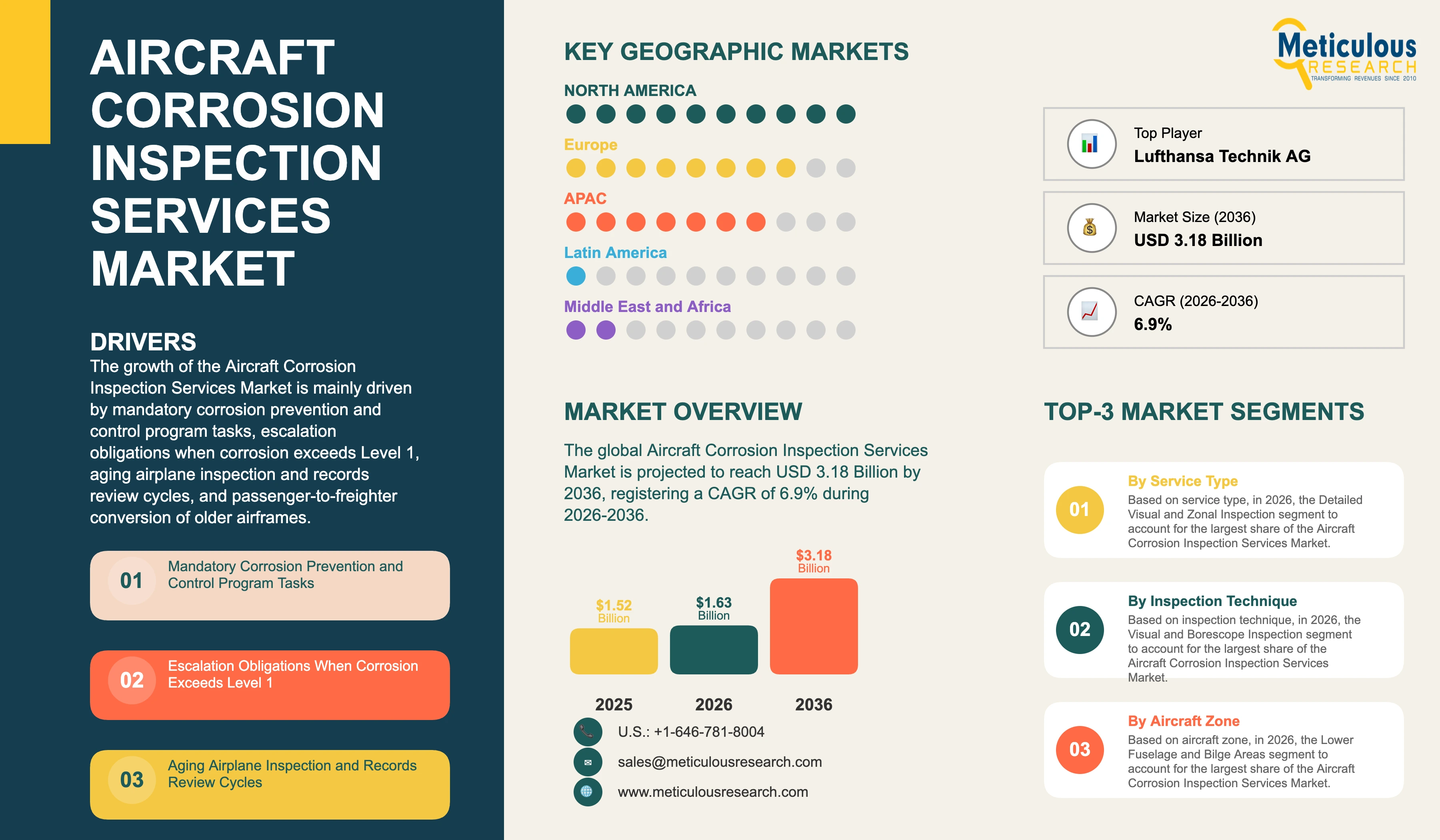
The global Aircraft Corrosion Inspection Services Market was valued at USD 1.52 billion in 2025. This market is expected to reach USD 3.18 billion by 2036 from an estimated USD 1.63 billion in 2026, registering a CAGR of 6.9% during the forecast period (2026-2036).
- Published
- Nov 2026
- Pages
- 265
- Format
- PDF + Excel
- Report ID
- MRAD - 1042849
- Base year
- 2025
- 2025 · BASELINE
- $1.52B
- 2036
- $3.18B
- CAGR 2026–2036
- 6.9%
2025 baseline · 2026–2036 forecast at 6.9% CAGR · hover a bar for the value
Key highlights
The global Aircraft Corrosion Inspection Services Market is projected to reach USD 3.18 billion by 2036, driven by mandatory corrosion prevention and control program tasks, escalation obligations when corrosion exceeds Level 1, aging airplane inspection and records review cycles, and passenger-to-freighter conversion of older airframes.
North America is expected to account for the largest market share in 2026 and is also projected to register the fastest growth during the forecast period, supported by the size of the installed fleet operated under corrosion prevention and control program requirements in the region, together with the concentration of heavy maintenance and nondestructive inspection capacity serving it.
By service type, Detailed Visual and Zonal Inspection are expected to account for the largest market share, whereas Corrosion Mapping and Structural Condition Survey are projected to witness the fastest growth through 2036.
By inspection technique, Visual and Borescope Inspection are expected to account for the largest market share, whereas Thermographic and Emerging Methods are projected to witness the fastest growth through 2036.
By aircraft zone, Lower Fuselage and Bilge Areas are expected to account for the largest market share, whereas Wing Structure and Fuel Tanks are projected to witness the fastest growth through 2036.
A corrosion prevention and control program is defined by the United States authority as a program designed to control corrosion so that damage does not exceed Level 1, with a baseline program comprising corrosion control tasks, definitions of corrosion levels, compliance times and procedures to modify the program when corrosion exceeds Level 1.
Level 1 corrosion covers local damage found between successive inspections that can be reworked or blended out within manufacturer or authority limits, damage beyond those limits attributable to an event not typical of fleet usage, and light corrosion over several years where cumulative blend-outs now exceed allowable limits.
Where corrosion exceeds Level 1 the operator must notify the authority and implement an approved means of reducing future findings in that area to Level 1 or better, which converts a single finding into a program change.
An implementation threshold is the airplane age in years since initial issuance of the certificate of airworthiness at which the program is applied in a given area, and a repeat interval is the calendar time between successive corrosion task accomplishments.
A typical corrosion control task covers removing equipment and interior furnishings for access, cleaning, inspecting all areas visually or nondestructively, removing corrosion, evaluating and repairing damage, unblocking drainage holes, applying corrosion preventive compounds and reinstalling dry insulation blankets.
Aging airplane inspections and records reviews apply to airplanes operated under Part 121 and repeat at intervals not exceeding seven years, with the operator notifying the authority at least 60 days before the airplane and its records are made available.
That review requires records covering total years in service, airframe time and flight cycles, life-limited part status, airworthiness directive status, a list of major structural alterations and a report of major structural repairs with their current inspection status.
Supplemental inspection requirements effective after 20 December 2010 add damage-tolerance-based inspections for fatigue critical structure on transport category turbine-powered airplanes type certificated after 1 January 1958 with 30 or more passenger seats or 7,500 pounds or more of payload capacity.
The annual cost of corrosion across United States defense equipment and infrastructure was put at USD 20.6 billion for fiscal year 2016 in a government accountability review published in November 2018, which frames the scale of military inspection and mitigation demand.
Report summary
| Particulars | Details |
|---|---|
| Forecast Period | 2026-2036 |
| Base Year | 2025 |
| Estimated Year | 2026 |
| CAGR (Value) | 6.9% |
| Format | PDF, Excel & Cloud Portal · 265 pages |
| CAGR (Volume) | 4.3% |
| Market Size (Value) in 2026 | USD 1.63 billion |
| Market Size (Value) in 2036 | USD 3.18 billion |
| Market Size (Volume) in 2026 | 31,500 corrosion inspection events |
| Market Size (Volume) in 2036 | 48,200 corrosion inspection events |
| Average Selling Price, 2026 | USD 51,750 per inspection |
| Average Selling Price, 2036 | USD 66,000 per inspection |
| Segments Covered | By Service Type: Detailed Visual and Zonal Inspection, Nondestructive Inspection and Measurement, Corrosion Mapping and Structural Condition Survey, Treatment, Rework and Protective Coating Application, Program Management and Regulatory Reporting. By Inspection Technique: Visual and Borescope Inspection, Eddy Current Inspection, Ultrasonic Inspection, Radiographic Inspection, Thermographic and Emerging Methods. By Aircraft Zone: Lower Fuselage and Bilge Areas, Fuselage Lap Joints and Skin, Wing Structure and Fuel Tanks, Landing Gear Bays and Wheel Wells, Galley, Lavatory and Cargo Floor Areas, Empennage and Control Surfaces, Engine Pylons and Nacelles. By Operator Type: Commercial Passenger Airlines, Cargo Operators, Military and Government Operators, Lessors and Asset Managers, Business and General Aviation. |
| Countries Covered | U.S.; Canada; Germany; France; U.K.; Italy; China; Japan; India; South Korea; Mexico; Brazil |
| Key Companies | Lufthansa Technik AG, Air France-KLM S.A., ST Engineering Ltd, AAR Corp., Mistras Group, Inc., Delta Air Lines, Inc., and The Boeing Company |
Report overview
Segments covered: service type, inspection technique, aircraft zone, operator type.
In volume terms, the market is estimated at 31,500 corrosion inspection events in 2026 and is expected to reach 48,200 corrosion inspection events by 2036, registering a CAGR of 4.3% during the forecast period. The average selling price is estimated at USD 51,750 per inspection in 2026 and USD 66,000 per inspection in 2036.
The growth of this market is mainly driven by mandatory corrosion prevention and control program tasks that must hold corrosion damage at or below Level 1, escalation obligations that require notifying the authority when findings exceed Level 1, aging airplane inspection and records review cycles repeating at intervals not exceeding seven years, fleet retention and deferred replacement, and passenger-to-freighter conversion of older airframes. However, factors such as access cost and downtime within heavy maintenance visits, certified inspector availability, operator reluctance to expand inspection scope beyond the required tasks, and the difficulty of detecting hidden and inaccessible corrosion are expected to restrain the growth of this market to some extent.
Among aircraft zones, Lower Fuselage and Bilge Areas are expected to account for the largest market share in 2026, while Wing Structure and Fuel Tanks are projected to register the highest CAGR during the forecast period. Geographically, North America is expected to account for the largest share of this market in 2026 and is also expected to register the highest CAGR during the forecast period.
The Aircraft Corrosion Inspection Services Market comprises services that detect, measure, record and treat corrosion on aircraft structure and systems, measured at the point of sale by service providers with volume expressed as corrosion inspection events. The market covers detailed visual and zonal inspection, nondestructive inspection and measurement, corrosion mapping and structural condition survey, treatment, rework and protective coating application, and program management and regulatory reporting, performed through visual and borescope inspection, eddy current, ultrasonic, radiographic and thermographic and emerging methods, across lower fuselage and bilge areas, fuselage lap joints and skin, wing structure and fuel tanks, landing gear bays and wheel wells, galley, lavatory and cargo floor areas, empennage and control surfaces and engine pylons and nacelles, bought by commercial passenger airlines, cargo operators, military and government operators, lessors and asset managers and business and general aviation. Structural repair and modification work beyond corrosion removal and treatment, airframe heavy maintenance labor outside the corrosion tasks, coating and sealant manufacture, and engine internal inspection fall outside the scope.
Demand here is created by a regulatory objective rather than by a condition. A corrosion prevention and control program is defined as a program designed to control corrosion so that damage does not exceed Level 1, and a baseline program comprises corrosion control tasks, definitions of corrosion levels, compliance times and procedures to modify the program when corrosion exceeds Level 1. The inspection therefore recurs whether or not corrosion is present, because the program exists to demonstrate that it is not.
Findings beyond Level 1 generate a second and larger layer of work. The operator must notify the authority and implement an approved means of reducing future findings in that area to Level 1 or better, so a single finding produces a program change rather than a repair alone. Corrosion Mapping and Structural Condition Survey is projected to be the fastest-growing service type in this market at 9.8% because establishing the extent of a finding and the condition of the surrounding structure is what an approved remedy has to be built on.
Access rather than detection consumes the cost. A typical corrosion control task covers removing equipment and interior furnishings for access, cleaning, inspecting all areas visually or nondestructively, removing corrosion, evaluating and repairing damage, unblocking drainage holes, applying corrosion preventive compounds and reinstalling dry insulation blankets. Detailed Visual and Zonal Inspection holds the largest service share of this market in 2026 on that basis, and the same access requirement is why corrosion work sits inside heavy maintenance visits rather than being scheduled on its own.
Program obligations compound with aircraft age across several rules at once. Aging airplane inspections and records reviews repeat at intervals not exceeding seven years with 60 days advance notification and require records covering airframe time, flight cycles, airworthiness directive status, major structural alterations and a report of major structural repairs with their current inspection status. Supplemental inspection requirements effective after 20 December 2010 add damage-tolerance-based inspections for fatigue critical structure on transport category turbine-powered airplanes type certificated after 1 January 1958 carrying 30 or more seats or 7,500 pounds or more of payload.
Older airframes moving into cargo service extend that exposure rather than ending it. Cargo Operators is projected to be the fastest-growing operator type in this market at 9.6%, as passenger airframes converted to freighters re-enter intensive service at an age when implementation thresholds in most zones have long passed and repeat intervals are at their shortest. Military demand sits alongside that, against an annual corrosion cost across United States defense equipment and infrastructure put at USD 20.6 billion for fiscal year 2016 in a government review published in November 2018.
North America is expected to account for the largest share of this market in 2026, supported by the size of the commercial fleet operated under corrosion prevention and control program requirements, aging airplane review cycles and supplemental structural inspection rules within one regulatory framework, together with military demand against an annual defense corrosion cost put at USD 20.6 billion for fiscal year 2016.
Europe is projected to grow at 6.0% and holds the second largest regional position in this market in 2026. Operators carry equivalent continuing airworthiness obligations under their own authority, with corrosion tasks performed within scheduled base maintenance and structural condition recorded through the continuing airworthiness management organization. Germany grows at 6.4% as the base of the largest independent provider of airframe and component maintenance, while France, the United Kingdom and Italy carry both airline maintenance divisions and independent nondestructive inspection capability serving operators across the region.
The Middle East & Africa region is projected to grow at 7.4%, where high ambient temperature, humidity and airborne salt and sand at Gulf and coastal African bases accelerate corrosion so that findings incidence per inspection is higher at equivalent airframe age, with Gulf carriers holding substantial in-house structural capability while African operators with older mixed fleets depend on external providers. Latin America is projected to grow at 6.8%, with Mexico taking a growing share through heavy maintenance capacity where labor cost makes the access-heavy portion of the task economic, and coastal operating environments across the region shortening effective repeat intervals.
Some of the key players operating in the aircraft corrosion inspection services market are Lufthansa Technik AG, Air France-KLM S.A., ST Engineering Ltd, AAR Corp., Mistras Group, Inc., Delta Air Lines, Inc., and The Boeing Company, among others.
Key strategies include bundling treatment and protective compound application with inspection inside one access window, since the marginal cost of treatment with a zone open is small against the cost of opening it again; developing corrosion mapping capability that supports the approval submission an operator must make after a finding above Level 1, with that service growing at 9.8%; adopting area-coverage techniques including thermography and pulsed eddy current that reduce disassembly, growing at 11.2%; locating capacity where heavy maintenance visits are performed, since the work follows the base visit; and recording findings as structured condition data that later inspections measure change against.
Report infographic
Market dynamics
19 factors across 4 forcesMandatory Corrosion Prevention and Control Program Tasks
A corrosion prevention and control program is defined as a program designed to control corrosion so that damage does not exceed Level 1, and a baseline program comprises corrosion control tasks, definitions of corrosion levels, compliance times and procedures to modify the program when corrosion exceeds Level 1. An implementation threshold is the airplane age in years since initial issuance of the certificate of airworthiness at which the program applies in a given area, and a repeat interval is the calendar time between successive task accomplishments. Because the task is scheduled against age and interval rather than against evidence of corrosion, the inspection recurs on a clean aircraft exactly as it does on a corroded one. Demand in this market is therefore a function of fleet age distribution rather than of corrosion incidence, which makes it among the more predictable aftermarket service streams.
Escalation Obligations When Corrosion Exceeds Level 1
Where corrosion exceeds Level 1, the operator must notify the authority and implement an approved means of reducing future findings in that area to Level 1 or better. Level 1 itself covers local damage that can be reworked or blended out within manufacturer or authority limits, damage beyond those limits attributable to an event not typical of fleet usage, and light corrosion over several years where cumulative blend-outs now exceed allowable limits. A finding above that threshold therefore commits the operator to a program change rather than to a repair, and the approved remedy must be built on evidence of the extent of the problem. Corrosion Mapping and Structural Condition Survey grows at 9.8% in this market as a direct consequence of that obligation.
Aging Airplane Inspection and Records Review Cycles
Aging airplane inspections and records reviews apply to airplanes operated under Part 121 and repeat at intervals not exceeding seven years, with the operator notifying the authority at least 60 days in advance and making the airplane available in a specified condition together with records of total years in service, airframe time and flight cycles, life-limited part status, airworthiness directive status, major structural alterations and a report of major structural repairs with their current inspection status. Preparing for that review means establishing the current condition of previously repaired structure, which is where corrosion most often recurs. The seven-year cycle therefore produces inspection demand independent of the corrosion program repeat intervals, and the two obligations are generally satisfied within the same maintenance visit.
Fleet Retention and Deferred Replacement
Aircraft held in service beyond their planned replacement age pass implementation thresholds in more zones and move onto shorter repeat intervals, so the inspection burden per airframe rises with each year of retention. Average revenue per inspection in this market moves from USD 51,750 in 2026 to USD 66,000 in 2036 while inspection volume grows at 4.3% against value at 6.9%. That gap is scope rather than price, because an older airframe requires more zones opened, more nondestructive measurement and more treatment within the same visit. Fleet retention therefore raises the value of this market faster than it raises the number of inspections performed.
Passenger-to-Freighter Conversion of Older Airframes
Cargo Operators is projected to be the fastest-growing operator type in this market at 9.6%. Passenger airframes converted to freighters re-enter intensive service at an age when implementation thresholds in most zones have long passed and repeat intervals are at their shortest, and the conversion itself introduces major structural alterations that must be listed for the aging airplane records review. Cargo floor areas, main deck loading structure and lower lobe compartments also carry different moisture and spillage exposure from passenger configuration. A converted airframe therefore enters service with both a heavier inspection program and a changed corrosion risk profile from the one its original program was written against.
Table of contents
12 chapters · 143 sections · 265 pages · click to expandSegmental analysis
| Segment | Largest share (2026) | Fastest growth (2026–2036) |
|---|---|---|
| By Service Type | Detailed Visual and Zonal Inspection | Corrosion Mapping and Structural Condition Survey |
| By Inspection Technique | Visual and Borescope Inspection | Thermographic and Emerging Methods |
| By Aircraft Zone | Lower Fuselage and Bilge Areas | Wing Structure and Fuel Tanks |
| By Operator Type | Commercial Passenger Airlines | Cargo Operators |
| Other segments | Visual and Borescope Inspection | Thermographic and Emerging Methods |
By Service Type
- Detailed Visual and Zonal Inspection are expected to account for the largest share of the global Aircraft Corrosion Inspection Services Market.
- The large share of this segment is mainly due to the task definition requiring equipment and interior furnishings to be removed, all areas cleaned and inspected and drainage holes unblocked, which makes zonal inspection the labor-bearing element of every corrosion task performed on schedule.
- However, Corrosion Mapping and Structural Condition Survey are projected to register the highest CAGR during the forecast period.
- The rapid growth of this segment is attributed to the obligation on an operator finding corrosion beyond Level 1 to notify the authority and implement an approved means of reducing future findings in that area, which requires the extent of the condition established across the zone rather than at the point of the finding.
- Detailed Visual and Zonal Inspection are expected to account for the largest market share in 2026.
- Corrosion Mapping and Structural Condition Survey are projected to register the highest CAGR during the forecast period, owing to the obligation on an operator finding corrosion beyond Level 1 to notify the authority and implement an approved means of reducing future findings in that area, which requires the extent of the condition established across the zone rather than at the point of the finding.
- Wing Structure and Fuel Tanks are projected to register the highest CAGR during the forecast period, owing to microbiological growth in water accumulated at tank low points attacking structure and coatings from inside a zone that cannot be inspected without defueling and entry, which makes the task costly to schedule and easy to defer.
- Cargo Operators are projected to register the highest CAGR during the forecast period, owing to converted passenger airframes re-entering intensive service at an age when implementation thresholds in most zones have passed and repeat intervals are shortest, with conversion itself introducing major structural alterations that enter the records review.
By Inspection Technique
- Visual and Borescope Inspection are expected to account for the largest market share.
- The large share of this segment is mainly due to the specification of visual inspection as the default method across the majority of corrosion tasks once a zone has been opened and cleaned, supported by borescope access to areas that cannot be reached directly.
- However, Thermographic and Emerging Methods are projected to register the highest CAGR during the forecast period.
- The rapid growth of this segment is attributed to the coverage of area rather than points by infrared thermography, shearography and pulsed eddy current, which reduces the disassembly required and therefore attacks access cost rather than inspection cost.
By Aircraft Zone
- Lower Fuselage and Bilge Areas are expected to account for the largest market share.
- The large share of this segment is mainly due to the accumulation of condensation and spillage at the lowest points of the airframe, which produces the shortest repeat intervals and the highest incidence of findings requiring blend-out within manufacturer limits.
- However, Wing Structure and Fuel Tanks are projected to register the highest CAGR during the forecast period.
- The rapid growth of this segment is attributed to microbiological growth in water accumulated at tank low points attacking structure and coatings from inside a zone that cannot be inspected without defueling and entry, which makes the task costly to schedule and easy to defer.
By Operator Type
- Commercial Passenger Airlines are expected to account for the largest market share.
- The large share of this segment is mainly due to the size of the passenger fleet operated under corrosion prevention and control program requirements and aging airplane review cycles repeating at intervals not exceeding seven years, which sets the base volume of scheduled corrosion tasks.
- However, Cargo Operators are projected to register the highest CAGR during the forecast period.
- The rapid growth of this segment is attributed to converted passenger airframes re-entering intensive service at an age when implementation thresholds in most zones have passed and repeat intervals are shortest, with conversion itself introducing major structural alterations that enter the records review.
Other segments
- Visual and Borescope Inspection are expected to account for the largest market share in 2026.
- Thermographic and Emerging Methods are projected to register the highest CAGR during the forecast period, owing to the coverage of area rather than points by infrared thermography, shearography and pulsed eddy current, which reduces the disassembly required and therefore attacks access cost rather than inspection cost.
- Lower Fuselage and Bilge Areas are expected to account for the largest market share in 2026.
- Commercial Passenger Airlines are expected to account for the largest market share in 2026.
Geographic analysis
Asia-Pacific
Fastest growthAsia-Pacific is projected to be the fastest-growing region in this market at 9.0%, with India the fastest-growing country at 11.6%. Heavy maintenance capacity being added in the region captures corrosion work because the task requires the aircraft to be opened, so it follows the base visit rather than being sourced separately. Providers establishing nondestructive inspection capability alongside that capacity serve both regional operators and airframes positioned there for checks. India is projected to be the fastest-growing country at 11.6%, where fleet growth and the establishment of heavy maintenance capacity are occurring together so that corrosion work performed inside base visits is being captured locally rather than sent abroad. China holds the largest regional fleet and an expanding maintenance base. Japan is projected to be the slowest-growing country at 3.4%, where fleets are comparatively young and operator maintenance organizations hold the work in house, and South Korea and Southeast Asian providers serve both regional and visiting airframes. Asia-Pacific is projected to register the highest CAGR at 9.0%, as fleet growth and the establishment of heavy maintenance capacity occur together so that corrosion tasks performed inside base visits are captured regionally rather than sent abroad, with India projected to be the fastest-growing country at 11.6%. Asia-Pacific Heavy Maintenance Capacity Growth Geographic Analysis
North America
Largest shareNorth America is expected to account for the largest share of this market in 2026 and is projected to grow at 6.2%. The corrosion prevention and control program framework, the Level 1 classification and the notification obligation above it apply to the largest commercial fleet operated under one authority, alongside aging airplane inspections and records reviews repeating at intervals not exceeding seven years and supplemental inspection requirements effective after 20 December 2010. Military demand sits alongside commercial work against an annual corrosion cost across defense equipment and infrastructure put at USD 20.6 billion for fiscal year 2016. Canadian demand follows operator fleets and the maintenance base serving them. Mexico accounts for a growing share through heavy maintenance capacity serving both domestic carriers and operators from further north, where labor cost makes the access-heavy portion of the corrosion task economic to perform. Brazilian demand follows mainline and regional fleets together with a domestic maintenance base. Coastal operating environments across the region raise findings incidence relative to inland fleets of comparable age, which shortens effective repeat intervals.
Europe
Europe is projected to grow at 6.0% and holds the second largest regional position in this market in 2026. Operators carry equivalent continuing airworthiness obligations under their own authority, with corrosion tasks performed within scheduled base maintenance and structural condition recorded through the continuing airworthiness management organization. Germany grows at 6.4% as the base of the largest independent provider of airframe and component maintenance, while France, the United Kingdom and Italy carry both airline maintenance divisions and independent nondestructive inspection capability serving operators across the region.
Latin America
Latin America is projected to grow at 6.8%.
Middle East & Africa
The Middle East & Africa region is projected to grow at 7.4%. High ambient temperature, humidity and airborne salt and sand at Gulf and coastal African bases accelerate corrosion relative to temperate operations, so findings incidence per inspection is higher at equivalent airframe age. Gulf carriers hold substantial in-house structural capability while African operators with older mixed fleets depend on external providers, and the region also holds maintenance hubs where visiting airframes are inspected alongside resident fleets.
Competitive landscape
The global Aircraft Corrosion Inspection Services Market is fragmented, with competition among airline affiliated maintenance divisions, independent airframe maintenance providers and specialist nondestructive inspection companies. Market participants compete primarily on nondestructive inspection method coverage and personnel qualification, turnaround time within a base visit, authority approvals held, consistency of corrosion level classification, and labor cost at the inspection location.
bundling treatment and protective compound application with inspection inside one access window, developing corrosion mapping capability that supports approval submissions, adopting area-coverage techniques that reduce disassembly, locating capacity where heavy maintenance visits are performed, and recording findings as structured condition data that future inspections measure against
The report provides a comprehensive competitive assessment of the leading companies operating in the global Aircraft Corrosion Inspection Services Market. The key players profiled in the report include Lufthansa Technik AG (Germany), Air France-KLM S.A. (France), ST Engineering Ltd (Singapore), AAR Corp. (U.S.), Mistras Group, Inc. (U.S.), Delta Air Lines, Inc. (U.S.), and The Boeing Company (U.S.).
- Lufthansa Technik AG
- Air France-KLM S.A.
- ST Engineering Ltd
- AAR Corp.
- Mistras Group, Inc.
- Delta Air Lines, Inc.
- Boeing Company
Expert perspectives
A corrosion prevention and control program exists to hold damage at or below Level 1, which means the inspection is performed to demonstrate absence rather than to find something. Demand in this market therefore tracks fleet age distribution and repeat intervals rather than corrosion incidence, and it is among the more forecastable aftermarket streams for that reason. The implementation threshold measured from initial issuance of the certificate of airworthiness is the variable that matters, not the operating environment.
An operator that inspects beyond the required tasks and records a finding above Level 1 must notify the authority and implement an approved means of reducing future findings in that area to Level 1 or better, so looking harder carries a cost that looking only as far as the program requires does not. Providers offering additional survey work are selling against that incentive, which is why Corrosion Mapping and Structural Condition Survey grows at 9.8% from findings already made rather than from voluntary scope expansion.
The task sequence requires equipment and interior furnishings removed, surfaces cleaned, drainage holes unblocked, compounds applied and insulation reinstalled, with inspection a small part of the whole, so cost sits in access rather than in measurement and the methods gaining ground reflect that, with Thermographic and Emerging Methods growing at 11.2% alongside robotic and remote scanning. Value per inspection rises from USD 51,750 in 2026 to USD 66,000 in 2036 against inspection volume growth of 4.3%, and that gap is scope on older airframes rather than rate increase.
Customer perspectives
“The program is written to keep everything at Level 1, so most of what we pay for is proving there is nothing there. The moment something is classified above Level 1 the cost changes completely, because we are then notifying the authority and committing to a fixed program change for that area. That is the number that worries our planners, not the inspection itself.”
“Nobody is paying us for the eddy current probe, they are paying us for the three days it takes to get to the structure and the three days to put the aircraft back together. Anything that lets us see through a floor panel or a sealed joint without taking it apart changes the quote more than any new detection method would.”
“Our airframes come to us already past most of the implementation thresholds, so we inherit the heaviest version of the program from day one. The conversion also changes where moisture ends up, and the original program was not written for a main deck full of containers. We treat the first few checks as finding out what we actually bought.”
Frequently asked questions
The global Aircraft Corrosion Inspection Services Market is estimated at USD 1.63 billion in 2026.
The market is projected to reach USD 3.18 billion by 2036.
The market is expected to grow at a CAGR of 6.9% during 2026-2036.
Growth is driven by mandatory corrosion prevention and control program tasks, escalation obligations when a finding exceeds Level 1, and aging airplane inspections and records reviews repeating at intervals not exceeding seven years. Fleet retention and passenger-to-freighter conversion, with cargo operators growing at 9.6%, also contribute.
A corrosion prevention and control program is defined as a program designed to control corrosion so that damage does not exceed Level 1. Where corrosion exceeds Level 1, the operator must notify the authority and implement an approved means of reducing future findings in that area to Level 1 or better.
A typical task covers removing equipment and interior furnishings for access, cleaning, inspecting visually or by nondestructive methods, removing corrosion, evaluating and repairing damage, unblocking drainage holes, applying corrosion preventive compounds and reinstalling dry insulation blankets. The inspection is a small part of that sequence, so corrosion work is performed inside heavy maintenance visits.
Aging airplane inspections and records reviews apply to airplanes operated under Part 121 and repeat at intervals not exceeding seven years, with the authority notified at least 60 days in advance. Supplemental inspection requirements effective after 20 December 2010 add damage-tolerance-based inspections for fatigue critical structure.
The principal challenges are access cost and downtime, certified inspector availability, operator reluctance to inspect beyond required tasks, and detection of hidden corrosion, with thermographic and emerging methods growing at 11.2% in response. Repeatability of corrosion level classification between providers on borderline findings is also a challenge.
Emerging technologies include infrared thermography and shearography, pulsed eddy current, ultrasonic phased array inspection, computed radiographic methods, and robotic crawlers, drone-mounted sensors and automated scanning. Each addresses access rather than detection sensitivity, and thermographic and emerging methods grow at 11.2%.
A corrosion prevention and control program must control corrosion so that damage does not exceed Level 1, and findings above Level 1 require notification to the authority and an approved means of reducing future findings. Aging airplane reviews repeat at intervals not exceeding seven years, supplemental inspection requirements effective after 20 December 2010 add damage-tolerance-based inspections, and nondestructive inspection personnel must hold qualification by method and level.
Detailed Visual and Zonal Inspection are expected to account for the largest market share in 2026.
Corrosion Mapping and Structural Condition Survey are projected to register the highest CAGR during the forecast period. This is owing to the obligation on an operator finding corrosion beyond Level 1 to implement an approved means of reducing future findings, which requires the extent of the condition established across the zone.
Visual and Borescope Inspection are expected to account for the largest market share in 2026.
Thermographic and Emerging Methods are projected to register the highest CAGR during the forecast period. This is owing to the coverage of area rather than points by infrared thermography, shearography and pulsed eddy current, which reduces the disassembly required.
Lower Fuselage and Bilge Areas are expected to account for the largest market share in 2026.
Wing Structure and Fuel Tanks are projected to register the highest CAGR during the forecast period. This is owing to microbiological growth in water accumulated at tank low points, in a zone that cannot be inspected without defueling and entry.
Commercial Passenger Airlines are expected to account for the largest market share in 2026.
Cargo Operators are projected to register the highest CAGR during the forecast period. This is owing to converted passenger airframes re-entering intensive service at an age when implementation thresholds have passed and repeat intervals are shortest.
North America is expected to account for the largest share of this market in 2026, supported by the size of the commercial fleet operated under corrosion prevention and control program requirements. Military demand against an annual defense corrosion cost put at USD 20.6 billion for fiscal year 2016 also contributes.
Asia-Pacific is projected to register the highest CAGR at 9.0%, as fleet growth and heavy maintenance capacity are established together and corrosion tasks are captured regionally. India is projected to be the fastest-growing country at 11.6%.
Europe is projected to grow at 6.0% and holds the second largest regional position in this market in 2026. Germany grows at 6.4% as the base of the largest independent provider of airframe and component maintenance.
The Middle East & Africa region is projected to grow at 7.4%, where high temperature, humidity and airborne salt and sand accelerate corrosion. Latin America is projected to grow at 6.8%, with Mexico taking a growing share through heavy maintenance capacity.
Some of the key players are Lufthansa Technik AG, Air France-KLM S.A., ST Engineering Ltd, AAR Corp., Mistras Group, Inc., Delta Air Lines, Inc., and The Boeing Company, among others.
Key strategies include bundling treatment and protective compound application with inspection inside one access window, and developing corrosion mapping capability that supports approval submissions. Others are adopting area-coverage techniques that reduce disassembly, locating capacity where heavy maintenance visits are performed, and recording findings as structured condition data.
Cite this report
Meticulous Research. (2026). Aircraft Corrosion Inspection Services Market - Global Opportunity Analysis and Industry Forecast (2026-2036) (Report No. MRAD - 1042849). Meticulous Market Research Pvt. Ltd. https://www.meticulousresearch.com/product/aircraft-corrosion-inspection-services-market-7532