
Air Conditioners Market (2026-2036)
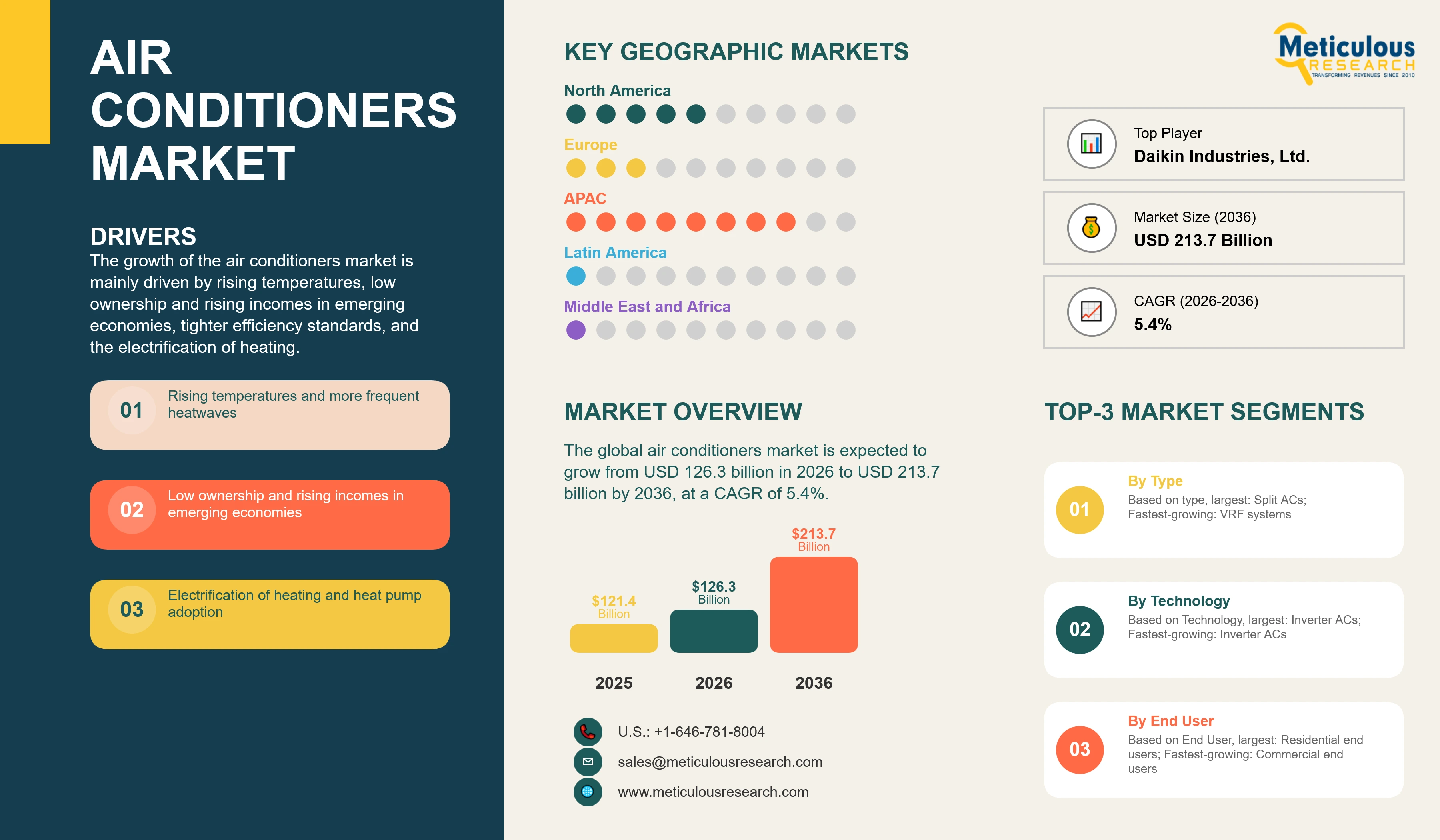
The global air conditioners market was valued at USD 121.4 billion in 2025. This market is expected to reach USD 213.7 billion by 2036 from an estimated USD 126.3 billion in 2026, registering a CAGR of 5.4% during the forecast period (2026-2036). In terms of volume, the market is expected to grow from 151.0 million units in 2026 to 211.0 million units by 2036, at a CAGR of 3.4%.
- Published
- Nov 2026
- Pages
- 310
- Format
- PDF + Excel
- Report ID
- MRSE - 104700
- Base year
- 2025
- 2025 · BASELINE
- $121.4B
- 2036
- $213.7B
- CAGR 2026–2036
- 5.4%
2025 baseline · 2026–2036 forecast at 5.4% CAGR · hover a bar for the value
Key highlights
According to the Japan Refrigeration and Air Conditioning Industry Association (JRAIA), world air conditioner demand reached about 139.8 million units in 2025, up 6% from about 131.6 million units in 2024. China alone accounted for about 57.1 million units, or roughly 41% of world demand.
The International Energy Agency (IEA) estimates that electricity demand for space cooling has risen by about 50% since 2015 to around 2,900 TWh. Cooling represents about 10% of annual electricity use but about 30% of peak electricity demand, and it generated about 1,400 GW of peak demand in 2025.
The World Meteorological Organization (WMO) confirmed 2024 as the warmest year on record, at about 1.55 °C above the 1850-1900 average, and the ten years from 2015 to 2024 were the ten warmest on record, which is raising the need for cooling in homes and workplaces.
Refrigerant rules are reshaping product lines. In the U.S., new residential and light commercial air conditioners and heat pumps made from January 1, 2025 must use refrigerants with a GWP below 700, moving the market from R-410A to R-454B and R-32. In the EU, Regulation (EU) 2024/573 bans F-gases with a GWP of 150 or more in small (up to 12 kW) split air-to-air systems from 2029 and all F-gases in these systems from 2035.
India is one of the fastest-growing volume markets. ICRA reports that room air conditioner sales reached a record 12.5-13.0 million units in FY2025, and that domestic manufacturing capacity of 24-26 million units is projected to reach 40-42 million units by 2030, supported by the Production-Linked Incentive (PLI) scheme.
The industry is consolidating. Bosch completed its USD 8 billion acquisition of Johnson Controls' residential and light commercial HVAC business and the Johnson Controls-Hitachi Air Conditioning joint venture on July 31, 2025, and Fujitsu General joined the Paloma Rheem group in August 2025.
By type, split ACs account for the largest share of 48.0% in 2026, while VRF systems register the highest CAGR.
By function, reversible (heat pump) ACs account for the larger share of 57.5% in 2026 and also register the higher CAGR.
By technology, inverter ACs account for the larger share of 74.5% in 2026 and also register the higher CAGR.
By refrigerant, R-32 accounts for the largest share of 47.5% in 2026, while R-290 (propane) registers the highest CAGR.
By end user, residential end users account for the largest share of 62.0% in 2026, while commercial end users register the highest CAGR.
By geography, Asia-Pacific accounts for the largest share of 54.5% in 2026, while the Middle East & Africa registers the highest CAGR of 7.3%.
Report summary
| Particulars | Details |
|---|---|
| Base Year | 2025 |
| Estimated Year | 2026 |
| Forecast Period | 2026-2036 |
| Market Size in 2025 | USD 121.4 billion |
| Market Size in 2026 | USD 126.3 billion |
| Market Size by 2036 | USD 213.7 billion |
| CAGR (2026-2036) | 5.4% |
| Format | PDF, Excel & Cloud Portal · 310 pages |
| Market Volume in 2026 | 151.0 million units |
| Market Volume by 2036 | 211.0 million units (CAGR 3.4%) |
| Largest Segment by Type (2026) | Split ACs (48.0%) |
| Largest Segment by End User (2026) | Residential End Users (62.0%) |
| Largest Region (2026) | Asia-Pacific (54.5%) |
| Fastest-Growing Region | Middle East & Africa (CAGR 7.3%) |
| Companies Profiled | 20 companies and other companies |
| Segments Covered | Type, Function, Tonnage, Technology, Refrigerant Type, Energy Efficiency Class, Connectivity, Distribution Channel, End User, Geography |
| Countries Covered | U.S., Canada, Germany, Italy, Spain, France, U.K., Netherlands, Poland, Türkiye, Sweden, Belgium, Switzerland, Rest of Europe, China, Japan, India, South Korea, Australia, Indonesia, Vietnam, Thailand, Philippines, Malaysia, Singapore, Rest of Asia-Pacific, Brazil, Mexico, Argentina, Chile, Rest of Latin America, Saudi Arabia, U.A.E., Egypt, South Africa, Rest of Middle East & Africa |
Report overview
Segments covered: type, function, tonnage, technology, refrigerant type, energy efficiency class, connectivity, distribution channel, end user, refrigerant.
The growth of this market is mainly driven by rising temperatures and more frequent heatwaves, low air conditioner ownership and rising incomes in emerging economies such as India, Indonesia, Vietnam, Saudi Arabia, and Nigeria, urbanization and growth in residential and commercial construction, tighter energy-efficiency standards that speed up the replacement of older units, and the electrification of space heating, which is boosting demand for reversible heat pump air conditioners. However, factors such as high upfront purchase and installation costs, pressure on electricity grids during peak demand, the cost and complexity of the transition to low-GWP refrigerants, and volatile copper, aluminium, and steel prices are expected to restrain the growth of this market to some extent.
Air conditioners are systems that cool, dehumidify, and in many cases heat indoor spaces by moving heat with a refrigerant cycle. This report covers the global revenue earned by manufacturers and brand owners from the sale of split, window, portable, packaged/ducted, and variable refrigerant flow (VRF) air conditioners used in homes, commercial buildings, and industrial facilities. It excludes chillers, automotive air conditioning, precision cooling for data centers, installation labor, and after-sales service.
Air conditioning has become one of the largest consumer and building equipment categories in the world. JRAIA estimates that about 121.6 million residential units and about 18.2 million commercial units, including packaged air conditioners and VRF systems, were sold worldwide in 2025. Single-split room air conditioners make up the bulk of residential demand, while ducted unitary systems dominate in the U.S. and VRF systems are widely used in offices, hotels, and apartment buildings in China, Japan, and the Middle East.
Demand is highly concentrated in Asia. China is by far the largest market, and Chinese manufacturers also supply a large share of the units sold in other countries. The IEA estimates that China produces about 170 million air conditioners a year and exports about 60 million. Japan, the U.S., and South Korea have very high household ownership, while most households in India, Southeast Asia, Africa, and parts of Latin America still do not own an air conditioner, even though these regions face many more hot days each year than Europe or North America.
Technology in the market has changed quickly over the past decade. Inverter compressors, which vary their speed to match the cooling load, are now standard in China, Japan, and Europe and are spreading fast in India and Southeast Asia. Reversible heat pump models that can both cool and heat are replacing cooling-only units in cooler climates, and in the U.S. they are gaining share against conventional central air conditioners paired with gas furnaces. Wi-Fi connectivity, app and voice control, air purification, and AI-based comfort settings are becoming common in mid-range and premium models.
The refrigerant transition is the most important regulatory change in the industry. Under the Kigali Amendment to the Montreal Protocol, countries are phasing down HFCs, and the U.S. and the EU have set firm dates to move away from R-410A. Manufacturers have shifted residential products to R-32 and R-454B, while R-290 (propane), a natural refrigerant with very low global warming potential, is gaining ground in small split and portable units, especially in Europe.
The business is shaped by scale manufacturing, distribution networks, and installer relationships. Room air conditioners are sold through electronics retailers, brand stores, and, increasingly, e-commerce platforms, while ducted and VRF systems are sold through HVAC distributors, dealers, and contractors or directly to building developers. Leading companies include Daikin Industries, Midea Group, Gree Electric Appliances, Haier Smart Home, Carrier Global, Mitsubishi Electric, LG Electronics, Samsung Electronics, Panasonic, Robert Bosch, Trane Technologies, and Lennox International.
Over the forecast period, the air conditioners market is expected to grow steadily as more households in hot emerging economies buy their first unit, as older units are replaced with more efficient models, and as heat pump air conditioners take a larger role in heating. Growth in value is expected to outpace growth in volume, as the product mix shifts toward inverter, heat pump, VRF, low-GWP, and connected models with higher prices.
This comment explains why residential end users account for 62.0% of the market, why split ACs account for 48.0% of the market, and why inverter ACs account for 74.5% of the market. It also shows why online and financing-led sales are growing in emerging economies.
This comment explains why the Middle East & Africa is the fastest-growing region and why VRF systems and commercial end users are the fastest-growing type and end user.
This comment shows why reversible heat pump ACs account for the larger share of the market and why R-290 is the fastest-growing refrigerant segment.
Report infographic
Market dynamics
17 factors across 5 forcesRising temperatures and more frequent heatwaves
The most important driver of the air conditioners market is rising heat. The WMO confirmed that 2024 was the warmest year on record, at about 1.55 °C above pre-industrial levels, and that each of the ten years from 2015 to 2024 ranks among the ten warmest. Heatwaves are becoming longer, hotter, and more frequent in South Asia, the Middle East, Southern Europe, and the southern U.S., and nights are warming as well, which makes it harder for homes to cool down without mechanical cooling.
Hot weather has a direct effect on sales. Each unusually hot summer in a major market brings a surge in purchases, and manufacturers in India, Japan, and Southern Europe have reported record or near-record seasons in recent years. Heat is also increasingly seen as a health risk for older people, children, and outdoor workers, which is turning air conditioning from a comfort product into an essential one in many countries.
Low ownership and rising incomes in emerging economies
Large parts of the world's hottest regions still have low air conditioner ownership. The IEA estimates that only about 40% of the global population has access to air conditioning, while more than 80% of people experience cooling needs during at least part of the year. In India, Indonesia, the Philippines, Nigeria, and many other countries, most households do not yet own a unit.
As incomes rise and electricity access improves, these households are becoming first-time buyers. JRAIA estimates that India's residential demand rose from about 7.4 million units in 2022 to about 11.6 million units in 2024, and demand in Vietnam, Indonesia, Saudi Arabia, and other emerging markets has also grown. Lower-priced inverter models, consumer financing, and e-commerce are making air conditioners affordable to a wider range of buyers in smaller cities and towns.
Urbanization and construction activity
Urban growth adds new apartments, offices, shopping malls, hotels, hospitals, and schools, nearly all of which are built with air conditioning in hot and humid climates. Cities also tend to be warmer than surrounding areas because of the urban heat island effect, which further raises cooling needs. Large construction programs in Saudi Arabia, the U.A.E., India, and Southeast Asia are creating strong demand for VRF, packaged, and ducted systems, while developers in China and India increasingly hand over apartments with air conditioning already installed.
Tighter efficiency standards and replacement demand
Governments are raising minimum energy performance standards and tightening energy labels, which pushes buyers toward newer and more efficient models. India's Bureau of Energy Efficiency (BEE) raised the ISEER thresholds for its star ratings from January 1, 2026, so that a model rated 5-star in 2025 is now rated 4-star. The U.S. moved to the SEER2 test standard in 2023, and the EU, China, and Japan all have efficiency labeling and minimum standards for air conditioners.
These rules increase the value of each unit sold and encourage the replacement of older, less efficient equipment. A large installed base of units that are more than ten years old in China, Japan, the U.S., and Europe provides a steady stream of replacement demand, which also makes the market less dependent on new construction.
Electrification of heating and heat pump adoption
Reversible air conditioners that work as air-to-air heat pumps can provide efficient heating as well as cooling. As governments in Europe, North America, and parts of Asia seek to reduce fossil fuel use in buildings, heat pumps are increasingly replacing gas and oil heating. In the U.S., AHRI data show that air-source heat pump shipments reached about 3.6 million units in 2025, close to the roughly 4.1 million central air conditioners shipped, although both declined from 2024. In Southern and Central Europe, split heat pump air conditioners are a low-cost way for households to add both cooling and efficient heating.
Table of contents
17 chapters · 212 sections · 310 pages · click to expandGeographic analysis
Asia-Pacific
Largest shareIn 2026, Asia-Pacific is expected to account for the largest share of 54.5% of the global air conditioners market. The large share of this region is mainly due to China, which is the world's largest air conditioner market and production base, with JRAIA estimating demand of about 57.1 million units in 2025. Japan has one of the highest rates of household ownership in the world and demand of about 10.6 million units in 2025, while India, Indonesia, Vietnam, Thailand, and the Philippines are among the fastest-growing markets for first-time buyers. Strong local manufacturers, such as Midea, Gree, Haier, Hisense, AUX, Daikin, Mitsubishi Electric, Panasonic, LG, Samsung, Voltas, and Blue Star, support high product availability and competitive prices. Within Asia-Pacific, India is expected to be one of the fastest-growing countries. JRAIA estimates residential demand in India at about 11.3 million units in 2025, and capacity additions under the PLI scheme, rising incomes, and frequent heatwaves are expected to support strong growth, although unseasonal rain in 2025 reduced sales in that season. Southeast Asian markets are supported by hot and humid climates, urbanization, and manufacturing investment.
North America
North America is the second-largest market, supported by very high air conditioning penetration in the U.S., a large installed base of ducted central air conditioners and heat pumps, and a strong replacement cycle. U.S. shipments of central air conditioners and heat pumps fell in 2025 after strong buying ahead of the refrigerant change in 2024, but the market is expected to recover as inventories normalize and older systems are replaced with R-454B and R-32 equipment. Carrier, Trane Technologies, Lennox, Daikin (Goodman), Bosch, and Rheem are important suppliers.
Europe
Europe is expected to grow steadily as summers become hotter and as air-to-air heat pumps are used for heating. Italy, Spain, France, Greece, and Türkiye are the largest markets for split units, while Germany, the Netherlands, Poland, and Northern Europe are seeing rising adoption from a low base. The F-gas Regulation is expected to accelerate the shift to R-290 and other low-GWP products. Daikin Europe reported record turnover of EUR 5.25 billion for fiscal year 2025.
Middle East & Africa
Fastest growthThe Middle East & Africa is projected to register the highest CAGR of 7.3% during the forecast period. JRAIA estimates that demand in the Middle East grew by about 29% in 2024 and 8% in 2025, supported by extreme summer temperatures, large construction programs in Saudi Arabia and the U.A.E., and strong demand for VRF and packaged systems. Africa has very low ownership but a fast-growing urban middle class in Egypt, Nigeria, South Africa, and Kenya.
Latin America
Latin America is expected to grow steadily, led by Brazil and Mexico, as rising incomes and hot climates support first-time purchases and local manufacturing expands.
Competitive landscape
The global air conditioners market is moderately concentrated, with the top five players estimated to account for about 45% of the market in 2025. The market includes diversified HVAC manufacturers, Chinese and Korean home appliance companies, Japanese electronics and air conditioning specialists, U.S. unitary equipment manufacturers, and regional brands in India and other emerging markets.
Daikin Industries is the leading air conditioning specialist, with net sales of a record JPY 5,015.0 billion in fiscal year 2025, ended March 31, 2026, and a strong position in VRF, ducted, and residential systems across Japan, the U.S., Europe, and Asia. Midea Group, Gree Electric Appliances, and Haier Smart Home lead in China and are expanding quickly overseas. Midea reported 2025 revenue of RMB 458.5 billion, while Gree reported revenue of RMB 170.4 billion, with its consumer appliances business, including air conditioners, at RMB 133.1 billion. AUX Electric, Hisense, and TCL are other major Chinese manufacturers, and AUX listed on the Hong Kong Stock Exchange in September 2025.
Carrier Global, Trane Technologies, Lennox International, Bosch, and Rheem are leading suppliers of ducted unitary systems in North America, while Mitsubishi Electric, Panasonic, Mitsubishi Heavy Industries Thermal Systems, GENERAL Inc. (formerly Fujitsu General), LG Electronics, and Samsung Electronics are strong in split and VRF systems worldwide. In India, Voltas, Blue Star, and Havells (Lloyd) compete with Daikin, LG, Samsung, and Panasonic.
Companies compete on energy efficiency, product reliability, price, brand reputation, distribution and installer networks, after-sales service, refrigerant technology, and smart features. Key strategies include launches of low-GWP and high-efficiency products, capacity expansion in India, Southeast Asia, Mexico, and the Middle East, acquisitions to add brands and channels, and partnerships with distributors, developers, and utilities.
Consolidation is expected to continue, as large groups acquire regional brands and distribution businesses and as smaller manufacturers struggle with the cost of the refrigerant transition and with price competition. Companies that combine scale manufacturing, strong compressor and inverter technology, low-GWP product ranges, and broad installer networks are expected to gain share.
Some of the key players operating in the air conditioners market are Daikin Industries, Ltd., Midea Group Co., Ltd., Gree Electric Appliances, Inc. of Zhuhai, Haier Smart Home Co., Ltd., AUX Electric Co., Ltd., Carrier Global Corporation, Mitsubishi Electric Corporation, LG Electronics Inc., Samsung Electronics Co., Ltd., Panasonic Holdings Corporation, Robert Bosch GmbH, Trane Technologies plc, Lennox International Inc., Mitsubishi Heavy Industries Thermal Systems, Ltd., Hisense Home Appliances Group Co., Ltd., GENERAL Inc., Voltas Limited, Blue Star Limited, Havells India Limited, and AB Electrolux, among others.
- Panasonic
- Mitsubishi Heavy Industries Thermal Systems
- GENERAL Inc. (formerly Fujitsu General)
- LG Electronics
- Samsung Electronics
Expert perspectives
The air conditioners market is moving from a volume story led by China to a broader growth story led by first-time buyers in hot emerging economies, by heat pump adoption in cooler climates, and by the shift to low-GWP refrigerants. We expect value growth to outpace volume growth throughout the forecast period, as buyers trade up to inverter, heat pump, connected, and higher-efficiency models.
Over the forecast period, the market is expected to grow at a CAGR of 5.4%, from USD 126.3 billion in 2026 to USD 213.7 billion in 2036, while volume grows at a CAGR of 3.4%, from 151.0 million units to 211.0 million units. Growth will be supported by rising heat, low ownership in India, Southeast Asia, Africa, and the Middle East, and replacement demand in mature markets, while price competition in China, raw material costs, and grid limits will moderate growth.
Split ACs remain the largest type, while VRF systems grow fastest. Reversible heat pump models and inverter technology already account for most of the market and continue to gain share. R-32 is the largest refrigerant today, but R-290 grows fastest from a small base. Residential end users remain the largest segment, while commercial end users grow fastest. Asia-Pacific remains the largest region, and the Middle East & Africa is the fastest-growing region at a CAGR of 7.3%.
For manufacturers, the key priorities are to secure low-GWP compressor and refrigerant technology, build local production close to high-growth markets, offer affordable inverter models for first-time buyers, invest in installer training and service networks, and use connectivity to build recurring service revenue.
We expect the refrigerant transition to be the main source of competitive change over the next decade. Manufacturers that can deliver safe, efficient R-290 and other low-GWP products at scale will be best placed to win in Europe and in other markets that adopt similar rules, while those that rely on high-GWP products risk losing share as regulations tighten.
Electricity access and grid capacity will remain important factors for growth. Better efficiency standards, time-of-use tariffs, solar integration, and demand response programs can allow more households to use air conditioning without overloading grids, while weak grids will continue to limit adoption in some lower-income countries.
Customer perspectives
Buyers of air conditioners include households, residential developers, commercial building owners and operators, facility managers, HVAC contractors, and industrial users. Their decisions depend mainly on price, energy efficiency and running costs, reliability, brand reputation, installation and service availability, noise, and smart features. The viewpoints below are representative of the buyer groups covered in primary research for this study.
Frequently asked questions
The global air conditioners market was valued at USD 121.4 billion in 2025, up from USD 117.6 billion in 2024, and is estimated at USD 126.3 billion in 2026. The market includes split, window, portable, packaged/ducted, and VRF air conditioners sold for residential, commercial, and industrial use.
Cite this report
Meticulous Research. (2026). Air Conditioners Market - Global Opportunity Analysis and Industry Forecast (2026-2036) (Report No. MRSE - 104700). Meticulous Market Research Pvt. Ltd. https://www.meticulousresearch.com/product/air-conditioners-market-5384