Water Based Pressure Sensitive Adhesives Market (2026-2036)
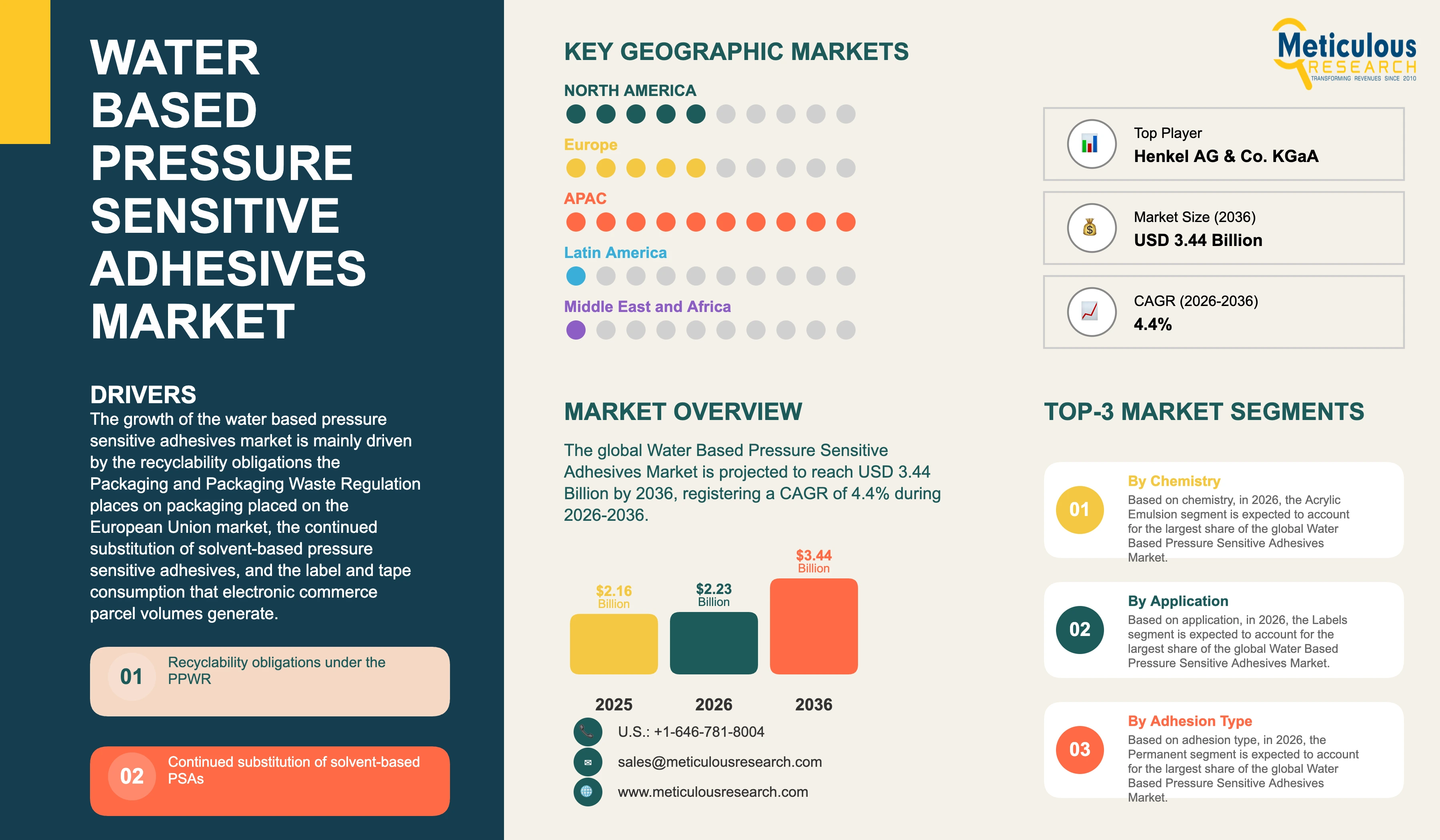
The global water based pressure sensitive adhesives market was valued at USD 2.16 billion in 2025. This market is expected to reach USD 3.44 billion by 2036 from an estimated USD 2.23 billion in 2026, registering a CAGR of 4.4% during the forecast period (2026-2036).
- Published
- Nov 2026
- Pages
- 279
- Format
- PDF + Excel
- Report ID
- MRCHM - 1042658
- Base year
- 2025
- 2025 · BASELINE
- $2.16B
- 2036
- $3.44B
- CAGR 2026–2036
- 4.4%
2025 baseline · 2026–2036 forecast at 4.4% CAGR · hover a bar for the value
Key highlights
The global water based pressure sensitive adhesives market is estimated at USD 2.23 billion in 2026 and is projected to reach USD 3.44 billion by 2036.
Market volume is estimated at 1, 540.00 kilotons in 2026 and is projected to reach 2,508.50 kilotons by 2036 at a CAGR of 5.0%, measured on an as-supplied wet emulsion basis.
The average selling price is estimated at USD 1.45 per kg in 2026 and is projected to reach USD 1.37 per kg by 2036.
Acrylic emulsion is expected to account for the largest chemistry share in 2026, while polyurethane dispersion is projected to register the highest CAGR of 7.8%.
Permanent adhesion is expected to hold the largest adhesion type share in 2026, while removable adhesion is projected to grow fastest at a CAGR of 6.2%.
Labels are expected to be the largest application in 2026, while medical and hygiene applications are projected to register the highest CAGR of 7.0%.
Paper is expected to account for the largest facestock substrate share in 2026, while film is projected to grow fastest at a CAGR of 6.4%.
Food and beverage packaging is expected to be the largest end-use industry in 2026, while logistics and electronic commerce are projected to register the highest CAGR of 6.6%.
Asia-Pacific is expected to hold the largest regional share in 2026 and is also projected to register the highest CAGR of 5.6%.
Regulation (EU) 2025/40, the Packaging and Packaging Waste Regulation, entered into force on 11 February 2025 and applies generally from 12 August 2026.
Under that regulation, recyclability performance grades apply to packaging from 2030.
Packaging must be able to be collected, sorted and recycled at scale when it becomes waste from 2035.
Stricter recyclability obligations apply from 2038 under the same regulation.
The regulation requires all packaging placed on the European Union market to be recyclable, which places label and tape adhesive behaviour in washing and sorting inside the packaging compliance assessment.
Report summary
| Particulars | Details |
|---|---|
| Base Year | 2025 |
| Forecast Period | 2026-2036 |
| Market Size in 2025 | USD 2.16 billion |
| Market Size in 2026 | USD 2.23 billion |
| Market Size by 2036 | USD 3.44 billion |
| Value CAGR (2026-2036) | 4.4% |
| Format | PDF, Excel & Cloud Portal · 279 pages |
| Volume in 2026 | 1,540.00 kilotons |
| Volume by 2036 | 2,508.50 kilotons |
| Volume CAGR (2026-2036) | 5.0% |
| Volume Basis | As-supplied wet emulsion, not dry solids |
| Average Selling Price in 2026 | USD 1.45 per kg |
| Average Selling Price by 2036 | USD 1.37 per kg |
| Measurement Basis | Water based pressure sensitive adhesive supplied to converters and coaters, excluding solvent-based, hot-melt, ultraviolet curable and silicone pressure sensitive adhesives, finished labels, tapes and graphics films, release liners and facestocks, and structural and assembly adhesives |
| Largest Chemistry Segment | Acrylic emulsion |
| Fastest-Growing Chemistry Segment | Polyurethane dispersion (CAGR 7.8%) |
| Largest Adhesion Type | Permanent |
| Fastest-Growing Adhesion Type | Removable (CAGR 6.2%) |
| Largest Application | Labels |
| Fastest-Growing Application | Medical and hygiene (CAGR 7.0%) |
| Largest Facestock Substrate | Paper |
| Fastest-Growing Facestock Substrate | Film (CAGR 6.4%) |
| Largest End-Use Industry | Food and beverage |
| Fastest-Growing End-Use Industry | Logistics and electronic commerce (CAGR 6.6%) |
| Largest Region | Asia-Pacific |
| Fastest-Growing Region | Asia-Pacific (CAGR 5.6%) |
| Segments Covered | Chemistry, Adhesion Type, Application, Facestock Substrate, End-Use Industry, and Geography |
| Geographies Covered | Asia-Pacific, Europe, North America, Latin America, and Middle East & Africa |
| Companies Profiled | 12 companies, including Henkel AG & Co. KGaA, H.B. Fuller Company, Arkema S.A., BASF SE, Avery Dennison Corporation, and Dow Inc. |
Report overview
Segments covered: chemistry, adhesion type, application, facestock substrate, end-use industry.
In volume terms, this market is estimated at 1,540.00 kilotons in 2026 and is projected to reach 2,508.50 kilotons by 2036, registering a CAGR of 5.0% during the same period, measured on an as-supplied wet emulsion basis rather than on dry solids. The average selling price is estimated at USD 1.45 per kg in 2026 and is projected to decline to USD 1.37 per kg by 2036 as acrylic emulsion capacity expands in Asia-Pacific and higher-solids grades reduce the water shipped per kilogram of adhesive delivered.
The growth of this market is mainly driven by the recyclability obligations the Packaging and Packaging Waste Regulation places on packaging placed on the European Union market, the continued substitution of solvent-based pressure sensitive adhesives on volatile organic compound and workplace exposure grounds, the label and tape consumption that electronic commerce parcel volumes generate, and the thin-film facestock conversion that requires adhesives able to coat without curl or bleed. However, factors such as the drying energy that removing water from a coated web consumes against a hot-melt or solvent route, and the wet strength and low-temperature performance limits inherent to an aqueous dispersion, are expected to restrain the growth of this market to some extent.
Acrylic emulsion accounts for the largest share of this market because it provides the ultraviolet stability, ageing resistance and clarity that label and graphics applications require at the lowest cost per kilogram of any water based chemistry. Polyurethane dispersion grows faster because medical, hygiene and specialty film applications require the skin compatibility, elongation and adhesion to low surface energy substrates that an acrylic emulsion cannot deliver.
Water based pressure sensitive adhesives are aqueous polymer dispersions coated onto a facestock and dried, leaving a film that bonds on contact under light pressure without solvent, heat or chemical reaction. Market sizing in this report is on both a value basis in USD and a volume basis in kilotons measured on an as-supplied wet emulsion basis rather than on dry solids, with average selling price derived from the two. The measurement basis is water based pressure sensitive adhesive supplied to converters and coaters, and it excludes solvent-based, hot-melt, ultraviolet curable and silicone pressure sensitive adhesives, finished labels, tapes and graphics films, release liners and facestocks, and structural and assembly adhesives of every kind.
The commercial unit is a dispersion rather than a polymer, and the distinction matters for how the market is measured. An emulsion is supplied at roughly half to three-fifths solids, so the water shipped is part of the delivered weight and part of the freight cost, and a higher-solids grade delivers more adhesive per kilogram without changing the polymer. Price per kilogram as supplied therefore falls as solids rise even where the cost of the adhesive film on the web does not, which is why the as-supplied basis has to be stated rather than assumed.
What the converter buys is a balance between tack, peel and shear that cannot be improved in all three directions at once. Raising tack to improve initial grab softens the film and lowers shear holding power, while raising cohesive strength to hold shear reduces the wet-out that gives a label its initial adhesion on a textured or curved surface. Acrylic emulsions are formulated across that triangle rather than at an optimum, which is why a supplier carries dozens of grades for applications that look similar. Selection follows the facestock, the surface being labelled and the service conditions rather than headline adhesion figures.
Regulation (EU) 2025/40, the Packaging and Packaging Waste Regulation, which entered into force on 11 February 2025 and applies generally from 12 August 2026 has placed the adhesive inside the packaging compliance question for the first time. Recyclability performance grades apply to packaging from 2030, packaging must be able to be collected, sorted and recycled at scale when it becomes waste from 2035, and stricter recyclability obligations apply from 2038. A pressure sensitive label is a small mass fraction of a bottle or tray but its adhesive determines whether the label separates in a wash step and whether residue carries into the recyclate, so the adhesive now bears on how the pack grades rather than only on how the label performs.
That assessment runs on behaviour rather than on composition. An adhesive that releases cleanly in a caustic wash lets a label be removed and the polymer recovered, while one that remains bonded or fragments carries paper fibre and adhesive into the flake stream and depresses the quality of the recyclate. Film labels on film packaging raise a separate question, since the label and the pack can be the same polymer family and sort together only if the adhesive does not interfere. Converters are consequently specifying wash-off and sorting behaviour alongside peel and shear.
Substitution away from solvent-based adhesives continues on grounds that are independent of packaging policy. A solvent-based coating line requires solvent recovery or thermal oxidation, carries fire and workplace exposure controls, and faces volatile organic compound limits at the installation, none of which a water based line requires. The remaining solvent positions are those where water based performance has not matched them, principally high-temperature shear, aggressive plasticiser resistance and adhesion to low surface energy plastics. Each of those gaps closed by formulation converts a position permanently rather than temporarily.
Parcel volume rather than retail activity now drives a substantial part of tape demand. Electronic commerce fulfilment seals cartons with pressure sensitive tape, labels them with pressure sensitive shipping labels, and in many cases applies a second return label, so a single parcel can carry three separate pressure sensitive products. Those applications demand adhesion to recycled corrugated board, which carries more surface dust and lower surface energy than virgin board, at the temperatures a distribution network actually reaches. The requirement has pulled formulation toward higher initial tack on difficult paper surfaces.
Thin-film conversion is the other structural change in the facestock. Label films have been downgauged to reduce material use, and a thinner facestock transmits adhesive behaviour to the surface, so curl, bleed at the die and edge ooze become visible defects where a heavier paper would have concealed them. Clarity matters on a clear-on-clear label in a way it does not on paper, and an emulsion has to dry without haze or surfactant migration to deliver it. Those requirements favour the narrower set of grades formulated for film rather than adapted from paper.
Medical and hygiene applications sit at the opposite end of the specification range. Skin contact adhesives have to adhere reliably to a moving, perspiring surface and release without trauma, which is a different mechanical problem from holding a label on glass, and polyurethane dispersions and specialty acrylics are formulated for it. Those grades carry biocompatibility and extractables evidence that general label grades do not, and the evidence rather than the adhesion is what qualifies them. Volume is small against labels and tapes while value per kilogram is several times higher.
Permanent adhesion is expected to hold the largest share in 2026.
Removable adhesion is projected to register the highest CAGR of 6.2% during the forecast period.
Labels are expected to account for the largest share in 2026.
Medical and hygiene applications are projected to register the highest CAGR of 7.0% during the forecast period.
Paper is expected to hold the largest share in 2026.
Film is projected to register the highest CAGR of 6.4% during the forecast period.
Food and beverage is expected to account for the largest share in 2026.
Logistics and electronic commerce are projected to register the highest CAGR of 6.6% during the forecast period.
Asia-Pacific is expected to account for the largest share in 2026, supported by the label and tape converting capacity concentrated in China, India, Japan and southeast Asia. China is projected to grow at 5.8% and India at 7.8%.
Asia-Pacific is also projected to register the highest CAGR of 5.6% during the forecast period.
Europe is projected to grow at a CAGR of 3.2%, with Germany at 3.0%, and holds the second-largest regional share on a mature converting base with the most complete substitution away from solvent-based coating. The regulatory position is the most consequential of any region, since Regulation (EU) 2025/40 applies from 12 August 2026 with recyclability performance grades from 2030.
The Middle East & Africa is projected to grow at a CAGR of 4.8% from a smaller base as converting capacity is established closer to consumption. Latin America is projected to grow at a CAGR of 4.2%, with Brazil at 4.4% and Mexico at 4.6%.
Henkel AG & Co. KGaA, H.B. Fuller Company, Arkema S.A., BASF SE and Avery Dennison Corporation together accounted for an estimated 48.6% of this market in 2026. The 12 companies profiled in this report together accounted for an estimated 74.5%.
Report infographic
Market dynamics
15 factors across 5 forcesRecyclability Obligations Under the Packaging and Packaging Waste Regulation
Regulation (EU) 2025/40, the Packaging and Packaging Waste Regulation, which entered into force on 11 February 2025 and applies generally from 12 August 2026 requires all packaging placed on the European Union market to be recyclable, applies recyclability performance grades from 2030, requires packaging to be collectable, sortable and recyclable at scale from 2035, and imposes stricter recyclability obligations from 2038. A pressure sensitive label is a small mass fraction of a pack but its adhesive determines whether the label separates in a wash step and whether residue carries into the recyclate, so the adhesive bears on how the pack grades. Converters and brand owners are reformulating label constructions ahead of the 2030 grades rather than after them, because a pack redesign runs on a longer cycle than a regulatory deadline. Demand is consequently shifting toward the wash-off and clean-release grades rather than growing uniformly. The obligation also reaches imported packaging, so a brand owner selling into the European Union reformulates the construction globally rather than maintaining two.
Continued Substitution of Solvent-Based Pressure Sensitive Adhesives
A solvent-based coating line requires solvent recovery or thermal oxidation equipment, fire protection and workplace exposure controls, and operates against volatile organic compound limits at the installation, while a water based line requires none of those. The remaining solvent positions are those where aqueous performance has not matched them, principally high-temperature shear holding, plasticiser resistance and adhesion to low surface energy plastics. Each gap closed by formulation converts a position permanently, since no converter reinstalls solvent handling once it has been removed. The substitution therefore produces one-way volume transfer rather than share that can move back. Converters that removed solvent handling also lost the option of running a solvent grade as a fallback, which raises what they will pay for an aqueous grade that closes a performance gap.
Label and Tape Consumption Generated by Electronic Commerce Parcel Volumes
A single parcel can carry a pressure sensitive carton sealing tape, a shipping label and a return label, so fulfilment volume multiplies pressure sensitive consumption rather than merely tracking it. Those applications bond to recycled corrugated board, which carries more surface dust and lower surface energy than virgin board, across the temperature range a distribution network reaches rather than a laboratory condition. Formulation has moved toward higher initial tack on difficult paper surfaces as a result, which is a different balance from the shear-dominated requirement of a packaging tape on virgin board. The demand is also less cyclical than industrial tape demand because it follows parcel counts rather than manufacturing output. Return logistics add a second label to a proportion of shipments that retail distribution never carried, which lifts consumption per parcel beyond what the outbound label alone would indicate. Fulfilment operations also run tape and label application at speeds that make initial tack rather than ultimate bond strength the property that decides whether a seal holds.
Thin-Film Facestock Conversion Requiring Coatable Grades Without Curl or Bleed
Label films have been downgauged to reduce material use, and a thinner facestock transmits adhesive behaviour to the visible surface, so curl, die bleed and edge ooze appear as defects that a heavier paper would have concealed. Clear-on-clear constructions additionally require the dried film to be free of haze and surfactant migration, which is a formulation property rather than a coating one. Grades developed for film rather than adapted from paper carry those properties, and the set is narrower than the paper label range. The conversion therefore shifts volume toward higher-value grades rather than simply reducing adhesive coat weight, and it narrows the supplier set on any given construction because the optical requirements are as binding as the adhesive ones.
Table of contents
13 chapters · 155 sections · 279 pages · click to expandSegmental analysis
| Segment | Largest share (2026) | Fastest growth (2026–2036) |
|---|---|---|
| By Chemistry | Acrylic emulsion | — |
| Other segments | — | Polyurethane dispersion |
By Chemistry
- Acrylic emulsion is expected to account for the largest share in 2026, supported by ultraviolet stability, ageing resistance and clarity at the lowest cost per kilogram of any water based chemistry.
Other segments
- Polyurethane dispersion is projected to register the highest CAGR of 7.8% during the forecast period.
Geographic analysis
Asia-Pacific
Largest shareIn 2026, Asia-Pacific is expected to account for the largest share of the global water based pressure sensitive adhesives market and is also projected to register the highest CAGR of 5.6% during the forecast period. The large share and rapid growth of this region are attributed to the label and tape converting capacity concentrated in China, India, Japan and southeast Asia, the packaged consumer goods consumption growth across those markets, the electronic commerce parcel volumes that generate tape and label demand independently of retail, and the acrylic emulsion capacity established close to the converting base. China is projected to register a CAGR of 5.8% and India a CAGR of 7.8%.
Europe
Europe holds the second-largest regional share, supported by a mature label and tape converting industry and by the earliest and most complete substitution away from solvent-based coating, and the region is projected to grow at 3.2%, with Germany at 3.0%. The regulatory position is the most consequential of any region, since Regulation (EU) 2025/40 applies generally from 12 August 2026, recyclability performance grades apply from 2030, recycling at scale is required from 2035 and stricter obligations follow from 2038. Constructions reformulated for those grades in Europe are frequently adopted globally by brand owners operating across regions.
North America
North America is projected to grow at 3.4%, with the United States at 3.4%, on a converting base comparable to Europe but without an equivalent packaging recyclability instrument, which places the regional emphasis on parcel and variable information labelling rather than on wash-off constructions.
Latin America
Latin America is projected to grow at 4.2%, with Brazil at 4.4% and Mexico at 4.6% as packaged goods consumption and export-oriented converting both expand.
Middle East & Africa
The Middle East & Africa is projected to grow at 4.8% from a smaller base as converting capacity is established closer to consumption. Converting proximity rather than formulation capability determines where this adhesive is supplied. An emulsion is roughly half water by weight, has a limited shelf life, and is destroyed by freezing, so it is manufactured close to the coater rather than shipped between regions, which is the opposite of the pattern in the specialty adhesive markets. Regional capacity therefore follows converting capacity rather than leading it, and a supplier without a plant in a region competes there only in specialty grades whose value per kilogram bears the freight. That division is why the largest suppliers operate emulsion plants in every major converting region rather than exporting from a central site.
Competitive landscape
The global water based pressure sensitive adhesives market is characterised by the presence of formulated adhesive companies supplying converters, chemical producers supplying acrylic dispersions both as formulated adhesives and as polymer, and integrated label and tape manufacturers that formulate for their own conversion. Competition is contested on portfolio breadth across the tack, peel and shear balance and on regional emulsion capacity rather than on peak adhesion, since an emulsion is manufactured close to the coater and a grade serves a defined substrate and service condition. Henkel AG & Co. KGaA, H.B. Fuller Company, Arkema S.A., BASF SE and Avery Dennison Corporation together accounted for an estimated 48.6% of this market in 2026, while the companies profiled in this report together accounted for an estimated 74.5%.
Regulation (EU) 2025/40 entered into force on 11 February 2025 and applies generally from 12 August 2026, with recyclability performance grades from 2030, recycling at scale required from 2035 and stricter obligations from 2038, which has moved label adhesive development toward wash-off and clean-release behaviour tested on the finished pack. Suppliers responded through wash-off grades published against named pack polymers, higher-solids grades that reduce drying load and freight, film-specific grades developed rather than adapted, and polyurethane dispersions for medical, hygiene and low surface energy film. Recyclability evidence and solids content accounted for most competitive activity through 2026, alongside regional emulsion capacity additions.
Integrated converters hold a position that formulated adhesive suppliers do not, because they develop the adhesive and the construction together and can test recyclability on their own finished laminate. Avery Dennison Corporation, 3M Company and Nitto Denko Corporation formulate for their own conversion alongside their merchant positions, while Synthomer plc, Wacker Chemie AG and Celanese Corporation supply dispersions into the converting base. Some of the key players operating in the water based pressure sensitive adhesives market are Henkel AG & Co. KGaA (Germany), H.B. Fuller Company (U.S.), Arkema S.A. (France), BASF SE (Germany), Avery Dennison Corporation (U.S.), Dow Inc. (U.S.), Synthomer plc (U.K.), Wacker Chemie AG (Germany), 3M Company (U.S.), Nitto Denko Corporation (Japan), Toyo Ink SC Holdings Co., Ltd. (Japan), and Celanese Corporation (U.S.), among others.
- —
Regulation (EU) 2025/40 entered into force on 11 February 2025 and applies generally from 12 August 2026, with recyclability performance grades applying to packaging from 2030, recycling at scale required from 2035 and stricter recyclability obligations from 2038. Suppliers have brought forward wash-off grades published against named pack polymers, higher-solids grades that reduce drying load and freight, film-specific grades developed rather than adapted from paper, and polyurethane dispersions for medical, hygiene and low surface energy film applications.
- Henkel AG & Co. KGaA
- H.B. Fuller Company
- Arkema S.A.
- BASF SE
- Avery Dennison Corporation
- Dow Inc
Expert perspectives
Volume grows at 5.0% against 4.4% in value over the forecast period, and the average selling price falls from USD 1.45 per kg in 2026 to USD 1.37 per kg by 2036 as acrylic emulsion capacity expands in Asia-Pacific and higher-solids grades reduce the water shipped per kilogram of adhesive delivered. The solids effect is the one most often misread, since a price per kilogram as supplied that falls while solids rise can leave cost per square metre coated unchanged.
Regulation (EU) 2025/40 has changed what a label adhesive is assessed on. Recyclability performance grades apply to packaging from 2030, recycling at scale is required from 2035 and stricter obligations follow from 2038, and the adhesive determines whether a label separates in a wash step and whether residue carries into the recyclate. End-of-life behaviour has consequently joined tack, peel and shear as a routine selection criterion rather than remaining a specialty enquiry.
The commercial difficulty is that recyclability is assessed on the pack and not on the adhesive. A grade cannot be certified in isolation, its contribution depends on the facestock, ink and pack polymer around it, and the testing is commissioned by the brand owner. Suppliers therefore generate evidence across constructions they do not control, at their own cost, with no certificate to sell, which is why technical capability in this area converts into commercial position slowly.
Nothing in this market can be improved in all directions at once. Raising tack softens the film and lowers shear, raising cohesive strength reduces the wet-out that gives initial adhesion on a textured surface, and the three properties are traded rather than optimised. That is why a supplier carries dozens of grades for applications that look alike, and why portfolio breadth rather than peak performance is what a converter actually buys.
Substitution away from solvent is one-way and that makes the remaining positions valuable. No converter reinstalls solvent recovery, thermal oxidation and fire protection once removed, so each performance gap closed by formulation transfers volume permanently. The gaps that remain are high-temperature shear, plasticiser resistance and adhesion to low surface energy plastics, and polyurethane dispersions address the last of those, which is part of why that chemistry grows fastest at 7.8%.
Where this adhesive is made is decided by freight rather than by technology. An emulsion is roughly half water, has limited shelf life and is destroyed by freezing, so it is manufactured beside the coater rather than shipped between regions. Regional capacity follows converting capacity, and a supplier without a local plant competes only in the specialty grades whose value per kilogram bears the freight, which is the opposite of the pattern in every other adhesive market in this cluster.
Customer perspectives
Wash-off behaviour is now asked before adhesion performance, and because recyclability is assessed on the finished construction the same adhesive is requalified across each pack it is used on.
Drying capacity rather than the coating head limits output on water based lines, so solids content and energy cost decide both grade selection and which coating technology a job is allocated to.
Pack redesign cycles are longer than the regulatory timetable, which pulls reformulation forward, while chilled and wet service conditions remain a performance gap that keeps converters running more than one adhesive technology on the same site.
“Our customers now ask how the label comes off in a wash before they ask how well it sticks on. The problem is that we cannot answer it with an adhesive datasheet, because the test is run on the finished construction with their facestock, their ink and their bottle. We end up qualifying the same adhesive several times over for different packs.”
“On our water based lines the oven sets the line speed, not the coating head, so solids content is worth more to me than price per kilo. Two grades at the same price are not the same purchase if one carries ten percent more adhesive. With energy where it is, that calculation decides which line a job runs on.”
“We are reformulating label constructions now for grades that do not apply until 2030, because a pack redesign takes longer than the deadline allows if we wait. On our chilled lines water based still does not hold, so we are running two technologies and we would rather not.”
Frequently asked questions
This market was valued at USD 2.09 billion in 2024 and USD 2.16 billion in 2025, and is estimated at USD 2.23 billion in 2026. In volume terms it is estimated at 1,540.00 kilotons in 2026 on an as-supplied wet emulsion basis.
This market is projected to reach USD 3.44 billion by 2036 in value and 2,508.50 kilotons in volume.
This market is projected to register a value CAGR of 4.4% and a volume CAGR of 5.0% during the forecast period 2026-2036. The average selling price is projected to move from USD 1.45 per kg in 2026 to USD 1.37 per kg by 2036.
Growth is driven by the recyclability obligations of Regulation (EU) 2025/40, the continued substitution of solvent-based pressure sensitive adhesives, the label and tape consumption electronic commerce parcel volumes generate, and the thin-film facestock conversion that requires coatable grades free of curl and bleed.
Drying capacity rather than the coating head frequently sets line speed, and energy cost enters the comparison against hot-melt directly. Dried emulsion films limit wet strength and low-temperature performance, tack, peel and shear are traded rather than optimised, and recyclability is assessed on the pack rather than on the adhesive.
Wash-off and clean-release grades serve the recyclability performance grades that apply from 2030. Polyurethane dispersions address medical, hygiene and low surface energy films, higher-solids grades reduce drying load and freight, and grades for recycled corrugated board and recycled-content films address deteriorating substrates.
Acrylic emulsion is expected to account for the largest share in 2026, supported by ultraviolet stability, ageing resistance and clarity at the lowest cost per kilogram of any water based chemistry.
Polyurethane dispersion is projected to register the highest CAGR of 7.8% during the forecast period.
Permanent adhesion is expected to hold the largest share in 2026.
Removable adhesion is projected to register the highest CAGR of 6.2% during the forecast period.
Labels are expected to account for the largest share in 2026.
Medical and hygiene applications are projected to register the highest CAGR of 7.0% during the forecast period.
Paper is expected to hold the largest share in 2026.
Film is projected to register the highest CAGR of 6.4% during the forecast period.
Food and beverage is expected to account for the largest share in 2026.
Logistics and electronic commerce are projected to register the highest CAGR of 6.6% during the forecast period.
Asia-Pacific is expected to account for the largest share in 2026, supported by the label and tape converting capacity concentrated in China, India, Japan and southeast Asia. China is projected to grow at 5.8% and India at 7.8%.
Asia-Pacific is also projected to register the highest CAGR of 5.6% during the forecast period.
Europe is projected to grow at a CAGR of 3.2%, with Germany at 3.0%, and holds the second-largest regional share on a mature converting base. Regulation (EU) 2025/40 applies from 12 August 2026 with recyclability performance grades from 2030.
The Middle East & Africa is projected to grow at a CAGR of 4.8% from a smaller base as converting capacity is established closer to consumption. Latin America is projected to grow at a CAGR of 4.2%, with Brazil at 4.4% and Mexico at 4.6%.
Henkel AG & Co. KGaA, H.B. Fuller Company, Arkema S.A., BASF SE and Avery Dennison Corporation together accounted for an estimated 48.6% of this market in 2026. The 12 companies profiled in this report together accounted for an estimated 74.5%.
Regulation (EU) 2025/40 entered into force on 11 February 2025 and applies generally from 12 August 2026, with recyclability performance grades from 2030. Suppliers have brought forward wash-off grades, higher-solids grades, film-specific grades, and polyurethane dispersions for medical, hygiene and low surface energy film.
Cite this report
Meticulous Research. (2026). Water Based Pressure Sensitive Adhesives Market - Global Opportunity Analysis and Industry Forecast (2026-2036) (Report No. MRCHM - 1042658). Meticulous Market Research Pvt. Ltd. https://www.meticulousresearch.com/product/water-based-pressure-sensitive-adhesives-market-7341