Recyclable Label Adhesives Market (2026-2036)
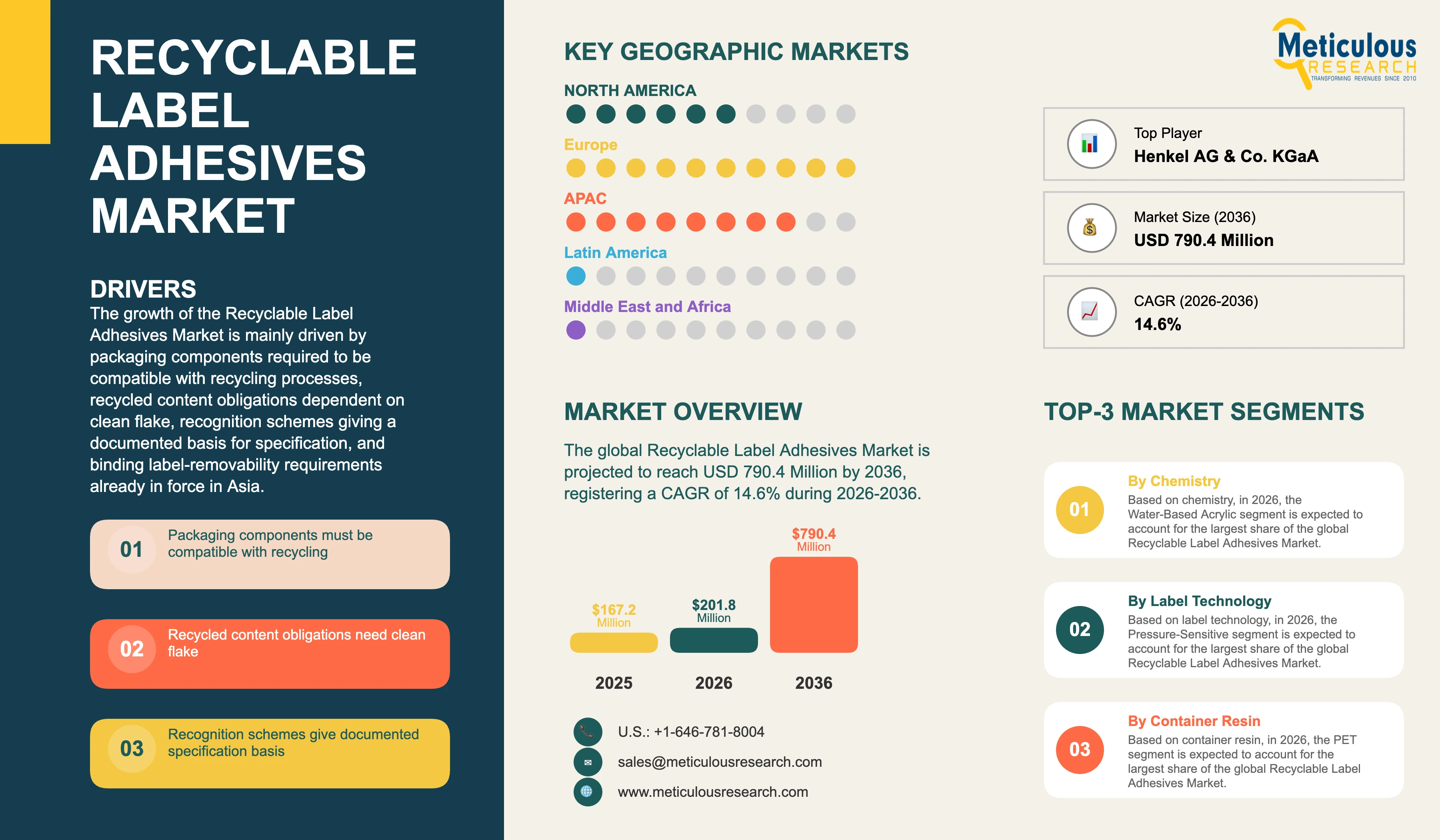
The recyclable label adhesives market is valued at USD 201.8 million in 2026 and is projected to reach USD 790.4 million by 2036, at a CAGR of 14.6% during the forecast period. The market was valued at USD 167.2 million in 2025 and at USD 139.9 million in 2024.
- Published
- Nov 2026
- Pages
- 258
- Format
- PDF + Excel
- Report ID
- MRCHM - 1042752
- Base year
- 2025
- 2024 · HISTORICAL
- $139.9M
- 2036
- $790.4M
- CAGR 2026–2036
- 14.6%
2024–2025 baseline · 2026–2036 forecast at 14.6% CAGR · hover a bar for the value
Key highlights
This market measures label adhesives formulated and sold to meet a recyclability or wash-off requirement for the container they are applied to, taken at the adhesive supplier gate on a tonne of dry adhesive solids basis.
Conventional permanent and removable label adhesives carrying no recyclability claim are excluded, as are label facestock, liner and inks, shrink sleeve films, container resin, and the wash chemicals and equipment used by recyclers.
Regulation (EU) 2025/40 provides in Article 6(1) that all packaging placed on the market shall be recyclable, with Article 6(2) defining that as designed for material recycling and separately collected, sorted and recycled at scale.
Article 6(9) provides that all components of a unit of packaging shall be compatible with the established collection, sorting and recycling processes and shall not hinder the recyclability of the main body.
Article 3(37) defines design for recycling as the design of packaging, including individual components, that ensures recyclability using processes proven in an operational environment.
Article 6(2)(a) applies from 1 January 2030 or 24 months after the Article 6(4) delegated acts enter into force, whichever is later, and from that date packaging shall not be placed on the market unless recyclable within grades A, B or C.
From 1 January 2038, packaging shall not be placed on the market unless recyclable within grades A or B, removing the route a limited-compatibility adhesive currently relies on.
Article 6(4) requires the Commission to adopt the delegated acts establishing design-for-recycling criteria and performance grades by 1 January 2028, the grades being described in Table 3 of Annex II.
Article 6(5) requires implementing acts setting the recycled-at-scale methodology and thresholds by 1 January 2030, Article 3(39) defining recycled at scale as an annual quantity of 30% or more for wood and 55% for all other materials at Union level.
Article 5(2) provides for restrictions on substances that negatively affect recycling as part of the Article 6(4) design-for-recycling criteria.
The European PET Bottle Platform quick test QT508 of May 2025 washes flakes in a 2.0% by weight sodium hydroxide solution at 85 degrees Celsius for 15 minutes at 500 revolutions per minute.
That procedure sets adhesive on flakes below 0.5%, flake loss below 3%, labels sinking below 1%, and dissolved adhesive or coating not exceeding 500 parts per million, with no residual label pieces on the PET flakes.
The RecyClass evaluation protocol for labels and adhesives on PET bottles, REP-PETbot-02 version 2.0 updated in December 2025, washes flakes at about 85 degrees Celsius in 1% by weight sodium hydroxide with 0.3% by weight surfactant for 15 minutes.
That protocol requires label and PET separation efficiency of at least 99% for full compatibility and at least 95% for limited compatibility, with PET flake loss below 2% and adhesive detached from the label facestock below 50% in both cases.
Both are self-assessment instruments: the quick test describes its results as purely indicative and not a formal approval, and the RecyClass protocol states that it is not an official assessment and may not be used as a marketing tool.
RecyClass granted full compatibility for the RW85C wash-off acrylic pressure-sensitive adhesive of UPM Adhesive Materials on 15 September 2025 under letter 2025-PETb-016, conditional on a coating weight of 14 plus or minus 2 grams per square metre and a polyolefin facestock below 1 gram per cubic centimetre.
That approval is valid for two years, covers the adhesive technology only, and requires each specific packaging to be tested individually, with any formulation change reported for reassessment.
The Korean Promotion of Saving and Recycling of Resources Act of 24 December 2018, implemented by the Ministry of Environment in December 2019, grades packaging as excellent, good, normal or difficult to recycle and requires the grade on the label.
Report summary
| Particulars | Details |
|---|---|
| Base Year | 2025 |
| Actual Years | 2024-2025 |
| Forecast Period | 2026-2036 |
| Market Size in 2024 | USD 139.9 million |
| Market Size in 2025 | USD 167.2 million |
| Market Size in 2026 | USD 201.8 million |
| Market Size in 2036 | USD 790.4 million |
| Value CAGR (2026-2036) | 14.6% |
| Format | PDF, Excel & Cloud Portal · 258 pages |
| Volume in 2025 | 50.50 kilotons |
| Volume in 2026 | 58.00 kilotons |
| Volume in 2036 | 190.00 kilotons |
| Volume CAGR (2026-2036) | 12.6% |
| Average Selling Price, 2026 | USD 3,480 per tonne |
| Average Selling Price, 2036 | USD 4,160 per tonne |
| Units | Value in USD million; volume in kilotons of adhesive on a dry solids basis; price in USD per tonne |
| Measurement Basis | Label adhesives formulated and sold to meet a recyclability or wash-off requirement for the container they are applied to, measured at the adhesive supplier gate on a tonne of dry adhesive solids basis |
| Coat Weight Reference | Recognised pressure-sensitive constructions are specified at a coating weight of 14 plus or minus 2 grams per square metre against a facestock coating basis of 43 grams per square metre, which is the basis on which adhesive tonnage is converted from label area |
| Historical Value Growth | Value grew at 20.1% a year between 2024 and 2026 against volume growth of 14.8% a year, as early conversions concentrated in premium beverage lines where label coverage and adhesive price are both high; the forecast of 14.6% is lower in percentage terms and larger in absolute volume, with price rising at 1.8% a year on mix |
| Obligation Timing | Article 6(2)(a) of Regulation (EU) 2025/40 applies from 1 January 2030 or 24 months after the Article 6(4) delegated acts enter into force, whichever is later; those delegated acts establishing design-for-recycling criteria and performance grades are due by 1 January 2028; grade A or B becomes mandatory from 1 January 2038 |
| Recognition Scope Note | Scheme recognitions cover the adhesive technology only, are valid for two years, require each specific packaging to be tested individually, and are issued under protocols that describe their own results as indicative rather than as a formal approval |
| Overlap Note | Water-based acrylic wash-off label grades counted here are also counted in the Water Based Pressure Sensitive Adhesives Market title, so the two titles are non-additive on that chemistry |
| Exclusions | Conventional permanent and removable label adhesives carrying no recyclability claim; label facestock, release liner and inks; shrink sleeve films and sleeve seam adhesives; container resin; tapes and non-label adhesives; wash chemicals, surfactants and de-inking agents used by recyclers; sorting and washing equipment |
| Segments: Chemistry | Water-Based Acrylic; Hot-Melt; Solvent-Based Acrylic; Other Chemistries including Ultraviolet-Cured and Bio-Based |
| Segments: Label Technology | Pressure-Sensitive; Wet-Glue; Hot-Melt Wrap-Around; Linerless and Direct-Apply |
| Segments: Container Resin | PET; High-Density Polyethylene; Polypropylene; Glass and Other |
| Segments: End Use | Beverages; Home and Personal Care; Food; Pharmaceutical and Healthcare; Other Applications |
| Largest Segment by Chemistry, 2026 | Water-Based Acrylic, at 61.0% |
| Fastest-Growing Segment by Chemistry | Other Chemistries, at 22.5% |
| Largest Segment by Label Technology, 2026 | Pressure-Sensitive, at 58.0% |
| Fastest-Growing Segment by Label Technology | Linerless and Direct-Apply, at 24.0% |
| Largest Segment by Container Resin, 2026 | PET, at 54.0% |
| Fastest-Growing Segment by Container Resin | Polypropylene, at 16.0% |
| Largest Segment by End Use, 2026 | Beverages, at 44.0% |
| Fastest-Growing Segment by End Use | Home and Personal Care, at 16.0% |
| Largest Region, 2026 | Europe, at 38.0% |
| Fastest-Growing Region | Asia-Pacific, at 16.0% |
| Fastest-Growing Country | South Korea, at 18.4% |
| Slowest-Growing Country | Canada, at 11.2% |
| Regions Covered | Europe; Asia-Pacific; North America; Latin America; Middle East & Africa |
| Countries Covered | Germany; France; Italy; U.K.; China; Japan; South Korea; India; U.S.; Canada; Mexico; Brazil |
| Key Players | Henkel AG & Co. KGaA; H.B. Fuller Company; Arkema S.A.; Avery Dennison Corporation; UPM-Kymmene Corporation; 3M Company; Dow Inc.; Synthomer plc; Lintec Corporation; HERMA GmbH; Nitto Denko Corporation |
| Top Five Share, 2026 | 46.8% |
| Profiled Companies Share, 2026 | 57.3% |
| Currency | USD |
Report overview
Market value is measured in in USD million; volume in kilotons of adhesive on a dry solids basis; price in USD per tonne. Segments covered: chemistry, label technology, container resin, end use.
The growth of this market is mainly driven by the requirement that every component of a unit of packaging be compatible with established recycling processes, recycled content obligations that depend on flake free of adhesive residue, recognition schemes that give a brand owner a documented basis on which to specify an adhesive, and binding label-removability requirements already in force in Korea and Japan. However, factors such as the design-for-recycling criteria and performance grades not due to be adopted before 1 January 2028, wash-off chemistry priced above conventional grades for the same bond, recognition that expires after two years and does not transfer to a finished pack, and protocol wash conditions that differ from plant practice are expected to restrain the growth of this market to some extent.
A label adhesive is a few grams of material per container and decides whether the container can be recycled into food-grade resin. A pressure-sensitive label on a clear PET bottle is applied at a coating weight of around 14 grams per square metre, which on a 1,000 square centimetre label is about 1.4 grams of adhesive against 25 to 30 grams of bottle. If that adhesive stays on the flake through a caustic wash, it carries into the melt as a contaminant, yellows the resin and drops the output out of bottle-grade specification.
The recycling process the adhesive has to survive is narrow and consistent across jurisdictions. Flake is washed in dilute sodium hydroxide at around 85 degrees Celsius for about 15 minutes, then separated by density so that label material floats and PET sinks. An adhesive that releases cleanly in those conditions, stays attached to the label facestock and does not dissolve into the wash water leaves a flake that recyclers can use. An adhesive that softens and smears does the opposite, and no downstream step removes it.
That is why the technical criteria in this market are written as removal percentages rather than as bond strengths. The European PET Bottle Platform quick test allows no more than 0.5% of adhesive on the flakes and no more than 500 parts per million dissolved into the wash liquor. The RecyClass protocol requires label and PET separation efficiency of at least 99% for full compatibility, with adhesive detached from the label facestock below 50%, so the adhesive must leave the bottle and stay with the label rather than simply letting go of both.
The commercial difficulty is that those are the same requirements an adhesive must meet while also holding a label on a wet, cold, curved container through filling, distribution and retail handling, at line speeds above 200 containers a minute. A conventional permanent acrylic does the holding without difficulty and fails the wash. A removable adhesive passes the wash and does not hold. The chemistries sold into this market are the narrow set that does both, and they are priced above conventional grades accordingly.
Water-based acrylic chemistry accounts for most of the volume because alkali-releasable functionality is most readily built into an acrylic emulsion. The adhesive is formulated with acid functionality that is neutralised in the caustic wash, which converts the adhesive from tacky to water-dispersible at wash temperature while leaving it unaffected at ambient conditions. Hot-melt and solvent-based grades serve wrap-around and high-humidity applications where an emulsion does not perform, and ultraviolet-cured grades are the newest route.
Demand is pulled by the brand owner rather than by the converter or the recycler. A beverage company with a recycled-content commitment needs rPET that meets food-contact specification, and the price and availability of that resin depend on how clean the flake entering the recycler is. The brand owner therefore specifies the label construction, the converter buys the adhesive the specification names, and the adhesive supplier sells against a recognition document rather than against a performance datasheet alone.
The regulatory position in Europe is the strongest forward driver and the weakest present one. Article 6(9) of Regulation (EU) 2025/40 states that all components of a unit of packaging shall be compatible with the established collection, sorting and recycling processes and shall not hinder the recyclability of the main body, which is a direct obligation covering label adhesive. The grade thresholds that decide whether a given adhesive clears it sit in Annex II and depend on design-for-recycling criteria the Commission need not adopt before 1 January 2028.
Application follows 24 months after those delegated acts or 1 January 2030, whichever is later, so the earliest date on which a non-compliant adhesive is excluded from the European market is 2030 and later if the acts slip. Grade A or B becomes mandatory only from 1 January 2038, which is when a limited-compatibility adhesive loses its conditional route. The obligation is firm in principle and unquantified in practice for the next two years.
What governs purchasing in the meantime is the recognition schemes. A RecyClass technology approval or an equivalent recognition from the Association of Plastic Recyclers gives a brand owner a defensible basis for a specification, and those documents are what adhesive suppliers now compete for. The approval granted for the RW85C wash-off acrylic on 15 September 2025 is the pattern: full compatibility, tied to a coating weight of 14 plus or minus 2 grams per square metre and a polyolefin facestock below 1 gram per cubic centimetre.
Those documents are narrower than they are often taken to be. The RW85C approval is valid for two years, covers the adhesive technology only, and states that each specific packaging must still be tested individually, with any formulation change reported for reassessment. The protocols themselves carry the same qualification, the quick test describing its results as purely indicative and not a formal approval, and the RecyClass protocol stating that it is not an official assessment and may not be used as a marketing tool.
The binding requirements that exist today are Asian rather than European. The Korean Promotion of Saving and Recycling of Resources Act of 24 December 2018, implemented by the Ministry of Environment in December 2019, grades packaging as excellent, good, normal or difficult to recycle, requires the overall grade on the label, and backs it with suspension of manufacture, import or sale after an improvement period. The removal criterion applied under that framework calls for more than 97% label removal at 80 degrees Celsius in 2% sodium hydroxide within 10 minutes, with the label also hand-removable.
PET bottles are the dominant container because the recycling stream is the most mature, the food-contact end market is the most valuable and the wash conditions are the most standardised. Polypropylene and high-density polyethylene containers are the faster-growing side of the market, since those streams wash under different conditions, carry a label load that was never designed for release, and are now being brought inside the same recognition schemes, with the RW85C approval covering HDPE container recycling alongside PET under a separate letter.
Label technology divides the market as much as chemistry does. Pressure-sensitive construction carries the largest share because it dominates premium beverage, personal care and household labelling and because its adhesive layer is continuous and therefore fully exposed to the wash. Wet-glue and hot-melt wrap-around constructions use far less adhesive per container and present a different release problem, since the adhesive is applied in beads or stripes and the facestock is usually paper or polypropylene film.
Linerless and direct-apply formats are the fastest-growing technology from a small base. Removing the liner removes the largest waste stream in label converting, and a linerless construction requires an adhesive that tolerates direct contact with the facestock reverse while still releasing in a caustic wash, which is a harder formulation problem than a lined pressure-sensitive label presents.
Pricing reflects a premium over conventional label adhesive rather than a commodity index. Alkali-releasable acrylic grades sell above standard permanent emulsions for the same coverage, and ultraviolet-cured and bio-based grades above that again. The 1.8% a year increase in average selling price across the forecast period is mix rather than inflation, as the premium chemistries take share from the conventional-adjacent grades counted here.
Growth between 2024 and 2026 ran at 20.1% a year in value against 14.8% a year in volume, because conversions in that period were concentrated in premium beverage lines where coverage and price are both high. The forecast rate of 14.6% is lower in percentage terms and much larger in absolute volume, with the step change expected around the 2030 application date rather than spread evenly across the period.
Report infographic
Market dynamics
20 factors across 5 forcesPackaging Components Required to Be Compatible With Recycling Processes
Article 6(9) of Regulation (EU) 2025/40 provides that all components of a unit of packaging shall be compatible with the established collection, sorting and recycling processes and shall not hinder the recyclability of the main body. Label adhesive is such a component, and the provision reaches it directly rather than through the label or the pack.
Article 6(1) provides that all packaging placed on the market shall be recyclable, and Article 6(2)(a) requires design for material recycling, defined in Article 3(37) as design including individual components of packaging that ensures recyclability using processes proven in an operational environment.
From the application date, packaging shall not be placed on the market unless it is recyclable within grades A, B or C, and from 1 January 2038 only within grades A or B. An adhesive that smears onto flake therefore becomes a reason a pack cannot be sold rather than a quality complaint from a recycler.
Recycled Content Obligations Dependent on Clean Flake
A recycled-content obligation can only be met with resin that meets the specification of the application, and for a food-contact bottle that means flake free of adhesive residue. Adhesive that survives the wash carries into the melt, yellows the resin and pushes the output below bottle-grade specification.
Article 6(5) of Regulation (EU) 2025/40 requires implementing acts setting the recycled-at-scale methodology and thresholds by 1 January 2030, with Article 3(39) defining recycled at scale as an annual quantity equal to or greater than 55% for materials other than wood at Union level.
The commercial effect runs through the brand owner. A beverage company holding a recycled-content commitment needs rPET at food-contact specification and at a price that depends on flake cleanliness, so it specifies the label construction and the converter buys the adhesive the specification names.
Recognition Schemes Giving a Documented Basis for Specification
A brand owner specifying an adhesive needs a document rather than a datasheet. RecyClass granted full compatibility for the RW85C multipurpose wash-off acrylic pressure-sensitive adhesive of UPM Adhesive Materials on 15 September 2025 under approval letter 2025-PETb-016, and an equivalent route exists through the Association of Plastic Recyclers critical guidance protocols.
The approval states the conditions on which it rests: a coating weight of 14 plus or minus 2 grams per square metre, a polyolefin facestock below 1 gram per cubic centimetre, and compliance of any additional inks or features with the design-for-recycling guidelines.
Recognitions of that kind are what adhesive suppliers now compete for, because they convert a formulation into a specifiable item. They also pull the whole label construction into the purchase decision, which raises the value of a supplier able to offer adhesive and facestock together.
Binding Label-Removability Requirements Already in Force in Asia
The Korean Promotion of Saving and Recycling of Resources Act, issued on 24 December 2018 and implemented by the Ministry of Environment in December 2019, grades packaging as excellent, good, normal or difficult to recycle, requires manufacturers to self-assess each component, and requires the overall grade to appear on the label.
Penalties after the grace and improvement periods extend to suspension of manufacturing, importation or sales. The removal criterion applied under that framework calls for more than 97% label removal at 80 degrees Celsius in 2% sodium hydroxide within 10 minutes, with the label also hand-removable.
Japanese practice requires label separation without residue after either hot water washing at 85 degrees Celsius for 15 minutes or 1.5% sodium hydroxide at 85 degrees Celsius for 15 minutes. Those are the only requirements currently enforceable against a pack, which is why Asia-Pacific records the highest regional CAGR in this market at 16.0%.
Table of contents
12 chapters · 134 sections · 258 pages · click to expandSegmental analysis
| Segment | Largest share (2026) | Fastest growth (2026–2036) |
|---|---|---|
| By Chemistry | Water-based acrylic adhesives | Other chemistries including ultraviolet-cured and bio-based grades |
| By Label Technology | Pressure-sensitive construction | Linerless and direct-apply formats |
| By Container Resin | PET | Polypropylene |
| By End Use | Beverages | Home and personal care |
By Chemistry
- Recyclable Label Adhesives Market Analysis by Chemistry
- Water-based acrylic adhesives are expected to hold the largest share of this market in 2026.
- Alkali-releasable functionality is most readily built into an acrylic emulsion, by formulating acid functionality that is neutralised in the caustic wash so the adhesive converts from tacky to water-dispersible at wash temperature while remaining unaffected at ambient conditions.
- The RW85C adhesive recognised by RecyClass on 15 September 2025 is a multipurpose wash-off acrylic pressure-sensitive grade of this type.
- The chemistry grows at 14.9% over the forecast period.
- Other chemistries including ultraviolet-cured and bio-based grades are expected to record the highest CAGR during the forecast period at 22.5%.
- Ultraviolet-cured hot-melt is applied at low viscosity without water or solvent and crosslinked after coating, which allows higher cohesive strength at a given coat weight than an emulsion achieves.
- Higher cohesive strength is what keeps the adhesive attached to the facestock during the wash, which is the criterion of adhesive detached from the facestock below 50% rather than a separation measure.
- Hot-melt adhesives based on styrenic block copolymers and synthetic rubber serve wrap-around and high-humidity applications where an emulsion does not perform, and are applied in beads or stripes rather than as a continuous layer, which reduces the exposed area in the wash.
- The chemistry grows at 13.2% over the forecast period.
- Solvent-based acrylic adhesives grow slowest of the four at 11.0%, on tightening solvent emission limits in converting and on the availability of emulsion grades that now match their wet-surface performance.
- They retain positions where very low coat weight at high cohesive strength is required and where a converter already holds solvent coating capacity.
By Label Technology
- Recyclable Label Adhesives Market Analysis by Label Technology
- Pressure-sensitive construction is expected to hold the largest share of this market in 2026.
- It dominates premium beverage, personal care and household labelling, and its adhesive layer is continuous and therefore fully exposed to the wash, so the recyclability outcome depends on the adhesive more completely than in any other format.
- The RecyClass protocol asks for about 1, 000 square centimetres of glued surface for pressure-sensitive labels against about 300 square centimetres for wrap-around, which is a measure of the difference.
- The technology grows at 14.8%.
- Linerless and direct-apply formats are expected to record the highest CAGR during the forecast period at 24.0% from a small base.
- Removing the release liner removes the largest waste stream in label converting, and a linerless adhesive must tolerate direct contact with the facestock reverse and survive winding and dispensing without a liner while still releasing in a caustic wash.
- The format answers a converting waste problem and a recyclability requirement with one change.
- Wet-glue construction grows slowest at 12.6%.
- It uses far less adhesive per container than a pressure-sensitive label and is applied in beads or stripes to paper or film facestock, so the release problem is different in kind and in several cases is already solved by water-soluble casein and synthetic grades in use for decades.
- Conversion demand is therefore concentrated in the constructions that are not already releasable.
- Hot-melt wrap-around construction grows at 14.0%, serving high-speed beverage and household lines where a polypropylene film is wrapped and seamed with a small adhesive quantity.
- The seam adhesive is the recyclability variable rather than the label area, which keeps adhesive consumption per container low and makes the conversion inexpensive relative to a pressure-sensitive change.
By Container Resin
- Recyclable Label Adhesives Market Analysis by Container Resin
- PET is expected to hold the largest share of this market in 2026.
- The bottle recycling stream is the most mature, the food-contact end market is the most valuable, and the wash conditions are the most standardised, with both the European PET Bottle Platform quick test and the RecyClass protocol written around dilute sodium hydroxide at about 85 degrees Celsius for 15 minutes.
- That combination of a valuable output and a defined test is what made PET the first stream to specify adhesive.
- The resin grows at 14.6%.
- Polypropylene is expected to record the highest CAGR during the forecast period at 16.0%.
- The stream washes under different conditions and carries a label load that was never formulated for release, so almost the entire installed base is a conversion opportunity rather than a replacement one.
- The release mechanism has to be re-engineered rather than transferred, since a wash that runs cooler, shorter or with different surfactant loading will not trigger an adhesive tuned to PET conditions.
- High-density polyethylene grows at 15.2%, and is the resin where recognition schemes have moved fastest beyond PET.
- The RW85C adhesive was recognised as releasable in high-density polyethylene container recycling under approval letter 2025-HDPE-010 on the same date as the PET letter, covering natural and white recyclate, which establishes that a single adhesive technology can hold recognitions across resins.
- Glass and other containers grow slowest at 11.4%.
- Glass recycling tolerates label and adhesive residue far better than polymer recycling does, since the material is remelted at temperatures that destroy organic residue, so the recyclability pressure on adhesive is weaker.
- The Korean grading framework nonetheless treats synthetic resin or metal mixed label materials on glass bottles as difficult to recycle, which creates demand where that framework applies.
By End Use
- Recyclable Label Adhesives Market Analysis by End Use
- Beverages are expected to hold the largest share of this market in 2026.
- Bottle-to-bottle recycling is the application where recycled content is most valuable, most visible and most often the subject of a public commitment, and a beverage label is large relative to the container, so adhesive consumption per unit is high.
- Line speeds above 200 containers a minute and wet, cold filling surfaces also make it the hardest application to formulate for.
- The segment grows at 14.6%.
- Home and personal care is expected to record the highest CAGR during the forecast period at 16.0%.
- The category runs predominantly on high-density polyethylene and polypropylene containers, which are the resins converting later and faster, and it uses decorative pressure-sensitive labels with high surface coverage.
- Products in the category also face a wider range of fill chemistries and surface energies than beverages, which raises the technical requirement on the adhesive.
- Food grows at 14.6%, matching beverages, on rigid polymer containers for dairy, spreads and chilled products where the label is smaller and the recycled-content pressure is similar.
- Pharmaceutical and healthcare grows at 13.0%, where label legibility and adhesion through cold chain and autoclave conditions outrank recyclability in the specification, and where regulatory change to a label construction carries its own approval burden.
- Other applications including industrial and chemicals grow slowest at 12.4%.
- Containers in these uses are often reconditioned rather than recycled, label requirements are driven by hazard communication durability, and the end markets for the recovered resin are less demanding, so an adhesive premium has less to recover against.
Geographic analysis
Europe
Largest shareEurope is expected to account for the largest share of this market in 2026, while Asia-Pacific is expected to register the highest CAGR during the forecast period. Europe leads because Regulation (EU) 2025/40 makes component compatibility with recycling processes a condition of placing packaging on the market, and because the recognition schemes that govern purchasing in the interim are European institutions. Conversion began earlier here than anywhere else and the installed base of recognised constructions is the largest. The region grows at 15.2%, with Germany and Italy the largest national markets on their beverage and household filling bases and France close behind.
Asia-Pacific
Fastest growthAsia-Pacific grows fastest at 16.0% because it holds the only requirements currently enforceable against a pack. South Korea grows fastest of the countries covered at 18.4%, under a framework that grades packaging as excellent, good, normal or difficult to recycle, requires the overall grade on the label, and carries suspension of manufacture, import or sale as a penalty after the improvement period. Japanese practice requires label separation without residue after hot water or dilute caustic washing at 85 degrees Celsius for 15 minutes. China accounts for the largest volume within Asia-Pacific on the scale of its beverage and personal care filling, with conversion driven by export packaging specifications and by domestic recycled content programmes rather than by a removability rule. India grows from a small base on rising rigid packaging consumption and an expanding organised PET recycling sector.
North America
North America grows at 12.7%, the slowest of the three major regions, because the governing mechanism is a voluntary design guidance rather than a regulation. The Association of Plastic Recyclers critical guidance protocols are the route by which an adhesive is recognised, and extended producer responsibility programmes in a small number of states are only now beginning to modulate fees on recyclability. The United States holds the overwhelming majority of the regional total and Canada grows slowest of the countries covered at 11.2%.
Latin America
Latin America grows at 11.6%. Brazil holds the larger share on its beverage filling base and an established PET collection sector, with Mexico second on its beverage and household manufacturing. Conversion in both is driven by multinational brand owner specifications applied to local filling rather than by domestic packaging rules.
Middle East & Africa
The Middle East and Africa grows slowest at 10.8%. Rigid container recycling infrastructure is limited outside a few markets, recovered resin commands a lower premium, and no jurisdiction in the region conditions market access on a recyclability grade, so adhesive conversion follows export packaging requirements and the standards of multinational fillers.
Competitive landscape
Two supplier types compete in this market and sell to different buyers. Adhesive formulators sell raw adhesive to label stock producers and to converters, and compete on formulation, coating behaviour and recognition status. Label material producers sell coated facestock with the adhesive already applied, and compete on the recognised construction as a unit. The second group has gained ground as recognitions have come to specify coating weight and facestock density together, since a construction sold as a recognised whole removes the converter obligation to hold the specification.
Concentration is high by the standards of the circularity titles in this portfolio. The top five participants are estimated to hold 46.8% of this market in 2026 and the profiled companies 57.3%, reflecting the fact that label adhesive is a specialty position within large diversified adhesive and pressure-sensitive materials businesses rather than a field of independent entrants.
Recognition status is the principal basis of competition. RecyClass granted full compatibility for the RW85C multipurpose wash-off acrylic pressure-sensitive adhesive of UPM Adhesive Materials on 15 September 2025 under approval letter 2025-PETb-016, and the same adhesive was recognised as releasable in high-density polyethylene container recycling under letter 2025-HDPE-010. The approval is conditional on a coating weight of 14 plus or minus 2 grams per square metre and a polyolefin facestock below 1 gram per cubic centimetre, is valid for two years, and covers the adhesive technology rather than any finished pack.
Avery Dennison Corporation holds the longest-established position through its CleanFlake adhesive technology, which enables pressure-sensitive label materials to separate from PET containers during recycling without leaving adhesive residue on the flake, passes the Association of Plastic Recyclers critical guidance, and is documented against the design guidelines of Plastics Recyclers Europe, the European PET Bottle Platform and Petcore Europe. The company technical guide of October 2025 records converting performance above 500 feet a minute and dispensing above 200 units a minute, and notes that a metallised facestock with the same adhesive can lower a package rating from class B to class C.
Some of the key players operating in the recyclable label adhesives market are Henkel AG & Co. KGaA, H.B. Fuller Company, Arkema S.A., Avery Dennison Corporation, UPM-Kymmene Corporation, 3M Company, Dow Inc., Synthomer plc, Lintec Corporation, HERMA GmbH, and Nitto Denko Corporation, among others.
- Henkel AG & Co. KGaA
- H.B. Fuller Company
- Arkema S.A.
- Avery Dennison Corporation
- UPM-Kymmene Corporation
- 3M Company
- Dow Inc.
- Synthomer plc
- Lintec Corporation
- HERMA GmbH
- Nitto Denko Corporation
Expert perspectives
The list driver for this title is bottle-to-bottle recycling quality, and the technical case for it is sound. Adhesive at a coating weight of around 14 grams per square metre decides whether a bottle yields food-grade flake, and no downstream step removes residue once it survives the wash. The quantified criteria confirm how narrow the window is: no more than 0.5% adhesive on flakes and no more than 500 parts per million dissolved under the European PET Bottle Platform quick test, and at least 99% label and PET separation efficiency for full compatibility under the RecyClass protocol.
What does not yet hold is the legal mechanism. Article 6(9) of Regulation (EU) 2025/40 requires every packaging component to be compatible with established recycling processes, but the grade thresholds that decide compliance sit in Annex II and depend on design-for-recycling criteria the Commission need not adopt before 1 January 2028. Application follows 24 months later or on 1 January 2030, whichever is later, and grade A or B becomes mandatory only from 1 January 2038.
The requirements enforceable against a pack today are Asian. The Korean framework implemented in December 2019 grades packaging and backs the grade with suspension of manufacture, import or sale, and Japanese practice requires separation without residue after dilute caustic or hot water washing at 85 degrees Celsius. That is why Asia-Pacific carries the highest regional CAGR at 16.0% while Europe carries the largest share, and it is the clearest evidence that enforcement rather than ambition moves this market.
In the interim the purchase is governed by recognition documents whose scope is narrower than their commercial use suggests. The RW85C approval is valid for two years, covers the adhesive technology only and requires each pack to be tested individually. The protocols behind such approvals describe their own results as indicative rather than formal, and the RecyClass protocol states that it is not an official assessment and may not be used as a marketing tool.
The practical consequence is a market where demand is specified by brand owners rather than created by regulation, and where the specification can be withdrawn as easily as it was written. That supports the 14.6% value CAGR and argues against a steeper one, since nothing in the current framework compels a converter to change an adhesive before 2030.
Growth between 2024 and 2026 ran at 20.1% a year in value against 14.8% in volume, because early conversions concentrated in premium beverage lines where label coverage and adhesive price are both high. The forecast rate is lower in percentage terms and much larger in absolute volume, with the step expected around the 2030 application date and the 2038 grade requirement rather than spread evenly, and with average selling price rising at 1.8% a year on mix rather than on input cost.
Frequently asked questions
The market is valued at USD 201.8 million in 2026 and is projected to reach USD 790.4 million by 2036, at a CAGR of 14.6%. It was valued at USD 167.2 million in 2025 and USD 139.9 million in 2024.
It measures label adhesives formulated and sold to meet a recyclability or wash-off requirement for the container they are applied to, taken at the adhesive supplier gate on a tonne of dry adhesive solids basis. Conventional label adhesives with no recyclability claim, facestock, liner and inks, shrink sleeve films, container resin, and recycler wash chemicals and equipment are excluded.
Technically yes, legally not yet. The European obligation that would compel the purchase has no quantified threshold yet and cannot exclude a non-compliant adhesive before 2030.
Article 6(1) provides that all packaging placed on the market shall be recyclable, and Article 6(9) that all components of a unit of packaging shall be compatible with the established collection, sorting and recycling processes. Article 6(2)(a) applies from 1 January 2030 or 24 months after the Article 6(4) delegated acts enter into force, whichever is later, with grades A or B required from 1 January 2038.
Article 6(4) requires the Commission to adopt the delegated acts establishing design-for-recycling criteria and performance grades by 1 January 2028, with the grades described in Table 3 of Annex II. Article 6(5) requires implementing acts setting the recycled-at-scale methodology and thresholds by 1 January 2030.
The European PET Bottle Platform quick test QT508 of May 2025 washes flakes in a 2.0% by weight sodium hydroxide solution at 85 degrees Celsius for 15 minutes at 500 revolutions per minute. The RecyClass protocol REP-PETbot-02 version 2.0 washes at about 85 degrees Celsius in 1% by weight sodium hydroxide with 0.3% by weight surfactant for 15 minutes.
The quick test sets adhesive on flakes below 0.5%, flake loss below 3%, labels sinking below 1%, and dissolved adhesive or coating not exceeding 500 parts per million. The RecyClass protocol requires label and PET separation efficiency of at least 99% for full compatibility and at least 95% for limited compatibility, with flake loss below 2% and adhesive detached from the label facestock below 50%.
Less than its commercial use suggests. The RW85C approval of 15 September 2025 is valid for two years, covers the adhesive technology only, and states that each specific packaging must be tested individually.
Water-based acrylic holds the largest share in 2026, because alkali-releasable functionality is most readily built into an acrylic emulsion. Other chemistries including ultraviolet-cured and bio-based grades record the highest CAGR at 22.5%.
PET holds the largest share in 2026, on the most mature recycling stream, the most valuable food-contact end market and the most standardised wash conditions. Polypropylene records the highest CAGR at 16.0% and high-density polyethylene follows at 15.2%.
Pressure-sensitive construction holds the largest label technology share in 2026, while linerless and direct-apply formats grow fastest at 24.0% from a small base. Beverages hold the largest end-use share, while home and personal care grows fastest at 16.0%.
Europe holds the largest share in 2026 at 38.0%, because Regulation (EU) 2025/40 makes component compatibility a condition of placing packaging on the market. Asia-Pacific grows fastest at 16.0%, with South Korea the fastest-growing country at 18.4%, while North America grows at 12.7% on voluntary design guidance.
The Korean Promotion of Saving and Recycling of Resources Act, issued on 24 December 2018 and implemented in December 2019, grades packaging and requires the overall grade on the label, with suspension of manufacturing, importation or sales after the grace and improvement periods. Japanese practice requires label separation without residue after hot water or 1.5% sodium hydroxide washing at 85 degrees Celsius for 15 minutes.
Some of the key players are Henkel AG & Co. KGaA, H.B. Fuller Company, Arkema S.A., Avery Dennison Corporation, UPM-Kymmene Corporation, 3M Company, Dow Inc., Synthomer plc, Lintec Corporation, HERMA GmbH, and Nitto Denko Corporation, among others. The top five hold an estimated 46.8% in 2026 and the profiled companies 57.3%.
RecyClass granted full compatibility for the RW85C wash-off acrylic pressure-sensitive adhesive of UPM Adhesive Materials on 15 September 2025 under letter 2025-PETb-016, and recognised it for HDPE container recycling under letter 2025-HDPE-010. The Avery Dennison technical guide of October 2025 records CleanFlake adhesive technology passing the Association of Plastic Recyclers critical guidance.
Design-for-recycling criteria are not due before 1 January 2028 and cannot exclude an adhesive before 2030, while wash-off chemistry carries a premium over conventional grades. Recognitions expire after two years and do not transfer to a pack, and protocol wash conditions differ between schemes and from plant practice.
Cite this report
Meticulous Research. (2026). Recyclable Label Adhesives Market - Global Opportunity Analysis and Industry Forecast (2026-2036) (Report No. MRCHM - 1042752). Meticulous Market Research Pvt. Ltd. https://www.meticulousresearch.com/product/recyclable-label-adhesives-market-7435