Silicone Structural Glazing Sealants Market (2026-2036)
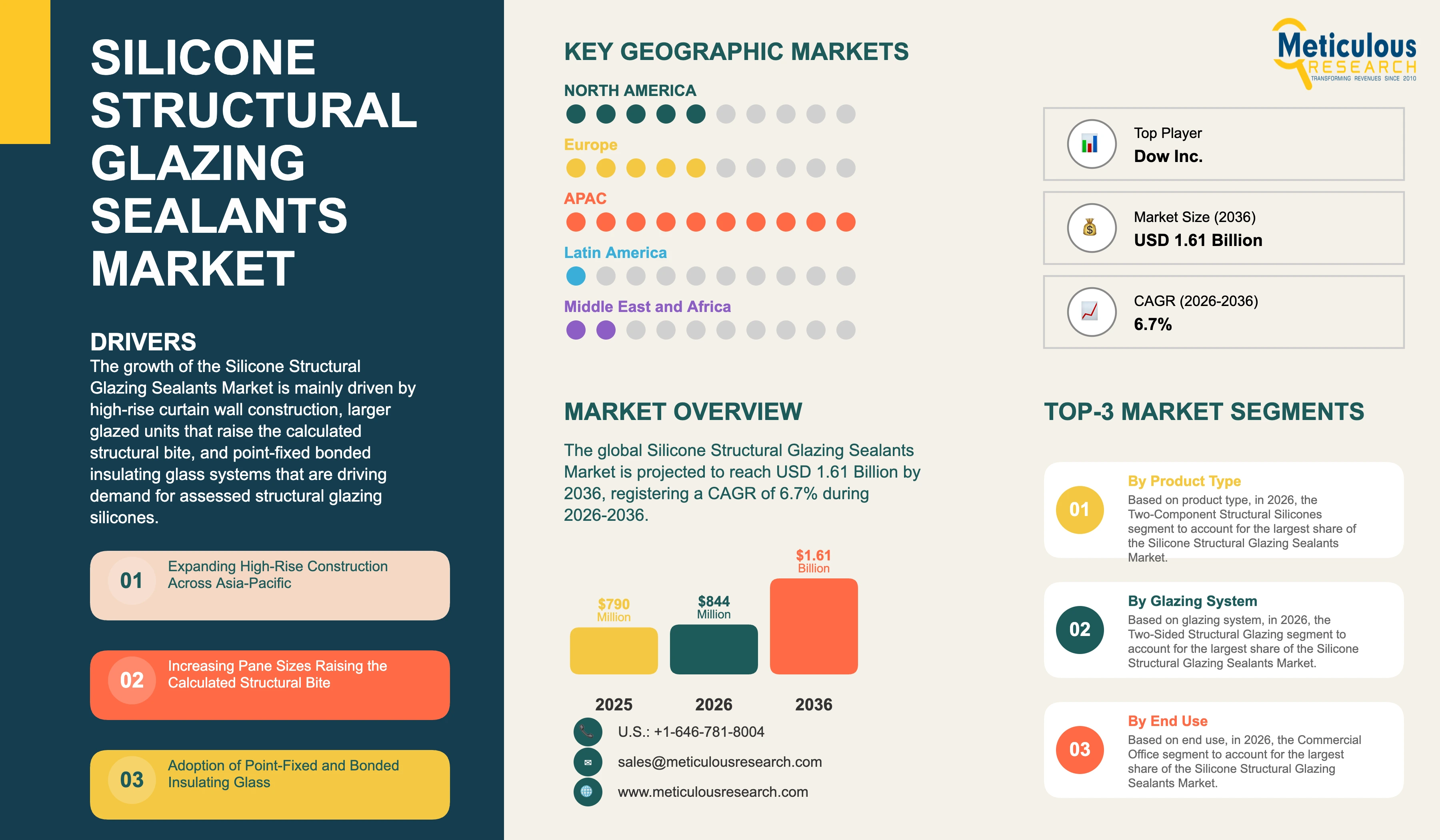
The global Silicone Structural Glazing Sealants Market was valued at USD 790.0 million in 2025. This market is expected to reach USD 1.61 billion by 2036 from an estimated USD 844.0 million in 2026, registering a CAGR of 6.7% during the forecast period (2026-2036).
- Published
- Nov 2026
- Pages
- 249
- Format
- PDF + Excel
- Report ID
- MRCHM - 1042828
- Base year
- 2025
- 2025 · BASELINE
- $790.0M
- 2036
- $1.61B
- CAGR 2026–2036
- 6.7%
2025 baseline · 2026–2036 forecast at 6.7% CAGR · hover a bar for the value
Key highlights
The global Silicone Structural Glazing Sealants Market is projected to reach USD 1.61 billion by 2036, driven by high-rise curtain wall construction, larger glazed units, point-fixed insulating glass systems, and remedial re-glazing of aging facades.
Asia-Pacific is expected to account for the largest market share in 2026 and is also projected to register the fastest growth during the forecast period, supported by unitized curtain wall with structurally bonded glass being the default envelope for commercial and residential towers across the region, with the glazing shops that bond those units concentrated there.
By product type, Two-Component Structural Silicones are expected to account for the largest market share, whereas Ultraviolet-Resistant Structural Silicones are projected to witness the fastest growth through 2036.
By glazing system, Two-Sided Structural Glazing systems are expected to account for the largest market share, whereas Point-Fixed & Bonded Insulating Glass Units are projected to witness the fastest growth through 2036.
According to current European Technical Assessments, the design tensile stress for structural glazing silicones runs from 0.14 megapascals on a two-component system to 0.20 and 0.21 megapascals on higher-modulus grades, each derived at a global safety factor of 6.0.
North American practice has applied a sealant design strength of 138 kilopascals, or 20 pounds per square inch, on structural glazing projects from the first application in 1964 through to recent towers, with recorded project bites of 9.5 to 40 millimeters.
The static shear allowable for permanent load is only about 0.010 to 0.0105 megapascals, between one-fourteenth and one-twentieth of the tensile allowable, which limits the self-weight a structural seal can be asked to carry and sustains demand for mechanically supported systems.
The adhesive bite is calculated rather than selected, with the governing check requiring the bite to be at least the short side of the pane multiplied by the combined design action of wind, snow and self-weight and divided by twice the design tensile stress.
The revised European construction products framework entered into force on 7 January 2025 and has applied since 8 January 2026, and approvals based on the predecessor assessment guideline are no longer valid as a basis for declaration of performance and marking.
Approvals based on assessment documents cited under the previous framework can be used for declaration of performance until 9 January 2036 and to issue new approvals until 9 January 2031, which places a dated compliance timetable on every qualified product in the European market.
A European Technical Assessment issued on 6 July 2026 states an assumed working life of 25 years and records that this is not a guarantee, which is converting structural glazing maintenance on 1980s and 1990s towers into scheduled re-bonding programs.
Report summary
| Particulars | Details |
|---|---|
| Forecast Period | 2026-2036 |
| Base Year | 2025 |
| Estimated Year | 2026 |
| CAGR (Value) | 6.7% |
| Format | PDF, Excel & Cloud Portal · 249 pages |
| CAGR (Volume) | 5.5% |
| Market Size (Value) in 2026 | USD 844.0 million |
| Market Size (Value) in 2036 | USD 1.61 billion |
| Market Size (Volume) in 2026 | 56.00 kilotons of sealant as supplied |
| Market Size (Volume) in 2036 | 96.00 kilotons |
| Average Selling Price, 2026 | USD 15,071 per ton |
| Average Selling Price, 2036 | USD 16,771 per ton |
| Segments Covered | By Product Type: Two-Component Structural Silicone, One-Component Structural Silicone, Structural Silicone for Insulating Glass Secondary Seals, Ultraviolet-Resistant Structural Silicone. By Glazing System: Two-Sided Structural Glazing, Four-Sided Structural Glazing, Point-Fixed & Bonded Insulating Glass Units. By Application Setting: Factory & Shop Glazing, Field Glazing, Remedial & Re-Glazing. By End Use: Commercial Office, Retail & Mixed Use, Hospitality & Institutional, Residential High-Rise, Other Buildings. |
| Countries Covered | Asia-Pacific: China, India, Japan, South Korea, Rest of Asia-Pacific. North America: U.S., Canada. Europe: Germany, U.K., France, Rest of Europe. Middle East & Africa: UAE, Saudi Arabia, Rest of Middle East & Africa. Latin America: Mexico, Rest of Latin America. |
| Key Companies | Dow Inc., Sika AG, H.B. Fuller Company, Momentive Performance Materials Inc., Arkema S.A., and Hermann Otto GmbH |
Report overview
Segments covered: product type, glazing system, application setting, end use.
In volume terms, the market is estimated at 56.00 kilotons of sealant as supplied in 2026 and is expected to reach 96.00 kilotons by 2036, registering a CAGR of 5.5% during the forecast period. The average selling price is estimated at USD 15,071 per ton in 2026 and USD 16,771 per ton in 2036.
The growth of this market is mainly driven by rising high-rise commercial and residential construction across Asia-Pacific, increasing pane sizes that raise the calculated structural bite per unit, growing adoption of point-fixed and bonded insulating glass systems, and expanding remedial and re-glazing work on facades reaching the stated working life of their structural seals. However, factors such as a design tensile stress held between 0.14 and 0.21 megapascals under a global safety factor of 6.0, a static shear allowable for permanent load of only about 0.010 megapascals, a normal adhesive bite range limited to 6 to 20 millimeters, and the withdrawal of approvals based on the superseded assessment guideline as a basis for declaration of performance are expected to restrain the growth of this market to some extent.
Among end uses, Commercial Office buildings are expected to account for the largest market share in 2026, while Residential High-Rise buildings are projected to register the highest CAGR during the forecast period. Geographically, Asia-Pacific is expected to account for the largest share of this market in 2026 and is also expected to register the highest CAGR during the forecast period.
The Silicone Structural Glazing Sealants Market comprises silicone sealants qualified to transfer structural load between glass and its supporting frame, together with the structural seal of bonded insulating glass units. The market includes two-component and one-component structural silicones, structural silicones for insulating glass secondary seals, and ultraviolet-resistant grades for exposed edge bonding, applied in two-sided and four-sided structural glazing and in point-fixed and bonded insulating glass systems. The market ecosystem extends from siloxane and polymer suppliers through sealant formulators and technical assessment bodies to glazing fabricators, curtain wall contractors and the building owners that maintain these facades over multi-decade service lives.
Demand in this market is governed by structural calculation rather than by specification preference, because the sealant carries wind load from the glass into the frame and the consequence of bond failure is a pane falling from height. The adhesive bite is required to be at least the short side of the pane multiplied by the combined design action of wind, snow and self-weight and divided by twice the design tensile stress, so sealant consumption per unit follows pane geometry and site wind loading directly. Current European Technical Assessments give design tensile stresses of 0.14, 0.20 and 0.21 megapascals, each derived from the characteristic breaking stress at a global safety factor of 6.0, while North American practice has applied a design strength of 138 kilopascals, or 20 pounds per square inch, since the technology was first used in 1964.
Permanent load is the most restrictive limit in the system and shapes the structure of the market. The static shear allowable under permanent load is about 0.010 to 0.0105 megapascals, between one fourteenth and one twentieth of the tensile allowable, so a seal asked to carry the dead weight of a pane requires many times the bite that wind alone would demand. Two-sided systems, in which mechanical support carries self-weight and the structural seal carries only wind and movement, consequently hold the majority of installed area, while fully bonded four-sided systems remain the minority despite offering a cleaner elevation. Dynamic shear design values of 0.105, 0.14 and 0.17 megapascals across current assessments set the wind and seismic racking capacity of the joint.
Dimensional and structural limits are tightly specified. The normal adhesive bite range is 6 to 20 millimeters with a minimum seal thickness of 4 millimeters, while recorded project bites run from 9.5 millimeters on an Alaskan office building to 40 millimeters on vision and spandrel units in Hong Kong, which places large-pane work outside the standard assessment envelope and into case-by-case assessment. Supporting structure is constrained in parallel, with the sealant support frame limited to one two-hundredth deflection between anchorages and one three-hundredth between adjacent anchorages on the same edge, and the glass pane to one hundredth of its smallest side.
Application conditions concentrate the work in controlled environments. Factory bonding is specified between 5 and 35 degrees Celsius in workshop or dust-free conditions, with two-component metering accuracy and cure verification forming the basis of the quality plan, which is why factory and shop glazing holds the majority of this market and field glazing is used only where unitization is impractical. Assessment conditions assume surface temperatures from minus 20 to 80 degrees Celsius, with minus 40 degrees Celsius applied locally and 100 degrees Celsius for opaque glazing, and thermal movement calculated for a temperature change of plus or minus 25 kelvin.
The European regulatory framework is undergoing a transition that defines activity across the forecast period. The revised construction products framework entered into force on 7 January 2025 and has applied since 8 January 2026, and approvals resting on the predecessor assessment guideline no longer support declaration of performance and marking. Approvals resting on assessment documents cited under the previous framework can be used for declaration of performance until 9 January 2036 and to issue new approvals until 9 January 2031. The governing document is the European Assessment Document for bonded glazing kits and bonding sealants, cited by Commission decision in 2023, with separate documents covering insulating glass units with structural sealant punctually anchored and rooflights with bonded cover glass, and Germany layering national technical approvals for factory-bonded panes and construction technique permits for the assembly above the European route.
Service life expectations and competing attachment methods are shaping the opportunity set. A European Technical Assessment issued on 6 July 2026 states an assumed working life of 25 years and records that this is not a guarantee, which places towers glazed in the 1980s and 1990s past the stated life of their structural seals and is converting facade maintenance into scheduled re-bonding. Structural glazing tapes carry a permissible tension of 0.085 newtons per square millimeter in one national system approval, against 0.14 to 0.21 megapascals for structural silicone, so the silicone retains a clear margin on allowable stress while the tape offers immediate handling strength and no cure cycle. On the supply side, the shutdown of a basic siloxanes plant in the United Kingdom was announced on 7 July 2025 as one of three upstream European closures, expected from the middle of 2026.
Asia-Pacific is expected to account for the largest regional share in 2026, supported by unitized curtain wall being the default envelope for towers across the region and by the concentration of glazing fabrication capacity there.
Europe is expected to grow more slowly than other regions, with construction volumes flat and forecast-period activity concentrated in transferring approvals onto current assessment documents, while Germany layers national technical approvals and construction technique permits above the European route.
The Middle East & Africa is expected to record strong growth from a moderate base, with the UAE and Saudi Arabia carrying commercial and mixed-use tower demand under surface temperatures at the upper end of the assessed range. Latin America is expected to grow more modestly, with Mexico carrying the regional position.
Some of the key players operating in the silicone structural glazing sealants market are Dow Inc., Sika AG, H.B. Fuller Company, Momentive Performance Materials Inc., Arkema S.A., and Hermann Otto GmbH, among others.
Leading companies are focusing on higher-modulus grades that raise the assessed design tensile stress, ultraviolet-resistant chemistries for point-fixed insulating glass units, and early transfer of legacy approvals onto current European Assessment Documents, while extending national approval coverage, building project-specific adhesion testing into facade engineering programs, and securing siloxane feedstock following announced European capacity closures.
Report infographic
Market dynamics
10 factors across 4 forcesExpanding High-Rise Construction Across Asia-Pacific
Rising high-rise commercial and residential construction is a major factor driving the Silicone Structural Glazing Sealants Market, as unitized curtain wall with structurally bonded glass is the default envelope specification for towers across Asia-Pacific and the Middle East. Because factory bonding is specified between 5 and 35 degrees Celsius in workshop or dust-free conditions, the panels are bonded in a glazing shop before reaching site, which concentrates demand in the fabrication plants serving these programs rather than in the construction markets themselves. Glazed area per building has risen with tower height and floor plate, with single developments now carrying curtain wall areas in the tens of thousands of square meters and individual towers running to tens of thousands of insulating glass units, which consolidates a large bonded area into a single procurement and favors suppliers with qualified products and local technical support.
Increasing Pane Sizes Raising the Calculated Structural Bite
The trend toward larger glazed units is significantly increasing sealant consumption per unit, because the adhesive bite is calculated rather than selected. The governing check requires the bite to be at least the short side of the pane multiplied by the combined design action of wind, snow and self-weight and divided by twice the design tensile stress, so a wider pane at the same wind loading requires proportionally more bite and therefore more sealant. Recorded project bites already run from 9.5 millimeters to 40 millimeters against a normal assessment range of 6 to 20 millimeters, indicating how far large-pane work has moved beyond the standard envelope. Deflection limits move in parallel, with the support frame held to one two-hundredth between anchorages and the pane to one hundredth of its smallest side, so larger units require a stiffer frame and a deeper bonded joint together, supporting demand for two-component systems that develop full strength through a deep section.
Growing Adoption of Point-Fixed and Bonded Insulating Glass Systems
The increasing use of insulating glass units that are bonded and punctually anchored is creating strong demand for assessed structural silicones, as this configuration places the structural seal in the edge of the unit itself rather than between the unit and a frame. The seal is consequently exposed to direct ultraviolet radiation and requires a grade assessed for that exposure, and a dedicated European Assessment Document covering insulating glass units with structural sealant punctually anchored gives the configuration its own approval route rather than requiring it to be argued case by case. The insulating glass seal carries a share of the same demand, since the outer seal of a structural hermetic seal is normally at least 6 millimeters thick and must retain the cavity as well as transfer load, and these requirements are expected to drive sustained growth in ultraviolet-resistant and insulating glass grades.
Table of contents
12 chapters · 129 sections · 249 pages · click to expandSegmental analysis
| Segment | Largest share (2026) | Fastest growth (2026–2036) |
|---|---|---|
| By Product Type | Two-Component Structural Silicones | Ultraviolet-Resistant Structural Silicones |
| By Glazing System | Two-Sided Structural Glazing systems | Point-Fixed & Bonded Insulating Glass Units |
| By Application Setting | Factory & Shop Glazing | Remedial & Re-Glazing |
| By End use | Commercial Office buildings | Residential High-Rise buildings |
| Other segments | Two-Sided Structural Glazing systems | Ultraviolet-Resistant Structural Silicones |
By Product Type
- Two-Component Structural Silicones are expected to account for the largest share of the global Silicone Structural Glazing Sealants Market.
- The large share of this segment is mainly due to cure that is independent of ambient humidity and section thickness, which allows a deep bite to develop full strength on a predictable cycle in a glazing shop and makes unitized production possible.
- However, Ultraviolet-Resistant Structural Silicones are projected to register the highest CAGR during the forecast period.
- The rapid growth of this segment is attributed to the exposure of the structural seal to direct ultraviolet radiation in point-fixed and stepped insulating glass units, which requires a grade assessed for that exposure.
- Two-Component Structural Silicones are expected to account for the largest market share in 2026.
- Residential High-Rise buildings are projected to register the highest CAGR during the forecast period, owing to developers converting from punched windows and mechanically retained glazing to unitized bonded systems in order to compete on elevation and daylight.
By Glazing System
- Two-Sided Structural Glazing systems are expected to account for the largest market share.
- The large share of this segment is mainly due to mechanical support carrying the self-weight of the pane so that the structural seal carries only wind and movement, which a static shear allowable of about 0.010 megapascals makes necessary.
- However, Point-Fixed & Bonded Insulating Glass Units are projected to register the highest CAGR during the forecast period.
- The rapid growth of this segment is attributed to a dedicated assessment route for bonded and punctually anchored units and design demand for elevations with no visible framing.
By Application Setting
- Factory & Shop Glazing are expected to account for the largest market share.
- The large share of this segment is mainly due to application being specified between 5 and 35 degrees Celsius in workshop or dust-free conditions, with two-component metering and cure verification requiring controlled plant.
- However, Remedial & Re-Glazing are projected to register the highest CAGR during the forecast period.
- The rapid growth of this segment is attributed to towers glazed in the 1980s and 1990s passing the 25-year assumed working life stated in current assessments.
By End use
- Commercial Office buildings are expected to account for the largest market share.
- The large share of this segment is mainly due to structurally bonded unitized curtain wall being the default envelope for towers and the glazed area per building being the largest of any use.
- However, Residential High-Rise buildings are projected to register the highest CAGR during the forecast period.
- The rapid growth of this segment is attributed to developers converting from punched windows and mechanically retained glazing to unitized bonded systems in order to compete on elevation and daylight.
Other segments
- Ultraviolet-Resistant Structural Silicones are projected to register the highest CAGR during the forecast period, owing to the exposure of the structural seal to direct ultraviolet radiation in point-fixed and stepped insulating glass units, which requires a grade assessed for that exposure.
- Two-Sided Structural Glazing systems are expected to account for the largest market share in 2026.
- Point-Fixed & Bonded Insulating Glass Units are projected to register the highest CAGR during the forecast period, owing to a dedicated assessment route for bonded and punctually anchored units and design demand for elevations with no visible framing.
- Factory & Shop Glazing are expected to account for the largest market share in 2026.
- Remedial & Re-Glazing are projected to register the highest CAGR during the forecast period, owing to towers glazed in the 1980s and 1990s passing the 25-year assumed working life stated in current assessments.
- Commercial Office buildings are expected to account for the largest market share in 2026.
Geographic analysis
Asia-Pacific
Largest shareIn 2026, Asia-Pacific is expected to account for the largest share of the global Silicone Structural Glazing Sealants Market and is also projected to register the highest CAGR during the forecast period. Unitized curtain wall with structurally bonded glass is the default envelope for commercial and residential towers across the region, and the glazing shops that bond those units are concentrated there, so bonded area is recorded where the fabrication plant sits rather than where the building stands. China holds the largest country position on tower construction and unitized curtain wall fabrication capacity, India is projected to register the fastest country growth on commercial and residential high-rise development, and South Korea and the rest of the region supply much of the processed glass and panel fabrication that the region consumes. Continued tower construction and expanding fabrication capacity are expected to support strong demand growth throughout the forecast period. Asia-Pacific is also expected to witness the fastest growth during the forecast period, supported by continued tower construction, expanding panel fabrication capacity and rising adoption of larger glazed units.
North America
North America is expected to account for the second-largest share of the market. Structural silicone glazing originated in the region in 1964 and the installed base is the oldest anywhere, which places a disproportionate share of the remedial and re-bonding opportunity there even as new construction grows more slowly. The United States carries most of the regional position on commercial office and institutional construction and on the re-glazing of towers built in the 1980s and 1990s, while Canada contributes commercial and institutional work under a colder thermal movement assumption. A sealant design strength of 138 kilopascals has been applied consistently across regional projects from the first application through to recent towers.
Europe
Europe is expected to account for a substantial but slower-growing share of the market, with construction volumes flat and forecast-period activity concentrated in transferring approvals rather than in new glazed area. Germany, the United Kingdom and France carry the largest national positions, and Germany layers national requirements above the European route by granting national technical approvals for factory-bonded glass panes and covering the assembly through a construction technique permit, with fixings to the subframe requiring separate verification where they are not otherwise regulated.
Middle East & Africa
The Middle East & Africa region is expected to record strong growth from a moderate base, with the UAE and Saudi Arabia carrying the regional position on commercial and mixed-use towers built under surface temperatures at the upper end of the assessed range.
Latin America
Latin America is expected to account for a smaller share of the market, with Mexico carrying the regional position across commercial and mixed-use construction and demand concentrated in new curtain wall rather than in remedial work.
Competitive landscape
The global Silicone Structural Glazing Sealants Market is moderately consolidated, with competition among silicone producers, construction adhesive and sealant groups, and specialist structural glazing formulators holding current European and national technical assessments. Market participants compete primarily on assessed design tensile and shear values, approval coverage across tension, dynamic shear and ultraviolet exposure, substrate compatibility and adhesion testing support, cure and production throughput in glazing shops, and technical service through facade engineering.
Leading companies are investing in higher-modulus grades that raise the assessed design tensile stress from 0.14 toward 0.21 megapascals, in ultraviolet-resistant chemistries for point-fixed and stepped insulating glass units, and in the transfer of legacy approvals onto current European Assessment Documents ahead of the 9 January 2031 and 9 January 2036 deadlines. Suppliers are also extending national approval coverage, including German national technical approvals for factory-bonded panes and construction technique permits for the assembly, and are building project-specific adhesion and compatibility testing into facade engineering programs in order to secure specification early. Long-term supply agreements with curtain wall fabricators, applicator training and certification, and investment in siloxane feedstock security following the announced closure of European upstream capacity remain the key strategies adopted by major vendors.
The report provides a comprehensive competitive assessment of the leading companies operating in the global Silicone Structural Glazing Sealants Market. The key players profiled in the report include Dow Inc. (U.S.), Sika AG (Switzerland), H.B. Fuller Company (U.S.), Momentive Performance Materials Inc. (U.S.), Arkema S.A. (France), and Hermann Otto GmbH (Germany).
- Dow Inc.
- Sika AG
- H.B. Fuller Company
- Momentive Performance Materials Inc.
- Arkema S.A.
- Hermann Otto GmbH
Expert perspectives
The Silicone Structural Glazing Sealants Market is one in which the quantity of product consumed is an output of structural calculation rather than a design decision, and that determines how value accrues to suppliers. The adhesive bite must be at least the short side of the pane multiplied by the combined design action and divided by twice the design tensile stress, so two of the three inputs belong to the architect and to the site wind loading. The only variable a supplier controls is the allowable, and across current European assessments that runs from 0.14 to 0.21 megapascals at a global safety factor of 6.0, while North American practice has applied 138 kilopascals since 1964.
The consequence is that growth is driven by glazed area and pane geometry rather than by facade ambition, and that the defensible commercial position is the approval portfolio rather than the formulation. A higher assessed allowable is worth real money to a facade engineer, because 0.21 against 0.14 megapascals reduces the bite required at the same wind load and pane size and therefore the depth of the frame, and that is the available headroom. Permanent load reinforces the point, with a static shear allowable of about 0.010 megapascals keeping self-weight on mechanical support and holding four-sided systems to the minority of installed area despite their architectural appeal.
For companies planning entry or expansion, the most attractive positions over the forecast period are likely to be found in ultraviolet-resistant grades for point-fixed and bonded insulating glass units, remedial re-bonding of facades past the 25-year assumed working life, higher-modulus grades that reduce specified bite, and national approval coverage in markets that layer requirements above the European route. The principal risk for established suppliers is administrative rather than technical, since approvals resting on the predecessor guideline no longer support declaration of performance and those resting on previous-framework documents expire for that purpose on 9 January 2036, with new approvals from them ending on 9 January 2031, in the same period as announced European siloxane capacity withdrawal.
Customer perspectives
“The bite is not something we choose. It falls out of the pane size, the wind load and the allowable in the assessment, and the only lever a supplier has is that allowable. Moving from 0.14 to 0.21 megapascals genuinely changes the frame depth we have to specify, and on a tall building that is worth far more than the difference in sealant price. What we will not do is accept a product without a current assessment behind the numbers.”
“Everything we bond is done in the shop between 5 and 35 degrees, with the mix ratio recorded and cure checked on sample beads, because once the panel is assembled nobody can inspect that joint again without destroying it. Two-component is not a preference for us, it is the only way to get full strength through a deep bite on a predictable cycle. The failures the industry talks about are workmanship, and they show up early.”
“We have towers from the late eighties where the assessment life on the structural seal has simply run out. Nothing has failed, but we cannot run a building on an expired assumption, so we are surveying elevations and planning re-bonding as a capital program. Doing that on an occupied building is a different job from new glazing, and the substrates are often coatings nobody makes any more.”
Frequently asked questions
The global Silicone Structural Glazing Sealants Market is estimated at USD 844.0 million in 2026.
The market is projected to reach USD 1.61 billion by 2036.
The market is expected to grow at a CAGR of 6.7% during 2026-2036.
The market is driven by rising high-rise commercial and residential construction across Asia-Pacific, increasing pane sizes that raise the calculated structural bite, growing adoption of point-fixed and bonded insulating glass systems, and expanding remedial re-glazing of facades reaching the stated working life of their structural seals.
The adhesive bite must be at least the short side of the pane multiplied by the combined design action of wind, snow and self-weight and divided by twice the design tensile stress. The normal assessment range is 6 to 20 millimeters with a minimum seal thickness of 4 millimeters, while recorded project bites run from 9.5 to 40 millimeters.
Current European Technical Assessments give design tensile stresses of 0.14, 0.20 and 0.21 megapascals, each derived at a global safety factor of 6.0, with dynamic shear design values of 0.105 to 0.17 megapascals. North American practice has applied a design strength of 138 kilopascals, or 20 pounds per square inch, since 1964.
The static shear allowable under permanent load is only about 0.010 to 0.0105 megapascals, between one fourteenth and one twentieth of the tensile allowable, so a seal asked to carry the dead weight of a pane requires many times the bite that wind alone would demand.
A design tensile allowable limited to 0.14 to 0.21 megapascals, a static shear allowable for permanent load of about 0.010 megapascals, project-specific substrate compatibility and adhesion testing, workmanship-related failure risk that cannot be inspected after panel assembly, and the transfer of legacy approvals under the revised construction products framework remain the major market challenges.
Higher-modulus two-component structural silicones, ultraviolet-resistant grades for exposed edge bonding, point-fixed and punctually anchored insulating glass systems, structural glazing tapes as an alternative attachment method, and instrumented cure verification in unitized fabrication are transforming the market.
Suppliers must hold a European Technical Assessment issued against the European Assessment Document for bonded glazing kits and bonding sealants, with separate documents covering punctually anchored insulating glass units and rooflights with bonded cover glass. Approvals based on the predecessor assessment guideline no longer support declaration of performance, those based on previous-framework documents expire for that purpose on 9 January 2036 and for issuing new approvals on 9 January 2031, and national approvals apply in addition in markets such as Germany.
Two-Component Structural Silicones are expected to account for the largest market share in 2026.
Ultraviolet-Resistant Structural Silicones are projected to register the highest CAGR during the forecast period, owing to the exposure of the structural seal to direct ultraviolet radiation in point-fixed and stepped insulating glass units, which requires a grade assessed for that exposure.
Two-Sided Structural Glazing systems are expected to account for the largest market share in 2026.
Point-Fixed & Bonded Insulating Glass Units are projected to register the highest CAGR during the forecast period, owing to a dedicated assessment route for bonded and punctually anchored units and design demand for elevations with no visible framing.
Factory & Shop Glazing are expected to account for the largest market share in 2026.
Remedial & Re-Glazing are projected to register the highest CAGR during the forecast period, owing to towers glazed in the 1980s and 1990s passing the 25-year assumed working life stated in current assessments.
Commercial Office buildings are expected to account for the largest market share in 2026.
Residential High-Rise buildings are projected to register the highest CAGR during the forecast period, owing to developers converting from punched windows and mechanically retained glazing to unitized bonded systems in order to compete on elevation and daylight.
Asia-Pacific is expected to account for the largest regional share in 2026, supported by unitized curtain wall being the default envelope for towers across the region and by the concentration of glazing fabrication capacity there.
Asia-Pacific is also expected to witness the fastest growth during the forecast period, supported by continued tower construction, expanding panel fabrication capacity and rising adoption of larger glazed units.
Europe is expected to grow more slowly than other regions, with construction volumes flat and forecast-period activity concentrated in transferring approvals onto current assessment documents, while Germany layers national technical approvals and construction technique permits above the European route.
The Middle East & Africa is expected to record strong growth from a moderate base, with the UAE and Saudi Arabia carrying commercial and mixed-use tower demand under surface temperatures at the upper end of the assessed range. Latin America is expected to grow more modestly, with Mexico carrying the regional position.
Some of the key players operating in the silicone structural glazing sealants market are Dow Inc., Sika AG, H.B. Fuller Company, Momentive Performance Materials Inc., Arkema S.A., and Hermann Otto GmbH, among others.
Leading companies are focusing on higher-modulus grades that raise the assessed design tensile stress, ultraviolet-resistant chemistries for point-fixed insulating glass units, and early transfer of legacy approvals onto current European Assessment Documents, while extending national approval coverage, building project-specific adhesion testing into facade engineering programs, and securing siloxane feedstock following announced European capacity closures.
Cite this report
Meticulous Research. (2026). Silicone Structural Glazing Sealants Market - Global Opportunity Analysis and Industry Forecast (2026-2036) (Report No. MRCHM - 1042828). Meticulous Market Research Pvt. Ltd. https://www.meticulousresearch.com/product/silicone-structural-glazing-sealants-market-7511