Spatial Proteomics Market (2026-2036)
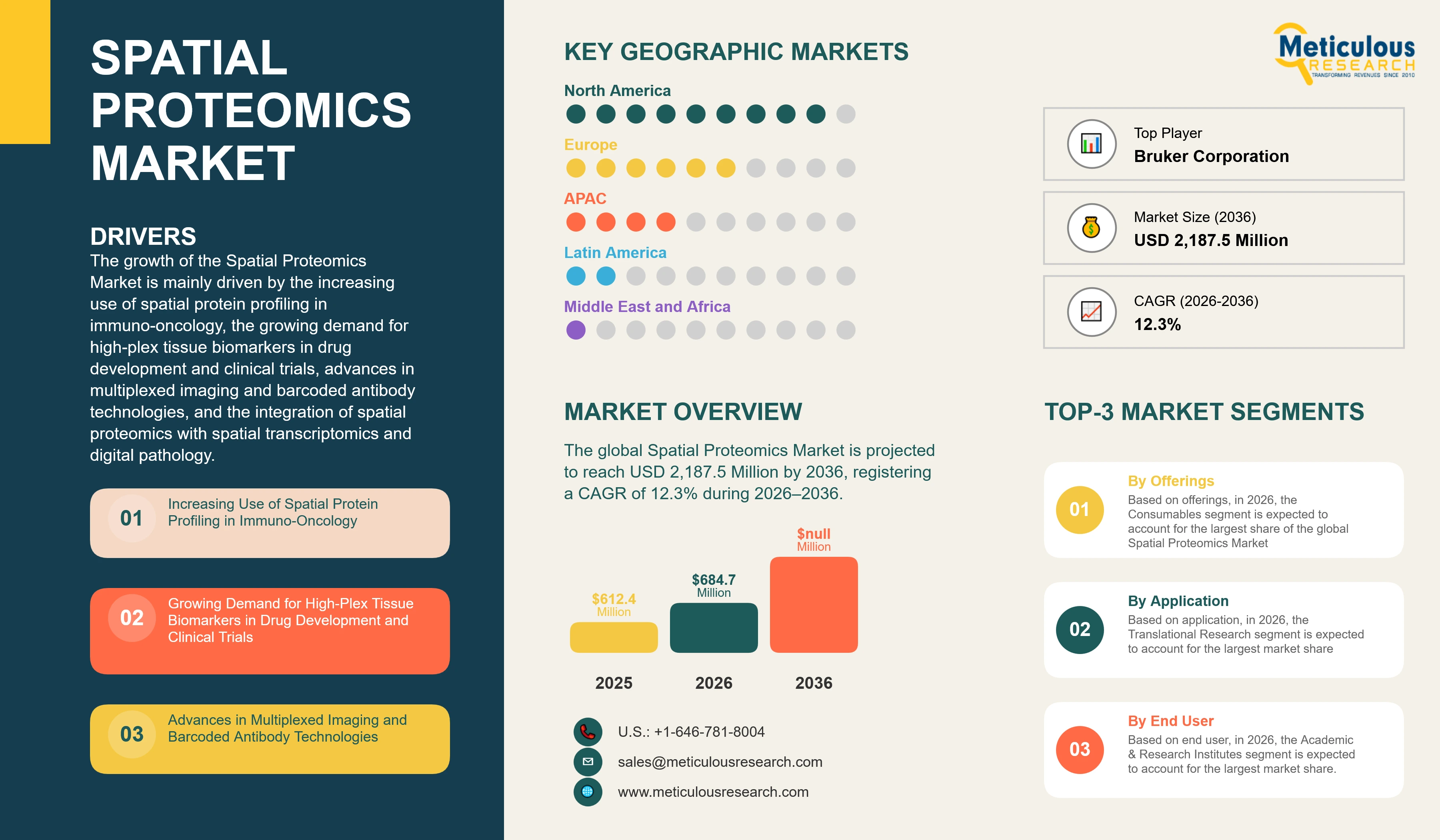
The global Spatial Proteomics Market was valued at USD 612.4 million in 2025. This market is expected to reach USD 2,187.5 million by 2036 from an estimated USD 684.7 million in 2026, registering a CAGR of 12.3% during the forecast period (2026-2036).
- Published
- Oct 2026
- Pages
- 317
- Format
- PDF + Excel
- Report ID
- MR-2341
- Base year
- 2025
- 2025 · BASELINE
- $612.4M
- 2036
- $2.19B
- CAGR 2026–2036
- 12.3%
2025 baseline · 2026–2036 forecast at 12.3% CAGR · hover a bar for the value
Key highlights
The global Spatial Proteomics Market is projected to reach USD 2, 187.5 million by 2036, driven by immuno-oncology research, tissue biomarker development, higher-throughput platforms, and spatial multiomics.
North America is expected to account for the largest market share in 2026, while Asia-Pacific is projected to register the fastest growth during the forecast period, supported by expanding cancer research, biopharmaceutical development, and spatial biology core facilities in China, Japan, and South Korea.
By technology, Multiplexed Immunofluorescence is expected to account for the largest market share in 2026, whereas Oligonucleotide-Barcoded Antibody Technologies are projected to witness the fastest growth through 2036. In February 2026, Bruker launched the CellScape XR spatial proteomics platform, and at the American Association for Cancer Research (AACR) annual meeting in April 2026 introduced workflows linking its GeoMx Digital Spatial Profiler, CellScape XR, and CosMx Spatial Molecular Imager, presenting 208-plex CellScape XR datasets.
Spatial proteomics is moving into clinical trial biomarker testing. In 2026, RareCyte launched the Orion HT high-throughput spatial imaging system, with 30-slide automation, and the Orion LE system for panel development and translational studies, and Navigate BioPharma Services, a Novartis subsidiary, is among the first to apply Orion HT to clinical trial biomarker testing.
The competitive landscape is consolidating. In June 2026, Merck KGaA, Darmstadt, Germany, announced an agreement to acquire Bio-Techne for USD 11.3 billion, a company whose portfolio includes the Lunaphore COMET platform for fully automated, high-throughput hyperplex analysis of RNA and protein biomarkers on the same tissue section. In July 2026, Standard BioTools agreed to sell its mass cytometry business, which includes the Hyperion imaging mass cytometry platform, to Multiplex Bio for up to USD 10 million, as part of a strategic transformation that includes a reverse merger with Treeline Biosciences.
Report summary
| Particulars | Details |
|---|---|
| Forecast Period | 2026-2036 |
| Base Year | 2025 |
| Estimated Year | 2026 |
| CAGR (Value) | 12.3% |
| Format | PDF, Excel & Cloud Portal · 317 pages |
| Market Size (Value) in 2026 | USD 684.7 Million |
| Market Size (Value) in 2036 | USD 2,187.5 Million |
| Segments Covered | By Offering: Instruments (Multiplexed Immunofluorescence Imaging Systems, Mass Spectrometry Imaging Systems, Digital Spatial Profiling & In Situ Multiomics Systems), Consumables (Antibody Panels & Reagents, Barcoded & Conjugated Antibodies, Kits & Other Consumables), Software, Services. By Technology: Multiplexed Immunofluorescence (Cyclic Immunofluorescence, Spectral Imaging), Mass Spectrometry-Based Imaging (Imaging Mass Cytometry, MALDI Imaging), Oligonucleotide-Barcoded Antibody Technologies, Other Technologies. By Sample Type: FFPE Tissue, Fresh-Frozen Tissue, Other Samples. By Application: Translational Research, Drug Discovery & Development, Clinical Research & Diagnostics, Basic Research. By Indication: Oncology, Immunology & Inflammatory Diseases, Neuroscience, Infectious Diseases, Other Indications. By End User: Academic & Research Institutes, Pharmaceutical & Biotechnology Companies, Contract Research Organizations, Hospitals & Clinical Laboratories. |
| Countries Covered | North America: U.S., Canada. Europe: Germany, U.K., France, Switzerland, Netherlands, Spain, Rest of Europe. Asia-Pacific: China, Japan, South Korea, Singapore, Australia, India, Rest of Asia-Pacific. Latin America: Brazil, Mexico, Rest of Latin America. Middle East & Africa: Saudi Arabia, UAE, Rest of Middle East & Africa. |
| Key Companies | Bruker Corporation, Quanterix Corporation, Bio-Techne Corporation, 10x Genomics, Inc., Danaher Corporation (Leica Microsystems), Miltenyi Biotec B.V. & Co. KG, RareCyte, Inc., and Vizgen, Inc. |
Report overview
Segments covered: offering, technology, application, end user.
The growth of this market is mainly driven by the increasing use of spatial protein profiling in immuno-oncology and translational research, the growing demand for high-plex tissue biomarkers in drug development and clinical trials, continuous advances in multiplexed imaging and barcoded antibody technologies, and the integration of spatial proteomics with spatial transcriptomics and digital pathology. In addition, the introduction of higher-throughput and automated platforms, the use of artificial intelligence (AI) for image analysis and cell phenotyping, and the movement of spatial assays toward clinical research and diagnostics are further supporting the growth of this market.
The Spatial Proteomics Market, also referred to as the multiplexed tissue imaging market, spatial protein profiling market, or high-plex tissue proteomics market, comprises the instruments, consumables, software, and services used to detect and quantify multiple proteins in intact tissue sections and cells while preserving their spatial location. The market includes multiplexed immunofluorescence imaging systems based on cyclic or spectral imaging, such as PhenoCycler, PhenoImager, COMET, MACSima, Cell DIVE, Orion, and CellScape systems; mass spectrometry-based imaging systems, including imaging mass cytometry and matrix-assisted laser desorption/ionization (MALDI) imaging; digital spatial profilers and in situ spatial molecular imagers that use oligonucleotide-barcoded antibodies to measure proteins alongside RNA; consumables such as antibody panels, barcoded and conjugated antibodies, staining reagents, and kits; image analysis and AI software; and spatial proteomics services. These technologies show which cells express which proteins, where those cells are located, and how they interact, providing information that cannot be obtained from bulk or dissociated single-cell analysis. The market ecosystem extends from technology and reagent providers to software developers, contract research and service providers, academic research institutions, pharmaceutical and biotechnology companies, and hospitals and pathology laboratories.
The market is experiencing growth as researchers and drug developers recognize the importance of the tissue microenvironment in disease and treatment response. In cancer, the location and interactions of tumor cells, immune cells, and stromal cells strongly influence whether a tumor responds to immunotherapy, and traditional immunohistochemistry can measure only one or a few markers per tissue section. Spatial proteomics can measure dozens to hundreds of proteins in a single section, enabling detailed mapping of cell types, functional states, and cellular neighborhoods. Bruker has presented 208-plex datasets on its CellScape XR platform, and Quanterix offers the PhenoCode Discovery IO60 Human Protein Panel covering 60 biomarkers in a single assay, illustrating the depth of analysis now possible.
Technology providers are introducing higher-throughput, more automated, and more integrated platforms. In February 2026, Bruker launched the CellScape XR spatial proteomics platform, and at the American Association for Cancer Research (AACR) annual meeting in April 2026 introduced workflows linking its GeoMx Digital Spatial Profiler, CellScape XR, and CosMx Spatial Molecular Imager, presenting 208-plex CellScape XR datasets. Quanterix, which completed the acquisition of Akoya Biosciences in July 2025, reported Q2 2026 revenue of USD 32.9 million, up 34%, launched a Spatial Molecular Barcoding kit for the PhenoCycler Fusion and Spatial Spectral DAPI 2.0 for the PhenoImager HT, and lowered its 2026 revenue guidance to USD 142 million to USD 148 million, assuming no improvement in academic or pharmaceutical end markets. In 2026, RareCyte launched the Orion HT high-throughput spatial imaging system, with 30-slide automation, and the Orion LE system for panel development and translational studies, and Navigate BioPharma Services, a Novartis subsidiary, is among the first to apply Orion HT to clinical trial biomarker testing. These developments are expanding spatial proteomics from discovery research to larger translational studies and clinical trial biomarker analysis, where throughput, reproducibility, and standardized workflows are critical.
Spatial proteomics is also increasingly combined with spatial transcriptomics and digital pathology. The Lunaphore COMET platform of Bio-Techne enables the detection of RNA and protein biomarkers on the same tissue section when combined with RNAscope technology, and Bio-Techne has developed a 21-plex sequential immunofluorescence panel with clinically validated antibodies for profiling lymphoid malignancies. 10x Genomics launched its Atera in situ spatial biology platform in April 2026 and has established clinical collaborations with leading cancer centers in Boston, including Dana-Farber Cancer Institute, as well as the Cleveland Clinic and Lausanne University Hospital, reflecting growing interest in spatial analysis for cancer diagnostics.
The competitive landscape is consolidating and restructuring. Bruker acquired NanoString, the developer of GeoMx and CosMx, in 2024, and Quanterix completed the acquisition of Akoya Biosciences in July 2025. In June 2026, Merck KGaA, Darmstadt, Germany, announced an agreement to acquire Bio-Techne for USD 11.3 billion, a company whose portfolio includes the Lunaphore COMET platform for fully automated, high-throughput hyperplex analysis of RNA and protein biomarkers on the same tissue section. In July 2026, Standard BioTools agreed to sell its mass cytometry business, which includes the Hyperion imaging mass cytometry platform, to Multiplex Bio for up to USD 10 million, as part of a strategic transformation that includes a reverse merger with Treeline Biosciences. Vizgen, which includes Ultivue, raised a USD 48 million Series E financing in January 2026, while Miltenyi Biotec continues to expand the use of its MACSima imaging system in core facilities and research institutions in Europe and Asia.
At the same time, the market faces near-term pressure from constrained research budgets. Quanterix reduced its 2026 revenue guidance and recorded a USD 26.9 million goodwill impairment related to Akoya, Bruker reported that U.S. academic demand remained soft in Q2 2026, and the Diagnostics and Spatial Biology segment of Bio-Techne recorded revenue of USD 336.4 million in the fiscal year ended June 2026, down 2.4%. As a result, providers that can demonstrate translational and clinical value, offer higher throughput and lower cost per sample, and support pharmaceutical customers are expected to capture the largest share of growth over the forecast period.
Report infographic
Market dynamics
15 factors across 5 forcesIncreasing Use of Spatial Protein Profiling in Immuno-Oncology
The increasing use of spatial protein profiling in immuno-oncology is a major factor driving the Spatial Proteomics Market, as the spatial organization of tumor, immune, and stromal cells is a key determinant of response to immune checkpoint inhibitors and other immunotherapies. Spatial proteomics enables researchers to measure immune cell types, activation states, and checkpoint proteins in their tissue context, and to identify spatial biomarkers that predict treatment response more accurately than single-marker assays. Panels such as the Quanterix PhenoCode Discovery IO60 Human Protein Panel, which measures 60 immuno-oncology biomarkers at once, are designed specifically for these applications.
As immunotherapy expands across cancer types and combination therapies, demand for spatial biomarkers to understand mechanisms of response and resistance is growing. These trends are increasing demand for multiplexed imaging instruments, antibody panels, and analysis software in oncology research and drug development.
Growing Demand for High-Plex Tissue Biomarkers in Drug Development and Clinical Trials
The growing demand for high-plex tissue biomarkers in drug development and clinical trials is significantly accelerating market growth, as pharmaceutical companies seek to stratify patients, confirm mechanism of action, and identify predictive biomarkers from limited biopsy samples. In 2026, RareCyte launched the Orion HT high-throughput spatial imaging system, with 30-slide automation, and the Orion LE system for panel development and translational studies, and Navigate BioPharma Services, a Novartis subsidiary, is among the first to apply Orion HT to clinical trial biomarker testing. A July 2026 Nature Communications paper also used the Orion platform in a Phase I/II colorectal cancer trial.
Clinical trial applications require high throughput, reproducibility, and standardized workflows, and often involve outsourcing to specialized service providers. As spatial biomarkers become more widely used in clinical development, demand for automated platforms, validated panels, and spatial proteomics services is expected to grow steadily over the forecast period.
Advances in Multiplexed Imaging and Barcoded Antibody Technologies
Continuous advances in multiplexed imaging and barcoded antibody technologies are expanding the number of proteins that can be measured, the size of tissue areas that can be imaged, and the speed of analysis. In February 2026, Bruker launched the CellScape XR spatial proteomics platform, and at the American Association for Cancer Research (AACR) annual meeting in April 2026 introduced workflows linking its GeoMx Digital Spatial Profiler, CellScape XR, and CosMx Spatial Molecular Imager, presenting 208-plex CellScape XR datasets. Quanterix has launched a Spatial Molecular Barcoding kit for the PhenoCycler Fusion, and RareCyte has introduced 30-slide automation with Orion HT. These technologies are increasing plex, resolution, and throughput, supporting adoption across research and translational applications.
Integration of Spatial Proteomics with Spatial Transcriptomics and Digital Pathology
The integration of spatial proteomics with spatial transcriptomics and digital pathology is creating new demand, as researchers seek to understand both gene expression and protein activity in the same tissue. Bio-Techne enables RNA and protein detection on the same tissue section by combining RNAscope with the Lunaphore COMET platform, and Bruker has linked its GeoMx, CellScape XR, and CosMx platforms in integrated workflows. Spatial multiomic data provide a more complete picture of cell identity and function, increasing the value of spatial proteomics in cancer, immunology, and neuroscience research.
Table of contents
14 chapters · 157 sections · 317 pages · click to expandSegmental analysis
| Segment | Largest share (2026) | Fastest growth (2026–2036) |
|---|---|---|
| By Offering | Consumables | Software |
| By Technology | Multiplexed Immunofluorescence | Oligonucleotide-Barcoded Antibody Technologies |
| By Sample Type | FFPE Tissue | FFPE Tissue |
| By Application | Translational Research | Clinical Research & Diagnostics |
| By End User | Academic & Research Institutes | Pharmaceutical & Biotechnology Companies |
By Offering
- Spatial Proteomics Market Analysis by Offering
- Instruments are further segmented into Multiplexed Immunofluorescence Imaging Systems, Mass Spectrometry Imaging Systems, and Digital Spatial Profiling & In Situ Multiomics Systems.
- Consumables are further segmented into Antibody Panels & Reagents, Barcoded & Conjugated Antibodies, and Kits & Other Consumables.
- The Consumables segment is expected to account for the largest share of the global Spatial Proteomics Market.
- The large share of this segment is mainly due to the recurring use of antibody panels, barcoded and conjugated antibodies, staining reagents, and kits in every spatial proteomics experiment, and the growing installed base of multiplexed imaging and spatial profiling platforms.
- The constrained capital spending reported by leading providers in 2026 also supports a higher share for recurring consumables relative to instruments.
- However, the Software segment is projected to register the highest CAGR during the forecast period.
- The rapid growth of this segment is attributed to the increasing size and complexity of high-plex spatial datasets, the need for automated cell segmentation and phenotyping, and the growing use of AI for spatial pattern analysis and biomarker discovery.
- The Instruments segment is expected to account for a significant share, supported by new platforms such as CellScape XR, Orion HT, and Orion LE launched in 2026, while the Services segment is expected to record strong growth as pharmaceutical companies outsource clinical trial biomarker studies.
By Technology
- Spatial Proteomics Market Analysis by Technology
- Multiplexed immunofluorescence is further segmented into Cyclic Immunofluorescence and Spectral Imaging, while mass spectrometry-based imaging is further segmented into Imaging Mass Cytometry and MALDI Imaging.
- The Multiplexed Immunofluorescence segment is expected to account for the largest market share, due to the wide installed base of platforms such as PhenoCycler, PhenoImager, COMET, MACSima, Cell DIVE, Orion, and CellScape, their compatibility with standard pathology workflows, and their use in both discovery and translational research.
- However, the Oligonucleotide-Barcoded Antibody Technologies segment is projected to register the highest CAGR during the forecast period, owing to their ability to measure high numbers of proteins and to combine protein and RNA detection, as demonstrated by the integration of GeoMx and CosMx workflows by Bruker and the spatial molecular barcoding kit introduced by Quanterix.
By Sample Type
- Spatial Proteomics Market Analysis by Sample Type
- The FFPE Tissue segment is expected to account for the largest market share and register the highest CAGR during the forecast period, as FFPE tissue is the standard format for clinical pathology archives and clinical trial biopsies, making it critical for translational and clinical applications of spatial proteomics.
By Application
- Spatial Proteomics Market Analysis by Application
- The Translational Research segment is expected to account for the largest market share, due to the extensive use of spatial proteomics to understand disease mechanisms, identify biomarkers, and link tissue features to clinical outcomes in academic medical centers and cancer research institutes.
- However, the Clinical Research & Diagnostics segment is projected to register the highest CAGR during the forecast period, driven by the use of spatial biomarkers in clinical trials, the development of clinically validated panels, and collaborations between spatial biology companies and leading cancer centers.
- Oncology is expected to account for the largest share, supported by immuno-oncology research and drug development.
By End User
- Spatial Proteomics Market Analysis by End User
- The Academic & Research Institutes segment is expected to account for the largest market share, as universities, research institutes, and core facilities account for a large share of the installed base of spatial proteomics platforms.
- However, the Pharmaceutical & Biotechnology Companies segment is projected to register the highest CAGR during the forecast period, driven by the use of spatial biomarkers in immuno-oncology drug development and clinical trials, while Contract Research Organizations are expected to record strong growth as drug developers outsource spatial biomarker studies.
Geographic analysis
North America
Largest shareIn 2026, North America is expected to account for the largest share of the global Spatial Proteomics Market. The large share of this region is mainly attributed to the concentration of cancer research centers, academic medical centers, pharmaceutical and biotechnology companies, and leading spatial biology providers, including Bruker Spatial Biology, Quanterix, 10x Genomics, RareCyte, and Vizgen. Clinical collaborations, such as those between 10x Genomics and Dana-Farber Cancer Institute and the Cleveland Clinic, and the use of Orion HT by Navigate BioPharma Services for clinical trial biomarker testing, are expanding the use of spatial proteomics in translational and clinical research. However, soft U.S. academic demand reported by Bruker and Quanterix in 2026 is expected to moderate near-term instrument growth in the region. Canada is expected to contribute to regional growth, supported by cancer research institutes and academic core facilities.
Europe
Europe is expected to account for a significant share of the market, supported by strong academic research, cancer research networks, and the presence of leading technology providers. Germany is an important market, as the home of Miltenyi Biotec and Merck KGaA and a major center of Bruker operations, while Switzerland is home to Lunaphore, the developer of the COMET platform, and Lausanne University Hospital, which collaborates with 10x Genomics on cancer diagnostics. The U.K., France, the Netherlands, Spain, and the Nordic countries are also expected to contribute, supported by core facilities and translational research centers. Bruker reported strong growth in academic and government bookings in Europe in Q2 2026, supporting demand in the region.
Asia-Pacific
Fastest growthAsia-Pacific is projected to register the highest CAGR during the forecast period. The growth of this region is driven by expanding cancer research, growing biopharmaceutical development, and investment in spatial biology core facilities. Bruker reported strong academic and government bookings in China in Q2 2026, and research institutions such as the University of Hong Kong are hosting spatial multiomics technology programs. China is expected to account for the largest share within Asia-Pacific, while Japan, South Korea, Singapore, and Australia are expected to see strong growth, supported by translational cancer research and clinical research programs. India is also expected to emerge as a growing market.
Latin America
Latin America and the Middle East & Africa are expected to account for smaller shares of the market, with demand supported by academic cancer research and the development of precision oncology programs in selected countries, including Brazil, Saudi Arabia, and the UAE.
Competitive landscape
The global Spatial Proteomics Market is moderately consolidated, with a group of leading spatial biology and life science tools companies accounting for a significant share of the market, alongside specialized imaging platform developers, antibody and reagent suppliers, software providers, and service companies. Market participants compete primarily on plex, resolution, throughput, automation, compatibility with FFPE tissue, integration with RNA detection, panel availability, software and AI capabilities, and support for translational and clinical studies.
Leading companies are launching higher-throughput platforms, developing validated antibody panels, integrating protein and RNA workflows, investing in AI-enabled software, and expanding into clinical research. The market is also undergoing significant consolidation. Recent examples include the acquisition of NanoString by Bruker in 2024, the completion of the Akoya acquisition by Quanterix in July 2025, the launch of CellScape XR by Bruker in February 2026, the launch of Orion HT and Orion LE by RareCyte in 2026, the agreement by Merck KGaA to acquire Bio-Techne in June 2026, and the agreement by Standard BioTools to sell its mass cytometry business in July 2026.
The report provides a comprehensive competitive assessment of the leading companies operating in the global Spatial Proteomics Market. The key players profiled in the report include Bruker Corporation (U.S.), Quanterix Corporation (U.S.), Bio-Techne Corporation (U.S.), 10x Genomics, Inc. (U.S.), Danaher Corporation (Leica Microsystems) (U.S.), Miltenyi Biotec B.V. & Co. KG (Germany), RareCyte, Inc. (U.S.), and Vizgen, Inc. (U.S.).
- Bruker Corporation
- Quanterix Corporation
- Bio-Techne Corporation
- 10x Genomics, Inc.
- Danaher Corporation · Leica Microsystems
- Miltenyi Biotec B.V. & Co. KG
- RareCyte, Inc.
- Vizgen, Inc
Expert perspectives
The Spatial Proteomics Market is entering a period in which translational and clinical value, rather than plex alone, is becoming the main driver of adoption. With providers now offering panels from 60 to more than 200 proteins, automated platforms processing 30 slides at a time, and pharmaceutical service providers applying spatial assays to clinical trial biomarker testing, spatial proteomics is moving from discovery research toward routine use in drug development. The binding constraint is shifting from the number of proteins that can be measured to the ability to generate standardized, reproducible, and interpretable data at the throughput and cost that pharmaceutical and clinical customers require.
Three structural changes are expected to shape competitive positions through 2036. First, consolidation is concentrating the market among larger life science companies, including Bruker, Quanterix, and Merck KGaA through Bio-Techne, favoring providers with broad portfolios and commercial reach. Second, the combination of protein and RNA detection on the same tissue section is expected to become a standard requirement, increasing the importance of integrated platforms. Third, near-term pressure on academic budgets is shifting growth toward pharmaceutical, contract research, and clinical applications.
For companies planning entry or expansion, the most defensible positions over the forecast period are likely to be found in AI-enabled spatial analysis software, validated panels for clinical trial biomarkers, spatial proteomics services for pharmaceutical customers, and clinically oriented FFPE workflows. For established providers, the principal risks are constrained research budgets, the lack of standardization, and uncertainty created by ownership changes and restructuring.
Overall, the market is expected to grow strongly over the forecast period after a period of slower near-term demand, with consumables, multiplexed immunofluorescence, and translational research providing the core of demand and software, barcoded antibody technologies, clinical research, pharmaceutical customers, and Asia-Pacific providing the fastest growth.
Customer perspectives
Insights gathered during primary interviews with spatial biology core directors, translational oncology scientists, and clinical biomarker leaders operating in this market highlight where procurement priorities are shifting. The following perspectives reflect recurring themes raised across these discussions.
“This reflects the shift toward throughput and reproducibility in purchasing decisions.”
“This indicates the growing role of spatial proteomics in clinical development.”
“This points to the importance of multiomic integration and AI for clinical translation.”
Frequently asked questions
The global Spatial Proteomics Market is estimated at USD 684.7 million in 2026.
Cite this report
Meticulous Research. (2026). Spatial Proteomics Market - Global Opportunity Analysis And Industry Forecast (2026-2036) (Report No. MR-2341). Meticulous Market Research Pvt. Ltd. https://www.meticulousresearch.com/product/spatial-proteomics-market-7024