Southeast Asia Data Center Market (2026-2036)
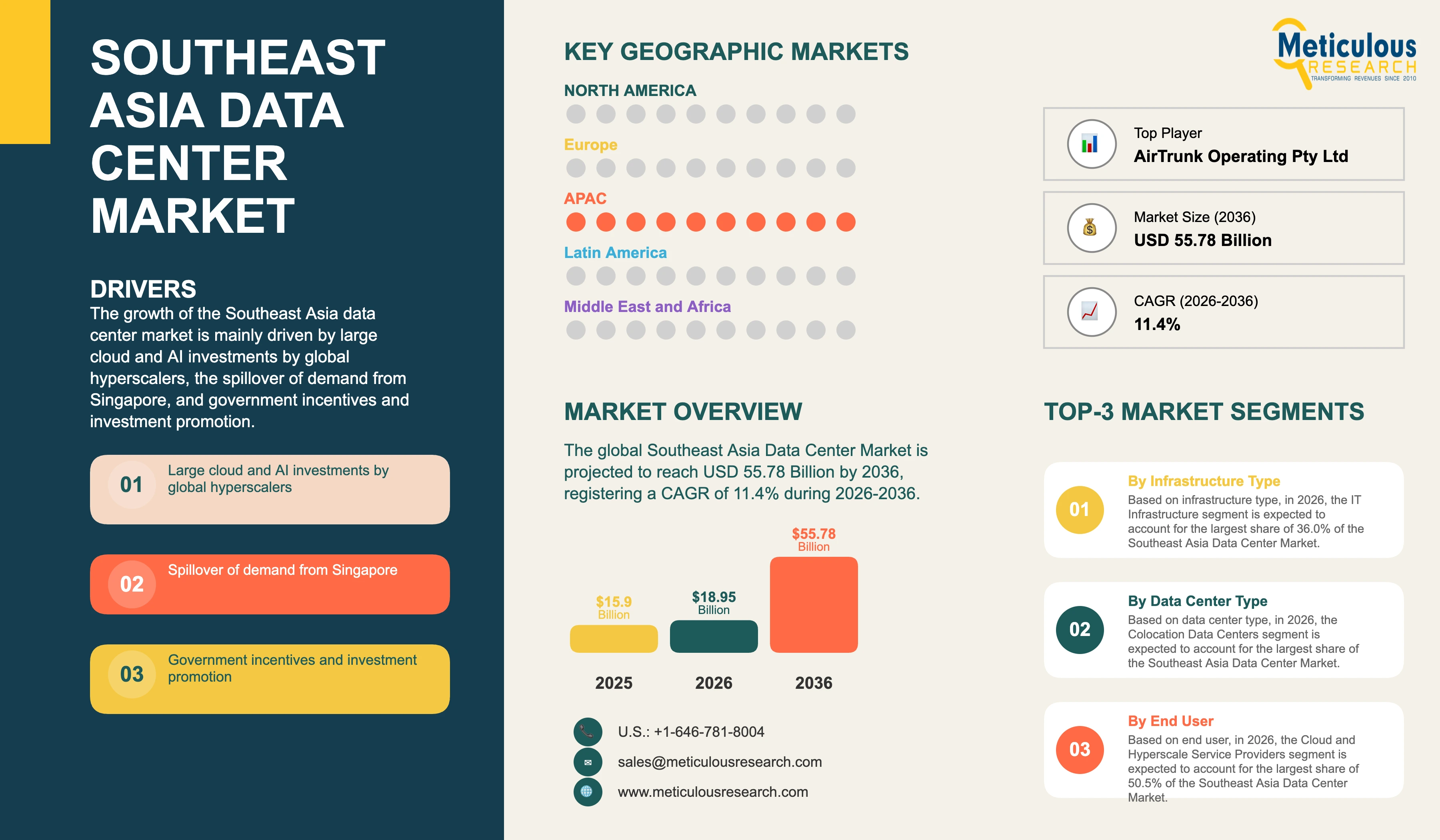
The Southeast Asia data center market was valued at USD 15.90 billion in 2025. This market is expected to reach USD 55.78 billion by 2036 from an estimated USD 18.95 billion in 2026, registering a CAGR of 11.4% during the forecast period (2026-2036). In terms of volume, the installed operational IT capacity of data centers in Southeast Asia is expected to reach 13,152 MW by 2036 from an estimated 4,050 MW in 2026, registering a CAGR of 12.5% during the forecast period.
- Published
- Nov 2026
- Pages
- 210
- Format
- PDF + Excel
- Report ID
- MRICT - 1042518
- Base year
- 2025
- 2025 · BASELINE
- $15.90B
- 2036
- $55.78B
- CAGR 2026–2036
- 11.4%
2025 baseline · 2026–2036 forecast at 11.4% CAGR · hover a bar for the value
Key highlights
Southeast Asia accounted for about half of Asia-Pacific's under-construction data center capacity in the first half of 2026, with 2,382 MW under construction, led by Malaysia at 1,039 MW and Thailand at 859 MW.
Johor's operational IT capacity rose 24% from the second half of 2025 to 1, 110 MW in the first half of 2026, up from 94 MW in 2023, making it one of the largest data center markets in Asia-Pacific alongside Singapore.
Malaysia approved RM95.8 billion in data center and cloud computing investments in the first half of 2026, close to 44% of all approved investments in the country, and data center-related approvals have reached RM385.7 billion since 2021.
Thailand's Board of Investment received 36 data center applications worth THB 728 billion in 2025, approved seven projects worth more than THB 96 billion in January 2026, and approved three data center projects worth THB 913 billion in May 2026, led by TikTok.
Singapore provisionally allocated 200 MW of new capacity to Digital Realty, Equinix, Keppel Data Centres, and ST Telemedia Global Data Centres in August 2026 under its second Data Centre Call for Application, with all four facilities to be located on Jurong Island.
Thailand temporarily suspended new data center approvals in September 2026 while it prepares new rules on energy and water use, and Malaysia has said that new projects will be approved only after power and water supply is confirmed.
Mechanical infrastructure is the fastest-growing infrastructure type, hyperscale self-build data centers are the fastest-growing data center type, and AI and GPU cloud providers are the fastest-growing end user.
By infrastructure type, IT infrastructure accounts for the largest share of 36.0% in 2026, while mechanical infrastructure registers the highest CAGR.
By data center type, colocation data centers account for the largest share in 2026, while hyperscale self-build data centers register the highest CAGR.
By tier standard, Tier III data centers account for the largest share in 2026, while Tier IV data centers register the highest CAGR.
By facility size, data centers above 50 MW account for the largest share in 2026 and also register the highest CAGR.
By end user, cloud and hyperscale service providers account for the largest share of 50.5% in 2026, while AI and GPU cloud providers register the highest CAGR.
By country, Malaysia accounts for the largest share of 33.0% in 2026, while Thailand registers the highest CAGR of 15.1%.
Report summary
| Particulars | Details |
|---|---|
| Base Year | 2025 |
| Estimated Year | 2026 |
| Forecast Period | 2026-2036 |
| Market Size in 2025 | USD 15.90 billion |
| Market Size in 2026 | USD 18.95 billion |
| Market Size by 2036 | USD 55.78 billion |
| CAGR (2026-2036) | 11.4% |
| Format | PDF, Excel & Cloud Portal · 210 pages |
| Installed IT Capacity (2026 to 2036) | 4,050 MW to 13,152 MW (CAGR 12.5%) |
| Largest Segment by Infrastructure Type (2026) | IT Infrastructure (36.0%) |
| Largest Segment by End User (2026) | Cloud and Hyperscale Service Providers (50.5%) |
| Largest Country (2026) | Malaysia (33.0%) |
| Fastest-Growing Country | Thailand (CAGR 15.1%) |
| Segments Covered | Infrastructure Type, Data Center Type, Tier Standard, Facility Size, End User, and Country |
| Geographic Scope | Malaysia, Singapore, Indonesia, Thailand, Vietnam, the Philippines, and Rest of Southeast Asia |
| Key Companies Profiled | AirTrunk, DayOne, ST Telemedia Global Data Centres, Equinix, Digital Realty, Princeton Digital Group, NTT DATA, Keppel Data Centres, Bridge Data Centres, YTL Data Centers, Schneider Electric, Vertiv, Eaton, and ABB |
Report overview
Segments covered: infrastructure type, data center type, tier standard, facility size, end user.
The growth of this market is mainly driven by large cloud and AI infrastructure investments by global hyperscalers, the spillover of demand from Singapore to Johor, Batam, and other nearby locations, strong government incentives for data center investment in Malaysia, Thailand, Indonesia, and the Philippines, and the rapid growth of the region's digital economy and data localization rules. However, factors such as constraints on power and water supply, rising electricity tariffs, and tighter approval rules for new data centers are expected to restrain the growth of this market to some extent.
Data centers are facilities that house the servers, storage, and network equipment used to run cloud services, websites, business applications, and, increasingly, artificial intelligence (AI) models. A data center combines IT infrastructure with the electrical systems that supply and back up power, the mechanical systems that remove heat, and the buildings, security, and management systems that house and run them. The Southeast Asia data center market covers investment in all of these elements across Malaysia, Singapore, Indonesia, Thailand, Vietnam, the Philippines, and the rest of the region. Capacity in this market is usually measured in megawatts of IT load, which reflects the amount of power available to run IT equipment, and investment per megawatt has been rising as new facilities are designed for denser AI equipment.
Southeast Asia has become one of the fastest-growing data center regions in the world, and in the first half of 2026 it accounted for about half of the data center capacity under construction in Asia-Pacific. For many years, Singapore was the region's main hub because of its strong connectivity, stable regulation, and large financial sector, and it still has more than 1,000 MW of operational IT capacity. However, a pause on new data centers in Singapore from 2019 to 2022 and continued limits on land and power have pushed much of the new demand to nearby locations, especially Johor in Malaysia and Batam in Indonesia.
Johor has grown faster than any other data center market in the region, with operational IT capacity rising from 94 MW in 2023 to 1,110 MW in the first half of 2026 and a development pipeline of more than 3,000 MW. Greater Kuala Lumpur has also attracted large investments from hyperscalers such as Microsoft, Google, and AWS. Thailand has emerged as the next major growth market, with Bangkok's under-construction capacity rising to 859 MW and very large investment approvals from the Board of Investment, while Indonesia, Vietnam, and the Philippines are growing from smaller bases, supported by large domestic populations and data localization rules.
Demand comes mainly from global cloud providers such as AWS, Microsoft, Google, Oracle, Alibaba Cloud, and Tencent Cloud, which are building cloud regions across the region, and from digital platforms such as TikTok, which has plans for very large data infrastructure in Thailand. AI is adding a new layer of demand, as GPU clusters for training and inference need very high power density and liquid cooling, and some operators are building campuses designed for AI from the start. Chinese technology companies have also become important customers, using Southeast Asian data centers to serve their regional businesses and international clients. Enterprises, banks, telecom operators, and governments also continue to add capacity, often through colocation providers.
The market is served by a mix of colocation operators, hyperscalers that build their own data centers, and infrastructure vendors. Leading colocation operators include AirTrunk, DayOne, ST Telemedia Global Data Centres, Equinix, Digital Realty, Princeton Digital Group, NTT DATA, Keppel Data Centres, Bridge Data Centres, and YTL Data Centers, while vendors such as Schneider Electric, Vertiv, Eaton, and ABB supply power and cooling equipment. Many operators are backed by large investment funds and are building multi-hundred-megawatt campuses for single hyperscale customers. Construction contractors, engineering firms, and local utilities also play a key role, as the speed of grid connection and construction often decides when new capacity can open.
Rapid growth has also created pressure on power grids, water supply, and land, which is leading governments to tighten their rules. Malaysia has introduced guidelines for sustainable data centers and said that new projects will only be approved once power and water supply is confirmed, while Thailand paused new approvals in September 2026 to prepare new rules. Singapore allocates new capacity through a competitive process that rewards green energy and high efficiency, and it has set aside land on Jurong Island for a large low-carbon data center park. These policies are expected to shape where and how fast new capacity is built over the forecast period.
Report infographic
Market dynamics
15 factors across 5 forcesLarge cloud and AI investments by global hyperscalers
Global cloud providers have announced very large investments in Southeast Asia to serve growing demand for cloud services and AI and to meet local data residency requirements. AWS operates cloud regions in Singapore, Indonesia, Malaysia, and Thailand and is discussing a region in the Philippines that could involve up to USD 5 billion over 15 years. Microsoft is investing USD 1.7 billion in cloud and AI infrastructure in Indonesia and is building data centers in Malaysia, and Google launched a cloud region in Bangkok in January 2026 and is building its first Malaysian data center in Selangor.
These investments create demand both for self-built hyperscale campuses and for large wholesale colocation contracts, as hyperscalers often lease capacity from operators such as AirTrunk, DayOne, and Princeton Digital Group to expand quickly. Global hyperscaler capital spending is expected to exceed USD 600 billion in 2026, and Southeast Asia is receiving a growing share of this spending as providers expand outside the U.S. and look for locations with available power and land. Cloud and hyperscale service providers account for the largest share of the market. Each new cloud region also attracts partners, software providers, and enterprises that need nearby capacity, which adds further demand.
Spillover of demand from Singapore
Singapore's limits on new data center capacity have pushed a large share of new demand to nearby locations, especially Johor in Malaysia and Batam in Indonesia, which can serve customers with low latency to Singapore's network hub. Singapore paused new data centers from 2019 to 2022 and now allocates new capacity through selective calls for applications, awarding about 80 MW in its pilot exercise and 200 MW in August 2026, which is small compared with demand.
Johor offers large land banks, lower costs, and access to power, and operators have built large campuses there to serve hyperscale customers, with operational capacity reaching 1,110 MW in the first half of 2026 and colocation vacancy of less than 1%. Batam is also attracting investment, including a planned 360 MW AI data center by Firmus Technologies. This spillover is a key reason why Malaysia holds the largest share of the market. The Johor-Singapore Special Economic Zone is also expected to support further investment by easing movement of people and goods between the two locations.
Government incentives and investment promotion
Governments across Southeast Asia are actively promoting data center investment as part of their digital economy plans. Thailand's Board of Investment offers tax incentives for data centers, with stronger incentives for energy-efficient and GPU-enabled facilities, and it received 36 data center applications worth THB 728 billion in 2025. Malaysia has set up a Data Centre Task Force to speed up approvals for flagship projects, with 27 flagship projects worth RM225.97 billion approved as of July 2026, and Indonesia and the Philippines are offering incentives and opening their markets to foreign operators.
These policies, along with the availability of land and power, have made Southeast Asia one of the most attractive regions for data center investment. Government support for renewable energy supply, such as green tariffs and direct power purchase options, is also helping operators meet the sustainability targets of hyperscale customers. Thailand, which has drawn the largest wave of new approvals, is the fastest-growing country in this market. Several governments are also building national AI and sovereign cloud programs, which create further demand for local data center capacity.
Growth of the digital economy and data localization
Southeast Asia has a population of more than 680 million people and one of the fastest-growing digital economies in the world, with strong growth in e-commerce, digital payments, streaming, gaming, and online services. Companies such as Grab, Shopee, Lazada, TikTok Shop, and many banks and telecom operators need local data center capacity to serve their users with low latency and high reliability.
Data localization and data protection rules in Indonesia, Vietnam, and other countries require some types of data, especially government and financial data, to be stored locally, which pushes cloud providers and enterprises to build or lease capacity in each country. The growth of AI applications in local languages and the adoption of cloud services by small businesses and governments are expected to add further demand over the forecast period. E-commerce, media, and digital platform companies also make up a growing share of demand as they expand their own infrastructure.
Table of contents
13 chapters · 126 sections · 210 pages · click to expandGeographic analysis
Asia-Pacific
Largest shareIn 2026, Malaysia is expected to account for the largest share of 33.0% of the Southeast Asia data center market. The large share of this country is mainly due to the rapid growth of Johor as a hyperscale hub, large investments in Greater Kuala Lumpur, strong government support, and the availability of land and power compared with Singapore. Malaysia has attracted more data center investment than any other country in the region in recent years, with RM95.8 billion of data center and cloud investments approved in the first half of 2026 alone and RM385.7 billion approved since 2021. Johor's operational capacity grew from 94 MW in 2023 to 1,110 MW in the first half of 2026, and Malaysia led Southeast Asia with 1,039 MW of capacity under construction. Major hyperscalers, including Microsoft, Google, and AWS, are investing in the country, and operators such as YTL Data Centers, DayOne, AirTrunk, Princeton Digital Group, and Bridge Data Centres have built large campuses. However, the government is tightening its approach, focusing on AI-related projects and requiring confirmed power and water supply, which could slow the pace of new approvals while improving the quality of investment. Malaysia's share is expected to decline gradually as other countries grow faster, but it will remain the largest market over the forecast period. Thailand is projected to register the highest CAGR of 15.1% during the forecast period. Growth is driven by very large investment approvals from the Board of Investment, including THB 913 billion of data center projects led by TikTok in May 2026, Google's new cloud region in Bangkok, and large campuses by True IDC, GSA Data Center (Gulf, Singtel, and AIS), Bridge Data Centres, and others in Chonburi, Rayong, and Samut Prakan. The temporary suspension of new approvals in September 2026 may slow growth in the short term, but new rules on energy and water use are expected to support more sustainable growth. Singapore holds a significant share of the market, supported by its role as the region's main connectivity and financial hub, more than 1,000 MW of operational capacity, and the 200 MW allocated in August 2026, although its growth is limited by land and power. Indonesia, led by Greater Jakarta and Batam, is growing quickly because of its large population, data localization rules, and investments by hyperscalers, while Vietnam and the Philippines are emerging markets with strong long-term potential. The rest of Southeast Asia includes Cambodia, Myanmar, Laos, and Brunei, where demand is still small.
Competitive landscape
The Southeast Asia data center market is fragmented, with a mix of global and regional colocation operators, hyperscalers that build their own campuses, telecom-backed operators, and local developers. Leading colocation operators include AirTrunk, DayOne, ST Telemedia Global Data Centres, Equinix, Digital Realty, Princeton Digital Group, NTT DATA, Keppel Data Centres, Bridge Data Centres, and YTL Data Centers, each with large campuses or portfolios in several countries. Hyperscalers such as AWS, Microsoft, and Google are also major builders of capacity in their own right.
Competition among operators centers on access to land and power, speed of delivery, ability to support high-density AI workloads, renewable energy supply, and relationships with hyperscale customers. Infrastructure vendors such as Schneider Electric, Vertiv, Eaton, and ABB compete to supply power and cooling equipment, while IT vendors supply servers, storage, and networking. Telecom operators, such as Telkom Indonesia, True, AIS, Singtel, and TM, also operate data centers, often in partnership with global operators.
The top five operators are estimated to account for 38.5% of operational IT capacity in 2025, reflecting the strong positions of large hyperscale-focused operators in Johor and Singapore. Hyperscalers' own self-built capacity is not included in this estimate, and Microsoft, Google, and AWS together control a large additional share of the region's capacity through their owned campuses. The market is consolidating as global funds back regional platforms and as operators acquire sites and smaller providers to expand into new countries.
Operators use several strategies to grow in this market, including building large master-planned campuses, signing long-term contracts with hyperscale anchor customers, securing renewable energy and water supply, partnering with local conglomerates and telecom operators, and raising capital from global investment funds. Many operators are also designing new facilities for liquid cooling and AI workloads. Competition is expected to center on power availability, AI readiness, sustainability, and the ability to deliver capacity quickly in several countries. Smaller and local operators often compete by focusing on specific cities, enterprise customers, or government contracts. Chinese operators, such as DayOne, which grew out of GDS's international business, have also expanded quickly in the region to serve Chinese and international customers, adding further competition in Johor, Batam, and Thailand.
Some of the key players operating in the Southeast Asia data center market are AirTrunk Operating Pty Ltd, DayOne Data Centers Limited, ST Telemedia Global Data Centres, Equinix, Inc., Digital Realty Trust, Inc., Princeton Digital Group, NTT DATA Group Corporation, Keppel Data Centres, Bridge Data Centres, YTL Power International Berhad (YTL Data Centers), Schneider Electric SE, Vertiv Holdings Co., Eaton Corporation plc, and ABB Ltd.
- —
Singapore allocated 200 MW to Digital Realty, Equinix, Keppel Data Centres, and ST Telemedia Global Data Centres in August 2026, Thailand approved THB 913 billion of data center projects led by TikTok in May 2026, Malaysia approved RM95.8 billion of data center investments in the first half of 2026, and AWS is discussing a cloud region in the Philippines.
- AirTrunk
- DayOne
- ST Telemedia Global Data Centres
- Equinix
- Digital Realty
- Princeton Digital Group
- NTT DATA
- Keppel Data Centres
- Bridge Data Centres
- YTL Data Centers
- Schneider Electric
- Vertiv
- Eaton
- ABB
Expert perspectives
The Southeast Asia data center market has become one of the most important growth regions for the global data center industry, driven by hyperscale cloud expansion, the spillover of demand from Singapore, and the rise of AI. In the first half of 2026, the region accounted for about half of Asia-Pacific's under-construction capacity, and Johor grew from a small market to more than 1,000 MW of operational capacity in less than three years. Thailand has emerged as the next major growth market, supported by record investment approvals.
However, the market is entering a new phase in which power, water, and policy matter as much as demand. Malaysia and Thailand have both tightened their approach to new projects, and Singapore continues to allocate capacity carefully, which means that operators with secured power, water, and approvals will have a strong advantage. The gap between announced pipelines and capacity that can actually be built is large, and investors will need to focus on projects with clear access to resources and customers.
Mechanical infrastructure is the fastest-growing infrastructure type, as liquid cooling becomes essential for AI workloads, and hyperscale self-build data centers are the fastest-growing data center type as cloud providers build their own campuses. AI and GPU cloud providers are the fastest-growing end user, and data centers above 50 MW hold the largest share and register the highest CAGR among facility sizes, reflecting the shift to very large campuses.
Malaysia remains the largest market, while Thailand is the fastest-growing country at a CAGR of 15.1%. The main swing factors are the pace of AI demand, the ability of grids to supply new capacity, changes in approval rules in Malaysia and Thailand, U.S. export controls on AI chips, and the growth of emerging markets such as Indonesia, Vietnam, and the Philippines. The pace at which Singapore releases new capacity will also affect how much demand spills over to its neighbors.
For operators and investors, the key decision is where to build, given differences in power availability, policy, and demand across the region. Operators that combine secured power and water, AI-ready designs, renewable energy, and strong hyperscale relationships will be best placed to grow. For hyperscalers and enterprises, spreading capacity across several countries can reduce risk and improve access to local markets. Early commitment matters, as capacity with secured power in prime locations is often taken years before completion.
Overall, growth in this market rests on continued cloud and AI investment and on the ability of governments and utilities to supply power and water sustainably. Operators that plan carefully around these constraints are expected to capture most of this growth.
Customer perspectives
Director of Data Center Capacity Planning - global cloud provider, Singapore
Singapore is still our network hub, but we cannot get enough power there. Most of our new capacity for the region is now in Johor, and we are leasing large blocks from operators who can deliver power on time.
The reliance of cloud providers on colocation operators in Johor and other hubs is why cloud and hyperscale service providers hold 50.5% of the market and why Malaysia holds the largest share at 33.0%. Power delivery dates are now the deciding factor in most capacity decisions.
The rapid growth of AI workloads is driving the fast growth of the AI and GPU cloud providers segment and of mechanical infrastructure, as operators add liquid cooling to new and existing facilities.
Head of Infrastructure - digital bank, Thailand
We need our core systems in the country, in a Tier III or better facility. The new campuses near Bangkok give us local options that did not exist a few years ago, and the hyperscalers being here makes hybrid cloud much easier.
Local data residency needs and new hyperscale investment are supporting rapid growth in Thailand, the fastest-growing country at a CAGR of 15.1%. Financial institutions also drive demand for Tier III and Tier IV facilities, which are growing quickly across the region.
“Our GPU clusters run at more than 100 kW per rack, and very few facilities in the region could support that two years ago. We now choose sites based on liquid cooling and power density first, then price.”
Frequently asked questions
The market was valued at USD 15.90 billion in 2025 and USD 12.85 billion in 2024, and is estimated at USD 18.95 billion in 2026.
The market is expected to reach USD 55.78 billion by 2036, supported by hyperscale cloud and AI investment, the spillover of demand from Singapore, government incentives, and the growth of the region's digital economy.
The market is expected to register a CAGR of 11.4% from 2026 to 2036 in value terms, while installed operational IT capacity is expected to grow at a CAGR of 12.5%, from 4,050 MW in 2026 to 13,152 MW in 2036.
Growth is driven by large cloud and AI investments by global hyperscalers, the spillover of demand from Singapore, government incentives and investment promotion, and the growth of the digital economy and data localization.
Power and water supply constraints and rising electricity costs and tighter approval rules restrain growth, while the risk of oversupply and speculative pipelines and geopolitical and export control risks remain key challenges.
Key opportunities include AI-ready and high-density data centers, renewable energy and green data centers, emerging markets in Indonesia, Vietnam, and the Philippines, and subsea cables and regional connectivity.
Singapore's limits on new data center capacity pushed demand to nearby locations, and Johor offers large land banks, lower costs, access to power, and low latency to Singapore. Its operational capacity grew from 94 MW in 2023 to 1,110 MW in the first half of 2026, with a development pipeline of more than 3,000 MW.
Malaysia has said new projects will only be approved once power and water supply is confirmed and is focusing on AI-related projects, Thailand suspended new approvals in September 2026 to prepare rules on energy and water use, and Singapore allocates new capacity through competitive calls that require green energy and high efficiency.
IT infrastructure is expected to account for the largest share of 36.0% of the market in 2026, while mechanical infrastructure is projected to register the highest CAGR.
Hyperscale self-build data centers are projected to register the highest CAGR among data center types, and Tier IV data centers are projected to register the highest CAGR among tier standards.
Data centers above 50 MW are expected to account for the largest share of the market in 2026 and are also projected to register the highest CAGR.
Cloud and hyperscale service providers are expected to account for the largest share of 50.5% of the market in 2026, while AI and GPU cloud providers are projected to register the highest CAGR.
Malaysia is expected to account for the largest share of 33.0% of the market in 2026.
Thailand is projected to register the highest CAGR of 15.1% during the forecast period, supported by large Board of Investment approvals and hyperscale investments.
The report profiles 14 companies, including AirTrunk, DayOne Data Centers, ST Telemedia Global Data Centres, Equinix, Digital Realty, and Princeton Digital Group. The top five operators account for an estimated 38.5% of operational IT capacity in 2025.
Singapore allocated 200 MW to Digital Realty, Equinix, Keppel Data Centres, and ST Telemedia Global Data Centres in August 2026, Thailand approved THB 913 billion of data center projects led by TikTok in May 2026, Malaysia approved RM95.8 billion of data center investments in the first half of 2026, and AWS is discussing a cloud region in the Philippines.
Cite this report
Meticulous Research. (2026). Southeast Asia Data Center Market - Global Opportunity Analysis and Industry Forecast (2026-2036) (Report No. MRICT - 1042518). Meticulous Market Research Pvt. Ltd. https://www.meticulousresearch.com/product/southeast-asia-data-center-market-7201