Secure Microelectronics for Defense Market (2026-2036)
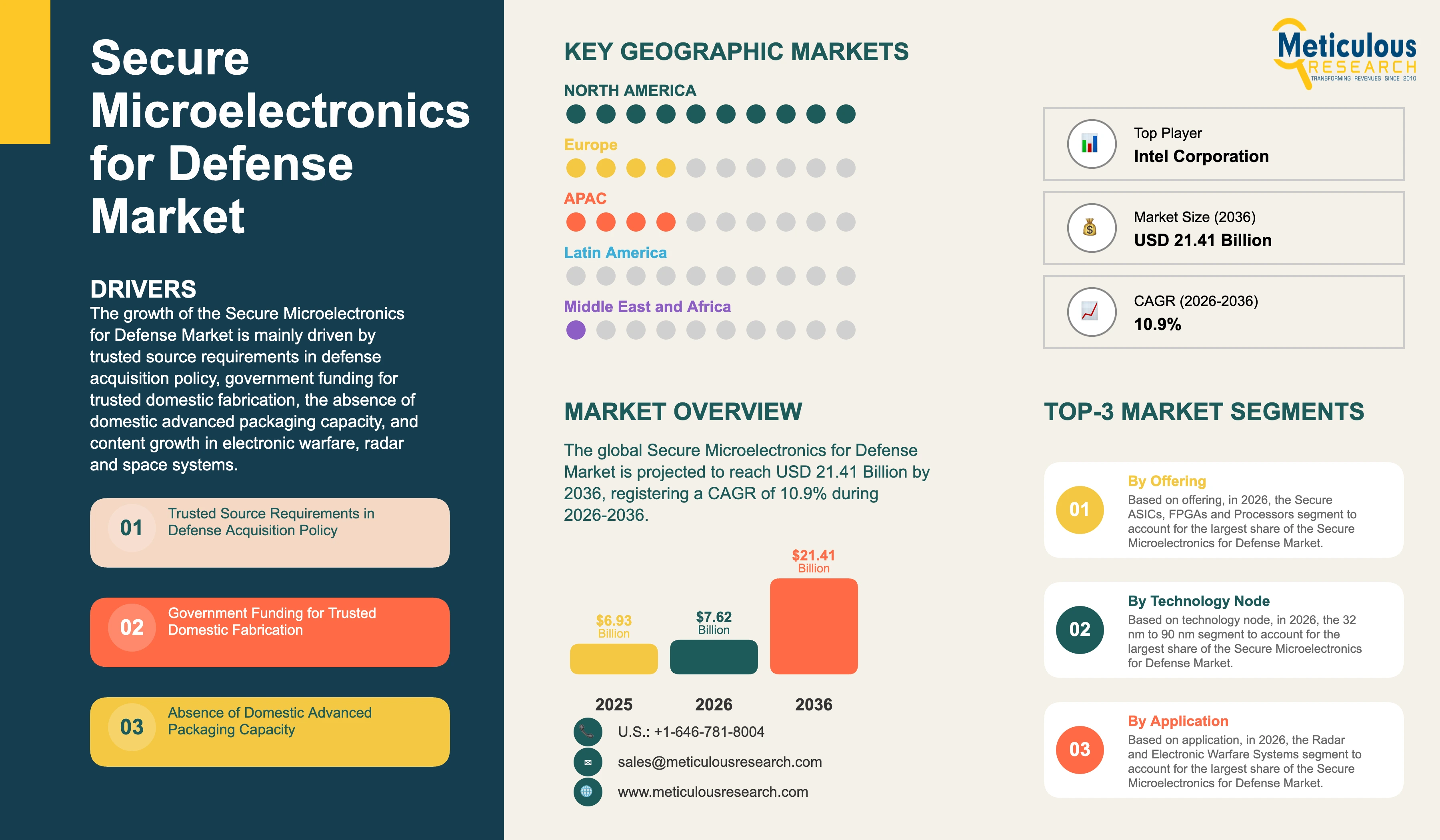
The global Secure Microelectronics for Defense Market was valued at USD 6.93 billion in 2025. This market is expected to reach USD 21.41 billion by 2036 from an estimated USD 7.62 billion in 2026, registering a CAGR of 10.9% during the forecast period (2026-2036).
- Published
- Nov 2026
- Pages
- 253
- Format
- PDF + Excel
- Report ID
- MRAD - 1042847
- Base year
- 2025
- 2025 · BASELINE
- $6.93B
- 2036
- $21.41B
- CAGR 2026–2036
- 10.9%
2025 baseline · 2026–2036 forecast at 10.9% CAGR · hover a bar for the value
Key highlights
The global Secure Microelectronics for Defense Market is projected to reach USD 21.41 billion by 2036, driven by trusted source requirements in defense acquisition policy, government funding for trusted domestic fabrication, the absence of domestic advanced packaging capacity, and content growth in electronic warfare, radar and space systems.
North America is expected to account for the largest market share in 2026 and is also projected to register the fastest growth during the forecast period, supported by the location of the accreditation program and the acquisition policy that requires trusted sources, together with the government funding and the prime contractor demand concentrated in the region.
By offering, Secure ASICs, FPGAs and Processors are expected to account for the largest market share, whereas Assured Packaging, Assembly and Test are projected to witness the fastest growth through 2036.
By technology node, 32 nm to 90 nm are expected to account for the largest market share, whereas Leading-Edge Nodes, 7 nm and Below are projected to witness the fastest growth through 2036.
By application, Radar and Electronic Warfare Systems are expected to account for the largest market share, whereas Satellites and Space Systems are projected to witness the fastest growth through 2036.
Trusted Supplier accreditation is granted across seven categories covering integrated circuit design, aggregation, brokerage, mask manufacturing, foundry, post-processing, and packaging, assembly and test, with contracts and agreements managed through the Trusted Access Program Office.
Trusted sources are required to prevent intentional or unintentional modification or tampering of integrated circuits, with assured chain of custody and protection against reverse engineering, under Department of Defense Instruction 5200.44 on Trusted Systems and Networks and Instruction 5200.39 on Critical Program Information.
Intel was awarded up to USD 3 billion in direct funding under the CHIPS and Science Act on 16 September 2024 for the Secure Enclave program, to expand trusted domestic manufacturing of advanced semiconductors for United States government use.
The Secure Enclave award builds on two earlier prototype programs, the Rapid Assured Microelectronics Prototypes using Advanced Commercial Capabilities program, known as RAMP-C, and the heterogeneous integrated packaging prototype program known as SHIP, and names the Intel 18A process.
Advanced packaging became an accredited trusted activity when a Florida operation received Category 1A Trusted Supplier accreditation on 14 May 2024, giving customers requiring trusted sourcing access to domestic advanced packaging.
That accreditation supports a five-year Department of Defense fan-out wafer level packaging effort valued at up to USD 190 million, alongside a USD 120 million award to expand advanced packaging capacity in Osceola County, Florida.
Radiation-hardened process productization received up to USD 99 million of additional Department of Defense funding announced on 27 September 2022 for a 90 nm radiation-hardened process, as part of a previously announced USD 170 million investment.
That qualification pathway targeted radiation and reliability testing and addition to the Defense Logistics Agency qualified manufacturers list with a Class V designation, which is the standard defense programs specify for space-grade parts.
Trusted foundry services supplied under the program cover multi-project wafer runs, dedicated prototypes, low- and high-volume production, a library of standard intellectual property blocks, and limited packaging and test.
Report summary
| Particulars | Details |
|---|---|
| Forecast Period | 2026-2036 |
| Base Year | 2025 |
| Estimated Year | 2026 |
| CAGR (Value) | 10.9% |
| Format | PDF, Excel & Cloud Portal · 253 pages |
| CAGR (Volume) | 5.8% |
| Market Size (Value) in 2026 | USD 7.62 billion |
| Market Size (Value) in 2036 | USD 21.41 billion |
| Market Size (Volume) in 2026 | 38.10 million assured device deliveries |
| Market Size (Volume) in 2036 | 66.90 million assured device deliveries |
| Average Selling Price, 2026 | USD 200 per device |
| Average Selling Price, 2036 | USD 320 per device |
| Segments Covered | By Offering: Secure ASICs, FPGAs and Processors, Radiation-Hardened and Radiation-Tolerant Devices, Trusted Foundry and Fabrication Services, Assured Packaging, Assembly and Test, Design Services, Intellectual Property and Verification. By Technology Node: Leading-Edge Nodes, 7 nm and Below, 10 nm to 28 nm, 32 nm to 90 nm, Above 90 nm and Legacy, Compound Semiconductor and Specialty Processes. By Application: Radar and Electronic Warfare Systems, Missile and Munitions Guidance, Satellites and Space Systems, Command, Control and Communications, Avionics and Mission Computing, Cryptographic and Cyber Systems, Ground and Naval Platforms. By End User: Defense Prime Contractors, Defense Ministries and Government Agencies, Subsystem and Electronics Suppliers, Research Laboratories and Universities. |
| Countries Covered | U.S.; Canada; Germany; France; U.K.; Italy; China; Japan; India; South Korea; Mexico; Brazil |
| Key Companies | Intel Corporation, BAE Systems plc, Microchip Technology Incorporated, Texas Instruments Incorporated, GlobalFoundries Inc., SkyWater Technology, Inc., and Teledyne Technologies Incorporated |
Report overview
Segments covered: offering, technology node, application, end user.
In volume terms, the market is estimated at 38.10 million assured device deliveries in 2026 and is expected to reach 66.90 million assured device deliveries by 2036, registering a CAGR of 5.8% during the forecast period. The average selling price is estimated at USD 200 per device in 2026 and USD 320 per device in 2036.
The growth of this market is mainly driven by trusted source requirements written into defense acquisition policy, government funding for trusted domestic fabrication including up to USD 3 billion awarded for secure leading-edge manufacturing, the absence of domestic advanced packaging capacity, radiation-hardened device qualification programs, and content growth in electronic warfare, radar and space systems. However, factors such as an accredited supplier base narrower than demand across the seven accreditation categories, defense volumes that sit below commercial foundry economics, qualification timelines for assured devices, and counterfeit parts and obsolescence in legacy nodes are expected to restrain the growth of this market to some extent.
Among applications, Radar and Electronic Warfare Systems are expected to account for the largest market share in 2026, while Satellites and Space Systems are projected to register the highest CAGR during the forecast period. Geographically, North America is expected to account for the largest share of this market in 2026 and is also expected to register the highest CAGR during the forecast period.
The Secure Microelectronics for Defense Market comprises microelectronic devices and services supplied under supply chain assurance requirements for defense and national security programs, measured at the point of delivery into a defense supply chain. The market covers secure application-specific integrated circuits, field programmable gate arrays and processors, radiation-hardened and radiation-tolerant devices, trusted foundry and fabrication services, assured packaging, assembly and test, and design services, intellectual property and verification, across leading-edge nodes at 7 nm and below, 10 nm to 28 nm, 32 nm to 90 nm, above 90 nm and legacy processes, and compound semiconductor and specialty processes, applied to radar and electronic warfare systems, missile and munitions guidance, satellites and space systems, command, control and communications, avionics and mission computing, cryptographic and cyber systems, and ground and naval platforms. Commercial semiconductor supply without assurance requirements, commercial off-the-shelf parts bought on specification alone, printed circuit board assembly, and the finished systems themselves fall outside the scope.
Policy rather than performance defines what qualifies for this market. Trusted sources must prevent intentional or unintentional modification or tampering of integrated circuits and maintain an assured chain of custody with protection against reverse engineering, under Department of Defense Instruction 5200.44 on Trusted Systems and Networks and Instruction 5200.39 on Critical Program Information. Accreditation is granted in seven distinct categories covering integrated circuit design, aggregation, brokerage, mask manufacturing, foundry, post-processing, and packaging, assembly and test, so a device can leave the trusted path at any one of seven stages.
Packaging was the stage that had no domestic answer, and that is where money moved first. Advanced packaging became an accredited trusted activity when a Florida operation received Category 1A Trusted Supplier accreditation on 14 May 2024, supported by a five-year fan-out wafer level packaging effort valued at up to USD 190 million and a USD 120 million award to expand capacity in Osceola County. Assured Packaging, Assembly and Test is projected to be the fastest-growing offering in this market at 14.6% on that basis.
Access to leading-edge logic is being purchased rather than waited for. Intel was awarded up to USD 3 billion in direct funding under the CHIPS and Science Act on 16 September 2024 for the Secure Enclave program, to expand trusted domestic manufacturing of advanced semiconductors for United States government use, building on the RAMP-C and SHIP prototype programs and naming the Intel 18A process. Leading-Edge Nodes at 7 nm and Below is projected to grow at 16.2% in this market, the fastest of any node band, from a base close to nothing.
Most defense silicon nevertheless sits well behind the leading edge and will remain there. Radiation-hardened productization funding of up to USD 99 million announced on 27 September 2022 supported a 90 nm radiation-hardened process as part of a previously announced USD 170 million investment, targeting radiation and reliability testing and addition to the Defense Logistics Agency qualified manufacturers list with a Class V designation. The 32 nm to 90 nm band holds the largest node share of this market in 2026 because radiation tolerance, long qualification life and supply continuity matter more on most defense part numbers than transistor density.
Value per device rather than device count carries the growth here. Volume grows at 5.8% against value at 10.9%, and average realized value moves from USD 200 per device in 2026 to USD 320 in 2036, as assurance obligations, packaging content and node mix each add cost to the same unit. Trusted foundry services supplied under the program cover multi-project wafer runs, dedicated prototypes, low- and high-volume production, a library of standard intellectual property blocks and limited packaging and test, and the multi-project wafer route exists because defense volumes rarely fill a mask set alone.
North America is expected to account for the largest share of this market in 2026, supported by the location of the accreditation program and the acquisition policy requiring trusted sources, the concentration of prime contractor demand and the accredited supplier base, and the government funding directed at trusted fabrication, radiation-hardened qualification and advanced packaging capacity.
Europe is projected to be the fastest-growing region in this market at 12.2%. Germany grows at 12.6% on defense budget increases applied to radar, electronic warfare, armored vehicle and naval programs, while France, the United Kingdom and Italy carry the missile, radar, submarine and combat aircraft programs that consume the devices. The region holds design capability, compound semiconductor manufacture and specialty foundries without an equivalent accreditation program of its own, so assurance is established through national arrangements and allied access, and suppliers able to satisfy requirements on both sides serve two procurement systems from one asset base.
The Middle East & Africa region is projected to grow at 10.6%, with demand following defense procurement and the local manufacturing capability established alongside it, where device content arrives inside imported systems and sustainment creates demand for legacy parts through aggregation and brokerage, and where programs established under offset arrangements carry trusted source requirements inherited from the supplying country. Latin America is projected to grow at 8.2% from the smallest regional base, with Mexico taking a growing share through electronics assembly and test capacity serving North American programs and Brazilian demand following military aircraft, radar and naval programs.
Some of the key players operating in the secure microelectronics for defense market are Intel Corporation, BAE Systems plc, Microchip Technology Incorporated, Texas Instruments Incorporated, GlobalFoundries Inc., SkyWater Technology, Inc., and Teledyne Technologies Incorporated, among others.
Key strategies include securing accreditation across more than one of the seven categories to offer a longer assured path; carrying radiation-hardened processes through radiation and reliability testing to a Class V qualified manufacturers list designation, as funded at up to USD 99 million within a USD 170 million investment; opening commercial leading-edge capacity to government programs under funded arrangements, as in the award of up to USD 3 billion on 16 September 2024; building domestic advanced packaging capacity with government support, following Category 1A accreditation in May 2024 and awards of up to USD 190 million and USD 120 million; and supplying intellectual property libraries and multi-project wafer access that spread mask cost across programs.
Report infographic
Market dynamics
20 factors across 4 forcesTrusted Source Requirements in Defense Acquisition Policy
Trusted sources are required to prevent intentional or unintentional modification or tampering of integrated circuits, to maintain an assured chain of custody and to protect against reverse engineering, under Department of Defense Instruction 5200.44 on Trusted Systems and Networks and Instruction 5200.39 on Critical Program Information. Accreditation is granted across seven categories covering integrated circuit design, aggregation, brokerage, mask manufacturing, foundry, post-processing, and packaging, assembly and test. A program that must source from accredited suppliers is buying from a defined list rather than from the semiconductor market, and the premium that list commands is a policy outcome rather than a pricing decision. Defense Prime Contractors hold the largest end user share of this market in 2026 because the obligation lands on the party integrating the system.
Government Funding for Trusted Domestic Fabrication
Intel was awarded up to USD 3 billion in direct funding under the CHIPS and Science Act on 16 September 2024 for the Secure Enclave program, to expand trusted domestic manufacturing of advanced semiconductors for United States government use. The award builds on two earlier prototype programs, RAMP-C and SHIP, and names the Intel 18A process. Government funding is being used to buy access to commercial leading-edge capacity rather than to build a separate defense fab, which is a different model from the trusted foundry arrangements it supplements. Leading-Edge Nodes at 7 nm and Below grow at 16.2% in this market on that route, and the volume involved remains small relative to commercial output at the same nodes.
Absence of Domestic Advanced Packaging Capacity
Advanced packaging became an accredited trusted activity when a Florida advanced packaging operation received Category 1A Trusted Supplier accreditation on 14 May 2024, giving customers requiring trusted sourcing access to domestic advanced packaging. The accreditation supports a five-year Department of Defense fan-out wafer level packaging effort valued at up to USD 190 million to expand that facility, alongside a USD 120 million award to expand capacity in Osceola County, Florida. A device fabricated domestically and packaged abroad has left the assured path at the final stage, which is why packaging accreditation attracted funding ahead of additional wafer capacity. Assured Packaging, Assembly and Test is projected to be the fastest-growing offering in this market at 14.6%, and heterogeneous integration raises the share of device value that sits in the package rather than in the die.
Radiation-Hardened Device Qualification Programs
Up to USD 99 million of additional Department of Defense funding was announced on 27 September 2022 for productization and qualification of a 90 nm radiation-hardened process, as part of a previously announced USD 170 million investment, targeting radiation and reliability testing and addition to the Defense Logistics Agency qualified manufacturers list with a Class V designation. Qualification rather than capability is what that funding buys, because a radiation-hardened process reaches a program only once it carries the designation. Radiation-Hardened and Radiation-Tolerant Devices hold a large share of this market, and the 32 nm to 90 nm band holds the largest node share in 2026 because radiation tolerance and qualification life outweigh transistor density on most defense part numbers.
Electronic Warfare, Radar and Space System Content Growth
Radar and Electronic Warfare Systems holds the largest application share of this market in 2026, since an active electronically scanned array carries transmit and receive modules in the hundreds to thousands and each one draws on compound semiconductor and specialty processes. Satellites and Space Systems is projected to be the fastest-growing application at 13.8%. Space hardware requires radiation-hardened parts qualified to Class V, and launch and satellite manufacture has moved from one-off builds to repeating production, so qualification cost is spread across more units than before. Compound semiconductor and specialty processes therefore grow alongside digital logic rather than being displaced by it.
Table of contents
12 chapters · 142 sections · 253 pages · click to expandSegmental analysis
| Segment | Largest share (2026) | Fastest growth (2026–2036) |
|---|---|---|
| By Offering | Secure ASICs, FPGAs and Processors | Assured Packaging, Assembly and Test |
| By Technology Node | 32 nm to 90 nm | Leading-Edge Nodes, 7 nm and Below |
| By Application | Radar and Electronic Warfare Systems | Satellites and Space Systems |
| By End User | Defense Prime Contractors | Subsystem and Electronics Suppliers |
| Other segments | Radar and Electronic Warfare Systems | — |
By Offering
- Secure ASICs, FPGAs and Processors are expected to account for the largest share of the global Secure Microelectronics for Defense Market.
- The large share of this segment is mainly due to the device value carried in the processing and logic content of radar, electronic warfare, guidance and mission computing systems, and the position of these parts as the items a program qualifies against a named source and a specification.
- However, Assured Packaging, Assembly and Test are projected to register the highest CAGR during the forecast period.
- The rapid growth of this segment is attributed to the accreditation of advanced packaging as a trusted activity in May 2024 together with a five-year fan-out wafer level packaging effort valued at up to USD 190 million and a USD 120 million capacity award, against a position of very little domestic advanced packaging.
- Secure ASICs, FPGAs and Processors are expected to account for the largest market share in 2026.
- Assured Packaging, Assembly and Test are projected to register the highest CAGR during the forecast period, owing to the accreditation of advanced packaging as a trusted activity in May 2024 together with a five-year fan-out wafer level packaging effort valued at up to USD 190 million and a USD 120 million capacity award, against a position of very little domestic advanced packaging.
- 32 nm to 90 nm are expected to account for the largest market share in 2026.
- Leading-Edge Nodes, 7 nm and Below are projected to register the highest CAGR during the forecast period, owing to up to USD 3 billion of direct funding awarded on 16 September 2024 to expand trusted domestic manufacturing of advanced semiconductors for government use on a named leading-edge process, from a base close to nothing.
- Satellites and Space Systems are projected to register the highest CAGR during the forecast period, owing to the requirement for radiation-hardened parts qualified to a Class V designation together with satellite and launch manufacture moving from one-off builds to repeating production, which spreads qualification cost across more units.
- Subsystem and Electronics Suppliers are projected to register the highest CAGR during the forecast period, owing to flowdown of trusted source requirements to the suppliers of modules, arrays and mission computers, who must satisfy the same accreditation obligations without the program-level funding available to primes.
By Technology Node
- 32 nm to 90 nm are expected to account for the largest market share.
- The large share of this segment is mainly due to radiation tolerance, qualification life and supply continuity outweighing transistor density on most defense part numbers, with radiation-hardened productization funded at 90 nm toward a Class V qualified manufacturers list designation.
- However, Leading-Edge Nodes, 7 nm and Below are projected to register the highest CAGR during the forecast period.
- The rapid growth of this segment is attributed to up to USD 3 billion of direct funding awarded on 16 September 2024 to expand trusted domestic manufacturing of advanced semiconductors for government use on a named leading-edge process, from a base close to nothing.
By Application
- Radar and Electronic Warfare Systems are expected to account for the largest market share.
- The large share of this segment is mainly due to the transmit and receive modules carried in active electronically scanned arrays in the hundreds to thousands per array, each drawing on compound semiconductor and specialty processes alongside digital signal processing content.
- However, Satellites and Space Systems are projected to register the highest CAGR during the forecast period.
- The rapid growth of this segment is attributed to the requirement for radiation-hardened parts qualified to a Class V designation together with satellite and launch manufacture moving from one-off builds to repeating production, which spreads qualification cost across more units.
By End User
- Defense Prime Contractors are expected to account for the largest market share.
- The large share of this segment is mainly due to the assurance obligation landing on the party integrating the system, which makes the prime responsible for establishing an accredited chain at every stage a device passes through.
- However, Subsystem and Electronics Suppliers are projected to register the highest CAGR during the forecast period.
- The rapid growth of this segment is attributed to flowdown of trusted source requirements to the suppliers of modules, arrays and mission computers, who must satisfy the same accreditation obligations without the program-level funding available to primes.
Other segments
- Radar and Electronic Warfare Systems are expected to account for the largest market share in 2026.
- Defense Prime Contractors are expected to account for the largest market share in 2026.
Geographic analysis
North America
Largest shareNorth America is expected to account for the largest share of this market in 2026 and is projected to grow at 10.4%. The accreditation program, the acquisition policy requiring trusted sources and the funding supporting domestic capacity all sit in the United States, including up to USD 3 billion awarded on 16 September 2024 for trusted leading-edge manufacturing, up to USD 99 million for radiation-hardened process productization within a USD 170 million investment, a five-year fan out wafer level packaging effort valued at up to USD 190 million and a USD 120 million packaging capacity award. Prime contractor demand and the accredited supplier base are concentrated in the same market, and Canadian demand follows component and subsystem supply into those programs. Mexico accounts for a growing share through electronics assembly and test capacity serving North American programs, where devices arrive already fabricated and the regional contribution sits at the assembly stage. Brazilian demand follows military aircraft, radar and naval programs and their domestic electronics suppliers. Regional consumption is concentrated in integration rather than in fabrication, so assured devices are imported as qualified parts.
Europe
Fastest growthEurope is projected to be the fastest-growing region in this market at 12.2%. Germany grows at 12.6% on defense budget increases applied to radar, electronic warfare, armored vehicle and naval programs, and the region holds design capability, compound semiconductor manufacture and specialty foundries without an equivalent accreditation program of its own, so assurance is established through national arrangements and allied access. France, the United Kingdom and Italy carry the missile, radar, submarine and combat aircraft programs that consume the devices, and suppliers satisfying requirements on both sides serve two procurement systems from one asset base. Europe is projected to register the highest CAGR at 12.2%, as rising defense budgets are applied to radar, electronic warfare, armored vehicle and naval programs across a region holding design capability, compound semiconductor manufacture and specialty foundries without an equivalent accreditation program of its own, with Germany growing at 12.6%.
Asia-Pacific
Asia-Pacific is projected to grow at 11.4% and holds the commercial semiconductor capacity on which assurance programs in other regions were originally dependent. China holds the largest regional volume across its own defense electronics manufacture. Japan is projected to be the slowest-growing country in this market at 7.8%, where semiconductor capability is long established and defense consumption is small relative to that base. India is projected to be the fastest-growing country at 14.6% as indigenous radar, missile, naval and space programs scale alongside domestic fabrication and packaging development, and South Korea follows its combat aircraft, naval and satellite programs.
Latin America
Latin America is projected to grow at 8.2% from the smallest regional base in this market.
Middle East & Africa
The Middle East & Africa region is projected to grow at 10.6%. Demand follows defense procurement and the local manufacturing capability established alongside it, where device content arrives inside imported systems rather than as material purchased locally, and where sustainment of those systems creates demand for legacy parts through aggregation and brokerage. Programs established under offset arrangements carry trusted source requirements inherited from the supplying country, which regional suppliers satisfy through accredited partners rather than through local accreditation.
Competitive landscape
The global Secure Microelectronics for Defense Market is consolidated, with competition among integrated device manufacturers with accredited facilities, defense electronics groups holding their own microelectronics centers, and specialty foundry and packaging operators. Market participants compete primarily on accreditation categories held, radiation-hardened and space qualification records, node and process range available under assurance, packaging and heterogeneous integration capability, and continuity of access to commercial capacity.
securing accreditation across more than one category to offer a longer assured path, carrying radiation-hardened processes through qualification to a Class V designation, opening commercial leading-edge capacity to government programs under funded arrangements, building domestic advanced packaging capacity with government support, and supplying intellectual property libraries and multi-project wafer access that spread mask cost across programs
The report provides a comprehensive competitive assessment of the leading companies operating in the global Secure Microelectronics for Defense Market. The key players profiled in the report include Intel Corporation (U.S.), BAE Systems plc (U.K.), Microchip Technology Incorporated (U.S.), Texas Instruments Incorporated (U.S.), GlobalFoundries Inc. (U.S.), SkyWater Technology, Inc. (U.S.), and Teledyne Technologies Incorporated (U.S.).
- Intel Corporation
- BAE Systems plc
- Microchip Technology Incorporated
- Texas Instruments Incorporated
- GlobalFoundries Inc.
- SkyWater Technology, Inc.
- Teledyne Technologies Incorporated
Expert perspectives
Accreditation is granted in seven separate categories and a device can leave the assured path at any one of them, which means a program assembles a chain rather than choosing a supplier. Few operations hold accreditation in more than one or two categories, so the stage without an accredited option sets the limit on the whole device however much capacity exists elsewhere. That structural feature, rather than wafer availability, is what the funding of the last three years has been addressing.
Packaging was the missing stage and the record shows it being closed deliberately. Category 1A Trusted Supplier accreditation for an advanced packaging operation on 14 May 2024, a five-year fan out wafer level packaging effort valued at up to USD 190 million and a USD 120 million capacity award together establish a domestic assured packaging base where very little existed. Assured Packaging, Assembly and Test grows at 14.6% in this market, and heterogeneous integration moves more of each device value into the package, so the stage that was the weakest link is becoming the larger prize.
Two node strategies are running at once and buyers should price both. Up to USD 3 billion awarded on 16 September 2024 buys government access to a commercial leading-edge process, and Leading-Edge Nodes at 7 nm and Below grow at 16.2% from a base close to nothing, while the 32 nm to 90 nm band holds the largest share because radiation tolerance and a Class V qualified manufacturers list designation decide most defense part numbers. Value per device rises from USD 200 in 2026 to USD 320 in 2036 against volume growth of 5.8%, and the increase is assurance, packaging and node mix rather than inflation.
Customer perspectives
Insights gathered during primary interviews with defense prime microelectronics and supply chain managers, accredited foundry and packaging operators, radiation-hardened device suppliers, and government microelectronics program offices operating in this market highlight where specification priorities are shifting. The following perspectives reflect recurring themes raised across these discussions.
This reflects assurance being assembled stage by stage rather than sourced from one supplier, with the accredited base constraining design choices rather than following them.
This indicates that defense volumes depend on shared mask and intellectual property models, and that accredited packaging is capturing a rising share of device value while qualification remains the schedule constraint.
This points to prototype programs preceding production funding by design, and to government leading-edge access depending on the continued commercial viability of the host fab.
“The hard part is not finding a fab, it is finding an accredited supplier at every single step the die passes through. We can have the wafer made domestically and still break the chain at packaging, and then the device does not qualify no matter how good it is. So we map the chain first and design to what is accredited, not the other way round.”
“Defense quantities will never fill a mask set at an advanced node, which is why multi-project wafers and shared intellectual property exist in this business. What changed is that packaging is now accredited and funded, and that is where the value is moving, because so much of a modern device is the integration rather than the die. Qualification is still the long pole.”
“We funded prototypes before we funded production, and that order matters, because it gave us a working design flow before anyone committed to capacity. Buying access into a commercial leading-edge line is cheaper than running a defense-only fab, but it ties us to that business staying healthy at those nodes. That is the exposure we accepted.”
Frequently asked questions
The global Secure Microelectronics for Defense Market is estimated at USD 7.62 billion in 2026.
The market is projected to reach USD 21.41 billion by 2036.
The market is expected to grow at a CAGR of 10.9% during 2026-2036.
Growth is driven by trusted source requirements in defense acquisition policy, government funding for trusted domestic fabrication including up to USD 3 billion awarded on 16 September 2024, and the absence of domestic advanced packaging capacity. Radiation-hardened device qualification programs and content growth in electronic warfare, radar and space systems also contribute.
Accreditation is granted across seven categories covering integrated circuit design, aggregation, brokerage, mask manufacturing, foundry, post-processing, and packaging, assembly and test. Trusted sources are required to prevent intentional or unintentional modification or tampering of integrated circuits, maintain an assured chain of custody and protect against reverse engineering.
Intel was awarded up to USD 3 billion in direct funding under the CHIPS and Science Act on 16 September 2024 for the Secure Enclave program, which builds on the RAMP-C and SHIP prototype programs and names the Intel 18A process. Trusted capacity is being established inside commercial leading-edge fabs, and Leading-Edge Nodes at 7 nm and Below grow at 16.2%.
A Florida advanced packaging operation received Category 1A Trusted Supplier accreditation on 14 May 2024, supporting a five-year fan-out wafer level packaging effort valued at up to USD 190 million and a USD 120 million award for capacity in Osceola County, Florida. Assured Packaging, Assembly and Test is projected to be the fastest-growing offering at 14.6%.
The principal challenges are an accredited supplier base narrower than demand across seven categories, defense volumes far below commercial runs at the same mask cost, and long qualification timelines. Counterfeit parts and obsolescence at legacy nodes, and provenance documentation at every transfer, are also challenges.
Emerging technologies include fan-out wafer level and 2.5D packaging, chiplets and heterogeneous integration, and structured ASIC and secure FPGA architectures. Radiation-hardened process technologies and anti-tamper, obfuscation and hardware root of trust features are also transforming the market.
Department of Defense Instruction 5200.44 on Trusted Systems and Networks and Instruction 5200.39 on Critical Program Information set the requirement for trusted sources, with Trusted Supplier accreditation granted in seven categories. Space and strategic parts additionally require a Defense Logistics Agency qualified manufacturers list with a Class V designation, and export control and foreign ownership considerations apply.
Secure ASICs, FPGAs and Processors are expected to account for the largest market share in 2026.
Assured Packaging, Assembly and Test are projected to register the highest CAGR during the forecast period, owing to the accreditation of advanced packaging as a trusted activity in May 2024 and the USD 190 million and USD 120 million awards, against very little domestic advanced packaging.
32 nm to 90 nm are expected to account for the largest market share in 2026.
Leading-Edge Nodes, 7 nm and Below are projected to register the highest CAGR during the forecast period, owing to up to USD 3 billion of direct funding awarded on 16 September 2024 for trusted domestic manufacturing on a named leading-edge process, from a base close to nothing.
Radar and Electronic Warfare Systems are expected to account for the largest market share in 2026.
Satellites and Space Systems are projected to register the highest CAGR during the forecast period, owing to the requirement for Class V radiation-hardened parts and satellite and launch manufacture moving from one-off builds to repeating production.
Defense Prime Contractors are expected to account for the largest market share in 2026.
Subsystem and Electronics Suppliers are projected to register the highest CAGR during the forecast period, owing to flowdown of trusted source requirements to suppliers of modules, arrays and mission computers who lack the program-level funding available to primes.
North America is expected to account for the largest share of this market in 2026, supported by the location of the accreditation program and acquisition policy, concentrated prime contractor demand and accredited supplier base, and government funding for trusted fabrication, radiation-hardened qualification and advanced packaging.
Europe is projected to register the highest CAGR at 12.2%, as rising defense budgets are applied across a region holding design capability, compound semiconductor manufacture and specialty foundries without its own accreditation program. Germany is growing at 12.6%.
Europe is projected to be the fastest-growing region at 12.2%, with Germany growing at 12.6% on defense budget increases, while France, the U.K. and Italy carry the programs that consume the devices. Assurance is established through national arrangements and allied access.
The Middle East & Africa region is projected to grow at 10.6%, with demand following defense procurement and device content arriving inside imported systems. Latin America is projected to grow at 8.2% from the smallest regional base, with Mexico taking a growing share through electronics assembly and test.
Key players include Intel Corporation, BAE Systems plc, Microchip Technology Incorporated, Texas Instruments Incorporated, GlobalFoundries Inc., SkyWater Technology, Inc., and Teledyne Technologies Incorporated, among others.
Key strategies include securing accreditation across more than one of the seven categories, carrying radiation-hardened processes to a Class V qualified manufacturers list designation, and opening commercial leading-edge capacity to government programs. Companies are also building domestic advanced packaging capacity with government support and supplying IP libraries and multi-project wafer access.
Cite this report
Meticulous Research. (2026). Secure Microelectronics for Defense Market - Global Opportunity Analysis and Industry Forecast (2026-2036) (Report No. MRAD - 1042847). Meticulous Market Research Pvt. Ltd. https://www.meticulousresearch.com/product/secure-microelectronics-for-defense-market-7530