Protein Hydrolysates Market (2025-2032)
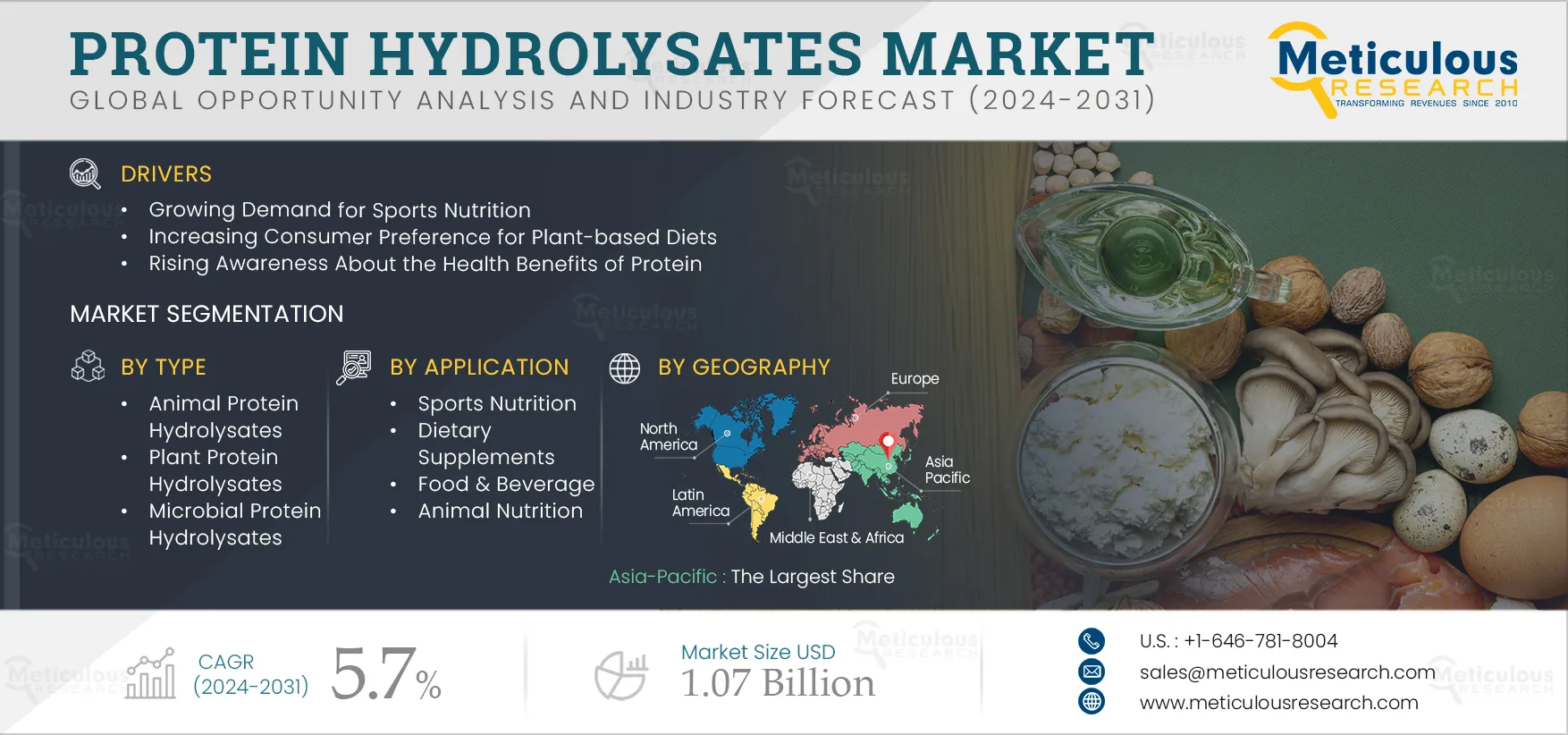
The Protein Hydrolysates Market was valued at $0.69 billion in 2024. This market is expected to reach $1.07 billion by 2032 from an estimated $0.72 billion in 2025, at a CAGR of 5.7% during the forecast period of 2025-2032. Protein Hydrolysates Market Size & Forecast The growth of this market is driven
- Published
- Oct 2024
- Pages
- 270
- Format
- PDF + Excel
- Report ID
- MR-1372
- Base year
- 2025
- 2024 · HISTORICAL
- $690.0M
- 2032
- $1.07B
- CAGR 2025–2032
- 5.7%
2024 baseline · 2025–2032 forecast at 5.7% CAGR · hover a bar for the value
Key highlights
By Type: In 2025, the Animal Protein Hydrolysates Segment is Expected to Dominate the Protein Hydrolysates Market
By Process: In 2025, the Enzymatic Hydrolysis Segment is Expected to Dominate the Protein Hydrolysates Market
By Form: In 2025, the Solid Segment is Expected to Dominate the Protein Hydrolysates Market
By Application: In 2025, the Sports Nutrition Segment is Expected to Account for the Largest Share of the Protein Hydrolysates Market
By Geography: Asia-Pacific to Dominate the Protein Hydrolysates Market in 2025
Report summary
| Particulars | Details |
|---|---|
| Number of Pages | 270 |
| Format | |
| Forecast Period | 2025–2032 |
| Base Year | 2025 |
| CAGR (Value) | 5.7% |
| Market Size (Value) | USD 1.07 Billion by 2032 |
| Segments Covered | By Type · Animal Protein Hydrolysates · Milk Protein Hydrolysates · Meat Protein Hydrolysates · Egg Protein Hydrolysates · Marine Protein Hydrolysates · Other Animal Protein Hydrolysates · Plant Protein Hydrolysates · Soy Protein Hydrolysates · Wheat Protein Hydrolysates · Pea Protein Hydrolysates · Other Plant Protein Hydrolysates · Microbial Protein Hydrolysates · By Process · Enzymatic Hydrolysis · Acid & Alkaline Hydrolysis · By Form · Solid · Liquid · By Application · Sports Nutrition · Dietary Supplements · Food & Beverage · Animal Nutrition |
| Countries Covered | North America (U.S., Canada), Europe (Germany, France, U.K., Italy, Spain, Russia, and Rest of Europe), Asia-Pacific (China, India, Japan, Australia, South Korea, and Rest of Asia-Pacific), Latin America (Brazil, Mexico, Argentina, and Rest of Latin America), and the Middle East & Africa (South Africa, Saudi Arabia, and the Rest of Middle East & Africa) |
| Key Companies | Arla Foods amba (Denmark), Glanbia Plc (Ireland), Kerry Group PLC (Ireland), Royal FrieslandCampina N.V. (Netherlands), Fonterra Co-operative Group Limited (New Zealand), Tate & Lyle PLC (U.K.), Archer-Daniels-Midland Company (U.S.), Lactalis Group (France), AMCO Proteins (U.S.), DSM-Firmenich (Netherlands), Kemin Industries, Inc. (U.S.), Axiom Foods, Inc (U.S.), and Roquette Frères (France) |
Report overview
Segments covered: type, process, form, application. Regions: North America, Europe, Asia-Pacific, Latin America, Middle East & Africa.
The growth of this market is driven by the growing demand for sports nutrition, increasing consumer preference for plant-based diets, and rising awareness about the health benefits of protein. Moreover, the rising popularity of infant formula products and increasing technological advancements in hydrolysis are expected to create market growth opportunities for the stakeholders in this market. Additionally, the increasing demand for functional foods is a major trend in the Protein Hydrolysates market.
Report infographic
Market dynamics
3 factors across 2 forcesGrowing Demand for Sports Nutrition
Currently, there is a growing consumer preference for sports and fitness activities, driving demand for protein-based dietary supplements and hydrolysates in the sports nutrition sector. As athletes and fitness enthusiasts increasingly pursue products that optimize performance and recovery, protein hydrolysates have become a favored option due to their distinctive attributes.
Protein hydrolysates result from the enzymatic breakdown of proteins into smaller peptides and amino acids, enhancing their absorption by the body. This rapid digestibility is especially advantageous for athletes seeking immediate nutrient replenishment after exercise. Compared to traditional protein sources, hydrolysates promote quicker muscle recovery and minimize soreness, addressing the specific needs of individuals engaged in rigorous training. Additionally, protein hydrolysates support immune function, which can be weakened during intense physical exertion. The bioactive peptides present in these proteins help regulate immune responses, offering an extra health benefit that is particularly appealing to athletes.
The sports nutrition market is experiencing rapid growth, fueled by increased awareness of health and fitness. As more consumers embrace active lifestyles, the demand for convenient and effective nutritional supplements is on the rise. Sports nutrition products, available in various formats such as powders, bars, and beverages, meet this demand by providing flexibility for athletes to seamlessly integrate them into their routines.
As consumers become more discerning about the nutritional content of their food, protein hydrolysates are gaining popularity due to their high bioavailability and functional benefits. These hydrolysates are increasingly incorporated into a diverse range of products, from sports drinks to meal replacements, appealing to both serious athletes and casual gym-goers. For example, Kerry Group plc (Ireland) offers Hyprol, a plant-based protein hydrolysate designed to enhance the quality of plant protein products and facilitate faster protein absorption. The demand for protein hydrolysates in the sports nutrition sector is expected to continue its upward trend, driven by the growing global participation in fitness activities.
Increasing Consumer Preference for Plant-based Diets
Consumers are increasingly embracing vegetarian and vegan lifestyles, driven by concerns about animal welfare, cultural influences, and a growing awareness of the potential side effects of animal product consumption. As the demand for plant-based foods rises, there is a corresponding need for high-quality protein sources that meet these dietary preferences. Protein hydrolysates, derived from the enzymatic breakdown of proteins, offer essential amino acids in a digestible and bioavailable form, making them an appealing choice for those pursuing plant-based nutrition. Hydrolysates sourced from peas, soy, and hemp not only provide significant nutritional benefits but also align with environmentally sustainable practices.
A significant factor driving this trend is the increasing awareness of the health benefits associated with plant-based diets. Plant-based proteins can reduce the risk of chronic diseases, improve heart health, and aid in weight management. According to Veganuary, in 2024, 706,965 individuals signed up to try a vegan diet, up from 400,350 in 2020. Additionally, in January 2025, 1.8 million people worldwide attempted to adopt a vegan lifestyle. As consumers become more health-conscious, they are seeking ways to incorporate adequate protein into their diets without relying on animal products. Protein hydrolysates address this demand by enhancing the nutritional profile of various food items, including snacks, beverages, and meal replacements. They provide essential amino acids in a form that is easily digestible and bioavailable, making them an appealing option for those pursuing plant-based nutrition.
Thus, the increasing consumer preference for plant-based diets is driving the demand for protein hydrolysates, as they offer a convenient, nutritious, and sustainable protein source.
Table of contents
12 chapters · 131 sections · 270 pages · click to expandSegmental analysis
| Segment | Largest share (2025) | Fastest growth (2025–2032) |
|---|---|---|
| By Type | Animal Protein Hydrolysates | Plant protein hydrolysates |
By Type
- The animal protein hydrolysates segment is expected to account for the largest share of the protein hydrolysates market.
- This segment’s large market share is primarily due to the widespread availability and high demand for animal-based protein hydrolysates across various industries, including food and beverages, animal nutrition, and more.
- Animal protein hydrolysates are valued for their high nutritional content and ease of digestibility, making them a preferred choice for consumers.
- Additionally, their benefits in enhancing muscle recovery and supporting immune function further contribute to their strong adoption.
- Milk protein hydrolysates are expected to account for the largest share of the animal protein hydrolysates market.
- Milk protein hydrolysates contain all the essential amino acids found in milk, offering a complete protein source that supports functions such as muscle repair and growth.
- They are commonly used in hypoallergenic infant formulas due to their digestibility and reduced allergenic properties, making them more tolerable for infants compared to standard milk formulas.
- Additionally, animal protein hydrolysates—including those derived from milk, egg, meat, and marine sources—are widely utilized across various applications such as sports nutrition, infant formula, dietary supplements, and food and beverage products.
- However, the plant protein hydrolysates segment is slated to register the highest CAGR during the forecast period.
- This segment's robust growth is primarily driven by the increasing vegan and vegetarian populations, rising product innovation in plant-based food and beverages, growing demand for clean-label products, and a heightened consumer focus on alternatives to animal protein.
- These factors are expected to support the market's growth during the forecast period.
Geographic analysis
Asia-Pacific
Largest shareIn 2025, Asia-Pacific is expected to account for the largest share of the protein hydrolysates market, followed by North America and Europe. The significant market share of the Asia-Pacific region can be attributed to several key factors, including increasing consumer health consciousness driven by the rising prevalence of diet-related diseases and an aging population. Additionally, the growing preference for plant-based diets and a rising vegan population are further boosting market growth. Furthermore, in 2025, China is expected to hold the largest share of the protein hydrolysates market within the Asia-Pacific region. Moreover, this region is slated to register the highest CAGR during the forecast period. The rapid growth of this segment is primarily driven by factors such as rapid urbanization, increasing middle-class incomes, a rise in sports and fitness activities in the region, and advancements in production technologies that enhance product development and innovation. Additionally, rising disposable incomes, the adoption of healthier lifestyles, and a growing demand for nutritious food in countries like China and India are expected to further support market growth. Asia-Pacific Dominates the Protein Hydrolysates Market
Competitive landscape
- June 2025
Arla Foods amba (Denmark) received FDA approval to use its whey protein hydrolysates in infant formula. These hydrolysates are beneficial for formula-fed infants who have difficulty tolerating traditional milk-based formulas, supporting their growth and nutritional needs.
- October 2024
Angel Yeast Co., Ltd (China) introduced a range of biotechnology products at the 2024 Spain CPHI Exhibition. The lineup includes ultrafiltration yeast extract FM888, yeast protein hydrolysate FP108, soy protein hydrolysate FP408, as well as cell wall extracts, yeast protein, β-glucan, and other essential products.
- June 2021
Arla Foods amba (Denmark) launched whey protein hydrolysate to overcome taste challenges in products for patients with maldigestion or malabsorption.
- Arla Foods amba · Denmark
- Glanbia Plc · Ireland
- Kerry Group PLC · Ireland
- Royal FrieslandCampina N.V. · Netherlands
- Fonterra Co-operative Group Limited · New Zealand
- Tate & Lyle PLC (U.K.)
- Archer-Daniels-Midland Company (U.S.)
- Lactalis Group · France
- AMCO Proteins (U.S.)
- DSM-Firmenich · Netherlands
- Kemin Industries, Inc. (U.S.)
- Axiom Foods, Inc (U.S.)
- Roquette Frères · France
Frequently asked questions
The global protein hydrolysates market size was valued at $0.69 billion in 2024.
Cite this report
Meticulous Research. (2024). Protein Hydrolysates Market - Global Opportunity Analysis and Industry Forecast (2025-2032) (Report No. MR-1372). Meticulous Market Research Pvt. Ltd. https://www.meticulousresearch.com/product/protein-hydrolysates-market-6055