Portable MRI Market (2026-2036)
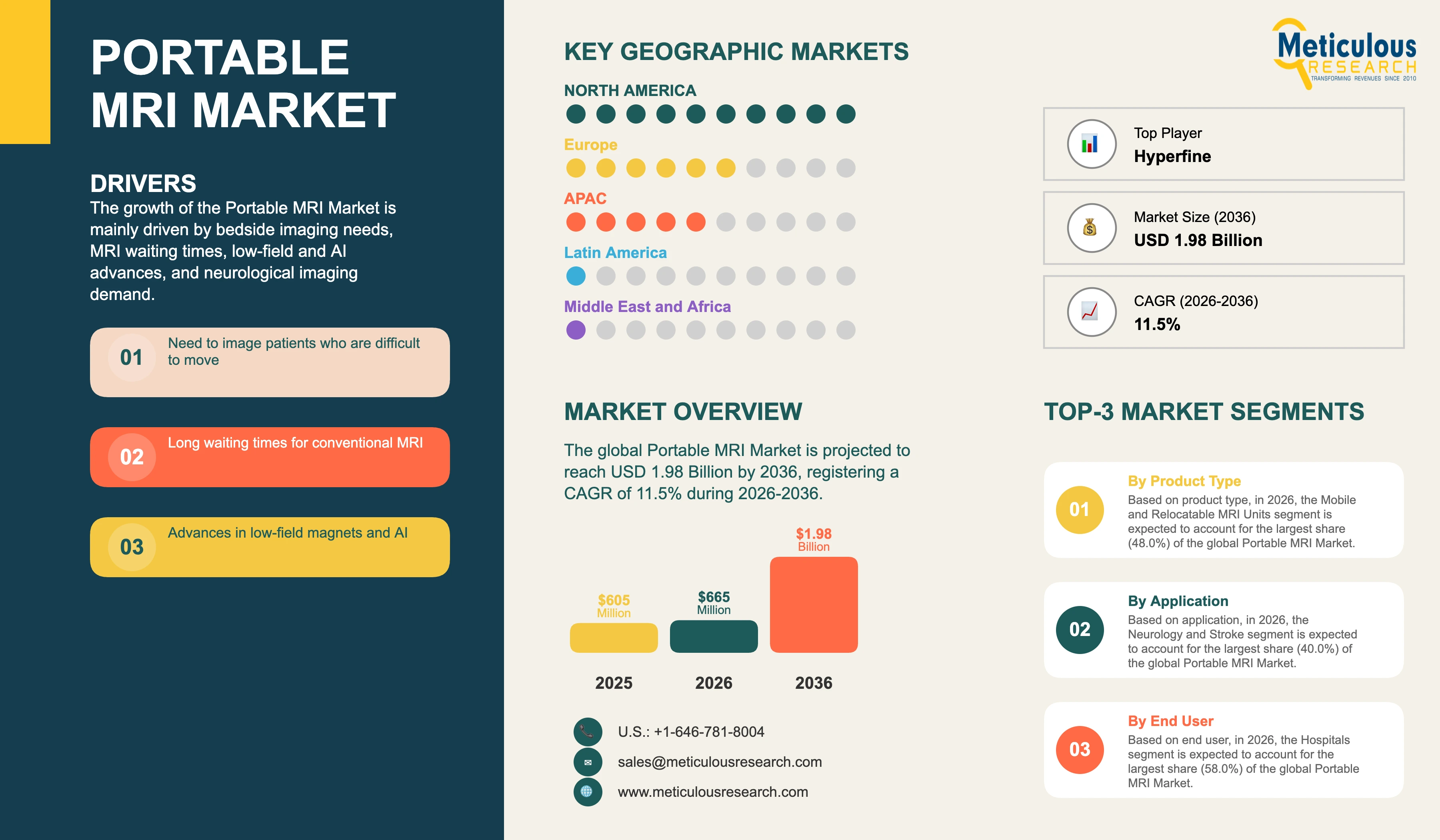
The global portable MRI market was valued at USD 605.0 million in 2025. This market is expected to reach USD 1.98 billion by 2036 from an estimated USD 665.0 million in 2026, registering a CAGR of 11.5% during the forecast period (2026-2036).
- Published
- Nov 2026
- Pages
- 257
- Format
- PDF + Excel
- Report ID
- MRHC - 1042633
- Base year
- 2025
- 2025 · BASELINE
- $605.0M
- 2036
- $1.98B
- CAGR 2026–2036
- 11.5%
2025 baseline · 2026–2036 forecast at 11.5% CAGR · hover a bar for the value
Key highlights
Hyperfine's Swoop system is the first FDA-cleared, AI-powered portable magnetic resonance brain imaging system and can scan in electromagnetically noisy environments, such as intensive care units and emergency departments, because it does not require the shielding used by conventional high-field MRI systems, according to the company and MD+DI. The system is FDA-cleared for brain imaging of patients of all ages.
Hyperfine reported record third-quarter 2026 revenue of USD 6.0 million, up 73% from a year earlier, after first-quarter revenue of USD 3.9 million, up 83%, and the company reiterated guidance for full-year 2026 revenue of about USD 20 million to USD 22 million, representing about 55% growth at the midpoint compared with 2025, according to MD+DI, MarketBeat, and Business Wire.
Results from Hyperfine's PRIME study showed that portable MRI reduced the median order-to-scan start time in the emergency department from 7.76 hours for conventional MRI to 1.28 hours, while its NEURO PMR study showed 92% blinded concordance with conventional MRI in identifying pathology and found patients four times more likely to choose portable MRI, according to the company's earnings disclosures.
Hyperfine obtained CE marking and UK Conformity Assessment approval for its next-generation Swoop system and Optive AI software in Europe, began launch activities in India with its first system in clinical use at the All India Institute of Medical Sciences in New Delhi, and is running a Contrast PMR study to support a future FDA submission for contrast-enhanced portable brain MRI, according to the company's first-quarter 2026 results.
Major MRI manufacturers, including Siemens Healthineers, GE HealthCare, Philips, Fujifilm, Canon Medical Systems, and United Imaging Healthcare, supply MRI systems for mobile and relocatable units used by imaging providers to serve hospitals and communities without permanent MRI suites, while companies such as Esaote and Synaptive Medical offer compact and dedicated MRI systems for extremity and head imaging. Major MRI manufacturers are also introducing low-helium and lighter systems that are easier to site in mobile and modular settings.
By product type, mobile and relocatable MRI units account for the largest share of 48.0% in 2026, while point-of-care ultra-low-field MRI systems register the highest CAGR.
By field strength, mid- and high-field (0.5T and above) accounts for the largest share in 2026, while ultra-low-field (below 0.1T) registers the highest CAGR.
By application, neurology and stroke accounts for the largest share in 2026, while critical and emergency care registers the highest CAGR.
By end user, hospitals account for the largest share of 58.0% in 2026, while specialty clinics register the highest CAGR.
By geography, North America accounts for the largest share of 42.0% in 2026, while Asia-Pacific registers the highest CAGR of 13.8%.
Report summary
| Particulars | Details |
|---|---|
| Forecast Period | 2026-2036 |
| Base Year | 2025 |
| Estimated Year | 2026 |
| CAGR (Value) | 11.5% |
| Format | PDF, Excel & Cloud Portal · 257 pages |
| Market Size in 2025 | USD 605.0 million |
| Market Size in 2026 | USD 665.0 million |
| Market Size by 2036 | USD 1.98 billion |
| Largest Segment by Product Type (2026) | Mobile and Relocatable MRI Units (48.0%) |
| Largest Segment by End User (2026) | Hospitals (58.0%) |
| Largest Region (2026) | North America (42.0%) |
| Fastest-Growing Region | Asia-Pacific (CAGR 13.8%) |
| Key Companies | 14 companies and other companies |
| Segments Covered | Product Type, Field Strength, Application, End User, Geography |
| Countries Covered | U.S., Canada, Rest of North America, Germany, U.K., France, Italy, Spain, Netherlands, Switzerland, Belgium, Sweden, Denmark, Norway, Finland, Austria, Poland, Ireland, Rest of Europe, China, Japan, India, South Korea, Australia, Indonesia, Thailand, Singapore, Malaysia, Vietnam, Philippines, Taiwan, New Zealand, Rest of Asia-Pacific, Brazil, Mexico, Argentina, Colombia, Chile, Peru, Rest of Latin America, Saudi Arabia, U.A.E., South Africa, Nigeria, Kenya, Israel, Turkey, Egypt, Rest of Middle East & Africa |
Report overview
Segments covered: product type, application, end user.
The growth of this market is mainly driven by the need to bring MRI to patients who are difficult to move, such as critically ill patients in intensive care units, the long waiting times for conventional MRI in emergency departments and outpatient settings, the advances in low-field magnet design and artificial intelligence-based image reconstruction that have made compact and point-of-care MRI clinically viable, the growing demand for MRI in neurology and stroke care, and the need to expand MRI access in rural areas and emerging markets where conventional MRI is scarce. However, factors such as the lower image quality and limited clinical indications of ultra-low-field systems compared with high-field MRI, limited reimbursement for point-of-care MRI, the high cost of mobile MRI units, and the need for clinical evidence and physician acceptance are expected to restrain the growth of this market to some extent.
Magnetic resonance imaging (MRI) provides detailed images of soft tissues, the brain, the spine, joints, and internal organs without ionizing radiation, which makes it one of the most valuable diagnostic imaging technologies. However, conventional MRI systems are large, heavy, and expensive, require dedicated shielded rooms, specialized power and cooling, and trained staff, and are usually located in radiology departments. Patients must be transported to the scanner, which can be difficult and risky for critically ill patients, and waiting times for MRI can be long. Portable MRI aims to overcome these limitations by bringing MRI closer to patients.
This report covers the global portable MRI market, including mobile and relocatable MRI units, such as trailer-mounted and modular MRI systems that can be moved between sites, compact and dedicated MRI systems designed for specific body parts or smaller spaces, such as extremity, head, and other dedicated scanners, and point-of-care ultra-low-field MRI systems that can be wheeled to the patient's bedside. The market is analyzed by product type, application, end user, and geography. Conventional fixed whole-body MRI systems installed in permanent shielded rooms are analyzed in separate reports. The market is measured on a revenue basis, including system sales and related software and upgrades, at manufacturer selling prices, on a sales basis in each country.
Point-of-care ultra-low-field MRI is the most innovative and fastest-changing segment of the portable MRI market. Hyperfine's Swoop system, the first FDA-cleared portable MRI system, uses a permanent magnet with a field strength much lower than conventional MRI, operates from a standard electrical outlet, does not require a shielded room, and can be wheeled into intensive care units, emergency departments, and neurology offices. Artificial intelligence-based image reconstruction, such as Hyperfine's Optive AI software, improves image quality and reduces noise. Clinical studies have shown that portable MRI can significantly reduce the time to imaging in emergency departments and provide high concordance with conventional MRI for identifying brain pathology.
Mobile and relocatable MRI units are an established part of the market. These systems, typically installed in trailers or modular buildings, allow imaging providers and hospitals to offer MRI at sites without permanent MRI suites, to increase capacity during equipment replacement or periods of high demand, and to serve rural communities. Mobile MRI units are supplied by major MRI manufacturers and are widely used in North America and Europe. Compact and dedicated MRI systems, such as extremity scanners and head-only systems, offer lower cost and smaller footprints for orthopedic, rheumatology, neurology, and other specialized applications.
Mobile and relocatable MRI units account for the largest share of the market by product type, while point-of-care ultra-low-field MRI systems are the fastest-growing product type. Neurology and stroke is the largest application, while critical and emergency care is the fastest-growing application. Hospitals are the largest end user, while specialty clinics are the fastest-growing end user. Mid- and high-field systems account for the largest share by field strength, while ultra-low-field systems are the fastest-growing field strength. North America accounts for the largest share of the market, while Asia-Pacific is the fastest-growing region.
Advances in magnet technology, gradient design, radiofrequency coils, and artificial intelligence are driving innovation in the market. Low-field and ultra-low-field systems that use permanent magnets or low-helium designs reduce costs and installation requirements, while AI-based reconstruction compensates for the lower signal of low-field systems. Major MRI manufacturers are also developing lower-field and helium-free systems that are easier to install and move, which is blurring the line between conventional and portable MRI.
The market includes companies focused on point-of-care MRI, such as Hyperfine, Promaxo, and Wellumio, major MRI manufacturers that supply systems for mobile, relocatable, and compact applications, such as Siemens Healthineers, GE HealthCare, Philips, Fujifilm, Canon Medical Systems, and United Imaging Healthcare, and companies offering compact and dedicated MRI systems, such as Esaote, Synaptive Medical, ASG Superconductors (Paramed), Time Medical, and Neusoft Medical Systems.
Over the forecast period, the portable MRI market is expected to grow strongly, supported by the adoption of point-of-care MRI in critical care, emergency, and neurology settings, continued demand for mobile and relocatable MRI capacity, the expansion of MRI access in emerging markets, and advances in AI and magnet technology. The pace of growth will depend on clinical evidence, reimbursement, image quality improvements, and acceptance by radiologists and referring physicians.
North America is expected to account for the largest share of 42.0% of the market in 2026, mainly due to the widespread use of mobile MRI units, the early commercialization of point-of-care MRI, high healthcare spending, and strong clinical research.
Asia-Pacific is projected to register the highest CAGR of 13.8% during the forecast period, driven by low MRI availability, aging populations, the rising burden of neurological diseases, and growing healthcare investment.
The report profiles 14 companies, including Hyperfine, Siemens Healthineers, GE HealthCare, Philips, Fujifilm, Canon Medical Systems, United Imaging Healthcare, Esaote, Synaptive Medical, Promaxo, Time Medical, ASG Superconductors (Paramed), Wellumio, and Neusoft Medical Systems.
Hyperfine's PRIME study showed that portable MRI reduced the median order-to-scan start time in the emergency department from 7.76 hours for conventional MRI to 1.28 hours, because the system can be brought to the patient without transport to the radiology department.
What comes next: Low-Field MRI and the Future of Accessible Imaging, a Meticulous Next™ foresight brief.
Report infographic
Market dynamics
18 factors across 5 forcesNeed to image patients who are difficult to move
Transporting critically ill patients from intensive care units to radiology departments for MRI is complex, time-consuming, and risky. Patients may be connected to ventilators, monitors, infusion pumps, and other equipment, and transport requires several staff members and carries risks of adverse events. As a result, many critically ill patients who could benefit from MRI, such as those with brain injuries, strokes, or altered consciousness, do not receive it. Point-of-care MRI systems that can be brought to the bedside make MRI available to these patients without the need for transport.
Hyperfine's Swoop system was designed specifically for this purpose and can scan in intensive care units and emergency departments without shielding. As clinical evidence demonstrates the value of bedside MRI in critical care, demand for point-of-care systems is expected to increase significantly.
Neonatal intensive care units are another important setting, as transporting fragile newborns for MRI carries significant risks and portable systems can reduce the need for transport. Bedside imaging can also reduce the need for sedation in some patients and allow repeated imaging to monitor changes in a patient's condition over time, which is difficult with conventional MRI.
Long waiting times for conventional MRI
Demand for MRI exceeds capacity in many health systems, leading to long waiting times for patients in emergency departments, inpatient wards, and outpatient settings. In emergency departments, waiting for conventional MRI can delay diagnosis and treatment and contribute to crowding. Hyperfine's PRIME study showed that portable MRI reduced the median order-to-scan start time in the emergency department from 7.76 hours for conventional MRI to 1.28 hours.
Mobile and relocatable MRI units also help health systems address capacity constraints by adding temporary or flexible capacity, and compact systems can provide additional capacity for specific applications, such as extremity imaging. These factors are expected to drive demand for portable MRI across all product types. Staff shortages in radiology departments also limit the number of conventional MRI examinations that can be performed, which increases interest in systems that are simpler to operate and can be used by trained staff in other departments.
Advances in low-field magnets and AI-based image reconstruction
Advances in permanent magnet design, gradient systems, radiofrequency coils, and artificial intelligence have made low-field and ultra-low-field MRI clinically viable. AI-based reconstruction and denoising software, such as Hyperfine's Optive AI, significantly improves the image quality of low-field systems, which have lower signal than high-field systems. These advances allow portable systems to produce images that are useful for many clinical decisions.
Continued improvements in hardware and AI are expected to further improve image quality, expand the range of clinical indications, and increase the acceptance of portable MRI among radiologists and clinicians. Hyperfine's NEURO PMR study reported 92% blinded concordance with conventional MRI in identifying pathology.
Growing demand for MRI in neurology and stroke care
MRI is the preferred imaging method for many neurological conditions, including stroke, multiple sclerosis, brain tumors, dementia, hydrocephalus, and traumatic brain injury. The incidence of stroke and neurodegenerative diseases is increasing as populations age, and new treatments for conditions such as Alzheimer's disease require regular MRI monitoring for side effects. These trends are increasing demand for brain MRI.
Portable MRI systems can support neurology care in emergency departments, intensive care units, and neurology offices, providing faster and more convenient access to brain imaging. Hyperfine has expanded into neurology offices since mid-2025, which represents a new site of care for MRI. Neurology practices can use these systems to monitor patients more frequently and make treatment decisions during the same visit.
Need to expand MRI access in underserved areas
Access to MRI is very limited in many rural areas and in low- and middle-income countries, where the cost of conventional MRI systems, the need for shielded rooms and reliable power, and the shortage of trained staff restrict availability. Portable, low-field, and compact MRI systems, which cost less and have simpler installation requirements, can expand access to MRI in these settings.
Mobile MRI units also bring MRI to rural communities in high-income countries, and point-of-care systems are being introduced in emerging markets, such as India, where Hyperfine began launch activities with its first system at the All India Institute of Medical Sciences in New Delhi. Hospital capacity constraints and pressure to shorten length of stay are another important factor.
Table of contents
12 chapters · 165 sections · 257 pages · click to expandSegmental analysis
| Segment | Largest share (2026) | Fastest growth (2026–2036) |
|---|---|---|
| By Product Type | Mobile and relocatable MRI units | Point-of-care ultra-low-field MRI systems |
| By Field Strength | Mid- and high-field (0.5T and above) | Ultra-low-field (below 0.1T) |
| By Application | Neurology and stroke | Critical and emergency care |
| By End User | Hospitals | Specialty clinics |
| Other segments | Hospitals | Specialty clinics |
By Product Type
- Portable MRI Market Analysis by Product Type
- The mobile and relocatable MRI units segment is expected to account for the largest share of 48.0% of the global portable MRI market.
- The large share of this segment is mainly due to the established use of trailer-mounted and modular MRI units by imaging providers and hospitals in North America and Europe, the high value of these systems, which typically use full-performance MRI scanners installed in mobile or relocatable enclosures, their role in providing additional MRI capacity during equipment replacement, renovations, and periods of high demand, and their use in serving rural communities and sites without permanent MRI suites.
- Mobile MRI units are supplied with scanners from major manufacturers such as Siemens Healthineers, GE HealthCare, Philips, and Canon Medical Systems.
- Mobile and relocatable units offer full diagnostic MRI capabilities, which makes them suitable for the same range of clinical applications as fixed MRI systems, including neurological, musculoskeletal, oncology, and body imaging.
- Demand for these units is supported by the growing need for MRI capacity and the flexibility they provide to health systems.
- However, the point-of-care ultra-low-field MRI systems segment is projected to register the highest CAGR during the forecast period.
- The rapid growth of this segment is driven by the growing adoption of bedside MRI in intensive care units, emergency departments, and neurology offices, clinical evidence demonstrating faster imaging and high concordance with conventional MRI, improvements in AI-based image reconstruction, the expansion of clinical indications such as contrast-enhanced imaging, international regulatory approvals, and the low cost and simple installation requirements of these systems.
- Hyperfine has reported strong growth in system placements and record U.S. scan volumes, which reflects the growing adoption of point-of-care MRI across hospitals and neurology offices.
- Point-of-care systems are also increasingly offered through placement and subscription models, which lower the barrier to adoption for hospitals and neurology practices with limited capital budgets.
- The compact and dedicated MRI systems segment forms the second-largest segment, supported by the use of extremity MRI systems for orthopedic and rheumatology imaging, head-only systems for neurology and neurosurgery, and compact whole-body systems with smaller footprints and lower installation requirements.
- Companies such as Esaote, Synaptive Medical, ASG Superconductors (Paramed), and Time Medical offer compact and dedicated systems.
- The distinction between portable and conventional MRI is also expected to blur as major manufacturers introduce lighter, low-helium, and helium-free systems that are easier to install and move, which could expand the compact and relocatable segments.
By Field Strength
- Portable MRI Market Analysis by Field Strength
- The mid- and high-field (0.5T and above) segment is expected to account for the largest share of the global portable MRI market.
- The large share of this segment is mainly due to the use of 1.5T and 3T scanners in trailer-mounted and relocatable MRI units, which provide full diagnostic capabilities for neurological, musculoskeletal, oncology, and body imaging, the high value of these systems, and the use of mid-field compact systems for head and extremity imaging.
- Mobile imaging providers and hospitals rely on these systems to add MRI capacity and serve communities without permanent MRI suites.
- Mid- and high-field systems produce higher-resolution images and support a wide range of advanced sequences, which makes them suitable for the same clinical applications as fixed MRI scanners.
- Manufacturers are also introducing low-helium and sealed-magnet designs at these field strengths, which simplify installation in mobile and modular enclosures and reduce the risk of helium supply problems.
- However, the ultra-low-field (below 0.1T) segment is projected to register the highest CAGR during the forecast period.
- The rapid growth of this segment is driven by the adoption of point-of-care brain MRI systems such as Hyperfine's Swoop in intensive care units, emergency departments, and neurology offices, improvements in AI-based image reconstruction, clinical evidence showing high concordance with conventional MRI, and the low cost and simple installation of these systems.
- The low-field (0.1T to below 0.5T) segment includes compact extremity scanners and open MRI systems that offer lower costs and easier siting than high-field systems.
By Application
- Portable MRI Market Analysis by Application
- The neurology and stroke segment is expected to account for the largest share of the global portable MRI market.
- The large share of this segment is mainly due to the importance of MRI in diagnosing and monitoring stroke, brain tumors, multiple sclerosis, dementia, and other neurological conditions, the focus of point-of-care MRI systems such as Hyperfine's Swoop on brain imaging, the use of mobile and relocatable units for neurological imaging, and the use of head-only compact systems in neurology and neurosurgery.
- The rising incidence of stroke and neurodegenerative diseases is increasing demand for brain MRI.
- However, the critical and emergency care segment is projected to register the highest CAGR during the forecast period.
- The rapid growth of this segment is driven by the adoption of point-of-care MRI in intensive care units and emergency departments, clinical evidence showing that portable MRI can significantly reduce the time to imaging in emergency departments, the risks and costs of transporting critically ill patients to radiology, and the growing focus on reducing emergency department crowding.
- Hyperfine's PRIME study showed that portable MRI reduced the median order-to-scan start time in the emergency department from 7.76 hours to 1.28 hours.
- The musculoskeletal segment forms the second-largest segment, supported by the use of mobile MRI units and dedicated extremity scanners for imaging joints, sports injuries, and arthritis.
- The pediatric and neonatal imaging segment includes the use of portable MRI in neonatal intensive care units and pediatric hospitals, where reducing patient transport and avoiding sedation are important.
- The other applications segment includes oncology, body, prostate, and other imaging applications, such as Promaxo's office-based MRI system for prostate procedures.
- Pediatric and neonatal imaging is expected to grow steadily as clinical evidence supports the use of portable MRI in neonatal intensive care units, where it can reduce the need to transport fragile infants.
By End User
- The hospitals segment is expected to account for the largest share of 58.0% of the global portable MRI market.
- The large share of this segment is mainly due to the use of point-of-care MRI in hospital intensive care units, emergency departments, and neonatal units, the use of mobile and relocatable MRI units by hospitals to add capacity, and the use of compact and dedicated systems in hospital departments.
- Hospitals also have the largest volumes of patients who require MRI and the greatest need to reduce patient transport and imaging delays.
- However, the specialty clinics segment is projected to register the highest CAGR during the forecast period.
- The rapid growth of this segment is driven by the expansion of point-of-care MRI into neurology offices, the use of compact extremity MRI systems in orthopedic, sports medicine, and rheumatology practices, the growing need for MRI monitoring of patients receiving new neurological treatments, patient preference for convenient imaging, and the potential for brain health and longevity clinics to adopt portable MRI.
- The diagnostic imaging centers and mobile imaging providers segment accounts for a significant share of the market, supported by the use of mobile MRI units by imaging service providers that serve multiple hospitals and communities.
- These providers are important customers for mobile MRI units because they operate fleets of systems under contracts with hospitals and health systems, and they are expected to continue investing in new units to replace older systems and meet growing demand.
Other segments
- The hospitals segment is expected to account for the largest share of 58.0% of the portable MRI market, while the specialty clinics segment is projected to register the highest CAGR during the forecast period.
- The mid- and high-field (0.5T and above) segment is expected to account for the largest share of the portable MRI market, while the ultra-low-field (below 0.1T) segment is projected to register the highest CAGR during the forecast period.
Geographic analysis
North America
Largest shareIn 2026, North America is expected to account for the largest share of 42.0% of the global portable MRI market. The large share of this region is mainly due to the widespread use of mobile MRI units by imaging providers and hospitals in the U.S., the early FDA clearance and commercial launch of Hyperfine's Swoop point-of-care MRI system, high healthcare spending, the large number of hospitals and intensive care units, the focus on reducing emergency department crowding, and strong clinical research in portable MRI. Hyperfine reported record U.S. scan volumes in 2026, and its expansion into neurology offices is creating a new site of care for MRI. Canada also contributes to the regional market, with mobile MRI used to serve remote communities.
Asia-Pacific
Fastest growthAsia-Pacific is projected to register the highest CAGR of 13.8% during the forecast period. The rapid growth of this region is mainly driven by the low number of MRI systems per capita in many countries, large and aging populations, the rising burden of stroke and neurological diseases, growing healthcare investment, and the expansion of MRI access in China, India, and Southeast Asia. Hyperfine began launch activities in India in 2026 with its first Swoop system in clinical use at the All India Institute of Medical Sciences in New Delhi, while regional manufacturers such as United Imaging Healthcare and Neusoft Medical Systems offer MRI systems suited to the region.
Europe
Europe accounts for a significant share of the market, supported by the use of mobile and relocatable MRI units, particularly in the U.K., Germany, and France, the CE marking and UK Conformity Assessment approval of Hyperfine's next-generation Swoop system and Optive AI software, and the presence of companies such as Siemens Healthineers, Philips, Esaote, and ASG Superconductors.
Latin America
Latin America accounts for a smaller share of the market, with demand concentrated in Brazil and Mexico, where mobile MRI helps serve areas without permanent MRI suites, while the Middle East & Africa accounts for the smallest share, with significant unmet demand for MRI in Africa and growing healthcare investment in the Gulf countries. Regional differences in MRI availability, healthcare spending, reimbursement, regulatory approvals, and the need to reach underserved populations shape the adoption of portable MRI around the world. Regions with low MRI availability and growing healthcare investment are expected to see the fastest growth over the forecast period. Latin America and the Middle East & Africa account for smaller shares of the market, but they have very low numbers of MRI scanners per capita and large unmet demand for imaging. Mobile MRI units are used in Brazil, Mexico, Chile, and Colombia to serve areas without permanent scanners, and Gulf countries such as Saudi Arabia and the U.A.E. are investing in advanced imaging as part of healthcare expansion programs. In Africa, portable and low-field MRI systems could significantly expand access to brain imaging in countries such as Nigeria, Kenya, and South Africa, where conventional MRI is concentrated in a few large cities.
Competitive landscape
The global portable MRI market is moderately consolidated, with the top five players estimated to account for about 55% of the market in 2025. The market includes major MRI manufacturers that supply systems for mobile, relocatable, and compact applications, specialized point-of-care MRI companies, and companies offering compact and dedicated MRI systems.
Hyperfine is the leading company in point-of-care ultra-low-field MRI with its Swoop system and Optive AI software. Siemens Healthineers, GE HealthCare, Philips, Canon Medical Systems, and Fujifilm supply MRI systems for mobile and relocatable units and offer compact and low-helium systems, while United Imaging Healthcare and Neusoft Medical Systems offer MRI systems in Asia and other markets. Esaote offers dedicated extremity and compact MRI systems, Synaptive Medical offers a compact head-focused MRI system, ASG Superconductors (Paramed) offers open and compact MRI systems, Time Medical offers compact MRI systems, Promaxo offers an office-based MRI system for prostate procedures, and Wellumio is developing a portable MRI system for stroke.
Companies in this market compete on image quality, field strength, portability, installation requirements, clinical indications, AI capabilities, price, total cost of ownership, service, and clinical evidence. Hospitals also consider how portable systems fit into existing radiology workflows, how images are stored and interpreted, and whether placement or subscription models are available to reduce upfront costs. Key strategies include expanding clinical indications, generating clinical evidence, developing AI-based software, entering new sites of care such as neurology offices, obtaining regulatory approvals in new markets, and developing low-helium and helium-free systems.
Recent competitive activity in the portable MRI market has focused mainly on building clinical evidence, expanding indications, and entering international markets. Hyperfine released results from its PRIME and NEURO PMR studies, obtained CE marking and UK Conformity Assessment approval for its next-generation Swoop system and Optive AI software, began launch activities in India, and is conducting a Contrast PMR study to support a future FDA submission. Major MRI manufacturers continue to introduce low-helium and compact systems that are easier to install and move.
We expect competition in point-of-care MRI to increase as new companies enter the market and as major MRI manufacturers develop low-field and portable systems. Companies with strong clinical evidence, AI capabilities, and established relationships with hospitals and neurology practices are likely to gain share. Partnerships between point-of-care MRI companies and hospital networks, telehealth providers, and distributors are also expected to become more important for expanding adoption.
Some of the key players operating in the portable MRI market are Hyperfine, Inc., Siemens Healthineers AG, GE HealthCare Technologies Inc., Koninklijke Philips N.V., Fujifilm Holdings Corporation, Canon Medical Systems Corporation, Shanghai United Imaging Healthcare Co., Ltd., Esaote S.p.A., Synaptive Medical Inc., Promaxo, Inc., Time Medical Holdings, ASG Superconductors S.p.A. (Paramed), Wellumio Ltd., and Neusoft Medical Systems Co., Ltd., among others.
- —
Hyperfine reported record third-quarter 2026 revenue of USD 6.0 million, obtained CE marking and UK Conformity Assessment approval for its next-generation Swoop system, began launch activities in India, and released PRIME and NEURO PMR study results showing faster imaging and high concordance with conventional MRI.
- Hyperfine, Inc.
- Siemens Healthineers AG
- GE HealthCare Technologies Inc.
- Koninklijke Philips N.V.
- Fujifilm Holdings Corporation
- Canon Medical Systems Corporation
- Shanghai United Imaging Healthcare Co., Ltd.
- Esaote S.p.A
- Synaptive Medical Inc.
- Promaxo, Inc.
- Time Medical Holdings
- ASG Superconductors S.p.A · Paramed
- Wellumio Ltd.
- Neusoft Medical Systems Co., Ltd.
Expert perspectives
The portable MRI market is at an important stage, as point-of-care MRI moves from early adoption toward broader clinical use and as mobile and compact MRI systems continue to provide flexible MRI capacity. Advances in magnet technology and artificial intelligence have made low-field MRI clinically useful, and clinical evidence is demonstrating the value of bringing MRI to patients rather than bringing patients to MRI.
Over the forecast period, the market is expected to grow at a CAGR of 11.5%, from USD 665.0 million in 2026 to USD 1.98 billion in 2036. Growth will be supported by the adoption of point-of-care MRI in critical care, emergency, and neurology settings, continued demand for mobile MRI capacity, expansion in emerging markets, and advances in AI and magnet technology. The market's growth rate reflects the combination of a mature mobile MRI segment and a rapidly growing point-of-care segment.
Among the market segments, mobile and relocatable MRI units are the largest product type, while point-of-care ultra-low-field systems grow fastest. Neurology and stroke is the largest application, while critical and emergency care grows fastest, and hospitals are the largest end user, while specialty clinics grow fastest. Mid- and high-field systems are the largest field strength, while ultra-low-field systems grow fastest. North America is the largest region, and Asia-Pacific is the fastest-growing region at a CAGR of 13.8%.
In our view, the most important factor for the market over the forecast period will be the expansion of clinical indications and evidence for point-of-care MRI. The potential FDA clearance of contrast-enhanced portable brain MRI, studies demonstrating faster diagnosis and improved outcomes, and the growing use of portable MRI in neurology offices could significantly increase adoption. Reimbursement developments will also be critical. In the U.S., the higher reimbursement for contrast-enhanced brain MRI could improve the economics of point-of-care MRI in neurology offices, while in other countries public health systems will need to recognize the value of bedside MRI in reducing transport and length of stay.
We also expect major MRI manufacturers to play a larger role in the portable segment as they develop low-field, helium-free, and compact systems. This could increase competition for specialized companies but also expand the overall market by increasing awareness and acceptance of portable MRI. We also expect mobile MRI providers to continue to play an important role in addressing MRI capacity shortages, particularly in countries with long waiting lists.
Overall, we believe the portable MRI market will grow strongly over the forecast period, with point-of-care systems, critical and emergency care, specialty clinics, and Asia-Pacific providing the fastest growth. Portable MRI has the potential to significantly expand access to MRI and change how MRI services are delivered.
Customer perspectives
Neurocritical Care Physician - U.S. Academic Hospital
Moving a ventilated patient to the MRI suite takes a team and carries real risk. With bedside MRI, we can image patients with brain injuries when we need answers, not when transport is possible.
Operations Director - Mobile Imaging Provider, U.K.
Hospitals rely on our mobile MRI units to manage waiting lists and cover scanner replacements, and demand has stayed strong because MRI capacity is still short.
“Many of our patients wait weeks for MRI or travel long distances. A portable system that can be used in more places could make brain imaging far more accessible.”
Frequently asked questions
The global portable MRI market was valued at USD 605.0 million in 2025, up from USD 550.0 million in 2024, and is estimated at USD 665.0 million in 2026. The market includes mobile and relocatable MRI units, compact and dedicated MRI systems, and point-of-care ultra-low-field MRI systems.
The global portable MRI market is expected to reach USD 1.98 billion by 2036, supported by the need to image patients who are difficult to move, long waiting times for conventional MRI, advances in low-field magnets and AI, growing demand for neurological imaging, and the need to expand MRI access.
The market is expected to register a CAGR of 11.5% from 2026 to 2036.
Point-of-care MRI refers to low-field or ultra-low-field MRI systems that can be brought to the patient's bedside, operate from a standard electrical outlet, and do not require a shielded room. Hyperfine's Swoop system is the first FDA-cleared portable MRI system and is cleared for brain imaging of patients of all ages.
Market growth is mainly driven by the need to image patients who are difficult to move, long waiting times for conventional MRI, advances in low-field magnets and AI-based reconstruction, growing demand for MRI in neurology and stroke care, and the need to expand MRI access in underserved areas.
The lower image quality and limited indications of ultra-low-field systems and limited reimbursement and the high cost of mobile units restrain growth, while the need for clinical evidence and physician acceptance and safety and workflow considerations are key challenges.
Key growth opportunities include point-of-care MRI in critical care, emergency, and neonatal settings, neurology offices and outpatient care, expansion in emerging markets, and helium-free and low-helium MRI systems.
Mobile and relocatable MRI units are expected to account for the largest share of 48.0% of the market in 2026, while point-of-care ultra-low-field MRI systems are projected to register the highest CAGR.
Neurology and stroke are expected to account for the largest share of the market in 2026, while critical and emergency care is projected to register the highest CAGR.
In 2026, the hospitals segment is expected to account for the largest share of 58.0% of the portable MRI market, while the specialty clinics segment is projected to register the highest CAGR during the forecast period.
In 2026, the mid- and high-field (0.5T and above) segment is expected to account for the largest share of the portable MRI market, while the ultra-low-field (below 0.1T) segment is projected to register the highest CAGR during the forecast period.
North America is expected to account for the largest share of 42.0% of the market in 2026, mainly due to the widespread use of mobile MRI units, the early commercialization of point-of-care MRI, high healthcare spending, and strong clinical research.
Asia-Pacific is projected to register the highest CAGR of 13.8% during the forecast period, driven by low MRI availability, aging populations, the rising burden of neurological diseases, and growing healthcare investment.
The report profiles 14 companies, including Hyperfine, Siemens Healthineers, GE HealthCare, Philips, Fujifilm, Canon Medical Systems, United Imaging Healthcare, Esaote, Synaptive Medical, Promaxo, Time Medical, ASG Superconductors (Paramed), Wellumio, and Neusoft Medical Systems.
Hyperfine reported record third-quarter 2026 revenue of USD 6.0 million, obtained CE marking and UK Conformity Assessment approval for its next-generation Swoop system, began launch activities in India, and released PRIME and NEURO PMR study results showing faster imaging and high concordance with conventional MRI.
Hyperfine's PRIME study showed that portable MRI reduced the median order-to-scan start time in the emergency department from 7.76 hours for conventional MRI to 1.28 hours, because the system can be brought to the patient without transport to the radiology department.
Cite this report
Meticulous Research. (2026). Portable MRI Market - Global Opportunity Analysis and Industry Forecast (2026-2036) (Report No. MRHC - 1042633). Meticulous Market Research Pvt. Ltd. https://www.meticulousresearch.com/product/portable-mri-market-7316