Population Genomics Market (2026-2036)
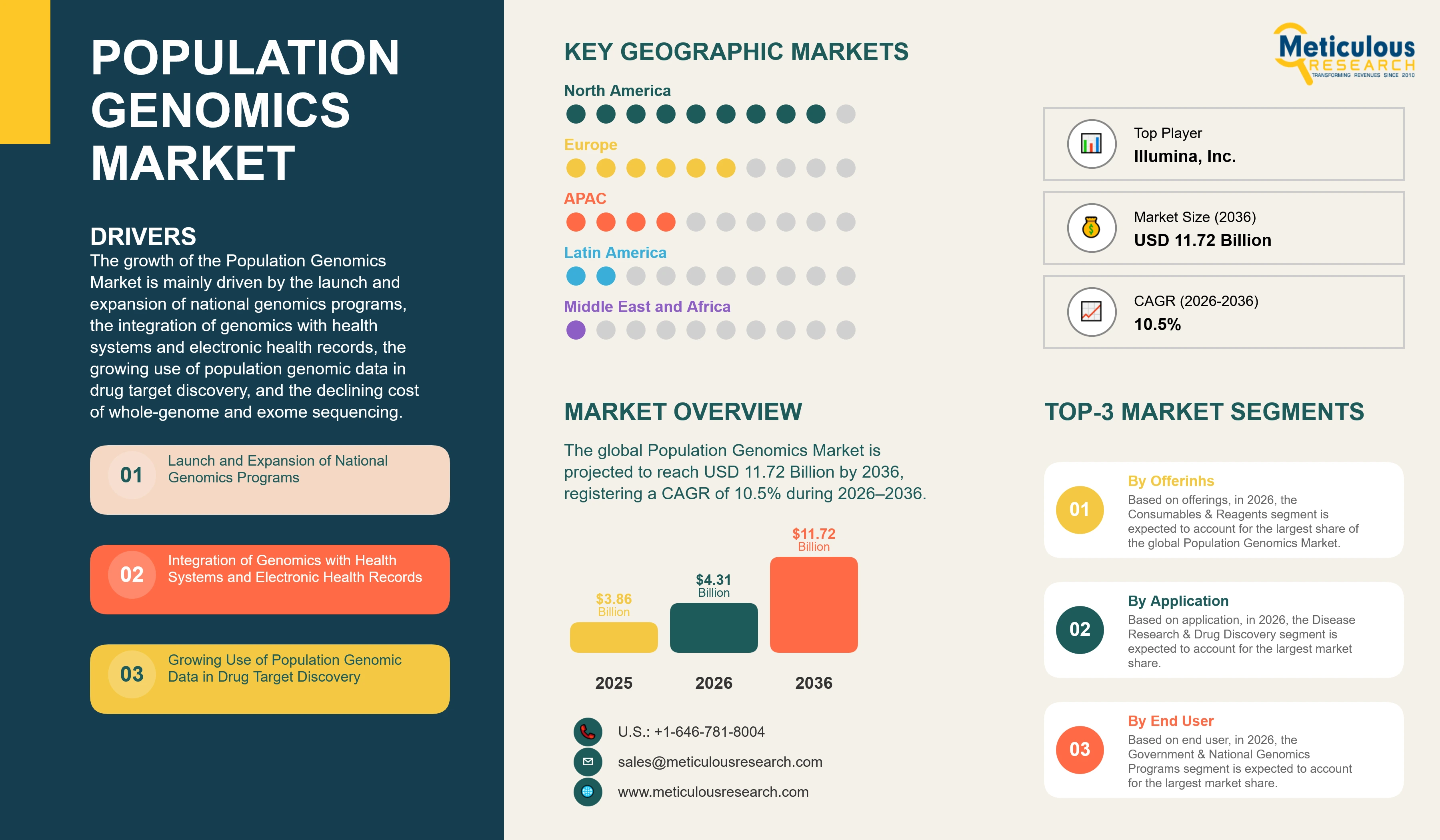
The global Population Genomics Market was valued at USD 3.86 billion in 2025. This market is expected to reach USD 11.72 billion by 2036 from an estimated USD 4.31 billion in 2026, registering a CAGR of 10.5% during the forecast period (2026-2036).
- Published
- Oct 2026
- Pages
- 378
- Format
- PDF + Excel
- Report ID
- MR-2345
- Base year
- 2025
- 2025 · BASELINE
- $3.86B
- 2036
- $11.72B
- CAGR 2026–2036
- 10.5%
2025 baseline · 2026–2036 forecast at 10.5% CAGR · hover a bar for the value
Key highlights
The global Population Genomics Market is projected to reach USD 11.72 billion by 2036, driven by national genomics programs, health system sequencing initiatives, genetics-guided drug discovery, and lower sequencing costs.
North America is expected to account for the largest market share in 2026, while Asia-Pacific is projected to register the fastest growth during the forecast period. In January 2025, India released the Indian Genomic Dataset of 10,000 whole genomes through the GenomeIndia project, accessible through the Indian Biological Data Centre, and the Ministry of Science and Technology has set a goal of sequencing about 10 million genomes reflecting the diversity of the Indian population.
Health systems are becoming major drivers of population sequencing. In January 2025, Truveta and more than 30 U.S. health systems launched the Truveta Genome Project, with the goal of sequencing the exomes of the first 10 million volunteers, with sequencing performed by the Regeneron Genetics Center, which has sequenced about three million exomes to date, and strategic investments from Regeneron, Illumina, and 17 health systems.
By technology, Short-Read Whole-Genome Sequencing is expected to account for the largest market share in 2026, whereas Long-Read Sequencing is projected to witness the fastest growth through 2036. The Emirati Genome Programme had sequenced more than 600,000 genomes by late 2024, including 100,000 using long-read sequencing combined with epigenetic data, with the M42 Omics Centre of Excellence operating one of the largest genomics facilities in the world, toward a target of one million samples.
By offering, Consumables & Reagents are expected to account for the largest market share in 2026, while Software & Data Platforms are projected to grow the fastest, as programs shift toward secure, cloud-based analysis of linked genomic and health data.
Report summary
| Particulars | Details |
|---|---|
| Forecast Period | 2026-2036 |
| Base Year | 2025 |
| Estimated Year | 2026 |
| CAGR (Value) | 10.5% |
| Format | PDF, Excel & Cloud Portal · 378 pages |
| Market Size (Value) in 2026 | USD 4.31 Billion |
| Market Size (Value) in 2036 | USD 11.72 Billion |
| Segments Covered | By Offering: Consumables & Reagents, Instruments, Services (Sequencing & Genotyping Services, Data Analysis & Interpretation Services), Software & Data Platforms. By Technology: Short-Read Whole-Genome Sequencing, Whole-Exome Sequencing, Genotyping Arrays, Long-Read Sequencing, Multiomic Technologies. By Application: Disease Research & Drug Discovery, Precision Medicine & Clinical Care, Rare Disease Diagnosis, Newborn & Reproductive Genomic Screening, Pharmacogenomics, Population Health & Ancestry Research. By End User: Government & National Genomics Programs, Biobanks & Research Consortia, Healthcare Systems & Hospitals, Pharmaceutical & Biotechnology Companies, Academic & Research Institutes. |
| Countries Covered | North America: U.S., Canada. Europe: U.K., Finland, Estonia, Denmark, France, Germany, Rest of Europe. Asia-Pacific: China, India, Japan, South Korea, Singapore, Taiwan, Australia, Rest of Asia-Pacific. Latin America: Brazil, Mexico, Rest of Latin America. Middle East & Africa: UAE, Saudi Arabia, Qatar, Rest of Middle East & Africa. |
| Key Companies | Illumina, Inc., Thermo Fisher Scientific Inc., Pacific Biosciences of California, Inc., Oxford Nanopore Technologies plc, MGI Tech Co., Ltd., Ultima Genomics, Inc., Regeneron Pharmaceuticals, Inc. (Regeneron Genetics Center), Eurofins Scientific SE (Eurofins Genomics), M42, and DNAnexus, Inc. |
Report overview
Segments covered: offering, technology, application, end user.
The growth of this market is mainly driven by the launch and expansion of national genomics programs and population-scale biobanks, the integration of genomic data with electronic health records to support precision medicine, the growing use of population genomic data in drug target discovery, and the declining cost of whole-genome and exome sequencing. In addition, the introduction of newborn and preventive genomic screening programs, the emphasis on genetic diversity in research cohorts, the expansion of long-read and multiomic sequencing, and the use of cloud-based trusted research environments and artificial intelligence (AI) to analyze very large datasets are further supporting the growth of this market.
The Population Genomics Market, also referred to as the national genomics programs market, population-scale sequencing market, or biobank genomics market, comprises the instruments, consumables and reagents, services, and software and data platforms used to sequence, genotype, store, and analyze the genomes of large populations. The market includes short-read and long-read sequencers, genotyping arrays, sequencing and library preparation reagents, sequencing and genotyping services, data analysis and interpretation services, bioinformatics software, and cloud-based data platforms and trusted research environments used by national genomics programs, biobanks, health systems, research consortia, and pharmaceutical companies. Population genomics programs combine genetic data with health records, lifestyle information, and increasingly proteomic, epigenomic, and other multiomic data to understand the genetic basis of disease, improve diagnosis and prevention, and discover new drug targets. The market ecosystem extends from technology providers and sequencing service laboratories to data platform providers, governments and public health agencies, health systems, research institutions, and pharmaceutical companies.
The market is experiencing strong growth as governments and health systems invest in genomics as a foundation for precision medicine. Large population datasets allow researchers to identify genetic variants associated with disease, understand how genetic risk differs across populations, and develop tools such as polygenic risk scores and pharmacogenomic guidance. At the same time, the declining cost of sequencing has made it feasible to sequence whole genomes or exomes for hundreds of thousands to millions of people, transforming population genomics from a research activity into a component of national health strategies.
National programs in North America and Europe are among the largest in the world. In June 2026, the All of Us Research Program of the U.S. National Institutes of Health (NIH) expanded its dataset to more than 747,000 participants, including 535,000 whole-genome sequences, nearly 482,000 linked electronic health records, and more than 1.3 billion genetic variants, with more than 86% of participants from communities historically underrepresented in health research. The U.S. Department of Veterans Affairs Million Veteran Program has enrolled more than one million veterans. In the U.K., UK Biobank released whole-genome sequence data for about 500,000 participants, and its Pharma Proteomics Project, a collaboration with 14 biopharmaceutical companies, is measuring more than 5,400 proteins in up to 600,000 samples. Our Future Health in the U.K. has recruited more than 2 million consented participants and released genotype data for 755,000 participants, with imputed genotype data first released in December 2025 and genetic ancestry data in May 2026, while Eurofins Genomics was selected to genotype up to 5 million participants. Genomics England is running the Generation Study, which aims to sequence the genomes of 100,000 newborns to evaluate whether genome sequencing can identify more than 200 rare genetic conditions, and expects the National Genomic Research Library to hold more than 500,000 whole genomes by 2030, supporting the ambition in the NHS 10 Year Health Plan to offer genomic sequencing at birth.
Health systems and pharmaceutical companies are also investing directly in population sequencing. In January 2025, Truveta and more than 30 U.S. health systems launched the Truveta Genome Project, with the goal of sequencing the exomes of the first 10 million volunteers, with sequencing performed by the Regeneron Genetics Center, which has sequenced about three million exomes to date, and strategic investments from Regeneron, Illumina, and 17 health systems. These initiatives link genetic data with real-world clinical data from health systems, creating resources for drug discovery and clinical research, and reflect the growing value that pharmaceutical companies place on large genetic datasets. The sale of the assets of 23andMe to TTAM Research Institute for USD 305 million in 2025, after a competing proposal from Regeneron Pharmaceuticals, further illustrates the strategic value of large genetic databases.
Asia-Pacific and the Middle East are emerging as major centers of population genomics. The Emirati Genome Programme had sequenced more than 600,000 genomes by late 2024, including 100,000 using long-read sequencing combined with epigenetic data, with the M42 Omics Centre of Excellence operating one of the largest genomics facilities in the world, toward a target of one million samples. In January 2025, India released the Indian Genomic Dataset of 10,000 whole genomes through the GenomeIndia project, accessible through the Indian Biological Data Centre, and the Ministry of Science and Technology has set a goal of sequencing about 10 million genomes reflecting the diversity of the Indian population. In Singapore, the PRECISE-SG100K population health study is generating genomic and proteomic data, supported by collaborations with Thermo Fisher Scientific and Seer. These programs reflect a growing emphasis on generating genetic data for populations that are underrepresented in existing datasets.
Technology innovation is expanding the scope of population genomics. Long-read sequencing is being used to capture structural variants and methylation, as in the 100,000 long-read genomes of the Emirati Genome Programme, while PacBio reported the start of sequencing for a population-scale program for Basecamp Research in 2026. Ultra-low-cost sequencing platforms, such as the UG 100 platform of Ultima Genomics, which was selected for the UK Biobank proteome study, and new chemistries that combine genetic and methylation information, such as the Illumina 5-Base Solution, are increasing the information obtained per sample and reducing costs.
At the same time, the market faces challenges related to funding, data privacy, and the complexity of managing very large datasets. NIH funding for the All of Us Research Program was about USD 158 million in fiscal year 2025, roughly 71% lower than in fiscal year 2023, illustrating the dependence of many programs on public funding. As a result, providers that can offer low-cost, high-throughput sequencing, secure data platforms, and analysis that delivers clinical and research value are expected to capture the largest share of growth over the forecast period.
Report infographic
Market dynamics
15 factors across 5 forcesLaunch and Expansion of National Genomics Programs
The launch and expansion of national genomics programs is a major factor driving the Population Genomics Market, as governments invest in large-scale sequencing and genotyping to support precision medicine, public health, and research. In June 2026, the All of Us Research Program of the U.S. National Institutes of Health (NIH) expanded its dataset to more than 747,000 participants, including 535,000 whole-genome sequences, nearly 482,000 linked electronic health records, and more than 1.3 billion genetic variants, with more than 86% of participants from communities historically underrepresented in health research. The Emirati Genome Programme had sequenced more than 600,000 genomes by late 2024, including 100,000 using long-read sequencing combined with epigenetic data, with the M42 Omics Centre of Excellence operating one of the largest genomics facilities in the world, toward a target of one million samples. In January 2025, India released the Indian Genomic Dataset of 10,000 whole genomes through the GenomeIndia project, accessible through the Indian Biological Data Centre, and the Ministry of Science and Technology has set a goal of sequencing about 10 million genomes reflecting the diversity of the Indian population.
These programs require large volumes of sequencing instruments, reagents, and services, as well as data infrastructure and analysis capabilities. As more countries launch national programs and existing programs expand, demand for population genomics products and services is expected to grow steadily over the forecast period.
Integration of Genomics with Health Systems and Electronic Health Records
The integration of genomic data with electronic health records and health system operations is significantly accelerating market growth. Linking genetic data to clinical records allows researchers to study disease outcomes at scale and allows health systems to use genetic information in care. The All of Us dataset includes nearly 482,000 electronic health records linked to genomic data, and the Truveta Genome Project aims to sequence 10 million exomes from volunteers at more than 30 U.S. health systems. Genomics England is running the Generation Study, which aims to sequence the genomes of 100,000 newborns to evaluate whether genome sequencing can identify more than 200 rare genetic conditions, and expects the National Genomic Research Library to hold more than 500,000 whole genomes by 2030, supporting the ambition in the NHS 10 Year Health Plan to offer genomic sequencing at birth. As health systems adopt genomics for diagnosis, prevention, and population health management, demand for population-scale sequencing is expected to increase.
Growing Use of Population Genomic Data in Drug Target Discovery
The growing use of population genomic data in drug target discovery is creating strong demand from pharmaceutical companies. Drug targets supported by human genetic evidence are more likely to succeed in clinical development, and pharmaceutical companies are investing in sequencing initiatives, biobank partnerships, and genetic data assets. The Regeneron Genetics Center has sequenced about three million exomes and has identified dozens of genetic-based drug targets, and 14 biopharmaceutical companies are collaborating in the UK Biobank Pharma Proteomics Project. These investments are expected to support demand for sequencing, multiomic data generation, and analysis.
Declining Cost of Whole-Genome and Exome Sequencing
The declining cost of sequencing is making it feasible to sequence whole genomes or exomes for very large populations. PacBio offers long-read whole-genome sequencing at a list price of USD 345 per genome with its SPRQ-Nx chemistry, and ultra-low-cost short-read platforms are reducing the cost of high-throughput sequencing. As costs decline, programs are moving from genotyping arrays to whole-genome sequencing, increasing the amount of genetic information collected per participant and supporting demand for sequencing consumables and services.
Table of contents
12 chapters · 149 sections · 378 pages · click to expandSegmental analysis
| Segment | Largest share (2026) | Fastest growth (2026–2036) |
|---|---|---|
| By Offering | Consumables & Reagents | Software & Data Platforms |
| By Technology | Short-Read Whole-Genome Sequencing | Long-Read Sequencing |
| By Application | Disease Research & Drug Discovery | Newborn & Reproductive Genomic Screening |
| By End User | Government & National Genomics Programs | Healthcare Systems & Hospitals |
By Offering
- Population Genomics Market Analysis by Offering
- Services are further segmented into Sequencing & Genotyping Services and Data Analysis & Interpretation Services.
- The Consumables & Reagents segment is expected to account for the largest share of the global Population Genomics Market.
- The large share of this segment is mainly due to the recurring use of sequencing reagents, library preparation kits, and genotyping arrays for every participant sequenced or genotyped in population programs, and the scale of programs such as All of Us, Our Future Health, the Emirati Genome Programme, and the Truveta Genome Project.
- However, the Software & Data Platforms segment is projected to register the highest CAGR during the forecast period.
- The rapid growth of this segment is attributed to the increasing volume and complexity of population datasets, the shift toward secure cloud-based trusted research environments, and the growing use of AI for data analysis.
- The Services segment is expected to account for a significant share, supported by large sequencing and genotyping contracts, such as those of the Regeneron Genetics Center for the Truveta Genome Project and Eurofins Genomics for Our Future Health, while the Instruments segment is expected to grow with the establishment of national sequencing facilities.
By Technology
- Population Genomics Market Analysis by Technology
- The Short-Read Whole-Genome Sequencing segment is expected to account for the largest market share, due to its use as the standard method in many national programs, including All of Us and UK Biobank, and the declining cost of high-throughput sequencing.
- However, the Long-Read Sequencing segment is projected to register the highest CAGR during the forecast period, owing to its ability to capture structural variants, repeat expansions, and methylation, its use in programs such as the Emirati Genome Programme, and the declining cost of long-read genomes, such as the USD 345 list price of PacBio SPRQ-Nx genomes.
- The Whole-Exome Sequencing segment is expected to grow strongly, supported by the Truveta Genome Project, while the Genotyping Arrays segment is expected to remain important for the largest cohorts.
By Application
- Population Genomics Market Analysis by Application
- The Disease Research & Drug Discovery segment is expected to account for the largest market share, due to the primary use of population datasets for research and the investment of pharmaceutical companies in population sequencing and biobank partnerships.
- However, the Newborn & Reproductive Genomic Screening segment is projected to register the highest CAGR during the forecast period, driven by programs such as the Generation Study, which aims to sequence 100,000 newborns, the ambition in the NHS 10 Year Health Plan to offer genomic sequencing at birth, and planned premarital and newborn genome testing in the UAE.
By End User
- Population Genomics Market Analysis by End User
- The Government & National Genomics Programs segment is expected to account for the largest market share, as national programs in the U.S., U.K., UAE, Saudi Arabia, India, and other countries fund a large share of population sequencing.
- However, the Healthcare Systems & Hospitals segment is projected to register the highest CAGR during the forecast period, driven by health system sequencing initiatives such as the Truveta Genome Project and the integration of genomics into routine care, while the Pharmaceutical & Biotechnology Companies segment is expected to record strong growth through investments in population datasets.
Geographic analysis
North America
Largest shareIn 2026, North America is expected to account for the largest share of the global Population Genomics Market. The large share of this region is mainly attributed to large national and health system programs, the presence of leading technology providers and sequencing centers, and strong pharmaceutical investment in genetic data. In June 2026, the All of Us Research Program of the U.S. National Institutes of Health (NIH) expanded its dataset to more than 747,000 participants, including 535,000 whole-genome sequences, nearly 482,000 linked electronic health records, and more than 1.3 billion genetic variants, with more than 86% of participants from communities historically underrepresented in health research. In January 2025, Truveta and more than 30 U.S. health systems launched the Truveta Genome Project, with the goal of sequencing the exomes of the first 10 million volunteers, with sequencing performed by the Regeneron Genetics Center, which has sequenced about three million exomes to date, and strategic investments from Regeneron, Illumina, and 17 health systems. The Million Veteran Program has enrolled more than one million veterans. However, the reduction in NIH funding for All of Us may moderate the growth of publicly funded programs. Canada is expected to contribute to regional growth, supported by provincial genomics initiatives and research programs.
Europe
Europe is expected to account for a significant share of the market, led by the U.K., which hosts several of the largest population genomics programs in the world. UK Biobank has released whole-genome data for about 500,000 participants, and our Future Health in the U.K. has recruited more than 2 million consented participants and released genotype data for 755,000 participants, with imputed genotype data first released in December 2025 and genetic ancestry data in May 2026, while Eurofins Genomics was selected to genotype up to 5 million participants. Genomics England is running the Generation Study, which aims to sequence the genomes of 100,000 newborns to evaluate whether genome sequencing can identify more than 200 rare genetic conditions, and expects the National Genomic Research Library to hold more than 500,000 whole genomes by 2030, supporting the ambition in the NHS 10 Year Health Plan to offer genomic sequencing at birth. Finland, through FinnGen, Iceland, Estonia, Denmark, France, and Germany are also important markets, supported by national biobanks and genomic medicine initiatives, and the European 1+ Million Genomes initiative aims to enable cross-border access to genomic data.
Asia-Pacific
Fastest growthAsia-Pacific is projected to register the highest CAGR during the forecast period. The growth of this region is driven by large and genetically diverse populations, the launch of national genomics programs, and growing investment in precision medicine. In January 2025, India released the Indian Genomic Dataset of 10,000 whole genomes through the GenomeIndia project, accessible through the Indian Biological Data Centre, and the Ministry of Science and Technology has set a goal of sequencing about 10 million genomes reflecting the diversity of the Indian population. In Singapore, the PRECISE-SG100K study is generating genomic and proteomic data, while China is expected to account for the largest share within Asia-Pacific, supported by large research cohorts and domestic sequencing technology providers. Japan, South Korea, Taiwan, and Australia are also expected to see strong growth, supported by national biobanks and genomic medicine programs.
Middle East & Africa
The Middle East & Africa is expected to record strong growth, led by national programs in the Gulf. The Emirati Genome Programme had sequenced more than 600,000 genomes by late 2024, including 100,000 using long-read sequencing combined with epigenetic data, with the M42 Omics Centre of Excellence operating one of the largest genomics facilities in the world, toward a target of one million samples. Saudi Arabia and Qatar also operate national genome programs, while efforts to expand genomic research in Africa are increasingly important for understanding human genetic diversity.
Latin America
Latin America is expected to account for a smaller share of the market, with demand supported by research programs in Brazil and Mexico and growing interest in studying admixed populations.
Competitive landscape
The global Population Genomics Market is moderately consolidated, with a small number of sequencing and genotyping technology providers accounting for a significant share of the market, alongside large-scale sequencing service providers, pharmaceutical genetics centers, data platform providers, and national genomics organizations. Market participants compete primarily on cost per genome or sample, throughput and capacity, data quality, the breadth of information captured, including structural variants and methylation, data security and compliance, data platform capabilities, and the ability to support large national contracts.
Leading companies are reducing sequencing costs, launching higher-throughput and multiomic sequencing solutions, establishing national sequencing facilities, and partnering with governments, health systems, and pharmaceutical companies. Recent examples include the launch of the Truveta Genome Project with the Regeneron Genetics Center in January 2025, the release of the Indian Genomic Dataset in January 2025, the selection of Thermo Fisher Scientific and Ultima Genomics for the UK Biobank proteome study, the launch of the Illumina 5-Base Solution in October 2025, the rollout of PacBio SPRQ-Nx chemistry in 2026, and the expansion of the All of Us dataset in June 2026.
The report provides a comprehensive competitive assessment of the leading companies operating in the global Population Genomics Market. The key players profiled in the report include Illumina, Inc. (U.S.), Thermo Fisher Scientific Inc. (U.S.), Pacific Biosciences of California, Inc. (U.S.), Oxford Nanopore Technologies plc (U.K.), MGI Tech Co., Ltd. (China), Ultima Genomics, Inc. (U.S.), Regeneron Pharmaceuticals, Inc. (Regeneron Genetics Center) (U.S.), Eurofins Scientific SE (Eurofins Genomics) (Luxembourg), M42 (UAE), and DNAnexus, Inc. (U.S.).
- Illumina, Inc.
- Thermo Fisher Scientific Inc.
- Pacific Biosciences of California, Inc.
- Oxford Nanopore Technologies plc
- MGI Tech Co., Ltd.
- Ultima Genomics, Inc.
- Regeneron Pharmaceuticals, Inc. (Regeneron Genetics Center)
- Eurofins Scientific SE · Eurofins Genomics
- M42
- DNAnexus, Inc
Expert perspectives
The Population Genomics Market is entering a period in which the integration of genomic data into health systems, rather than the generation of genomes alone, is becoming the main source of value. With more than 747,000 participants in All of Us, more than 2 million in Our Future Health, more than 600,000 genomes sequenced in the UAE, and a goal of 10 million exomes in the Truveta Genome Project, population genomics has reached a scale at which the key questions are how the data will be used, who will fund it, and how it will improve care. The binding constraint is shifting from the cost of sequencing to sustainable funding, data governance, and the demonstration of clinical and economic value.
Three structural changes are expected to shape competitive positions through 2036. First, funding is diversifying from governments to health systems and pharmaceutical companies, favoring providers that can support public-private partnerships. Second, programs are moving from arrays to whole-genome, long-read, and multiomic data, increasing the information captured per participant. Third, newborn and preventive screening programs could turn population genomics from a research activity into a recurring part of health care.
For companies planning entry or expansion, the most defensible positions over the forecast period are likely to be found in low-cost, high-throughput sequencing, long-read and multiomic population studies, secure data platforms and trusted research environments, and national programs in Asia-Pacific and the Middle East. For established providers, the principal risks are public funding constraints, data privacy and geopolitical restrictions on genetic data, and the need to demonstrate clinical utility.
Overall, the market is expected to grow strongly, with consumables, short-read whole-genome sequencing, disease research, and government programs providing the core of demand and data platforms, long-read sequencing, newborn and preventive screening, health systems, and Asia-Pacific providing the fastest growth.
Customer perspectives
Insights gathered during primary interviews with national genomics program leaders, health system genomics directors, and pharmaceutical genetics heads operating in this market highlight where procurement priorities are shifting. The following perspectives reflect recurring themes raised across these discussions.
“This reflects the shift of priorities from data generation to governance and value.”
“This indicates the growing role of health systems in population genomics.”
“This points to the value of multiomic population datasets for drug discovery.”
Frequently asked questions
The global Population Genomics Market is estimated at USD 4.31 billion in 2026.
Cite this report
Meticulous Research. (2026). Population Genomics Market - Global Opportunity Analysis And Industry Forecast (2026-2036) (Report No. MR-2345). Meticulous Market Research Pvt. Ltd. https://www.meticulousresearch.com/product/population-genomics-market-7028